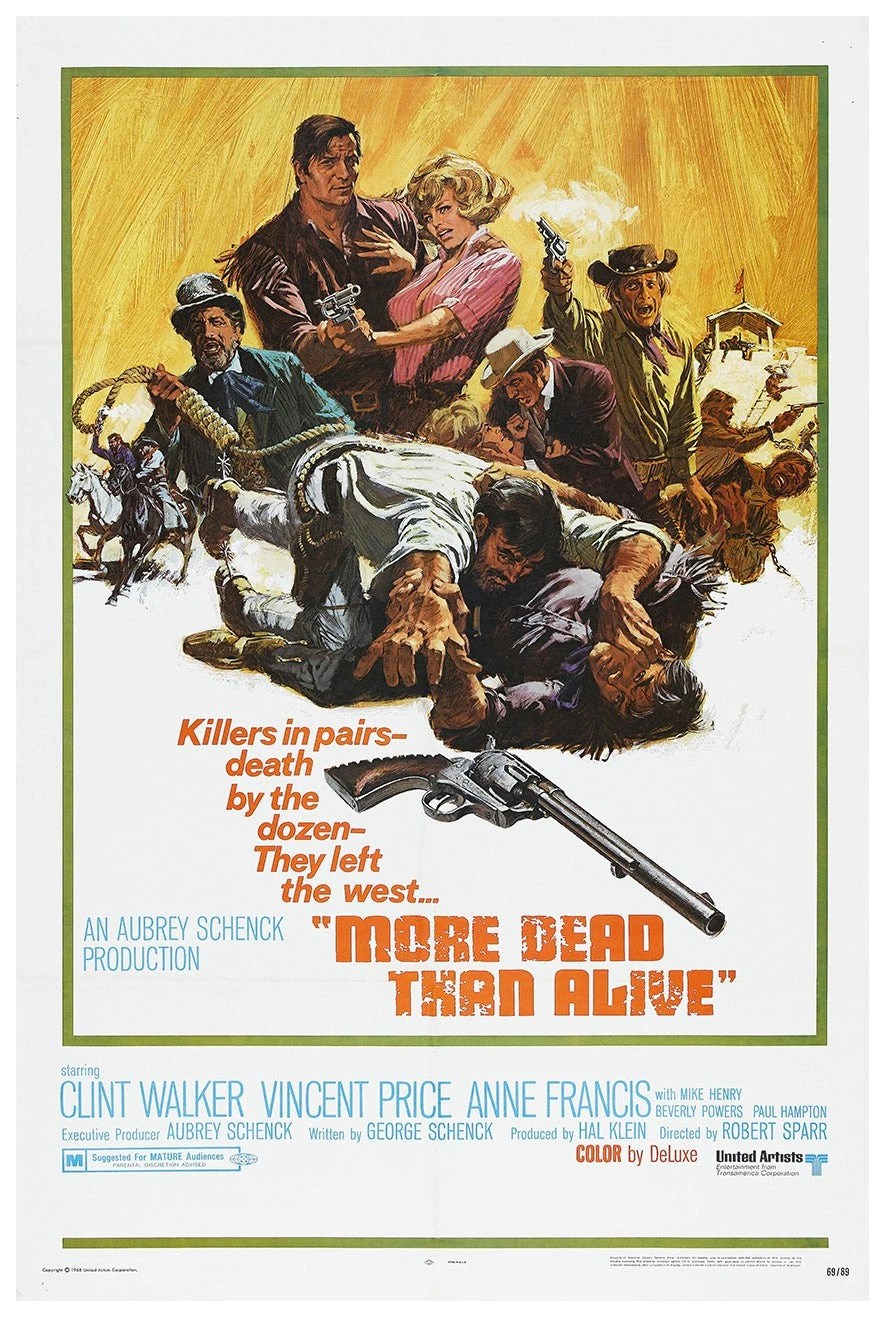
You wonder why some actors never make it big. Clint Walker, with a hefty television career behind him, was one of the many graduates from The Dirty Dozen (1967). But whereas such disparate characters as Donald Sutherland (Mash, 1970), Charles Bronson (Farewell Friend, 1968), Jim Brown (100 Rifles, 1969) and even Telly Savalas (though mostly on the small screen) went on to become substantial marquee names, soft-spoken square-jawed gentle giant Clint Walker was left by the wayside. He still earned some top-billed credits, but these were all in low-budget programmers.
The odd thing is that had he come onto the scene a decade later when muscle-bound hunks like Sylvester Stallone and Arnold Schwarzenneger were all the rage he might have easily jumped to the top. Ironically, another muscleman Mike Henry (Tarzan and the Great River, 1967) pops up here, as if to prove to the newcomer that muscle no longer cuts it in Hollywood when slimmer stars like Paul Newman and Steve McQueen are all the rage and even denoted tough guys like Lee Marvin lack the heavyweight build.
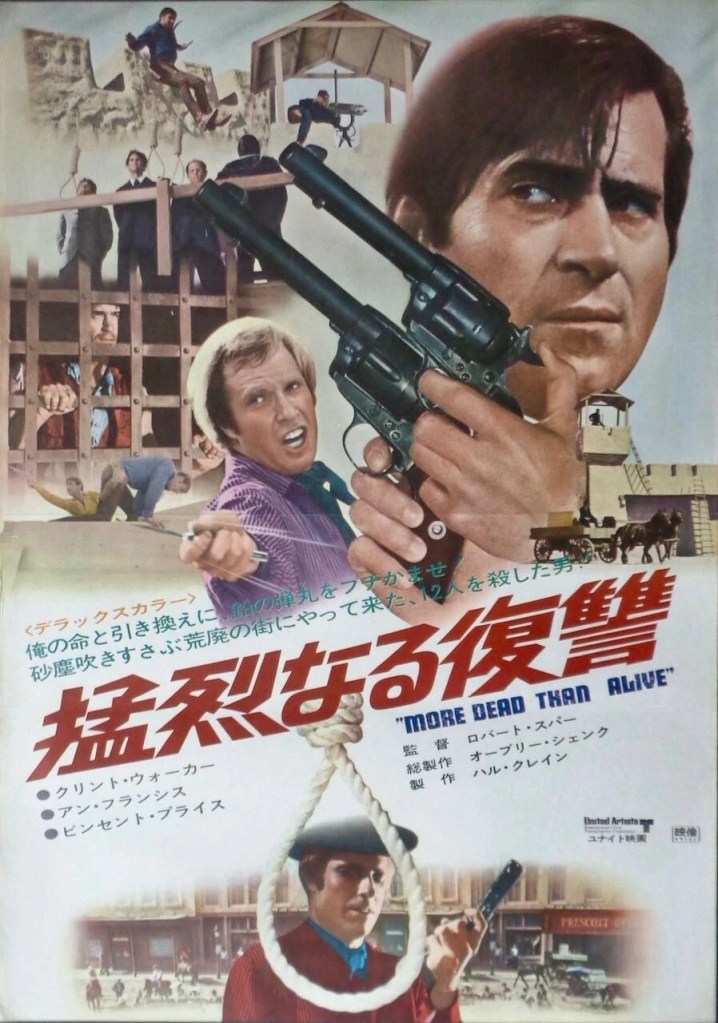
Like the climax to The Wild Bunch (1969), the opening section is a paeon to the glories of the Gatling Gun as it mows down a posse of prisoners trying to escape. Cain (Clint Walker) is one of the few jailbirds who simply hunkers down and refuses to consider running. Whether it’s this determination not to cause the guards any trouble or some unexpected softer approach on the part of the authorities, he is later set free after serving 18 years.
It’s only then we realize he’s actually “Killer Cain” with twelve notches (presumably one for every death) on his revolver. But he’s determine to go straight and refuses the opportunity offer by travelling showman Dan Ruffallo (Vincent Price) to even play the part of the bad guy. But his record goes against him when trying to find employment. So he takes on the job of delivery guy only to end up in the arms of some thugs from prison led by Luke Santee (Mike Henry) who has a score to settle. Having beaten him up, they decide not to finish him off, so they can enjoy the pleasure of beating him up over and over. Given Clint Eastwood has set the tone for the hero being badly beaten up and/or left for dead, the thumping Cain takes tends towards the excessive.
So if you’re trying to get a killer to disavow his plan to avoid violence, that’s not the best plan. When Cain escapes, you expect this to turn into a revenge western. Except it doesn’t. It’s an avoidance western, Cain trying to stay out of the way of any kind of shooting.
There are some interesting directorial aspects. It looks very much as if Robert Sparr, a television director making his movie debut, has absorbed the influences of the French New Wave. There are jump cuts all over the place. We cut from Cain looking forlorn at night to him standing in a queue in daylight looking for a job. We go from an outdoor encounter with Ruffalo to suddenly the pair of them sitting down inside.
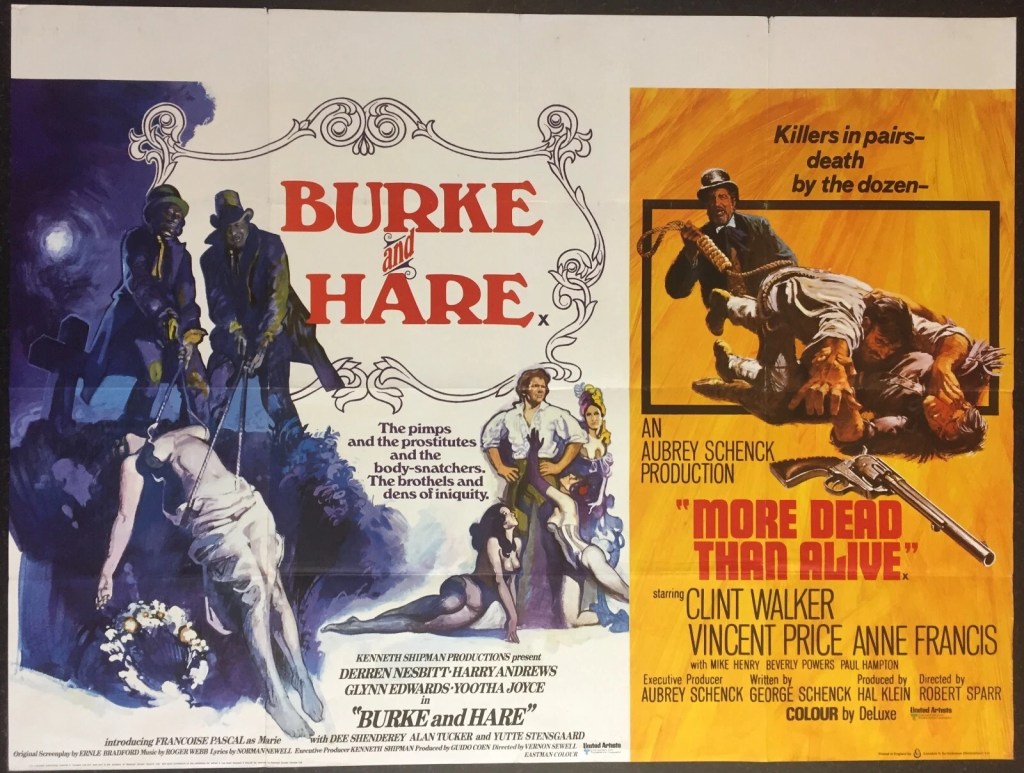
And as with like Butch Cassidy and the Sundance Kid and The Wild Bunch, both out the same year, the message is that the Old West is dying. Not only do we have primitive mechanized transport in the shape of a bicycle there’s also a rudimentary telephone while gunmen are more likely to prosper showing off their skills in a tent than being a gun for hire for ambitious ranchers and the like.
This is determinedly offbeat, not falling into the standard narrative traps for the genre. Cain, while trying to shed the murderous aspects of his previous life, eventually goes to work in the circus. That sets him down in the moral mire, taking advantage of his infamous reputation while at the same time not lifting a gun in anger and wooing artist Monica (Anne Francis).
However, no surprise this is under-rated. In part that’s because it doesn’t deliver on the early violent promise, the title very much a misnomer, so those expecting a spaghetti western leave disappointed while anyone looking for much else wouldn’t be attracted by the violence and the title. In fact, it’s a very thoughtful piece. Not entirely original because criminal-going-straight is standard stuff, usually quickly snookering the good guy-bad guy into mostly bad guy activity, regardless of his justification for doing so. But here, the killer manages to avoid further bloodshed despite continuous provocation.
Apart from the moral aspect, it treads an interesting path between demystifying the Old West and mystifying it. Monica has come west to capture the Old West before it dies away. There’s a ghost town but the only gunslinging on show is staged. Cain is a major attraction because peace-loving law-abiding folks like nothing better than seeing a genuine killer up close.
The notches on his gun weren’t acquired in typical Hollywood hero style with a shootout in the main street and the good guy never drawing first. In fact, most of Cain’s killings fall into the dubious category.
Most westerns take place over a short period of time, just as long as it takes to set up the good guys and the bad guys with a bit of romance on the side. This takes place over a year and romance is very slow-burn so that artist Monica nips in and out of the narrative.
Having a record blunts Cain’s attempts to get a decent job, the only long-term work as a bouncer in a saloon until his pseudonym is blown. He joins the Wild West Show only to twice quit it, either when he is riled by intemperate gunman wannabe Billy (Billy Valence) or when he comes face to face with old lawman Carson. At the end he returns to earn enough cash to buy some livestock for a farm.
There are three significant deaths, two sudden, and all offer something unusual in that department. The ending is as unexpected as it is shocking.
Both Clint Walker (The Great Bank Robbery, 1969) and Vincent Price (Witchfinder General/The Conqueror Worm, 1968) deliver excellent subdued performances, the latter far removed from his usual horror line and the lugubrious tones kept in check. Anne Francis (The Satan Bug, 1965) has a rare big screen outing. Written by George Schenck (Barquero, 1970).
You would not call this – outside of the jump cuts – particularly stylistic, equally it avoids the visual traps of endless sunsets or panoramas and we’re not subjected to minutes wasted just watching cowboys ride somewhere. But it definitely is a cut above in terms of thematic complexity, in the ability to tell a story over a period of time, and to take the hero in an unexpected direction.


