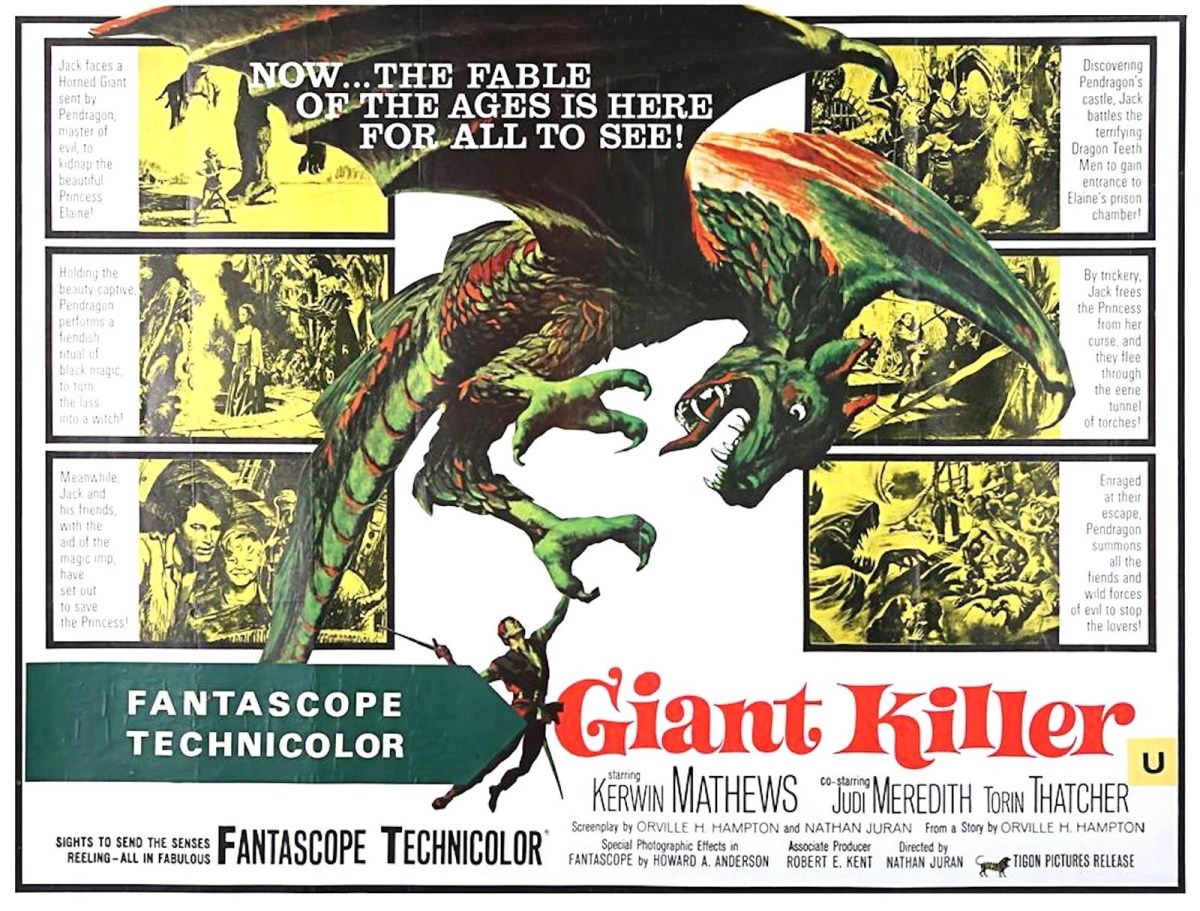
Jack the Giant Killer (1962) ***

Just to be clear, this is not, as I had automatically assumed, about Jack and the Beanstalk. Also, it’s worth pointing that the stop-motion animation is not, as I had equally automatically assumed, the work of Ray Harryhausen. It hadn’t occurred to me that anyone else could follow in Harryhausen’s footsteps, especially when this number has gathered together some of the other constituents of Harryhausen’s first gem, The Seven Voyages of Sinbad (1958), namely star Kerwin Matthews, co-star Torin Thatcher and director Nathan Juran 

This falls into the “See!” (don’t forget the exclamation mark!) category of moviemaking when the audience is expected to sit transfixed as strange creatures appear one after the other and in between is very much of the ho-hum variety.
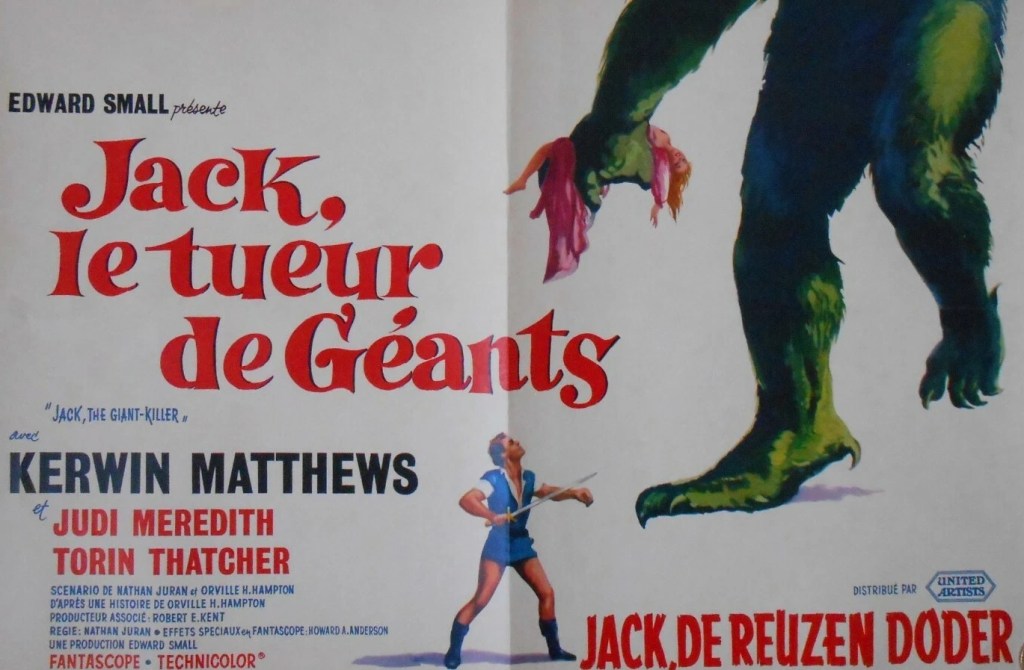
To be sure, this is a very entertaining little piece with, as in the stop-motion formula, everything else taking second place to the variety of monsters – the titular giant, spectral figures, a dinosaur, a two-head monster, and a magician who can make things disappear. Given that the heroine doubles up as the villainess, this takes the narrative into unusual waters. And that’s before we come to the leprechaun-in-the-bottle.

It is just as well the special effects are up to scratch – for the time – because everything is played like a pantomime. The villain, Pendragon (Torin Thatcher), isn’t far short of issuing the occasional hiss and his face has a strange hue to put it mildly. But he’s a clever evil wizard and under the guise of playing tribute to King Mark (Dayton Lummis) presents his daughter Princes Elaine (Judi Meredith) with a large doll’s house from which emerges a tiny creature whose main appeal is that he can dance.

Come night, however, and after Pendragon has sneaked into the castle, the creature is released and turns into the rampaging titular giant who kidnaps the princess in his mighty claws. Farmer Jack (Kerwin Matthews) comes to the rescue and manages to tangle the giant in the workings of the mill and kills him.

You’d expect romance to bloom and initially it does, but you’d think the king would be more grateful than to nip romance in the bud by sending Elaine to France to hide out in a convent. (I should point out the tale is set in Cornwall, so France is just across the sea). But the ship doesn’t reach its destination. Skeletal witches attack. Elaine is captured once again. Jack and the ship’s captain’s son end up in the drink where they are rescued by a friendly Viking who has in his possession the imp-in-the-bottle who can grant wishes.
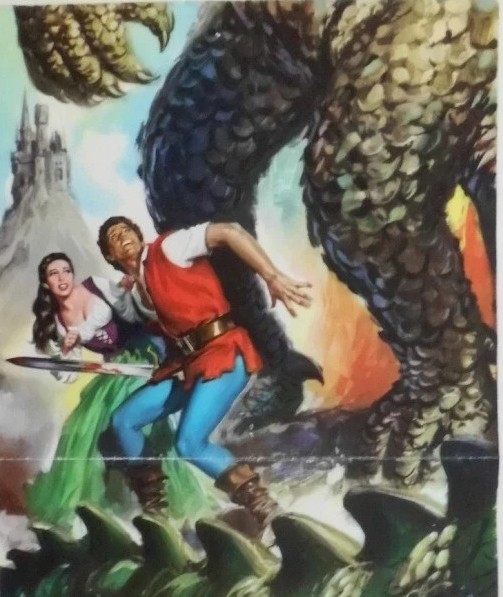
Pendragon’s scheming and magic ensures that Elaine is turned into a villainess and even when Jack rescues her for a second time her villainy ensures he’s the one who’s captured and the imp and bottle are chucked into the sea.

There’s a fair bit of the conjuring of bad spells – humans are turned into dogs and monkeys – and a fair bit of trying to break them but Pendragon always appears to have another spell up his sleeve and able to conjure up more creatures. Now it’s a two-headed giant confronting Jack who is then able to summon a sea monster to retaliate. But Pendragon can turn himself into a dragon.

There’s certainly an element of the Harryhausen in the clash of the monsters and the wanton destruction that appears to be their sole reason for existence. Naturally, it all ends happily and with all spells lifted romance can resurface.

I’m probably going to upset the Harryhausen cognoscenti by professing my admiration for the stop-motion animation work by Project Unlimited (The Time Machine, 1960). They might be a bit crude compared to Harryhausen but they certainly did the job.

This didn’t condemn Kerwin Matthews to fantasy and he moved immediately into thriller Maniac (1963). Judi Meredith wasn’t so fortunate and ended up as the female lead in low-budget thrillers like Dark Intruder (1965). Torin Thatcher (The Sandpiper, 1965) had a ball over-acting.

Nathan Juran (East of Sudan, 1964) sticks to the knitting. He wrote the screenplay with Orville H. Hampton (Riot on Sunset Strip, 1967).

Not going to tax your brain but good fun.

Siege of the Saxons (1963) ***

King Arthur (plus Excalibur) meets Robin Hood (minus Merrie Men). I wouldn’t have been surprised to see Billy the Kid put in an appearance in this kind of history-defying picture. In case you were unaware, or less of a pedant than myself, there were at least two centuries (possibly eight, depending on your sources) between monarch and outlaw. There’s a princess, but going by the more prosaic name of Katherine, rather than the legendary Guinevere, and for that matter Lancelot and Galahad are excused duty, though the wizard Merlin pops up.

I hate to break it to you, but there is no siege. But there is, as if this more than makes up for that omission, marauding Vikings. Or at least marauders pretending to be Vikings, or that might just be my fault, assuming that those helmets with the rounded pointy bits were the preserve of the Norsemen.

And, presumably, for legal reasons (“passing off” in the jargon and there being a British television series and Hammer film to contend with) Robin Hood isn’t called Robin Hood even though he’s an outlaw in a forest who robs the rich to give to the poor. His moniker is Robert Marshall. You’d need to be well up on your history to work out why the Saxons would be considered bad guys when England was populated by Anglo-Saxons.

But when I explain this is made by the same duo that plundered a stock footage hypermarket for East of Sudan (1964) you’ll probably agree that accuracy was not their strong suit. Which is a shame, because it’s a half-decent tale of treachery and revenge and gives the underrated Janette Scott (Paranoiac, 1963) a strong role.

They couldn’t be bothered with all that Saxon confusion in France and just hyped it as a King Arthur gig, even though far from having an adventure he dies.

Anyways, Edmund (Ronald Howard), dastardly lover of Katherine (Janette Scott), daughter of an infirm King Arthur (Mark Dignam), sets up Robert (Ronald Lewis) to take the fall for his murder of the sovereign via his anonymous henchman known as The Limping Man (Jerome Willis). Katherine is reluctant, naturally, to head off into the unknown with the outlaw, especially when he insists on disguising her (none too cleverly it has to be said) as a boy while they seek out Merlin (John Laurie) in the hope that his wizardry can muck things up for the imposter.

It’s a wasted journey, not because he’s not filled with the requisite wisdom, but if they’d just left things to Excalibur in the first place all would be sorted. You see, the villain hasn’t worked out there was a good reason that Arthur managed to yank said sword out of the stone in the first place. Edmund can pull at the sword until he’s blue in the face but it’s not going to shift out of its scabbard, because, well, he ain’t Arthur. Just as well Edmund deprived Arthur of the bedside dying scene beside the lake where the king could chuck it in to ensure nobody of the dastardly persuasion could take advantage of its magical powers.

But, aha, genetics enter the equation. You could have made an entire new film out of chasing down the King Arthur Code, but luckily we are too many decades away from that kind of malarkey. So – feminist alert – it’s Katherine who’s inherited the genes. And – woke alert – who should ascend to the throne alongside her but the outlaw.

So it’s fairly straightforward stuff, swordfights, chases, a battle or two, bad guys and good guys and resolutely old-fashioned except for the feminist climax. Just a shame that nobody can match Janette Scott’s screen charisma, so though Ronald Lewis (Nurse on Wheels, 1963) can deliver a one-liner with aplomb and cut a swathe through bad guys, he’s not in her league. This is B-picture stuff without the redemptive features of noir or general nastiness or maybe a future star director making an impact.

Nathan Juran (First Men in the Moon, 1964) directed from a script by Jud Kinberg (East of Sudan) and John Kohn (The Collector, 1965) loosely based on the work of Thomas Malory who dreamed up the Camelot repertoire.

Undemanding.

East of Sudan (1964) ***

Remembering this picture as a summer holiday matinee of stiff-upper-lip-ness entangled in all sorts of Khartoumery, I came at this film with low expectations. Given producer Charles H. Schneer’s (First Men on the Moon, 1964) involvement, there were no Ray Harryhausen magical special effects. I was only aware of star Anthony Quayle as a bluff supporting actor in epics like Lawrence of Arabia (1962) and The Fall of the Roman Empire (1964) and Sylvia Syms as a willowy supporting actress (The World of Suzie Wong, 1960). So I was in for a pleasant surprise. Take away the back projection, stock footage and the unlikely zoo of wild animals and there is a fairly decent action film set in the Sudan on the fringes of the Mahdi uprising (that story filmed as Khartoum the following year).

Quayle is a former army sergeant awaiting court martial when he escapes from a battle near Khartoum, ends up saving governess Syms, her charge Jenny Agutter (making her debut), officer Derek Fowlds (BBC Yes, Minister) and a wounded soldier. The motley crew flees down the Nile in a boat. You know you are in for something quite different when the soldier dies and Quayle wants to toss him overboard. Overruled by prim Syms and stiff upper lip Fowlds, this good deed is rewarded by losing their beached boat while burying the dead. A picture like this only survives on twists. Burning the remainder of their boat to attract the attention of the British relief force only brings in their wake a mob of Arabs, who we are informed, in a spicy exchange, don’t know the ten commandments, especially “thou shalt not kill.”  It turns into a battle of the sexes, with Syms’ innocence and good breeding quickly eroded in the face of danger, her natural antipathy towards a scallywag like Quayle softening. Lacking due deference, said scallywag is given some choice lines which spark up proceedings. It being Africa, the animals have nothing better to do than torment them, so cue snakes, crocodiles, charging rhinos, hippos, elephants without even an entertaining monkey to lighten proceedings. Quayle sets his ruthless tendencies to one side to take a tender, paternal interest in young Agutter. Ongoing action prevents the usual male-female meet-cute African Queen-style banter and it’s all the better for it.

Capture by African tribesman takes the story on an interesting detour. Quayle, attempting to make friends, shouts out despairingly (and without irony), “Don’t any of you even speak English?” only for chieftain Johnny Sekka (The Southern Star, 1969) to stride out of the bushes with the reply, “I speak, English, Arabic and Swahili.” Quayle explains, “We come in peace.” Sekka retorts, “With gun in hand?” Game on! The plot goes offbeat when we become involved in Sekka’s life. A former slave, his village presents an unusually realistic alternative world not least for Agutter, ill by this time, saved by an African witch doctor.  There are further surprises, clever ruses to foil the enemy, revelations about Syms and a surprising but very British ending.

Quayle is convincing, reveling in the opportunity to create a fully-formed character rather than  confined to a small chunk of a picture. Syms, too, with more on offer than normal, Agutter (Walkabout, 1971) not a precocious Disney cut-out, and Fowlds revealing what did for all those years before turning up on television as puppet Basil Brush’s sidekick. As a British B-picture making do on a small budget, it overcomes this particular deficiency with some sparkling dialogue and attitudes that go against both the time in which it was set and the era in which it was made.

NOTE: Khartoum, The Southern Star, The Fall of the Roman Empire, The Southern Star and First Men in the Moon (with Harryhausen effects) have all been reviewed on this blog.     

Discover WordPress

A daily selection of the best content published on WordPress, collected for you by humans who love to read.

The Atavist Magazine

by Brian Hannan

WordPress.com News

The latest news on WordPress.com and the WordPress community.