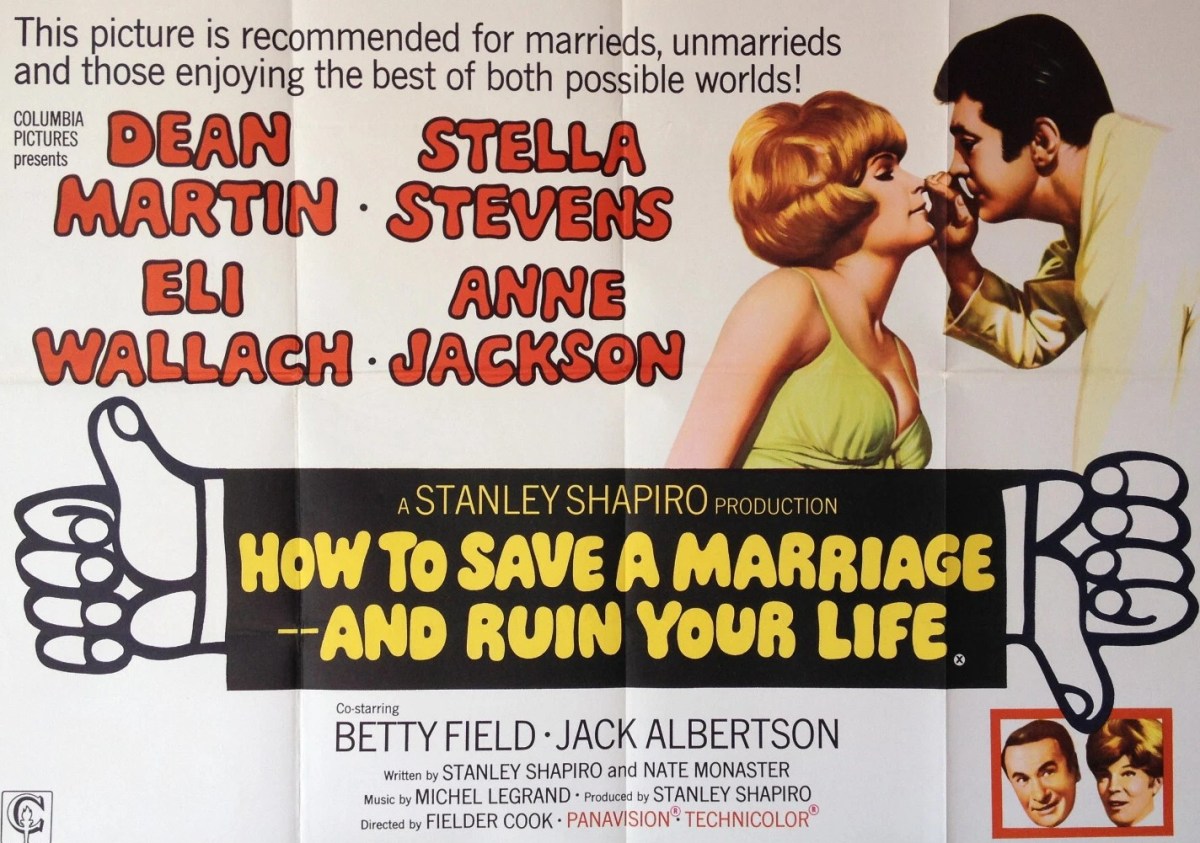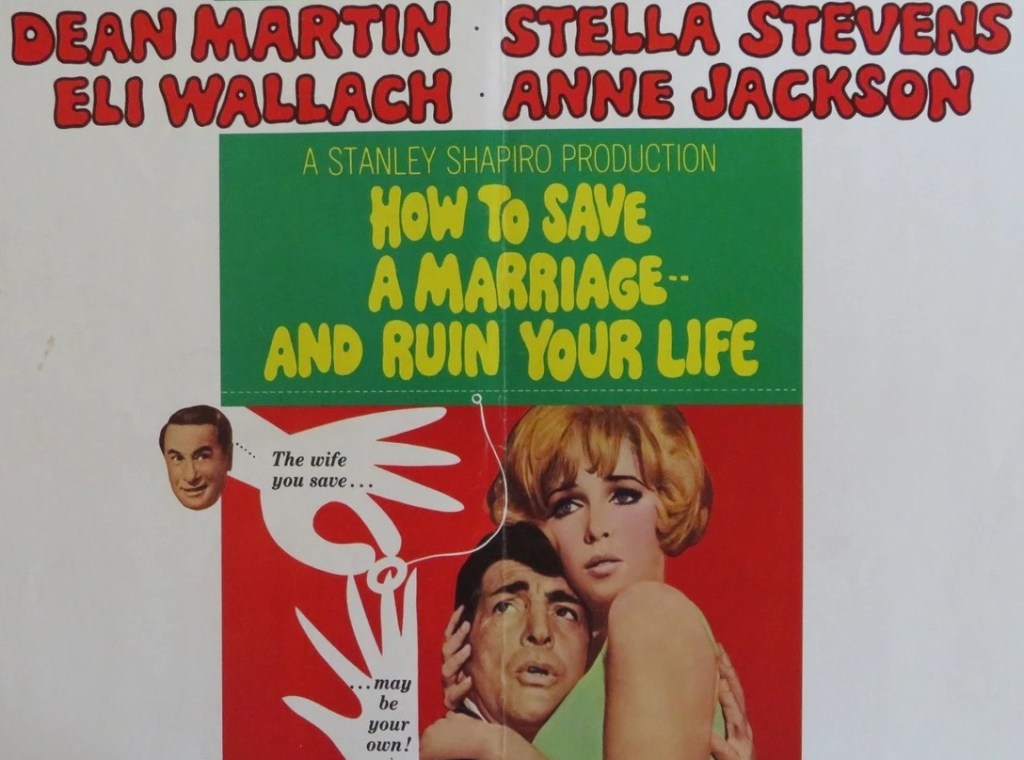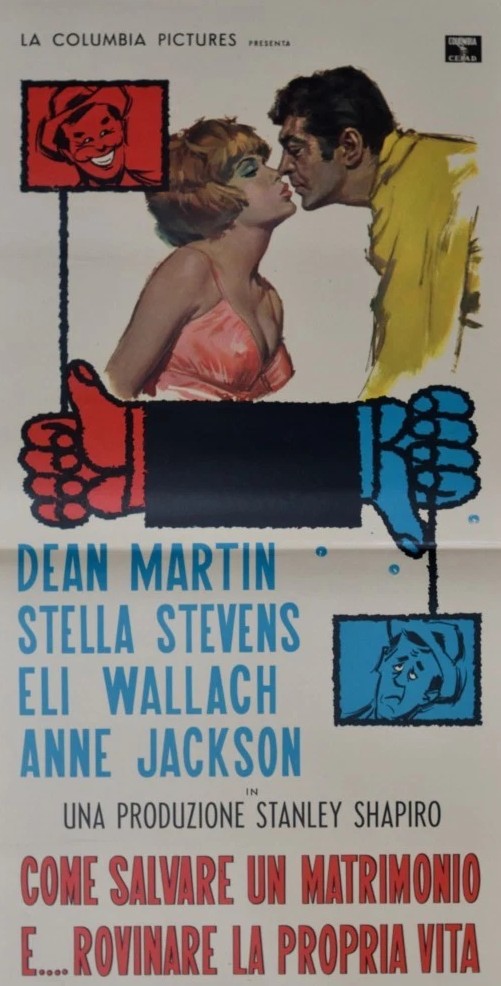
How to Save a Marriage…And Ruin Your Life (1968) ****

Eight years before Michelle Triola struck a legal blow for women’s rights in her ground-breaking “palimony” case against Lee Marvin, this highly under-rated comedy – with none of the highbrow or earnest pontificating usually associated with issue movies – points the world in that direction. This was high concept before the word was invented. Would have made a perfect bittersweet Doris Day-Rock Hudson concoction especially as mistaken identity is at the heart of the matter. And the final half-hour where feminist revenge kicks in achieves more in the male-comeuppance-game than either the meretricious Three in the Attic (1968) or the more high falutin’ Carnal Knowledge (1971).

On top of that it’s hilarious. It’s packed with one-liners, zingers and brilliant repartee and the second section where revenge unwinds is an absolute hoot. Given, star Dean Martin (5 Card Stud, 1968) could have worked a tad harder on his comic timing, While he leans away from the tough guy of his recent spate of westerns maybe he leans too far into his Rat Pack-style persona. But Eli Wallach (The Magnificent Seven, 1960) and Stella Stevens (Sol Madrid/ The Heroin Gang, 1968), scarcely known for their comedic chops, more than make up, with Stevens especially good at channelling her interior Doris Day when that star screwed up her eyes and started given the male what-for.

There’s a brilliant sub-plot revolving around a grave that is a delight all on its own. Screenwriter Stanley Shapiro was the genius behind Pillow Talk (1959), Lover Come Back (1961) and That Touch of Mink (1962) and he knew when to play it subtle, embrace slapstick or go straight for the jugular.

Call it “mistress-alimony” or “mistress pension” or just the unfairness of the male gaze when it decides that the recipient of its gaze now lacks the physical attributes which attracted the gaze in the first place. Swollen ankles, a thickening of the waist –  and a decade of service as a mistress is over and the lady in question, a decade older, physical attributes diminished, comes away from the relationship with virtually nothing, certainly nothing like security or the alimony to which a divorced wife would be entitled.

How we get to this point is mistaken identity. Playboy commitment-phobe David Sloane (Dean Martin) tries to help resolve the marital problems of buddy Harry Hunter (Eli Wallach) by taking out of temptation’s way Harry’s mistress. Unfortunately he mixes up Harry’s real mistress Muriel Laszlo (Anne Jackson) with one of Harry’s very attractive employees Carol Corman (Stella Stevens), a woman of principle who refuses promotion when it means sleeping with her supervisor.

Unfortunately, Carol falls in love with David, especially after he spins her a line that he can’t marry again for fear of betraying his wife Edna, who died the day after they married. Equally unfortunately, Harry decides to make up with wife Mary (Katharine Bard) and take her on a second honeymoon. To ensure no backsliding, David helps Harry draft a nasty legal letter telling Muriel to quit the apartment.

Just about at the same time as David realizes he’s made a mistake over the mistress, Carol discovers that “Edna” is not David’s wife. Egged on by a disconsolate Muriel, who is being turfed out after years of adoring service, Carol takes revenge in hilarious fashion. She pretends to be the easily-seduced woman that David has convinced Harry she is, resulting in her pretending to sleep with David’s business partner and two of his chums, resulting in David, taking physical offence at such perceived betrayal, being jailed and locked up in a sanatorium. Then she launches a one-woman picket line outside his office, standing up for deserted mistresses everywhere.

Meanwhile, Harry’s second honeymoon lasts only a few hours and he tries to get Muriel back, whereupon the women are inspired to force him to sign a mistresses’ charter whereby they are compensated for loss of mistress-hood and heavily rewarded for remaining in the relationship.

The stars have a great time. Director Fielder Cook (Prudence and the Pill, 1968) can’t believe his luck in landing such a sassy script, co-written by Nate Monaster (That Touch of Mink).

Too funny to be tabbed a message picture but it certainly makes its points in style.

The Informers / Underworld Informers (1963) ***

Who would be a film director? One minute you’re in charge of Swiss Family Robinson (1960), Disney’s biggest live-action venture since 20,000 Leagues under the Sea (1954), and knocking up a home run at the box office. Then you’re handed a massive budget, mega-cast and huge logistics with the added responsibility of saving near-bankrupt 20th Century Fox with 70mm roadshow The Longest Day (1962) and then you’re hurled  into two more roadshows, Those Magnificent Men in Their Flying Machines (1965) and Battle of the Bulge (1965), the latter in Cinerama, again big budgets and all-star casts.

And in between you’re relegated to this black-and-white run-of-the-mill London cop thriller. Maybe you said you were fed up with all those stars and big budgets and fancied a more intimate number. Maybe not. Maybe you just weren’t flying as high as you imagined and like anyone else you just had to eat.

While you’re not contending with the likes of John Wayne, Robert Mitchum or Henry Fonda, at least for The Informers you’ve a pretty good British cast, many of whom would become marquee attractions or make their bones in television. Star Nigel Patrick would head up the Zero One TV series (1963-1965), Harry Andrews (Play Dirty, 1968) would be a sterling movie supporting player. Colin Blakely would be Dr Watson in Billy Wilder’s The Private Life of Sherlock Holmes (1970), Derren Nesbitt would shine as a Gestapo officer in Where Eagles Dare (1968), and Oscar-nominated Frank Finlay would be one of The Three Musketeers (1973).

This crime tale has inefficient cops being led a merry dance by efficient bank robbers. While top cop Supt Bestwick (Harry Andrews) puts his faith in the new-fangled wire-tapping and electronic eavesdropping, underling Chief Inspector Johnnoe (Nigel Patrick) prefers the more traditional method of relying on informers, “snouts” in underworld parlance, such as the perpetually sozzled Jim Ruskin (John Cowley).

The cops might have had a better chance if the robbers weren’t listening in to the cops or using the informer route to mislead them. While Johnnoe might get the better of gangster kingpin Hoyle (Derren Nesbitt) in a verbal duel, he’s resolutely outwitted when it comes to criminal wiles, duped by another crook Sale (Frank Finlay) and gangster’s moll Maisie (Margaret Whiting) so that he ends up on a corruption charge, which puts him out of the investigation.

Luckily, he’s got a smart determined wife Mary (Katherine Woodville) who sets about clearing his name with the help of junk dealer Charlie (Colin Blakely), brother of murdered snout Jim.

Most of this is what would be later termed police procedural as the cops follow up leads and enter the lion’s den and get trapped in bureaucracy until Johnnoe, suspended from duty and out on bail, no longer has to play by the rules. The rogue cop was more of an American movie tradition than the British but Johnnoe makes a good stab at it.

Charlie’s not inclined to play by the rules either and gets together a mob of his own to hit the robbers and revenge his brother. Given the Brits aren’t armed to the teeth, when it comes to the battle royal, they go in there with wrenches and other hand-tools supplemented by the occasional knife rather than machine guns or shotguns. But it’s still an astonishing fight for this era of British crime.

There’s some unusual emotional elements, too, particularly with the moll and a surprising sequence involving Roy Kinnear, generally not considered to have such emotional depth. Did I mention the cat? The one who attempts, for fun, to foil an escape by a trapped cop.

Not quite in the vein of the later British crime thrillers like Get Carter (1971) or Villain (1971) but certainly moving in a harder-nosed direction.

Ken Annakin is almost going back to his British cinematic roots and proving he can do the business on a small budget. Written by Alun Falconer (Never Let Go, 1960) from the novel by Douglas Warner.

Better class of British crime.

I caught this on YouTube but it’s as likely to turn up on Talking Pictures TV.

I Deal in Danger (1966) ***

Crooner Robert Goulet, winner of the 1963 Grammy for best new star, was going down a familiar route of transition to the big screen. Bing Crosby and Frank Sinatra, Oscar-winners both, had led the line for singers who made it big in films. And they wouldn’t be the last – Barbra Streisand (Funny Girl, 1968), Kris Kristofferson (Convoy, 1978), Jennifer Lopez (Hustlers, 2019) and Lady Gaga (Joker: Folie a Deux, 2024) would also achieve the crossover.

Goulet has the looks and delivery to fit into the burgeoning espionage market, though this is set in World War Two. As well as action, it is packed full of crises to be overcome, double agents, triple agents, dirty tricks, and clever maneuvers. You never know which way it’s going to go at any given moment.

David March (Robert Goulet) is an American double agent who has infiltrated the Third Reich at a very high level – he acts as a kind of Lord Haw-Haw, predicting the Germans will come out on top and sneering at Allied efforts to stop them. But he’s under suspicion from Gestapo officer Elm (Werner Peters) who’s convinced the Yank is the last of an 18-strong espionage operation called Blue Light.

Having passed on information to the Allies, via a hole in a bar of soap, about the Germans working on a new secret weapon, March is later tasked with destroying it. But first he has to deal with another Yank traitor, Spauling (Donald Herron),who, ostensibly, could break March’s cover. Instead, it turns out Spauling’s job is to sacrifice himself to enhance March’s cover.

March is horrified at the prospect of having to shoot his old friend stone dead, even if Spauling is suffering from an incurable illness and only has weeks to live, so more like a mercy killing than murder. Instead, with a clever ruse, March turns the tables on Elm, convincing his own colleagues that the Gestapo officer is the last member of Blue Light, leaving March in the clear to concentrate on sabotage.

Naturally, as a spy, he must have an affair and who better than with fellow double agent Suzanne (Christine Carere) who convinced the Germans she was a collaborator after her French father, a World War One hero, was hanged by his own countrymen in World War Two.

So now we’re into The Heroes of Telemark (1965)/The Guns of Navarone (1961) territory except the secret weapon is a submarine that can cross the Atlantic fitted with enough missiles to take the USA out of the war without going to all the bother of an invasion.

But the sabotage operation is far from straightforward. March and Suzanne enrol in their mission German scientist Gretchen (Eva Pflug), whose scientist father has been denounced by the Germans but, in one of the best scenes, draws the line at treachery. And soon Gretchen has qualms about betraying her colleagues. Suspicious guards foil March’s attempts to smuggle in items essential to explosions. March’s own principles are called into question.

And with his initial plans hampered, March aims for implosion rather than explosion, turning the weapon on the factory building it.

Very passable entertainment and would have suited a marketplace desperate for the supporting material that could make up a decent double bill. You can’t quibble with Robert Goulet (I’d Rather Be Rich, 1964) especially as the espionage game threw up lots of worse actors. French actress Christine Carrere and German Eva Pflug bring a Continental air to proceedings while Werner Peters (Battle of the Bulge, 1965) continues his run of bad guys.

You might be more attracted by director Walter Grauman who helmed 633 Squadron (1964) and cult writer-director Larry Cohen (Black Caesar, 1973). This was, in fact, culled from four out of seven episodes of a US television series Blue Light (1966), created by Grauman and Cohen and  swiftly re-edited to hit the overseas market.

Basically, a better class of B-picture.

Wake Me When It’s Over (1960) ***

You could scarcely find a better example of the pleasant undemanding fare that constituted Hollywood’s bread-and-butter than this mild comedy. It takes 20 minutes to even get to first base, setting our hero on his journey to a distant land, and another 20 minutes before the narrative sets out a purpose, from which various romantic and dramatic complications can arise. It doesn’t boast any stars.

If top-billed Ernie Kovacs (North to Alaska, 1960), in his third movie (and first as the headline act) had any marquee attraction it was to a television audience following his output in various comedy shows, but those would carry no weight abroad.  The second-billed Dick Shawn (A Very Special Favor, 1965) carried even less appeal. He was best known as a guest star liable to pop up on television shows. Both comics were an acquired taste, belonging to the avant-garde, so their styles were not guaranteed to necessarily go down well. Not like, for example, more established comedians such as Bob Hope or Jerry Lewis.

The public was even less familiar with female lead Margo Moore (The George Raft Story, 1961). She only made three movies in total, this being the middle one.

This probably was greenlit thanks to director Mervyn Leroy who had helmed two very successful service comedies, Mister Roberts (1955), replacing John Ford, and No Time for Sergeants (1958), both based on hit Broadway plays.

Through a bureaucratic error, unassuming Gus Brubaker (Dick Shawn) is re-drafted into the U.S. military and dispatched to a remote island near Japan where, this being in the aftermath of the Korean War, there is nothing for the soldiers to do except laze around. Capt Stark (Ernie Kovacs), the unit commander, is as intent on doing nothing as anyone else.

Brubaker hits on the idea of utilizing the natural hot springs of the area to build a hotel using materials acquired very cheaply in order to capitalize on this wonder, offering hot spa treatments to visitors and recuperating soldiers.

The soldiers, including resident medic Capt Farrington (Jack Warden), sign on, seeing it as a business opportunity, involvement in which, somehow, does not run contrary to military regulations. Just when you’re waiting for the picture to develop some snap – it’s not going to be romance between Brubaker and Ume (Nobu McCarthy), daughter of the local mayor, because he’s already happily married to Marge (Noreen Nash) – up pops Lt Nora McKay (Margo Moore), bringing a female sensibility to the project and in charge of hiring the 40 local women to staff Hotel Shima.

With Brubaker off limits, it’s up to Stark and McKay to make romantic hay, though that ultimately encounters complication. Building the hotel would be the modern equivalent of a corporate team building operation because the solders soon revert to proper military ways and bond.

But word misleadingly gets out that far from being known for its healing properties, the hotel is actually a front for sexual encounters and Brubaker is court-martialed, leading to all sorts of shenanigans. After being found guilty, he is let off the hook due to the original bureaucratic error that led him to be re-drafted in the first place.

Once it gets going – and that’s quite a long time – it turns into harmless enjoyment and the two stars have ample opportunity to show they are not run-of-the-mill comedians. There are some good visual jokes, The cans of beer Brubaker has dropped in a pool to cool explode to demonstrate the water is actually a hot spring, the MacGuffin of the piece. On finding himself on the island, Brubaker plans to immediately submit a request to leave. The filing cabinet for a simple request is half-full, the one seeking a transfer full and the one demanding he be viewed as a special case overflowing.

Charming in its own way. Didn’t turn anyone into a star but proved that Hollywood could make this kind of small picture – what we’d call a “sleeper” – with enough going on to maintain interest.  

Carnal Knowledge (1971) ****

You could argue that this is every bit as meretricious as Three in the Attic (1968). That the misogynism is every bit as rampant, the language considerably coarser, women judged by their physical attributes rather than their brains, men boasting about every little detail of their sex lives. More locker room than intelligentsia. You could argue that Porky’s (1981) and American Pie (1999) take exactly the same approach with no suggestion they have reached some exalted critical status.

There’s similar reliance here as in Three in the Attic on technical tricks, long monologues with the camera in a fixed position, and it would appear as if the person is indeed breaking the fourth wall and talking directly to the audience except for one shot, two at most, of a listener. Or the same fixed approach focusing on, for example, a girl laughing hysterically or a female skater, and background music that appears completely irrelevant except in the most perfunctory fashion depicting a time period.

Of course, there’s no comparison when it comes to the actors. This boasts a stellar cast – Jack Nicholson (Easy Rider, 1969) with one Oscar nomination already under his belt casting a spell on the audience, Candice Bergen (Soldier Blue, 1970), a standout among the new generation of female stars, and Ann-Margret (Stagecoach, 1966) at one point bigger than either in the Hollywood stratosphere making a comeback that would win her an Oscar nomination. Art Garfunkel, one half of the most potent double act in the recording business, was making his movie debut.

Director Mike Nichols was on a hell of a roll, his first two pictures – Who’s Afraid of Virginia Woolf (1966) and The Graduate (1967) – awash with Oscar kudos and unprecedented box office gravy. 

And you could make the same double-handed argument about feminism. Susan (Candice Bergen) would certainly count as a liberated women given she’s stringing along best buddies Jonathan (Jack Nicholson) and Sandy (Art Garfunkel), not just having sex with both, but leading the way with the shy latter. And once married to Sandy she keeps him up to scratch in the bedroom, teaching him to make love the way she likes it.

Given Jonathan’s obsession with the inches on the female body that are so important to him, it’s amazing her was at all interested in Susan, except for his competitive streak, delighted to steal away the girl who is apparently his pal’s girl. While Sandy appears the more insecure, in fact Jonathan more than matches him, always comparing Susan’s gentler treatment of Sandy. He might even have invented the tale of his poor childhood in order to gain her sympathy.

Certainly, once Sandy and Susan are married, Jonathan’s jealousy goes up a notch, annoyed that his pal is greeted by his wife on return from work with a martini and dinner while his voluptuous girlfriend Bobbie (Ann-Margret) struggles to warm up a television dinner and can’t keep his apartment tidy.

While Jonathan avoids commitment, Arthur isn’t as committed as he seems, having a mistress Cindy (Cynthia O’Neal) in tow, whom Jonathan thinks it’s fair game to woo and even gives Arthur carte blanche to take a chance on Bobbie.

Even given the misogyny of the period, you’d struggle to find two more obnoxious men. Any woman that attempts to be their match or gives as good as she gets is deemed a “ball-buster” or just after men for their money. You’re almost thankful that, just like Three in the Attic, there’s a touch of morality at the end, with the impotent Jonathan reduced to paying sex workers to tell him how powerful he is in order to gain an erection. Though Sandy appears to get off scot-free – now dating 18-year-olds.

But the performances all round are superb. Susan could perhaps have done with her character being filled out rather than just seen through the eyes of the men. Ann-Margret revived her career with his performance, of a woman whose body has betrayed her, all her sexiness not winning her the security she desires. It’s as bold a move for Jack Nicholson to play such a loathsome arrogant character. I was never convinced by Art Garfunkel.

Despite the tricksy presentation, Mike Nichols, as with Who’s Afraid of Virginia Woolf, traps his characters under an intense microscope. Screenwriter Jules Feiffer, better known at the time as a cartoonist and playwright, excels in his debut.

Hard going at times given the repellant characters but still excellent.  

Three in the Attic (1968) *

Wish I’d never watched Two Gentlemen Sharing on Amazon Prime if this is the kind of “recommendation” its algorithms throw up. It would be easy enough to dismiss it as the kind of rubbish that American International was famed for – it turned into their biggest hit in a decade – except I’ve a sneaky feeling that it’s the kind of rubbish that could get greenlit these days and sold as a feminist revenge drama.

The fact that it is just so badly made doesn’t help even with a leavening of decent middle-range stars like Christopher Jones (Privilege, 1967) and Yvette Mimieux (Dark of the Sun / The Mercenaries, 1968). It is full of montages, jump cuts, voice overs, slow-mo and any other technical experimentation that might liven up the dross rather than going to the effort of writing scenes that explore character.

The stars might well have carried it except the plot defies belief. College lothario Paxton Quigley (Christopher Jones) has three girls on the leash – middle class Tobey (Yvette Mimieux), teacher Eulice (Judy Pace) who yearns to be a chic biker chick, and way out artist Janet (Maggie Thrett). Paxton has sex with each of them twice a week on rotation and spends his spare time boasting to his pal Jake (John Beck).

The girls find out about his triple dealing and decide to take their revenge. How? By throwing all his clothes out into the street? Smashing up his Yamaha? Mixing him up a concoction that’s going to put him in bed for a week? Taking a sledgehammer to his private parts?

Nope. They reckon the best revenge is to “give him a taste of his own medicine.” Which is to lock him up in an attic and force on him non-stop sex?

So, setting aside the element of kidnapping, coercion and female rape, wearing a guy out by subjecting him to what he loves doing seems bizarre in the extreme. This could only be the kind of notion dreamed up by a guy (step forward screenwriter Stephen Yafa, whose screenplay had won a competition). It’s like one of those old-fashioned parental discipline notions where your old man makes you smoke a cigar till you’re sick after he’s caught you taking a puff of a cigarette as a teenager.

It’s just too coarse for words. Sure, Paxton initially has commitment issues, Tobey trying to hustle him too quickly into an apartment-share.

Honestly, I’ve no idea how anybody got talked into making this. Directed by Richard Wilson (Invitation to a Gunfighter, 1964). There’s a Tarantino connection if you’re interested.

Hellish.

Fury at Smuggler’s Bay (1961) ***

Surprising to find so much moral complexity when it seemed we would be restricted to discussing the difference between good bad smugglers and bad bad smugglers and good good bad guys and bad bad guys. Given the limited running time (it clocks in at 82 minutes) we’ve also just got about enough time to take in hypocrisy.

Compromise, too, for that matter. Squire’s son Christopher (John Fraser) is inclined to warn girlfriend smuggler’s daughter  Louise (Michele Mercier) that his father Squire Trevenyan (Peter Cushing) is setting soldiers on the local smugglers. The local highwayman known as The Captain (William Franklyn) is considered something of a decent fellow because once he’s robbed travellers going along the road one way he’ll make sure they’re not robbed on their return.

Trevenyan finds the most convenient way to prevent his son marrying beneath himself is to imprison Louise’s father Francois (George Coulouris) on the grounds of receiving stolen goods – his sentence is deportation to Australia. He’s helped by his son having to run off to London after killing one of the smugglers in self-defense, the father assuming anyone witness to the struggle will side with the smuggler.

Aware that maybe the plot’s getting a bit too cute for anyone’s liking, director John Gilling makes the most of the thunderous seas, boats getting battered to bits in the storm, waves hammering the wheelhouse, men swept overboard from vessels losing their way because rudimentary lighthouses have been shattered by predatory smugglers (known as “wreckers”). Stunning Cornwall scenery also helps though beaches being littered with heavy-duty rocks rather than glistening sand tends to inhibit action sequences.

The wreckers are the bad bad smugglers, the ordinary locals, dealing with a bit of rum and tobacco to avoid the exciseman or helping themselves to loot from legitimate shipwrecks, are the good bad smugglers.

You can always depend on a good bad highwayman to defend an innocent girl against a bad bad smuggler. As you might expect the Squire is deliberately ineffectual since he’s being blackmailed by Black John (Bernard Lee), leader of the wreckers, because Christopher is the result of an indiscretion. So it’s left to the son to race back from London and set things to rights.

Although there’s a bit of fenceplay – there is one good duel between Christopher and The Captain –  it’s not really a swashbuckler, a knife or pistol or musket the more likely weapon of choice, and since the director’s enamored of the silhouette against the darkening sky quite often what takes place is obscured.

Which helps the final section of the plot, as Christopher puts abroad that he’s dead while secretly signing up with Black John. This could have fitted into the Renown portfolio given the number of twists. Traps backfire. Ruses fail. Falling for the tale that his son is dead, Trevenyan puts the boy in mortal danger by sending troops to the beaches. Various rivals have to team up for the good of the cause.

By the time it turns into high adventure most of the moral complexities have been resolved.

The only problem is it’s the bad guys who steal the picture. While Peter Cushing (The Skull, 1965) continues his evolution as an actor of considerable scope, John Fraser (Tamahine, 1963) is a cardboard cut-out of a hero. But Bernard Lee, before assuming the mantle of M in the James Bond series, cuts loose as the bad bad guy while William Franklyn (The Big Day, 1960) does a dastardly good job of creating a charming good bad guy. For a bonus there’s rising French star Michele Mercier (You Can’t Win ‘Em All/Dubious Patriots, 1970).

Written and directed, with some panache, by John Gilling (The Pirates of Blood River, 1962).

Entertaining matinee fare with a soupcon of complexity.

De Gaulle: Resistance (2026) ***** – Seen at the Cinema

As far as the Brits and Americans were concerned the North African campaign of World War Two consisted of the former’s Field Marshal Montgomery knocking hell out of German General Rommel at El Alamein and the latter’s General Patton demolishing Panzer divisions at will. The fact that the British victory would not have occurred except for one largely forgotten battle has been completely ignored. The Brits were holed up in Tobruk with even less chance of escaping the combined German and Italian armies than at Dunkirk, no fleets of small boats likely to come to the rescue in the Mediterranean.

It took an incredible stand-off at a tiny desert post called Bir Hakeim to buy the British enough time to escape to Tobruk and regroup and eventually conquer Rommel at El Alamein.

Who inhabited this outpost and sacrificed thousands of lives? The nascent Free French Army of around 4,000 men, commanded by veteran General Koenig (Benoit Magimel,) with neither tanks nor airplanes holding out against the vastly superior forces of Rommel fully equipped with both tanks and airplanes.

Just one of the many nuggets in this totally absorbing film about the titular French general, exiled in London, who became the voice of French Resistance after Marshall Petain had surrendered to the invaders and set up the collaborative Vichy government.

It was a heck of a feat for De Gaulle because even in France nobody had a clue who he was. At the start of the war he was an insignificant colonel way down the pecking order and I doubt if any of the French people knew of his courageous counter-attack against the Germans. The Brits had even less of a clue about him and his arrogance certainly didn’t endear him to the British upper classes who were running the country.

Support for him among the various French officials living in London was negligible and for a good while he looked like a raving madman with his insistence that France had not surrendered. After the war, he was famously a thorn in the British side, and from this film you can see why as he was subjected to personal humiliation and betrayal by his supposed Allies. But he did have panache, chutzpah, and that was something Churchill, an old soldier himself, admired.

He launched what appeared the most bizarre offensive against the Germans, aiming to set off a tinderbox of revolt among the French colonies in Africa, beginning with Chad and Cameroon, hoping that such insurrection would spread to Dakar and Algiers on the North African coast and thus make it easier for the Allies to attempt a landing. Given that his forces on the ground numbered between one and six, this was either strategic genius or the work of a deluded lunatic.

Luckily, the colonies, thousands of miles away from the Germans, could ignore Petain and raise up the French flag in defense. The plan fell to pieces, however, when De Gaulle shot himself in the foot by refusing to allow the British Navy to attack Dakar since it was being held by French troops and he didn’t want to kill his own countrymen, as the British had done when it destroyed the French fleet to avoid it falling into German hands.

At various points, De Gaulle is stabbed in the back by Churchill and his own group in England, betrayed, exiled even in his exile, routinely treated as a nobody. He should have salvaged his reputation at Bir Hakeim, given the murderous action permitted the Brits to escape Tobruk, and while he was feted in the streets and praised in the British newspapers, he was still distrusted by the Allies and when Algiers was liberated it was collaborator Admiral Darlan (Mathieu Kassovitz) who was put in charge of all the French forces in Africa.

Luckily, there was a deus ex machine to hand, a young man called Fernand (Florian Lesieur), who appeared to interrupt general proceedings in the movie from time to time and whose sole role, it would appear, was to prove that there was resistance on the ground in Paris although at that point it merely took the form of demonstrations. Fernand was in many ways an echo of De Gaulle. When he first called upon Parisians to rise up in civil disobedience, only a handful responded. Later, he, too, entered exile, in Algiers. Fortunately, he was at hand to assassinate the French commander, leaving the way open for De Gaulle to regain command.

You’ll have to wait till Part Two of this epic epic (we’re talking nearly six hours in total)  to discover what happened next.

You’ll find me in that audience. We’re familiar with Churchill’s struggles in World War Two, but although I knew De Gaulle was the self-proclaimed leader of the Free French, I had no idea who he was and what he actually did. In truth, the image most fixed in my mind about the man who later became the French President was that he was the guy who ducked to avoid an assassin’s bullet but that was merely a fiction – The Day of the Jackal.

A ton of this is just politics, but it’s the nerve-shredding politics of trying to hold your ground when you’re being hammered on all sides.

Simon Abkarin (Casino Royale, 2006)  is superb in the title role, given the opportunity to express all sides of the General’s character – petulance, arrogance, cunning, loyalty, stoicism, determination, willpower, self-belief – and the moments when he realizes he is condemning his valiant Free French troops to death by insisting they do not attempt to escape Bir Hakeim, but fight a rearguard action to the bitter end (or until the British evacuated Tobruk), is immensely moving.

Simon Russell Beale (The Magic Faraway Tree, 2026) portrays the hard-drinking British leader, perplexed by De Gaulle’s behavior that threatens to ruin his relationship with the President Roosevelt (Campbell Scott). Florian Lesieur (Cassandre, 2024) has to touch on as many emotions as Abkarin. With Abkarin and Lesieur hogging the dramatic high notes, there’s not much room for another breakout performance but I suspect we’re going to see more of Anamaria Vartolomei (The Count of Monte Cristo, 2024)  who plays Livia, the Jewish friend of Fernand.

Superbly directed by Antonin Baudry in only his second movie after The Wolf’s Call (2019). As much as we are looking in the direction of young bucks who can turn a million-dollar budget into sheer gold in horror pictures like Backrooms (2026), we should also be acknowledging someone who can handle a bigger-budgeted effort with such aplomb. He co-wrote the screenplay with Berenice Vale in her movie debut based on a book by Julian T. Jackson.

Exceptional. Highly recommended.

In the Cool of the Day (1963) ***

Jane Fonda tagged this the worst film of her career but that’s a bit harsh and I suspect it owed a lot to the actress being dressed up Audrey Hepburn-style in outfits that scarcely suited her. While it’s certainly overheated, melodramatic moments indicated by thundering music, but a marvellous supporting cast, including a quite bitchy Angela Lansbury, provides ample compensation.

It’s  romance in the Love Story vein, rich young flighty heroine Christine (Jane Fonda) at death’s door half her life, but feeling smothered by understandably over-protective husband Sam (Arthur Hill). When she falls for married publisher Murray (Peter Finch) and sets off on a trip to Greece, chaperoned it turns out by Murray’s bitter wife Sybil (Angela Lansbury), it takes a while for romance to physically bud. That it does at all is only because   Sybil has taken off with suave traveling salesman Leonard (Nigel Davenport).

The movie takes a long time to heat up because, as in The Bramble Bush fashion, there’s overmuch character filling-in to do. Part of the interest in this picture is how the bad guys are effectively good guys, more victims of their partner’s behavior than anything else, though for story purposes, the audience has to be persuaded otherwise.

So besotted Sam, having dealt with umpteen bouts of his wife’s pneumonia and lung operations, a “slave” to her illnesses, is deemed as treating her like a child rather than a wife, preferring her ill rather than well, and denying her the adventure to which she feels entitled. When she meets Murray she has run away. Murray’s wife has a downer on her husband because, wait for it, he killed her child and left her facially scarred (hidden now by hair but she’s still very sensitive about it) in a car accident he caused.

But she’s portrayed as over-sensitive, worried about her appearance, snippy, blaming him for her distraught life, and worse, a philistine, hating being dragged around ancient Greek monuments. Aware of her husband’s proclivities, she mocks, “You’d be an idiot to fall in love with her.” And any time she ventures out, the music rises to a crescendo as if she is a character straight out of film noir.

When she goes off with Leonard, her love affair is viewed as sneaky rather than redemptive, even though he restores her faith in herself. Triumphantly, she tells Christine, “He’s all yours” and her husband “nobody need feel sorry for me any more.”Admittedly, she does take revenge by informing Christine’s husband, who has entrusted his wife to Murray’s care, of their affair. And you would be hard put to argue, although the film wants you to believe otherwise, that Sybil and Sam have been ill-treated by their partners, Sam, in particular, funding her trip to Greece in the hope that allowing her the freedom she needs will save their marriage.

Of course, the characters of both partners, even if their self-pitying is the result of circumstance, do mean that Christine and Murray are presented as people trapped in bad marriages and for whom love, however brief, provides sanctuary from tortured lives, her physical, his more mental, since he is not averse to guilt. 

Sybil’s lack of interest in tourist Greece handily gives the prospective lovers plenty time to fall in love, amid gorgeous scenery, and breathing in air rich in culture. With all film made in the 1960s and set in foreign parts – Pretty Polly (1967) another example – sometimes the story takes second place to the scenery, so it’s lucky that the romance is played out against such an interesting background, an ideal combination, killing two birds with one stone if you like. Given this is prior to Zorba the Greek (1964), the filmmakers have even managed to sneak in some traditional Greek dancing, albeit on the deck of a ferryboat.

Dress-wise, the lovers are ill-matched, Murray plodding around in a suit while Christine parades the latest often clingy fashion. When Sybil departs the scene, that leaves one unhappy character of the unhappy couple free of marital encumbrance, but still leaves open the question of how Christine will rid herself of Sam and, more importantly, will Murray wish to take on the all-consuming job of nursing Christine. He never gets the chance to find out. When she does fall ill – as the result of Murray recklessly keeping her out in a thunderstorm – her mother Lily (Valerie Kendrick) swoops in to rush her to hospital.

Spoiler Alert – I’m telling you that she dies because it seems to me that the ending the filmmakers hoped for is not how the audience will perceive it. Beautiful young woman dies too young, yep that’s there, but the man, now free and able to shake off his dull life and start afresh as a writer, seems a long shot. Given he has now, thanks to the thunderstorm episode, killed two people, I would surprised if guilt was not uppermost in his mind.

Not so-good-it’s-bad, and despite the complications, and perhaps because of the Sybil-Leonard romance, it’s certainly an interesting picture as much, perhaps, because it fails to send the audience in the desired direction.

In only her fifth movie, Jane Fonda (They Shoot Horses, Don’t They, 1969), exhibiting the nervous friskiness that would become a hallmark, does pretty well with a febrile, spoiled, character. If she falls down at all it’s that she appears uncomfortable wearing Orry Kelly’s fabulous gowns and it would take Hollywood some time to work out she was not a natural successor to Audrey Hepburn. Peter Finch (The Pumpkin Eater, 1964) is perfectly at ease with the illicit.

But Angela Lansbury (Harlow, 1965), a hoot as the wife who turns rejection into triumph, steals the show. Throw in Arthur Hill (Moment to Moment, 1966), Nigel Davenport (Sands of the Kalahari, 1965), for once neither smug nor snippy, Alexander Knox (Khartoum, 1966), veterans Constance Cummings (The Criminal Code, 1930) and Valerie Taylor (Went the Day Well, 1942), John Le Mesurier (The Liquidator, 1965) and Alec McCowan (Frenzy, 1972) and you have a movie where hardly a moment goes by without admiring a performance.

Robert Stevens (I Thank a Fool, 1962) directed from a screenplay by Meade Roberts (Danger Route, 1967) based on the novel by Susan Ertz.

Fame Is The Name of the Game (1966) ***

Glossy entry into the investigation business, no down’n’dirty private eyes this time round, racking up alimony, office the saloon of a bar, little in the way of fashionable attire, best friends with the bottle. Okay, so Jeff Dillon (Anthony Franciosa) is a newshound not a private dick – same difference.

Main problem is that the three main characters seem to be in different movies. Jeff, all teeth, comes over like he’d rather be down on the beach surfing, his unwanted assistant Peggy (Susan Saint James) like she’s auditioning for Nancy Drew, and artist Leona (Jill St John) like she’s in the femme fatale business.

Small-screen effort in the U.S., released on the big screen in the rest of the world,
a fairly common move at the time.

And it takes forever for our intrepid newshound to work out that the dead girl Ellen found in an upmarket hotel room has been murdered rather than committing suicide. Any time the plot looks like slowing down up pops an interesting character. Gangster Ben Welcome’s (Jack Klugman) secretary (Myrna Ross) turns out to have a neat side hustle as a bodyguard, stiletto heels at the ready to pin a man to the ground.

Ex-baseball star Dizzy (Jay C. Flippen) is a massive fan of passive smoking, the only way, given his health condition, that he can get any smoke into his lungs. Telephone operator Pat (Nanette Fubray) uses her smiles for wiles while sticking it to the man. A beggar doesn’t bother to check if a corpse might be still alive before trying to steal his boots.

While the dialog isn’t exactly full of zingers, it does have some zip and repartee. For too long, though, the plot ambles along rather than anything else.

The dead woman had been married to loser Eddie (Robert Duvall) and befriended Dizzy before ending up as the mistress of billionaire Cruikshank (Lee Bowman). But once the dots begin to be joined, it takes on a seamier tone, sexual coercion, blackmail, murder.

There’s a terrific twist at the end which makes up for a lot of the aimlessness.

A shame this came out the same year as Harper/The Moving Target which reinvigorated the genre and had as its leading man a sex symbol who didn’t act – as Franciosa does here – as if he was a sex symbol. Anthony Franciosa (Fathom, 1967) is the main problem. He’s too full of himself, constantly flashing his teeth as if that’s a get-out-of-jail-free card, and lacks the edge the role requires.

Both Jill St John (Tony Rome, 1967) and Susan Saint James (New Face in Hell, 1967) fall into the rising star category, though the former is easily the more accomplished. Interesting supporting cast in Jack Klugman (The Graduate, 1967), Jack Weston (The Thomas Crown Affair, 1968), Robert Duvall (The Godfather, 1972) and Jay C. Flippen (Hellfighters, 1968).

Ably spun by director Stuart Rosenberg (Cool Hand Luke, 1967) from a screenplay by Ranald MacDougall (Dark of the Sun/The Mercenaries, 1968).

This had an unusual genesis in that it was one of the first made-for-tv movies. Universal promoted the 90-minute feature as a world premiere and it turned into an unusual series with three different stars – the others were Gene Barry (Marco 7, 1967) and Robert Stack (Borderlines/ The Caretakers, 1963) – taking turns headlining an episode.

While classier fare than you might have expected from television during the 1960s, it came up short when compared to similar ideas played out on the big screen. Where it did end up in the cinema, it was as a supporting feature.

You can catch it on YouTube. The streamer even chucks in about 20 ads for free.

Discover WordPress

A daily selection of the best content published on WordPress, collected for you by humans who love to read.

The Atavist Magazine

by Brian Hannan

WordPress.com Blog

News, Tips & Website Tutorials