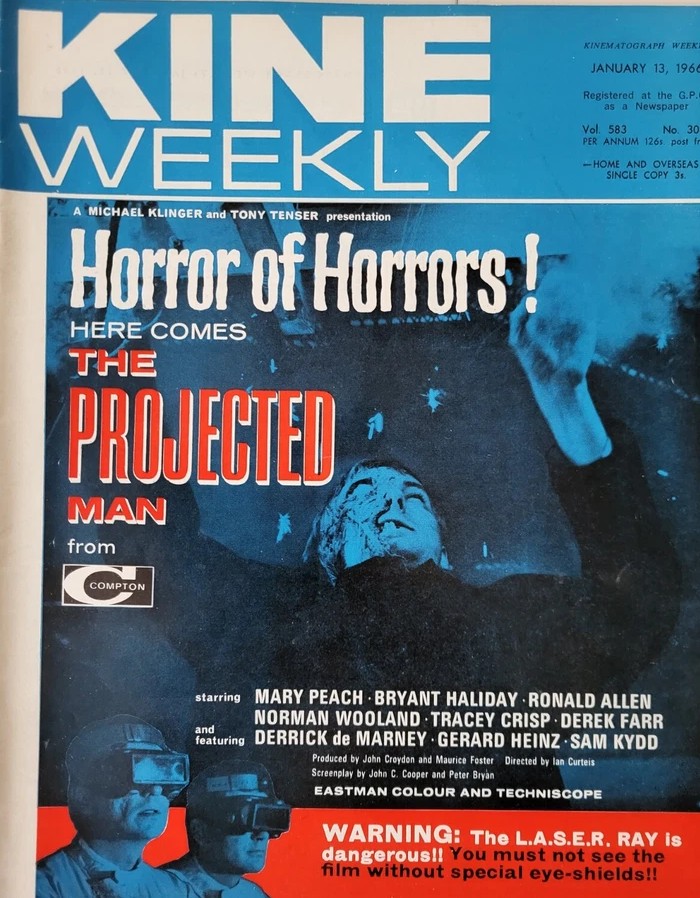
You might well have ruminated on the notion that laser had been invented simply for the purposes of terrorizing James Bond. So, here, long before Star Trek got into the game with its teleporting machine, is the ubiquitous laser being employed to move a human from place to place. Though Brits would just head for the nearest available Police Box a la Doctor Who should they wish to shift from place to place, not to mention from planet to planet.
Standard science hooey is stoked by office politics and internal sabotage by department boss Dr Blanchard (Norman Woolands), somehow open to threats of blackmail, and rivalry between colleagues Dr Paul Steiner (Bryant Halliday) and Dr Chris Mitchell (Paul Allen) for the affections of Dr Patricia Hill (Mary Peach).
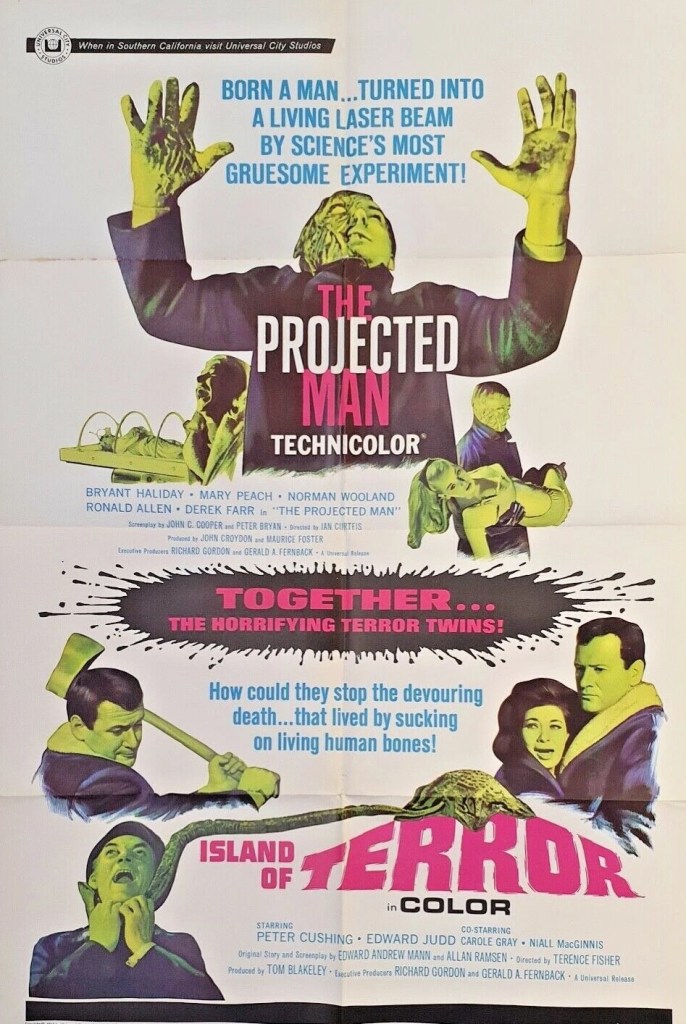
In any case, the experiments don’t always go according to plan, a transmitted mouse only lasts a few minutes and a watch goes backwards. The whole project looks like being scuppered after the equipment catches fire during a demonstration for renowned visiting Swiss scientist Professor Lembach (Gerard Heinz).
Steiner recruits his secretary Sheila for one last attempt, which just goes to show you hardly need a PhD to take part in top-secret ground-breaking work, in defiance of orders to shut down the laboratory. Mitchell and Hill, who’ve been cozying up, arrive in time to see Steiner disappear. Good news though when he does reappear it’s to prevent, however unintentionally, a burglary, but killing, however unintentionally, the perpetrators. You might think, given one side of his face is destroyed, that they died of fright but instead he’s got some secret superpower where he can kill with a touch.
Given this occurs halfway through we’ve got plenty of time left for Steiner to go on a killing spree and target all the people who were working against him. But such murders leave a trail and a cop, Inspector Davis (Derek Farr), starts to connect the killings. In an interesting twist, it’s not a contender for MCU world for Steiner – he needs energy to survive so heads to a power plant for a top-up ignoring attempts by the lovebirds to tempt him back to the lab to have a go at reversing the experiment.
By now Steiner exudes such energy that he’s, literally, bullet-proof. Still, eventually he’s tempted back to the lab. But he doesn’t want to be turned back into his old self and sets about destroying the lab. Unfortunately, the laser is reactivated and hits him again and this time he disappears for good.

This is the kind of low-budget operation that can’t afford to show a laser beam so the scientific razzamatazz is limited to flashing lights. But there’s some decent plotting and an attempt to show the sadder side of the monster, a la King Kong and Frankenstein. However, an audience is more interested in a monster on the rampage.
Competent acting throughout since the cast aren’t given much to play with. British star Mary Peach (No Love for Johnnie, 1961) won top-billing over American Bryant Halliday (Devil Doll, 1964). A directorial curiosity since it’s the only movie for Ian Curteis, later better known for teleplays such as Churchill and the Generals (1979) and The Falklands Play (2002).
Written by John Croydon (First Man into Space, 1959), Peter Bryan (The Blood Beast Terror, 1968) and Frank Quattrochi in his movie debut.
Budget restrictions don’t harm this one’s entertainment value.

