The Projected Man (1966) ***

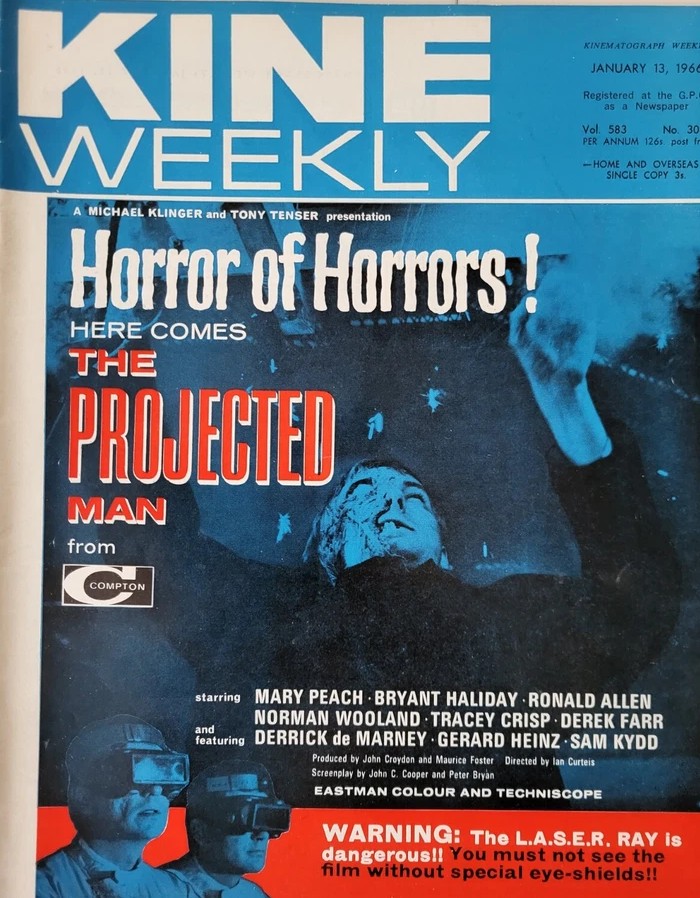
You might well have ruminated on the notion that laser had been invented simply for the purposes of terrorizing James Bond. So, here, long before Star Trek got into the game with its teleporting machine, is the ubiquitous laser being employed to move a human from place to place. Though Brits would just head for the nearest available Police Box a la Doctor Who should they wish to shift from place to place, not to mention from planet to planet.

Standard science hooey is stoked by office politics and internal sabotage by department boss Dr Blanchard (Norman Woolands), somehow open to threats of blackmail, and rivalry between colleagues Dr Paul Steiner (Bryant Halliday) and Dr Chris Mitchell (Paul Allen) for the affections of Dr Patricia Hill (Mary Peach).
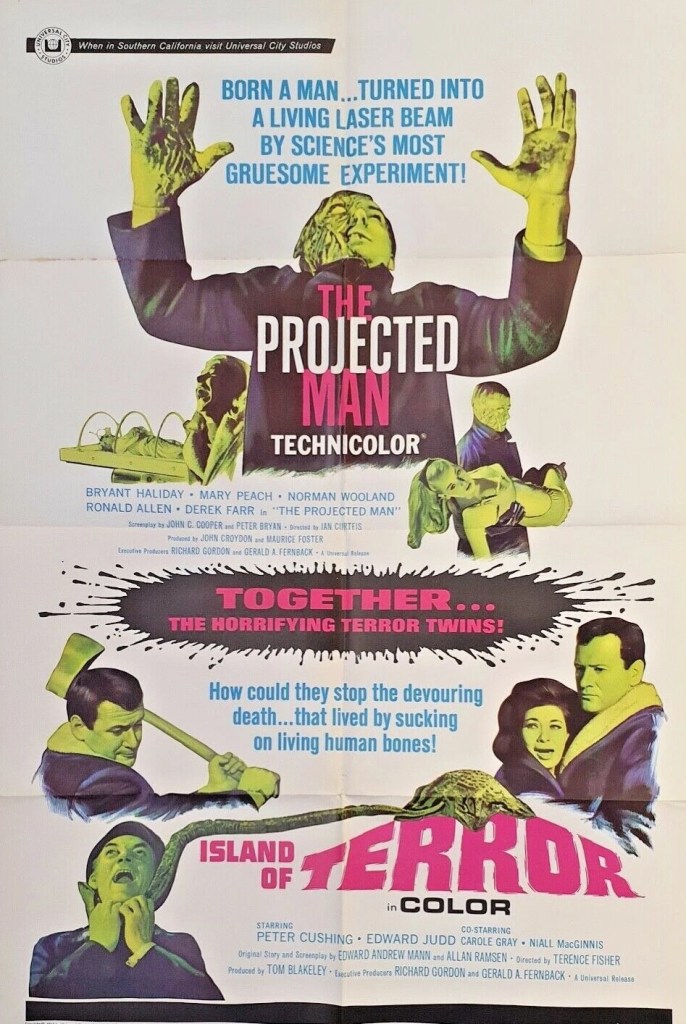
In any case, the experiments don’t always go according to plan, a transmitted mouse only lasts a few minutes and a watch goes backwards. The whole project looks like being scuppered after the equipment catches fire during a demonstration for renowned visiting Swiss scientist Professor Lembach (Gerard Heinz).

Steiner recruits his secretary Sheila for one last attempt, which just goes to show you hardly need a PhD to take part in top-secret ground-breaking work, in defiance of orders to shut down the laboratory. Mitchell and Hill, who’ve been cozying up, arrive in time to see Steiner disappear. Good news though when he does reappear it’s to prevent, however unintentionally, a burglary, but killing, however unintentionally, the perpetrators. You might think, given one side of his face is destroyed, that they died of fright but instead he’s got some secret superpower where he can kill with a touch.

Given this occurs halfway through we’ve got plenty of time left for Steiner to go on a killing spree and target all the people who were working against him. But such murders leave a trail and a cop, Inspector Davis (Derek Farr), starts to connect the killings. In an interesting twist, it’s not a contender for MCU world for Steiner – he needs energy to survive so heads to a power plant for a top-up ignoring attempts by the lovebirds to tempt him back to the lab to have a go at reversing the experiment.

By now Steiner exudes such energy that he’s, literally, bullet-proof. Still, eventually he’s tempted back to the lab. But he doesn’t want to be turned back into his old self and sets about destroying the lab. Unfortunately, the laser is reactivated and hits him again and this time he disappears for good.
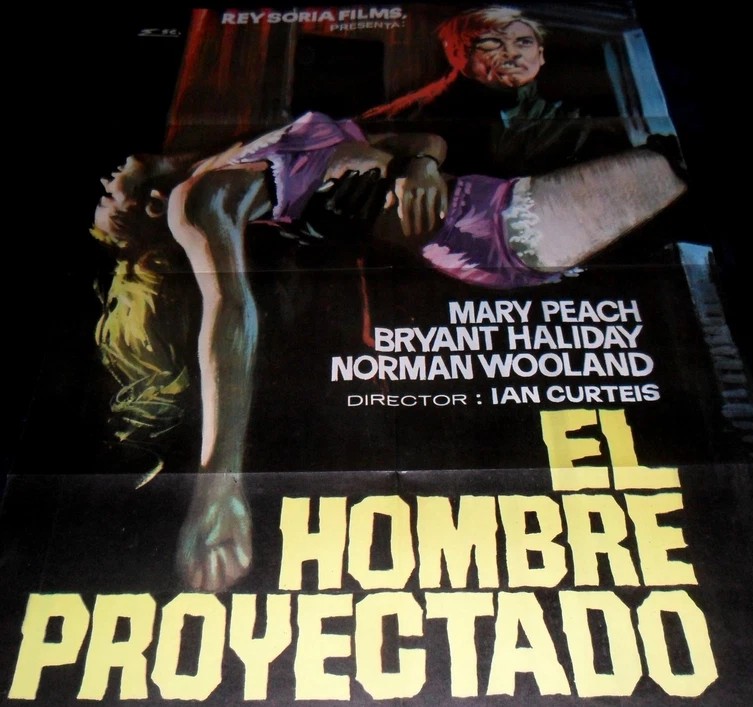
This is the kind of low-budget operation that can’t afford to show a laser beam so the scientific razzamatazz is limited to flashing lights. But there’s some decent plotting and an attempt to show the sadder side of the monster, a la King Kong and Frankenstein. However, an audience is more interested in a monster on the rampage.

Competent acting throughout since the cast aren’t given much to play with. British star Mary Peach (No Love for Johnnie, 1961) won top-billing over American Bryant Halliday (Devil Doll, 1964). A directorial curiosity since it’s the only movie for Ian Curteis, later better known for teleplays such as Churchill and the Generals (1979) and The Falklands Play (2002).

Written by John Croydon (First Man into Space, 1959), Peter Bryan (The Blood Beast Terror, 1968) and Frank Quattrochi in his movie debut.

Budget restrictions don’t harm this one’s entertainment value.
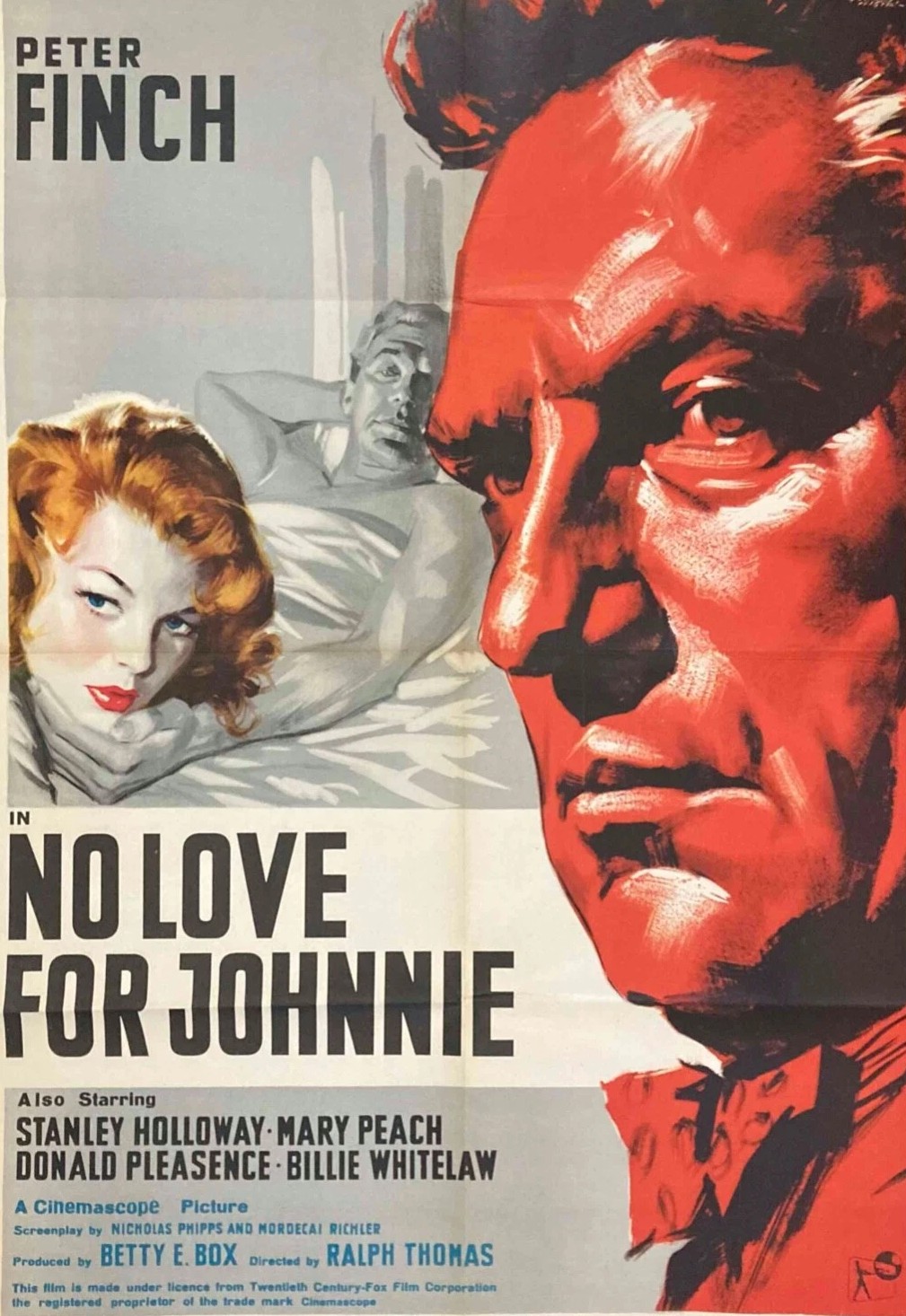
No Love for Johnnie (1960) ****

While hardly an excoriating view of British politics and lacking in the kind of high stakes narrative favored by the Americans in this sub-genre such as Advise and Consent (1961) or The Best Man (1964), it’s still an absorbing tale with a superb performance by Peter Finch, whose screen persona exudes power.

And while there’s plenty about the inside track, how the backroom deals are done, and the backstabbing, and the indifference of the politicians to those who elected them, it covers well the obsession with power.

If this is about power, it’s also about what lack of power does to a person. Politics is a pyramid game and even the most deluded politician believes that, with the right backing and a bit of luck, they can rise to the top. When they discover they are mere cannon fodder and recoil at the idea of spending all their time dealing with complaining constituents, they are prone to disillusion and seething disaffection.

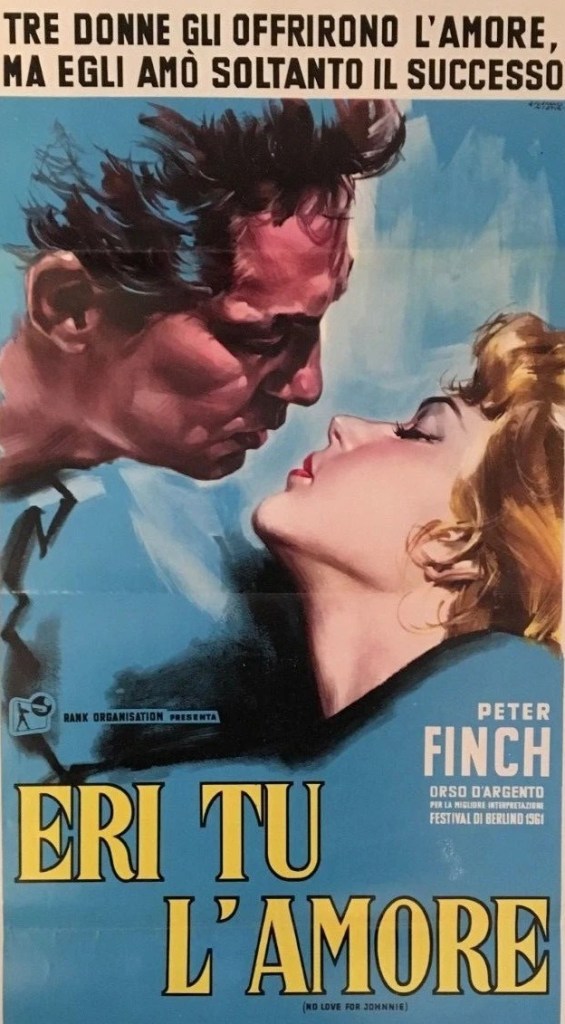
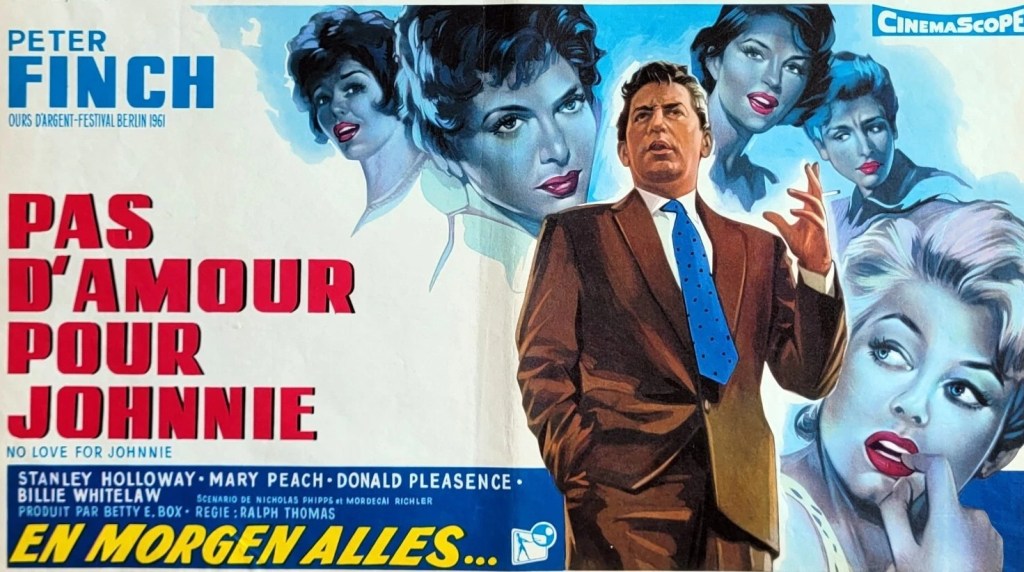
Although the poster might suggests that  re-elected MP Johnnie Byrne is a poor soul in the romantic stakes, his wife Alice (Rosalie Crutchley), who seems more attuned to the needs of the populace,  having abandoned him just after he’s won an election, and friendly neighbor Mary (Billie Whitelaw) pushing him away when he answers the phone in the middle of a clinch – “save your kisses for the Prime Minister,” she snaps – it’s clear that domesticity takes a poor second place to politics.

He’s extremely disappointed to be passed over for a place in the Cabinet, even the more minor position of a Junior Minister, that leaves him prey to the kind of grumbling back benchers intent on fomenting rebellion. But the rebels are generally all flawed individuals, more inclined to stoke controversy to get noticed or as a way of nursing disappointment at being relegated to the back seats of power.

Byrne isn’t a particularly attractive proposition. You wouldn’t want to be one of his constituents no matter what promises he makes to be re-elected. In those days people could just turn up at Parliament and request to see their MP and a flunkey would carry literally a note to the MP which would state the nature of the request. If it was about housing he would inform the flunkey to tell the constituent he was unavailable when in fact he’s sitting having tea in the cozy House of Commons café overlooking the River Thames.

Housing was as hot an issue then as it is now, too many people living in overcrowded insanitary apartments, paying high rents to unscrupulous landlords. But getting to the top of the local Council housing list was a massive problem. While, privately, Johnnie realizes that pushing open that particular door is virtually impossible, even for an MP, he can’t be bothered to give his constituents the time of day.

But he is sufficiently embittered to join the rebels and lead the way in poking holes at the Government’s policies. But then he meets a young artist/model Pauline (Mary Peach) and falls for her. I find it a bit implausible that such an ambitious man, having determined to make a name for himself by being a thorn in his Party’s foot, would miss a vital debate, especially one where he was the key figure, would skip it for a bout of sex with his lover.

Still, ironically enough, that works in his favor, and that may have been his intent. For the Prime Minister (Geoffrey Keen) assumes Johnnie has seen the error of his ways, his failure to appear for said critical debate taking the wind out of the incipient rebellion, and rewards him with a Junior post.

There’s an irony, too, in that Alice, deemed way too left-wing in her Communist pursuits for the left-wing Labour Party, is noted as having been an obstacle to Johnnie’s rise. But now that she’s out of the way, he can move up.

Getting promoted clearly won’t shift Johnnie out his apathy towards his constituents, but then, why should he, when he believes he has moved out of their reach by being ensconced in the Prime Minister’s inner circle, even if only on the fringes of that.

Peter Finch (I Thank a Fool, 1961) has the charisma and the glower to carry this off. The supporting cast is littered with rising stars such as Mary Peach (A Gathering of Eagles, 1963), Donald Pleasance (Soldier Blue, 1970) and Billie Whitelaw (Twisted Nerve, 1968) and even Oliver Reed (Hannibal Brooks, 1968).

Director Ralph Thomas was better known for comedy (the Doctor movie series) and thrillers (Some Girls Do, 1969) but he was equally adept at drama and here he turns an unflinching eye. Mention should be made of his wife, Betty Box, who was a major British producer at a time when both in Hollywood and in Britain excluded females from such a role.

Written by Nicholas Phipps (Doctor in Distress, 1963) and Canadian novelist Mordecai Richler (The Luck of Ginger Coffey, 1964) from the novel by Wilfred Fienburgh.

Like the best of this sub-genre exposes shady dealings in politics.

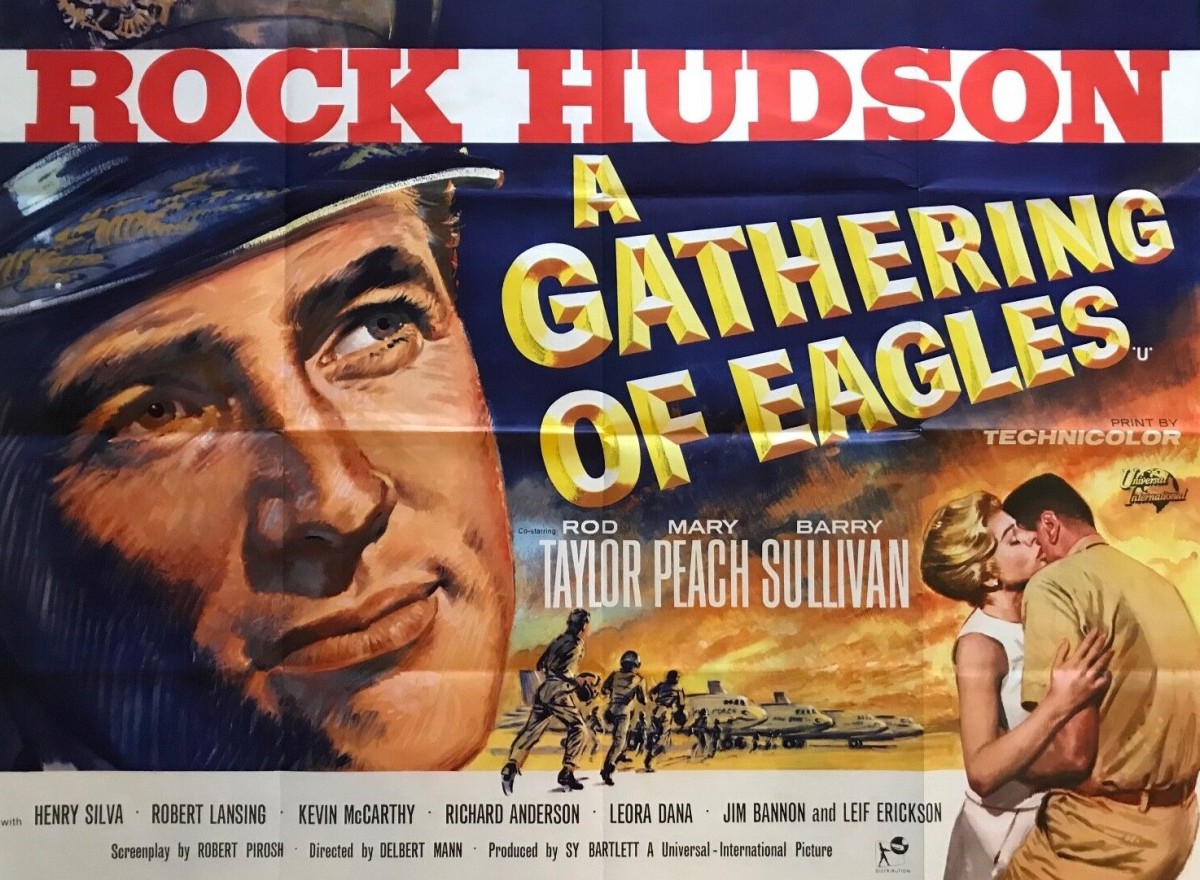
A Gathering of Eagles (1963) ***

Machines get in the way of this tale of men under pressure. Often viewed as a PR exercise for the Strategic Air Command to counter complaints about competence, and signally out of tune with a Hollywood faction that was beginning to view investment in nuclear weapons as a serious mistake, as epitomized by Fail Safe (1964), Dr Strangelove (1964) and The Bedford Incident (1965).

Not helped by action being under the auspices of simulation and not genuine war, filmmakers lacking the later bravura that just invented a side event, Top Gun, 1986, for example, to give audiences something to root for. Nor by a warehouse of info dumps.

That said, once it comes to the usual turf wars besetting any element of the military, the tension ponies up and there’s a real film underneath. There’s a surprising contemporary element to the narrative, two actually, firstly the arguments over leadership, and, secondly, the impact of PTSD, the endless deadline-based simulations as tough as being at war.

Hard-line efficiency expert Col Caldwell (Rock Hudson) is parachuted into a front-line B-52 Cold War command to toughen up sloppy procedure, bringing him into conflict with second-in-command Col Farr (Rod Taylor), a Korean War buddy. Caldwell rules by the book, Farr allows his men greater leeway. It comes down to the question of whether morale should be an issue or if men are expected to do their utmost even if they hate their leader. This debate about leadership style is prevalent today.

Caldwell is so tough he will sacrifice his buddy to get the job done better. And if people can’t handle the pressure they are better off out of the firing line. But since asking for a transfer to a less arduous berth would be viewed as a shameful admission of weakness, the only option for those who can’t cope is suicide. But since attempted suicide would not, as today, be viewed as a cry for help, anyone such attempt reduces the airman,, such as Col Fowler (Barry Sullivan) to a hospital bed where pity rains down on him.

The pressure comes in the shape of not just keeping on top of everything should the Russians suddenly decide to launch a missile attack, but dealing with intense simulations which appear out of the blue and require everyone to spring into battle stations. And in another prescient element, everyone is analysed to within an inch of their lives, marked down for the tiniest deviation from protocol, or not reaching the correct flight level or going too fast or too slow.

Caldwell is further hampered by English wife Victoria (Mary Peach) who fails to understand the pressure under which her husband, and all men in the base, operate, the kind of ground crew whose first question, on recovering from an operation, will not concern wife and kids but an airplane or a mission.

To add emotional heft, she is meant to have potentially fallen for Farr, and although rumors reach Caldwell’s superiors there’s no evidence of that. In the original script, the affair is spelled out, and such material was filmed, but it disappeared in the editing room. Perhaps because it proved that emotion was the Achilles heel of even the most efficient operation. In the actual movie, Victoria denies an affair and we believe her, but if an audience was shown her – and Farr – to be lying that casts a different complexion and at some level suggests betrayal.

In the air, despite assistance from the Strategic Air Command, the hardware is now out-dated, so of historical interest only, and while the movie fails to capture the tenor of the times, the situation of men under pressure has not changed.

Rock Hudson (Tobruk, 1967) is intensity on fire, Rod Taylor (Chuka, 1967) more laidback than in later films. Mary Peach (No Love For Johnnie, 1961) doesn’t have much of a filter between adoration and fury. Look out for Henry Silva (The Manchurian Candidate, 1962), Barry Sullivan (Harlow, 1965) and Kevin McCarthy (Hotel, 1967).

As you might expect, director Delbert Mann (Buddwing / Mister Buddwing, 1966) is more at home on the ground than in the air. Responsible for the screenplay were Sy Bartlett (Che!, 1969), also the producer, who had covered similar ground in Twelve O’Clock High (1949), and Robert Pirosh (Hell Is for Heroes, 1962)

The Top Gun of its day, bettered remembered now for the debate on leadership.

Discover WordPress

A daily selection of the best content published on WordPress, collected for you by humans who love to read.

The Atavist Magazine

by Brian Hannan

WordPress.com Blog

News, Tips & Website Tutorials