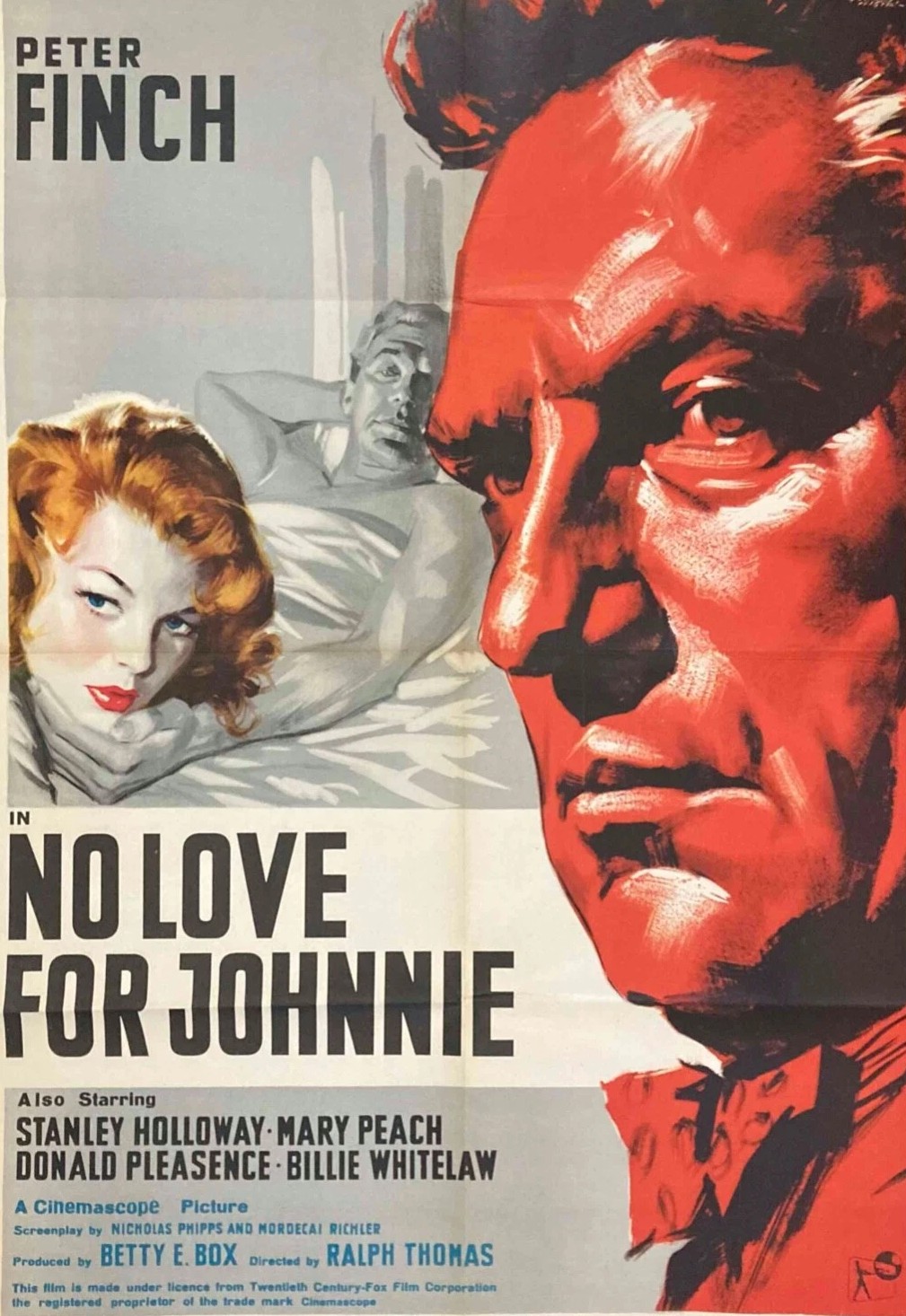
While hardly an excoriating view of British politics and lacking in the kind of high stakes narrative favored by the Americans in this sub-genre such as Advise and Consent (1961) or The Best Man (1964), it’s still an absorbing tale with a superb performance by Peter Finch, whose screen persona exudes power.
And while there’s plenty about the inside track, how the backroom deals are done, and the backstabbing, and the indifference of the politicians to those who elected them, it covers well the obsession with power.
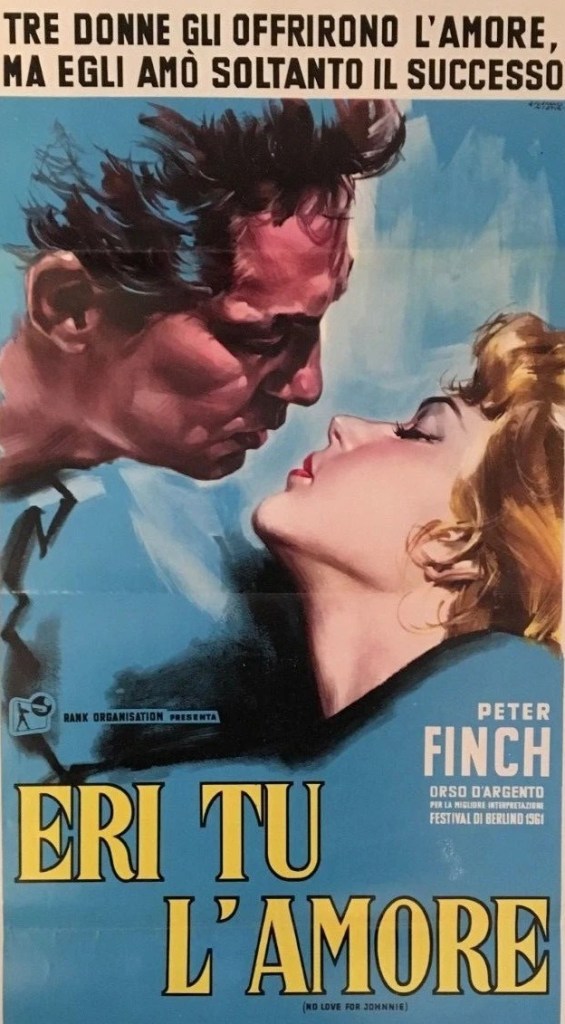
If this is about power, it’s also about what lack of power does to a person. Politics is a pyramid game and even the most deluded politician believes that, with the right backing and a bit of luck, they can rise to the top. When they discover they are mere cannon fodder and recoil at the idea of spending all their time dealing with complaining constituents, they are prone to disillusion and seething disaffection.
Although the poster might suggests that re-elected MP Johnnie Byrne is a poor soul in the romantic stakes, his wife Alice (Rosalie Crutchley), who seems more attuned to the needs of the populace, having abandoned him just after he’s won an election, and friendly neighbor Mary (Billie Whitelaw) pushing him away when he answers the phone in the middle of a clinch – “save your kisses for the Prime Minister,” she snaps – it’s clear that domesticity takes a poor second place to politics.
He’s extremely disappointed to be passed over for a place in the Cabinet, even the more minor position of a Junior Minister, that leaves him prey to the kind of grumbling back benchers intent on fomenting rebellion. But the rebels are generally all flawed individuals, more inclined to stoke controversy to get noticed or as a way of nursing disappointment at being relegated to the back seats of power.
Byrne isn’t a particularly attractive proposition. You wouldn’t want to be one of his constituents no matter what promises he makes to be re-elected. In those days people could just turn up at Parliament and request to see their MP and a flunkey would carry literally a note to the MP which would state the nature of the request. If it was about housing he would inform the flunkey to tell the constituent he was unavailable when in fact he’s sitting having tea in the cozy House of Commons café overlooking the River Thames.
Housing was as hot an issue then as it is now, too many people living in overcrowded insanitary apartments, paying high rents to unscrupulous landlords. But getting to the top of the local Council housing list was a massive problem. While, privately, Johnnie realizes that pushing open that particular door is virtually impossible, even for an MP, he can’t be bothered to give his constituents the time of day.
But he is sufficiently embittered to join the rebels and lead the way in poking holes at the Government’s policies. But then he meets a young artist/model Pauline (Mary Peach) and falls for her. I find it a bit implausible that such an ambitious man, having determined to make a name for himself by being a thorn in his Party’s foot, would miss a vital debate, especially one where he was the key figure, would skip it for a bout of sex with his lover.
Still, ironically enough, that works in his favor, and that may have been his intent. For the Prime Minister (Geoffrey Keen) assumes Johnnie has seen the error of his ways, his failure to appear for said critical debate taking the wind out of the incipient rebellion, and rewards him with a Junior post.
There’s an irony, too, in that Alice, deemed way too left-wing in her Communist pursuits for the left-wing Labour Party, is noted as having been an obstacle to Johnnie’s rise. But now that she’s out of the way, he can move up.
Getting promoted clearly won’t shift Johnnie out his apathy towards his constituents, but then, why should he, when he believes he has moved out of their reach by being ensconced in the Prime Minister’s inner circle, even if only on the fringes of that.
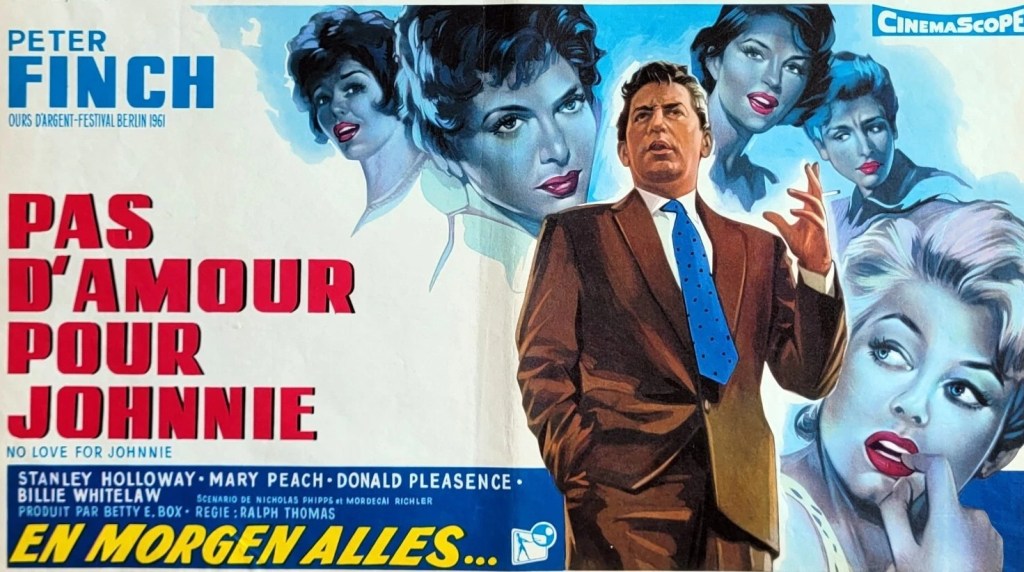
Peter Finch (I Thank a Fool, 1961) has the charisma and the glower to carry this off. The supporting cast is littered with rising stars such as Mary Peach (A Gathering of Eagles, 1963), Donald Pleasance (Soldier Blue, 1970) and Billie Whitelaw (Twisted Nerve, 1968) and even Oliver Reed (Hannibal Brooks, 1968).
Director Ralph Thomas was better known for comedy (the Doctor movie series) and thrillers (Some Girls Do, 1969) but he was equally adept at drama and here he turns an unflinching eye. Mention should be made of his wife, Betty Box, who was a major British producer at a time when both in Hollywood and in Britain excluded females from such a role.
Written by Nicholas Phipps (Doctor in Distress, 1963) and Canadian novelist Mordecai Richler (The Luck of Ginger Coffey, 1964) from the novel by Wilfred Fienburgh.
Like the best of this sub-genre exposes shady dealings in politics.


One thought on “No Love for Johnnie (1960) ****”