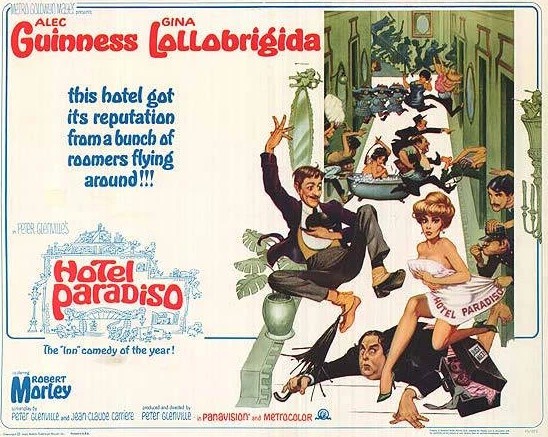
Few stars made such a deft job of switching their screen persona. If, in the 1960s (or later) you associated Alec Guinness with dramas such as Lawrence of Arabia (1962) or Doctor Zhivago (1965) and were very familiar with that droll drawl of a voice, you would be astonished the discover that he could wear a comedy hat – minus the droll drawl – to similar effect. My first surprise here was that this Alec Guinness was vocally unrecognizable. Not only was he charming but had a romantic streak.
Then you’ve got Gina Lollobrigida who could also mix drama (Woman of Straw, 1964) with comedy (Come September, 1961) but who could also hold back her screen persona, limiting the zest and eliminating the coquettishness.
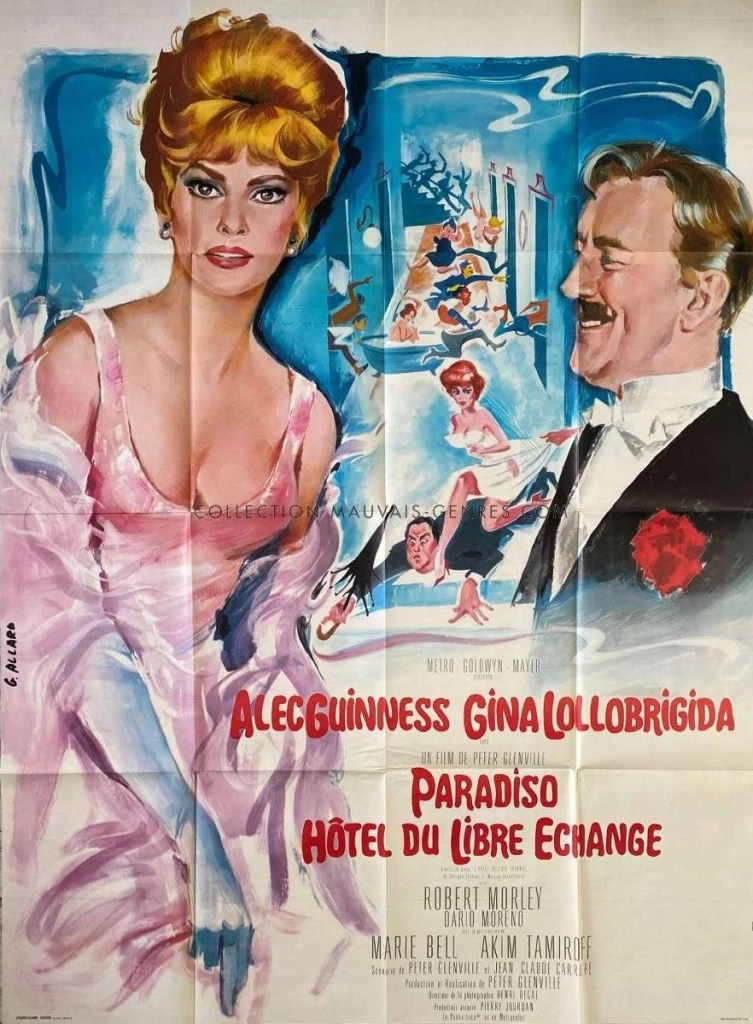
And for good measure, what’s director Peter Glenville doing here? Seven out of the eight movies he helmed were dramas and heavyweight ones at that in the vein of Becket (1964) and The Comedians (1967), top-heavy with stars of the caliber of Peter O’Toole, Richard Burton and Elizabeth Taylor. You wouldn’t have him down for a comedy, let alone a French farce. But Glenville had translated the 1894 Georges Feydeau farce for the London West End stage in 1956 – it also reached Broadway – and the production he directed starred Guinness (Bert Lahr on Broadway).
I’m generally immune to farce. Either the characters are idiots or the action is idiotic. Here the two main characters, Marcele (Gina Lollobrigida) and Benedict (Alec Guinness), in the same predicament, attract audience sympathy. Both are married to domineering partners and would just like a bit of fun, so ;plan to spend time in the titular hotel where rooms are rented by the hour. But they are equals, it’s not like Benedict is a fawning numbskull being run rings round by a haughty Marcele.
In the hands of a master farceur like Feydeau the plot, such as it is, works like a dream. The plot of course is to get a number of people into the same building and find reasons for them to want to avoid each other. Usually, such avoidance is triggered by sexual malfeasance.
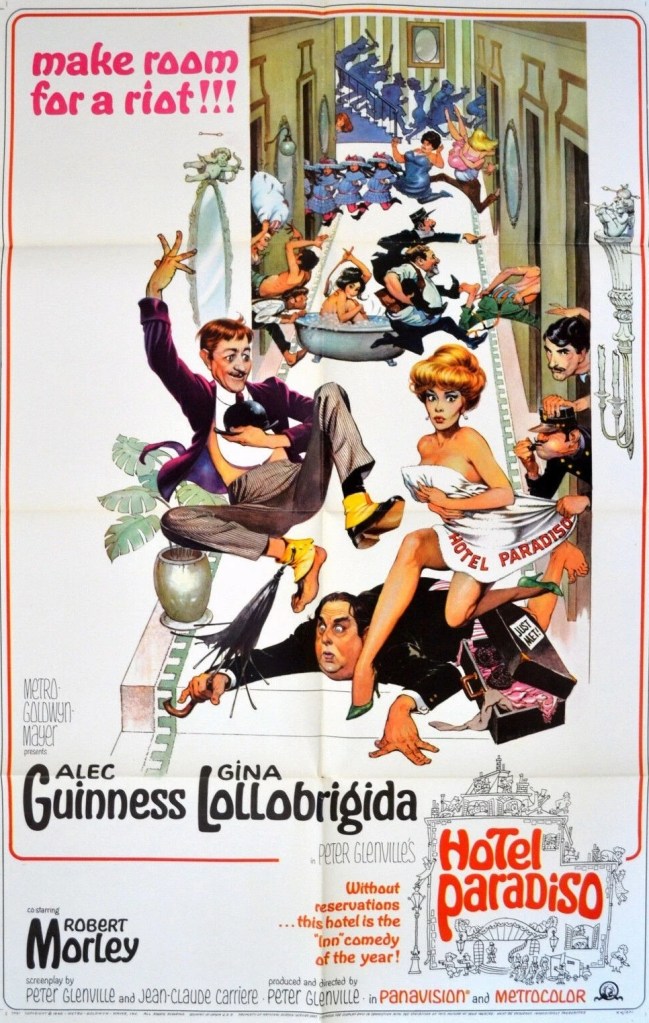
So the last people the tentative lovers expect to run into (and have to avoid) is Marcele’s husband Henri (Robert Morley) – there on business, he’s a drain specialist – or Benedict’s friend Martin (Douglas Byng) with four daughters in tow, or, for that matter, Marcele’s forward maid Victoire (Ann Beach) there for an assignation with Henri’s nephew Maxime (Derek Fowlds), who, of course, equally fear discovery.
Adding to the ensuring chaos are an incompetent bellboy and an unwelcome police inspector (Leonard Rossiter). One of the joys of this piece is the polish of the plotting. It’s not dependent so much on the obvious avoidance techniques, but on other more tangible elements such as hot water bottles, chairs, tea, hats, and ghosts (the hotel is believed to be haunted). Many of the best laffs are based purely on character. Henri is so arrogant that, ending up in the wrong room, he assumes it’s the result of a thief that his usual items have gone missing and that the thief is so dumb that he’s left his hair on a hairbrush. There’s an in-joke in just watching the usually immoveable object that constitutes Robert Morley being forced to run at a pace.
There’s even a contemporary element – someone present commenting on proceedings – who turns out to be Georges Feydeau himself whose observations of the human frailties on show provide him with the makings of a hit play.
Stepping outside their usual screen personas, Guinness and Lollobrigida spark so well off each other it’s a surprise no one thought to team them again. Robert Morley (Topkapi, 1964) is, as always, pure comedy gold.
It’s a wonder, too, that Peter Glenville didn’t follow up with another movie comedy. There’s more inventiveness and visual dexterity here than in anything else he directed. You always had the impression in his dramas that he was desperate to “make a point” while here, relieved of such a necessity, he can indulge in frivolity. Jean-Claude Carriere (La Piscine/ The Swimming Pool, 1969) lent a hand to the screenplay.
An unexpected delight.


