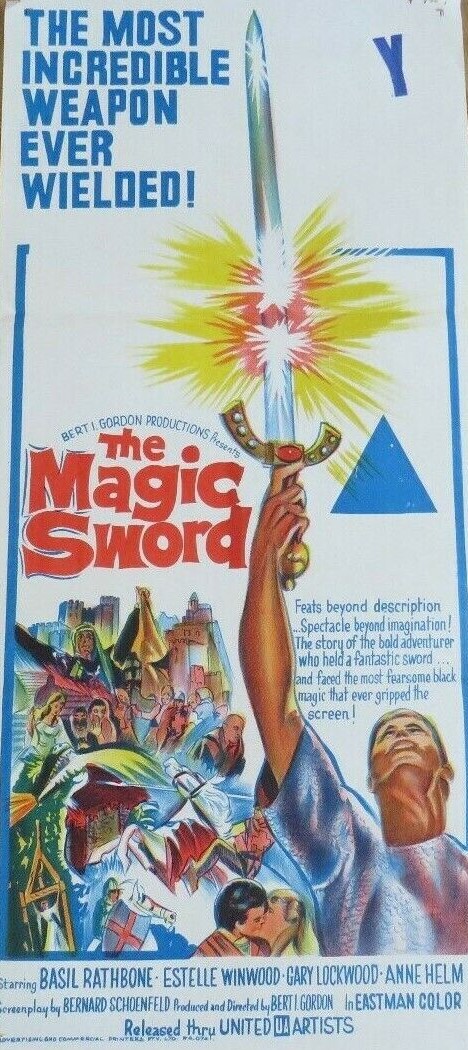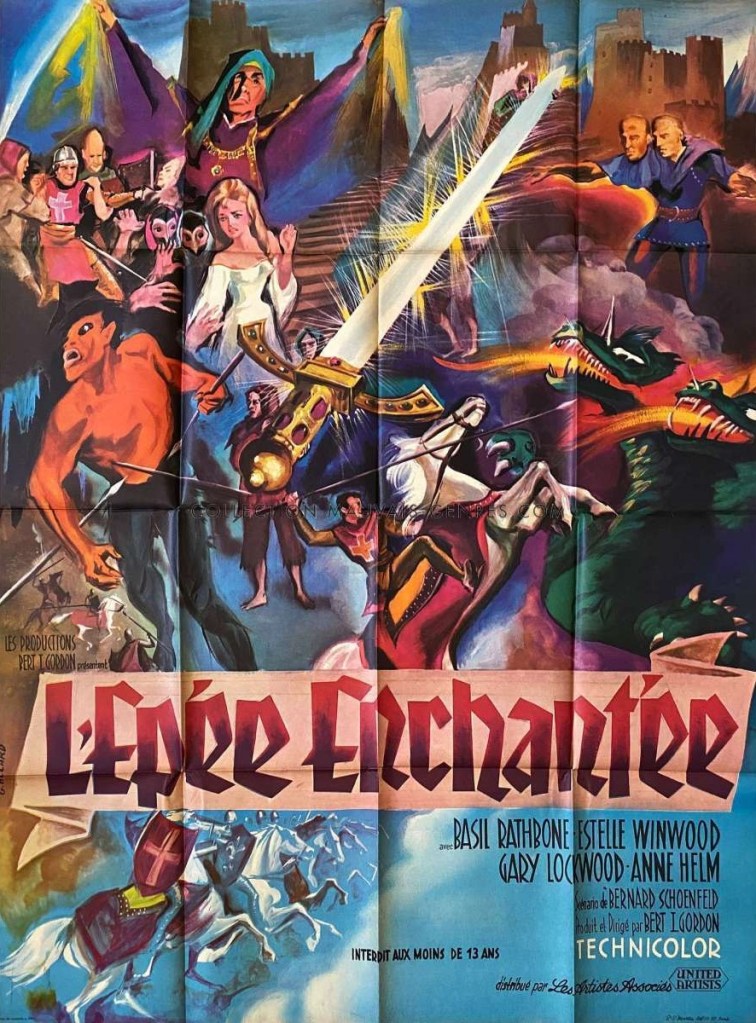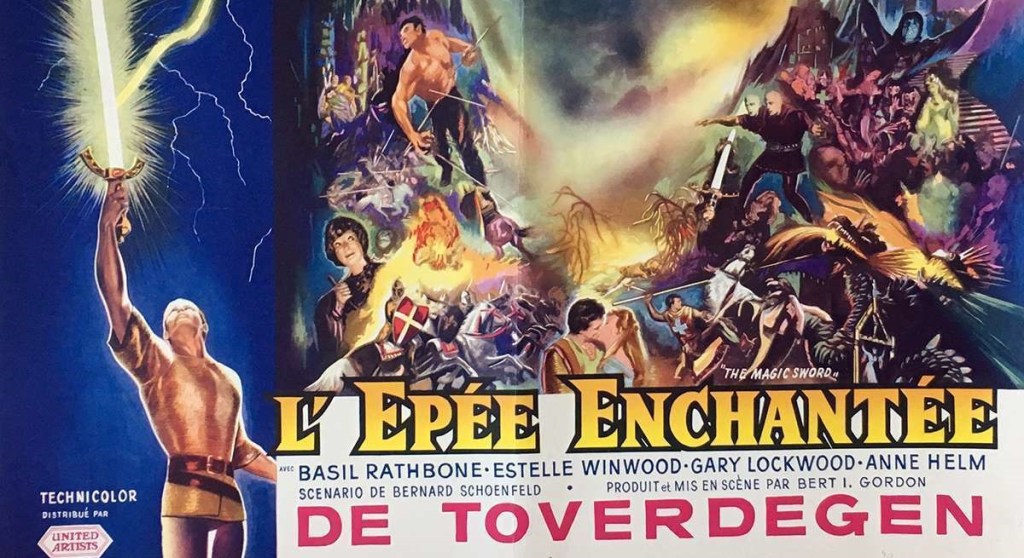
The Magic Sword (1962) ***

Where’s Ray Harryhausen when you need him? Not much wrong in this fun low-budget adventure that a few doses of Dynamation wouldn’t fix. While it means the monsters don’t cut it – man in mask with a dodgy perm playing an ogre, two-headed dragon whose flames appear superimposed – the rest of it is as up to scratch as you might expect from a genre that relies on exploiting old myths.

And we do get a look at Gary Lockwood (The Model Shop, 1969) in embryo and Basil Rathbone (The Comedy of Terrors, 1963) having a whale of a time as a villain who somehow (point plot not explained) has lost his magic ring. That means he’s going to strike a deal with loathsome knight Sir Branton (Liam Sullivan) – who happened across it (plot point unexplained) – to kidnap Princess Helene (Anne Helm). He’s somewhat hindered in explaining his plans because his voice is often drowned out by the thunder he can summon just by lifting his arms.

But it’s magic vs. magic as the pair come up against sorceress Sybil’s (Estelle Winwood) adopted son Sir George (Gary Lockwood) who’s stolen a set of enchanted artefacts including the titular sword, armor, a shield and the fastest horse in the world and heads off to rescue fair maiden from the castle of Lodac (Basil Rathbone) where the aforementioned dragon is on a steady diet of consuming a human being (or two, if twins or sisters are to hand) once a week.

Sybil, who seems to exist in some kind of darkroom, constantly lit by red, is a hoot, when not turning herself into a cat, unable to recall spells, not surprising since her memory has to span 300 years. Her coterie includes a chimp who does nothing (what’s the point of that, you might wonder, though perhaps magic is involved in just getting it to sit still) and a two-headed man, both faces speaking the same words at the same time.

There’s a tilt at a magnificent seven scenario as Sir George brings to life six sidekicks, a multi-cultural melange if ever, or a stab at attracting audiences from six different countries if you like. You need to be mob-handed at this game because the bunch, assisted or sabotaged by the accompanying Sir Branton, need to overcome The Seven Curses of Ladoc (the film’s alternative title in various parts), including the ogre and a malodorous swamp, and sure enough those dangers soon cut the motley band down to size.

Meanwhile, the imprisoned princess has watched the dragon eat, and is tormented by dwarves (though the caged elves turn out to be friendlier). There’s going to be two showdowns, not one, since Lodac has no intention of allowing Sir Branton the glory of rescuing said princess and therefore winning her hand in marriage. He is hell-bent on revenge, since the king’s father had burned his sister at the stake as a witch.

The meet-cute if you like is princess and potential rescuer facing each other across a dungeon while tethered by rope to stakes. Sybil does try to help but damned if she can remember the final words of her spell.

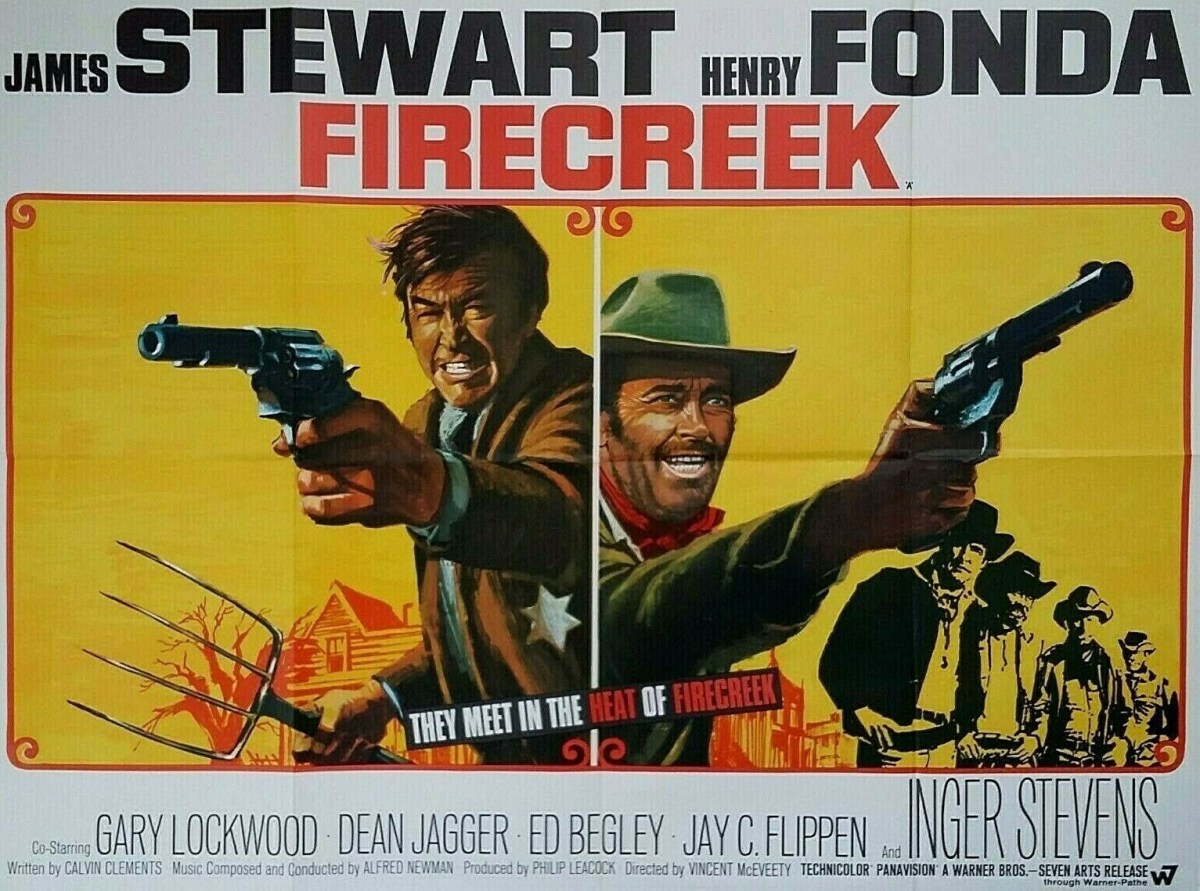
Gary Lockwood, in his first leading role, takes the whole thing seriously, and only made two more films before something in this role and It Happened at the World’s Fair (1963) and Firecreek (1967) tipped off Stanley Kubrick that here was a star in the making for 2001: A Space Odyssey (1968). So it does show that no part, however preposterous, is worth turning down.

Basil Rathbone would steal the show – as he should being top-billed – were it not for the fun-loving Estelle Winwood (Games, 1967) as the dotty aunt kind of sorceress. What Hollywood dictat I wonder determined that leading actresses often made their entrance swimming naked in a pool. Anne Helm (The Interns, 1962) doesn’t have much to do except look scared. You might spot Danielle De Metz (The Scorpio Letters, 1967).

With Sybil to dupe, all the curses to overcome and deal with the duplicitous Sir Branton, the pace never lets up. And it’s short (just 80 minutes) so no time for dawdling.

Director Bert I. Gordon (The Amazing Colossal Man, 1957) has been here before with the special effects that appear dodgy to the contemporary eye but were ground-breaking at the time when SFX did not command multi-million-dollar budgets. Screenplay by Gordon and Oscar-nominated Bernard C. Schoenfeld (13 West Street, 1962).

While Harryhausen tales were always redeemed by the special effects, this is perfectly acceptable late-night entertainment when the critical guard is down.

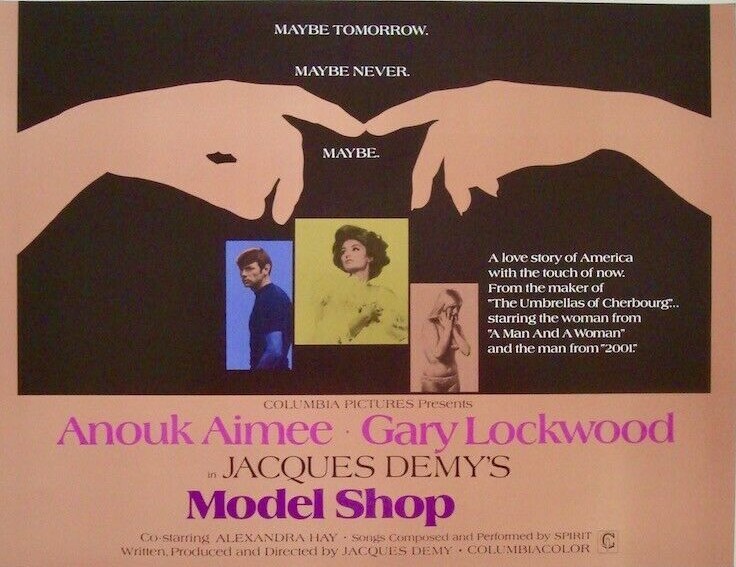
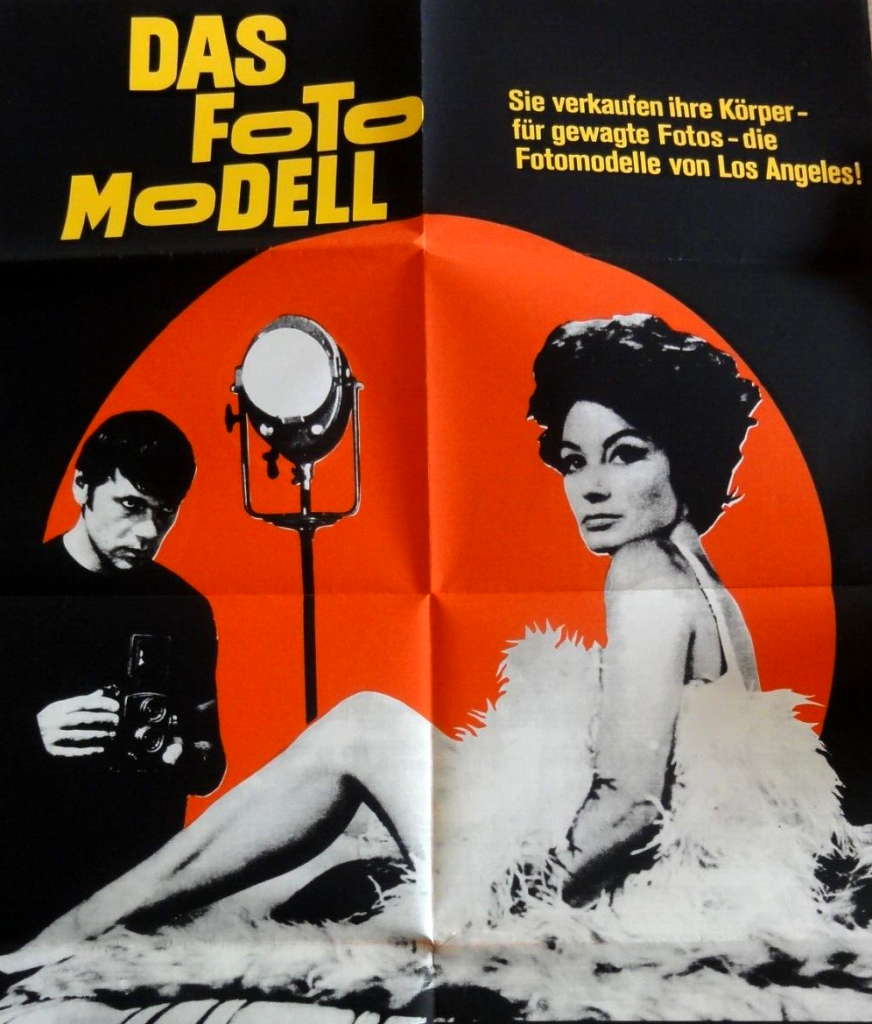
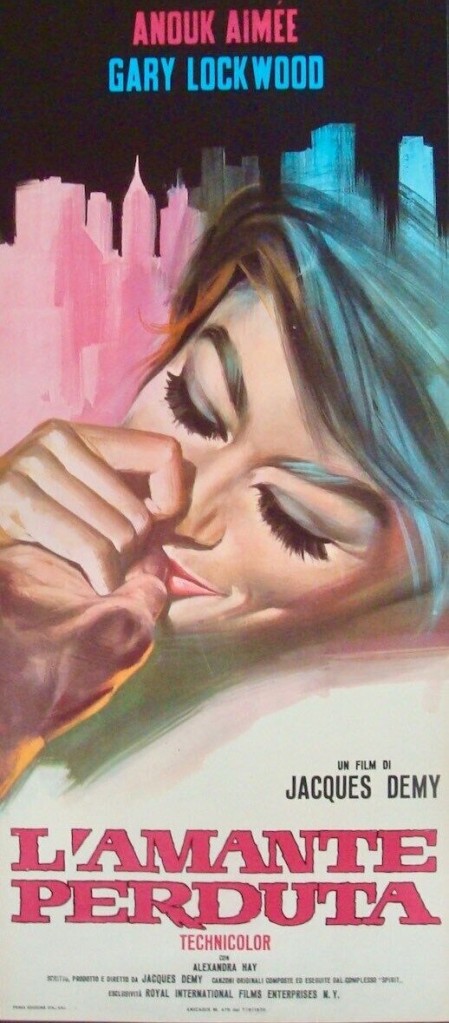
Model Shop (1969) ***

Surprising number of similarities to The Appointment (1969), including the aura of seediness, but lacking that film’s inherent tension or style. Lola (Anouk Aimee) is another model pursued by a another man who catches a glimpse of her in the street as in the Lumet affair. But it turns out a “model shop” is a tacky dive where men pay to take photographs of semi-naked women rather than anything to do with haute couture.

Lola is as depressed as Carla in The Appointment and for the same reason, abandoned by her boyfriend, who has gone off to gamble in Las Vegas. But new lover George (Gary Lockwood) is the antithesis of the successful Omar Sharif. You are inclined to give him a free pass because he’s got the draft hanging over him.

If he was disaffected, that could explain it. But he’s just bone idle, sponging off everyone in sight, musician friends and more ambitious girlfriend Gloria (Alexandra Hay), an actual model, though more in the commercial line than high fashion, but bringing in enough to pay his bills.

You might feel sorry for him that “the man” is trying to repossess his car until you see it’s an MG coupe that an unemployed guy could not afford and that when he does get enough cash to pay the outstanding payment he comes up with another excuse rather than parting with the money. He studied architecture but hasn’t the gumption to make his way in the adult world whereas Gloria accepts she might have to sit in a bathtub naked for a potential client if she wants to get on.

He won’t marry Gloria or give her a child so she’s full of empty threats to leave him but doesn’t carry that out until she discovers photos of Lola that he’s left lying around. There’s not much going on. It’s certainly a downmarket world. George and Gloria lived in a rundown suburb of Los Angeles with a pumpjack drilling for oil outside their front door.

A good chunk of time is spent on the road, not “out along the highway looking for adventure” as in Easy Rider (1969) and not in the great outdoors, but mindless drifting, or tailing Lola, around L.A.. There’s some kind of deadline on their romance – she’s headed home to France, his call-up is immediately imminent so unless there’s some expose of the seedier side of the city going on there’s not much else, just two people who lost their way finding brief solace in each other.

Anyone attracted by Anouk Aimee’s top billing is going to be disappointed, not in her performance, which reveals a markedly vulnerable gal beneath the glam (though she does dress haute couture). But Gary Lockwood (They Came to Rob Las Vegas, 1968) is front and central; she doesn’t turn up until about a third of the way through and only has a handful of scenes thereafter. So it’s that kind of slice-of-life movie, what the British used to term a “kitchen sink” picture, and takes place over a short time-span.

Gary Lockwood is excellent but he’s not asked to do very much, and you kind of get the impression he’s just being his charming self. Aimee seems to have cornered the market in playing “degrading” women, accused of being a sex worker in The Appointment and loaned out to high-class friends of her husband in Justine (1969). In some senses, bringing out the  character behind the tawdry image appears her forte. Alexandra Hay (Skidoo, 1968) is equally good, the grit behind the glam, not just a pretty face.

But just nothing happens. The background – the draft, potential Vietnam peace talks, the occasional joint – is scarcely a visceral snapshot of America at the time. European director looks at America and doesn’t much like what he sees, but less obviously a commentary on society along the lines of Antonioni’s Zabriskie Point the following year or even the home-grown Medium Cool (1969).

And lacking the style of Demy’s previous outing, the exuberant musical The Young Girls of Rochefort (1967) and you keep on expecting – hoping – the characters are going to burst into song. Oddly enough, it suffers from an unexpected culture clash. Relocate the same characters and the same story to Paris, speaking French with subtitles, and it would have worked better no matter how slight the story because it would automatically be infected by Gallic charm and even the poorer streets there would be interesting.

Carole Eastman (Five Easy Pieces, 1970) a.k.a. Adrien Joyce contributed to Demy’s screenplay. Members of rock band Spirit appear in the film and provide several tracks but there was no soundtrack album to take advantage of their involvement.

You might be interested to know that Harrison Ford was at one time up to play the lead. Hay was a starlet under contract to Columbia who financed the film. Equally oddly, it was not sufficiently arthouse to appeal to the cognoscenti and it was little surprise that the studio eventually chose to promote the seedier aspects in the marketing.

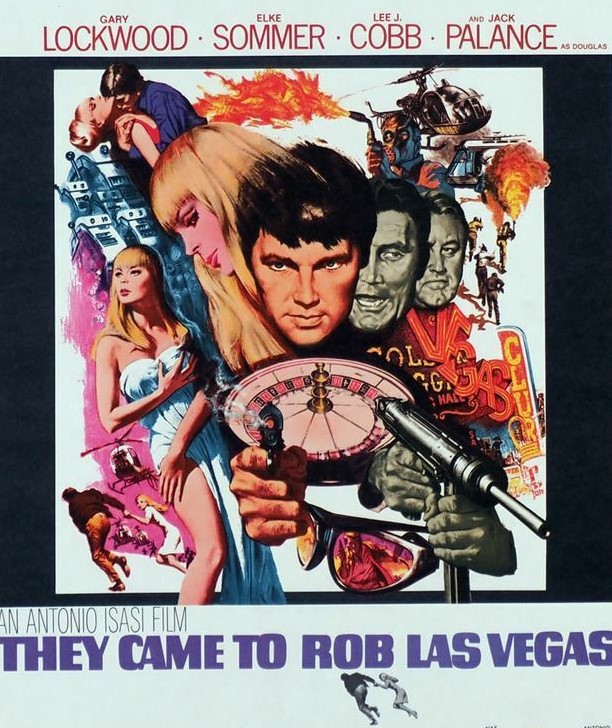
They Came To Rob Las Vegas (1968) ***

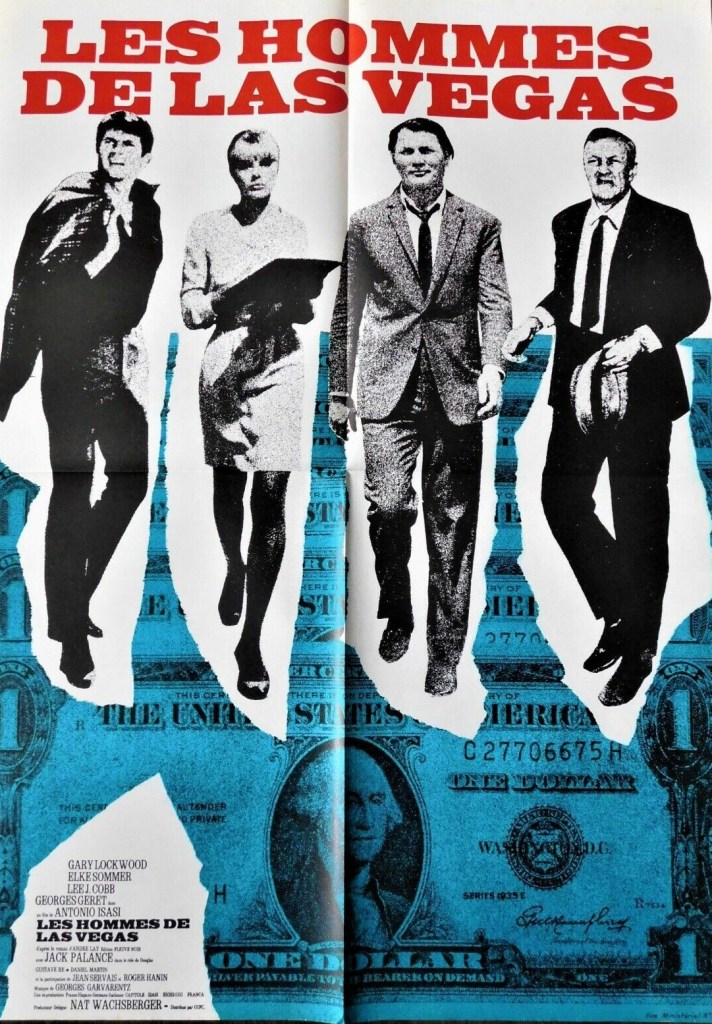
Actually, they didn’t. The thieves planned to pull off a heist of $7 million from a security truck as it travelled through the Nevada desert en route to Mexico. Las Vegas pops into the story every now and then, criminal mastermind Tony (Gary Lockwood) employed there as a croupier in order to romance the girlfriend Ann (Elke Sommer) of millionaire Steve (Lee J. Cobb) who owns the security business being targeted.

The picture’s overlong and a shade complicated but the robbery is terrific, if a bit unbelievable, while the ending is existential and almost Boorman-esque. It’s futuristic, too, with computers programming routes for security vehicles to make them harder to follow, pretty sophisticated visual communications for the era. The trucks are more like armored cars,  tough as tanks, steel so thick it’s impervious to an oxy-acetylene cutter, and with machine guns mounted on the roof.

You’ll scarcely have heard of the director, Spaniard Antonio Isasi (That Man in Istanbul, 1965) whose career only spanned eight movies. And while you might be familiar with Gary Lockwood (2001: A Space Odyssey, 1968), Elke Sommer (The Prize, 1963), Lee J. Cobb (Coogan’s Bluff, 1968), and Jack Palance (Once a Thief, 1965) who plays Douglas, an F.B.I. agent investigating Steve’s Mafia connections, you’ll struggle to keep tabs on the myriad other characters who flit in and out of what ends up as a four-way narrative.

So we start out with Tony’s brother (see, I told you it was complicated) who has bust out of jail and wants to go back to old-style heists that involve shoot-outs in the street, nostalgia getting the better of him as he winds up dead. Then we’ve got Steve who wants to quit the underworld. That seems to be a trope of the time, The Brotherhood (1968) and Stiletto (1969) going down a similar route.  When the truck is hijacked, Steve comes under suspicion from his Mafia buddies, who reckon he’s looking for an easy way to fund his retirement.

Meanwhile, as well as the $7 million in legitimate cash, the truck is also carrying millions in Mafia loot to be laundered across the border in Mexico, a notion that’s already attracted the attention of Douglas and his team.

Meanwhile, meanwhile, Tony is carrying out some low-grade casino theft, as croupier dealing Ann some very helpful cards and topping up his salary to the tune of $400-$500 a day. Ann, who could as easily be water ski-ing or living the high life in Acapulco with the married Steve, still takes time out of the mistress gig to undertake her ordinary job at the security company’s head office where she is in charge of the seemingly mindless task of feeding route cards into the computer.

While this takes quite a while to get all the wheels in motion and the various sub-plots and characters to fall into line, when finally we get to the robbery, it’s a cracker. Though you might find yourself asking who was funding the heist, with its five-man crew, helicopter, flame-thrower,  machine guns, plus what can only be described as a giant vault buried in the desert.  

At first, the heist appears patently old-fashioned. Gangsters dressed as guards replace the real guards but once in the back of the truck they have neither access to the loot nor the driver’s cabin. No matter, they know where the truck is headed, out into the desert, where they have made the road impassable with heaps of sand and just in case that didn’t work shoot out a tyre. The flame thrower finishes the job.

Thomas Crown would be impressed by their planning for they have another tyre buried in the sand to swap for the useless one and they also have metal tracks that can be laid over the sand to ease passage. They need the tracks because the truck goes off-road over the top of a dune and is lowered into the vault while the rotary blades of the whirligig serve to cover the top with a layer of sand, returning the desert to its normal pristine condition.

But we’re far from finished. We still have betrayal, underground paranoia, Steve being stalked by Douglas, the Mafia getting uppity with Steve, Steve becoming suspicious of Ann, a hapless motorist caught in the crossfire, squads of cops and goons descending on the hijack spot, and Tony still having to work out how to open the unbreakable truck.

At times, the plot comes together with devastatingly simplicity, but at other times the various strands merely serve to blow the whole thing apart. None of the principals is on their A-game, most appearing overly stiff and clichéd, while you’re still trying to work who all these other characters are.

The heist itself is splendidly done and the twist ending worthy of comment. Most of the time it’s pretty watchable but what should be a relatively seamless narrative is undone by over-plotting.

While the time was ripe for an ingenious heist, the crime thriller had taken one of those periodic leaps into new territory, what with Point Blank (1967) and The Thomas Crown Affair (1968), so it was virtually impossible to accommodate a movie with so many narrative jumps, where motive was unclear, characters diffuse and the tone widely variable.

On the other hand, as I said, the heist had me enthralled and the twist ending had me intrigued.

Discover WordPress

A daily selection of the best content published on WordPress, collected for you by humans who love to read.

The Atavist Magazine

by Brian Hannan

WordPress.com Blog

News, Tips & Website Tutorials