The Martian (2015) ***** – Seen at the Cinema (again!)

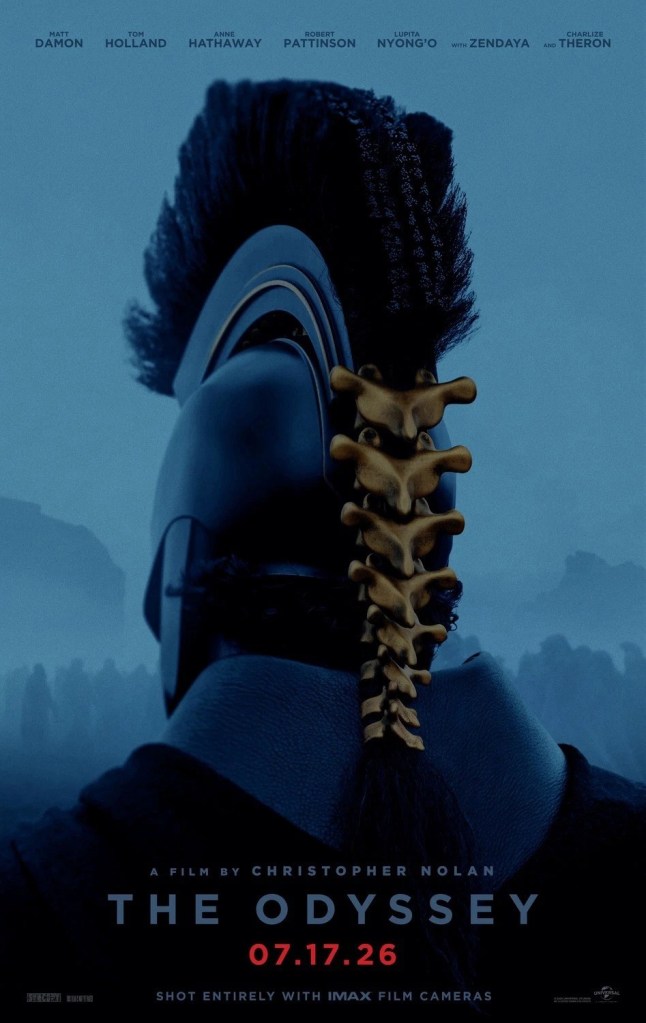
My guess is that the combination of the success of Project Hail Mary (2026), whose author Andy Weir also wrote this, and the imminent The Odyssey from Christopher Nolan which stars Matt Damon were the triggers for this big-screen reissue. These days, most reissues only play for one day, but this proved so popular it ran in two screens.

Although I reviewed it not so long ago that was on the back of a television screening and seeing it on the big screen reminded of just how brilliant it was – and it more than saved my Monday cinema outing after the abject The Invite. ao forgive me if I give this another plug.

You might recall how annoyed I was several weeks ago by being asked to tolerate Chris Pratt stuck in a chair in Mercy (2026) talking to the camera for what seemed like a solid hour. It struck me then how few actors could manage a whole film one-handed – Tom Hanks in Cast Away (2000) the most obvious example. But, in the wake of Project Hail Mary (2026) I realized there was another contender, Matt Damon as the stranded astronaut in Ridley Scott’s The Martian.

And sure, he eventually gets some help in maintaining audience interest once he communicates with Earth and the spaceship. But here’s the kicker. Mostly what he’s doing is exposition. That’s the one thing a star avoids like the plague. It’s usually left to the supporting actors to set the scene, explain the ins-and-outs of a situation.

But here it’s all down to Damon. He spends his time talking to camera, identifying a problem, usually so scientific you’d need academic books beside you, and then solving it. So, yes, like Cast Away, he’s a bloke on a version of a desert island who’s got to find his way to safety through how own devices.

But even so. What kind of screen persona do you need not just to keep us interested but enthralled? When he sees the first shoots of potato appear, it carries a massive emotional kick. The role of the people on Earth is wonderment and cynicism – no way he can do that sort of thing. Which rachets up the tension and then our hero does the impossible.

There’s always a moment in these space movies where someone comes up with something that’s never been done before – slingshots using gravity, Apollo 13 (1995) littered with improvisation. These scientists are I guess exceptionally brainy to qualify as lunar astronauts but even so.

As I said, I was coming to this again after Project Hail Mary so I was attuned to the science, or the expectation of science and the need to keep the audience informed. But Mark Watney (Matt Damon) comes up with unbelievably-inspired elements of improvisation, some of course pure science but others pure common sense, like pointing the camera at letters to spell out words.

It’s a heck of a ride, especially as with being under Ridley Scott’s command, there’s not a darn alien in sight, no stomach-bursting squeamishness to maintain audience attention, no rampaging monster scuttling along a spaceship. This is Mars as arid as you have been led to believe. Yes, an occasional mountain range or dustbowl to evoke the West of John Ford, and storms coming out of nowhere, but generally speaking as placid and dull a domain as you could wish for.

So in visual terms not much to help out the star. Every movement he makes is fraught with danger. He can choose to freeze through a long night or switch on the heating and thus lose vital battery power.

Every now and then, to speed things up, Ridley Scott literally does just that, characters whizzing around like they’ve just emerged from a silent movie. But mostly it’s slow painstaking going.

Of course we need a big finale and Scott obliges. And every now and then he flicks an emotional switch back on Earth and Nasa boss  Teddy Sanders (Jeff Daniels) has to explain how the astronaut they held a memorial for is actually still alive, and the spaceship team have to come to terms with the fact that they abandoned not a corpse but a guy very much alive. There’s no room for humor, but occasionally some is squeezed in – Sanders having to apologize to the President for Watney’s profanity being globally broadcast.

Ridley Scott (Gladiator II, 2024) reins in the bombast and picks his way through a tricky scenario keeping the audience very much onside. Matt Damon (Oppenheimer, 2023)  , who has surely inherited the Tom Hanks “everyman” mantle, demonstrates the power of a screen persona, in making an audience hang on his every word, even though most of what he says is scientific mumbo-jumbo. Jessica Chastain (Mothers’ Instinct, 2024) is the pick of the supporting cast.

Written by Drew Goddard who is as sure-footed here as on Project Hail Mary, again adapting a bestseller by Andy Weir.

Well worth another look.

The Invite (2026) ** – Seen at the Cinema

Not so much a gabfest as an outbreak of verbal diarrhea. This exceedingly slim offering is what passes these days for the kind of movie that might be appreciated by an intelligent audience or served up as counter-programming to the onslaught of the summer blockbuster.

But it’s as if the idea of marriages in trouble is novel, never been properly examined until the current new wave came along – for some reason Alan Parker’s Shoot the Moon (1982) with Albert Finney and Diane Keaton as the warring couple came to mind as an example of how easily this subject had been dealt with in the past without the necessity for coming at it all coy.

Everyone rabbits on at forty words to the dozen, talking over each other, repeating themselves as if the notion of editing had never occurred to anyone so that it ends up as a stagey four-hander, not far I would imagine from the stage play on which it is based.

And it has one of the most infuriating scores I have ever come across. I’m sure it’s intended as post-ironic or some such. Instead of allowing the words to speak for themselves the dialog is heavily overlaid with ominous music whose intensity is heightened as emotions rise.

Worse, this is primarily a shaggy dog story and a good bit of bait-and-switch, allowing the characters (Shock! Horror!) to utter such words as “double penetration” and “pegging” (Google them) – all of which sexual preferences are laboriously explained to married apparent innocents Joe (Seth Rogan) and Angela (Olivia Wilde) by more worldly pair Pina (Penelope Cruz) and Hawk (Edward Norton).

The invite in question is to join in a sex party, to turn the stuffed shirts into swingers. Olivia is jealous of the orgasms she can hear from Pina who lives upstairs in a weird apartment block where despite each couple living above or below the other they can still, by quirk of narrative or architecture, see each other through the window (go figure) which comes in handy if one of the couples is a secret exhibitionist and the other a voyeur.

Our foursome represent little more than standard cliches – stoner Joe and his neurotic wife who has to tidy up the kitchen before embarking on sex, the supposed charmer Hawk and the more obviously sexy Pina who is not averse to bursting out of her cleavage. There are jokes about exhibitionism and about Hawk not being musclebound enough to be a firefighter.

There are about ten worthwhile minutes in the entire picture when the characters properly open up, though Joe revealing himself as a failure, Angela as a self-centered stay-at-home mum with artistic ambitions she cannot be bothered to properly explore, and Hawk as not as tough as he seems, is not enough to prop up the rest of the picture.

For a comedy, even a purportedly sophisticated one what with all this talk about sex, it’s remarkably light of the laff front and in any case any opportunity for the audience to even snigger is seriously jeopardized by having a director (Olivia Wilde) with no sense of comic timing, barely leaving a millisecond between lines that could elicit a laugh, guaranteeing that nothing has the opportunity to strike home.

I’m no big fan of Seth Rogen (Good Fortune, 2025) since as far as I can tell he always plays the same character but at least he’s not as mealy-mouthed as the others. But when you rely on tantrums to inject some life into a picture you’re on a hiding to nothing.

I can see why this has received generally good reviews. It’s the critics’ job to push in front of audiences a discerning movie or two, but, as often as not, they are so determined to prod the audience that they nudge them towards movies that barely deserve the praise.

Edward Norton (A Complete Unknown, 2024) has been confined to small parts of late so it’s good to see him last out a full film. Penelope Cruz (Ferrari, 2023) offers more emotion, sass and psychology than the others. Olivia Wilde (Babylon, 2022) overacts like crazy.

In her capacity as director, count this as another misfire for Olivia Wilde (Don’t Worry, Darling, 2022). Will McCormack (Toy Story 4, 2019) and Rashida Jones (On the Rocks, 2020) adapted the play by Cesca Gay.

This had an old-fashioned platform release in the U.S., which meant it could rack up decent averages by only being shown in a handful of cinemas, allowing marketeers to dupe the media into thinking it was a hit.

Steer clear.

Blood and Black Lace (1964) ****

Director Mario Bava channels his inner Douglas Sirk in a rich color palette for this early version of giallo. About as surprisingly rich is the camerawork, which, for a low-budget picture is exceptionally accomplished, tracking, drifting, bobbing between characters. This early in the 1960s, nudity was not so prevalent but setting a movie in a fashion house – ensuring the beauty quotient is remarkably high – provided sufficient opportunity for ladies to be seen (within a work context naturally) in a certain amount of undress and you can be sure the killer leaves them half-naked. And it’s not the usual giallo sex maniac at work either but, despite the volume of murders, a killer driven by a desire to conceal shame.

Blackmail, theft, abortion, cocaine addiction, pregnancy, impotence and illicit affairs are among the secrets the protagonists wish to keep hidden, all risking exposure by a diary kept by the first victim Isabella (Francesco Ungaro). So rather than a whodunit, it’s a whydunit. The killer is particularly creepy, face concealed behind white gauze like an Egyptian mummy. As the Italian title explains, six women are intended for the chop, so that kind of rules out a great deal of tension as you spend your time counting. Are we nearly there yet? And as we run out of obvious potential victims, who the heck is there left to kill? Of course, by that time, we are into twist territory and that element is certainly neatly done.

The main candidates for the murderer are: Franco (Dante DiPaolo), Riccardo (Franco Ressel), Cesare (Luciano Piggozi). Massimo (Cameron Mitchell)  and Marco (Massimo Righi). These are the official ones, rounded up by Inspector Silvestri (Thomas Reiner). But that still leaves housekeeper Clarice (Harriet Medin) in her black leather coat. And a fashion house being a festering wound of jealousy, sex, status and privilege you wouldn’t discount any of the models either nor an owner Cristiana (Eva Bartok) who is such a slave-driver she denies her seamstresses time to mourn.

Emotions would be running high in this establishment never mind with a killer on the loose. Relationships are so fraught that even when this is the worst possible time to be alone in a house, certain of the models refuse to offer sanctuary to others and one, Tao-Li (Claude Dantes), just plans to head for the hills (Paris, in other words) and abandon the others. Add to that a high degree of stupidity. When Greta (Lea Lander) discovers the disfigured corpse of Nicole (Arianna Gorini) in the trunk of her car, rather than calling the police, she drags the body into the house and hides it under the stairs while her butler is about to serve tea. Except it’s not out of folly, it’s because Greta, like all the women here, wishes to protect a male, passion reigning supreme to the extent that the thought of losing a lover even if he is a murderer is too much to bear.

The inspector’s task would be made easy if the killer had a distinctive modus operandi. Death occurs through strangulation, suffocation, drowning (though with cut wrists to make it look like suicide), falling from a great height and Nicole’s face thrust into a stove. If victims take a long time to die, it’s not from the killer’s sadism but his/her incompetence. Virtually none are speedily dispatched, murder not as easy as you might imagine, an idea that Hitchcock purloined in Torn Curtain (1966)

For most of the time the way the camera moves you would wouldn’t think you were watching a film about a serial killer (in those days as rare in reality as in fiction) but a dense emotional tale as spun by the likes of Luchino Visconti (The Leopard, 1963) amidst a backdrop of wealth and beauty. Setting aside the murders, there is a feast of intrigue, and a rich seam of characters, though the central theme seems to be (not surprising for the era) that money and beauty are not as fulfilling as love, something that women will commit various crimes (though stopping short of murder) to achieve.   

I would imagine it was just such intricate camerawork that put audiences off the picture on initial release, a big flop in Italy and, if screened anywhere else (as in Britain) the lower part of a double bill. Not quite as intense as Bava’s previous The Whip and the Body (1963) nor so stylistically driven as Danger : Diabolik (1968) and some way short of horror masterpieces like Black Sabbath (1963), this is still an interesting watch, something of a template for future giallo and from a pure directorial perspective glorious to watch.

The number of characters featured and the time spent on the various deaths limit the opportunities for any one star to dominate but Hungarian Eva Bartok (Operation Amsterdam, 1960) leads the line on the female side while American transplant Cameron Mitchell (Minnesota Clay, 1964) and Dante DiPaulo (Sweet Charity, 1969) vie for male acting honors. The screenplay was a joint effort by Marcello Fondato, Giuseppe Barilla and Bava.

YouTube has this for free though be warned it comes with ads and for the sumptuous photography alone you may want in any case to splash out.

More Dead than Alive (1969) ****

You wonder why some actors never make it big. Clint Walker, with a hefty television career behind him, was one of the many graduates from The Dirty Dozen (1967). But whereas such disparate characters as Donald Sutherland (Mash, 1970), Charles Bronson (Farewell Friend, 1968), Jim Brown (100 Rifles, 1969) and even Telly Savalas (though mostly on the small screen) went on to become substantial marquee names, soft-spoken square-jawed gentle giant Clint Walker was left by the wayside. He still earned some top-billed credits, but these were all in low-budget programmers.

The odd thing is that had he come onto the scene a decade later when muscle-bound hunks like Sylvester Stallone and Arnold Schwarzenneger were all the rage he might have easily jumped to the top. Ironically, another muscleman Mike Henry (Tarzan and the Great River, 1967) pops up here, as if to prove to the newcomer that muscle no longer cuts it in Hollywood when slimmer stars like Paul Newman and Steve McQueen are all the rage and even denoted tough guys like Lee Marvin lack the heavyweight build.

Like the climax to The Wild Bunch (1969), the opening section is a paeon to the glories of the Gatling Gun as it mows down a posse of prisoners trying to escape. Cain (Clint Walker) is one of the few jailbirds who simply hunkers down and refuses to consider running. Whether it’s this determination not to cause the guards any trouble or some unexpected softer approach on the part of the authorities, he is later set free after serving 18 years.

It’s only then we realize he’s actually “Killer Cain” with twelve notches (presumably one for every death) on his revolver. But he’s determine to go straight and refuses the opportunity offer by travelling showman Dan Ruffallo (Vincent Price) to even play the part of the bad guy. But his record goes against him when trying to find employment. So he takes on the job of delivery guy only to end up in the arms of some thugs from prison led by Luke Santee (Mike Henry) who has a score to settle. Having beaten him up, they decide not to finish him off, so they can enjoy the pleasure of beating him up over and over. Given Clint Eastwood has set the tone for the hero being badly beaten up and/or left for dead, the thumping Cain takes tends towards the excessive.

So if you’re trying to get a killer to disavow his plan to avoid violence, that’s not the best plan. When Cain escapes, you expect this to turn into a revenge western. Except it doesn’t. It’s an avoidance western, Cain trying to stay out of the way of any kind of shooting.

There are some interesting directorial aspects. It looks very much as if Robert Sparr, a television director making his movie debut, has absorbed the influences of the French New Wave. There are jump cuts all over the place. We cut from Cain looking forlorn at night to him standing in a queue in daylight looking for a job. We go from an outdoor encounter with Ruffalo to suddenly the pair of them sitting down inside.

And as with like Butch Cassidy and the Sundance Kid and The Wild Bunch, both out the same year, the message is that the Old West is dying. Not only do we have primitive mechanized transport in the shape of a bicycle there’s also a rudimentary telephone while gunmen are more likely to prosper showing off their skills in a tent than being a gun for hire for ambitious ranchers and the like.

This is determinedly offbeat, not falling into the standard narrative traps for the genre. Cain, while trying to shed the murderous aspects of his previous life, eventually goes to work in the circus. That sets him down in the moral mire, taking advantage of his infamous reputation while at the same time not lifting a gun in anger and wooing artist Monica (Anne Francis).

However, no surprise this is under-rated. In part that’s because it doesn’t deliver on the early violent promise, the title very much a misnomer, so those expecting a spaghetti western leave disappointed while anyone looking for much else wouldn’t be attracted by the violence and the title. In fact, it’s a very thoughtful piece. Not entirely original because criminal-going-straight is standard stuff, usually quickly snookering the good guy-bad guy into mostly bad guy activity, regardless of his justification for doing so. But here, the killer manages to avoid further bloodshed despite  continuous provocation.

Apart from the moral aspect, it treads an interesting path between demystifying the Old West and mystifying it. Monica has come west to capture the Old West before it dies away. There’s a ghost town but the only gunslinging on show is staged. Cain is a major attraction because peace-loving law-abiding folks like nothing better than seeing a genuine killer up close.

The notches on his gun weren’t acquired in typical Hollywood hero style with a shootout in the main street and the good guy never drawing first. In fact, most of Cain’s killings fall into the dubious category.

Most westerns take place over a short period of time, just as long as it takes to set up the good guys and the bad guys with a bit of romance on the side. This takes place over a year and romance is very slow-burn so that artist Monica nips in and out of the narrative.

Having a record blunts Cain’s attempts to get a decent job, the only long-term work as a bouncer in a saloon until his pseudonym is blown. He joins the Wild West Show only to twice quit it, either when he is riled by intemperate gunman wannabe Billy (Billy Valence) or when he comes face to face with old lawman Carson. At the end he returns to earn enough cash to buy some livestock for a farm.

There are three significant deaths, two sudden, and all offer something unusual in that department. The ending is as unexpected as it is shocking.

Both Clint Walker (The Great Bank Robbery, 1969) and Vincent Price (Witchfinder General/The Conqueror Worm, 1968) deliver excellent subdued performances, the latter far removed from his usual horror line and the lugubrious tones kept in check. Anne Francis (The Satan Bug, 1965) has a rare big screen outing. Written by George Schenck (Barquero, 1970).

You would not call this – outside of the jump cuts – particularly stylistic, equally it avoids the visual traps of endless sunsets or panoramas and we’re not subjected to minutes wasted just watching cowboys ride somewhere. But it definitely is a cut above in terms of thematic complexity, in the ability to tell a story over a period of time, and to take the hero in an unexpected direction.

The Sweet Ride (1968) ***

Unusual drama mainlining on Californian surf, sex, bikers, a mystery of Blow-Up (1966) dimensions and the best entrance since Ursula Andress in Dr No (1962). Displays a 1960s vibe with a 1950s pay-off as the “hitchhiker” of responsibility rears its ugly head.

A woman thrown out of a car narrowly escapes being run over. The cops jack in the investigation after television actress Vickie (Jacqueline Bisset) refuses to explain why she’s been badly beaten up.  And so we enter flashback mode to supposedly find out. She makes a glorious entrance, emerging from the sea, minus bikini top, into the lives of surfer Denny (Michael Sarrazin), jazz pianist Choo-Choo (Bob Denver) and ageing beach bum and tennis hustler Collie (Tony Franciosca). From the off, she’s enigmatic, gives a false address, won’t explain bruises on her arm, has something clandestine going on with television producer Caswell (Warren Stevens) and like Blow-Up we are only privy to snippets of information.

She’s half-in half-out of a relationship with Dennis, with Collie hovering on the periphery hoping to pick up the pieces to his sexual advantage. Contemporary issues clog the background, Choo-Choo tries a camp number complete with pink dog to avoid the draft, a neighbor threatens to shoot Parker for wandering around in shorts and habitually stealing his newspaper, epithets like “degenerates” are tossed around, Choo Choo’s girlfriend Thumper, while appearing in movies with titles like Suburban Lust Queen acts den mother, there’s not much actual exciting surfing, and a biker called Mr. Clean is somehow involved.

The romance plays out well, Vicky unsure, Denny convinced but without a livelihood to offer and unable to get a straight answer out of her. Choo-Choo gets the gig of his dreams in Las Vegas and there’s an rape scene, more unsettling because it’s committed by Denny with the bizarre justification of getting “just for once something on my terms.”  And there’s the equally disquieting sense that the only explanation for Vickie’s behavior is to tab her a nymphomaniac, walking out of an argument with a mysterious man in a beach house to drop her clothes for a bout of sex with Mr Clean.

I must have seen a different picture from everyone else. A good few critics at the time and reviewers since appear to think Vickie was also victim of a gangbang by the bikers, but I can’t see why. When he sees Vickie coming down from the beach house, Mr. Clean shouts “everybody split” and his buddies clear the beach. However, Mr. Clean, ironically, gives the best indication of her state of mind, explaining that Vickie “kept staring back at the house and moaning about how she wanted to die” while he enjoyed the best night of his life sex-wise.

Denny and Collie prove not to be the pussycats they appear, bearding the bikers in their den and beating up Mr. Clean while Denny goes on to deliver a hiding to Caswell. But what this film turns out to be is an examination of vulnerability, how easily those with a new sense of freedom are trapped. An examination of contemporary mores, perhaps, but in not resolving the mystery of Vickie ultimately fails to deliver, especially as it does not, from the outset, carry the kind of artistic credentials of Antonioni in Blow-Up.

Perhaps the mystery needs no resolution, it’s just same old-same old dressed up in the novelty of sexual freedom. There’s no idea of why Vickie was beaten up, and essentially abandoned on the road to become accident fodder, and no hint really of why she fell foul of someone so badly she needed disposed of, no notion that she was a threat to anyone. (Or, for that matter, no explanation of what happened to her bikini top and why, if she was so apparently free with her charms, she was so shy about being seen half-naked.) On the other hand, victim may well have been Vicky’s destiny from the get-go, that kind of innocence only waiting to be defiled.

In any 1960s contemporary picture there’s always the temptation to accept as truthful or reject as phony the lives shown. The idea that sexual freedom bestows actual freedom is usually the issue until consequence (i.e. old-fashioned Hollywood morality) comes into play. This is less heavy-handed than, for example, Easy Rider (1969) or Bob & Carol & Ted & Alice (1969). The characters make decisions to grow up or to stay locked in a world of easy sex, dope and money. There’s no grand finale, just a more realistic drifting apart, and it’s only Vickie who comes apart, although that process had begun long before she met the drifters.  

Jacqueline Bisset (The Detective, 1968), in her divinely posh British accent, comes over well as an attractive screen presence and complex character. In fact, she has a bigger part here than in Bullitt (1968) or The Detective (1968). If you wanted anyone to portray a soulful hippie you need look no further than tousle-haired Michael Sarrazin (In Search of Gregory, 1969) and normally if you required someone on the sly, despicable side, Tony Franciosca (Fathom, 1967) might well be your first port of call, but Franciosca proves the surprise here, classic wind-up merchant and predator who exhibits considerable vulnerability when he realizes he is losing the worship of the idealistic young.

Former British matinee idol Michael Wilding (A Girl Named Tamiko, 1962) and Norma Crane (Penelope, 1966) appear as Vickie’s parents.  Bob Denver (Who’s Minding the Mint, 1967) and Michele Carey (The Spy with My Face, 1965) are solid support. Director Harvey Hart (Fortune and Men’s Eyes, 1970) tries to cover too much ground and could have done with narrowing the focus. Future Bond screenwriter Tom Mankiewicz (son of Joseph L.) made his screenwriting debut adapting the book by William Murray.

The DVD is a bit on the pricey side, but if you just want to check it out, YouTube has a print.

Jack the Giant Killer (1962) ***

Just to be clear, this is not, as I had automatically assumed, about Jack and the Beanstalk. Also, it’s worth pointing that the stop-motion animation is not, as I had equally automatically assumed, the work of Ray Harryhausen. It hadn’t occurred to me that anyone else could follow in Harryhausen’s footsteps, especially when this number has gathered together some of the other constituents of Harryhausen’s first gem, The Seven Voyages of Sinbad (1958), namely star Kerwin Matthews, co-star Torin Thatcher and director Nathan Juran 

This falls into the “See!” (don’t forget the exclamation mark!) category of moviemaking when the audience is expected to sit transfixed as strange creatures appear one after the other and in between is very much of the ho-hum variety.

To be sure, this is a very entertaining little piece with, as in the stop-motion formula, everything else taking second place to the variety of monsters – the titular giant, spectral figures, a dinosaur, a two-head monster, and a magician who can make things disappear. Given that the heroine doubles up as the villainess, this takes the narrative into unusual waters. And that’s before we come to the leprechaun-in-the-bottle.

It is just as well the special effects are up to scratch – for the time – because everything is played like a pantomime. The villain, Pendragon (Torin Thatcher), isn’t far short of issuing the occasional hiss and his face has a strange hue to put it mildly. But he’s a clever evil wizard and under the guise of playing tribute to King Mark (Dayton Lummis) presents his daughter Princes Elaine (Judi Meredith) with a large doll’s house from which emerges a tiny creature whose main appeal is that he can dance.

Come night, however, and after Pendragon has sneaked into the castle, the creature is released and turns into the rampaging titular giant who kidnaps the princess in his mighty claws. Farmer Jack (Kerwin Matthews) comes to the rescue and manages to tangle the giant in the workings of the mill and kills him.

You’d expect romance to bloom and initially it does, but you’d think the king would be more grateful than to nip romance in the bud by sending Elaine to France to hide out in a convent. (I should point out the tale is set in Cornwall, so France is just across the sea). But the ship doesn’t reach its destination. Skeletal witches attack. Elaine is captured once again. Jack and the ship’s captain’s son end up in the drink where they are rescued by a friendly Viking who has in his possession the imp-in-the-bottle who can grant wishes.

Pendragon’s scheming and magic ensures that Elaine is turned into a villainess and even when Jack rescues her for a second time her villainy ensures he’s the one who’s captured and the imp and bottle are chucked into the sea.

There’s a fair bit of the conjuring of bad spells – humans are turned into dogs and monkeys – and a fair bit of trying to break them but Pendragon always appears to have another spell up his sleeve and able to conjure up more creatures. Now it’s a two-headed giant confronting Jack who is then able to summon a sea monster to retaliate. But Pendragon can turn himself into a dragon.

There’s certainly an element of the Harryhausen in the clash of the monsters and the wanton destruction that appears to be their sole reason for existence. Naturally, it all ends happily and with all spells lifted romance can resurface.

I’m probably going to upset the Harryhausen cognoscenti by professing my admiration for the stop-motion animation work by Project Unlimited (The Time Machine, 1960). They might be a bit crude compared to Harryhausen but they certainly did the job.

This didn’t condemn Kerwin Matthews to fantasy and he moved immediately into thriller Maniac (1963). Judi Meredith wasn’t so fortunate and ended up as the female lead in low-budget thrillers like Dark Intruder (1965). Torin Thatcher (The Sandpiper, 1965) had a ball over-acting.

Nathan Juran (East of Sudan, 1964) sticks to the knitting. He wrote the screenplay with Orville H. Hampton (Riot on Sunset Strip, 1967).

Not going to tax your brain but good fun.

The Presidio (1988) ***

Blame the young whelp. Hollywood had form when it came to piggybacking a rising star on the back of an older established star. Go back to Montgomery Clift and John Wayne in Red River (1948) and you can see why it’s such a potent route to success. Young bucks like James Caan in another John Wayne number El Dorado (1967) fared less well. Tom Cruise got the hang of it, riding on the coattails of Paul Newman in The Color of Money (1986) and Dustin Hoffman for Rain Man (1988). Sean Connery was even known to help out – consider his mentoring of the characters played by Kevin Costner in The Untouchables (1987) or Wesley Snipes in Rising Sun (1993).

But sometimes it just doesn’t work. And that’s the main flaw here in an otherwise involving crime drama featuring unwilling partners that has the requisite car chases, a variety of smart moves, and a hefty load of emotional complication. Military cop Lt Col Alan Caldwell (Sean Connery) has daughter issues, daughter Donna (Meg Ryan) has daddy issues and commitment issues, while civilian cop Jay Austin (Mark Harmon) has authority issues.

Caldwell and Austin are forced to work together after a murder on San Francisco military base The Presidio.

Austin is altogether too volatile, too apt to go off at the mouth, and more important (in acting terms) hasn’t learned to rein it in, to reveal all through the eyes and bite off what snappy dialog comes his way rather than throwing stuff around and slamming doors and such. To complicate matters Austin and Caldwell have a past. To complicate matters even more – or to put it another way spice up proceedings – Austin and Donna get it together after a pretty neat meet-cute.

While in some ways Donna is cute, mostly she’s feisty, determined to put both dad and lover in their places. Both Caldwell and Austin have a top-class solo scene – the colonel when he turns the tables on a barroom bully, Harmon when he sweet-talks a secretary into providing vital information. The more experienced Caldwell tends to be one step ahead in terms of figuring out what’s going on. But in terms of the running, jumping and standing still stuff, it’s mostly Harmon who is dumped with the action, Caldwell the altogether cooler cat.

While Connery was coming off an Oscar for The Untouchables, I have to confess I’d never heard of Harmon. Turns out his rising stardom was on the back of a couple of television series –  Flamingo Road (1980-1982) and St Elsewhere (1983-1986) plus a turn as Ted Bundy in the mini series The Deliberate Stranger (1986). In terms of movies, he’d been top-billed in the lackluster thriller Let’s Get Harry (1986) and Carl Reiner surprise comedy hit Summer School (1987) which took in $15.7 million in rentals and placed 27th for the year, ahead of Kevin Costner in No Way Out and Bruce Willis in Blind Date.

Harmon was the replacement for Don Johnson who was on duty in Miami Vice. Whether Johnson would have been capable of taking on Connery is open to question. Harmon clearly struggled and Meg Ryan (Top Gun, 1986) ran away with what Connery left on the acting table.

This was an interesting role for Connery, not just coming to terms with his daughter but also with betrayal, and the climactic scene in a cemetery is a career highlight.

Back to the tale: under-rated director Peter Hyams (Capricorn One, 1978) keeps the action coming and in between ensures emotional tension holds sway. Apart from Harmon, what lets it down is the story – the real story I mean not the various personnel sorting out their private lives. It’s not that the conspiracy the pair uncover isn’t interesting, it’s just not interesting enough and I guessed from the minute he was introduced who the bad guy was.

But the dialog is meaty enough and Meg Ryan shows more promise and of course by this stage Connery is such an assured performer that he’s not going to put a foot wrong. I’m not sure that filming a car chase in the darkness on the city’s steep inclines was a good idea, apart from the white sparks zinging out of the darkness. A later Connery venture The Rock (1996) did it much better. Written by Larry Ferguson (The Highlander, 1986).

If you can ignore Harmon, a good evening’s watch.

NOTE: The movie didn’t do so well at the U.S. box office – just $10 million in rentals, but it took in nearly half as much again in Japan so my guess the Connery name in the global markets helped recouped the cost. But this was the beginning of the famous “long tail” when movies made a lot more after initial release and this was a case in point. Although it only placed 50th on Variety’s annual box office chart, it made the Top Ten for the year on video.

Creatures The World Forgot (1971) ***

Remove the minimal salacious elements (“Violence and Sex in Prehistoric Times” was the come-on for French audiences). Ignore the fact that there are few creatures to speak of (a bear, some warthogs and gazelles aren’t exactly going to terrify the audience). Set aside that denoted star Julie Ege (Every Home Should Have One, 1971) doesn’t appear until about halfway through.

Don’t bother, either, looking for that apparently indispensable item of female prehistoric attire – the fur bikini. Not a T Rex in sight and none of the Ray Harryhausen stop-motion animation that lit up previous forays into this world.  And you’re left with a surprisingly satisfying study of the ethnology of ancient civilizations.

There’s no dialog, nor subtitles for that matter to elucidate what’s going on, communication limited to grunts or, as likely, fists. Fighting – men vs men and women vs women – appears the most common pleasure. Although there’s also some primitive dancing. You’ve got a witch doctor but no idea what makes her so powerful.

The volcanic eruption that kicks off the narrative, forcing one tribe to search for another home, leading to unwelcome incursions into another tribe’s territory, is the least successful element although the subsequent earthquake is well done.

Outside of conflict and travel, what you’re left with is an interesting (if possibly inaccurate) taste of prehistoric life. Fall down a sand dune and you’ll die because you can’t scramble back up. Take on any horned beast and it’s likely their horns will tear you apart. If you can’t kill a gazelle, you’re going to have to make do with scorpions, snakes and rats. You certainly can’t alleviate your diet by growing anything, the land too poor and the notion of farming yet to revolutionize the world. Occasionally, you can protect yourself by dropping weighted spears from trees on your enemy.

The narrative roams around as much as the tribe. We kick off with a battle for power after a leader dies. Someone gives birth to twins, one easily recognizable by a scar on his chest. So then we jump to them as warring teenagers, fighting each other as much as trying to gain their father’s attention. The dark-haired one (Robert John) has more of the sheer physicality required to survive, the blond one (Tony Bonner) has more upstairs, capable of lassoing a porcupine for the sheer pleasure of developing his skills.

Then they’re grown up, and the blond one can trap warthogs using a net while the other, with less accurate spear-throwing, can’t catch anything. Eventually, they are battling over a deaf mute, who would ordinarily be killed at birth but survives due to the timely intervention of lightning, which is taken as a sign. Seduction isn’t on the cards either, and the dark-haired one attempts to rape the deaf mute (Marcia Fox).

She escapes but needs rescued from another tribe. That leads to the major action of the picture, a big battle in caves. The blond kills the enemy chief and takes as his reward the chief’s daughter (Julie Ege). That enrages the dark one who kidnaps the girl, planning to burn her on a pyre. The ending is pretty confusing, involving a python and the dark arts.

But take away the physical distractions of a Raquel Welch bursting out of a fur bikini and various monsters causing chaos and still there’s enough, almost in docu style, to maintain the interest.

Director Don Chaffey (One Million Years B.C., 1966) appears liberated by the focus being on ordinary mortals rather than sex symbols or Harryhausen. There’s a feeling of “what would David Lean do” when confronted with stark landscape or desert and here the composition is particularly good. Putting the focus on day-to-day survival provides all the narrative drive required. Beyond fairly basic characterization, there’s little to distinguish the characters.

You get the impression that if you edited out all the commotion and rivalry you might be left with an even better picture in the vein of those documentaries Hollywood used to churn out about foreign civilizations. This isn’t darkest Africa or darkest anywhere, the sun’s too strong an influence for that.

This was the final film in Hammer’s prehistoric quartet, whose main aim appeared to be to elevate the work of Harryhausen or give a rising female star a push into becoming a sex symbol, posters of whom could alleviate the drab lives of teenagers worldwide. While Harryhausen burnished his credentials, apart from Raquel Welch, neither Martine Beswick (Prehistoric Women/Slave Girls, 1967) nor Victoria Vetri (When Dinosaurs Ruled the Earth, 1970) made the grade on the marquee. Written by producer and Hammer head honcho Michael Carreras (The Lost Continent, 1968).

You might be surprised to find how engrossing a prehistoric movie can be minus the fur bikini or Harryhausen.

Backrooms (2026) ***** – Seen at the Cinema

Cinema is my oasis of calm. I go once a week on the same day (Monday), on my own, usually sit two rows from the front so I’m not interrupted by heads or popcorn or whispering, and sit in darkness for three or four hours, occasionally longer. It’s usually a seamless procession from car park to cinema. For a number of reasons, I hadn’t managed my weekly visit for a couple of weeks so I had a lot of catching–up to do so much so that a quadruple bill was on the cards. What could possibly go wrong to disturb my tranquillity.

For a start, my regular car park was shut for maintenance. So instead of a 10-minute walk from car park to cinema I had a 25-minute trudge. Access to the cinema proved more difficult than usual. The escalator was out of action and for some reason the people who make escalators make them with bigger steps so it’s always an awkward climb. Things didn’t look any better when I settled down for my first screening. There was no sound. We were shunted out and into another movie. I can’t even be bothered to tell you how bad it.

So my day required immediate redemption. I wasn’t so sure about Backrooms given I didn’t have the same ecstatic reaction to Obsession as others.

What is so astonishing about Backrooms is the tone. It’s not like other horror films built on a soundtrack of screams and visually propelled by jump starts and gore. The two main characters are, in the main, solid and observant. Failed architect and full-time misogynist Clark (Chiwetel Ejiofor) runs a struggling furniture store. He’s separated and apt to blame others for his situation, inclined to brush aside his heavy drinking and anti-feminism.

Mary (Renate Reinsve) is his therapist with a cruel past, her mother demented and paranoid. She often appears distant even in company, separated from the real world.

Trying to find out why his electricity bills are so high, Clark passes through a wall in his basement and finds another, peculiar, world, occupied primarily by pieces of furniture, in places stacked to the ceiling, or sinking at an angle into the floor as if the floor was sand, or disappearing into the ceiling. There are a host of corridors and doorways, some horizontal, some vertical, some sloping.

Using his architectural skills, Clark scopes out the labyrinthine space. He takes his findings to Mary who thinks he’s gone off his rocker. Clark enrols his two assistants to help him investigate the space further. But they come to a bad end. Shadows lurk, someone strong pulls on the end of a rope.

Eventually, Mary investigates her missing client and discovers this parallel world where people appear as only part of what they are, as if the maze remembers them in a different way.

There are some nods to horror but mostly this is psychological sci fi. It’s the unexplainable. Even scientists can’t explain it, relying on the experiences of those who returned to build up their knowledge of the other world.

But because director Kane Parsons in his debut is so restrained this has more of the hypnotic air of Last Year at Marienbad (1960) than anything in contemporary horror or sci fi. In the Alain Resnais film repeated dialog and repeated visuals did most of the work, but here it’s the endlessness, the implacability of the otherworld. Even the otherworldliness is understated, inanimate objects creating the disjointed mood. It’s like Planet of the Apes (1968) where escapee Charlton Heston discovers at the climax that he hasn’t escaped at all. Or Seconds (1966) where Rock Hudson can’t even escape.

One of the problems facing any sci fi or horror picture is the necessity to maintain the logic of the situation. Too often, a director or screenwriter, chasing another thrill, just slips out of the world they have created. That doesn’t happen here. This remains implacably, ruthlessly, logical so, although we have travelled through this strange world, we are no clearer at the end as to how it came into being or its purpose or how to avoid its trap.

There are no heroes and no heroics. Depending on your personality, the back rooms might provide succor. Or they might not.

It’s rare that you’d find two Oscar-nominated actors turning up in a low-budget horror picture. The impassive Renate Reinsve (Sentimental Value, 2025) comes off better than the more emotional Chiwetel Ejiofor (12 Years a Slave, 2014) but there’s not much between them. I’m sure the film’s unexpected box office success will stir demand for a sequel, but I hope not, for as it stands it’s every bit as outstanding a venture as the best of sci fi. Written by the director and Will Soodik, also making his movie debut.

If only Steven Spielberg had shown an ounce of this originality in Disclosure Day.

All hail Kane Parsons.

Disclosure Day (2026) *** – Seen at the Cinema

Thanks goodness other directors stepped up to the summer box office plate otherwise Hollywood would be left wringing its hands at this workmanlike, sanctimonious, effort. Like the recent Star Wars number, you get the impression the Steven Spielberg IP has long gone off the boil with the exception of sojourns into the prehistoric. He has not had a box office hit in years – The Fabelmans (2022) and West Side Story (2021) bit the dust along with The Post (2017) while Ready Player One (2018) only just made its money back.

Maybe it’s simply age (he’s pushing 80), but he’s lost that special magic that made him one of the all-time greats, the idea that he create something new, awesomely visual, rather than that he’s turned into an earnest lecturer.

Luckily, some other unexpected contenders – Project Hail Mary, Michael, Obsession, Backrooms – have stepped up the box office plate and Toy Story 5 is way ahead of initial projections while we we’ve still got another instalment of Minions and Spiderman to come, though judging from the trailers I’m less confident of Supergirl and The Odyssey delivering, though the latter may hit it big upfront judging from Imax advance bookings

This is a retread of Close Encounters of the Third Kind (1977), with the same male-female characters – weatherperson  Margaret (Emily Blunt) and ex-jailbird scientist Daniel (Josh O’Connor) – in search of something unknown, as though they are conduits to an alien world, one that serves up the same soup of aliens being wondrous beings, not to be illicitly tampered with. However, to peg all this on the Roswell “conspiracy” and to deck out almost every scene with men in black and men in black driving black cars seems an immense miscalculation.

The plot is full of holes, too, if you don’t mind me saying. How on earth did the rebels manage to snag a living alien from under the noses of the uber-security security forces of the quasi-government facility, or, even worse, have they made off with a baby creature and grown it themselves.

In social media world sure everyone is going to drop what they are doing and go past their bus stops or remain in situ to watch on their mobile phones “disclosure day” when an alien appears on their screen, but in the cinema world my guess is that audiences, like me, were staggered that after well nigh two-and-a-half-hours of a shaggy dog story this was all Mr. Spielberg could come up with.

Sure, there’s a bit of a chase scene here and there, and some form of telekinesis and people holding the kind of brick – that old-style mobile phones use to be made off – that has some kind of magical power, enough that Daniel’s girlfriend Jane (Eve Hewson) can be used as a conduit for Noah’s (Colin Firth) evil intentions, which is mainly to prevent “disclosure day.”

None of the supposed supernatural powers on show here are much to write home about, and there’s none of the wonder of Close Encounters and E.T. (1982), or even the more violent sci fi of Minority Report (2022) and War of the Worlds (2005) where aliens, whether artificially induced or not, are not on their best behavior. There’s not a single scene that you could say has the distinctive Spielberg stamp, rather a ramshackle screenplay that throws together a lot of different tangents in the hope, somehow, that they’ll all miraculously come together.

The only characters given any characterization are rootless Margaret and ex-novitiate Jane. Margaret is always on the look-out for something better, quite happy to wander from city to city to do so, the kind of ambitious also-ran who thinks they have a chance of grabbing the golden ring even if it means adding the occasional sexy shimmy to her weather-reading chores. Jane, Lord help us, is landed with the worst characterization I can remember, laden down with the idea that we might have to share the God-made universe with someone other than human beings. How on earth that 1950s idea made it into a contemporary movie is anybody’s guess and remember that Paul Schrader was yanked off screenwriting duties on Close Encounters for making it overtly religious.

Luckily, Emily Blunt (The Devil Wears Prada 2, 2026) more than holds the picture together and there’s certainly something touching in the way, using her sudden special powers, she puts troubled people at their ease. Daniel is there as a plot conduit, tasked with little more than exposition.

Noah and rebel leader Hugo (Colman Domingo) come across like the grown-ups, one trying to keep the spook in the box, the other trying to let it out.

There’s probably enough going on to keep you hooked, but the big reveal is a big disappointment.

Steven Spielberg does not save summer.  

Discover WordPress

A daily selection of the best content published on WordPress, collected for you by humans who love to read.

The Atavist Magazine

by Brian Hannan

WordPress.com Blog

News, Tips & Website Tutorials