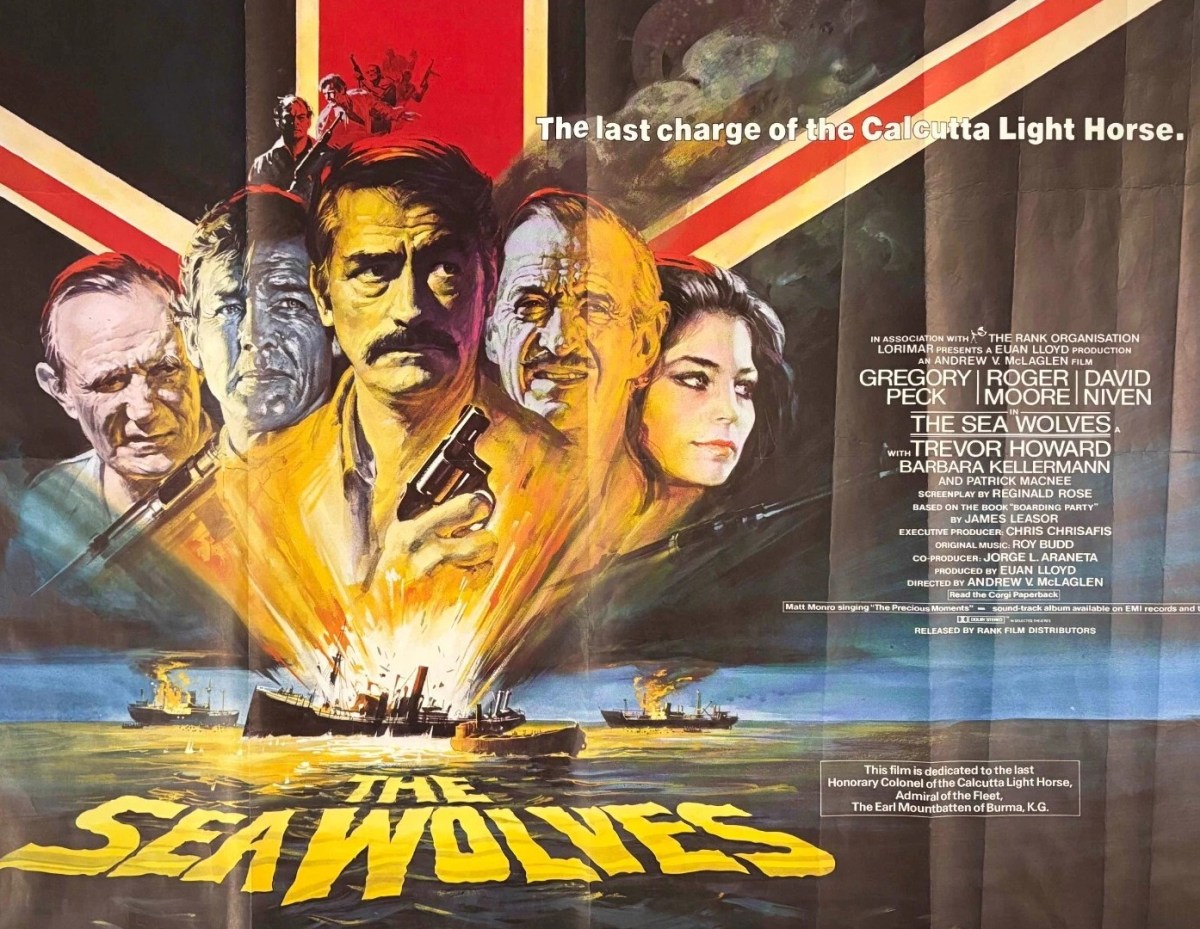
Francis Ford Coppola and Michael Cimino between them put paid to the more traditional “high adventure” war picture. The realism of Apocalypse Now (1979) and The Deer Hunter (1978), which came out months apart and gobbled up critical appreciation and Oscar nominations, spelled a more troubled release for the likes of Alistair MacLean’s Force 10 from Navarone (1979) and The Sea Wolves, which in part followed the MacLean template.
However, The Sea Wolves has never been properly appreciated for one important element – a more realistic portrayal of age and its limitations than was common in Hollywood. We tend to take it for granted that actors when not portraying superheroes can still in the action line have a special set of skills that allows them to throw themselves about or run and chase as if they were men 30 years younger. Liam Neeson was 73 when he was still taking down bad guys in Ice Road: Vengeance (2025), Tom Cruise a decade younger in the final episode of the Mission Impossible franchise in 2025 and Keanu Reeves a year short of 60 when committed to acrobatic action in John Wick Chapter 4 (2023). Jason Statham will be 60 when the sequel to The Beekeeper arrives next year.
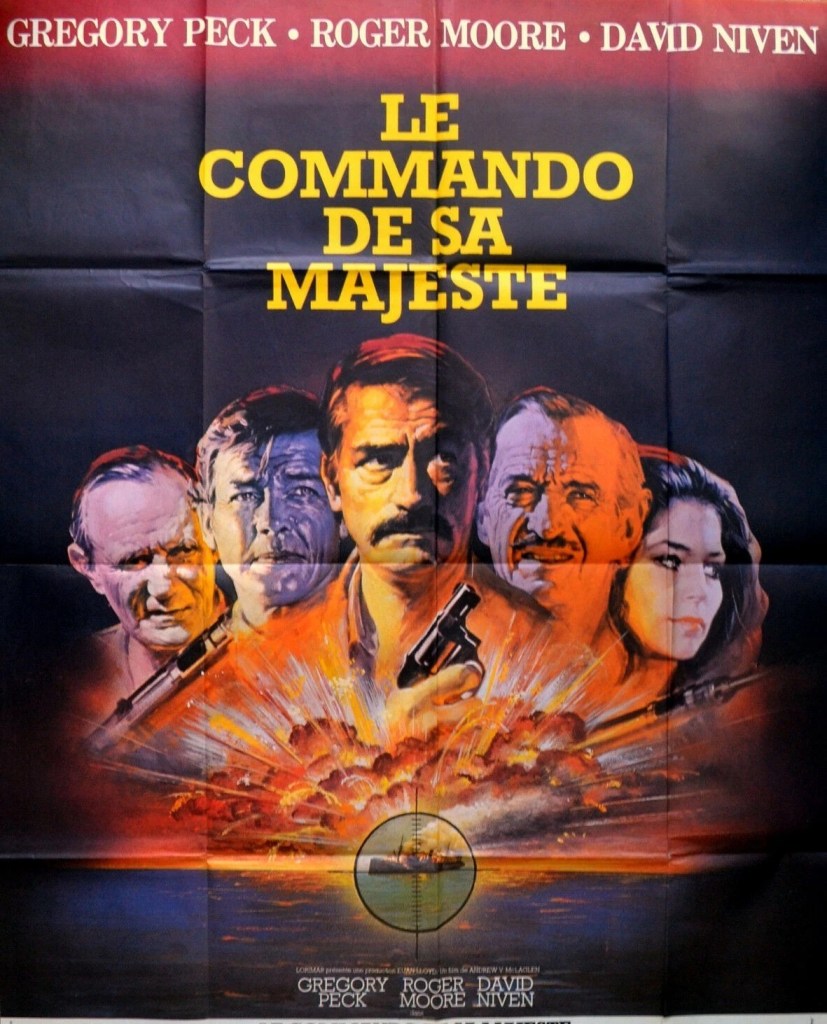
In the action world, age never seemed to catch up with or limit the heroes. In The Sea Wolves age is by far the biggest obstacle. The three pre-eminent heroes are played by actors aged between 52 and 71. Their characters are fallible.
SOE operatives Col Lewis Pugh (Gregory Peck) and Capt Gavin Stewart (Roger Moore), going undercover in neutral Goa in World War Two, prove unable to unravel the mystery that results in German submarines destroying British destroyers. Any time they get hold of a likely suspect, they have the bad habit of killing them. And Stewart, prone to over-indulgence in the opposite sex even in the midst of a critical operation, is duped by femme fatale Mrs Cromwell (Barbara Kellerman) who proves not only to be the German spy they are hunting but capable of knifing men to death.
It’s only because the pair fail in their initial mission that Pugh is forced to call on a rag-bag bunch of ageing ex-soldiers from India led by Col Grice (David Niven) and undertake a more difficult operation to infiltrate a Goa harbor, sink German ships and silence radio communication. This bunch are never going to complete the kind of training program served up to The Dirty Dozen (1967) or The Devil’s Brigade (1968) so that aspect is mostly treated for laughs.
Vulnerabilities abound. They are violently seasick en route or they can’t get the boat’s engine to work or are likely to mistake a distant shark for a U-boat.
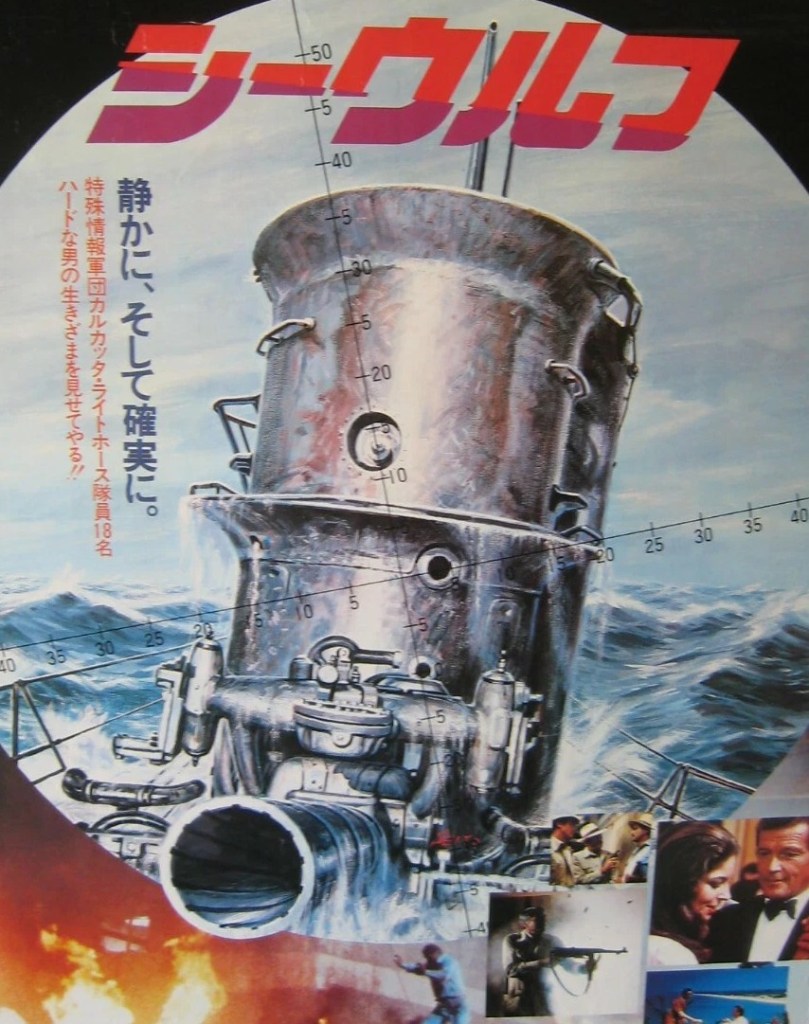
And there’s another unusual aspect of war that complicates proceedings. In most war films – and a feature of the current The Odyssey (2026) – the dead are left behind. Here, because the British are attacking a neutral territory, they can’t leave behind evidence of their involvement in the shape of corpses or wounded.
The actual plan is clever. Any sailors or officials in the target harbor who could possibly interfere are rendered incapable by the simple trick of getting them all drunk, a move sponsored by the British government. The battle itself is too long in coming and there are too many supporting characters involved for us to be committed to any of them and therefore the emotional impact of their deaths is minimal.
Sufficient tension is still generated but given the battle action only lasts about 20 minutes rather than the 150 minutes of Where Eagles Dare (1968), for example, it doesn’t quite qualify for the high adventure sub-genre.
Even the greatest of directors would fail to make work an action movie based on the type of people who should never be allowed near a machine gun or asked to join in fisticuffs, so that element is indeed a stretch. On the other hand, the frailties of those involved, determined not to admit to weakness, make this work.
By this point Gregory Peck’s career had received a second (or third) wind thanks to The Omen (1976) and The Boys from Brazil (1978). Roger Moore’s career had been revitalized by James Bond and he had just made Moonraker (1979), his most successful contribution to the series. David Niven was not in their marquee league but anyone who remembered him from The Guns of Navarone (1961) would go in with high expectations. Barbara Kellerman (The Quatermass Conclusion, 1979) is up to scratch as the cunning spy.
There’s a host of British supporting stars including Trevor Howard (Von Ryan’s Express, 1965), Patrick Macnee (The Avengers TV series 1961-1969), Patrick Allen (Puppet on a Chain, 1971) and Kenneth Griffith (The Lion in Winter, 1968).
Directed by Andrew V. McLaglen (Where Eagles Dare) from a script by Reginald Rose (Twelve Angry Men, 1957) based on the novel by James Leasor which recounted a true incident.
Not quite in the top drawer of the high adventure sub-genre but if you accept the approach and view this as something of an antidote to the standard war film you will find much to appreciate.


Brian, What a pleasant surprise! An unbelievably prompt response to my very recent enquiry! Was this in the pipeline? A very fair review of this decent adventure. Peck, Niven, Howard, Moore n Mclaglen drew me here. Moore was well suited for the role. Barbara Kellerman was never heard of after this. Thank you.
LikeLike
Brian, what a pleasant surprise! An unbelievably fast response to my very recent enquiry. A fair review of a decent adventure from Mclaglen. Peck n Niven drew me here. Moore was well chosen for this. Barbara Kellerman disappeared after this. Thank you.
LikeLiked by 1 person
You are welcome.
LikeLike
A good “old school” adventure. Was annoyed back in 1981, that Paramount dumped this on home video without a theatrical release. Richard Burton dropped out because his new wife didn’t want to go to Goa for the filming.
Interesting stuff:
“Opening credits include the following statement: “This film is dedicated to the memory of the last Honorary Colonel of the Calcutta Light Horse, Admiral of the Fleet, The Earl Mountbatten of Burma, K.G., 1900 – 1979.”
End credits include the following epilogue: “During the first 11 days of March 1943, U-boats sank 12 Allied ships in the Indian Ocean. After the Light Horse raid on Goa, only one ship was lost in the remainder of that month.”
The following statements are also included: “End title pictures of the burning of Ehrenfels, Drachenfels and Braunfels (March 10, 1943) and their salvage eight years later by courtesy of Damodar Malgalji & Co. (Pvt) Ltd. of Panjim, Goa”; “The Producers wish to thank The Government of India; The Administration and peoples of Goa; The Roshanara Club, Old Delhi; Guy Collins, London, and to pay tribute to Commander B. S. Davies R.N., whose skill and courage at the helm of ‘Phoebe’ contributed so much to the success of the mission.” The picture was “filmed entirely on location in India and West Germany and completed at Pinewood Studios, London, England by Richmond Light Horse Productions Ltd. for Varius A.G. An Anglo-American-Swiss Enterprise.”
According to an article in the 24 May 1980 Screen International, while producer Euan Lloyd was recuperating from kidney surgery, his friend Ingeborg Muller gave him the novel, The Boarding Party, written by James Leasor. Production notes in AMPAS library files reported the book chronicled a top secret mission in World War II, and the details had never been made public until Leasor’s book was published in 1978. Lloyd believed it would make a “marvelous movie,” similar to his 1978 feature film, The Wild Geese, also developed from a novel, and he acquired screen rights of The Boarding Party for £75,000. Lloyd had worked with screenwriter Reginald Rose on The Wild Geese, and paid him $250,000 to write the screenplay for The Boarding Party. Working with his “long-time collaborator” and executive producer, Chris Chrisafis, Lloyd invested his own money and obtained “private bank financing” to set up the production, retitled The Sea Wolves. An item in the 21 Mar 1979 Var reported that Andrew V. McLaglen would direct, and principal photography was scheduled to begin Nov 1979, with Lloyd employing key creative staff from The Wild Geese. Lloyd also reportedly hoped to reunite The Wild Geese stars Richard Burton, Roger Moore, and Richard Harris. The 4 Jul 1979 Var noted it was uncertain if Burton or Harris would appear in the film, and the 29 Aug 1979 Var announced that Gregory Peck was hired. A separate item in the 29 Aug 1979 Var reported that Roger Moore, who had declined to star, changed his mind and would headline the film alongside Gregory Peck. The 24 Oct 1979 Var noted that actress Barbara Kellermann was making her feature film debut in The Sea Wolves.
The 29 Aug 1979 Var reported the film’s budget was approximately $12 million, and the 24 May 1980 Screen International stated that Lorimar Productions put up half of the film’s budget in exchange for the domestic distribution rights. Principal photography began 26 Nov 1979, and production notes in AMPAS library files stated the movie was filmed on location in New Delhi and Goa, India. The first two weeks of principal photography were shot in New Delhi, and the rest of the three month schedule was filmed in Goa.
The 27 Sep 1979 DV reported that United Artists had a distribution deal with Lorimar Productions and would handle domestic distribution. An item in the 2 Oct 1979 HR announced that Lorimar signed with Varius A.G. to “cofinance and manage worldwide distribution” of the film. The 3 Mar 1980 HR announced The Sea Wolves would be released in Jul 1980, with United Artists handling domestic distribution and Lorimar Distribution International distributing worldwide. The 9 Jul 1980 Var review reported the film premiered in London, England, on 4 Jul 1980. Articles in the 25 Jul 1980 DV, the 27 Aug 1980 Var, and the 20 Nov 1980 Var announced that Lorimar and United Artists ended their distribution deal early. The contract began 1 Jan 1979 and was set to expire at the end of 1981, but the pact was allowed to lapse and would be terminated by the end of 1980. United Artists had planned to release The Sea Wolves in Oct 1980, but the release was delayed while Lorimar sought a new distributor. In Nov 1980, Paramount Pictures contracted to handle domestic distribution of Lorimar’s films. The 12 Feb 1981 DV reported The Sea Wolves would be among the films that Paramount Pictures would test market, and depending on the results, it might be placed on Paramount’s 1981 release schedule. The 3 Jun 1981 Var and production notes announced the film’s first domestic release in New York City on 5 Jun 1981. The Sea Wolves was released in Los Angeles, CA, on 4 Jun 1982.”
LikeLiked by 1 person
I don’t think it did well enough in the UK. Although I’d have thought Peck was still a good marquee attraction. Thanks for the background info.
LikeLike
Nice review! I like this one a lot but i have to say it doesn’t hold a candle to The Wild Geese which I love
LikeLiked by 1 person
I’ll be going back to that one, too.
LikeLiked by 1 person