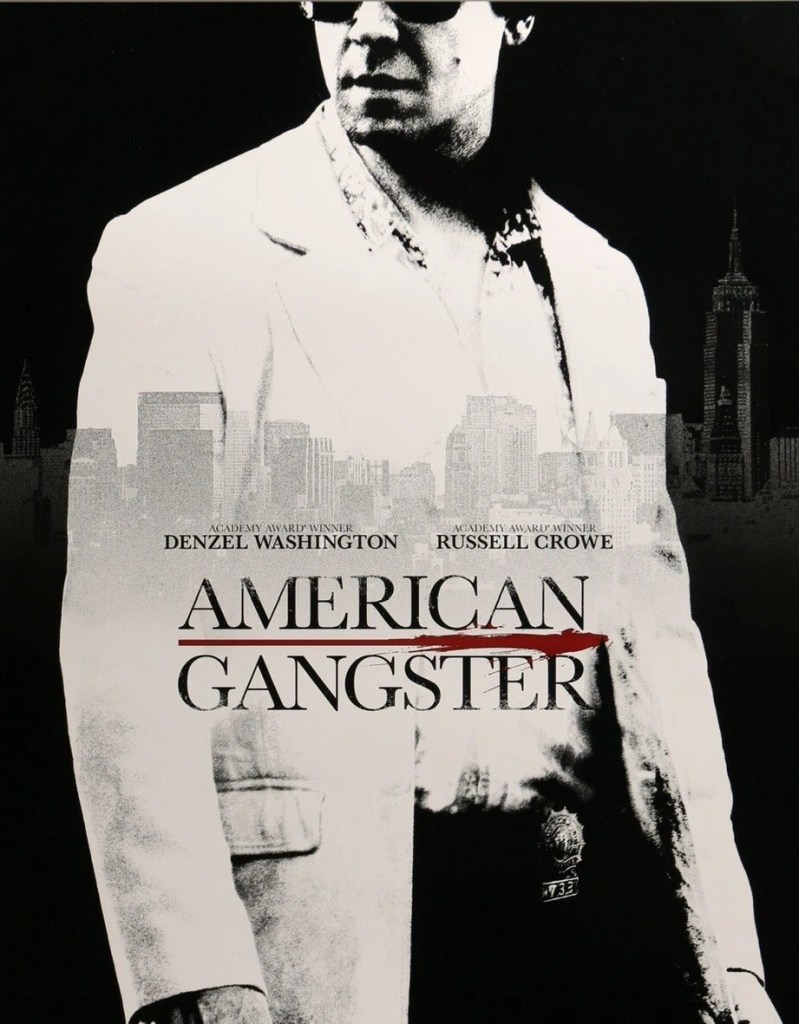
I’ve seen this more times than The Godfather (1972) and The Godfather Part II (1974) put together, so, for me, yeah, this is the greatest gangster picture of all time. There’s always a snobbery involved in talking about your all-time favorite picture. In discussions, I often find that the movie people consider the best is rarely the one they watch the most. While I adore both Godfather pictures on an academic level, they now seem a haul, especially with the running time, overtly grandiose.
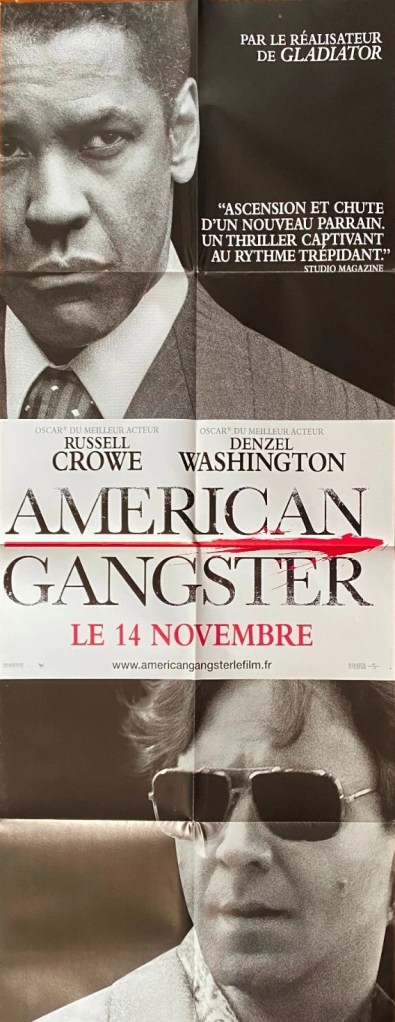
American Gangster, on the other hand, is fleet of foot. The dual storylines – Black gangster Frank Lucas (Denzel Washington) rising to the top, incorruptible cop Ritchie Roberts (Russell Crowe) heading a team targeting New York’s drug kingpins – neatly intersect until nearly the end.
Director Ridley Scott has thrown off the shackles of sci fi and history – the demands of the grandiose and the visually cinematic and (in the sci fi) the problems of finding a new way to tell the Alien tale when the audience is waiting for the gore. Here he concentrates on narrative that, seemingly at every turn, exposes character. The story is a fascinating one at that. Nobody in law enforcement or at the higher echelons of Government went after Frank Lucas because nobody thought a Black gangster could build an empire to which even the Mafia kowtowed.
Oddly enough, the violence is muted. Scott does away with the need for repeated violence by an opening shot that sets the scene, Lucas setting fire to a snitch. This is more of a story about big business, that entrepreneurial spirit by which America sets so much store. And it’s a story about family. Lucas recruits all his brothers for the enterprise. Roberts is an outcast in the family of cops because he refuses to be corrupted.
But Roberts is no saint. He is accused by wife Laurie (Carla Gugino) of being scrupulously honest on that front only so he can be dishonest in the rest of his life, with his promiscuity and neglect of his son. When Lucas has the entire extended family round the table to celebrate Xmas (or Thanksgiving – there’s turkey involved, that’s all I know) in a mansion, Roberts is reduced to a tuna sandwich in his cramped apartment.
This is a time when gangsters were celebrities, safe in the knowledge that they were untouchable as long as they paid off the cops. Lucas shuns excess, determines not to draw attention to himself, which is why he remains hidden for so long, and it’s only when, to satisfy his wife, he wears an outrageous fur outfit that he comes to the attention of Roberts.
As the tale zips along, in the background we witness the drugs industry at work, the packaging, the distribution, the clashes between rivals, the deaths of junkies (including a cop), and Vietnam, where corrupt soldiers have made possible Lucas’s clever scheme to buy drugs at the source, cutting out the middle man and ensuring the purity of the product.
But Lucas is a corporate hero. He believes in the brand. A brand, he says, is a guarantee of quality, its dissipation the cause of a dispute with mobster Nicky Barnes (Cuba Gooding Jr.). In the corporate drugs world, the Mafia might think it has drawn Lucas into its tentacles, but it’s the other way round.
This all climaxes in the most dangerous manner – cinematically speaking – possible. John Ford owns the doorway, has done since The Searchers (1956). Christopher Nolan has also taken a tilt at that particular cinematic crown in The Odyssey (2026) when the gates of Troy open to reveal the gigantic figure of Agamemnon in black shining armor. Here, the doors opening are those of a church. Lucas steps out to see the street deserted except for the waiting Roberts.
There are other standout scenes in a movie that careers along so fast it scarcely needs them – Roberts dressing a corpse up to look alive to escape a mob, the shock of the cops when Roberts hands in rather than shares out a million bucks, Lucas burning the fur coat in rage, any time corrupt Detective Trupo (Josh Brolin) appears the scene is a standout, Roberts begging corrupt cops for his money back, Lucas interrupting his breakfast to execute a rival in the street, even the meet-cute with Lucas’s future wife Eva (Lymari Nadel) “can you let go of my hand?”
Lucas dresses immaculately but conservatively, Roberts is in jeans but Tupo, in black leather coat, exudes power. There’s very little moralizing, although various people complain about the loss of an accepted order. The drug dealers go down but there’s no mention of imprisonment for the hordes of soldiers and airmen who took money to feed drugs to their own soldiers or ship them to America.
The cast is absolutely terrific, Denzel Washington (The Equalizer 3, 2023) a commanding, cunning, figure, Russell Crowe (Gladiator, 1999) with his shuffling walk, Chiwetel Ejiofor (Backrooms, 2026) and Josh Brolin (Weapons, 2025) as the most arrogant of the corrupt cops. Supporting roles are filled by the likes of John Hawkes (Three Billboards Outside Ebbing, Missouri, 2017) , Carla Gugino (Watchmen, 2009), Cuba Gooding Jr. (Jerry Maguire, 1996), Armand Assante (Blowtorch, 2016), Idris Elba (Heads of State, 2025) and Ruby Dee (A Thousand Words, 2012). Written by Steve Zaillian (The Irishman, 2019) based on an article by Mark Jacobson.
There’s one other stunning element that needs mentioning – the music by Marc Streitenfeld (Prometheus, 2012). This must be the most self-effacing score ever to grace a gangster picture.
If this has been made today, the trailers would be acclaiming the Oscar achievements of the actors – the tally comes to three winners and three nominees. Next year, when this is due a 20th anni reissue maybe that will be the promotional tag.
I might well be tempted to watch it again tonight.