American Gangster (2007) *****

I’ve seen this more times than The Godfather (1972) and The Godfather Part II (1974) put together, so, for me, yeah, this is the greatest gangster picture of all time. There’s always a snobbery involved in talking about your all-time favorite picture.  In discussions, I often find that the movie people consider the best is rarely the one they watch the most. While I adore both Godfather pictures on an academic level, they now seem a haul, especially with the running time, overtly grandiose.

American Gangster, on the other hand, is fleet of foot. The dual storylines – Black gangster Frank Lucas (Denzel Washington) rising to the top, incorruptible cop Ritchie Roberts (Russell Crowe) heading a team targeting New York’s drug kingpins – neatly intersect until nearly the end.
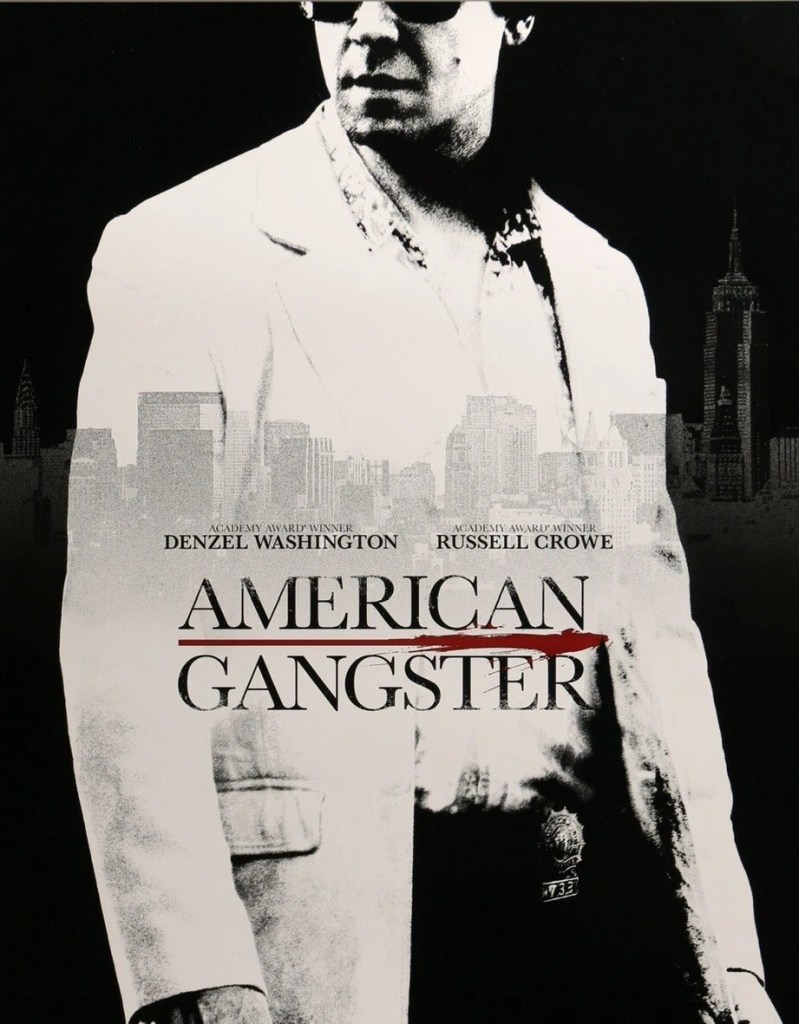
Director Ridley Scott has thrown off the shackles of sci fi and history – the demands of the grandiose and the visually cinematic and (in the sci fi) the problems of finding a new way to tell the Alien tale when the audience is waiting for the gore. Here he concentrates on narrative that, seemingly at every turn, exposes character. The story is a fascinating one at that. Nobody in law enforcement or at the higher echelons of Government went after Frank Lucas because nobody thought a Black gangster could build an empire to which even the Mafia kowtowed.

Oddly enough, the violence is muted. Scott does away with the need for repeated violence by an opening shot that sets the scene, Lucas setting fire to a snitch. This is more of a story about big business, that entrepreneurial spirit by which America sets so much store. And it’s a story about family. Lucas recruits all his brothers for the enterprise. Roberts is an outcast in the family of cops because he refuses to be corrupted.

But Roberts is no saint. He is accused by wife Laurie (Carla Gugino) of being scrupulously honest on that front only so he can be dishonest in the rest of his life, with his promiscuity and neglect of his son. When Lucas has the entire extended family round the table to celebrate Xmas (or Thanksgiving – there’s turkey involved, that’s all I know) in a mansion, Roberts is reduced to a tuna sandwich in his cramped apartment.

This is a time when gangsters were celebrities, safe in the knowledge that they were untouchable as long as they paid off the cops. Lucas shuns excess, determines not to draw attention to himself, which is why he remains hidden for so long, and it’s only when, to satisfy his wife, he wears an outrageous fur outfit that he comes to the attention of Roberts.
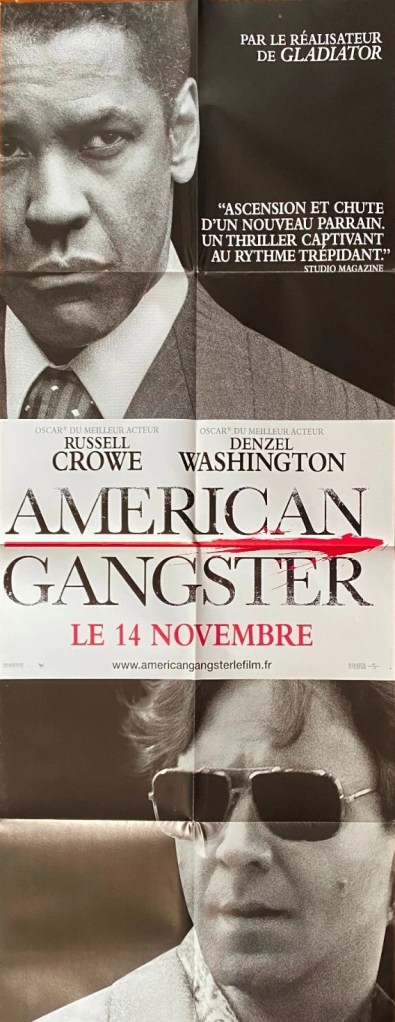
As the tale zips along, in the background we witness the drugs industry at work, the packaging, the distribution, the clashes between rivals, the deaths of junkies (including a cop), and Vietnam, where corrupt soldiers have made possible Lucas’s clever scheme to buy drugs at the source, cutting out the middle man and ensuring the purity of the product.

But Lucas is a corporate hero. He believes in the brand. A brand, he says, is a guarantee of quality, its dissipation the cause of a dispute with mobster Nicky Barnes (Cuba Gooding Jr.). In the corporate drugs world, the Mafia might think it has drawn Lucas into its tentacles, but it’s the other way round.

This all climaxes in the most dangerous manner – cinematically speaking – possible. John Ford owns the doorway, has done since The Searchers (1956). Christopher Nolan has also taken a tilt at that particular cinematic crown in The Odyssey (2026) when the gates of Troy open to reveal the gigantic figure of Agamemnon in black shining armor. Here, the doors opening are those of a church. Lucas steps out to see the street deserted except for the waiting Roberts.

There are other standout scenes in a movie that careers along so fast it scarcely needs them – Roberts dressing a corpse up to look alive to escape a mob, the shock of the cops when Roberts hands in rather than shares out a million bucks, Lucas burning the fur coat in rage, any time corrupt Detective Trupo (Josh Brolin) appears the scene is a standout, Roberts begging corrupt cops for his money back, Lucas interrupting his breakfast to execute a rival in the street, even the meet-cute with Lucas’s future wife  Eva (Lymari Nadel) “can you let go of my hand?”

Lucas dresses immaculately but conservatively, Roberts is in jeans but Tupo, in black leather coat, exudes power. There’s very little moralizing, although various people complain about the loss of an accepted order. The drug dealers go down but there’s no mention of imprisonment for the hordes of soldiers and airmen who took money to feed drugs to their own soldiers or ship them to America.

The cast is absolutely terrific, Denzel Washington (The Equalizer 3, 2023) a commanding, cunning, figure, Russell Crowe (Gladiator, 1999) with his shuffling walk, Chiwetel Ejiofor (Backrooms, 2026) and Josh Brolin (Weapons, 2025) as the most arrogant of the corrupt cops. Supporting roles are filled by the likes of John Hawkes (Three Billboards Outside Ebbing, Missouri, 2017) , Carla Gugino (Watchmen, 2009), Cuba Gooding Jr. (Jerry Maguire, 1996), Armand Assante (Blowtorch, 2016), Idris Elba (Heads of State, 2025) and Ruby Dee (A Thousand Words, 2012). Written by Steve Zaillian (The Irishman, 2019) based on an article by Mark Jacobson.

There’s one other stunning element that needs mentioning – the music by Marc Streitenfeld (Prometheus, 2012). This must be the most self-effacing score ever to grace a gangster picture.

If this has been made today, the trailers would be acclaiming the Oscar achievements of the actors – the tally comes to three winners and three nominees. Next year, when this is due a 20th anni reissue maybe that will be the promotional tag.

I might well be tempted to watch it again tonight.

Triple Bill Blues: Fall (2022) ***; The Forgiven (2021) **; Three Thousand Years of Longing (2022) ** – Seen at the Cinema

You may be aware that I am partial to a triple bill on my weekly Monday trip to the cinema. I’m rather an indiscriminate cinemagoer and generally just see what’s available, though it’s true return trips to view Top Gun: Maverick have helped paper over cracks in the current distribution malaise. Sometimes a triple bill can reveal unsung gems, sometimes I am rowing against the critical tide in my opinions and sometimes, not too often thank goodness, I end up seeing movies with few redeeming qualities. That was the circumstance this week.

FALL

So now I know. If I need to get a mobile phone dropped 2,000 feet without it breaking into pieces, the thing to do is stuff it inside a cadaver. That’s one of the more outlandish suggestions in this climbing picture two-hander that for most of the time is quite gripping.

So as not to have to spend the first anniversary of her husband’s death sozzled in booze and despair, Becky (Grace Caroline Currey) agrees to partner YouTube click-hound Hunter (Virginia Gardner) in scaling an extremely high disused radio mast. Becky, a mountaineer, had watched her husband fall to his death, so is pretty iffy about the expedition. When they reach the top they can’t get down again since the ladder they climbed has disintegrated. Although there was mobile phone reception at ground level, there’s none this high up. Hunter has 60,000 followers and reckons if only her phone reached the ground it would automatically activate so they toss it down in a shoe stuffed with a bra.

That doesn’t work nor does firing a flare pistol to alert two guys in a nearby RV – all they are alerted to is the girl’s vehicle which they promptly steal. The girls are trapped without water or drone, both stuck 50ft below on radio dishes. At one point you think this is going to go in an entirely different – murderous – direction after Becky discovers Hunter had an affair with her husband. But they manage to get over that hiccup. Recuing their water and drone results in Hunter being out of action as far as further climbing goes and it’s up to Becky to reach the top of the mast and recharge the drone from the power there, fending off a passing vulture.

There’s definitely one weird bit where it turns out that Hunter, who you imagined was up there all the time supporting a defeatist Becky, is already dead. But, luckily, the corpse provides the cavity in which to bury the mobile phone. I’m not sure much of a human body survives a drop of 2,000 ft, certainly not enough to safeguard a phone, but that’s the way this plays out.

A great mountaineering film is always a welcome find in my book. This isn’t great but it’s certainly passable. And while Becky is more interesting than the gung-ho Hunter, the pair, emotions almost spinning out of control, make a very watchable pair.

Grace Caroline Curry aka Grace Fulton (Shazam!, 2019) does well in her first starring role and Virginia Gardner (Monster Party, 2018) is as convincing. Jeffrey Dean Morgan (Rampage, 2018) has a small role. A novel take on the mountaineering sub-genre, it’s kudos to director Scott Mann (Heist, 2015) – who co-wrote the screenplay with Jonathan Frank (Final Score, 2018)  that I spent a lot of time wondering just how the hell they managed to make it look so realistic.

THE FORGIVEN

Note to studios, no matter how much you plan to tart up a modern version of Appointment in Samarra – aka a tale of unavoidable fate – you ain’t going to get anywhere if it’s filled with entitled obnoxious characters. The worst of it is this is well-made.

Functioning alcoholic doctor David Henninger (Ralph Fiennes) knocks down and kills young Muslim boy Driss (Omar Ghazaoui) while on the way with wife Jo (Jessica Chastain) to a hedonistic weekend party in Morocco hosted by Richard Galloway (Matt Smith) and his partner Dally (Caleb Landry Jones). There are hints that Driss was planning to hijack the tourists, but while his death is deemed an accident by the local cops, David agrees to go back with the boy’s father Ismael (Abdellah Taheri) and observe the local funeral rites and possibly pay the father off.

While her husband is away Jo has a one-night stand with serial seducer Tom (Christopher Abbott) while the rest of the party – including Lord Swanthorne (Alex Jennings) and assorted beautiful men and woman – trade bon mots and make racist and sexist remarks. While the arrogant David changes his perspective and accepts his fate, there is not, himself included, a single likeable person in the whole of the tourist contingent which makes it impossible to care what happens to anybody. Written and directed by John Michael McDonagh (Calvary, 2014) it spends all its time trying to make clever points, not realizing the audience has long lost interest.

THREE THOUSAND YEARS OF LONGING

Note to studios, if you’re going to indulge an action director in a vanity project, make sure he hires actors who don’t just drone on. It might also help if the director could decide what story he wants to tell, and not essentially present a voice-over narrative of stuff that happened in the past, no matter how exotic the timescale.

I was astonished to discover there actually is a job called narratologist. Alithea (Tilda Swinton) is a dried-up old stick of a narratologist who summons up the dullest genie/djinn in movie history known – no names, no pack drill – just as The Djinn  (Idris Elba) who proceeds to bore the audience to death with his stories of how he came to end up in a bottle.  

There’s a bundle of academic nonsense about storytelling, a swathe of tales that sound like rejects from The Arabian Nights, and a lot of unconnected characters. The invention of director George Miller (Mad Max: Fury Road, 2015) just isn’t inventive enough and the visuals just aren’t arresting enough. I’m assuming this got greenlit on the basis Miller would turn in a couple more in the Mad Max franchise.

The Harder They Fall (2021) * – Seen at the Cinema

Here’s the set-up: a cavalry officer, who has looted a town and slaughtered its population, apparently, is given the task of transporting notorious outlaw Rufus Buck (Idris Elba) by train from one jail to another for no particular reason, but a higher-up soldier has hired the remainder of Buck’s gang, led by Trudy Smith (Regina King) and Cherokee Bill (LaKeith Stanfield), to attack the train and kill this officer and in return Buck is granted is freedom. The train driver is so dumb that seeing a horseperson astride the track he simply stops the train, obviously not realising what time period he is in, and that in the lawless West, this person is not taking up this position because they missed their stop. When Buck returns to Redwood, a town no bigger than a postage stamp, he discovers it is actually extremely rich, source of wealth not explained either, except the money has been stolen by his associate Wiley Escoe (Deon Cole), leaving Buck to somehow recover the $50,000 that has been lost.

Buck has been on a losing streak, his own gang having been robbed of $25,000 by another gang led by Nat Love (Jonathan Majors), whose family, incidentally, has been slaughtered by Buck who carved a cross in the young Nat’s forehead, making him of course far too instantly recognisable for such a chosen profession, but that doesn’t seem to bother him.  

And that’s before it gets complicated with Love trying to get the drop on Buck, Buck trying to regain his stolen cash, rival gunslingers wanting to demonstrate their quick-draw skills, and rival saloon keepers Trudy and Mary Fields (Zazie Beetz). Fields is another contender for the dumb-and-dumber award after thinking the best way to scout the postage-sized town of Redwood is not just to sneak up in darkness and have a looksee but instead to pretend she’s moseyed into town with the intention of buying up the saloon and not having the sense to work out that Buck is just going to capture her and use her as bait. Oh, and just in case in case you do get lost, geographically, the titles of the various locations are splashed over the screen in ginormous letters.

Not only is the story a mess but it’s awash with songs, some of which appear thematically or historically relevant, but most are not and one of which written by director Jeymes Samuel (making his feature debut) was chosen as the ideal accompaniment for the climax. You might as well have called this picture Anachronism City, which is a shame because all the leading characters were real people. It was maybe a stretch to find a historically-accurate story in which to feature real people, but surely it could not have been so difficult as this.

And don’t get me started on the money – $25,000 / $50,000. Really? Don’t remember Butch Cassidy or Jesse James earning that amount. Where’s all this meant to come from? Did nobody on this picture have any idea how much people earned – and therefore could save – or how much might be in a bank vault? This is pluck-an-idea-out-of-the-air screenwriting.

There’s definitely a good deal of energy on show but mostly of the music video kind. There’s explosive violence of course. And occasionally there is a decent piece of composition. And you can’t fault the acting despite the failings of the script and the tendency towards Tarantino philosophizing. But it’s pretty much a complete misfire, especially if you like your westerns.

Discover WordPress

A daily selection of the best content published on WordPress, collected for you by humans who love to read.

The Atavist Magazine

by Brian Hannan

WordPress.com Blog

News, Tips & Website Tutorials