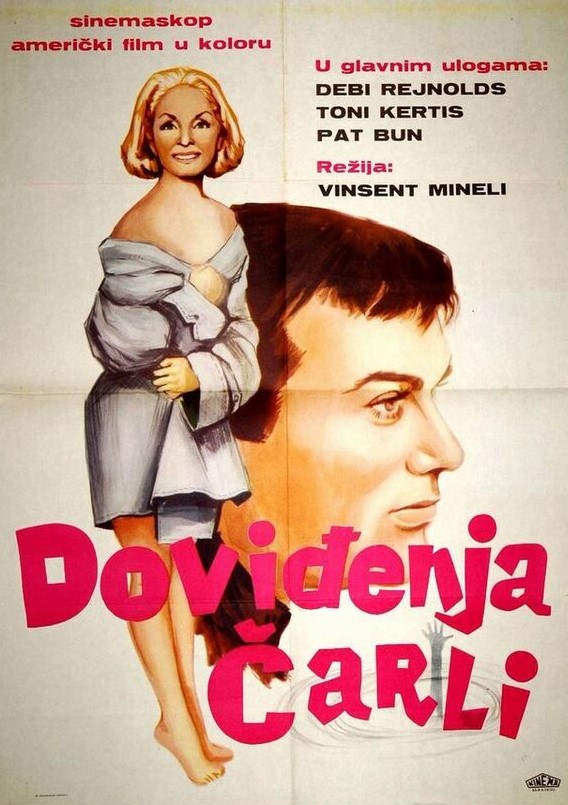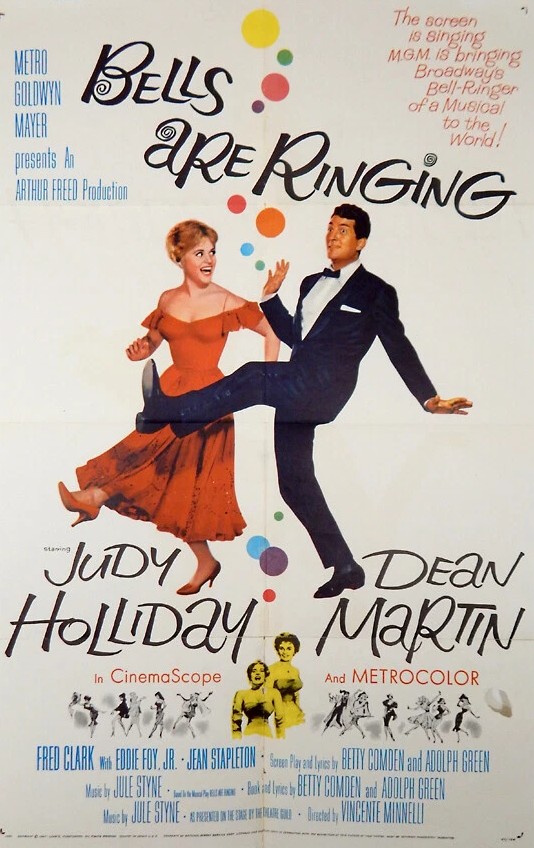
You probably haven’t heard of Judy Holliday. She had just broken through with an Oscar for Born Yesterday (1951) when her career hit the rocks after facing accusations of Communist sympathy in the HUAC trials early in that decade. That was the high point of her career and she only made six other movies. The Bells Are Ringing was the last and she died prematurely a few years later.
Holliday was odds-on to play on film the part she had originated on Broadway, and won the Tony for Best Actress (Musical). The musical ran for over two years on Broadway clocking up 924 performances. It was a class act, involving composer Jule Styne (Funny Girl, 1968), lyricists Betty Comden and Adolph Green (Singin’ in the Rain, 1952) and choreographers Jerome Robbins (West Side Story, 1961) and Bob Fosse (Sweet Charity, 1967).

Movie audiences would have heard about the musical and especially if they hadn’t been able to reach Broadway would have salivating at the prospect. Dean Martin (Bandolero, 1968) at that point in his career had lost the top-billing he’d enjoyed as part of the Martin-Lewis comedy partnership and the Rat Pack was yet to make its screen debut, so he was far from the main attraction. If this film was going to work, it depended on Holliday’s performance.
This was also a bit of a swansong for director Vincente Minelli (Gigi, 1958) and he’d only make one more musical, spending the rest of the 1960s knee deep in heavyweight dramas like The Sandpiper (1964). Minelli was a fresh pair of eyes for the musical as he hadn’t been involved in the Broadway show, but he doesn’t do much tinkering with the original set-up. About the only criticism you could make was that it doesn’t break out of the stage settings.
Like many musical confections of the period, the story is lightweight. Ella (Judy Holliday) works in a telephone answering service but becomes too attached to her clients, in particular struggling playwright Jeffrey (Dean Martin). She wants to help clients achieve their dreams.

A couple of subplots get in the way of a happy ending. A vice cop, Inspector Barnes (Dort Clark), is convinced the operation is a front for an escort service. The cop doesn’t spot the actual illegal activity taking place on the premises when music distribution boss J. Otto Prantz (Eddie Foy Jr.), romancing business owner Sue (Jean Stapleton), sets up a gambling racket.
There’s a further complication because Jeffrey thinks the person who answers his phone is 60 years old, so Ella has to use an assumed name to get close to him. But these complexities are of a light, frothy, comedic nature and luckily the star excels in just those departments.
To succeed, a musical needs more than hummable songs, it requires a star. As it happens, the star, if male – as proven by Yul Brynner in The King and I (1956), Rex Harrison in My Fair Lady (1964) and Lee Marvin in Paint Your Wagon (1969) – doesn’t have to even have a good voice or even be able to sing at all (they can talk their way through their songs).
But the voice of the female equivalent has to capture an audience, even if it’s not her own voice and her singing is dubbed. One of the joys of having the Broadway star in your film is the guarantee that she’s using her own voice, she can’t possibly be dubbed on a stage show, and if her voice took a theater by storm it’s going to electrify a cinema.
Judy Holliday has such a voice. But she also has terrific comedic skills. She’s an impressionistic par excellence, inventing voices to go with the characters her clients think they’re conversing with, and she’s wonderful with physical comedy, the flailing of arms and butting of heads. We’re not in Pink Panther territory, but we’re not far off, and director Minnelli has the sense not to over-egg the pudding. There’s a wonderful scene in a restaurant where the climax is her dress catching fire. We see the flames just starting to appear around her derriere. But then we cut to her sneaking into her apartment, hiding the damage.
The songs are terrific. The lyrics work both as interior monologue and identifying dilemma. I’m not sure the score has survived so well as some of Styne’s other musicals, but I found the music very appealing.
The plot works, there’s a happy ending, and the whole effort results in an endearing confection. You won’t go away thinking Dean Martin was going to resuscitate his career but you will wonder why Holliday, even in her brief lifetime, never made more movies.
An unexpected delight.