Lot feistier than the heart-warming genre might suggest with the usually restrained Henry Fonda (Advise and Consent, 1961) coming over like he’s had a gagging order lifted, letting rip not just with a plague of cuss words but damning to Hell every hypocrite under the sun. A perfect example of the haves and have-nots where to become elevated to the former you need to know your Latin.
Despite loathing religion, quarry miner Clay (Henry Fonda) has got quite the Biblical spirit, no intention of girding his loins when he can sire nine kids, a heck of a crew to support from meager wages. He enjoys the kind of pleasures – add alcohol and gambling to his lust – that his God-fearing neighbors find objectionable, though they put those aside when he’s neighbourly enough to carry out repairs on their property for no charge.
When wife Olivia wants him to break open the piggy bank to fund a graduation ring for their oldest, Clayboy – what was wrong with just calling your kid Junior, I wonder – (James MacArthur), her dream clashes with his. He’s already spent the money on the power saw he needs to cut down to size the logs with which he is building his dream house, a bigger building, and brand-new, so his offspring don’t need to sleep five or six to a room or on the floor.
Clayboy is astonished to discover he’s the top dog at school but winning the class medal opens doors poverty prevents him getting through. Even when the local pastor Clyde (Wally Goodman) finds a last-minute loophole, Clay’s excellent grades don’t meet qualification criteria for college, he’s lacking in Latin.
But if there’s one thing Clay has learned to overcome, it’s adversity and soon a scheme is hatched. But even that has a drawback. A scholarship won’t cover all the costs. While Olivia accepts the principle that God intended them to be poor, Clay rejects that notion, the kind that keeps the downtrodden in their place, denying them the opportunity for betterment that comes with education.
This ain’t no sermon but it’s not The Grapes of Wrath either. Poverty hasn’t kicked the living daylights out of everyone but nobody seems able to catch a break even when one is floating tantalisingly close. Ain’t a family saga either, covering too short a period of time, and little but a series of loosely-connected episodes that eventually come together.
Clay gets the preacher in the mire for filling him full of booze, telling him it’s a cure for mosquito bites, while the pair are fishing. Public revulsion at the drunk pastor loses the preacher his congregation. Clay sorts it out by berating the churchgoers as hypocrites and threatening to withdraw his free labor when it comes to repairs. Come the Latin crisis, turns out the preacher was an ace scholar in the subject and can do the teaching, on the condition that the anti-religious Clay attends church.
In the meantime, there’s another kind of education required of Clayboy. Claris (Mimsy Farmer), whose training extends to reproduction and pores over the unexpurgated dictionary, gleefully hovering over the dirty words, has to teach the young man that a young woman wants more than whispers in the ear and bunches of flowers. Unfortunately, Clayboy has another suitor Cora (Kathy Bennett) who doesn’t take kindly to him rejecting her advances and when the opportunity arises to sabotage his plans does so with pleasure.
This is a film about working people. Not labor as such, and not about labor unrest or agitation either. In the way of Witness (1985), there’s a great scene (minus the soaring music of course) of constructing a wooden building, there’s men drilling and hammering at the quarry, and a pivotal scene in chopping down a tree. People seeing the benefit of hard work are less convinced by the ephemeral attraction of education, especially when that seems either beyond their reach, out of their league or as likely to find as the end of a rainbow.
So without overly saying anything much about the class divide in the U.S. (which is unspoken anyway and assumed, what with equality and all, not to exist) this says a great deal.
Henry Fonda fills his boots. It’s a plum role and he goes for it. Certainly, it’s the opposite of all those buttoned-up parts he seemed to land. Maureen O’Hara (The Battle of the Villa Florita, 1965) has a smaller part and it’s a mercy after nine kids she managed to keep her figure. James MacArthur (Battle of the Bulge, 1965) has every scene stolen from him by the charming minx Mimsy Farmer (Bus Riley’s Back in Town, 1965). You might spot Donald Crisp (Pollyanna, 1960) in his final role.
If you equate director Delmer Daves with hard-hitting westerns like Broken Arrow (1950) and 3:10 to Yuma (1957), it’s worth remembering he had a strong romantic streak as exhibited in Rome Adventure/Lovers Must Learn (1962). But he deliberately avoids the comedy pratfall of the later Yours, Mine, Ours (1968), also starring Fonda. He wrote the screenplay based on the book by Earl Hamner Jr.
Because this reputedly led to The Waltons TV series, you could be mistaken for thinking it’s as schmaltzy. It’s anything but. Take away the lush background and the idyllic scenery and while it finally gets to a heart-warming climax it’s tougher going and with a sexuality way ahead of its time.
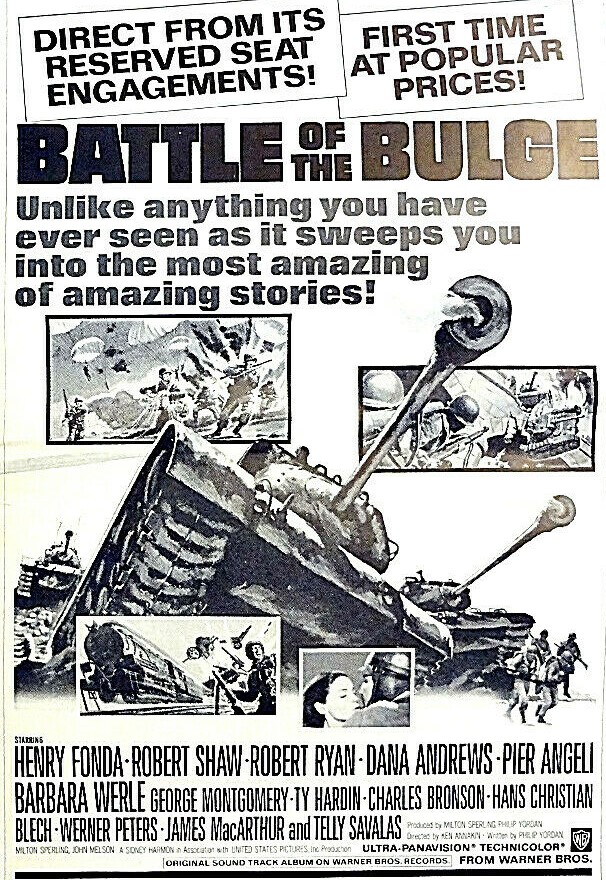
It was Hollywood’s worst nightmare. Two major studios – Columbia and Warner Brothers – were competing to make films about the Battle of the Bulge, one of the most famous episodes of the Second World War. Rival movies on similar or the same subject – classic examples You Only Live Twice (1967) vs Casino Royale (1967) or Deep Impact (1998) vs. Armageddon (1998) – risk cannibalising each other, each entry eating into the prospective audience of the opposition.
At first it seemed like the Columbia entry had the upper hand. Writer-producer Anthony Lazzarino had spent four years preparing The 16th of December: The Story of the Battle of the Bulge (the date referring to the start of the battle). Lazzarino’s project was endorsed by the U.S. Department of Defense which offered exclusive cooperation. Advisors were of the top rank – General Omar Bradley, General Hasso E. von Manteufel who had commanded the Panzers during the battle, British generals Sir Francis de Guingard and Robert Hasbrouck and Colonel John Eisenhower plus the cooperation of Eisenhower himself and Field Marshal Montgomery.
With a budget in the $6 million – $8.4 million range, and shooting was set to start in winter 1965, William Holden was lined up to play General Eisenhower and Kirk Douglas for General Hasso. Although initially intending to film in the Ardennes and Canada, ultimately the producers settled for the cheaper option of Camp Drum, one of the largest military installations in the U.S, a remote area in upper New York where the buildings could stand in for Bastogne, around which much of the real battle revolved, production there feasible because the Camp closed for winter. .
But that meant it would already be behind the eight-ball since Battle of the Bulge intended opening at Xmas 1965. Richard Fleischer (The Boston Strangler, 1968) was originally signed to direct. But he had become embroiled in a lawsuit with producer Samuel Bronston (El Cid, 1961, The Fall of the Roman Empire, 1964) whose production outfit had gone bust, killing off a deal for Fleischer to make The Night Runners of Bengal. The director was seeking g $910,000 in compensation.
Warner Brothers had enlisted Cinerama as co-producer, the studio’s first involvement in the stunning widescreen process and the first time war was considered a subject. The process had been utilised in other Hollywood pictures most notably MGM How the West Was Won (1962), but that has been as a supplier of the equipment, and taking a small share of the profits. But now Cinerama planned to enter the production business and had contracted with WB to shoot the film in the single-lens process instead of the more complicated three-camera approach which had led to vertical lies on screens.
Neither company was in great shape. Cinerama had posted a $17.9 million loss in 1964, WB $3.8 million. But whereas WB had My Fair Lady on the horizon, Cinerama was less reaons for optimism. Its income stream relied on sales of its equipment, either for filming or projection, and a levy from every cinema using the process. Expansion was seen as key to renewal. With only 67 cinemas equipped to show Cinerama in the U.S. and only 59 overseas, a major program was underway to reach 230 by 1967. Setting up a production division would ensure there were enough films to feed into Cinerama houses, and since such films were intended as roadshows, they would keep the cinemas product-secure for months on end.
Cinerama planned to spend $30 million on five films – John Sturges western The Hallelujah Trail (1965) budgeted at $5 million, Battle of the Bulge ($.75 million) while $6.5 million had been allocated to an adaptation of James Michener bestseller Caravans, $6 million for Beyond the Stars which became 2001: A Space Odyssey (1968) and $7 million for Grand Prix (1966). Added to the list was epic William the Conqueror, due to film in England in early 1966 with Robert Shaw taking top billing.
The WB-Cinerama project, which had taken a year to negotiate, was to be filmed in Spain under the aegis of producer Philip Yordan, one time associate of Bronston who had built a mini-Hollywood there. Yordan, Bronston’s chief scriptwriter, had written the screenplay along with his co-producer Milton Sperling. Instead of seeking official support or reproduce the battle in documentary detail, Yordan and Sperling aimed for a fictional account that took in the main incidents. The cast would include “ten important stars.”
Just what constituted an “all-star cast,” one of the key ingredients of the roadshow phenomenon of the 1960s, was open to question. While The Longest Day (1962) boasted stars of the pedigree of John Wayne, Robert Mitchum, Richard Burton and Sean Connery, it was also liberally sprinkled with actors of no marquee value. David Lean in Lawrence of Arabia (1962) had loaded his film with the likes of Oscar winners Alec Guinness, Anthony Quinn and Jose Ferrer to offset unknowns Peter O’Toole and Omar Sharif as the leads. While The Great Race (1965) could boast Jack Lemmon, Tony Curtis and Natalie Wood, It’s A Mad, Mad, Mad, Mad World (1963) only had Spencer Tracy amid a host of television comedians.
But none of the stars of Those Magnificent Men in Their Flying Machines (1964) had successfully opened a major picture. Of the Battle of the Bulge contingent only Henry Fonda could truly be called a current star, although his box office star had considerable dimmed since the days of The Grapes of Wrath (1939) and Fort Apache (1948). Former stars Robert Ryan and Dana Andrews were now supporting actors, Ty Hardin was best known for television, Charles Bronson (The Great Escape, 1963) had not achieved top billing and while James MacArthur had done so that was in youth-oriented movies. Initially, Italian prospect Pier Angeli (Sodom and Gomorrah, 1962) was announced as “the only principal female role” – playing a Frenchwoman – for a touching scene showing the effect of war on innocent women caught up in the conflict.
Just before filming was about to start, Fleischer pulled out, citing differences of opinion with the producers. Yordan turned to British director Ken Annakin, who had helmed the British sequences in The Longest Day and Those Magnificent Men in Their Flying Machines. There was soon a double whammy. Realizing he was losing ground, and hoping to sabotage its progress, Larrazino sued WB for $1 million, claiming that “another film, less accurate, would be confused with his picture.” Just as filming of the Battle of the Bulge got underway in January 1965, it was hit by a temporary restraining order. While failing to shut down the production, it imposed a marketing blockade. WB was prevented from publicising its picture, a potentially major blow given how dependent big budget roadshows were on advance bookings which could only be generated by advance publicity.
Annakin’s immediate response to the opportunity was delight. He commented that he had a “lot of toys to play with.” He found inspiration for his approach from an unusual source, the Daleks (“an apparently irrevocable onslaught of metal monsters”) from the BBC television series Dr Who. He decided he would use Cinerama as “a kind of 3D, shooting in such a way that the tanks would loom up as monsters against humans whom I would make small and puny.”
Although he had no influence in the casting, Annakin was already familiar with some of the actors, James MacArthur from Swiss Family Robinson (1960) and Werner Peters and Hans Christian Blech from The Longest Day. He did not receive such a warm welcome from Robert Shaw whom he had rejected for a role in The Informer.
He found Fonda “a remarkable professional…always on time, patient, eager to get to work, and always knew his lines.” He confessed to being a reluctant movie actor, preferring the stage, and had not been a big office draw since his work with John Ford in the 1930s and 1940s. Even critical successes like Twelve Angry Men (1957) had lost money, some of it the actor’s own, and prestige movies like The Best Man (1964) and Fail Safe (1964) failed to attract sufficient audiences. “In the theatre,” he said, “the actor achieves fulfilment from beginning to end. But on a picture you create a minute here and a minute there over a twelve-week period. When it’s finished there’s no recollection of what you did…Films are a director’s medium.” Battle of the Bulge was his 59th picture, after completing a supporting role in Otto Preminger’s In Harm’s Way (1965) and taking second billing to Glenn Ford in modern western The Rounders (1965).
There was a stand-off with Bronson on his first day after the actor kept the crew waiting while fiddling too long with his costume. Ty Hardin (television’s Bronco, 1958-1962) was accident-prone, tumbling into a frozen river in full kit, and whacking the director’s wife in the face with his helmet. Dana Andrews had a drink problem so that in some scenes Fonda and Ryan would be surreptitiously holding him up. But such veteran actors could improvise their way round scenes and “give me hints and lead me into changes.”
Andrews was enjoying career resurgence. His movie career was at a standstill, a ong way from a peak like Laura (1944). But his last significant top-billed parts were over a decade gone. “I was starting to get nothing for a while but offers came swarming in when I told my agent to go ahead and try from Walter Huston parts.” After only televisions roles in the four years since Madison Avenue (1961), Battle of the Bulge would mark his eighth role in 1965, including The Satan Bug and In Harm’s Way.
Winter in Spain was cold which meant it provided the ideal backdrop for the WB version. The chosen location, 4,500ft high in the mountains of Segovia provided identical conditions to the actual battle. Spain had provided 80 tanks including Tigers mounted with 90mm guns and Shermans. Half of the 20-week shoot would be spent in Segovia with interiors filmed at studios in Seville and the Roma facility in Madrid. The WB adviser was General Meinrad von Lauchert, a divisional tank commander during the battle. He hoped the picture would show the German solider “as he was, brave and good” rather than clichéd presentation and not give the “impression that the American Army had nothing to do but walk into Germany.”
He wanted the film to reflect the truth that the “Americans had to pay a high price for every yard.
Extras were drawn from the Spanish village of El Molar, with a population of just 2,400, which specialised in that supply. Locals could earn 200 pesetas a day. A pair of tavern owners had established this lucrative side-line, demand so high at this point that “they can play Russian World War One Deserters for Doctor Zhivago (1965) one day and shipped to World War Two the next for Battle of the Bulge.” Whenever Annakin found himself in trouble with the script he turned to the senior actors, Fonda, Ryan and Andrews who could improvise their way round scenes and “give me hints and lead me into changes.”
For the first scene, a week’s worth of white marble dust, representing snow, had been spread over the ground before 40 tanks emerged from a pine forest. But just as the cameras begun to turn, unexpectedly, against all weather forecasts, it began to snow. While initially a boon, when it continued to fall for five weeks the snow turned into a liability. Nobody was prepared for snow, not to the extent of snowploughs or even salt and it was a three-mile hike uphill to reach the tank location until army vehicles could be used to transport the crew. The tanks churned up so much mud that three or four cameras were required to catch the action.
“It was a director’s feast,” recalled Annakin, salivating about the prospect of a “vast panoramic” employing the entire array of tanks. To speed production, he had two units one hundred yards apart and jumped from one to the other, thus achieving 30-40 set-ups a day while the effects team exploded tubes and burned rubber tyres to create a fog of black battle smoke. A small town, already wrecked and shelled from the Spanish Civil War, added an air of realism when standing in for Bastogne.
Midway through shooting the producers realised the movie lacked a theme and from then on Annakin was faced with daily rewrites as new scenes were added to bring out the humanity implicit in war. Then Cinerama boss William Foreman arrived and demanded the insertion of the type of shot he believed his audiences were expecting, the equivalent of the runaway train and the ride through the rapids in How the West Was Won. He angled for a jeep racing downhill or a plane spinning and diving and happy to stump up any extra costs.
Such a request was more easily accommodated than his insistence that a role be found for his girlfriend Barbara Werle. a bit part actress Tickle Me (1965). While Yordan, wearing his producer’s hat, was willing to keep one of his main funders happy, the director and Robert Shaw were not. Shaw refused to do the scene until Foreman pleaded with both, explaining that in a vulnerable period of his personal life – when, in fact, he had been imprisoned – Werle had helped him out and he owed her a favour.
In Annakin’s opinion Werle was “willing but completely dumb…as though you had picked a girl straight from the cash desk of a supermarket.” Her one scene, as a courtesan offered to Robert Shaw by a grateful superior, was used to mark out the German commander as a man of honour when he rejection such temptation out of hand.
To overcome problems of matching earlier Panzer footage with the climactic battle to be shot on the rolling hills of Campo – in the earlier shots the ground was covered in snow, but now it was summer and the ground was scorched by the sun – Annakin relied on aerial shots, shooting downwards, “keeping as close as possible so as not to reveal what the terrain actually looked like” while on the ground two units shot close-ups of the action. The action was augmented by 30 model shots with miniature explosions.
When shooting was completed, there was a race to get the movie ready for its schedule launch, on December 16, 1965, the 21st anniversary of the start of the battle. There were ten weeks left to do post-production. Four editors had already been working on the material but Yordan asked Annakin, who had not been near a moviola for two decades, to personally edit the climactic battle scene. The director found the experience exhilarating: “matching my location footage with miniature shots; a four-foot helicopter (i.e. aerial) shot cut with a couple of feet of a U.S tank rounding rocks to face a Panzer; a shot of Telly Savalas at his gun site yelling ‘Fire’ intercut with a miniature tank blowing up.” But all his intricate work never made it into the final cut. Another editor fiddled around with the material and since no one had thought to make a dupe of Annakin’s original it was lost.
Although the challenge from Lazzarino had died away, the Pentagon was unhappy with the amount of time allocated to the German perspective. Yordan had the perfect riposte, pointing the finger at Annakin and saying “see what happens when you get a limey director.”
Werle had the last laugh. She was billed sixth in the credits (Angeli came fifth) but in the same typeface as Fonda, Shaw, Ryan and Andrews, and above the likes of Bronson, MacArthur and Hardin who not only all had substantially greater screen experience but had a bigger impact in the movie.
With the smallest part of all the listed stars, nonetheless she managed to turn the experience to her advantage, introduced to the press part of the marketing campaign and attending the world premiere at the Pacific Cinerama on December 16, 1965 in Los Angeles and the New York premiere the following day, brought forward four days, at the Warner Cinerama. In Los Angeles she arrived in true style at the head of a marching brigade of 100 service men.
SOURCES: Ken Annakin, So You Wanna Be A Director (Tomahawk, 2001) p167-181; “Du Pont, Bronston, Co-Defendants,” Variety, July 22, 1964, p4; “Schenck-Rhodes Roll Battle of Bulge at Camp Drum in U.S.” Variety, July 22, 1964, p42; “German Military Sensitivity,” Variety, September 23, 1964, p32; “Columbia Will Distribute Battle of Bulge Film,” Box Office, September 28, 1964, p18; “Plan Battle of Bulge As Cinerama Film,” Box Office, November 23, 1964, p4; “Tony Lazzarino To Produce The 16th of December,” Box Office, December 16, 1964, p4; “Rival Battles of Bulge; Bill Holden Up for Ike in Lazzarino Version,” Variety, December 16, 1964, p5; “Warner Reports Loss of £3,861,00,” Variety, December 23, 1964, p5; “L.A. Court Has Its Battle of Bulge Hearing, 27th,” Box Office, January 25, 1965, pW-2; “Dana Andrews Strategy: Regain Momentum,” Variety, March 10, 1965, p3; “Battle of Bulge Now Being Lensed in Spain,” Box Office, March 15, 1965, pNE2; “Winter in Spain Cold But Correct for Bulge Pic,” Variety, March 17, 1965, p10; “Cinerama Plans Five Films to Cost $30 Mil,” Box Office, April 19, 1965, p13; “For Actor Satisfying Legit Still Beats Pix, Reports Henry Fonda,” Variety, May 3, 1965, p2; “London Report,” Box Office, May 3, 1965, p8; “One Girl in WB Bulge,” Variety, May 5, 1965, p20; “Battle of Bulge Pic May Roll Next Winter,” Variety, May 5, 1965, p29; “El Molar, Spain’s Village of Extras,” Variety, May 12, 1965, p126; “Cinerama Report Loss,” Variety, May 13, 1965, p15; Advert, Box Office, July 12, 1965, p22; “WB To Film Cinerama Epic in England,” Box Office, October 11, 1965, p11; “Introduce Barbara Werle,” Box Office, October 18, 1965, pE3; “Battle of Bulge Opens N.Y. Now Dec 21,” Box Office, October 18, 1965, p10; “Actress To Attend Bows of Bulge in L.A., N.Y.,” Box Office, December 6, 1965, pW4.
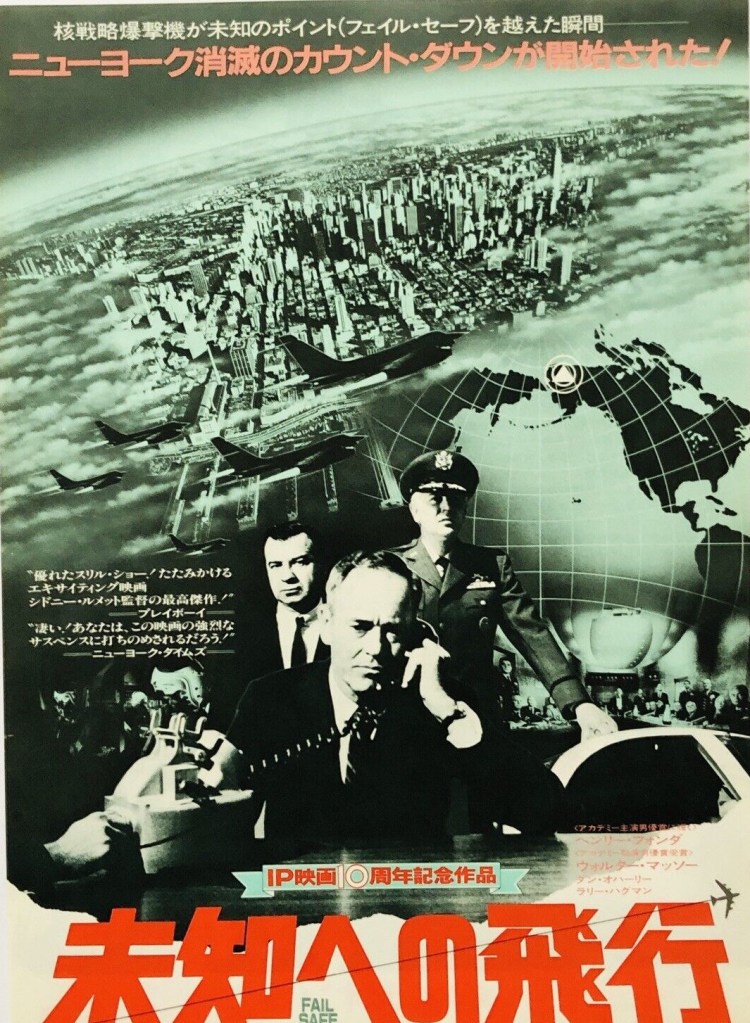
Given unexpected heft by current concerns over AI. Human error, it appears, is more simple to correct than computer malfunction. Once a course of action commences, machines have no way of checking it. And paranoia is the first casualty of truth. Bear in mind this was shockingly contemporary at the time it was made, the world in constant fear of nuclear war, the Cold War, that seemingly endless stalemate doing little to pacify terror.
Those whose job it ease the best outcome in the event of nuclear war were always inclined to rationalize staggering death tolls. So we begin with a late night discussion in which political analyst Dr Groeteschele (Walter Matthau) makes the argument that in the event of war, the country with the fewest casualties is the winner and in a nod to the ironic suggests the most likely survivors would be the worst type of convict, imprisoned underground, and office workers protected from the blast by being surrounded by filing cabinets crammed full of paper.
Just before the real drama begins there’s a neat scene where a women, turned on by a powerful man, makes a move on the doctor only to be slapped into place, sternly told by the prim analyst that he’s not of “her kind.” That’s not the only human element in the tale. the highest levels of secrecy may force top-level Army and Government executives to sacrifice families.
For no accountable reason, jets with nuclear warheads shift into an attacking position on the Russian border, the target if not stopped Moscow. The planes are unstoppable once they commence attack, unable to turn away from a strict sequence of pre-determined action. Not even the personal intervention by the President (Henry Fonda) of the United States can affect the outcome, the pilots already trained to ignore such an action on the grounds that the enemy could be imitating the President’s voice.
When the planes fail to turn back, the only option is for the Americans to blow their own planes out of the sky, an action that appears not just inconceivable to the Army personnel but treasonable. High-rankings officers ruthless trained for battle and to observe the protocol of obeying orders find this unconscionable.
Three dramas take place at once. On the ground the Army chiefs try to explore every option to avoid the unthinkable while battling with their own consciences at what appears to be the only way out. The President on the hotline to the Russian premier has to circumvent natural suspicion that this is a cunning ploy by the Yanks and then come to some agreement with the Russians on the assumption that Moscow may yet come under attack. We, the audience, are playing out the third element in our minds, a series of terrifying what if scenarios with indescribable consequence.
I’m not going to reveal the shock ending because it came as a hell of a shock to me, given I’d not seen the picture in decades.
It’s brilliantly-made with almost futuristic sets and noir lighting and the President effectively physically imprisoned, and not just by his conscience, stuck in a featureless cell presumably in the pits of the White House arguing the toss with the Russian chief, his only companion the translator (Larry Hagman) whose face seems to get greyer and greyer as he transmits worse and worse news.
Dr Groeteschele makes matters worse, at least to a pacifist left-wing viewer (though an opposite view would be taken by the hawks), by urging the President to take advantage of computer error and “first strike” and blow Russia to pieces, assuming that indulging in the attack option will result in fewer casualties in America, and thus, following his earlier projections, not just win the war but rid the word of the fear of nuclear war.
While the style is documentary, it’s a riveting watch. The tension is unbearable. Some like Col Cascio (Fritz Weaver) succumb to the pressure while the commanding General Black (Dan O’Herlihy) retains a stolid soldierly presence.
Sidney Lumet (The Pawnbroker, 1964) doesn’t put a foot wrong. Taking the line – rather than in The Bedford Incident (1965) of the wrong man with his finger on the button – of the right man trying to make the best of a botched job, he delivers a just superb picture. Walter Bernstein (The Magnificent Seven, 1960) does a terrific job in delivering a taut screenplay from a more meandering novel by Eugene Burdick and Harvey Wheeler.
There probably couldn’t be a more prescient movie for today.
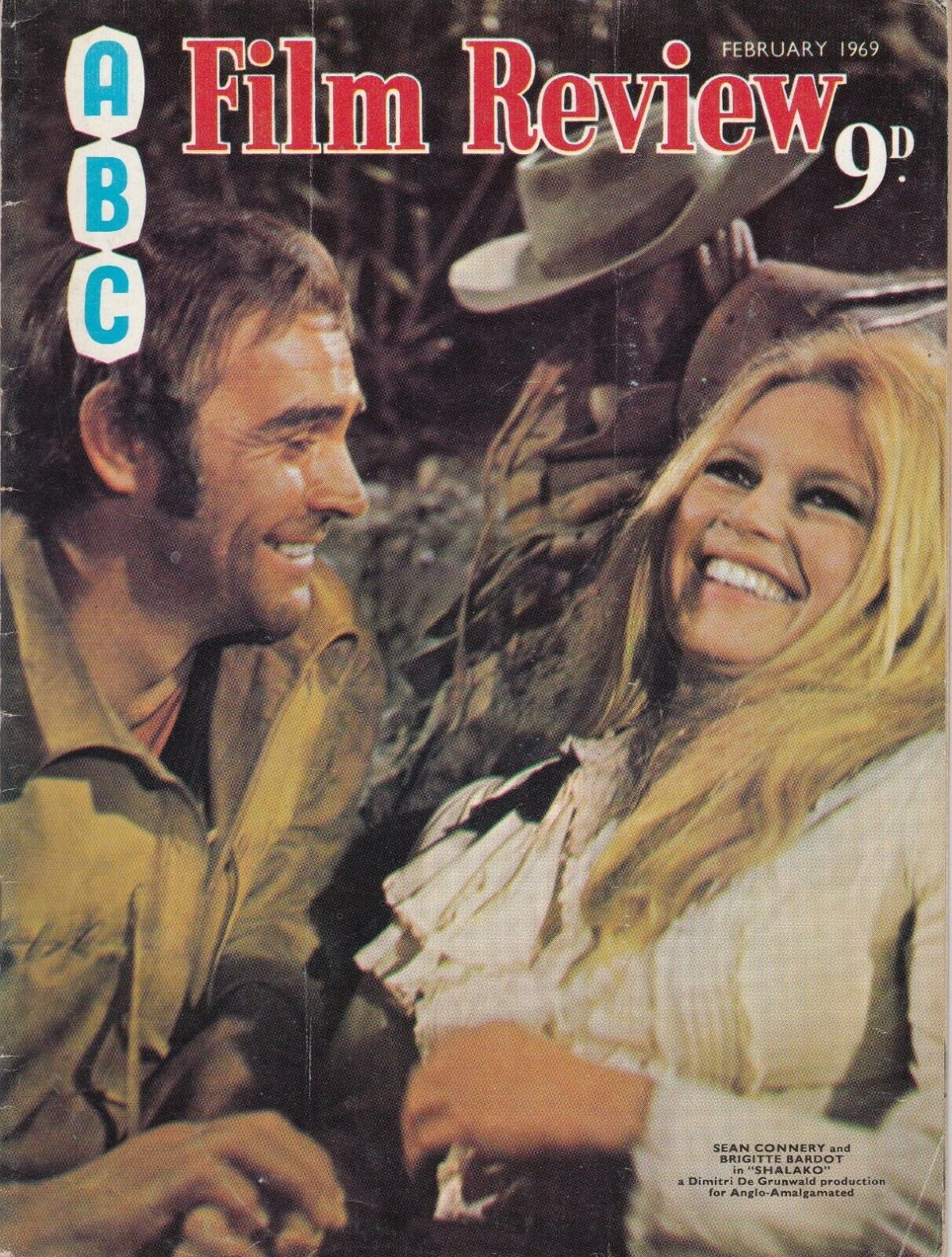
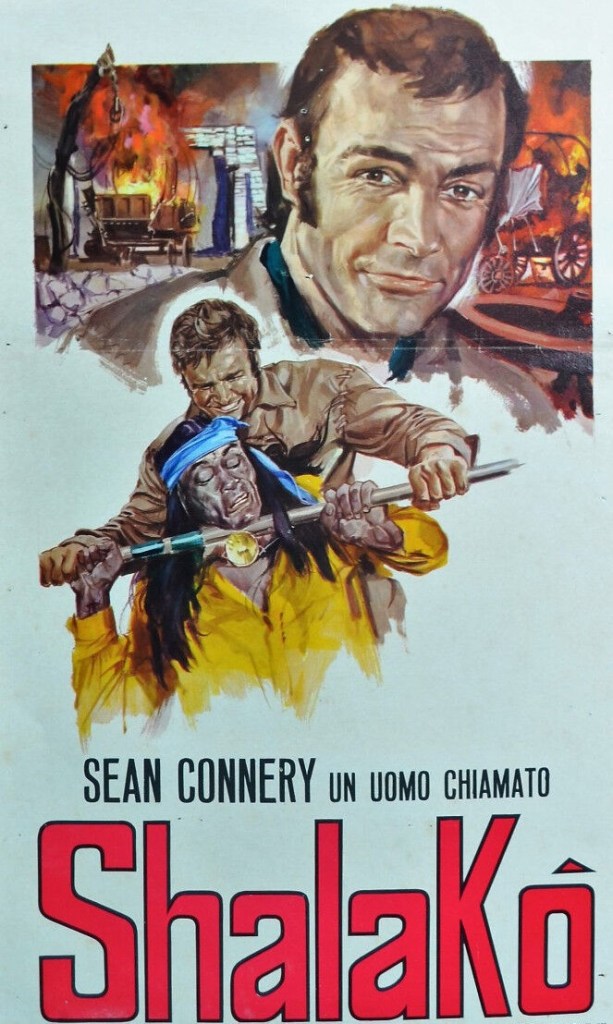
If you ever wondered just how a producer earns his crust, the convoluted process to make Shalako would provide a test case. British publicist turned producer Euan Lloyd had little on his calling card to gain entry to Hollywood, not even with the stars in tow for the project. Having worked for several years as a production assistant with Warwick Films, the British-based outfit headed by Cubby Broccoli and Irving Allen, he transitioned to associate producer on The Secret Ways (1961) but didn’t earn the moniker of producer until he pulled together an all-star cast for The Poppy Is Also A Flower (1966). Although released theatrically in Europe it was in reality a made-for-television number and screened as such in the United States.
So, actually, he was very much a neophyte producer. But early in his career he had become fast friends with Alan Ladd (Shane, 1953) and since they shared a love of westerns the actor had put him in touch with bestselling western author Louis L’Amour who was so taken with the Englishman’s enthusiasm he granted him a free option on any one of his un-filmed novels. Lloyd chose Shalako. “I could identify with that subject as it’s about a bunch of Europeans on safari in the West,” said Lloyd. (In fact, though as yet unfilmed, it was not as though nobody had tried. A report in Box Office magazine dated August 19, 1963, stated that Richard Carr was working on a screenplay for producer George Golitsin set for Universal).
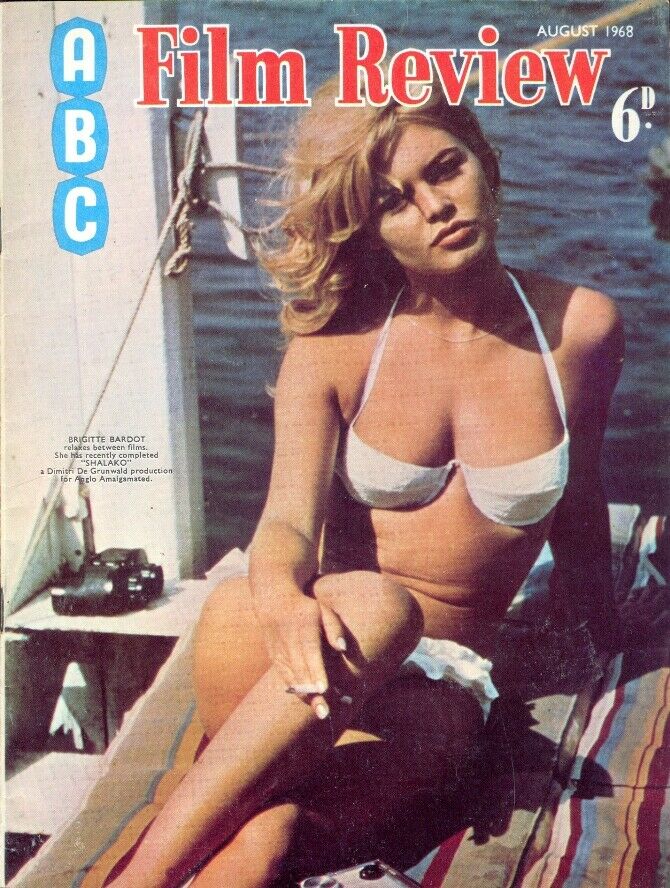
No connection to Shalako but little excuse necessary to showcase BB’s figure apparently.
On the production side, it would give him the excuse he required to put together a cast of non-Americans, stars from different nationalities who could open the distribution doors to significant European countries like France and Germany. His original starring pair were Henry Fonda (Firecreek, 1968) and Senta Berger, whom he knew from The Secret Ways and The Poppy Is Also A Flower. “Privately, she was the antithesis of the character she played in The Secret Ways…she came to mind as a very likely countess.”
He recruited Edward Dymytrk (Mirage, 1965), having got to know the director, a fugitive from the Communist witch hunt in the U.S., on the set of the British-made So Well Remembered (1947). Dmytryk had worked with Fonda on Warlock (1959). While appreciating Lloyd’s interest and keen to work again with Dmytryk, Fonda warned that he was not a strong enough marquee name to get the project off the ground.
To cover his back and using the names of his two stars and director, Lloyd set about pulling together finance from European sources. Although such co-productions were becoming more common, Lloyd must have set some kind of record by pre-selling the movie, in the end, to 36 different bodies. But still it wasn’t enough. Without an American partner, the movie was no-go. Fonda proved the sticking point and in 1967 Lloyd decided to go for broke with a bigger cast (Fonda was pretty gracious about being dumped, “I did warn you,” he said).
Sean Connery was not even initially on the list of proposed stars until Louis L’Amour alerted Lloyd to the length of the queues to see the latest Bond blockbuster (quite how a producer didn’t know that might be considered a mystery). Connery was incommunicado, filming a documentary in Scotland, but Lloyd managed to get in touch and seven weeks later he had what he believed, based on the Bond box office, was the biggest star in the world.
Part of the attraction for Connery of course was that for the first time he was receiving a salary ($1.2 million in total) commensurate with his box office. But it turned out as far as Hollywood was concerned, Connery had been taken in by his own publicity, studios pointing out that his non-Bond movies, Marnie (1964), The Hill (1965) and A Fine Madness (1966) had not approached his Bond box office.
Nor was Brigitte Bardot a golden name on the U.S. cinema scene. Until the mid-decade reissue of La Dolce Vita (1960), her first starring role And God Created Woman (1956) held the record for the biggest imported movie. But since them, except for Viva Maria (1966), her movies had been relegated to arthouses, hardly worth risking for a $400,000 salary – she was in Variety’s list of Top Ten Overpriced Stars.
Three major studios rejected the movie. Assuming all the majors would take the same view that “Connery will never make it away from Bond,” Lloyd targeted a mini-major, the kind of neophyte outfit that might pony up to get a big name on its forthcoming schedule, a way of proving it could play with the big boys. ABC, an offshoot of the television network, was hooked, paying $1.4 million for the privilege.
Trevor Howard, Karl Malden, Claire Bloom and Ingrid Pitt was all considered for roles. Even without them, as well as Bardot, the movie, in terms of credits, had the look of one of those all-star epics so beloved in the 1960s: Jack Hawkins (Lawrence of Arabia, 1962), Stephen Boyd whom Lloyd knew from being associate producer on Genghis Khan (1965) and German star Peter van Eyck (Station Six Sahara, 1963). And if Bardot wasn’t enough to get journalist tongues wagging, Connery would also be reunited with Honor Blackman from Goldfinger (1964). The cast also included Woody Strode (The Professionals, 1966), famed 1940s western star Don ‘Red’ Barry (The Adventures of Red Ryder, 1940) and English comedian Eric Sykes (The Plank, 1967).
Mexico was first choice of location until the devalued peso rendered it too expensive. Almeria in Spain, location of choice of many a spaghetti western, was the alternative. The biggest problem pre-shooting was that, to get into character, Connery had decided to grow a Mexican moustache, presumably not aware that moustaches were verboten for stars after The Gunfighter (1950) sank at the box office reputedly because Gregory Peck wore one. In the end, without the subject becoming a thorny issue, Connery shaved it off. He spent two weeks learning to ride under the tuition of Bob Simmons, a stunt arranger on the Bond pictures, so he could, indeed, sit as tall in the saddle as the great western stars. “He was a very proficient horseman by the time we started,” commented co-star Eric Sykes, “He looked as if he had been riding all his life.”
Meanwhile, Jack Hawkins (Masquerade, 1965) had undergone an operation for throat cancer and though he could speak his words were accompanied by a kind of belch and the voice for which he was so famous had disappeared. By coincidence Lloyd heard what he thought was Hawkins voicing a beer commercial. The distinctive tones belonged to Charles Gray (The Devil Rides Out, 1968) and he re-voiced Hawkins’ lines.
Despite Connery’s assertions to the contrary – his famous quote “she’s all girl but…all on the outside” was viewed as a detractory statement – Lloyd insisted it was a happy set. “I had absolutely no trouble from the cast during shooting and Sean and Brigitte performed perfectly and in harmony. Eddie Dmytryk was a man who knew exactly what he wanted and how to get it. The co-stars liked him enormously.”
Other sources paint a different picture, pointing to tension between Connery and Bardot over who was the bigger star, between Bardot and former lover Boyd, and between Connery and Dmytryk over the script. According to Eric Sykes, sitting beside Connery in between takes, the actor “would tear half a page or even a whole page of dialog out of his script…He was editing his part as he went along, apparently without reference to the director…One scene in particular with him and Brigitte Bardot, a long scene where they were sitting around a pool….it went on and on for about eight minutes…Sean’s editing turned it not a slick two- or three-minute scene…Eddie (Dmytryk) did not challenge it because when he saw what Sean had done he knew it was right.”
A big success in UK and Europe, it was a flop in the U.S. where ABC recorded a $1.2 million loss, but since every area was sold separately it is doubtful this shortfall would need to be repaid by the producer so counting the income from other sources it would have gone into profit. Incidentally, Connery was pictured wearing a moustache when the movie had its premiere and he was actually one of the few major stars who regularly wore a moustache in pictures and there are those who attribute his career longevity to cultivating a beard while still in his prime.
SOURCES: John Parker, Sean Connery, 1930-2020, The Definitive Biography (Bonnier Books, 2020) p171-176; Mac Mcsharry and Terry Hine, “The Way West,” Cinema Retro, Issue #2 May 2005, p38-42.
Having complained about lists and then recanted when one of my favorites got the nod at the top of the heap, I’m doing the same again.
The recent Sight & Sound once-in-a-decade Directors Poll did the unthinkable and placed Once Upon a Time in the West ahead of John Ford’s The Searchers (1956) which, virtually since release, had been anointed the top western of all time. The critics who participated in the Critics Poll, which ran concurrently with the Directors Poll, were not, I hasten to add, quite so convinced. According to the critics, the John Ford picture was still top dog, ahead of the Leone masterpiece in second place. But in a battle between directors, who make a living making pictures, and critics, whose only skill is writing about them, I know which side I would come down on. And in any case I had long sided with the directors on this issue.
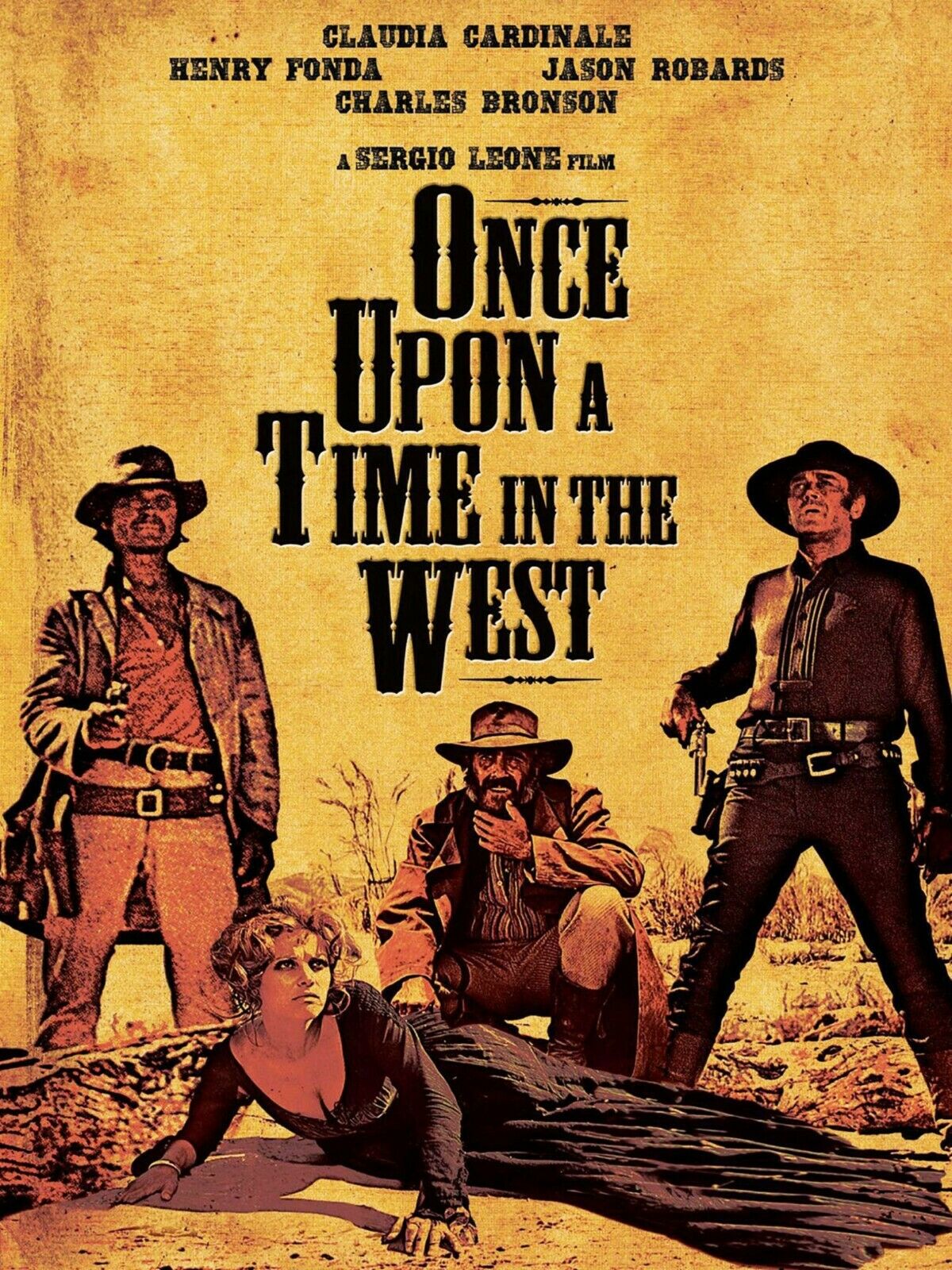
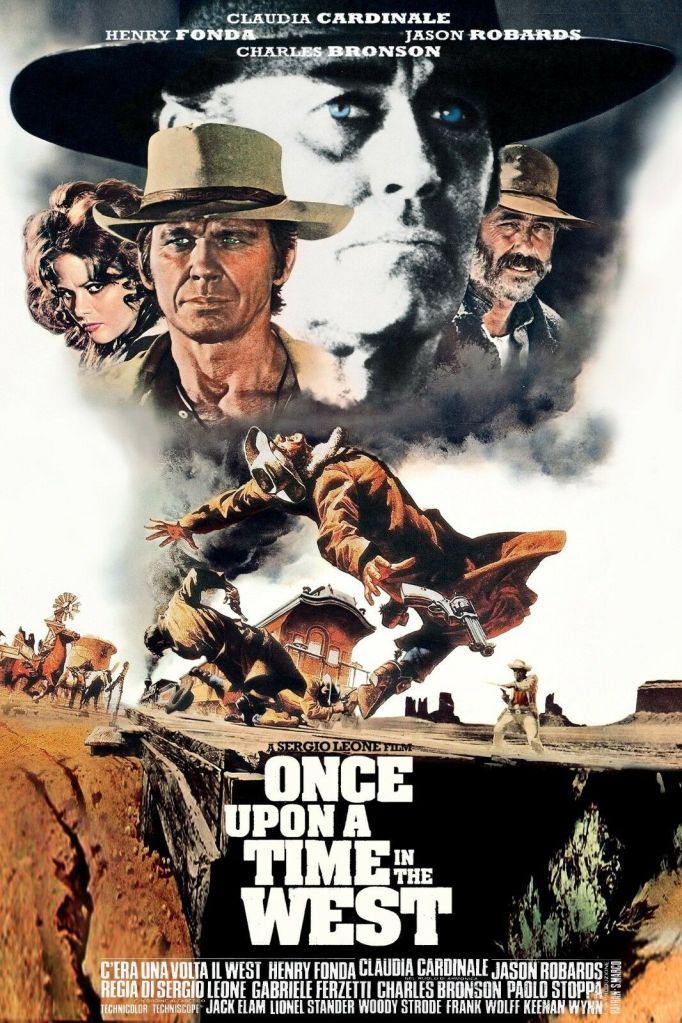
A masterpiece to savor. The greatest western ever made. Sergio Leone’s movie out-Fords John Ford in thematic energy, imagery and believable characters and although it takes in the iconic Monument Valley it dispenses with marauding Native Americans and the wrecking of saloons. That the backdrop is the New West of civilisation and enterprise is somewhat surprising for a movie that appears to concentrate on the violence implicit in the Old West. But that is only the surface. Dreams, fresh starts are the driving force. It made a star out of Charles Bronson (Farewell, Friend, 1968), turned the Henry Fonda (Advise and Consent, 1961) persona on its head and provided Claudia Cardinale (Blindfold, 1965) with the role of a lifetime. And there was another star – composer Ennio Morricone (The Sicilian Clan, 1969)
New Orleans courtesan Jill (Claudia Cardinale) heads west to fulfil a dream of living in the country and bringing up a family. Gunslinger Frank (Henry Fonda), like Michael in The Godfather, has visions of going straight, turning legitimate through railroad ownership. Harmonica (Charles Bronson) has been dreaming of the freedom that will come through achieving revenge, the crippled crooked railroad baron Morton (Gabriele Ferzetti) dreams of seeing the ocean and even Cheyenne (Jason Robards) would prefer a spell out of captivity.
The beginnings of the railroad triggers a sea-change in the west, displacing the sometimes lawless pioneers, creating a mythic tale about the ending of a myth, a formidable fable about the twilight and resurgence of the American West. In essence, Leone exploits five stereotypes – the lone avenger (Harmonica), the outlaw Frank who wants to go straight, the idealistic outlaw in Cheyenne, Jill the whore and outwardly respectable businessman Morton whose only aim is monopoly. All these characters converge on new town Flagstone where their narratives intersect.
That Leone takes such stereotypes and fashions them into a movie of the highest order is down to style. This is slow in the way opera is slow. Enormous thought has gone into each sequence to extract the maximum in each sequence. In so doing creating the most stylish western ever made. The build-up to violence is gradual, the violence itself over in the blink of an eye.
Unusually for a western – except oddities like Five Card Stud (1968) – the driving force is mystery. Generally, the western is the most direct of genres, characters establishing from the outset who they are and what they want by action and dialogue. But Jill, Harmonic and Cheyenne are, on initial appearances, mysterious. Leone takes the conventions of the western and turns them upside down, not just in the reversals and plot twists but in the slow unfolding tale where motivation and action constantly change, alliances formed among the most unlikely allies, Harmonica and Cheyenne, Harmonica and Frank, and where a mooted alliance, in the romantic sense, between Jill and Harmonica fails to take root.
There’s no doubt another director would have made shorter work of the opening sequence in Cattle Corner, all creaky scratchy noise, in a decrepit railroad station that represents the Old West, but that would be like asking David Lean to cut back Omar Sharif emerging from the horizon in Lawrence of Arabia (1962) or Alfred Hitchcock to trim back the hypnotic scenes of James Stewart following Kim Novak in Vertigo (1958). Instead, Leone sets out his stall. This movie is going to be made his way, a nod to the operatic an imperative. But the movie turns full circle. If we begin with the kind of lawless ambush prevalent in the older days, we end with a shootout at the Sweetwater ranch that is almost a sideshow to progress as the railroad sweeps ever onward.
No character is more against audience expectation than Jill. Women in westerns rarely take center stage, unless they exhibit a masculine skill with the gun. There has rarely been a more fully-rounded character in the movies never mind this genre. When we are introduced to her, she is the innocent, first time out West, eyes full of wonder, heart full of romance. Then we realise she is a tad more mercenary and that her previous occupation belies her presentation. Then she succumbs to Frank. Then she wants to give up. Then she doesn’t. Not just to stay but to become the earth mother for all the men working on the railroad.
Another director would have given her a ton of dialogue to express her feelings. Instead, Leone does it with the eyes. The look of awe as she arrives in flagstone, the despair as she approaches the corpses, the surrender to the voracious Frank, the understanding of the role she must now play. And when it comes to close-up don’t forget our first glimpse of Frank, those baby blue eyes, and the shock registering on his face in the final shoot-out, one of the most incredible pieces of acting I have ever seen.
And you can’t ignore the contribution of the music. Ennio Morricone’s score for Once Upon a Time in the West has made a greater cultural impact than even the venerated John Williams’ themes for Star Wars (1977) and Jaws (1975) with rock gods like Bruce Springsteen and Metallica among those spreading the word to successive generations and I wonder in fact how people were drawn to this big-screen showing by the opportunity to hear the score in six-track Dolby sound. There’s an argument to be made that the original soundtrack sold more copies than the film sold tickets.
The other element with the music which was driven home to me is how loud it was here compared to, for example, Thunderball (1965), which as it happens I also saw on the big screen on the same day. Although I’ve listened to certain tracks from the Bond film on a CD where the context is only the listener and not the rest of the picture, I was surprised how muted the music was for Thunderball especially in the action sequences. Today’s soundtracks are often loud to the point of being obstreperous, but rarely add anything to character or image.
If you live in the U.K. you should get the opportunity to see this once again on the big screen because the British Film Institute, which coincidentally owns Sight & Sound, is planning to screen all the 100 films in its latest poll. Other countries might take note.
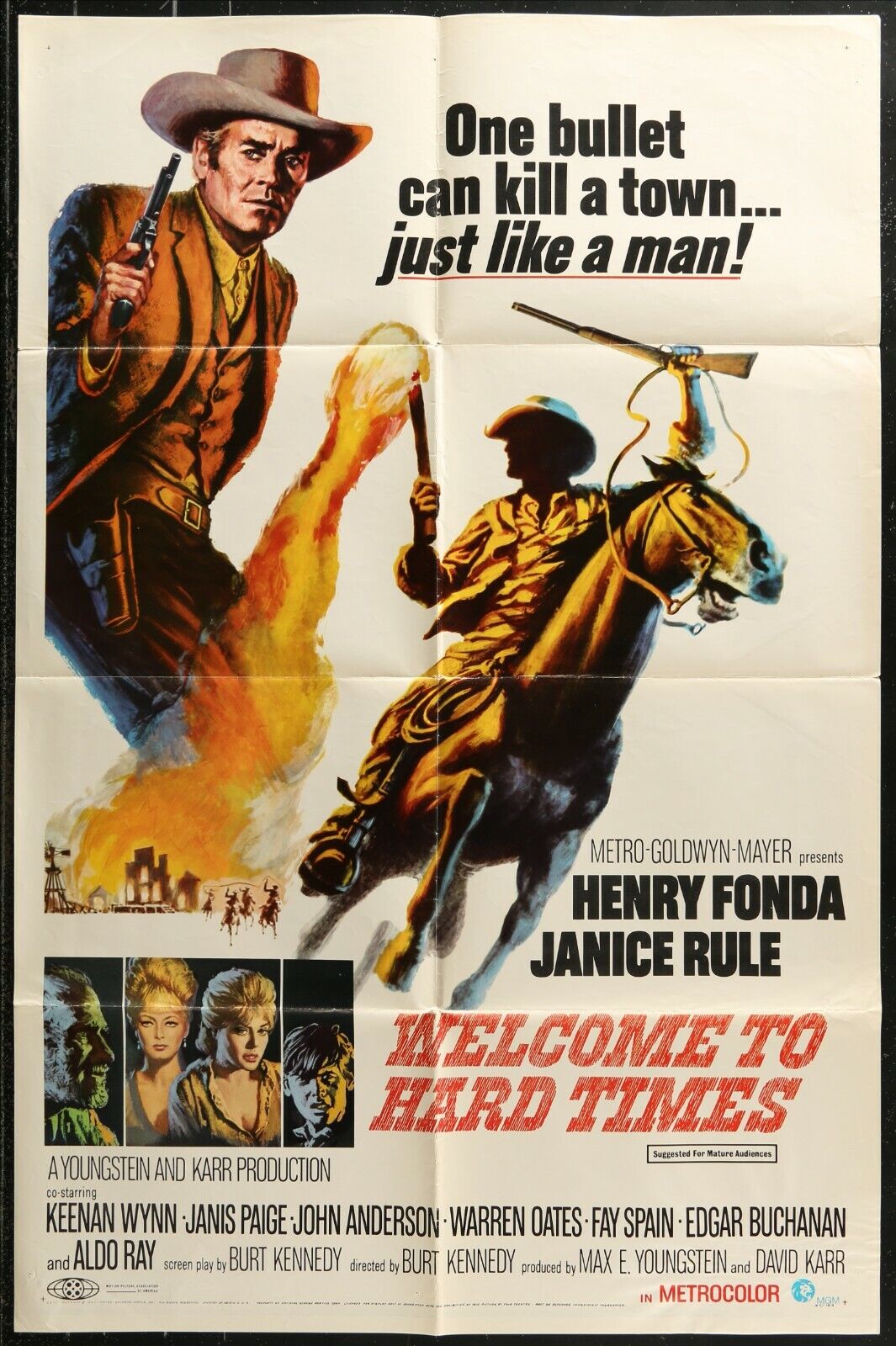
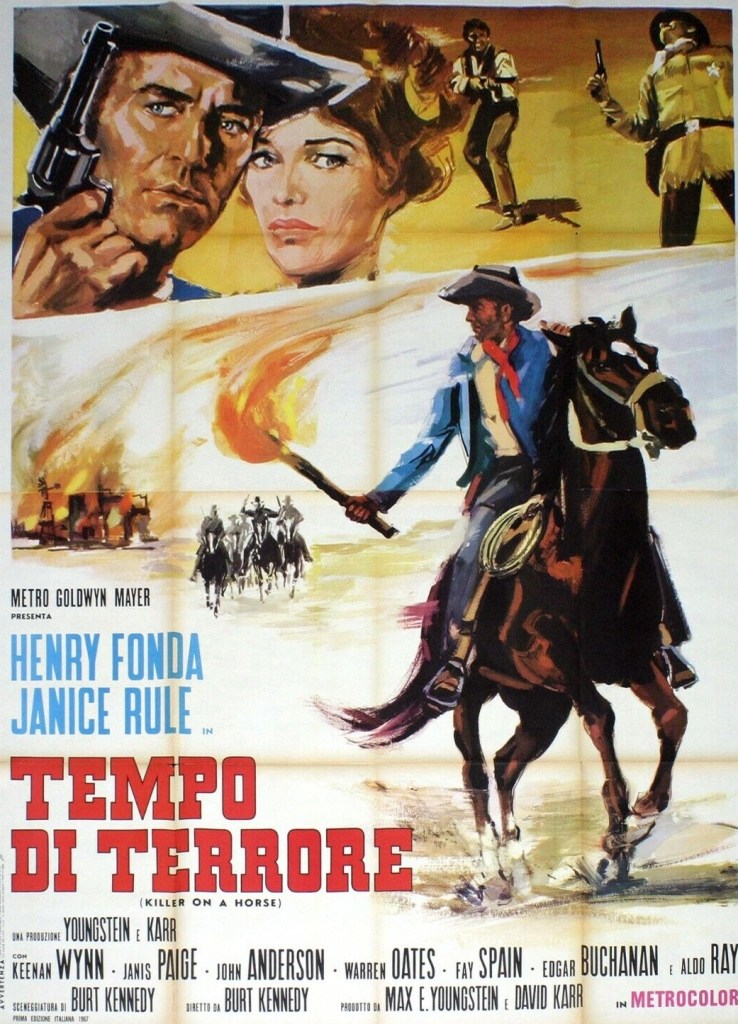
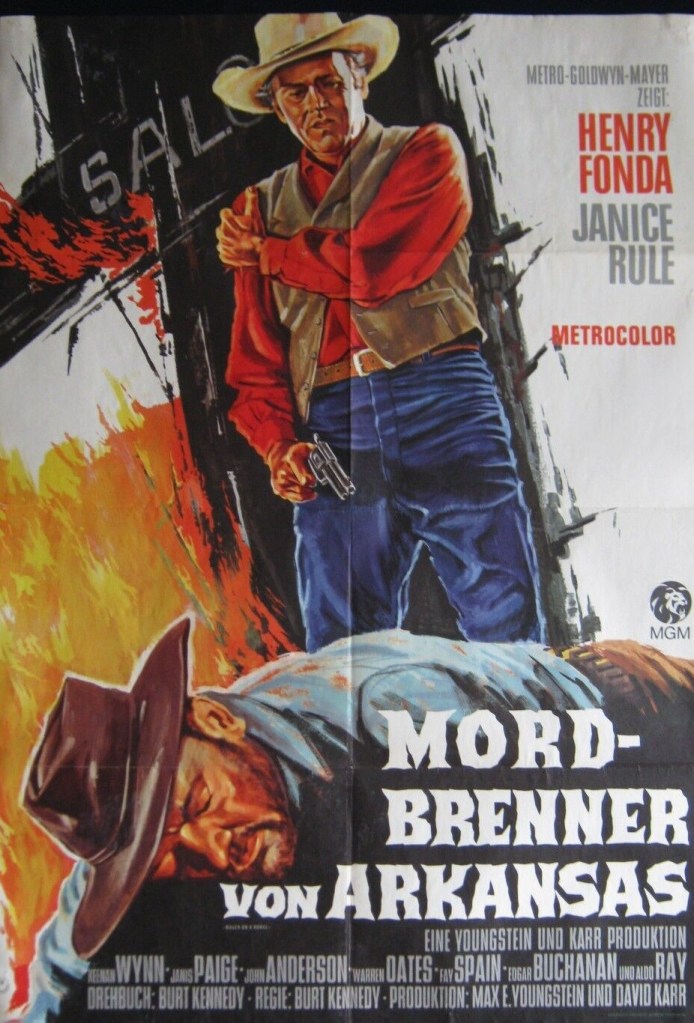
Director Burt Kennedy’s record with westerns was very much hit or miss. This revisionist effort is one of the former though it could as easily tipped into the latter, beginning with a shrill soundtrack that telegraphs every incident and the no-name villain. And you might also wonder if irony had taken such a hold of settlers that they would actually name their town “Hard Times” when there was a gold strike over the hills.
Anyway, this is certainly a town that lives up to its name. Can’t have been more than a dozen houses, a saloon of course, but it’s the muddiest place west of No Name City (Paint Your Wagon, 1969) and the meanest to hove into view since High Noon, with the townspeople in thrall not to an entire gang, but one nameless stranger (where have we seen that before).
The Man from Bodie (Aldo Ray), as he is known, is the bad guy from Hell. He shoots anyone who stands up to him like Fee (Paul Birch) or shows the slightest dissent like undertaker Hanson (Elisha Cook Jr) and rapes Fee’s girlfriend Flo (Ann McCrea) before dumping her corpse on the saloon stairs.
Will Blue (Henry Fonda), lawyer not lawman, hasn’t the guts to stand up to him, but comes the closest of the cowardly bunch. When The Man has done as much rampaging as a tiny town will allow he burns it to the ground. Most people leave, but Blue, having done too much running in his life, decides to stay to look after Fee’s orphaned son Jimmy (Michael Shea).
If Blue’s vengeful Oirish girlfriend Molly (Janice Rule) also remains it’s mostly to hate him for abandoning her to the madman – Blue had used her to distract the Man but then retreated when the going got tough leaving her to be raped at will. She sets up her own League of Desperadoes, recruiting new arrival Jenks (Warren Oates) and the orphan, to tackle the bad guy on his inevitable return.
Meanwhile, a mobile unit of sex workers, complete with tent, turns up to service the nearby gold workers. Their entrepreneurial boss Zar (Keenan Wynn) spots opportunity and helps Blue rebuild the town. Of course, everyone’s just waiting for Bodie Man to return.
Anyone that’s likeable or got anything approaching character is killed off at the start, so we’re left with an unlikeable, ambivalent, but realistic, crew. For all his later hi-falutin’ principles and pioneer spirit, Blue is still a coward who, to save his own skin, sacrificed Molly. Hoping to redeem himself by acting as surrogate father to Jimmy doesn’t result in him winning any respect from Molly.
This is one raped woman who found out the man on whom she was depending was no protector. Why should she ever love him again? And she’d be crazy to put her life in his hands once more. Of course, she could have got herself her own shotgun or pistol and ambushed Brodie Man when he took another shine to her, but instead she plays pretty please with Jenks, which is understandable, and the young Jimmy, which is deplorable.
That the sex worker magnate becomes one of the town’s foremost citizens might cleave closer to the bone than many viewers would like, but corruption was as endemic in America then as it presumably is now.
And it begs the question when all those pioneers headed out West how many of them were scum like Bodie Man? And how did the settlers think law-and-order was going to work out?
On the downside we have a villain, who, not content with killing and raping, demonstrates just how mean he is by smashing whisky bottlenecks because he hasn’t the patience to extract the cork with his teeth. Fee is dumb enough to take on the bad guy with a bit of log. Molly’s Irish accent is all over the place. And we could do with less music. And there’s a climactic twist that belonged to a horror film and is not only completely out of place but undoes the realistic tone by providing a somewhat sanctimonious ending.
But if you are expecting a movie along High Noon lines, with the good guy beating the bad, and winning the town’s respect, then you will be disappointed. On the other hand if you come prepared for one of the darkest westerns of the decade where the terrorizing outlaw exerts such fear that the townspeople, in defending themselves, pull down the shades between good and evil, then you will be amply rewarded.
The boldness of director Kennedy (The War Wagon, 1967) in reimagining the West as a place of venal proportions should be applauded. The direction might take a wrong turn here and there but the aim is effective. Henry Fonda (Firecreek, 1968) is good as ever and although I could do without the awful accent Janice Rule (Alvarez Kelly, 1966) is superb as the vengeful woman refusing Blue forgiveness and willing to use a youngster as a weapon.
A sound supporting cast includes Keenan Wynn (Warning Shot, 1967), Edgar Buchanan (Move Over, Darling, 1963), Janis Paige in her final movie outing, John Anderson (5 Card Stud, 1968) in a double role, Aldo Ray (The Power, 1968) and Warren Oates (The Wild Bunch, 1969).
Kennedy wrote the screenplay form the book by E.L. Doctorow.
These days fact-based magazine articles commonly spark movies – The Fast and the Furious (2001) was inspired by a piece in Vibe, A Beautiful Day in the Neighborhood (2019) started life in Esquire – but it was rare in the 1960s (see Note below).
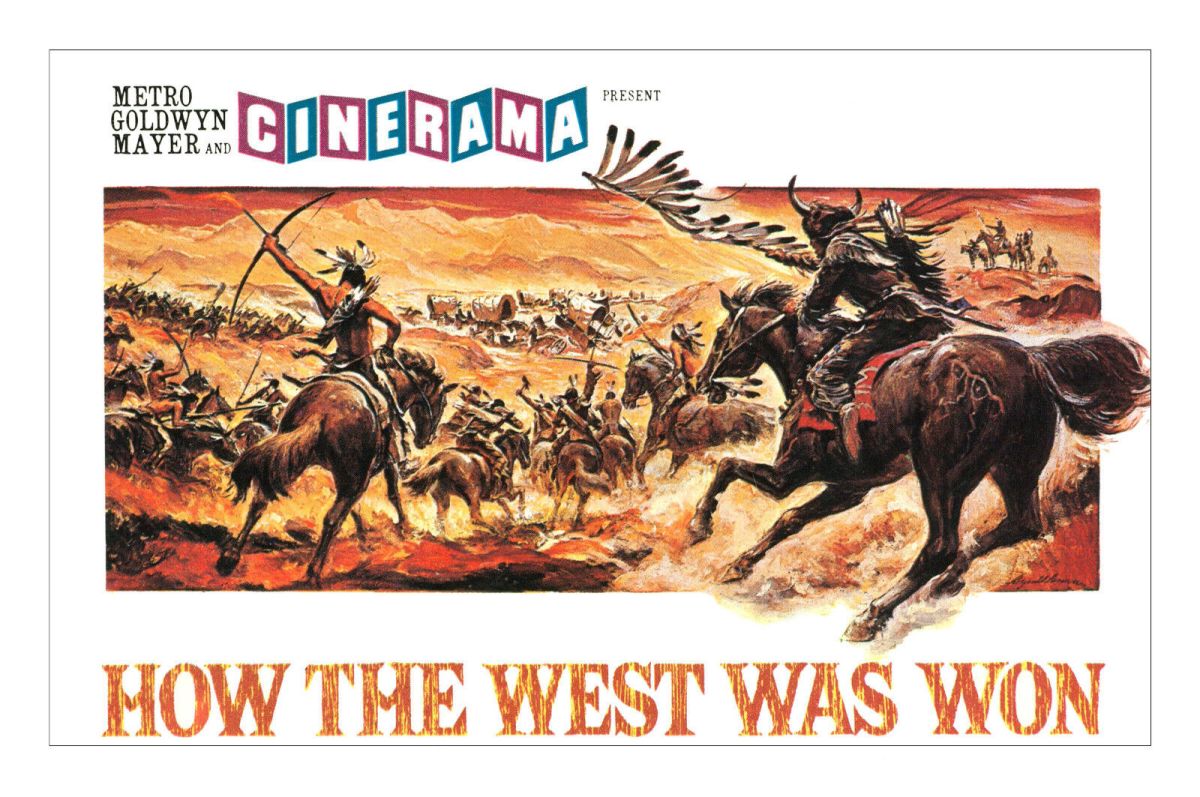
However, a series of seven lengthy historical articles in the multi-million-selling Life magazine in 1959 about the Wild West, extensively illustrated with material from the time, captured the attention of the nation. Bing Crosby acquired the rights, not as a potential movie, but for a double album recorded in July 1959 on a new label Project Records set up specifically for the purpose – two months after the series ended – and a proposed television special.
When the latter proved too expensive, the rights were sold to MGM which then linked up in a four-film pact with Cinerama to create the first dramatic picture in that format, the three-screen concept that had taken the public by storm in 1952 with This Is Cinerama. Since then, Cinerama had focused exclusively on travelogs and coined $115 million in grosses from just 47 theaters, including $9 million in seven years at the Hollywood theater in Los Angeles. Eight years in its sole London location had yielded $9.4 million gross from a quartet of pictures, Cinerama Holiday (1955) leading the way with (including reissue) a 120-week run, followed by 101 weeks of Seven Wonders of the World (1956), 86 for This Is Cinerama and 80 weeks for South Seas Adventure (1958).
Box office was supplemented with rentals of the projection equipment. But the novelty had worn off, lack of product denting consumer and industry interest, many of the theaters set up for the project returning the equipment, so that by the time of this venture there were only 15 U.S. theaters still showing Cinerama. The company went from surviving primarily on equipment royalties to becoming a producer-distributor-exhibitor. Ambitiously, the company believed it could generate $5,000 a week profit for each theater, and, assuming growth to 60 houses, that could bring in $15 million a year.
Crosby initially remained involved – crooning songs to connect various episodes – but that idea was soon abandoned. Director Henry Hathaway (North to Alaska, 1960), claimed he came up with the movie’s structure. “The original concept was mine,” he said, “The first step in the winning of the West was the opening of the canal, then came the covered wagon, next the Civil War which opened up Missouri and the mid-West then the railroads, and finally the West was won when the Law conquered it instead of the outlaw gangs; which was the theme I worked out for the picture.
“So I conceived the whole idea and then got writers to work on the five episodes. Each episode was about a song originally. Then I travelled all over the country to find locations.”
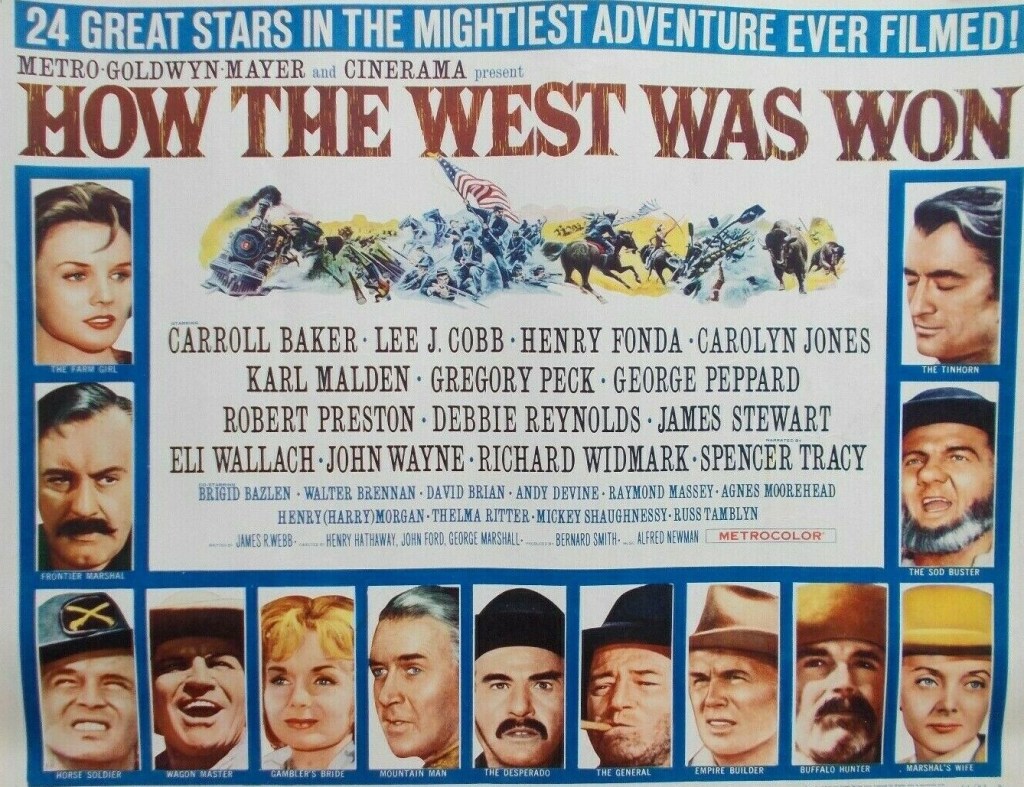
For once this was a genuine all-star cast headed up by actors with more than a passing acquaintance with the western: John Wayne (The Man Who Shot Liberty Valance, 1962), Oscar-winner Gregory Peck (The Big Country, 1958), James Stewart (Winchester ’73, 1950), Richard Widmark (The Alamo, 1960) and Henry Fonda (Fort Apache, 1948) with Spencer Tracy (Broken Lance, 1954) as narrator plus George Peppard (Breakfast at Tiffany’s, 1961) in his first western.
The two strongest female roles were given to actresses playing against type, Carroll Baker (Baby Doll, 1956), who normally essayed sexpots, as a homely pioneer and Debbie Reynolds (The Tender Trap, 1955), more at home in musicals and comedies, as her tough sister. The impressive supporting cast included Lee J. Cobb, Eli Wallach, Walter Brennan, Robert Preston, Carolyn Jones and Karl Malden.
Glenn Ford and Burt Lancaster were unavailable. Frank Sinatra entered initial negotiations but ultimately turned it down. Gary Cooper, also initially considered, died before the film got underway.
Initially under the title of The Winning of the West screenwriter James R. Webb (The Big Country, 1958) was entrusted with knocking the unwieldy non-fiction story into a coherent fictional narrative. In effect, it was an original screenplay at a time when Hollywood was turning its back on bestsellers, “the pre-sold theory less compelling.” His first draft accommodated various montages covering the journey from the Pilgrim Fathers to the building of the Erie Canal and the Civil War and it was only in subsequent drafts that the tale of Linus Rawlings (James Stewart) emerged with surprising focus on female pioneers.
Webb’s initial ending had involved a father-son conflict, presumably a fall-out between the Rawlings played by James Stewart and George Peppard, but that was rejected in order not to finish on a “note of bitterness” out of keeping with the spirit of the movie. Although he did not receive a credit, John Gay (The Happy Thieves, 1961) also contributed to the screenplay.
Given the film’s episodic structure it is amazing how well the various sequences fit together and the narrative thrust maintained. The story covers a 50-year stretch beginning in 1839 with the river sequence bringing together James Stewart and Carroll Baker. After Stewart is bushwhacked by river pirates, he marries Baker and they set up a homestead. The next section pairs singer Debbie Reynolds with gambler Gregory Peck whose wagon train is attacked by Indians on the way to San Francisco. Later, Stewart and son George Peppard enlist in the Civil War (featuring John Wayne as an unkempt General Sherman).
Stewart dies at the Battle of Shiloh. Peppard joins the cavalry and later as a marshal in Arizona meets Reynolds and prevents a robbery that results in a spectacular train wreck. It took a superb piece of screenwriting to pull the elements together, ensure the characters had just cause to meet and to create solid pace with a high drama and action quotient.
The undertaking was too much for one director. Initially, it was expected five would be required but this was truncated to three – John Ford (The Searchers, 1956), Henry Hathaway and George Marshall (The Sheepman, 1958) although Hathaway carried the biggest share of the burden and Richard Thorpe (Ivanhoe, 1952) handled some transitional historical sequences.
The directors broke new ground, technically. The Cinerama camera was actually three cameras in one, each set at a 48 degree to the next and when projected provided a 146-degree angle view. Each panel had its own vanishing point so the camera could, uniquely, see down both sides of a building.
But there were drawbacks. The cumbersome cameras required peculiar skills to achieve common shots. Directors lay on top of the camera to judge what a close-up looked like. Sets were built to take account of the way dimensions appeared through the lens, camera remaining static to prevent distortion. When projected, the picture was twice the size of 65mm and before the invention of the single-camera lens led to vertical lines running down the screen. Trees were built into compositions to hide these lines.
“You couldn’t move the camera much,” recalled Hathaway, “or the picture would distort. You have to shove everything right up to the camera. Actors worked two- and three-feet away from the camera. The opening dolly down the street to the wharf was the first time it had ever been done.
He added, “Over 50 per cent of the stuff on the train was made on the stage (i.e. a studio set) and 60 per cent of the stuff coming down the rapids. I never took a principal up north to the river, the principals never worked off the stage. We never photographed the scenes with transparencies in three cameras with Cinerama – we photographed them with one camera in 70mm and then split the negative.
“I wouldn’t shoot close-ups in Cinerama – I shot the close-ups in 70(mm) and then separated the negative because in Cinerama it distorted their arms. When (George) Stevens shot The Greatest Story Ever Told he used only 70mm and split it all. So from then on they never used the three cameras again. Now they’re actually shooting it in 35(mm).”
Rui Nogueira, “Henry Hathaway Interview,” Focus on Film, No 7, 1971, p19.
After a year spent in pre-production, an eight-month schedule due to start on May 28, 1961, and a completion date of Xmas 1961, MGM anticipated a 1962 launch, Independence Day pencilled in for the world premiere. The original $7 million budget mushroomed to $12 million and then to £14.4 million, $1 million of that ascribed to adverse weather conditions, hardly surprising given the extent of the location work. A total of $2.2 million went on the 10 stars and 13 co-stars, virtually talent on the cheap given the salaries many could command, transport cost $1 million and the same again in props including an 1840 vintage Erie canal boat.
Rain and overcast skies added $145,000 to the cost of shooting the rapids sequence in Oregon and another $218,000 was required when early snowfall scuppered one location and required traveling 1,000 miles distant. Nearly 13,000 extras were involved as well as 875 horses, 1,200 buffalo, 50 oxen and 160 mules. Thousands of period props were dispersed among the 77 sets. Over 2,000 pairs of period shoes and 1500 pairs of moccasins were fashioned as well as 107 wagons, many designed to break on cue.
Virtually 90 per cent of the picture was shot on location to satisfy Cinerama customers accustomed to seeing new vistas and to bring alive the illustrations from the original Life magazine articles. Backdrops included Ohio River Valley, Monument Valley, Cave-in-Rock State Park, Colorado Rockies, Black Hills of Dakota, Custer State Park and Mackenzie River in Oregon.
The picture, including narration, took over a year to make. Cinerama sensation was achieved by shooting the rapids, runaway locomotive, buffalo stampede, Indian attack, Civil War battle and cattle drive. Motion was central to Cinerama so journeys were undertaken by raft, wagon, pony express, railroad and boat, anything that could get up a head of steam.
Initially, too, the production team had been adamant – “rigid plans for running time will be met” – that the movie would clock in at 150-155 minutes (final running time was 165 minutes) and there was some doubt, at least initially, on the value of going down the roadshow route in the United States. Roadshow was definitely set for Europe, a 15-minute intermission being included in those prints, for a continent where both roadshow and westerns were more popular than in the States.
Big screen westerns in particular in Europe had not been affected by the advent of the small-screen variety. Some films received substantial boosts abroad. “The Magnificent Seven and Cimarron (both 1960) took giants steps forward once they made the transatlantic crossing.” British distributors also reported “striking” success with The Last Sunset (1961) and One-Eyed Jacks (1962) which had toiled to make a similar impression in the U.S.
In the end the decision was made to hold back the release in the U.S. in favor of another Cinerama project The Wonderful World of the Brothers Grimm, which had begun shooting later and ultimately cost $6 million, double its original budget. Rather than bunch up the release of both pictures, MGM opted to kick off its Cinerama U.S. launch with Grimm in 1962 and shifted How the West Was Won to the following year. MGM adopted the anticipation approach, holding the world premiere in London on November 1, 1962, and unleashing the picture in roadshow in Europe.
A record advance of $500,000 was banked for the London showing at the 1,155-seat Casino Cinerama (prices $1.20-$2.15) on roadshow separate performance release. Before the advertising campaign even began in October, a full month prior to the world premiere, over 62,000 reservations had been made via group bookings. Critics were enamored and audiences riveted. The cinema made “unusually large profits” and after two years had grossed $2.25 million from 1722 showings.
Dmitri Tiomkin (The Alamo, 1960) was hired to compose the music, but an eye condition prevented his participation though he later sued for $2.63 million after claiming he was fired before the assignment began. Alfred Newman (Nevada Smith, 1966) wrote the thundering score but uniquely for the time MGM shared the publishing rights with Bing Crosby. In the U.S. Bantam printed half a million copies of a paperback tie-in, sales of the soundtrack were huge and there was a massive rush to become involved by retailers and museums with educational establishments an easy target.
Audience response was overwhelming, a million customers in the first month, two million by the first 10 weeks at just 36 houses, some of which had only been showing it for half that time. But it failed to hit ambitious targets – predictions that it would regularly run for three years in some situations “based on the star roster and the fact the pic offers more natural U.S. vistas than anything yet done on the screen” proving wildly over-optimistic. Still, it had enjoyed 80 roadshow engagements including eight months at the Cinerama in New York and grossed $2.3 million in 92 weeks in L.A, $1.14 million after 88 weeks in Minneapolis and $1.5 million after one week fewer in Denver.
By 1965, as it began a general release 35mm roll-out with 3,000 bookings already taken, it had already passed the $9 million mark in rentals including a limited number of showcase breaks the previous year.
Nominated for a Best Picture Oscar, it won for screenplay, sound and editing. The movie became MGM’s biggest hit after Gone with the Wind and Ben-Hur. In my recent book The Magnificent ‘60s, The 100 Most Popular Films of a Revolutionary Decade I placed it twelfth on the chart of the decade’s top box office films.
It provided a popularity fillip for most of the big stars involved, none more so than James Stewart who, prior to shooting, had been on the verge of retirement. Box office appeal diminishing, work on his next picture Take Her, She’sMine postponed by the Actor’s Strike, after the death of his father he had “quietly begun to make plans to get out of his Fox contract, retire, and move his family out of Beverly Hills.” He had spent $500,000 on a 1,100-acre ranch and was already well set to quit acting having accumulated a large real estate portfolio in addition to oil well investments.
NOTE: Robert J. Landry (“Magazines a Prime Screen Source,” Variety, May 30, 1962, 11) pointed to Cosmopolitan as the original publication vehicle for To Catch a Thief (1955) by David Dodge in 1951 and Fannie Hurst’s Back Street (1932), serialized over six months from September 1930. Frank Rooney’s The Cyclist’s Raid – later filmed as The Wild One (1953) – first appeared in Harpers magazine. Movies as varied as Edna Ferber’s Ice Palace (1960) and The Executioners by John D. MacDonald, later filmed as Cape Fear (1962), were initially published in Ladies Home Journal. The Saturday EveningPost published Alan Le May’s The Avenging Texan, renamed The Searchers (1956), and Donald Hamilton’s Ambush at Blanco Canyon, renamed The Big Country (1958) as well as Christopher Landon’s Escape in the Desert which was picturized under the more imaginative Ice Cold in Alex (1958).
SOURCES: Brian Hannan, The Magnificent ‘60s, The 100 Most Popular Films of a Revolutionary Decade (McFarland, 2022) p168-170; Marc Eliot, James Stewart A Biography (Aurum Press, paperback, 2007) p350-351; Rui Nogueira, “Henry Hathaway Interview,” Focus on Film, No 7, 1971, p19; Sir Christopher Frayling, How the West Was Won, Cinema Retro, Vol 8, Issue 22, p25-29; Greg Kimble, “How the West Was Won – in Cinerama,” in70mm.com, October 1983; “Reisini Envisions Cinerama Leaving Travelog for Fiction Pix,” Variety, December 14, 1960, p17; “Metro in 4-Film Deal with Cinerama,” Variety, March 1, 1961, p22; “Cinerama Action Awaits Plot Tales,” Variety, March 8, 1961, p10; “Fat Bankroll for How West Was Won,” Variety, May 24, 1961, p3; “Return to Original Scripts,” Variety, June 28, 1961, p5;“MGM-Cinerama Set 3-Hour Limit For West Was Won,” Variety, August 23, 1961, p7; “Hoss Operas in O’Seas Gallop,” Variety, August 23, 1961, p7; “Coin Potential As To Cinerama,” Variety, September 20, 1961, p15; “Changing Economics on Cinerama,” Variety, October 11, 1961, p13; “Bantam’s 22 Paperback Tie-Ups in Hollywood,” Variety, October 25, 1961, p22; “How West Was Won for July 4 Premiere,” Box Office, December 11, 1961, p14; “Crosby Enterprises Holds West Cinerama Songs,” Variety, January 24, 1962, p1; “Grimm First in U.S. for Cinerama but Abroad West Gets Priority,” Variety, April 4, 1962, p13; “Cinerama Fiscalities,” Variety, April 11, 1962, p3; “Cinerama Story Pair Burst Budgets,” Variety, May 16, 1962, p3; “Tiomkin’s $2,630,000 Suit Vs MGM et al,” Variety, June 27, 1962, p39; “Hathaway a Pioneer,” Variety, July 25, 1962, p12; “Bernard Smith Clarifies Fiscal Facts,” Variety, August 8, 1962, p3; Review, Variety, November 7, 1962, p6; “London Critics Rave Over West,” Variety, November 7, 1962, p19; “Brilliant World Premiere in London for West,” Box Office, November 12, 1962, p12; “West in Cinerama the Big Ace,” Variety, November 14, 1962, p16; Feature Reviews, Box Office, November 26, 1962; Bosley Crowther, “Western Cliches; How West Was Won Opens in New York,” New York Times, March 28, 1963; “Big Book Aid for West,” Box Office, April 1, 1963, pA3; “West Was Won Seen By 2,000,000 in 10 Weeks,” Box Office, June 3, 1963, p15; “How West Was Won for 19 Showcase Theaters,” Box Office, June 15, 1964, pE1; “West End,” Variety, November 11, 1964, p27; “How West Was Won Ends Roadshowing,” December 9, 1964, p16; “3,000 Bookings Expected for How the West Was Won,” Box Office, May 3, 1965.
I’ve got Alfred Newman’s toe-tapping theme music in my head. In fact, every time I think of this music I get an earworm full of it. Not that I’m complaining. The score – almost a greatest hits of spiritual and traditional songs – is one of the best things about it. But then you’re struggling to find anything that isn’t good about it. But, for some reason, this western never seems to be given its due among the very best westerns.
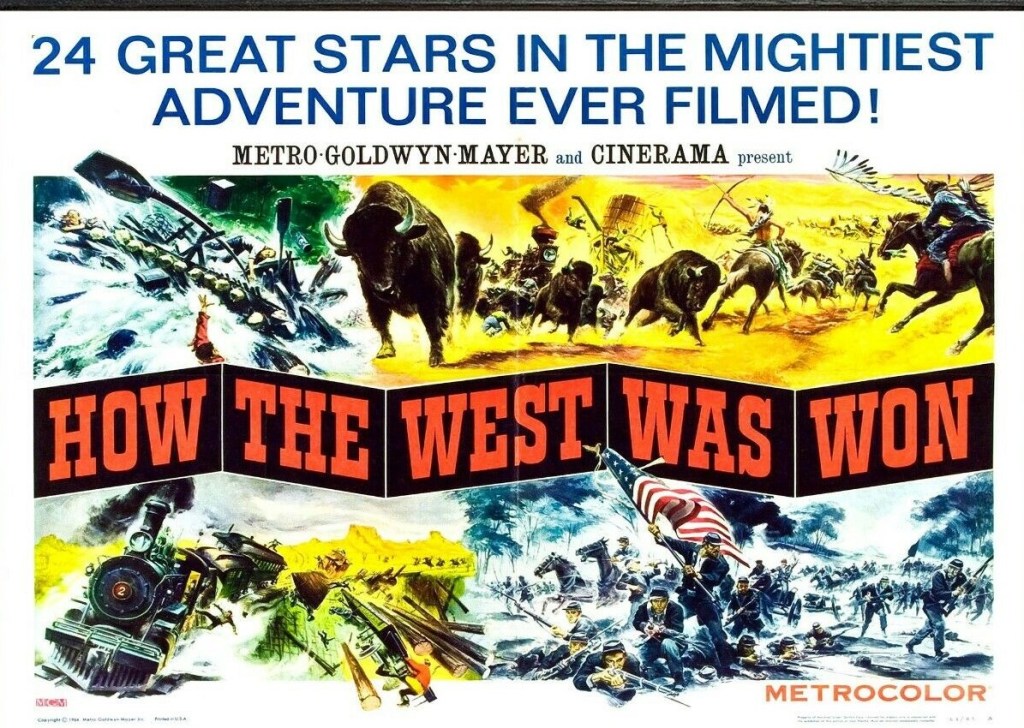
Not only is it a rip-roaring picture featuring the all-star cast to end all-star casts it’s a very satisfying drama to boot and it follows an arc that goes from enterprise to consequence, pretty much the definition of all exploration.
Given it covers virtually a half-century – from 1839 to 1889 – and could easily have been a sprawling mess dotted by cameos, it is astonishingly clever in knowing when to drop characters and when to take them up again, and there’s very little of the maudlin. For every pioneer there’s a predator or hustler whether river pirates, gamblers or outlaws and even a country as big as the United States can’t get any peace with itself, the Civil War coming plumb in the middle of the narrative.
Some enterprising character has built the Erie Canal, making it much easier for families to head west by river. Mountain man fur trader Linus Rawlings (James Stewart) on meeting prospective pioneers the Prescotts has a hankering after the young Eve (Carroll Baker) but as a self-confessed sinner and valuing his freedom has no intention of settling down. But he is bushwhacked by river pirates headed by Jeb Hawkins (Walter Brennan) and left for dead, but after saving the Prescotts from the gang changes his mind about settling down and sets up a homesteading with Eve.
We have already been introduced to Eve’s sister Lilith (Debbie Reynolds) who has attracted the attention of huckster Cleve Van Valen (Gregory Peck) and they meet again in St Louis where she is a music hall turn and widow. Her physical attraction pales in comparison with the fact she has inherited a gold mine. He follows her, unwelcome, in a wagon train which survives attack by Cheyenne, but still she resists him, not falling for him until a third meeting on a riverboat.
Zeb Rawlings (George Peppard) wants to follow his father to fight in the Civil War. Linus dies there, but there’s no great drama about it, he’s just another casualty, and the death is in the passing. In probably the only section that feels squeezed in, following the Battle of Shiloh a disillusioned Zeb saves General Sherman (John Wayne) and Ulysses S. Grant (Harry Morgan) from an assassin.
Returning home to find Eve dead, Zeb hands over his share of the farm to his brother and heads west to join the U.S. Cavalry at a time when the Army is required to keep the peace with Native Americans enraged by railroad expansion. Zeb links up with buffalo hunter Jethro Stuart (Henry Fonda), who appeared at the beginning as a friend of his father.
Eve, a widow again, meets up in Arizona with family man and lawman Zeb who uncovers a plot by outlaw Charlie Gant (Eli Wallach) to hijack a train. Zeb turns rancher once again, looking after her farm.
But the drama is peppered throughout by the kind of vivid action required of the Cinerama format, all such sections filmed from the audience point-of-view. So the Prescotts are caught in thundering rapids, there’s a wagon train attack and buffalo stampede, and a speeding train heading to spectacular wreck. There’s plenty other conflict and not so many winsome moments.
Interestingly, in the first half it’s the women who drive the narrative, Eve taming Linus, Lilith constantly fending off Cleve. And there’s no shortage of exposing the weaknesses and greed of the explorers, the railroad barons and buffalo hunters and outlaws, and few of the characters are aloof from some version of that greed, whether it be to own land or a gold mine or even in an incipient version of the rampaging buffalo hunters to pick off enough to make a healthy living.
And here’s the kicker. Virtually all the all-star cast play against type. John Wayne (Circus World, 1964) reveals tremendous insecurity, Gregory Peck (Mirage, 1965) is an unscrupulous though charming renegade, the otherwise sassy Debbie Reynolds (My Six Loves, 1963) is as dumb as they come to fall for him, and for all the glimpses of the aw-shucks persona James Stewart (Shenandoah, 1965) plays a much meaner hard-drinking hard-whoring version of his mean cowboy. Carroll Baker (Station Six Sahara, 1963) is an innocent not her usual temptress while George Peppard (The Blue Max, 1966) who usually depends on charm gets no opportunity to use it. .
Also worth mentioning: Henry Fonda (Madigan, 1968), Lee J. Cobb (Coogan’s Bluff, 1968), Carolyn Jones (Morticia in The Addams Family, 1964-1966), Eli Wallach (The Moon-Spinners, 1964), Richard Widmark (Madigan), Karl Malden (Nevada Smith, 1966) and Robert Preston (The Music Man, 1962).
Though John Ford (The Man Who Shot Liberty Valance, 1962) had a hand in directing the picture, it was a small one (the short Civil War episode), and virtually all the credit belongs to Henry Hathaway (Circus World) who helmed three of the five sections with George Marshall (The Sheepman, 1958) taking up the slack for the railroad section.
And though you might balk at the idea of trying to cover such a lengthy period, there’s no doubting the skill of screenwriter James R. Webb (Alfred the Great, 1969) to mesh together so many strands, bring so many characters alive and write such good dialog. Bear in mind this was based on a series of non-fiction articles in Life magazine, not a novel, so events not characters had been to the forefront. Webb populated this with interesting people and built an excellent structure.
I’m still tapping my toe as I write this and I was tapping my toe big-style to be able to see this courtesy of the Bradford Widescreen Weekend on the giant Cinerama screen with an old print where the vertical lines occasionally showed up. Superlatives are superfluous.
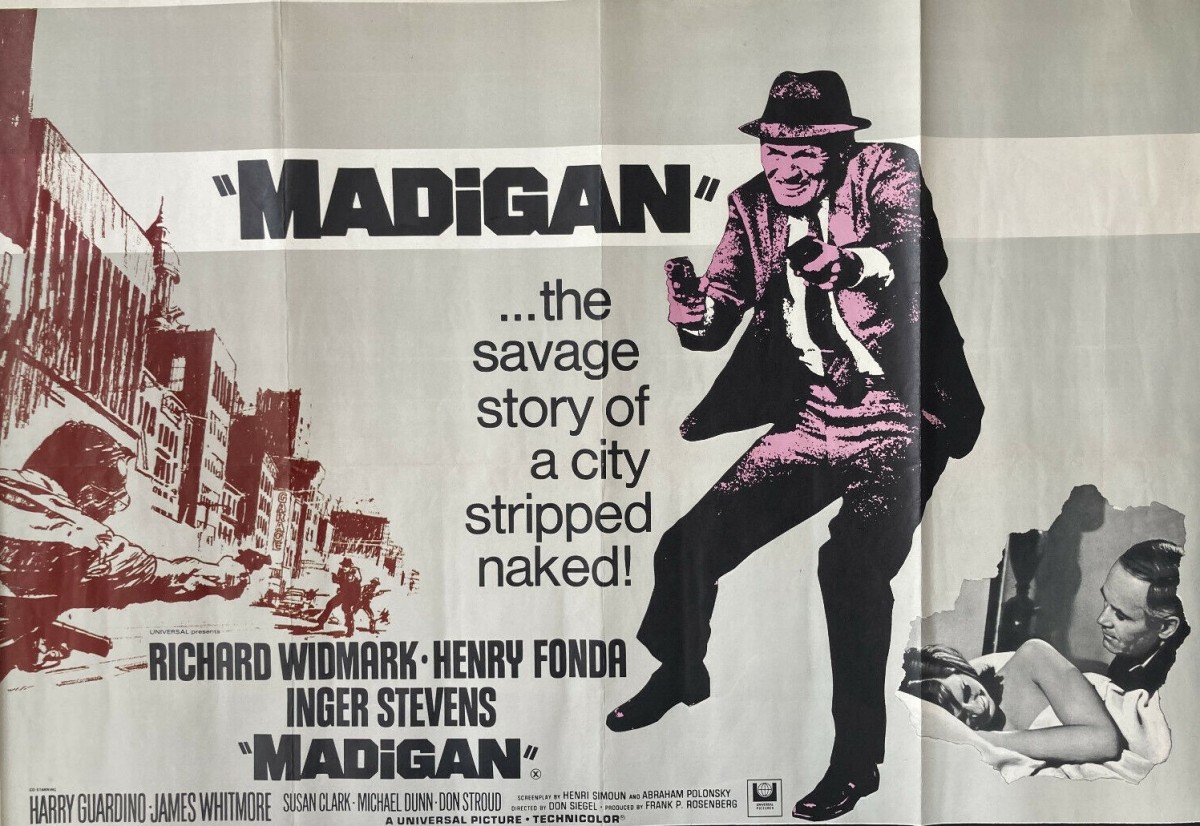
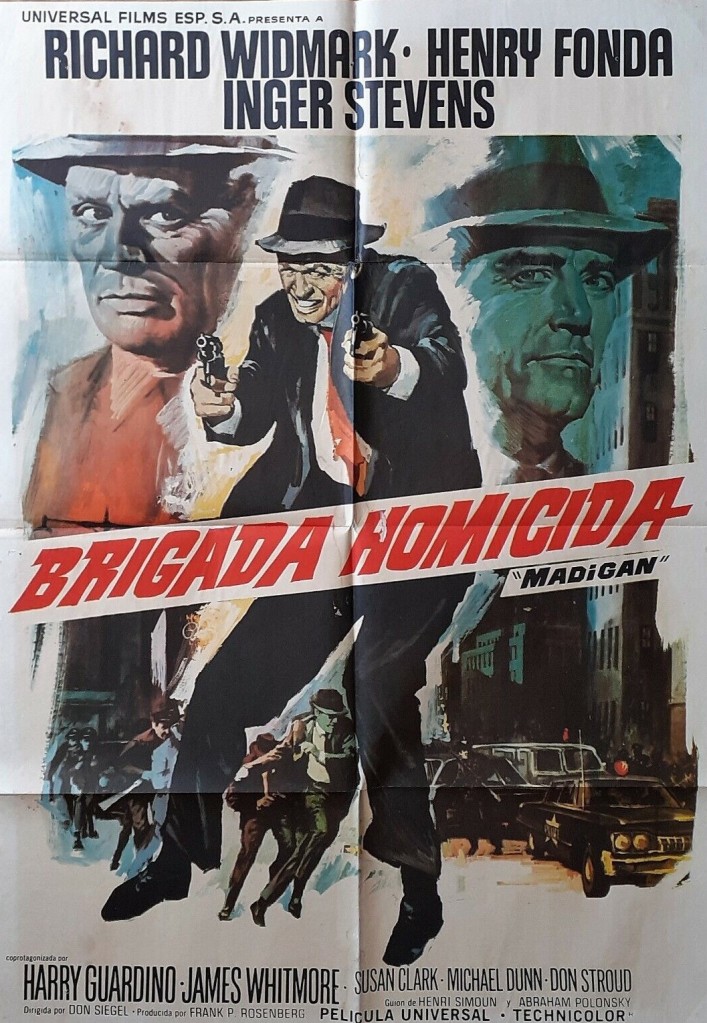
Reignited the careers of director Don Siegel (no Hollywood traction since Hell Is For Heroes in 1962), Richard Widmark (reduced to supporting roles) and Henry Fonda (no longer first name on the team sheet for the biggest pictures) and reinvented the cop thriller as a gritty urban affair. The plot – chasing down a suspect – is a MacGuffin to explore tough police methods, corruption, and the harm the job does to the domestic lives of the police.
Detective Dan Madigan (Richard Widmark) and partner Rocco Bonero (Harry Guardino) come woefully and embarrassingly unstuck when hood Benesch (Steve Ihnat) evades capture and steals their guns. They have 72 hours to bring him back or be suspended. So, basically, they spend most of the time following a bunch of leads, intimidating anyone who gets in their way, including a helpless secretary. And while Bonero is happily domesticated, Madigan’s lonely wife Julia (Inger Stevens) is fed up with late nights and broken promises to the extent of considering a one-night stand when hubby stands her up once too often.
Commissioner Russell (Henry Fonda) has his hands full dealing with the errant detectives without the ramifications of corruption involving his best friend, long-time cop Chief Inspector Kane (James Whitmore). The widowed Russell would be a poster-boy for the principled cop except he’s having an affair with married woman Tricia (Susan Clark).
While Madigan is kicking and snarling his way through the underworld, Russell is trying to work out how to save his friendship and his affair. And while they might appear opposites, the classy top officer and the street cop, the uptight Russell envies Madigan’s way with people. Madigan is comped drinks and even a suite at the Sherry-Netherland hotel not merely because he’s a cop but because his charm goes a long way.
And while Russell dithers over helping out a friend, Madigan has no qualms about being taking for a ride by an old pal down on his luck and in need of an excuse to be bought a drink. When it comes down to it, Madigan is the better advert for humanity.
The soap opera elements don’t intrude too much on the thriller. Madigan and Bonero go in with fists blazing and work their way through a menagerie of skunks including Castiglione (Michael Dunn) and stool pigeon Hughie (Don Stroud). Benesch is a piece of work, not just clever enough to use his lover’s nudity to distract the attention of cops, but sufficiently hard-boiled to shoot a cop dead in the street and have little hesitation in opening fire on anyone who comes too close.
There’s some fascinating internal cop politics as Kane locks horns with Chief of Detectives Lynch (Bert Freed) over the latter’s insistence on suspending Madigan. And Russell has to finagle his way through the problems a well-heeled son is causing a rich doctor (Raymond Jacques).
Every time the pace slackens, the movie falls back on the old Chandler routine, have someone come through the door with a gun (a fist would suffice). Madigan is a driven cop, struggling to hold onto his marriage, Julia too often the sacrificial lamb. And for all his outward bravado, there’s a superb scene when unexpectedly encountering Russell he turns into a stammering ball of nerves, like a schoolkid anticipating a roasting from a headmaster.
Richard Widmark (The Bedford Incident, 1964) has a hell of a part, tough guy, check, but with a side helping of kindness, and pretty assured on the loving front, investing what could have been a fairly cliched character with a good deal of complexity. Henry Fonda (Firecreek, 1968) does a lot of pacing as his self-esteem implodes; how can he be a good guy if he’s running around with another man’s wife and how can he stick to his principles if he’s going to let a pal away with corruption?
Inger Stevens (Firecreek, 1968) is impressive as the disappointed wife trying to keep disappointment at bay. Harry Guardino (Hell Is For Heroes) always makes a good sidekick, but James Whitmore (The Split, 1968) digs into a sack of guilt as he attempts to avoid the oncoming storm. Don Stroud was almost auditioning for Don Siegel – he would turn up again in Coogan’s Bluff (1968) and Joe Kidd (1973); Susan Clark, too, Eastwood’s squeeze in Coogan’s Bluff. In smaller parts are Sheree North (Lawman, 1971) and Raymond St Jacques (Uptight, 1968).
But the show belongs to Don Seigel. There can be few directors so out-of-favor that they are able on their return to kick start a new cop cycle that culminated in Dirty Harry (1971). While this pulls no punches on the action front, it’s the quieter behind-the-scenes domesticity that almost as much catches the eye, the way he gives the characters time to breathe, opens them up to reveal more intricate inner workings.
It also spelled rebirth for blacklisted screenwriter Abraham Polonsky (Tell Them Willie Boy Is Here, 1969) in his first credit under his own name for 17 years. He didn’t do it all himself, though, Howard Rodman (Coogan’s Bluff) sharing the chores, the pair working from the novel The Commissioner by Richard Dougherty.
In October 1962 Otto Preminger bought the rights to Harm’s Way, a thumping big bestseller by Ronald Basset with a host of characters and sub-plots which serve, like Advise and Consent by Allen Drury, to analyse an American institution, in this case the Navy, pre- and post-Pearl Harbor. In some respects, it was an odd choice, Preminger better known for pictures that filleted such august institutions, The Cardinal (1964) exposed the inner workings of the Catholic Church. On the other hand, it rubbed shoulders quite happily with Exodus (1960), a tale of battle against the odds.
Preminger’s aim was to blunt the current onslaught of movie pessimism with a picture that ended on an optimistic note. He observed: “We are attacked, we are unprepared in every way, and manage by sheer guts, character and resourcefulness to start to work out of it.” He concluded that such action “should remind us and perhaps other people that there is never any reason to give up or to give in to anything that is not right or dignified.”
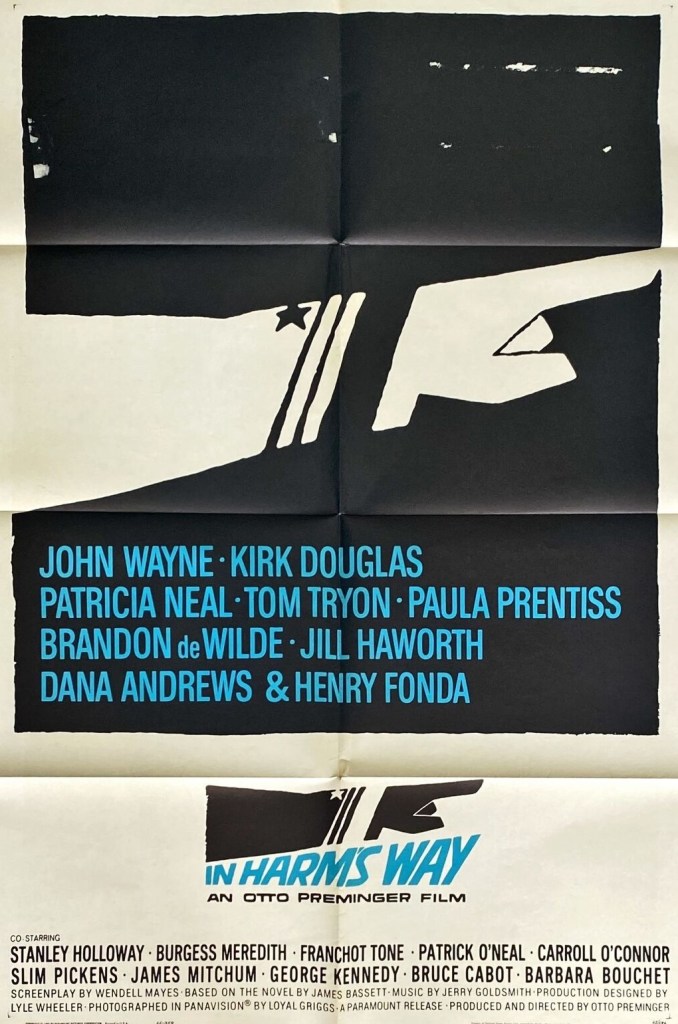
Celebrated Saul Bass poster.
“One of the reasons I made In Harm’s Way,” explained the director, “is that it is a big step away from most of the films I have made so far. I try not to repeat myself too much…not to make pictures in just one category…I was very fascinated by the characters and the story..,(which) shows that people will act even if they are unprepared and don’t want war.”
Wendell Mayes (Advise and Consent, 1962) started on the screenplay right away, taking it so far as embarking on a rewrite with the director in London. But the project was unexpectedly shelved for a couple of years. In the meantime Preminger assigned a different writer, Richard Jessup. But when the concept received the director’s full attention once again Mayes was at the wheel and with a different approach. “I had a fresher point of view and did many things that were not in the book at all. I think we improved it for that reason, since we had quite forgotten the novel.”
But collaboration with Preminger was exacting. “We sat together and and worked over almost every line,” explained the director. “I always work very closely with the writer on the screenplay…There is one man, the independent producer-director, who from very beginning takes the whole responsibility and has complete autonomy. I feel responsible for the script: I engaged the writer and I worked with him. Like I direct actors, I feel a director also directs the script.”
In particular, into sharper focus came the son, Jeremiah (played in the film by Brandon de Wilde) of Rockwell Torrey (John Wayne). In the book he had been a passing, insignificant character, who quickly befriended his father. “He had no feelings about the fact that his father had left his mother, and we changed that in the script,” said Mayes. This provided not just a source of dramatic tension but a more mature role for Wayne, who had to express regret for the estrangement, all his fault. (Although the idea of a son enlisting against the mother’s wishes reflect a similar situation in Rio Grande, 1950).
Wayne was Preminger’s first choice. “Because it has passive elements, a strong actor like Wayne is ideally cast,” said the director. Despite being sent an incomplete script, the star signed up – for $500,000. “I don’t look for stars and I don’t avoid them,” he said. The leading roles in Bunny Lake Missing (1965) and The Cardinal (1964) went to relative unknowns. “I would not ask John Wayne to play, say, a coward because his image is not the image of a coward, or have him play a Greek philosopher…He at least fulfilled all my expectations more than I could possibly hope for. Kirk Douglas, too, came to my mind almost immediately.”
The movie should have ended up at Columbia which had funded the director’s last two movies and would back Bunny Lake. But Preminger had just struck a deal for seven pictures with Paramount and in January 1964 that agreement was announced with the re-titled In Harm’s Way (a phrase associated with John Paul Jones).
Mayes completed the new draft two months later with the rest of the cast now assembled, including Preminger contract players Tom Tryon (The Cardinal) and Jill Haworth (Exodus) who replaced original choice Carol Lynley (Bunny Lake). Keir Dullea turned down the part of Jeremiah. Advise and Consent’s Henry Fonda came on board as the overall Navy commander at the expense of Chill Wills who was fired after shooting had begun.
One uncredited recruitment was Hugh O’Brian (Africa, Texas Style, 1967) who undertook the part of Liz Eddington’s lover. “He played a role as a favor without compensation,” recalled Preminger. “He did not want billing and only asked that I give some money to a charity. I needed somebody who was a secure actor and right for the part because I used a complete beginner (Barbara Bouchet) for the girl he plays opposite. And if I used some other young actor with her, people would have felt that this couple would disappear almost immediately at the beginning of the film. It was important to me to establish this young couple as an important episode at the beginning of the film and he helped that.”
The director spent three days scouting locations in Hawaii but decided to shoot in black-and-white because “ a picture like this has much more impact and you can create more of the feeling, the illusion of reality, than when you shoot it in color.” False guns mounts were attached to more recent ships since the older relevant vessels were no longer available.
Wayne with co-star Patricia Neal.
Shooting started on June 23. The biggest issue was transportation, drivers getting lost reaching locations for the night-for-night sequences. Preminger struggled to meet his shooting schedule and the movie was soon over budget thanks to long hours, Sunday working and extra local staff. Even so, the Hawaii shoot came in 17 days ahead of schedule. Five days were assigned for shooting at sea. Larger than usual miniatures – some as much as 55ft long – were shot over a month on a lake in Mexico and in the Gulf of Mexico, the battle of Leyte Gulf costing an estimated $1 million. “I needed the real horizon,” said Preminger.
Some scenes were proving impossible to capture first time out. A second unit had two attempts filming a car going over a cliff, a marine landing was spoiled by water on the lens, and technical problems prevented Preminger achieving a “mystic-hour shot” of a plane taking off. Part of the director’s problem was his insistence on rehearsal. “I could make every picture in ten days if I slough it. Some actors just need more time and more rehearsal.”
Despite observers expecting – perhaps hoping – for volatile confrontation between the director and star, the pair enjoyed a cordial relationship based on mutual respect. Of Wayne, Preminger commented that he was “the most cooperative actor, willing to rehearse, willing to do anything as long as anybody. I was surprised really how disciplined a professional Wayne is and he liked this particular part very much.”
From Wayne’s perspective, “He had my respect and I had his respect. He is terribly hard on the crew and he’s terribly hard on people that he thinks are sloughing. But this is a thing that I can understand because I’ve been there (directing The Alamo) and I know that if a fellow comes on and he’s careless and he hasn’t thought at all about his…I come ready and that he appreciated that. I was usually there ahead of him on the set and he couldn’t believe that. So we had a really nice relationship.”
It was surprising Wayne remained on such an even keel since he was beginning to suffer from the cancer that would eventually kill him. “He looked ill,” Tryon remembered, “He was coughing badly, I mean, really awful. It was painful to see, so God knows what it was like for him. He’d begin coughing in the middle of a scene and Preminger would have to stop filming.” Although he refused to consult a doctor during filming, he agreed to a check-up once shooting of his role was complete, three weeks earlier than scheduled. He may indeed have owed his life to Preminger’s speedy shooting.
Kirk Douglas had a bone to pick with Preminger after the director stole the glory of being the first director to publicly announce, on Exodus, that he had employed a blacklisted writer, pre-empting Douglas who had done the same for Spartacus (1960). Although Douglas didn’t rank Preminger as a director he enjoyed a good relationship with him except for one minor confrontation.
Douglas got on well with Wayne: “There was a mutual respect…We got along quite well…He was a strange fellow. I’ll never forget the talk we had about my playing in Lust for Life (1956). Although emotionally we were not close and politically we were antipodal he asked me to work with him several times.” (Not entirely true – Douglas would have been the driving force for their collaboration on Cast a Giant Shadow in 1966 and he fell out spectacularly with Wayne on The War Wagon in 1967).
But others suffered from Preminger’s notorious temper, Tom Tryon in particular. The bullying became so bad Kirk Douglas once walked off the set. Douglas advised Tryon to fight back but Tryon could not pluck up the courage. Chill Wills who endured Preminger at his “absolute worst” did stand up to him and was fired. Patrick O’Neal turned on actors who refused to fight their corner. “Stand up to him once and find out he’s a human being,” was his advice.
Myth has it that Paula Prentiss’s role was truncated after she fell foul of the director but rumour was baseless. In fact, Prentiss was another of the director’s defenders, claiming he was “absolutely wonderful to work with. For a scene to work, tension needs to be put into a scene. There have to be genuine efforts to make the scene work. And Preminger understood this and was able to get much conflict and tension into the scenes.” And he was not all tough talk. She recalls him as particularly gentle guiding her through the scene where she asks her husband to make her pregnant.
Although surpassing the original $5 million budget, it was not by much, an extra $436,000. The Production Code had objected to the phrase “screw the captain,” a line Preminger refused to remove and despite further protest from the censor, who threatened to withhold the precious official approval,the director got his way. Preminger had shot the scene where Barbara Bouchet was dancing topless from the rear but the still photographs were sensational enough for publication in Playboy in its May 1965 issue.
The decision to shoot in black-and-white probably accounted for the picture’s relatively poor box office. Its length and the all-star cast should have qualified it for roadshow. (It was roadhsow for all of one day at two prestigious new York first houses; the next day it went continuous, but you could advance book a seat for an extra 50 cents). It was a sign of how quickly audience perceptions had changed that only three years previously the black-and-white The Longest Day had appeared as a roadshow and proved a resounding hit.
As a result of Wayne’s illness The Sons of Katie Elder was postponed. Preminger moved onto a smaller project, Bunny Lake Is Missing and Douglas reverted to top billing for The Heroes of Telemark (1965). Tom Tryon never worked for Preminger again and after top-billing in The Glory Guys (1965) faded from Hollywood view, re-emerging as the bestselling author of The Other. Paula Prentiss shifted sideways into television with He and She (1967-1968) and Jill Haworth made very few films after this, of which most were horror.
SOURCES: Chris Fujiwara, The World and Its Double, The Life and Work of Otto Preminger (Faber and Faber, 2008), p317-329; Scott Eyman, John Wayne, The Life and Legend, (Simon & Schuster, 2015) p385-387; Maurice Zolotow, Shooting Star, A Biography of John Wayne (Simon & Schuster, 1974) p361-362; Michael Munn, John Wayne: The Man Behind the Myth (Robson Books, 2003) p254-255; Kirk Douglas, The Ragman’s Son (Simon & Schuster, 2012), p387-381; Ian Cameron, Mark Shivas, Paul Mayersberg, “Interview with Otto Preminger,” Movie 13 (Summer 1965), p15-16; Patrick McGilligan, Backstory 3, p266; Otto Preminger, “Keeping Out of Harm’s Way,” Films and Filming, June 1965, p6; Newsweek, April 20, 1964; New York Herald Tribune, October 17, 1965, p55.