You wouldn’t figure director Henry Hathaway for a caper movie. He seemed more at home with action, whether that be war (The Desert Fox, 1951), adventure (Legend of the Lost, 1957) or western (Nevada Smith, 1966) although he was a dab hand at film noir (Kiss of Death, 1947). And before the big-budget all-star Oceans 11 entered the equation in the same year as Seven Thieves – and stole much of its thunder – the heist movie ran mostly on B-movie steam such as Rififi (1955), The Killing (1956) and Big Deal on Madonna Street (1958).
And probably judged against other glossy efforts of the 1960s like Topkapi (1964) and Gambit (1967) Seven Thieves would appear on the surface to come up a bit short. No doubt accounting for it being so under-rated. But while this is in itself a neat little thriller the kick comes in the emotional entanglements and a succession of twists at the end that sends it in my book into a higher category.
And it’s so outrageously clever that the mystery of why French-based criminal mastermind Theo Wilkins (Edward G. Robinson) would reach out across the Atlantic Ocean to recruit former jailbird Paul Mason (Rod Steiger) to spearhead the heist of a cool four million dollars from a Monte Carlo casino is not resolved until the end, and in spectacular fashion.
Technically, there are actually only six thieves, the other is an inside man, Raymond (Alexander Scourby), who has fallen for the seductive charms of nightclub dancer Melanie (Joan Collins). Making up the rest of the septet are safe cracker Louis (Michael Dante) and muscle-cum-driver Hugo (Berry Kroeger) with Poncho (Eli Wallach) playing the key role of the pretend crippled, arrogant, irascible millionaire – and contrary to the claims of one poster he is the decoy not Melanie.
Distrust of his team makes Theo bring in Paul, who ruthlessly knocks them into shape, putting into seamless action the plan devised by Theo. Simply put, Poncho is going to act as a distraction by having a heart attack at the gambling table while Paul and Louis climb out a window along a ledge to the casino director’s flat which provides, by means of an elevator, direct access to the underground vaults. Once they’ve stolen the cash, they clamber back along the ledge and hide in the flat where, by this time, Theo, playing the role of Poncho’s personal physician, has taken him. The money will be hidden in Poncho’s wheelchair and removed to a waiting ambulance.
But Paul is a rather suspicious character and wants to know what he’s letting himself in for so in turn works out the weaknesses of his team. Melanie hides behind a façade of high birth, Pancho is too reckless, “measuring danger only in terms of profit,” Hugo prone to unnecessary violence, while Louis has omitted to mention he is terrified of heights, the ledge on which the operation depends standing on a 100ft high cliff.
In some posters, this was promoted as Al Capone (Steiger) vs Little Caesar (Robinson).
The plan relies on Poncho actually appearing to be dead, so dead that the casino director (Sebastian Cabot) will not hesitate, at Theo’s insistence, to shift him out of sight of the rest of the gamblers into his flat. But Complication No 1 is that Poncho doesn’t want to be dead, even if it is a ruse, skeptical of Theo’s plan to convincingly knock him out by means of a carefully measured dose of cyanide. Complication No 2 is that a night club client recognizes Melanie and casts doubt on her credentials as a lady of quality. Complication No 3 is that English physician Dr Halsey (Alan Caillou) questions whether Poncho is as dead as he seems.
But such complications are nothing compared an extraordinary range of twists that raise tension sky-high at the movie’s denouement. I challenge you to guess what these three superbly-conceived twists would be, all of them one by one turning the project on its head, and it rapidly shifts from one direction to another, ending with an unbelievable – and yet so in keeping with the premise – climax.
Attention to character detail lifts this out of the rut, whether it be Theo’s penchant for collecting seashells, Paul resplendent in a white suit, Melanie resisting the blandishments of becoming a kept woman, Raymond trying to climb out the murky depths into which the lure of Melanie has taken him, and a series of subtle relationships, some developing through the robbery, others which began long before the heist working themselves out.
The heist itself is well done, tension kept constant mostly through the failings of the crew and the suspicions of the dupes. All in all an excellent picture.
This was a critical film in the careers of most of the cast. Edward G. Robinson (The Cincinnati Kid, 1965) was handed his first top-billed role in four years. It was a deliberate change of pace for Rod Steiger (The Pawnbroker, 1964). For Eli Wallach, best known at the time for stage work, it was the first of three films that year that would launch him into the higher ranks of top supporting stars; it was followed by The Magnificent Seven and The Misfits. After being leading lady to the likes of Gregory Peck and Richard Burton, this spelled the end of Twentieth Century Fox’s belief in Joan Collins’ star qualities while for Michael Dante (The Naked Kiss, 1964) it was a step up.
Wallach and Dante could be accused of over-acting but Robinson, Steiger and Collins all act against type with considerable effect. Hathaway does a superb job working from a script by Sydney Boehm (Rough Night in Jericho, 1967) based on the Max Catto bestseller.
Half breed Max Sand (Steve McQueen) has little truck with the notion that revenge is a dish best served cold. But he’s too young and raw, far from Lee Marvin’s callous killer in Point Blank (1969), to properly avenge the slaughter of his family by three outlaws.
This is a coming-of-age tale with a distinct difference. Max’s development includes, apart from initiation into sex of course, learning to read and write so he can make sense of signposts in order to track down the murderers and receiving tuition from gunsmith Jonas Cord (Brian Keith) so that he can at least loose off some shots without doing himself damage. Vengeance burns so deep that he even stages a bumbled robbery so he can be sent to the prison where the second of his targets is incarcerated. Now that’s dedication for you. And along the way he learns the most important lesson of all, how to live, and not destroy himself through vengeance.
Even so, all Cord’s tuition counts for nought when Max needs a knife to dispatch his first victim Coe (Martin Landau). And he’s not yet so slick with a weapon to avoid serious injury himself. Kiowa saloon girl Neesa (Janet Margolin) nurses him back to health at her tribe’s camp. They become lovers but he rejects the wisdom of the elders and the opportunity to make a life with her.
Unfortunately, Bowdre (Arthur Kennedy) is a jailbird. And worse, held prisoner in a swamp. Probably the worst bank robbery ever committed sends Nevada there. Max enrols another woman, Cajun Pilar (Suzanne Pleshette) working in nearby rice fields – fraternization between the jailbirds and these women permitted – to steal a boat to help him and Bowdre escape. Bowdre gets his and this time it’s Pilar who is the collateral damage.
A genuine outlaw now, Max has no trouble joining a band of robbers headed by Fitch (Karl Malden), the final prey. By now calling himself Nevada Smith, Max’s plans are thrown into confusion when it becomes apparent Fitch is aware of his true identity. A surprise ending is on the cards whichever way you cut it, and especially thrilling since it occurs during a well-planned gold bullion robbery.
It’s a film of two parts but divided into three if you like, the unusual swamp setting fitting in between two sections of more straightforward western. Though in the hands of director Henry Hathaway (True Grit, 1969), there is little that’s so straightforward given his mastery of the widescreen and his hallmark extreme long shot. He’s capable of moving from the extreme violence of the vicious murder and rape of Max’s mother to the son’s discovery of the bodies shown just through Max’s physical reaction. And there’s some irony at play, too: gold triggers slaughter and climax; mental dereliction not as feared as its physical counterpart.
Although Hathaway was a true veteran, he was not best known for westerns in the manner of John Ford, more at home with film noir (Kiss of Death, 1947), war (The Desert Fox, 1951) and big-budget pictures like Niagara (1954) with Marilyn Monroe and Legend of the Lost (1957) teaming John Wayne and Sophia Loren. Orior to this. in a 30-year career he had only made three westerns of note – The Trail of the Lonesome Pine (1936), Rawhide (1951) and Garden of Evil (1954). So it was something of a surprise that in the 1960s over half his output was in the western genre. And unlike Ford and Howard Hawks who stuck to the formula of action within a defined community, Hathaway tended towards films of adventure, where the main character, often of a somewhat shady disposition, wandered far and wide.
Steve McQueen (The Cincinnati Kid, 1965) carries the picture with some aplomb, moving deftly from the wet-behind-the-ears youngster to a clever and calculated killer and still retaining enough humanity to enjoy a romantic dalliance. There’s enough action here to satisfy McQueen’s fans spoiled by The Magnificent Seven (1960) and The Great Escape (1963) and for those who had come to appreciate his acting plenty to enjoy. This and The Cincinnati Kid, where perforce as a poker player, he had to do a great deal of brooding, solidified his screen persona, a star you can’t keep your eyes off, wondering what on earth is going on in his mind. As much as he’s playing a character finding his feet, this is McQueen at very nearly the top of his game.
Brian Keith (The Rare Breed, 1966) is the pick of the support, adding a little softness to his usual more hard-nosed screen characters. The villains – Karl Malden (The Cincinnati Kid), Martin Landau (The Hallelujah Trail, 1965) and Arthur Kennedy (Claudelle Inglish, 1961) – are all good in their own different ways, and in the hands of excellent actors, easily differentiated. Suzanne Pleshette (Fate is the Hunter, 1964) shines in a too-brief role.
The sterling supporting cast includes Janet Margolin (Bus Riley’s Back in Town, 1965), Pat Hingle (Sol Madrid, 1968) and Raf Vallone (The Secret Invasion, 1964). John Michael Hayes (Harlow, 1965) fashioned the screenplay from The Carpetbaggers by Harold Robbins.
Although Hollywood had been prone to sequels – Father’s Little Dividend (1951) following Father of the Bride (1950), Return to Peyton Place (1961), Return of the Seven (1966) etc – there had been no perceived market for prequels, so this was something of a first, Alan Ladd having essayed an older and considerably more sophisticated Nevada Smith in the 1964 film of Harold Robbins bestseller.
Not cut out for the musicals, comedies, historical adventures (let’s not count The Greatest Story Ever Told, 1965), thrillers, dramas, and spy pictures that dominated that 1960s the western was John Wayne’s default. After his initial battle with lung cancer, he enjoyed an extended period of success in Henry Hathaway’s The Sons of Katie Elder (1965), Howard Hawks’ El Dorado (1967) and Burt Kennedy’s The War Wagon (1967) before diversifying in Vietnam war picture The Green Berets (1968), which he directed and was also a hit, and Andrew V. McLaglen oil drama Hellfighters which did, however, fall short of his high box office standards. So when any big western picture was mooted, it was either Wayne or James Stewart to whom producers first came calling. But when the actor particularly wanted a part, he usually got it.
Charles Portis was a journalist with one modern novel, Norwood published in 1966, to his name when he wrote True Grit, published in 1968, which, unusually for a western, spent 22 weeks in the New York Times bestseller list. The main attraction for a reader was the equally unusual first-person narrator, Mattie Ross, towards the end of her life telling the tale of how as a 14-year-old in Arkansas she sought bloody revenge for the death of her father. The narrative voice was highly individual with colorful phrases, punchy dialogue, and a taut storyline.
Producer Hal Wallis snapped it up for $300,000, beating out Wayne’s Batjac operation. Wallis had been making his own pictures for over two decades, having originally overseen films as varied as swashbuckler Captain Blood (1935) and Casablanca (1942). He also had a western pedigree, having set up John Sturges’ Gunfight at the O.K. Corral (1957), The Sons of Katie Elder and Five Card Stud (1968) with Dean Martin and Robert Mitchum.
The movie went into speedy production, barely a year from the novel’s publication to the world premiere. From the start Wallis had Wayne in mind for Rooster Cogburn, with Robert Mitchum as back-up. Mia Farrow turned down the role of Mattie Ross when she found out the director was to be Henry Hathaway. Genevieve Bujold turned it down because she didn’t want to work with Wayne. Wayne favored Katharine Ross (The Hellfighters, 1968) or Michele Carey (El Dorado) or his daughter Aissa whom Hathaway ruled out. Sally Field from the television series The Flying Nun was also considered, but the part finally went to 21-year-old Kim Darby.
She had been in the movies since 1963 (an uncredited role in Bye, Bye, Birdie) and, excepting small roles in Bus Riley’s Back in Town (1965) starring Ann-Margret, fourth-billing in both the low-budget The Restless Ones (1965) and Arthur Penn television movie Flesh and Blood (1968), confined to guest roles in routine television series such as The Fugitive, Star Trek, Gunsmoke and Bonanza.
Elvis Presley was touted for the role of Le Boeuf but manager Col. Parker insisted his client receive top billing and the role went to another popular singer Glen Campbell, who had made his movie debut in The Cool Ones (1967). Robert Duvall, filling the boots of Lucky Ned Pepper, was also a refugee from television (The Outer Limits, The Fugitive, Combat) although he had delivered a memorable performance as Boo Radley in To Kill a Mockingbird (1962) and had risen to third-billing for Francis Ford Coppola’s The Rain People (1969).
Henry Hathaway, a former child actor, had directed 60 movies beginning in 1932. But he had learned about direction at the feet of Josef von Sternberg and Victor Fleming, both hard taskmasters, and only made the move into megging at the third attempt. First of all, he had spent nine months touring India with the idea of making a film in the style of silent documentaries Grass: A Nation’s Battle for Life (1925) or Chang: A Drama of the Wilderness (1927). He managed to attract the interest of Irving G. Thalberg but the producer died before funding materialized. Next, Paramount planned to hire him when the studio planned an early 1930s investment in color but got cold feet and the idea was dropped. Finally, when Paramount decided it was going to make its own westerns, rather than buying them in, he was hired to direct Heritage of the Desert (1932) starring Randolph Scott but after six more in that genre – being paid $100 a week for the first two and then $65 a week for the next two after the Depression bit – he hit pay dirt with adventure The Lives of a Bengal Lancer (1935) with Gary Cooper and comedy Go WestYoung Man (1936) with Mae West.
When Paramount finally embraced three-color Technicolor they chose Hathaway to direct adventure The Trail of the Lonesome Pine (1936) starring Sylvia Sidney and Fred MacMurray. “It cannot be merely accidental that he was selected,” commented historian Kingley Canham, arguing that Hathaway had “more than just an aptitude for freshening familiar material through technical resourcefulness.”
And like John Ford he was economical with the camera. “I only shoot what can be used so the producer has no choice…I always cut in the camera, the cutter just has to put the ends together,” he said. Determined to achieve verisimilitude, instead of using studio hand-made locusts for biopic Brigham Young (1940), he travelled to Nevada where had been a big invasion of the insects. Except for this film and The Shepherd of the Hills (1941), starring Wayne, he steered clear of westerns, preferring action and drama. However, he was instrumental in helping Wayne extend his acting style. For Shepherd of the Hills, Hathaway “added new subtleties to the already characteristic western hero persona – the roiling gait and economy of dialog were still very much in evidence but his acting was more mature, more sensitive, and more assured.”
He was called upon to demonstrate further technical mastery in the first of Twentieth Century Fox’s semi-documentary dramas The House on 92nd St (1945) followed by film noir Dark Corner (1946) and Kiss of Death (1947). He made his first western in a decade with Rawhide (1951) toplining Tyrone Power and Susan Hayward and only two other westerns in the 1950s – Garden of Evil (1954), teaming Cooper and Hayward, and Hell to Texas (1958) with Audie Murphy, the twist in this one being the hero rather than the villain subjected to a manhunt. Another technical innovation came with The Desert Fox (1951), where he “did the whole raid before the titles,” the first time any action had been shown prior to the rolling of the opening credits.
He was so impressed with the acting skills of Marilyn Monroe in Niagara (1953) that he purchased Somerset Maugham’s Of Human Bondage intending to team her with Montgomery Clift, but nothing came of the concept. He worked with Wayne again in Legend of the Lost (1957) co-starring Sophia Loren.
But, like Wayne, he returned in triumph to the western in the 1960s, all bar two of his movies in this decade in this genre, the first four of the decade starring Wayne – North to Alaska (1960), How the West Was Won (1962), Circus World (1964) and The Sons of Katie Elder. He had finished up on Five Card Stud when Hal Wallis invited him to direct True Grit. He had only received one Oscar nomination, four decades previously, for The Lives of a Bengal Lancer, and no avant garde French film critic was reassessing his work, but he was known to bring movies in on time, and had his own distinct style if anyone could be bothered looking for it.
Certain themes did reappear, revenge for one, which was central to The Trail of the Lonesome Pine, Kiss of Death, historical adventure The Black Rose (1950), Prince Valiant (1954) with James Mason, The Sons of Katie Elder and Nevada Smith (1966) starring Steve McQueen. He also focused on disruption within the family, and situations where an older man aids an impetuous youngster, both instrumental to True Grit. “He is the only director I know,” observed Kingsley Canham, “to have specialized in films about backwoods and mountains.”
Screenwriter Marguerite Roberts was also old-school, born in 1905, with over 30 screen credits. She sold her first script while working as a secretary at Fox, had her first screen credit in 1933 for Sailor’s Luck. By 1939 she was earning $2,500 a week at MGM and turned out Honky Tonk (1941) with Clark Gable and Lana Turner, Sea of Grass (1946) with Katharine Hepburn and Spencer Tracy, Gunga Din remake Soldiers Three (1951) and big-budget historical adventure Ivanhoe (1951) with Robert Taylor and Elizabeth Taylor.
Like Abraham Polonsky she fell out of favor with Hollywood for her left-wing sympathies and was blacklisted for nearly a decade until Daniel Petrie’s The Main Attraction (1962) with Pat Boone and Nancy Kwan, Guy Green’s Diamond Head (1962) with Charlton Heston and Rampage (1963) with Robert Mitchum. She, too, had been working for Hal Wallis on Five Card Stud before receiving the commission to adapt the Portis book.
Roberts was familiar with the Old West, since her father had been a lawman in Colorado. Screenwriter Wendell Mayes, who wrote From Hell to Texas, commented that “Henry Hathaway is very easy for a writer to work with.” “When a screenplay is finished,” said Hathaway, “I go through it and work on it. I worked on True Grit with Marguerite Roberts because there was a great deal of repetition in the book and I eliminated a lot of things.” John Wayne felt Hathaway “never got the creative credit I think is due him…He was sort of a story doctor…a fine, instinctive, creator.”
Her first problem was how to translate the book’s distinctive first-person style onto the screen without the entire movie sounding too archaic and although many speeches were lifted verbatim from the book it was Roberts who established Mattie Ross as an authority figure from the outset by introducer the teenager as her father’s “bookkeeper” and inventing the argument about the type of horses he intended to buy.
The result is an unusual composite of tight storyline, exuberant characterization and wonderful dialog. The movie was filmed mainly in Colorado – Ouray, Owl Creek Pass, Ridgway, Canon City, Montrose, Bishop, and Gunnison – as well as Durango in Mexico and Inyo National Park in California where Hot Creek was used for the outlaw’s cabin and also Sherwin Summit.
The critics, who had slaughtered The Green Berets the previous year, and been largely indifferent to many of his previous westerns during the 1960s, virtually gave him a standing ovation. Variety called it a “top adventure drama…Wayne towers over everything in the film – the actors, script and even the magnificent Colorado mountains.”
Vincent Canby of the New York Times called it “a triumph…one of the major movies of the year.” The New York Daily News claimed it was “John Wayne’s finest moment.” The New York Post came closest to defining its appeal: “Few westerns will come along this or any other year that can be as fully enjoyed by as many people of varying ages and sex.” Vernon Scott of United Press was not alone in predicting “Wayne should win the Oscar.”
Joyce Haber of the Los Angeles Times said, “come Oscar time Wayne will be a leading contender.” Norma Lee Browning of the Chicago Tribune informed readers that “there’s already talk that he may, at long last, get an Oscar nomination.” Charles McHarry of the New York Daily News held the same view. Time opined “a flawless portrait of a flawed man.” International Motion Picture Exhibitor found it “the perfect vehicle for Henry Hathaway’s directorial style. He approached the simple western story in the most straightforward manner…garnished it with a delightful humor that springs right out of the vagaries of the homespun characters…and giving it a rhythm that carries the viewer along despite its lengthy running time.”
Allen Eyles in Focus on Film summed up the film’s appeal: “That True Grit could end up being the best western of the year is a tribute to old Hollywood – to a producer, director, star, cameraman and others who’ve been at the top of the film business for more than three decades. Their solid, unpretentious professionalism enables them to meet the challenge of filming a first-rate novel with pleasing assurance and directness…it is far superior to…the poorly-shaped but occasionally striking The Wild Bunch from Peckinpah…(it) is not innovatory in style but the details are communicated with a freshness that is appealing.”
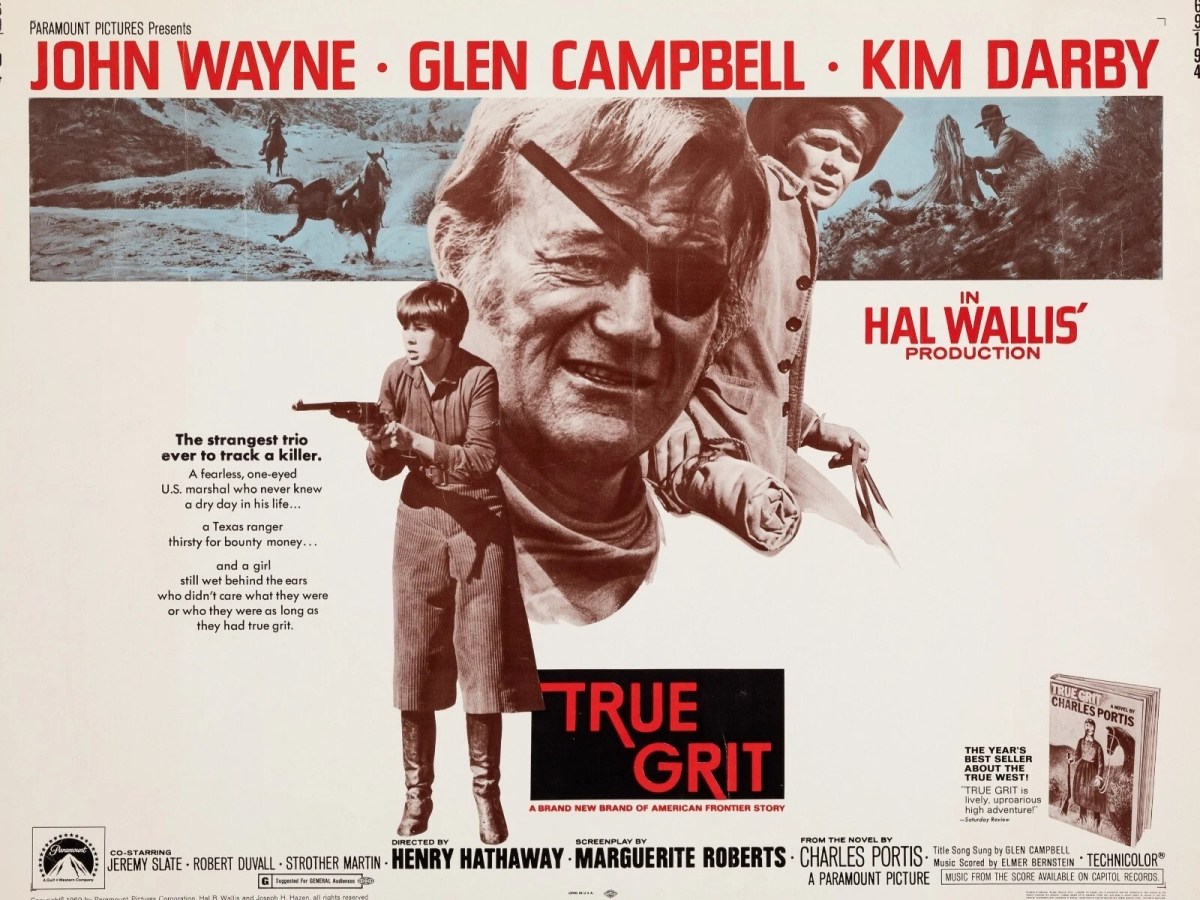
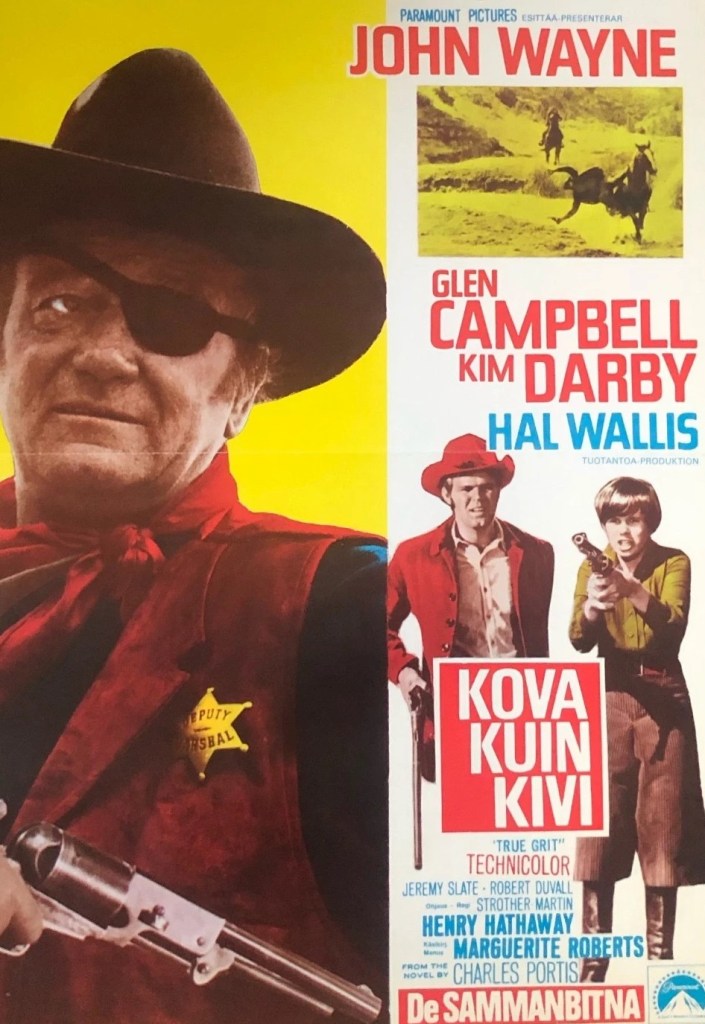
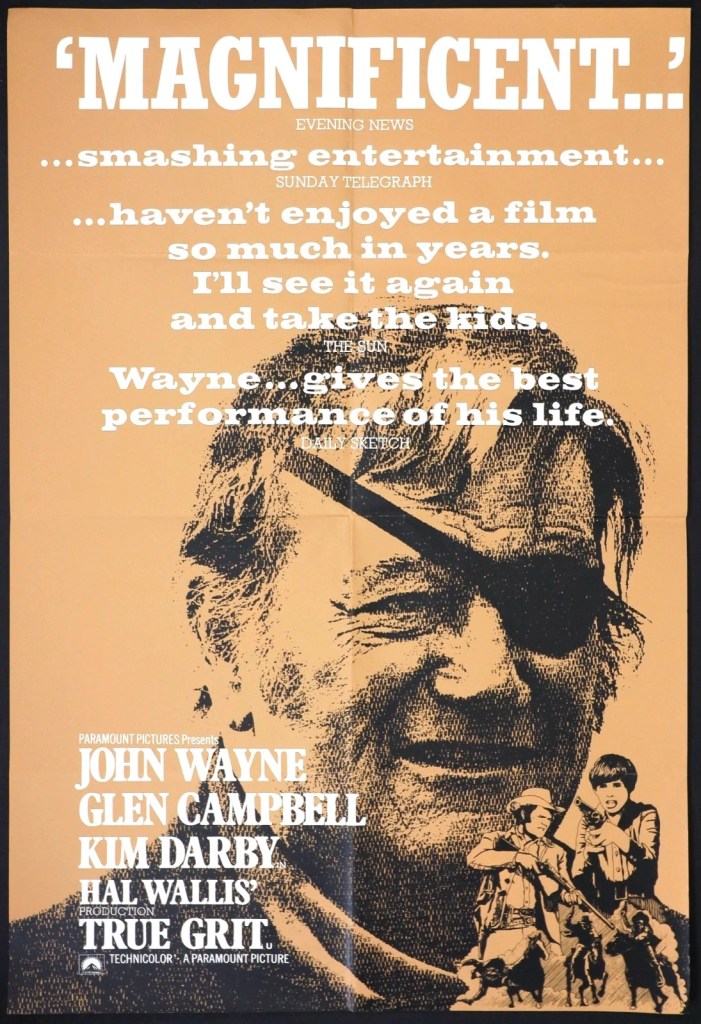
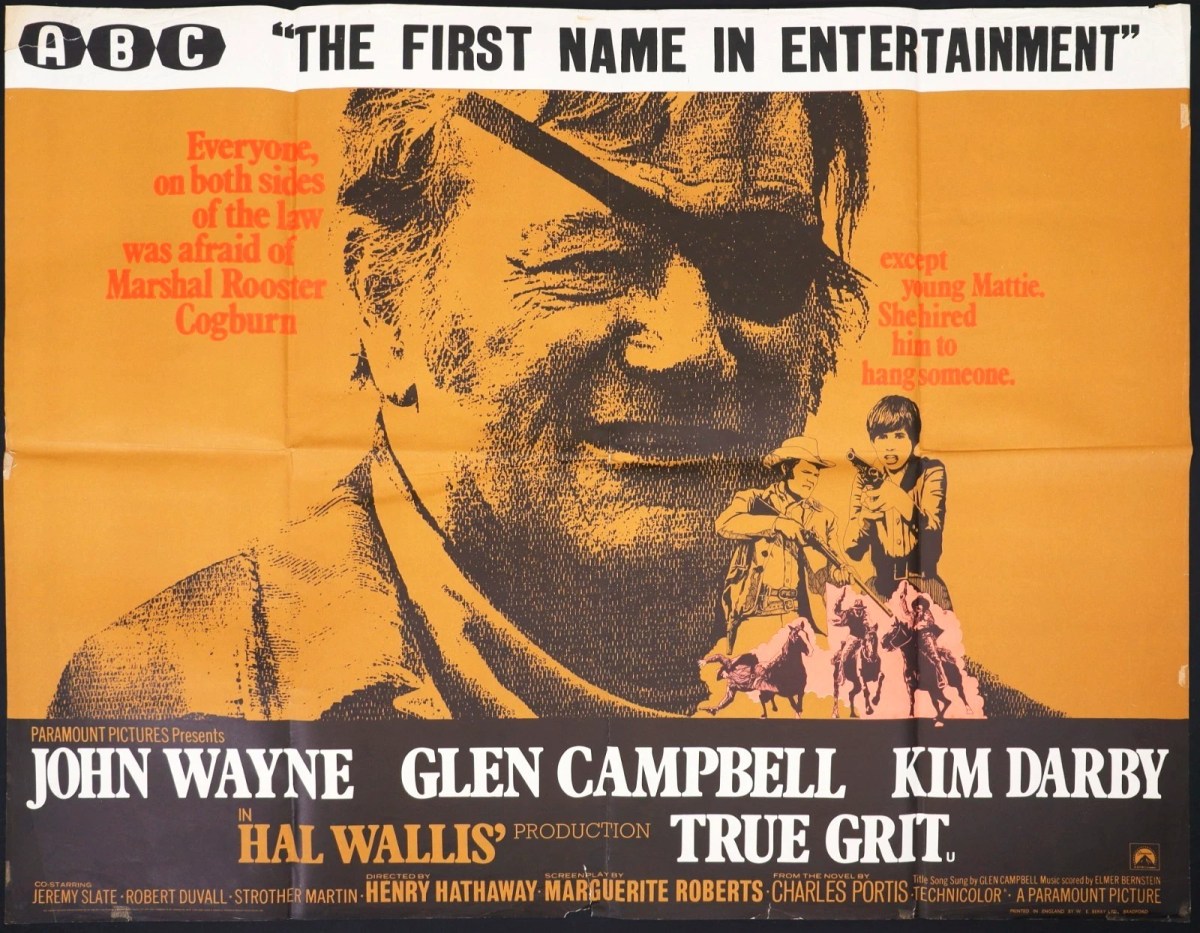
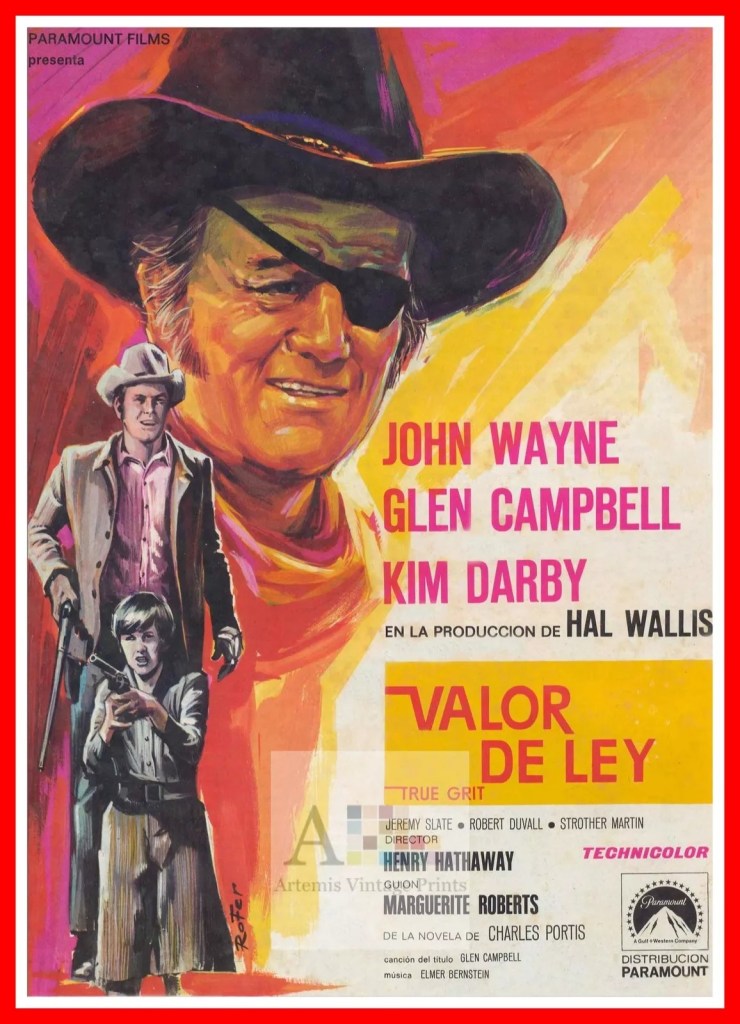
Unusually, for a film of the period, the movie repeated a single image in all of its advertising, Wayne’s face dominating the composition, with below him Mattie Ross standing gun in hand and Glen Campbell behind him. That Campbell sang the title song over the credits led to the release of a record, and there was a New American Library book tie-in. Ancillary promotional items included a t-shirt embellished with the words “This Man Has True Grit,” and buttons announcing “I Have True Grit” and, alternatively, “Give Me a Man with True Grit.” Stetson created a special hat called “The Duke,” with a special one costing $1,500 to be presented to Johnny Carson on his show, with an advertising campaign that included Playboy and Esquire while Aramis created a special line of “Grit Soap.”
Time magazine had raised expectations for the picture by putting John Wayne on the front cover, on August 8, although this was in part retaliation to Life’s joint cover story on Wayne and Dustin Hoffman which ran in the Jul 11 issue, and Paramount took a gamble opening it in New York at the Radio City Music Hall, partly a ploy to boost European revenues, the first western to be so honored, although the theater covered itself by claiming the movie was an “outdoor adventure” rather than a western per se. The picture broke all sorts of records there and went on to conquer America, shattering Dallas records, for example, and then helped along by the Time cover story. For a few months it looked set to become the best performing western of all time, but was soon overtaken by the release of Butch Cassidy and the Sundance Kid. Even so, it took $11.5 million in rentals to finish sixth in the annual chart. It was reissued after Wayne’s Oscar triumph the following year in an unlikely double bill with Oscar-nominated The Sterile Cuckoo and grossed $3.7 million in the twelve days. But Paramount, trying to offset calamitous losses, prematurely sold off the western to television so its reissue value was sharply curtailed.
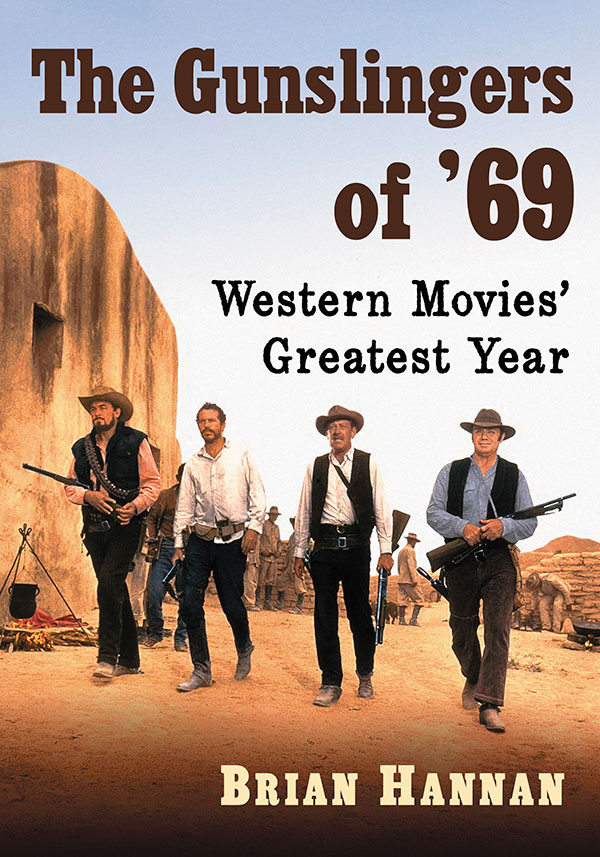
SOURCE: Brian Hannan, The Gunslingers of ’69: Western Movies’ Greatest Year, (McFarland, 2019).
An old-style western with a modernized anti-hero in Rooster Cogburn (John Wayne), nearly as “rapaciously brutal” as the same year’s The Wild Bunch, a script with language that captured the period, a heroine Mattie Ross (Kim Darby) who falls into the robust Barbara Stanwyck/Maureen O’Hara mold, humor and action in equal measure, and an unfussy director (Henry Hathaway) who loved the panorama even more than John Ford.
Although still critically rated as not as good as The Wild Bunch, and still mostly disdained by academics, I would argue that it has been grossly under-rated and fully deserving of a re-evaluation. In the first place, despite direction very much in the old school, Hathaway exhibits many stylistic flourishes, not least the very long shot which has rarely been used to such effect. He also utilizes the shaky-camera point-of-view in a much more effective manner than Mackenna’s Gold (1969) to record Cogburn’s charge at the outlaws and there is even a zoom, to pick out the villain Tom Chaney.
Also, you know exactly where you are in a Hathaway picture, not just in the narrative sense, but in terms of how people lived and where the towns and farms were in relation to each other (the Ross farm is 70 miles from Fort Smith, the hamlet of McAllister 60 miles from the villains’ hideout). He liked to show many aspects of a town, so we see where the courthouse is in relation to the jail and the stable by the simple expedient of having the characters walk past them. And the movie is littered with sound effects of the most ordinary kind (blacksmith’s hammer, train whistle, footsteps). The film is as much about progress as Once Upon a Time in the West and The Wild Bunch, the name of the town, Fort Smith, where much of the initial action takes place, indicates it was once a frontier town.
Rooster Cogburn feels crowded out by a new generation of lawyers challenging swift justice, and Mattie Ross, hunting the killers of her father, is well schooled in argument, winning many a confrontation with apparently more experienced and wily men by being more adept at negotiation and like a chess player always one move ahead. The aftermath of the Civil War lingers in the background, demonstrated by Mattie’s weapon and Cogburn’s antipathy to Texas Ranger LaBeef (Glen Campbell). But the story strikes an even balance, no matter how assured Mattie Ross comes across in civilization she almost comes apart in the wilds and without the protection of Cogburn would have met the kind of fate at the hands of men undergone by female characters in The Stalking Moon (1969), Mackenna’s Gold and The Wild Bunch.
It should be said here that the movie is full of audience direction, we are always told where Mattie will go next or where Cogburn is intending to go, with accompanying plausible reason, especially when later Cogburn calls off the hunt for the outlaws. There is no exploration of mystery, the characters are always upfront, and where characters express regret is it minus the self-pitying of The Wild Bunch. Nobody is defined by something they should have done instead, so, in that respect, the narrative is as clear as the overall direction.
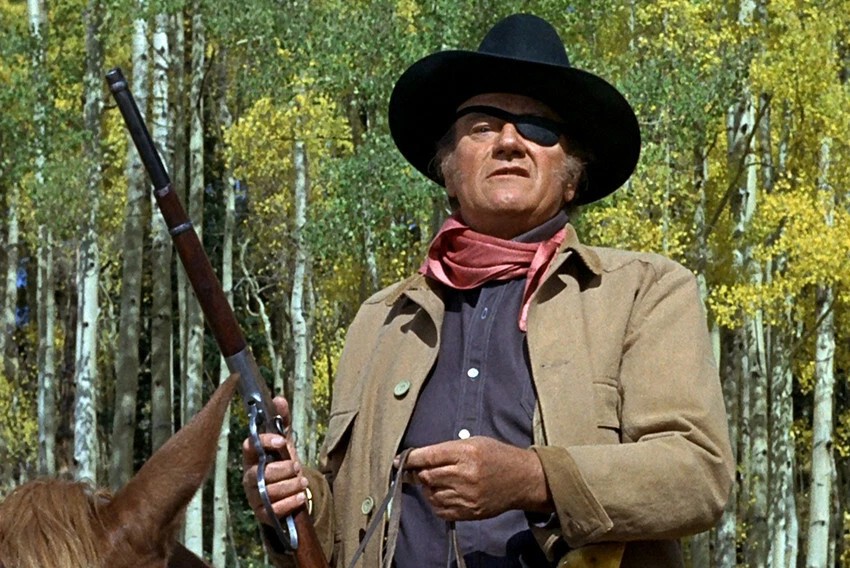
We hear Cogburn’s voice before we see him, as if the director is preparing us for a different John Wayne. This is the actor in a new timbre, the usual slow drawl replaced by a raucous bark. And it is a different Wayne, one eye covered in a black patch, giving him a piratical look. He hustles the prisoners out, kicking one straggler viciously in the butt. Wayne walks differently, too. Instead of the famous slow walk, Cogburn is a man in a hurry, pushing forward with purposeful stride, ignoring Mattie as she comes racing after him, slamming the basement door in her face.
LeBeef is another dreamer, “nobody yet” but aiming to “marry well”, in this case “a well-placed young lady in Waco” who would “look with favor” on him for bringing back Chaney who has also killed a senator. His charm fails to convince Mattie to join forces. She sees right through him: “I have no regard for you but I’m sure you have enough for yourself to go around.”
Then comes a four-minute Mattie tour de force as she confronts Col Stonehill (Strother Martin) and demands $300 in reparation for the loss of her father’s saddle and for selling him dodgy horses. She threatens him with the law in the shape of Daggett, her secret weapon, and she knows enough about legality to beat Stonehill at his own game. Even better, this is no meek woman. It is one thing to be able to score points off an old lawman like Cogburn, who would have been putty in the hands of any capable woman of the Stanwyck/O’Hara variety, but another to outwit a wily old horse-dealer like Stonehill (his title a hangover from the Civil War and one which ensures a measure of respect). Even better again, she knows she will win, so confident that she has already drawn up the papers to sign.
Now neither Cogburn nor LeBeef are witness to this demonstration of her capability, so they will, naturally, treat her as a young girl, “baby sister” in Cogburn’s dismissive term. But Hathaway is setting a trap for the audience. Having witnessed this display, we think she will be able to hold her own in the wilderness, mistaking her willfulness for sagacity, and so are on her side in her attempts to win over the two men, when, in fact, she will prove to be so out of her depth as to endanger herself and others.
The pursuit is dogged, and everyone at some point is found wanting. Cogburn smokes the villains out from their cabin and would kill the others without warning except LaBeef objects out of principle and Mattie wants Chaney alive.
At Mattie’s prompting, we hear Cogburn’s mostly unvarnished, but never maudlin, history, he lost his eye in the war, committed a robbery to fund the purchase of an eating place that had a billiard table, married a grass widow, until she left him for her first husband, taking their son, Horace, hiding his sorrow at the boy’s departure in a grumpy “he never liked me anyway” and berating him as “clumsy.” When she lies down to sleep, he gazes at her fondly for the first time, perhaps prompted by memory of his loss.
In the climactic shoot-out, in the most famous John Wayne image since his character’s introduction in Stagecoach (1969), first in long shot then from his point-of-view with a shaky camera, he grasps the reins in his teeth and fires two-handed. He kills two but Pepper shoots his horse from under him and Cogburn, in a sign of his age when otherwise traditionally cowboys leap free of a falling horse, is trapped on the ground under the weight of the animal, unable to reach his gun or to shift. The wounded Pepper advances. He towers over Cogburn until LaBeef, whose marksmanship had previously been in question, saves his life.
And that should pretty much have been the end of the picture, roll credits with Chaney being hung, but there is still nearly 15 minutes to go. Returning to collect Chaney, LaBeef is ambushed, cracked on the head by a rock. Mattie shoots Chaney but the recoil sends her into the snake pit. Cogburn arrives in time to kill the wanted man, also sending him into the pit. She has damaged her shoulder and cannot pull herself up on a rope so Cogburn has to descend. He shoots a rattlesnake but another bites her.
She still had enough presence of mind to demand he first collect her fallen gun and her father’s gold piece from Chaney’s corpse. As he hauls himself up, a dazed LaBeef, mounted on a horse, pulls on the tope to ease their ascent, but the effort is too much, and he keels over and dies.
Mattie strokes his head, the first sign of her changed feelings towards him. Alternatively, this could be guilt because it was her wrong-headedness that caused his death, but that seems unlikely, she is not one to covet regret. Cogburn slaps saliva on the wound (rather than, as we might expect from watching other westerns, sucking out the poison), puts her arm in a sling, and sticks her on Blackie, her horse, despite her protests about the little horse carrying such a weight. Cogburn is ruthless, riding the horse so hard it dies. Then he carries her and finally steals a buggy.
Where previously most of the journey had been rendered in long shot, now Hathaway reverts to medium shot and close up of the haggard Cogburn racing desperately to save the girl’s life. When we cut to Cogburn and Chen Lee instinctively we know she has been saved. The lawyer Daggett appears to pay Cogburn what he is owed plus $200 for saving her life, though, typically, she has prepared a receipt for him to sign.
Then she is home. It is winter. Snow lies on the ground. Cogburn explains there was no woman waiting for LaBeef, though the marshal has collected the reward. She shows him her father’s grave and wants Cogburn, the father she has adopted, to be buried in the same burial ground. She gives him her father’s gun and in a final triumphant moment the “fat old man” gloriously rides over a four-bar fence waving his hat in the air.
John Wayne received just reward with his Oscar, Glen Campbell (The Cool Ones, 1967) does better than we might expect from a singer. Kim Darby (Bus Riley’s Back in Town, 1965) was ignored by Oscar voters but she certainly holds her own. Terrific direction by Henry Hathaway (5 Card Stud, 1968) from a script by Marguerite Roberts (5 Card Stud) based on the bestseller by Charles Portis (Norwood, 1970).
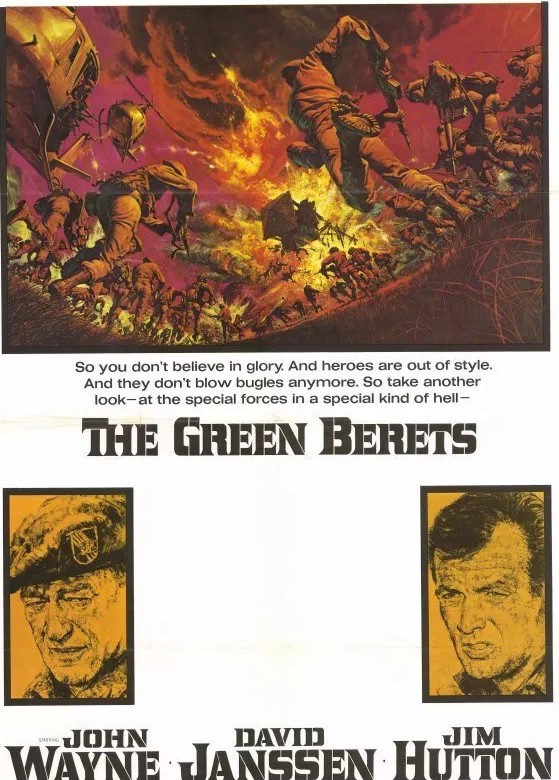
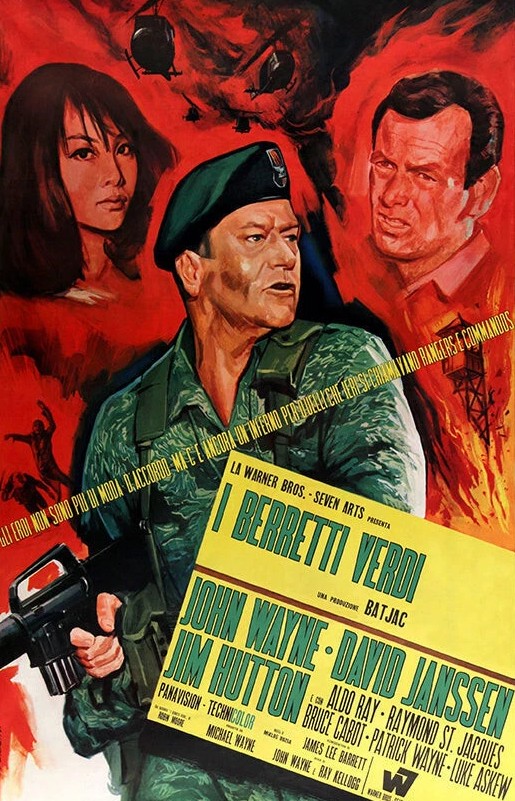
As if John Wayne hadn’t endured enough directing The Alamo (1960), he took on an even weightier task with this Vietnam War picture which, from the start, was likely to receive a critical roasting given the actor’s well-known stance on the conflict and his anti-Communist views that dated back to the McCarthy Era of the 1950s. Wayne had enjoyed a charmed life at the box office with three successive hit westerns, Henry Hathaway’s The Sons of Katie Elder (1965) with Dean Martin, Burt Kennedy’s The War Wagon (1967) co-starring Kirk Douglas, and best of all from a critical and commercial standpoint Howard Hawks El Dorado (1967) pairing Robert Mitchum. Outside of box office grosses, Wayne’s movies tended to be more profitable than his box office rivals because they were generally more inexpensive to make.
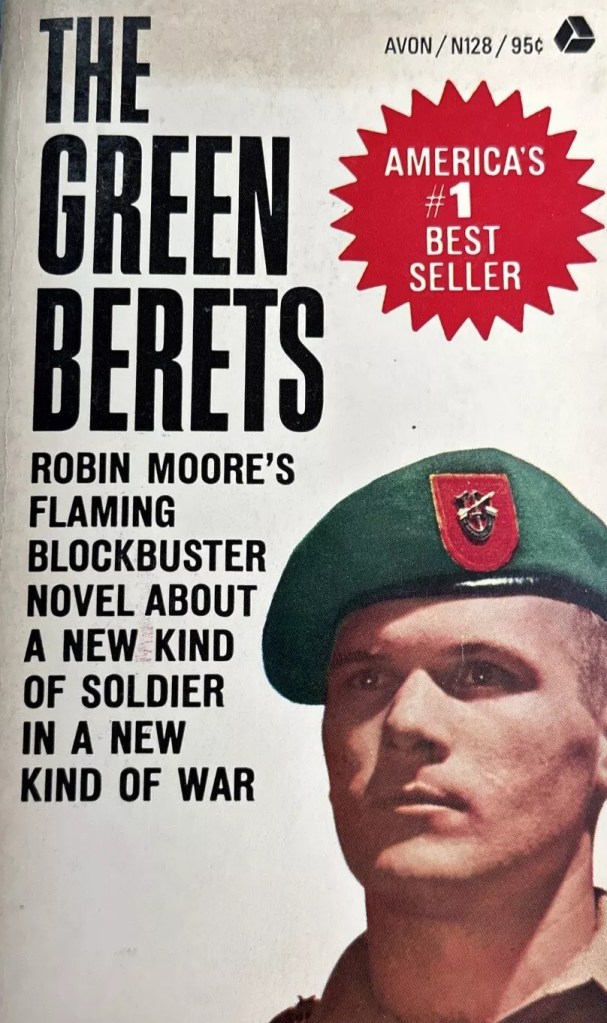
Columbia had been the first to recognize the potential of the book by Robin Moore and purchased the rights pre-publication in 1965 long before antipathy to the war reached its peak. A screenplay was commissioned from George Goodman who had served in the Special Forces the previous decade and was to to return to Vietnam on a research mission. But the studio couldn’t turn out a script that met the approval of the U.S. Army. Independent producer David Wolper (The Devil’s Brigade, 1968) was next to throw the dice but he couldn’t find the financing.
In 1966 Wayne took a trip to Vietnam and was impressed by what he saw. He bought the rights to the non-fiction book by Robin Moore (who also wrote The French Connection) for $35,000 plus a five per cent profit share. While the movie veered away in many places from the book, the honey trap and kidnapping of the general came from that source, although, ironically, that episode was entirely fictitious, originating in the mind of Robin Moore.
Universal originally agreed to back The Green Berets with filming scheduled for early 1967 but when it pulled out the project shifted to Warner Bros. And as if the director hadn’t learned his lesson from The Alamo, it was originally greenlit for a budget of $5.1 million, an amount that would prove signally inappropriate as the final count was $7 million. Wayne turned down the leading role in The Dirty Dozen (1967) to concentrate on this project. Wayne’s character was based on real-life Finnish Larry Thorne who had joined the Special Forces in Vietnam in 1963 and was reported missing in action in 1965 (his body was recovered four decades later).
As well as John Wayne, the movie was a platform for rising stars like Jim Hutton (Walk, Don’t Run, 1966), David Janssen (Warning Shot, 1967) and Luke Askew (Easy Rider, 1969) who replaced Bruce Dern. Howard Keel, who had appeared in The War Wagon, turned down a role.
Wayne holstered his normal $750,000 fee for acting plus $120,000 for directing. But it turned out The Alamo had taught him one important lesson – not to shoulder too much of the responsibility – and Ray Kellogg for the modest sum of $40,000 was brought in as co-director. It was produced by Wayne’s production company, Batjac, now run by his son Michael. But neither Wayne nor Kellogg proved up to the task and concerned the movie was falling behind schedule and over budget the studio drafted in veteran director Mervyn Leroy – current remuneration $200,000 plus a percentage – whose over 40 years in the business ranged from gangster machine-gun fest Little Caesar (1931) to his most recent offering the Hitchcock-lite Moment to Moment (1966).
But exactly what LeRoy contributed over the next six months was open to question. Some reports had him directing all the scenes involving the star; others took the view that primarily he played the role of consultant, on set to offer advice. Even with his presence, the movie came in 18 days over schedule – 25 per cent longer than planned. Unlike the later Apocalypse Now (1979), it didn’t go anywhere near South-East Asia so the location didn’t add any of Coppola’s lush atmosphere, though the almost constant rain in Georgia, while a bugbear for the actors, helped authenticity.
It was filmed instead on five acres of Government land around Fort Benning, Georgia, hence pine forests rather than tropical trees. President Lyndon B. Johnson and the Department of Defense offered full cooperation. But that was only after the producers complied with Army stipulations regarding the screenplay. James Lee Barratt’s script was altered to show the Vietnamese involved in defending the camp and the kidnapped was switched from being over the border. Also axed, though this time by the studio, was Wayne’s wish for a romantic element – the studio preferred more action. Sheree North (Madigan, 1968) was offered the role of Wayne’s wife but she also turned it down on political grounds. Vera Miles (The Hellfighters, 1968) was cast but she was edited out prior to release.
The Army provided UH-1 Huey helicopters, the Air Force chipped in with C-130 Hercules transports, A-1 Skyraiders and the AC-47 Puff the Magic Dragon gunship and also the airplane that utilized the skyhook system. Actors and extras were kitted out in the correct jungle fatigues and uniforms. Making a cameo appearance was Col Welch, commander of the Army Airborne School at Ft Benning. The sequence of soldiers doing drill was actually airborne recruits.
The attack on the camp is based on the Battle of Nam Dong in 1964 when the defenders saw off a much bigger enemy unit.
This set was built on a hill inside Fort Benning. The authentic detail included barbed wire trenches and punji sticks plus the use of mortar fire. While the camp was destroyed during filming the other villages were later used for training exercises. .
The pressure told on the Duke physically – he lost 15lb. But the oppressive heat and weather of that location – it was mostly shot in summer 1967 – was nothing compared to the reviews. It was slated by the critics with Wayne’s age for an active commander called into question, never mind the parachuting, the gung-ho heroics and the dalliance in an upmarket nightclub.
“In terms of Wayne’s directorial career,” wrote his biographer Scott Eyman, “The Alamo has many defenders, The Green Berets has none.” That assessment, of course, would be to ignore the moviegoers around the world who bought tickets and put the picture into reasonable profit.
Wayne was clear in his own mind about the kind of movie – “about good against bad” – he was making and accommodated neither gray areas nor took note of current attitudes to the war as exemplified by nationwide demonstrations. Co-stars David Janssen, Jim Hutton and George Takei were opposed to the war. Takei, a regular on the Star Trek series, missed a third of the episodes on the second season; his lines were written to suit the character of Chekov, who went on to have a bigger role in the television series. Composer Elmer Bernstein turned down the gig as it went against his political beliefs. “The Ballad of the Green Berets,” heard over the opening credits was not composed for the film, having been released two years earlier.
Most critics hated it – “Truly monstrous ineptitude” (New York Times); “cliché-ridden throwback” (Hollywood Reporter); “immoral” (Glamour). Even those reviews that were mixed still came down hard: “rip-roaring Vietnam battle story…but certainly not an intellectual piece” (Motion Picture Exhibitor). Not that Wayne was too concerned. At the more vital place of judgement – the box office – it took in $9.5 million in rentals (what’s returned to the studios once cinemas have taken their cut) – $8.7 million on original release and a bit more in reissue – in the U.S. alone plus a good chunk overseas.
It was virtually impossible to examine a movie like this without taking a political stance. Other movies covering the same topic were allowed greater latitude regarding authenticity, audiences and critics like appearing to accept that creating watchable drama often took precedence over the facts. Both The Deer Hunter (1978) and Apocalypse Now, considered the best of this sub-genre, clearly ventured away from strict reality. With over half a century distancing the contemporary viewer from those inflammatory times, it’s worth noting that it still divides critics. Or, rather, critics and the general public take opposing views.
Although Rotten Tomatoes deems it “an exciting war film”, the critics voting on that platform gave it a lowly 23 per cent favourable report compared to a generally positive 61 per cent from the ordinary viewer. That contrasts, for example, with a more even split for the likes of Exodus (1960) – 63 per cent from critics and 69 per cent from audiences. However, The Green Berets attracts twice as much interest, collaring 9,000 votes compared to just 4,300 for Exodus.
After this, Wayne’s fee went up to a flat million bucks a picture. “He wasn’t a guarantee of success,” explained his son Michael, “he was a guarantee against failure.” At this point in his career, he was gold-plated. Where other stars in his commercial league suffered the occasional box office lapse – Paul Newman’s career in the 1960s, for example, was riddled with flops like The Secret War of Harry Frigg (1968) – he did not. Especially with a global following, his pictures never lost money.
SOURCES: Michael Munn, John Wayne, The Man Behind the Myth, Robson, 2004; Scott Eyman, John Wayne, The Life and Legend, Simon and Schuster, 2014; Brian Hannan, The Magnificent 60s, The 100 Top Films at the Box Office, McFarland, 2023; Robin Moore, Introduction, The Green Berets, 1999 edition, Skyhorse Publishing; Laurence H. Suid, Guts and Glory, University of Lexington Press, 2002; The Making of The Green Berets, 2020; Review, Hollywood Reporter, June 17, 1968; Review, Motion Picture Exhibitor, June 19, 1968; Renata Adler, “The Absolute End of the ‘Romance of War’”, New York Times, June 30, 1968; Glamour, October 1968; “Big Rental Pictures of 1968,” Variety, January 8, 1969.
Producer Hal Wallis was known as a star maker. He had launched the careers of Burt Lancaster, Kirk Douglas, Lizabeth Scott, Dean Martin, Jerry Lewis and Shirley MacLaine and was instrumental in shaping Elvis Presley’s screen persona. Continually on the lookout for new talent and with a roster of pictures to cast, he had swooped in the mid-60s on Suzanna Leigh (Boeing Boeing, 1965), Broadway rising star Tanya Everett and on the basis of a television pilot Lithuanian-born Kaz Garas.
So if The Last Safari appears both overcooked and undercooked, put that down to Wallis saddling director Henry Hathaway with the untried Garas as his star, billed ahead, much to his fury, of veteran Stewart Granger (The Secret Invasion, 1964). The film’s way too long as the producer keeps finding ways to insert the youngster into the older man’s tale of hunting an elephant that killed his buddy. In fact, it’s another youngster, Gabriella Licudi (The Unearthly Stranger, 1965) who, with a fraction of Garas’s dialog, steals the show.
The safari picture was by now fast out of fashion, the days of glorifying hunting, even just to supply zoos as in Hatari! (1962), losing its appeal especially with the softer conservationist approach of Born Free (1966) and Africa, Texas Style (1967). So while issues regarding poaching, native self-determination, tribal tradition and colonial interference are given more coverage than you might expect, it still boils down to great white hunter Gilchrist (Stewart Granger) setting out to kill an elephant. That millionaire playboy Casey (Kaz Garas) keeps getting in his way is down to an odd screenplay and the top-billing error that seems determined to find more space for the younger irritant than for the older guy coming to terms with himself.
By the time Casey lands in Kenya in a zebra-striped private plane with native guide Grant (Gabriella Licudi), Granger has already torn up his hunter’s license. Much of the initial narrative is simply Casey pursuing him and being turned down, until the American simply decides to tag along, despite inexperience of the bush.
It’s unclear whether Grant is a guide-with-benefits but she milks him at every turn and filches anything she can, including a lucky charm belonging to Gilchrist. But where Casey drones on, the camera is kind to her, showing her character in tiny snippets, concealing the lucky charm at Gilchrist’s approach, for example, or not being at all perturbed at being excluded from dinner on the grounds that’s she’s a servant and astonished that Casey gets himself so wound up at what he sees as an injustice. She’s perfectly happy dancing the Watusi on her own away from the boring grown-ups. And she puts him in his place, “You want a trophy…I’m not for sale.”
Quite why Gilchrist is obsessed with this particular elephant is never satisfactorily explained. There’s guilt of course since he was the protector but any observer would see that the buddy had stupidly put himself in harm’s way for the sake of getting a better photo of a charging elephant. You get the impression that Gilchrist is just finding a long slow way to die, now he has little else to live for, and his profession is being swamped by idiots, and the work involves dealing with entitled nincompoops like Casey.
Every now and then the movie takes a different, occasionally cute, turn, like watching the baby hippos clamber all over their parents in the water, repetition of this item explained by Gilchrist’s preference for that animal rather than that someone dug up some interesting library shots. But, more likely, it’s dangerous intrusion on tradition. Both Grant and Casey take it upon themselves to participate in a tribal dance, which leads to fisticuffs after a native, following her response to his moves, takes a fancy to the woman. Another time Gilchrist has to rescue some white people trapped in a village because they had violated tradition or were upholding tradition (the reason was unclear). Another chap is trampled to death because his watch alarm went off at the wrong time.
Once the movie settles down to what Hathaway is expert at, old men heading off on quests, long vistas, unwanted traveling companion, it picks up though audiences were probably let down by the ending, not the expected savage slaughter. By the time Casey admits he has learned humility you’ve long lost interest in him.
Howard Hawks would have swung in with a gender switch to make this work, turning Grant into an annoying female, introducing a romantic tussle, hoping the age gap wouldn’t act as too much of a deterrent. Frustratingly, this is excellent in patches, primarily when Gilchrist gets to demonstrate tradecraft and understanding of tribal tradition.
Stewart Granger, in festering in his guilt far removed from the traditional hero, is surprisingly good. Kaz Garas’s career told its own story, this being his only top-billed movie. He’s been thrown in at the deep end and sunk not swam. I was surprised to see Gabriella Licudi not popping up elsewhere because she makes a good stab at the self-sufficient sassy heroine. Hathaway looks overburdened with Wallis’s star-making. John Gay (Soldier Blue, 1970) adapted the Gerald Hanley novel.
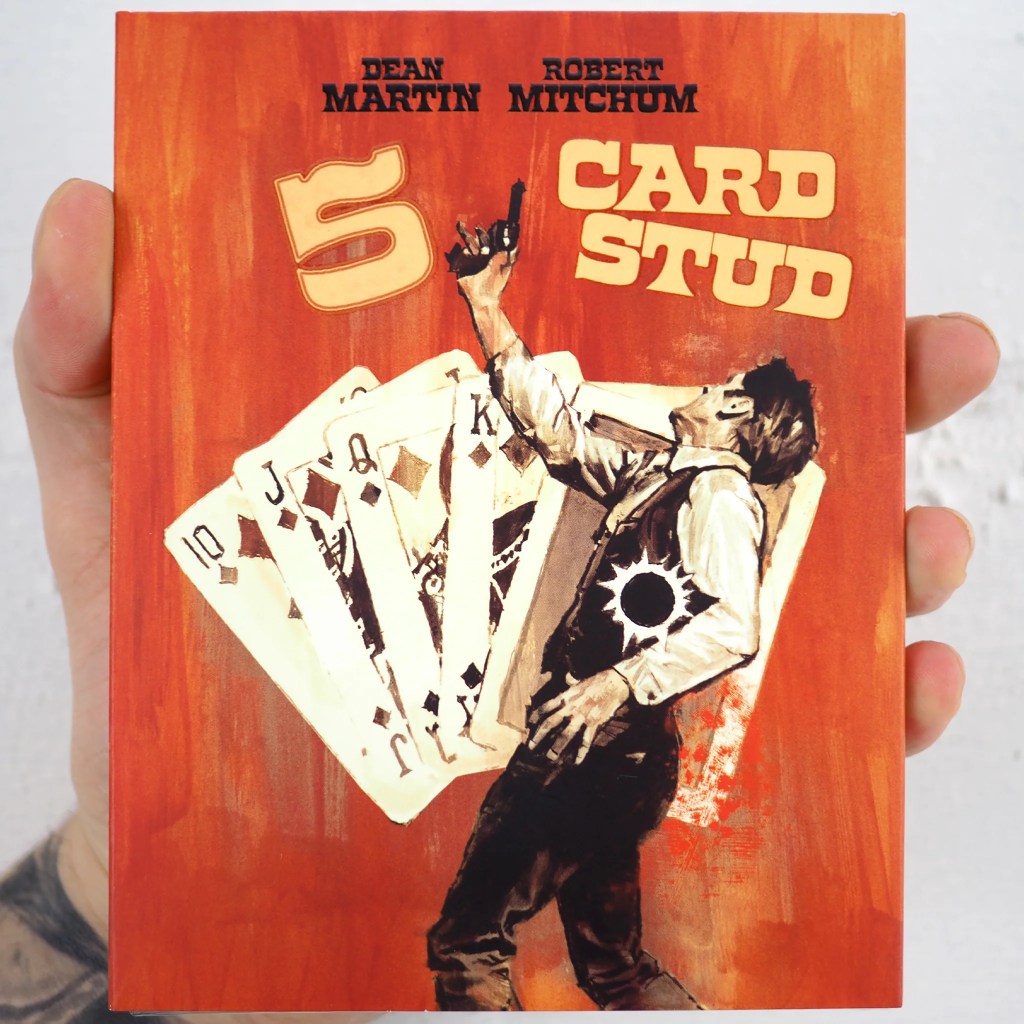
Every now and then in the writing of my blog an event occurs which comes as a great surprise. Last year, I was contacted from Los Angeles by Claudia Pretelin, a producer working for DVD specialist Vinegar Syndrome. They were planning a 4K restoration of Five Card Stud (1968) and, alighting on my review of the movie, Claudia asked if I would do the audio commentary, especially as I had detected the strong feminist undercurrent that runs through the western.
Five years ago, McFarland had published my book The Gunslingers of ’69: The Westerns’ Greatest Year. But if I had been writing about 1968, Five Card Stud would be one of the standouts. For whatever reason, it’s so under-rated it’s almost been completely forgotten, overshadowed by the three other westerns Henry Hathaway made either side of it, most importantly True Grit (1969) and The Sons of Katie Elder (1965) . Overshadowed because it wasn’t made by John Ford or Howard Hawks. Together with Sergio Leone, Sam Peckinpah and Clint Eastwood they were the directors most admired by critics. Overshadowed because it didn’t star John Wayne or James Stewart, both considered essential elements to any great western. Overshadowed because nobody gave a damn about Dean Martin (Rough Night in Jericho, 1967) as a serious actor.
But from the outset, this is distinctive with recurrent motifs and a visual symmetry – overhead camera, water, strangulation, the card table – that seems to have gone unnoticed, unlike The Searchers. Given the testosterone on display – Robert Mitchum (Secret Ceremony, 1969) in addition to Dean Martin – this is unusually an extremely feminist western. The three female leads are far from docile and screenwriter Marguerite Roberts has changed the source book, Glory Gulch by Ray Gaulden, to exploit those elements.
Entrepreneur Lily (Inger Stevens) runs an upmarket barbershop – generally a male monopoly – with an interesting sideline, but when it comes to romance she’s in charge, choosing – and dumping – the men. Nora (Katherine Justice) is a rancher’s daughter so smart and effective that her father has already decided that he’s going to leave her a half-share in his business rather than, as would be the norm, leaving it all to his son Nick (Roddy McDowell). Mama Malone (Ruth Springford) owns the eponymous saloon and takes no sass from anybody.
Van (Dean Martin) likes to think he has the measure of women, when in fact they have the measure of him. The story avoids the obvious lure of a love triangle, of jealous women competing for Van’s affections. Both the young Nora and the more mature Lily are pretty well grounded and judge their men by the standard of their kissing – that’s equality for you.
The movie was one of the fastest ever made, just five months from the start of shooting to release – that’s efficiency for you. And for many critics that was how they regarded director Henry Hathaway. He wasn’t considered a stylist, but a studio workhorse, apt to take what was offered, work in too many genres. But this is one of his most stylish films. In some ways it harks back to film noir. The story is a mystery. And his extensive use of overhead camera would be considered innovative had it been made now.
This is in fact about a serial killer, a treatise on law and order, almost acting as a conduit between the decade’s previous westerns when the good guys and the bad guys are easily distinguished to the end of the decade when such distinctions were muddied. Here, we don’t know who the bad guy is. He’s not a hero saving a town or enforcing law and order. Not a detective either, trying to nail down a killer. He’s only trying to save his own skin. The whodunit is really a MacGuffin, an opportunity to examine the hypocrisies of the West.
The Sons of Katie Elder, Nevada Smith (1966) and Five Card Stud are all about revenge, justified in you like in the first two. Play this another way and the vengeful preacher Rudd (Robert Mitchum) would be the hero, vindicated as much as characters in Hang ‘Em High (1968), Once Upon a Time in the West (1969) or True Grit.
Producer Hal B. Wallis (True Grit) bought Ray Gaulden’s western Glory Gulch in May 1967, three months after publication by Berkeley Medallion as a paperback original. (Reprinted a year later, it was re-titled Five Card Stud). It came cheap. Nobody else was bidding. Robert Redford (Downhill Racer, 1969) turned down the role of Rudd – he thought the character too obvious and didn’t like the way the narrative developed – so Robert Mitchum was actually second choice.
Filming was due to start in October 1967 but was delayed till February 1968. It was shot in Durango – a popular locale also utilized for Guns for San Sebastian (1968), Shalako (1968) and The Scalphunters (1968) – and Churabasco Studios in Mexico City. There were 22 actors and 52 crew. The main location was 8,000ft up on the Sierra Madre mountains. The actors were billeted in a motel, but Mitchum, demanding peace and quiet, had the end room so got more of the cold and required a portable oxygen tank. Instead of privacy he was frozen. The boilers didn’t work and allocated a single blanket he ended up piling all his clothes on the bed. Roddy McDowell wasn’t hired until after shooting began and he modelled his somewhat hippie sideburns after George Harrison. Mitchum was nearly crushed to death by a falling 18th high camera pedestal. While the two stars didn’t particularly hit it off there was no animosity either.
Some of those involved scarcely needed to work. Dean Martin was one of the richest men in the business. At a time when the very top stars took home $750,000 a picture, say $1.5 million if they made two movies a year, Martin took home closer to $5 million a year when you totted up fees from his television show, movies, records and performing. McDowell was the co-owner of a thriving disco franchise. Hathaway had just sold his stake in an oil business for $18 million.
Marguerite Roberts had been one of the top-earning screenwriters in the Hollywood
Golden Age. Starting out in 1933, her credits included Honky Tonk (1941) with Clark Gable and Lana Turner, The Sea of Grass (1947) starring Spencer Tracy and Katharine Hepburn and MGM’s big-budget blockbuster Ivanhoe (1951) teaming Robert Taylor and Elizabeth Taylor. Around the time of Five Card Stud she had two other projects on studio slates, Hero Suit and Flight and Pursuit, though neither was made and it was perhaps ironic that her next assignment concerned a lawman who took the same no-holds-barred approach to the criminal fraternity, namely True Grit, as the killer in this picture.
Filming began on February 7 and finished on April 14. It opened on July 12. That was a phenomenal turnaround for the period. A Time for a Killing/The Long Ride Home (1967), also starring Inger Stevens, took 16 months to reach the screen. In 1967 there were 125 films in studio backlogs – movies completed but no release date set as yet as yet, studios in no hurry, and often first run cinemas in the major cities clogged up by roadshows or long-running hits.
The western from mid-1960s had become the default for many stars. Where earlier in the decade stars might mix western and war with comedy and drama now for many top names for a period of three, four or five years they appeared either exclusively or almost exclusively in westerns. From 1965 to 1968 except for Matt Helm and one comedy Dean Martin had tackled five westerns. In the same period for James Stewart four out of five were westerns. For Mitchum it was four straight westerns from 1966 to 1968. In two years starting in 1967, four out of five Inger Stevens pictures were westerns. In three years, Glenn Ford made five straight westerns and after Battle of the Bulge (1965) Henry Fonda made four straight westerns. It was the same for directors: between 1965 and 1971 Andrew V. McLaglen made nothing but, and Burt Kennedy, in one year less, seven out of eight.
DVD with 4K restoration and audio commentary by yours truly available to pre-order and comes out in a few days.
The property had been bouncing around Hollywood for over decade. It had its origins in the true-life tale of the five Marlow brothers involving murder, revenge, and jailbreak, the story making national headlines when the case was heard at the U.S. Supreme Court in 1892. Based on the book The Fighting Marlows by Glenn Shirley,William H. Wright (Assignment in Brittany, 1943) shopped around a screenplay, jointly written with Talbot Jennings (Northwest Passage, 1940), that was purchased by Paramount in 1955.
Alan Ladd (Shane, 1953), who owed the studio a movie, was cast in the lead and the script went through rewrites by Frank Burt (The Man from Laramie, 1955) and Noel Langley (Knights of the Round Table, 1953) with shooting scheduled for 1956. John Sturges (The Magnificent Seven, 1960) was set to direct until Ladd quit, having bought his way out of his contract. Burt Lancaster (The Train, 1966) was brought in as his replacement.
When Lancaster dropped out, producer Hal Wallis took over the movie in 1959 and considered replacing him with James Stewart (Shenandoah, 1965) or Charlton Heston (The Hawaiians, 1970) with Dean Martin (Rio Bravo, 1959) as the second lead. But still the movie stalled for another five years before Wallis settled on John Wayne who signed on for $600,000 plus a one-third share of the profits and one-third ownership of the negative (a bounty that would continue to pay off through reissues and leasing to television). Henry Hathaway was paid a flat $200,000.
Wayne and Hathaway had history dating back to The Shepherd of the Hills (1941) based on the million-copy bestseller by Harold Bell Wright, and groundbreaking in its use of Technicolor, then in its infancy. They didn’t work again until desert treasure hunt Legend of the Lost (1957) which teamed Wayne with Sophia Loren. A few years later came North to Alaska (1960) followed by Circus World / The Magnificent Showman (1964).
Despite this long-term relationship, the most the director could offer about his star was that “Wayne is more particular about the pants he wears than anything in the world…unless he gets the thinnest kind of material it drives him crazy.”
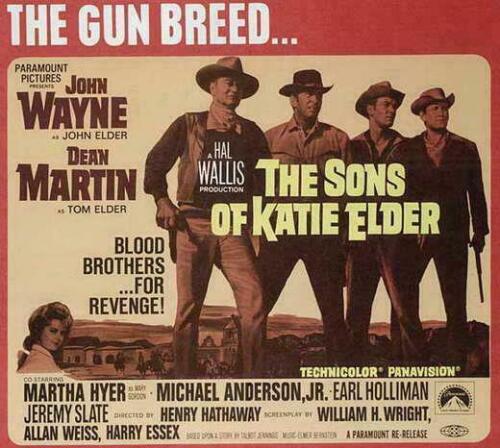
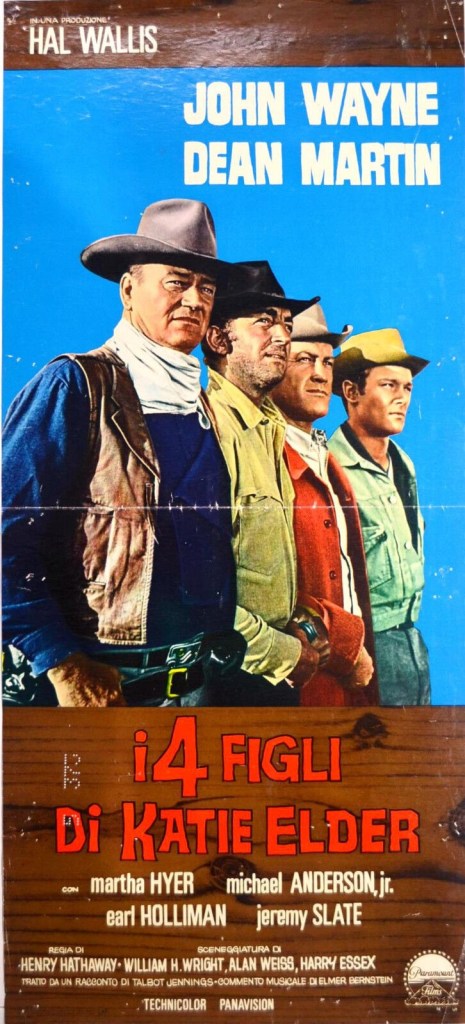
When the script was finally knocked into shape, the Marlow siblings had been trimmed from five to four, and that family had been replaced by the Elders, a nod to western aficionados who would recognize the name Katie Elder (“Big Nose Kate”), occasional companion of Doc Holliday whose story Wallis had previously filmed as Gunfight at the O.K. Corral (1957). Even though Elder wasn’t dead enough – she lived till 1940 – to conform to this picture, it seemed an odd decision to choose that name unless resonance was expected.
But it was still far from a done deal because Wayne’s cancer threatened to scupper the picture. Start of shooting scheduled for October 20, 1964, was shuttered when the disease was diagnosed on September 13 following the completion of Otto Preminger WW2 epic In Harm’s Way (1965). Aware surgery might jeopardize the picture, Wayne suggested Wallis replace him with Kirk Douglas (Cast a Giant Shadow, 1966).
Hathaway rejected the notion, but while neither star nor producer had any idea whether the operation would be successful, and whether Wayne would be even fit enough to work, or – God forbid, that the actor might already have made his last picture – Wallis took an optimistic approach and announced the picture would be delayed for a month and “even a little later.” Hathaway’s optimism was based on the fact that he had survived colon cancer a decade before.
At least the surgeon moved fast, operating four days after diagnosis, and again five days later. As well as fighting the damage surgery and pain had done to his body, Wayne found himself slipping into depression, convinced the operation would render him unemployable. “I’ll never work again if they find out how sick I am. If they think an actor is sick, they won’t hire him,” he said, a legitimate observation given the cost of shutting down a picture should the actor be unable to play his role.
Wallis’s business partner Joseph Hazen shared Wayne’s pessimism and urged the producer to recast with either William Holder (The 7th Dawn, 1964) or Robert Mitchum (The Way West, 1967). Paramount, too, fretted about insurance, the studio couldn’t risk hiring an uninsurable actor. Wallis refused to abandon Wayne and the studio finally agreed to tough conditions from the insurance company. So, on January 6, 1965, the principals gathered in Durango to commence the 46-day shoot on a production budgeted at $3.19 million.
The high elevations – 8,500 ft in places – were not conducive to someone recovering from a lung cancer operation and Wayne found it difficult to breathe. It didn’t help that on the fourth day of shooting Wayne was expected to jump into icy water for the sequence where the brothers were ambushed by the villains. It didn’t help, either, that Wayne was too big to wear a rubber suit to stave off the cold like his fellow actors.
Wayne never complained that Hathaway “worked me like a damn dog.” He realized that it “was the best thing ever happened to me. It meant I got no chance to walk around looking for sympathy.” The star put on a brave front, publicly acknowledging his battle with cancer as a way of giving hope to others while privately terrified not so much of dying but of being helpless. “I just couldn’t see myself lying in bed…no damn good to anybody.”
“He had to be the macho man,” commented Earl Holliman (The Power, 1968), a late substitute for original star Tommy Kirk (Swiss Family Robinson, 1960) who was sacked after being caught smoking marijuana, “he had to have more drinks than the next guy.” And despite the severity of his condition, and although publicly pretending he had given up tobacco, he continued smoking cigars.
Recalled Dean Martin (Rough Night in Jericho, 1967), “He’s two loud-speaking guys in one.” George Kennedy (Cool Hand Luke, 1967) asserted, “If you put him in a group with other movie stars, the eye went to him and that is the ultimate marker of respect. He was John Wayne. He was very real. It didn’t matter if he wasn’t Olivier; Olivier wasn’t John Wayne.”
But there were outward signs of the effect the illness had upon him. He was less sure of himself on a horse, riding with a shorter rein out of fear a horse would get away from under him, trying to minimize the chances of falling or being bucked from the animal. And as the film wore on, an oxygen inhaler was set up beside him on set.
Dennis Hopper (Easy Rider, 1969) was wary of working again with Hathaway after a difficult experience with him on From Hell to Texas (1958) starring Don Murray and Diane Varsi where the actor suffered the indignity of endless takes. Hopper quit three times and for good measure the director put the word around and virtually grounded the actor’s career. Hopper only made one movie in six years. In the interim he had married Brooke Hayward, daughter of actress Margaret Sullavan whom Hathaway respected, and peace was brokered.
Although on his best behavior on the shoot, Hopper was no less impressed. “He was a primitive director, he rarely moved his camera, the movement came from the actors.”
“Westerns are art,” declared Wayne. “They’ve got simplicity and simplicity is art…There’s simplicity of conflict you can’t beat…Westerns are our folklore and folklore is international…In Europe they understand that better than we do over here. “
Whether it was public sympathy for an ailing star and his resolve to fight cancer, or audience delight that he was back in a western after a gap of a few years, The Sons of Katie Elder was a huge hit with $5 million in initial rentals (what studios were left with after cinemas had taken their share). It earned more later in reissues but that initial sum was enough for thirteenth spot in the annual box office rankings though beaten by both Shenandoah and Cat Ballou. Its foreign earning would probably match domestic, to make it one of Wayne’s biggest earners for the decade.
SOURCES: Scott Eyman, John Wayne: His Life and Legend (Simon and Schuster Paperbacks, 2014) p111, p387-396 ; Ronald L. Davis, Duke: The Life and Image of John Wayne (University of Oklahoma Press, 1998) p266; Hal Wallis Collection, Margaret Herrick Library; Hedda Hopper, “Ladd To Star in Film of Pioneers’ Reunion,” Chicago Daily Tribune, November 9, 1955, p16; Thomas M. Pryor, “Hecht-Lancaster Obtains 2 Novels,” New York Times, January 12, 1956, p22; Oscar Godbout, “TV Movies Extras Get Salary Rises,” New York Times, July 3, 1956, p17; John Wayne, “Me? I Feel Fine,” Los Angeles Times, January 18, 1965; James Bacon, “Wayne’s Biggest Bout vs. Killer Cancer,” Los Angeles Herald Examiner, March 14, 1965; Roderick Mann, “John Wayne – A Natural as The Shootist, Los Angeles Times, March 7, 1976.
The rocking chair motif in this underrated film is ignored while the door opening and closing in The Searchers (1956) is hailed as one of cinema’s greatest images. Welcome to the world of director Henry Hathaway (Nevada Smith, 1966). Way down the pecking order when it comes to the makers of great westerns, below Sergio Leone (Once Upon a Time in the West, 1969) who only made four and Howard Hawks (Rio Bravo, 1959) only three.
Closer inspection, too, of The Wild Bunch (1969) might reveal cinematic ideas that turned up here first. Closer inspection of John Wayne (The Commancheros, 1961) might reveal a mighty fine, very touching, performance.
The genre was chock-full of vengeance, but here that is tempered by mystery over the death of their father, a drunken gambler, that has led to the loss of the family ranch, leaving the mother, for whose funeral the titular sons return, living hand-to-mouth, supplementing the usual sewing and mending with giving guitar lessons.
Hastings (James Gregory), a businessman with big ideas, has taken over the ranch and pretty much the local town of Clearwater. And he’s just hired extra muscle, notorious gunslinger Curley (George Kennedy), to swell his already-growing army.
Only the youngest son, Bud (Michael Anderson Jr), a reluctant college student, is clear of the taint of wrong-doing. John Elder (John Wayne) has a reputation as a gunfighter but unlike shifty younger brother Tom (Dean Martin) doesn’t have a wanted poster following him around. The other son Matt (Earl Holliman) takes after John, some shady action but no legal consequence.
This is certainly not a great fraternal union. When they’re not engaged in low-level investigation or trying to prevent themselves being lynched, they’re bickering and fighting. The only thing that unites them, beyond love of the deceased woman, is determination to continue paying for Bud’s education.
Apart from the ranch, one of Hastings’ other lucrative investments is a firearms business, which allows him to tote around a telescopic rifle which, of course, ensures he can bump off those who get in his way from a distance, without fear of discovery. The easiest way to get rid of the brothers is to have them arrested for murder and to kill off the one man, Sheriff Wilson (Paul Fix), who might have the brains and experience to work out something fishy was going on.
John Wayne is more emotional here than in any picture since The Searchers, though, as you’ll be aware, his emotion is registered through his eyes or bits of business rather than a lengthy speech. And given double duty of looking after the youngest while holding back the more tempestuous Tom.
Dean Martin’s (Five Card Stud, 1968) charm runs thin, as is intended, no woman to gull, and no cliché alcoholism a la Rio Bravo to fall back on. It’s a part he plays completely against type, although you can sense he’s bursting out of those confines in the false eye con. He’s pretty much always brought to heel by Wayne. The one time he defies big brother ends in personal calamity. Imagine a marquee name as big as Dean Martin taking on a role where the part sets him up to be walking in the Duke’s shadow, despite his efforts to break loose.
In fact, unusually for a western, until Butch Cassidy and the Sundance Kid (1969) came long, it’s replete with reversals. Hathaway plays with expectations from the outset, the opening sequence of big beast of a train puffing through fabulous scenery doesn’t bring John, instead, unknown to the waiting brothers, Curley disembarks. Katie Elder’s friend Mary (Martha Hayer) cuts off at the pass any idea the audience might have of incipient romance when she gives John both barrels.
Thanks to the screenplay, Michael Anderson Jr.(Major Dundee, 1965) and Earl Holliman (The Power, 1968) are given more bite than their roles might suggest and James Gregory (The Manchurian Candidate, 1962) makes his villain meaty though you suspect the presence of George Kennedy (Cool Hand Luke, 1967) is another lure, creating audience expectation that is not fulfilled. Martha Hyer (The Chase, 1966) is more conscience than glamor, spending most of the time on the sidelines.
You’d be surprised just how lean a production this is, and equally how deftly Hathaway avoids cliches. Just because there’s a kid you don’t need to teach him how to be a man. A huge herd of horses doesn’t need to stampede. Beautiful woman in the vicinity doesn’t necessarily call for a heated love affair. Ending up in jail doesn’t necessitate a bust-out. Villainous gunslinger doesn’t set up obligatory shootout in an empty street.
Hathaway’s unusual, too, in the way he anchors his pictures in reality. Here it’s a funeral director washing the wheels of his hearse, a blacksmith applying shackles.
You’d marvel, too, at just who was involved in fashioning the terrific screenplay: veteran William H. Wright, his first in two decades, Harry Essex (Creature from the Black Lagoon, 1954) in his first in eight years, and Allan Weiss whose six other movies were all Elvis Presley vehicles. Hardly the pedigree to produce one of the best westerns of the decade. This is the kind of screenplay where no line is wasted, not when a retort can be used to define character.
Most people remember the rousing theme by Elmer Bernstein (The Scalphunters, 1968), but actually there are also some very innovative musical passages worth listening out for.
Curiously, it was Andrew Sarris, hardly a John Wayne fan, who recognized the movie’s attributes, though in niggardly fashion, “The spectacle of people in Hollywood trying to do something different in a western at this late date is reassuring.”
It’s about time those differences and the picture’s excellence were recognized.
After I had written this original “Behind the Scenes” article I came across an interview with director Henry Hathaway that cast light on his interpretation of “Circus World” as well as an insight into his working methods. Rather than re-write the whole Blog I’ve added his words, which come from the magazine “Focus on Film,” as a stand-alone at the end of the original feature which gives some context to the Hathaway interview. If you’ve already read the “Circus World Behind the Scenes” you can just jump to the bottom of the page.
For John Wayne it was the best of deals and the worst of deals. He had signed a six-picture seven-year contract with Paramount. On the plus side the studio paid the entire amount upfront, wiping out the accumulated debts from the debacle of The Alamo (1960). On the debit side, he received only $500,000 per picture, well below his standard price of $750,000. In fact, Paramount could recoup some of its expense by hiring him out at his previous going rate.
Wayne was coming off hits McLintock (1963), Hatari! (1962) and How the West Was Won (1962) but other movies The Man Who Shot Liberty Valance (1962) and Donovan’s Reef (1963) – the first in the multi-picture deal – had punctured a hole in his supposed box office supremacy. But for maverick producer Samuel Bronston (El Cid, 1961), getting his hands on a star of the magnitude of Wayne was a coup. Originally entitled Those Were the Days, the title switched to the more appealing Circus World.
Dell comic book tie-in.
Bronston was a new-style producer. Apart from a $2.5 million injection by Paramount he financed his pictures by country-by-country advances, and backed by DuPont, hardly the first big company to be seduced by the prospect of becoming a big Hollywood player. Distributors who advanced money in this fashion made hay if the film hit the bull’s eye, but if it flopped they didn’t get their money back. And a flop made it more difficult for an independent producer to raise the dough for his next picture. So Wayne’s involvement was viewed as a guarantee.
Nicholas Ray (King of Kings, 1961) was initially hired to direct followed by Frank Capra (It’s a Wonderful Life, 1946), also made a Bronston partner, who tried to sabotage the script, planning only to shoot the sections he had rewritten. Bernard Gordon (55 Days at Peking, 1963) was credited with the original idea, but when Wayne came on board he brought with him James Edward Grant (The Commancheros, 1961).
Grant was only tempted by the promise of a three-picture deal. The tussle ended with Capra evicted at a cost of $150,000 and Henry Hathaway (North to Alaska, 1960) at the helm.
Hathaway instigated a week of rewrites with Ben Hecht (Spellbound, 1945) before settling down to more serious work with Grant.
Initial casting envisaged Rod Taylor (Dark of the Sun, 1968) in the role of Wayne’s partner and would-be lover of Cardinale, but he took the job without reading the script and on realizing it was little more than male romantic lead he bowed out. David Niven (55 Days at Peking, 1963) was initially signed as Wayne’s old buddy Cap but he, too, quit over the script. (Wayne and Taylor got on very well and should have teamed up for The War Wagon, 1967, until Kirk Douglas muscled his way in, later doing so for The Train Robbers, 1973. )
Their replacements John Smith (who had made his debut in Wayne picture The High and the Mighty, 1954) and the veteran Lloyd Nolan were hardly in the same box office league, but shaved cash off the budget.
A bigger concern than hiring a supporting cast was the circus. Bronston recruited famed European outfit Althoff Circus, whose 400 performers ensured the ringside element was authentic. For further realism Bronston added Bob Dover from Ringling Bros. There was no need for specialist horses, Bronston already having 125 trained from The Fall of the Roman Empire to pull circus wagons and for bareback riders.
The entire circus had to be transported by rail on 51 freight cars through the Brenner Pass to Germany and via Switzerland and France to Spain, halting at the Spanish border to unload the whole shebang onto a different train because the gauges didn’t match.
For the picture’s most spectacular scene, the capsizing of the ship transporting the circus, Bronston bought the 250ft long S.S. Cabo Huertas which was heading for the breaker’s yard. Repainted, decorated with circus posters and renamed S.S. Circus Maximus it was all set for a sinking overseen by special effects expert Alex Weldon (El Cid, 1961).
Three hundred tons of water were pumped into the half of the hold furthest away from the dock. The additional weight of 600 extras was enough to flip the ship on its side. Four 50-ton steam winches with steel cables kept the ship upright until it was time for action.
Female extras who were going to end up in the drink were fitted with corsets made of cork while the men wore cork belts hidden under their costumes. The Spanish Coast Guard cleared the harbor of debris and a local fleet of boats, just out of camera view, stood by for rescue. Seven divers patrolled the harbor bottom in case the cork failed to keep actors and extras afloat. Three sets of costumes were created for each participant so they would be kept dry as long as necessary.
Hathaway completed the scene without a single injury. He called it, “the greatest job of its kind I have ever been involved in.” Bronston, who was as much a detail man as Cecil B. DeMille, ensured the band played instruments from the period
The picture went in front of the camera in September 1963 with Wayne due to end his commitment on December 18. But severe flooding in Spain knocked the movie off schedule and it went way over budget, shooting running on until March 1964, the finishing touches added in London, the budget hitting $9 million.
Rita Hayworth, who hadn’t made a picture in two years, proved a handful, usually late on set, committing the cardinal sin of not learning her lines and, probably as worse, being rude to everyone
At just 135 minutes long, Circus World wasn’t originally envisaged as a roadshow until Cinerama put an estimated $2.5 million into the project, which defrayed the costs. By the time that partnership was announced, it was too late to shoot it in the Cinerama process. The 35mm Super Technirama footage was blown up to 70mm for showing in 60 U.S. theaters boasting the iconic Cinerama curved screens. Everything in Cinerama at that point was roadshow. And they had two more projects lined up with Bronston, Vittorio De Sica’s Paris 1900 and Jack Cardiff’s Brave New World, neither of which were made. Bronston also had another two movies in preparation with Paramount: The Nightrunners of Bengal to be directed by Richard Fleischer and Suez, neither made either.
Roadshow suited Paramount which had not used that method of premium release since The Ten Commandments (1956). In 1963 it had set up a roadshow department to handle the forthcoming Becket (1964) and The Fall of the Roman Empire, which were proper roadshow length of, respectively, nearly 150 minutes and over three hours. But, initially, Circus World did not fall into the roadshow category as far as Paramount was concerned. Only the arrival of Cinerama as an investor made it imperative.
To avoid a title clash with the ultra-successful It’s A Mad, Mad, Mad, Mad World (1963), British distributor Rank changed the title to The Magnificent Showman. That alteration did little to improve its box office, opening at London’s Coliseum for a “NSG” (not-so-good in Variety parlance) $11,200, not much more than The Fall of the Roman Empire in its 17th week, How the West Was Won (90th week) and Cleopatra (51st). Nonetheless it ran there for seven months, followed by a mass general release in the U.K. with a record number of prints. In the U.S., on the eve of general release in April 1965, Paramount considered a title change to Wild Across the World and a switch of marketing emphasis to John Wayne and action.
Audiences didn’t bite, certainly not enough to recoup the budget, and far from enough to prevent Bronston’s operation sliding into liquidation.
NEW STUFF FOLLOWS BELOW
“Circus World was a mistake,” averred director Henry Hathaway.
“Capra was working on it and Paramount had invested a lot of money. Capra was writing a story and Wayne didn’t like the story and the writer (Philip) Yordan didn’t like the story. He and Joseph Sistrom were working on it and they hadn’t quite finished it and Paramount finally got sick because they needed Wayne to get their money out of it and he had given them two months, I think, and he couldn’t give them any longer without charging them more money.
“I’d just finished Nevada Smith (what!!! – some poor editing here, given that film was made a couple of years after Circus World; presumably they meant How the West Was Won) and they said, ‘For Christ’s sake will you go over there because you know Wayne so well, get it straightened out enough so Wayne will say Ok I’ll do it and we’ll get it finished in some way.’
“I couldn’t stand this fellow Jimmy Grant who was the new writer – a phoney man – so I said ‘If you’ll let me work with Ben Hecht…’ So I flew back to New York with what we had and Ben and I had two weeks to try to get some cohesion into the story. We came back and Wayne said he was satisfied. Then we ran into a bad thing with Rita Hayworth on that picture because she was drinking a lot through it.
“I should never have got into it so quickly without more preparation, the fundamental story material was weak.
“I never look at rushes. You see I only work on location and there you can’t project them properly and I get disappointed because it doesn’t look good and maybe the machine’s bad and it looks too dark and then the actors want to put on or change their make-up. I don’t let actors wear make-up (!!!), only girls, so I don’t let the actors look at it – and because they don’t look at it, I don’t.
“I only shoot what can be used so the producer has no choice. According to the law of the Directors Guild the man that puts up the money – the company – owns it. If we want to have complete control we must put up the money ourselves. What right have you to say that because you’re stubborn, and you may not be right, that you have the last say with the man who has spent millions of dollars.
“Literally, you have the right to produce your own version and they pay extra time if necessary. Then you turn it over…The only alternative you have is that if they play with it too much you quit and you won’t work for them anymore.
“I never had that trouble because I’m very conservative and I don’t over-shoot like George Stevens. He shoots a scene all ways, upside down, crossways, backways, everyways. He previewed Shane (1953) just generally telling the story and it didn’t work too well…So he recut the picture telling it through the eyes of the woman Jean Arthur as a love story…and that didn’t work too well. So he took it back and showed it through the eyes of the boy who hero-worships a guy…and that was the successful version. Now it would be impossible for me to recut a picture any other way than the way I shot it. If it’s bad, it’s bad.
“I always cut in the camera. The cutter just has to put the ends together. For instance, I don’t shoot a whole master shot all the way through. I start it and then get into the two-shots and then I get into the close-up and then I get out of it. In other words I don’t make them do the whole scene over again in long shot and then in medium shots and then in close-ups and on and on because the actors get bored with the scene and they’re never as good. You try to direct the picture in a manner that doesn’t waste the energies of the first emotional performances of the actors in long shots that you can’t use.
“The hardest thing is getting people out of goddam scenes. It’s very difficult to get them in and out of scenes gracefully. Another thing that most people never learn is that in each scene there’s a reason for that scene and, as soon as you hit it, get out as fast as you can or there’ll be a repetition of it or it hangs on too long.”
NOTE: I should also point you in the direction of the How the West Was Won “Behind the Scenes” since the Focus on Film interview also covers the shooting of that film and I’ve since added it in.
SOURCES: Scott Eyman, John Wayne, The Life and Legend (Simon & Schuster, 2014) p379-385; Mel Martin, The Magnificent Showman (Bear Manor Media, 2007), p153-168; Rui Nogueira, “Henry Hathaway Interview,” Focus on Film, No 7, 1971, p19-20; Sheldon Hall, Introduction to Circus World, Bradford Widescreen Festival, 2022; “Rank To Distribute New Bronston Pic,” Variety, September 26, 1962, p15; “Althoff Circus Logistics for Bronston’s Film,” Variety, September 25, 1963, p4;“New Roadshow Dept at Paramount,” Variety, November 13, 1963, p3; “Bronston and Paramount in 4-Picture Deal,” Box Office, December 9, 1963, p7; “Circus World Filming in London,” Box Office, February 17, 1964, p14; “Bronston’s Circus Goes Cinerama,” Variety, February 19, 1964, p4; “Bronston-Cinerama Unite on 2 Films,” Box Office, February 24, 1964, p5; “Special Mass Release for Showman,” Kine Weekly, May 28, 1964, p3; “Paramount Retains Circus World Title,” February 24, 1965, p3.