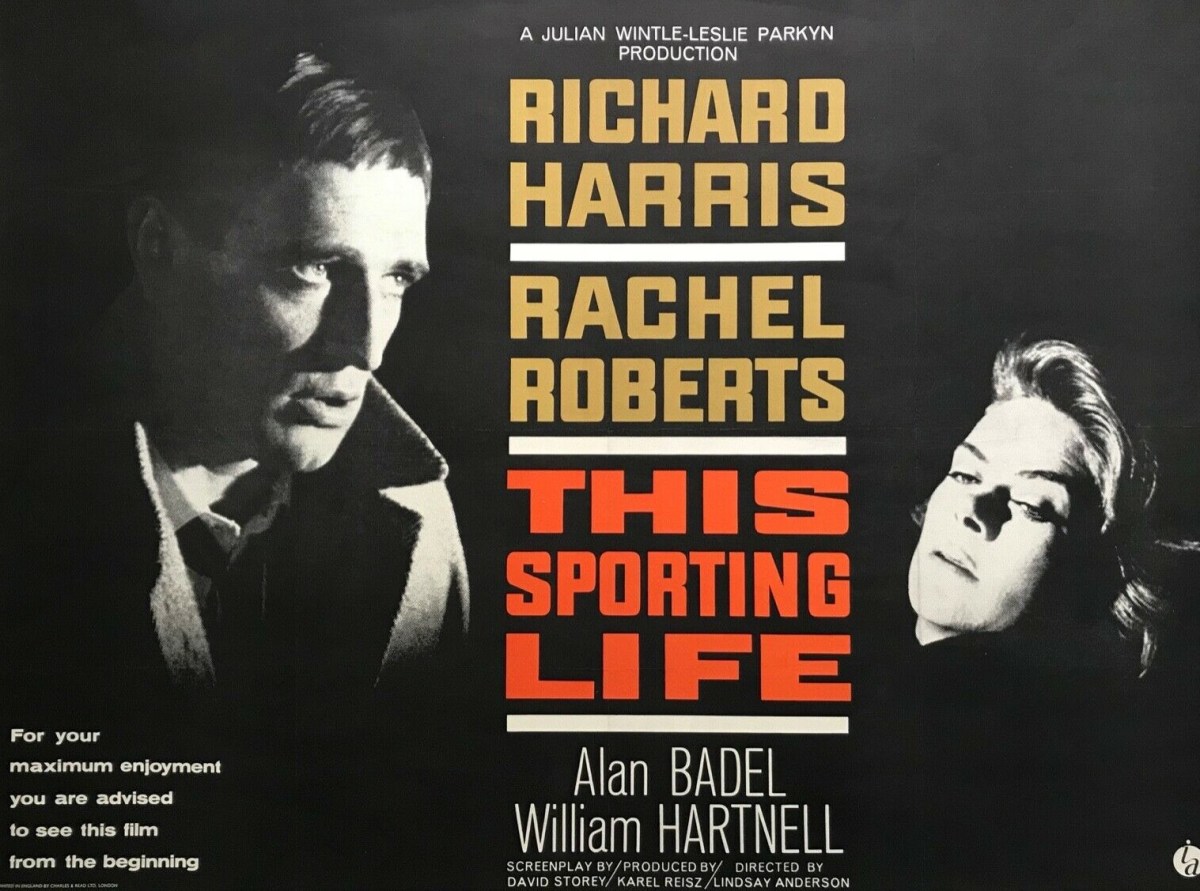
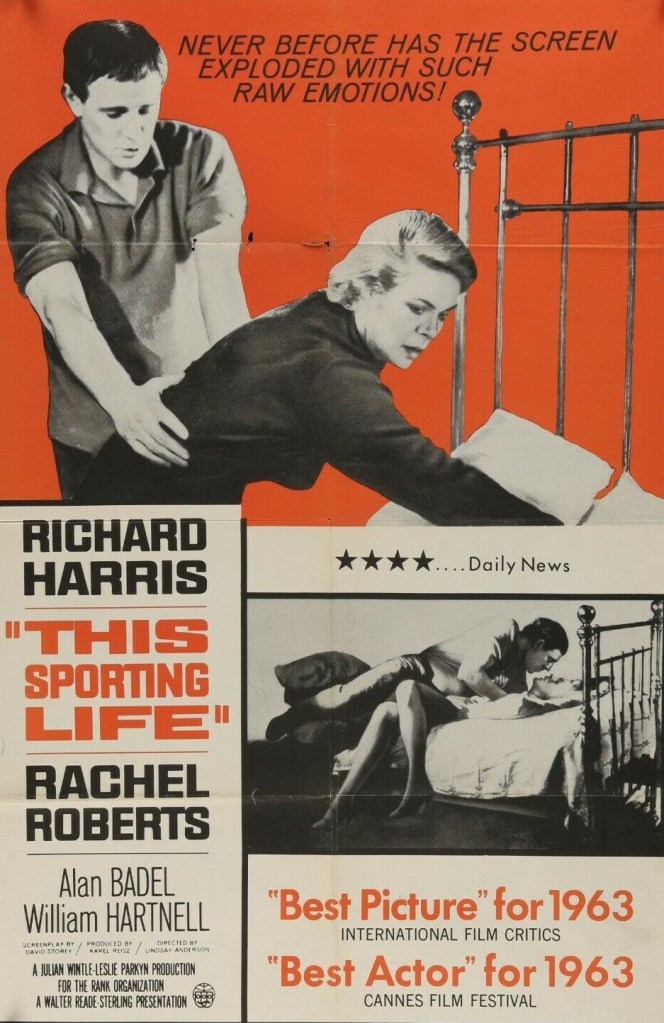
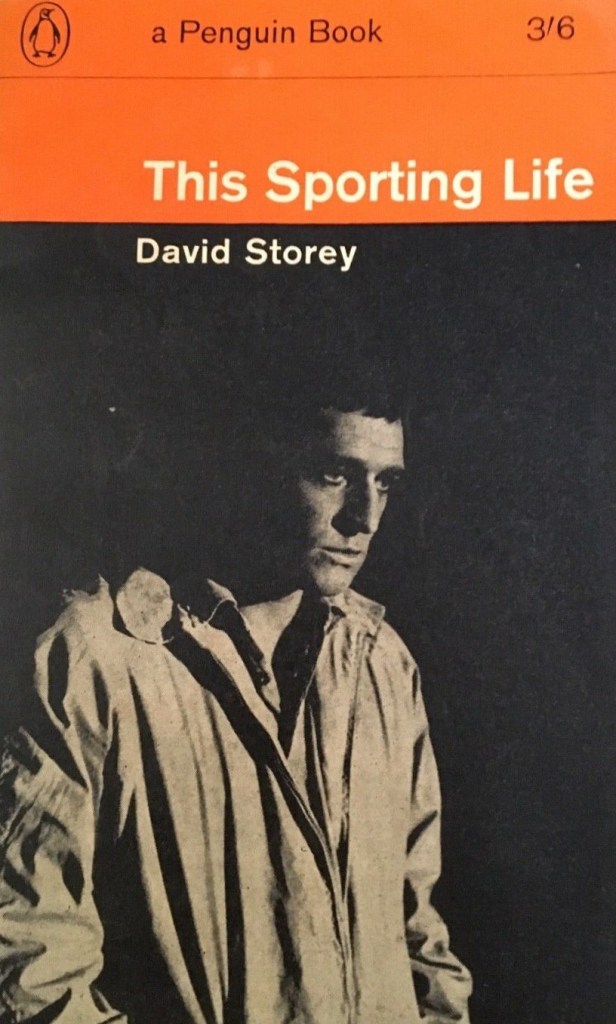
Star Albert Finney and director Karel Reisz of Saturday Night and Sunday Morning (1960) turned it down. Director Lindsay Anderson, screenwriter David Storey, author of the novel on which the film was based, and star Rachel Roberts all suffered from massive doubt in their own abilities.
Anderson was the last of a generation that included Reisz and Tony Richardson (Tom Jones, 1963) to make a movie. He was better known as film critic and theatre director. As far as the screen went, he had got only as far as five episodes of The Adventures of Robin Hood for television, and some documentaries and shorts. If he was going to make a movie it almost certainly depended on finance from British production outfit Woodfall which had backed Reisz and Richardson. However, Woodfall was outbid for the rights to This Sporting Life and Anderson only came into the frame when Reisz rejected the idea of directing the movie in favor of turning producer and giving Anderson his opportunity.

“I was not sure I was up to it,” confessed Anderson. Theoretically a tale of a rugby footballer Frank Machin’s (name changed from the Arthur Machin of the book) rise and fall, Anderson wanted to explore the novel’s “dark poetry” and the ambiguities of the a central character who was by turn overbearing and sensitive and involved in a “tortured, impossible relationship.”
However, Storey, also making his movie debut, struggled with the script. Until the sudden success of This Sporting Life, the aspiring artist had lived a debt-ridden life as a supply teacher (17 schools in three-and-a-half years) in poverty-stricken London boroughs, writing his novels on train journeys north to fulfill his contract to play professional rugby. Reprinted prior to publication This Sporting Life, his debut novel, received excellent reviews and won the inaugural U.S. MacMillan Award worth $7,500.
When the film industry came sniffing Storey took tea with Stanley Baker at the Dorchester Hotel, lunched with Tony Richardson at the Trocadero and was wooed by director Joseph Losey at his Knightsbridge flat. Initial expectations were that the rights would go for £3,000, but a bidding war between Woodfall and Rank sent the bill up to £10,000 with the latter emerging victorious. Karel Reisz agreed to become producer on condition he could choose director, writer and cast. He introduced Storey to Anderson and to an initially interested Albert Finney.

Storey, a working-class son of a coal miner, and Anderson stood at different ends of British class divide. Initially suspicious of each other, they had opposite temperaments. “Lindsay was an optimist,” explained Storey,” I was a reclusive, and when in doubt, morbid.” Even after Storey completed a treatment and the pair went north to scout locations, the project remained in doubt, in part because Anderson did not understand the book and had a “curious lack of confidence” and in part because Storey resisted reshaping the material into something “new.” In fact, Anderson’s lack of confidence was so deep it took several months before he actually signed his contract.
Storey, too, suffered from revisiting the area where he had grown up. The death of a sibling cast a devastating shadow over the rest of his life, the Wakefield rugby ground in fact “scarcely a stone’s throw “from the child’s grave. “Wakefield was being opened up to me in a way I had never known before,” explained Storey, referring to the grand houses visited as possible locations whose exteriors he had glimpsed while working as a marquee laborer.
Despite “exhaustive consultations” with Anderson and Reisz, the script failed to gell. “I felt the authority I wanted was not there,” commented Anderson. Although actors are often decried for interfering with the script, in this case it was star Richard Harris who arrived at the solution.
Anderson had been attracted to Harris from seeing him in the stage adaptation of J.P. Donleavy’s The Ginger Man. The director flew off to Tahiti where Harris was filming Mutiny on the Bounty (1962) to be met at the airport at five in the morning by the actor, “ his 18th century seaman’s hair down to his shoulders, bursting to tell me what he thought of the script we had sent him.”
Anderson recalled, “Within ten minutes we were at it…we talked and argued right through the day. I quickly realized he was right…we had lost what was most unique and brilliant in the novel…it was Richard, who, with passionate intransigence, brought us back to the book…in the evening after his shooting on the Bounty we sat in his bungalow going through the script and his own heavily-annotated copy of the novel…and slowly a conception emerged which began to satisfy us.”
Storey agreed with the new look which basically followed a subjective point-of-view rather than being cluttered by the novel’s flashbacks. “With an unequivocal endorsement of the book and the rejection of a script which had wearied me more than I’d imagined, I found rewriting the script in the manner in which the book had been written, from the inside looking out rather than the outside looking in, a surprisingly exhilarating task…Once Richard Harris had become identified with the part …the material was no longer a problem.”
Retaining that subjectivity was Anderson’s biggest issue An Oxford scholar, he had little innate understanding of Frank Machin’s world and in consequence “was liable to slip into an objective view of scenes that needed to be presented through Machin’s own temperament.” Harris proved instrumental in keeping the director on course.
Rachel Roberts twice turned down the role – Mary Ure (Look Back in Anger, 1959) was also in the frame with four other actresses – and failed to turn up for a screen test. Karel Reisz once commented how odd it was that “the two films that made this great-hearted flamboyant woman best-known (the other being Saturday Night and Sunday Morning) were ones in which she played withdrawn, bleak, ungiving women. Rachel’s great talent was to sink her personality into the part without losing access to her own sensuality. You felt the tension.”
Of This Sporting Life, Reisz added, “She had great doubts about her ability to play Mrs Hammond because she’s a very held back, undemonstrative woman. A passionate person, certainly, but someone who’s turned puritanical through so much constant repression of her feelings. Rachel was afraid of this: she didn’t know out of which part of herself to play the role.”
Lindsay Anderson was as unsure as Roberts: “She didn’t appear to me to be the Mrs Hammond character…Rachel was anything but repressed.” Actress Sybil Williams remembered finding a whole sheaf of notes in Rachel’s script about “the Mrs Hammond character she appeared to be playing so intuitively.” Said Anderson, “Richard Harris was bit awed by Rachel. She could acquit herself with a first-rate reading in just a couple of takes. Richard took a few more to feel he had got it right. Rachel’s security as an actress made him feelmore respectful towards her.”
The scenes between Harris and Roberts were endlessly rehearsed, involving a full 10 days prior to shooting and then during evening and weekends while in production. Roberts was playing a woman “whose feelings, though fierce, are almost continually suppressed: the relationship deepens without self-explanation…through incessant conflict…It called for an actress of exception ‘interior’ quality with real wildness within as well as the capacity for an iron restraint.”
Somewhere in the BBC archive is a programme, never aired, about the making of the film shot for its Monitor arts strand, although Storey was interviewed later on the show by Huw Wheldon, later BBC managing director.
Although Lindsay Anderson only made four more movies, the most memorable being If…(1968), and David Storey never wrote another screenplay, the pair achieved considerable success together when the author turned to writing plays such as Home (1970) and The Changing Room (1971), set in a rugby club.
If This Sporting Life appears to have two main characters driven by demons, part of the explanation as to how such creatures emerged from David Storey’s imagination can be found in his riveting memoir A Stinging Delight which traces a core of depression from his earliest days through to the times in later life when he was in and out of mental hospitals. Rachel Roberts also suffered from mental illness and committed suicide in 1980.
SOURCES: Lindsay Anderson, “Sport, Life and Art,” Films & Filming, February 1963, pages 17-20; David Storey, A Stinging Delight (Faber, 2021), pages 217-218, 221-223, 227-231, 233, 240-242; No Bells on Sunday, The Journals of Rachel Roberts, Edited with a documentary biography by Alexander Walker, Pavilion, 1984, pages 37, 55, 56, 58.