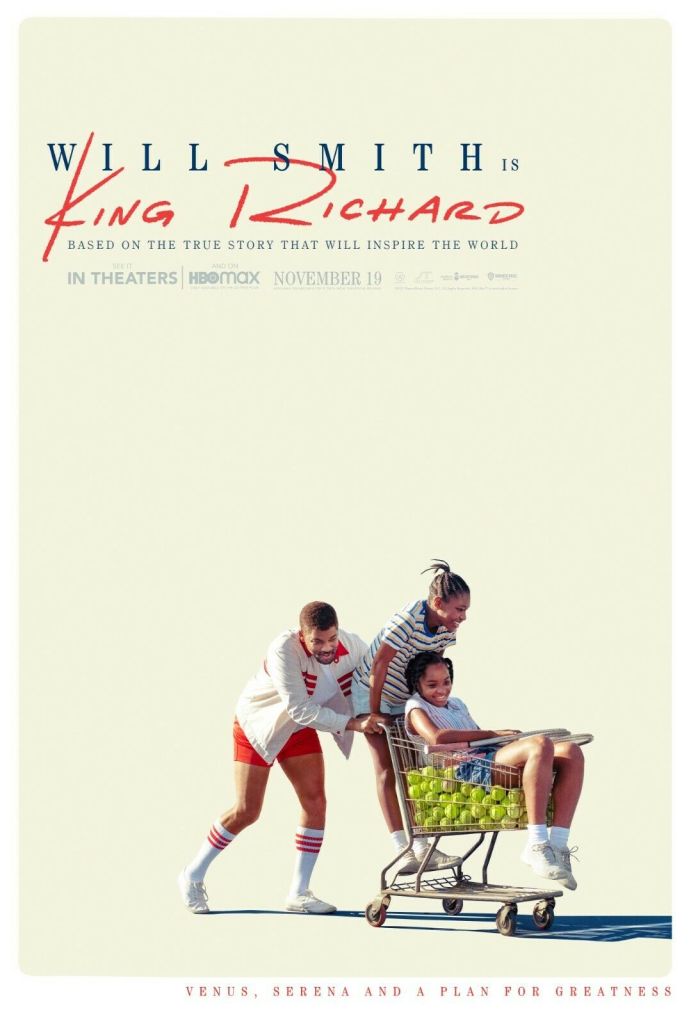
King Richard (2021) **** – Seen at the Cinema

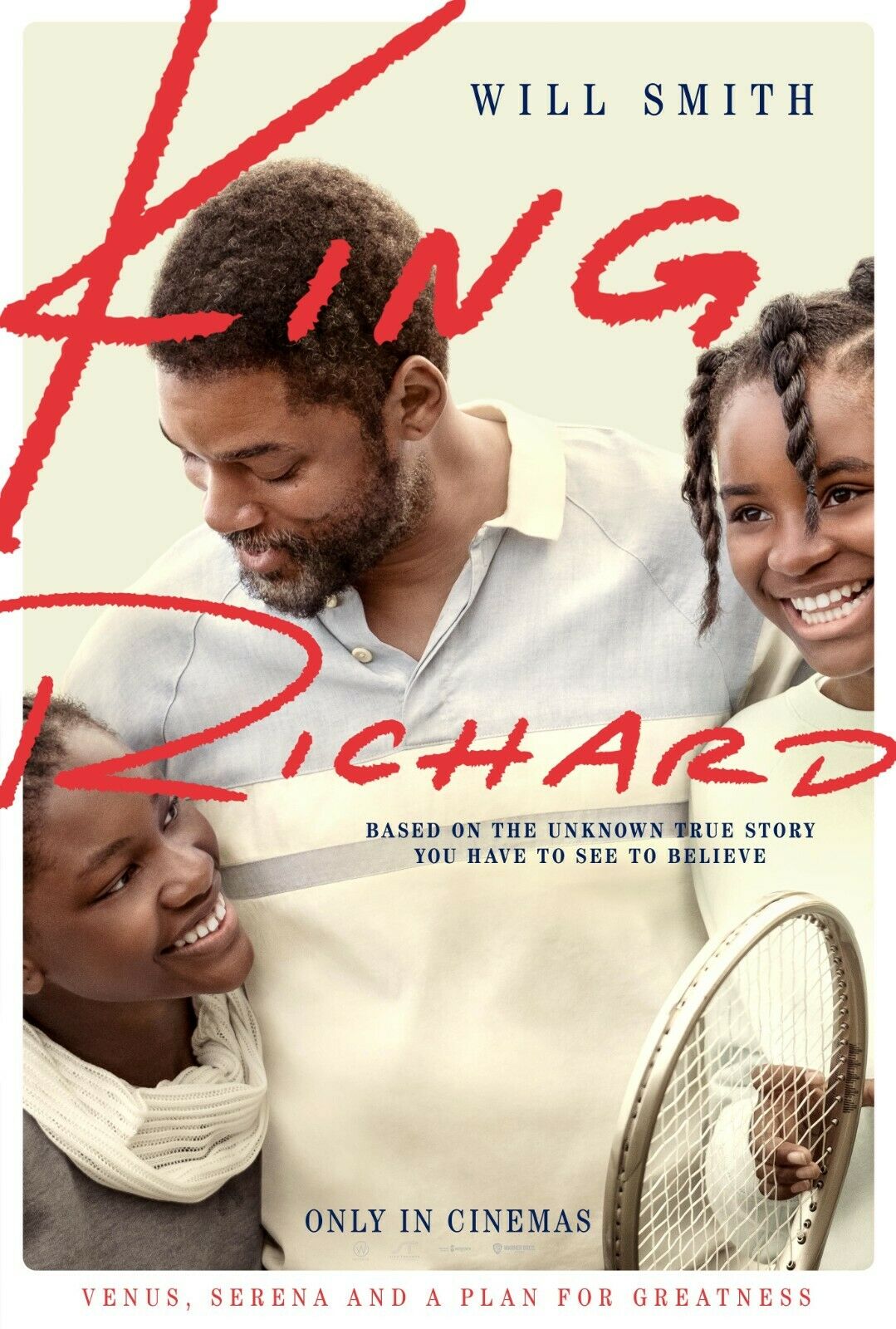
Absorbing sports biopic mixing feel-good and a no-holds-barred approach to the titular subject with a terrific performance from Will Smith. Some commentators complained the film was too long but I was so caught up in it I was surprised when it suddenly came to an end. Beyond recognizing the achievements of the Williams sisters, I had no foreknowledge of the Williams story. The movie follows their early years until the professional debut of Venus (Saniyya Sidney).

Although following a traditional triumph-over-adversity narrative, this is as concerned about the intricate workings of U.S. tennis where the odds were so stacked against black players, saving Arthur Ashe, that club members were taken aback to register the boldness with which Williams Snr, entered their arena. For most of the picture what we see is struggle, Richard Williams (Will Smith) trying to interest coaches in his two daughters. The tennis system is laid bare, the need for funding and then big bucks sponsorship the ultimate goal, the Jennifer Cipriani case quoted as the downside of a system where parents push their children to the limit, setting aside any interest in a normal childhood in a bid to break into the professional game.

Williams is both inspiration and a complete pain in the neck. He comes across as warm and awful at the same time, a whole set of rigid rules getting in the way of the happy family he seeks to establish. His arrogance takes some beating. Having devised a business plan to turn his kids into superstars he finds it difficult to change his tune even when his methods result in zero success. He wants to correct the coaches, on occasion cheat them, but is so determined that Venus and Serena will not become tennis brats that he holds back their leap up the junior tennis circuit in case it prevents their development as people, impacts on their education and denies them a childhood.

The tennis matches are well handled. My ignorance about the Venus sisters’ career path meant that I found the actual tennis riveting. And the fury of children beaten by the upstart Venus tells you all you need to know about the pressures facing prodigies.

Zach Baylin’s debut screenplay is terrific, finding time to fill us in on Williams’ checkered past, professional and romantic failure. Prejudice isn’t limited to white people, he is beaten up by local hoods while a neighbour calls in social services. Charting the family dynamics allows wife Oracene (Aunjanue Ellis) an occasional turn in the dramatic spotlight. The relationship between Venus and Serena (Demi Singleton) is well nuanced as they move from giggling kids to more mature teenagers, loyalty to each other tested when Venus receives preferential treatment, each with their individual battles, until in specific ways they take charge of aspects of their careers.

Will Smith (Bad Boys for Life, 2020) is a sure thing for an Oscar nomination, but the supporting cast is exceptionally strong. Aunjanue Ellis takes a giant step up from television (Lovecraft Country, 2020) and as the sisters Saniyya Sidney (Fences, 2016) and in her rmovie Demi Singleton – just 15 and 14, respectively – are both delightful and convincing. Jon Bernthal (Those Who Wish Me Dead, 2020) and Tony Goldwyn (The Mechanic, 2011) play real-life coaches, the former frustrated to the point of torture by Williams’ antics.

Reinaldo Marcus Green (Joe Bell, 2020) delivers on several counts: drawing sterling performances from the actors, allowing the screenplay to breathe so the picture doesn’t feel cramped or rush, and setting genuinely exciting tennis matches.

This is already a certified box office flop, in part because of Warner Brothers’ hybrid release, in part I guess don Richard Williams polarising public attitudes, and that’s a shame because it is thoroughly enjoyable and despite misgiving about Williams as a person it is a truly astonishing achievement that against all odds a security guard and his nurse wife should have achieved such success.

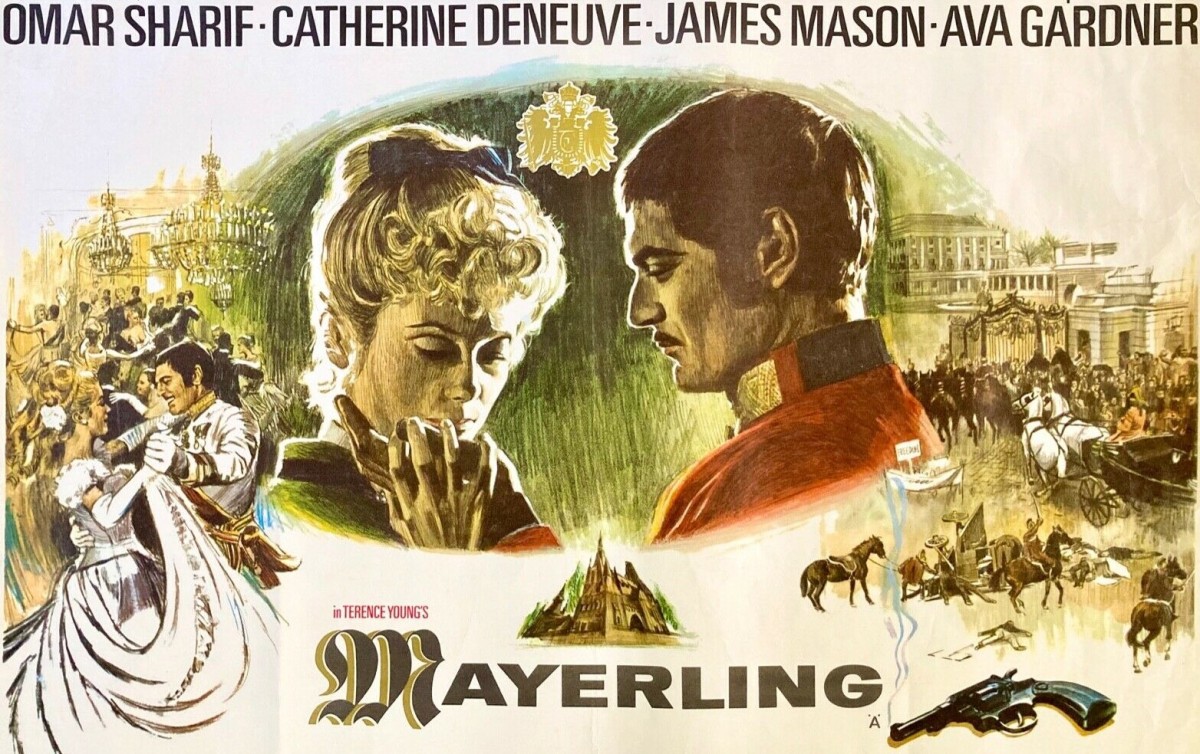
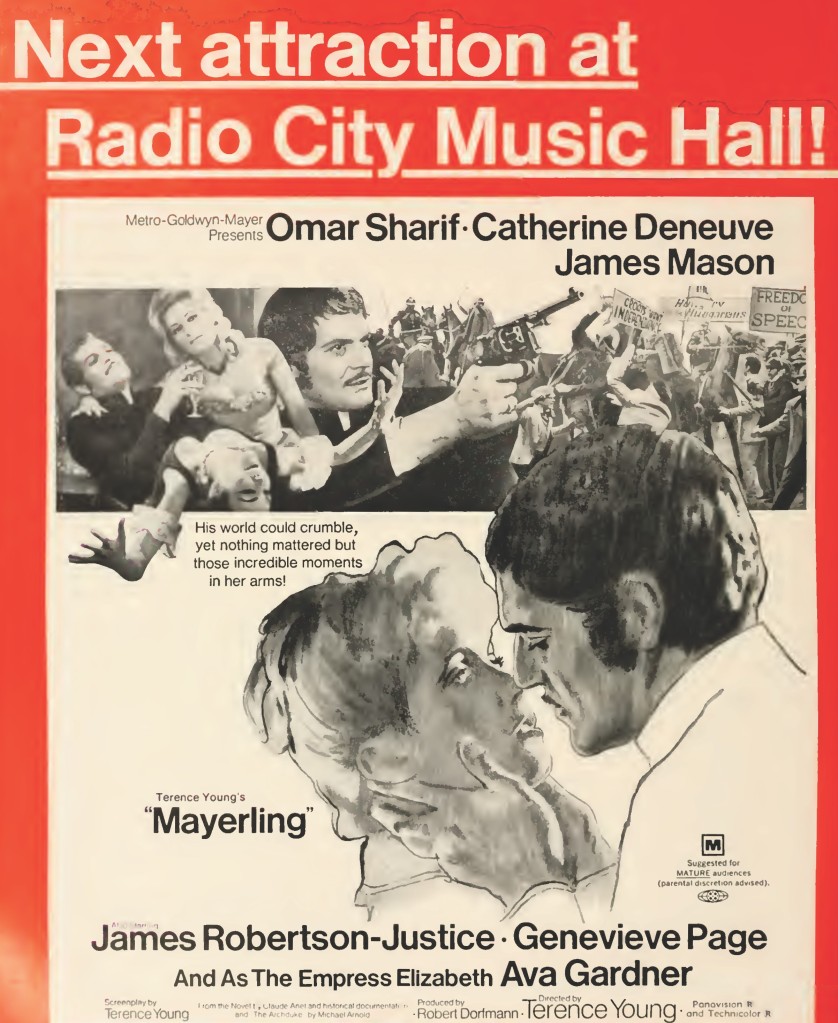
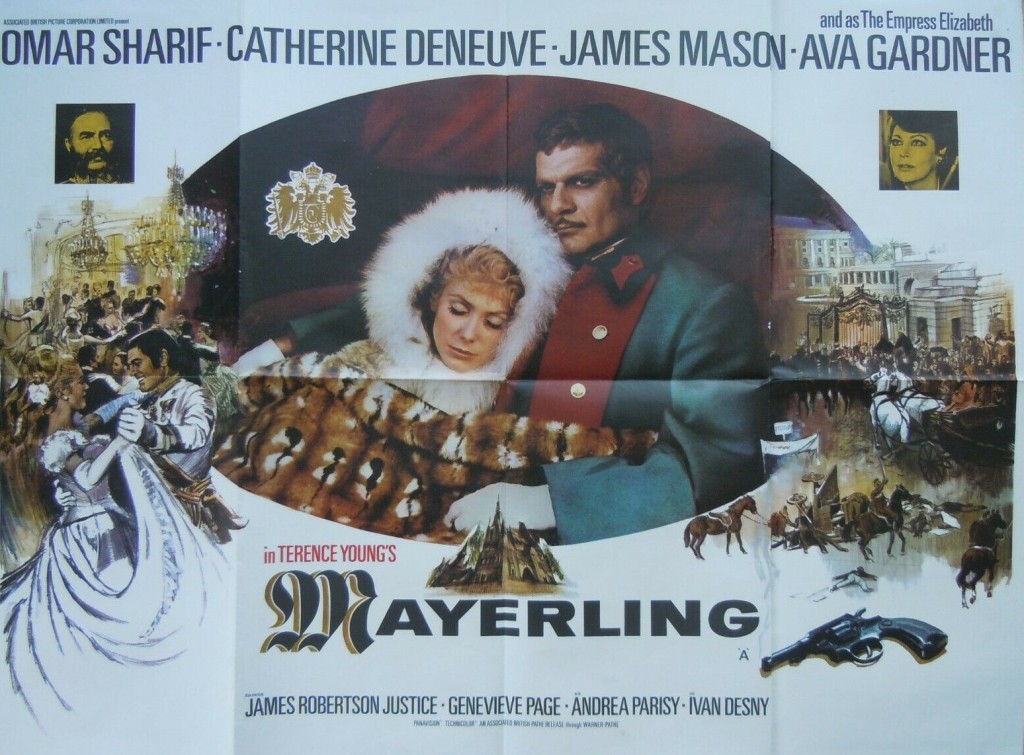
Mayerling (1968) ****

Sumptuous historical romantic drama set in a fading European empire awash with political intrigue and incipient revolution. Archduke Rudolf (Omar Sharif), married heir to the throne and constantly at odds with rigid father Emperor Franz-Josef (James Mason), sympathizes so strongly with Hungarian dissidents that he threatens to tear apart the Austro-Hungarian Empire. However, when he falls in love with Maria (Catherine Deneuve) and wants to marry her instead that, too, threatens to throw the empire into disarray.

Although dissolute, a mistress (or two) on the side, and addicted to morphine, that is not the way Rudolf is introduced to the audience. Instead, he is one of a string of bloodied men arrested after a demonstration giving his name to an officer in a police station who, once he is recognized, orders all other prisoners be released. He is the poster boy for good royalty. The Hungarians, agitating for independence, want him to become their king.

Beautifully mounted with lavish sets and enough in the way of balls, ballet, processions,  horse riding and sleighs to keep up a steady parade of visually interesting distractions, the films steadily builds up an undercurrent of tension, both between father and son and between rebels and ruler. The emperor is a political genius, not just spying on his son, but full of devious devices to hold together whatever threatens to break up the empire.

The romance develops slowly and with true historical perspective, the first kiss they share is not on the lips, Rudolf kisses both her cheeks, she kisses his palm. Yet, there is a real sense that, no matter his power, they can still both be trapped in roles they despise, separated at the whim of parents. Rudolf, as he understands true love for the first time, finds the self-belief to challenge political certainties.

The regal aspects are well done, arguments about the rule of monarchy come over as heated conversation rather than boring debate, the political realities unavoidable. Rudolf, desperate to avoid a future where someone has to die before he has a reason to live. Escape is not an option.

There is a wonderful bitchy atmosphere in the court, where ladies-in-waiting disparage each other behind their backs, one dress described as “wallpaper,” and are forever seeking advancement. Countess Larish (Genevieve Page) is a self-appointed procurer-in-chief for Rudolf, not caring what chaos she causes.

I should add, if you are as ignorant of your European history as myself, that Mayerling is a place not a person. I tell you this so that you don’t make my mistake of waiting for a Mayerling character to appear. The film pointedly avoids a history lesson but it could have spared a minute to explain that the events depicted take place just 20 years after the Austro-Hungarian Empire, the second largest land-mass in Europe, and among the top two or three nations. That would have helped clarify why Franz-Josef was in such a constant state,  worried about forces that could break up the empire, and as concerned that his son, living such a debauched life, lacked the personal skills to hold it together after his father’s death.

It is ironic that Rudolf does prove his worth as a result of being briefly separated from Maria, taking the army to task for its incompetent officers and poor maintenance of everything from weaponry to horses.

To his credit director Terence Young (Dr No, 1962) does not rely on Omar Sharif’s soulful brown eyes and instead allows action to convey character and looks and touch the meaning of his love. This is probably Omar Sharif’s best role, one where he clearly made all the acting decisions rather than being over-directed by David Lean as in Doctor Zhivago (1965). Catherine Deneuve is equally impressive as a far-from-docile innocent, especially given the wide range of more sexually aware characters she has created for Repulsion (1965) and Belle de Jour (1967).

James Mason (Age of Consent, 1969) is superb as the conniving emperor, so rigid he will not approve a change of buttons for the army, so cunning that an apparent rapprochement with his son has unseen strings attached. Ava Gardner (55 Days at Peking, 1963) sweeps in briefly as an empress protective of her son and making the best of life in a gilded cage. Also impressive are Genevieve Page (Grand Prix, 1966) and James Robertson Justice (Doctor in Distress, 1963) as the high-living British heir nonetheless under the thumb of his mother Queen Victoria.

Terence Young also wrote the literate, often amusing script, although Denis Cannan (A High Wind in Jamaica, 1965) and Joseph Kessel (Night of the Generals, 1967) are credited with additional dialogue. While Francis Lai (The Golden Claws of the Cat Girl, 1968) wrote the score he relies heavily on classical music from Aram Khachaturian’s Spartacus.

If you come at this not expecting a David Lean style affair full of striking compositions, but an old-fashioned drama advancing at leisurely pace, you will not be disappointed.

The Shoes of the Fisherman (1968) ****

Thought-provoking drama with a surprisingly contemporary slant set against the grandeur of the Vatican amid geo-political turmoil. At a time of global crisis, dissident Russian archbishop Lakotov (Anthony Quinn) is unexpectedly freed from a labour camp by the Russian premier (Laurence Olivier). Arriving at the Vatican, he is promoted to cardinal by the dying Pope (John Gielgud) before becoming an unexpected contender for Papal office.

The spectacular wealth of the Catholic Church is contrasted with the spectacular poverty of China, on the brink of starvation due to trade sanctions by the United States, nuclear war a potential outcome. The political ideology of Marxism is compared to the equally strict Christian doctrine, of which Lakotov’s friend Father Telemond (Oskar Werner) has fallen foul. There is a sub-plot so mild it scarcely justifies the term concerning television reporter George Faber (David Janssen) torn between wife Ruth (Barbara Jefford) and younger lover Chiara (Rosemary Dexter).

Lakotov is drawn into the Russian-Chinese-American conflict and the battle for the philosophical heart of the Christian faith while bringing personal succour to the lovelorn and performing the only modern miracle easily within his power, which could place the Church in jeopardy, while condemned to the solitariness of his position.

The political and philosophical problems addressed by the picture, which was set 20 years in the future, are just as relevant now. The film’s premise, of course, while intriguing, defies logic and although the climax has a touch of the Hollywood about it nonetheless it follows an argument which has split the Church from time immemorial.

You would not have considered this an obvious candidate for the big-budget 70mm widescreen roadshow treatment, but MGM, after the Church not surprisingly refused access to the Vatican, spent millions of dollars on fabulous sets, including the Sistine Chapel. The roadshow version of the picture, complete with introductory musical overture and an entr’acte at the intermission, is leisurely and absorbing, held together by a stunning – and vastly under-rated – performance by Anthony Quinn (The Lost Command, 1966) who has abandoned his usual bombastic screen persona in pursuit of genuine humility and yet faces his moments when he questions his own faith.

Ruth has a pivotal role in bringing Lakotov down to earth but George has the thankless task, setting aside the quandaries of his love life, of talking the audience through the sacred ceremonies unfolding sumptuously on screen as the cardinals bury one Pope and elect another.

You wouldn’t think, either, that Hollywood could find room in such a big-budget picture for philosophical discussion but questions not only of the existence of God but whether he has abandoned Earth are given considerable scope, as are discussions about Marxism and practical solutions to eternal problems. None of these arguments are particularly new but are given a fair hearing. There is a hint of the Inquisition about the “trial” Telemond faces. Oskar Werner (Interlude, 1968) carries off a difficult role.

David Janssen (Warning Shot, 1967) is mere window dressing and Rosemary Dexter (House of Cards, 1968) mostly decorative but Barbara Jefford (Ulysses, 1967) is good as the wounded wife. Laurence Olivier (Khartoum, 1966) is the pick of the sterling supporting cast which included John Gielgud (Becket, 1964), Burt Kwouk (The Brides of Fu Manchu, 1966), Vittorio de Sica (It Happened in Naples, 1960), Leo McKern (Assignment K, 1968), Frank Finlay (A Study in Terror, 1965), Niall McGinnis (The Viking Queen, 1967) and Clive Revill (Fathom, 1967). In a small role was Isa Miranda, the “Italian Marlene Dietrich,” who had made her name in Max Ophuls Everybody’s Woman (1934) and enjoyed Hollywood success in films like Hotel Imperial (1939) opposite Ray Milland.

Michael Anderson (Operation Crossbow, 1965) directed with some panache from a script by veteran John Patrick (The World of Suzie Wong, 1960) and Scottish novelist James Kennaway (Tunes of Glory, 1960) based on the Morris West bestseller.

I found the whole enterprise totally engrossing, partly because I did not know what to expect, partly through Anderson’s faultless direction, partly it has to be said by the glorious backdrop of the Vatican and the intricacy of the various rites, but mostly from the revelatory Quinn performance. And even if the plot is hardly taut, not in the James Bond clock-ticking class, it still all holds together very well. From the fact that it was a big flop at the time both with the public and the critics, I had expected a stinker and was very pleasantly surprised.

Uptight (1968) ****

While a misplaced attempt to relocate John Ford’s Oscar-winning The Informer (1935) to Cleveland, Ohio, after the funeral of Martin Luther King, director Jules Dassin more than makes up for it with his exploration of black militancy and racial conflict. The basic story of unemployed alcoholic Tank (Julian Mayfield) trying to regain the favor of local activist committee led by B.G. (Raymond St Jacques) is less interesting than the revolutionary backdrop.

Dassin was suited to uncovering the seamy side of life having helmed film noirs Brute Force (1947) and The Naked City (1948) and while in the 1960s concentrating on dramas he remained best-known for heist pictures Rififi (1955) and Topkapi (1964) so it was almost a given that this movie would feature a robbery.  Tank was supposed to be part of a team, led by Johnny Wells (Max Julien), hijacking guns, but he’s too drunk to help, and during the robbery after a guard is killed the finger points at Johnny. 

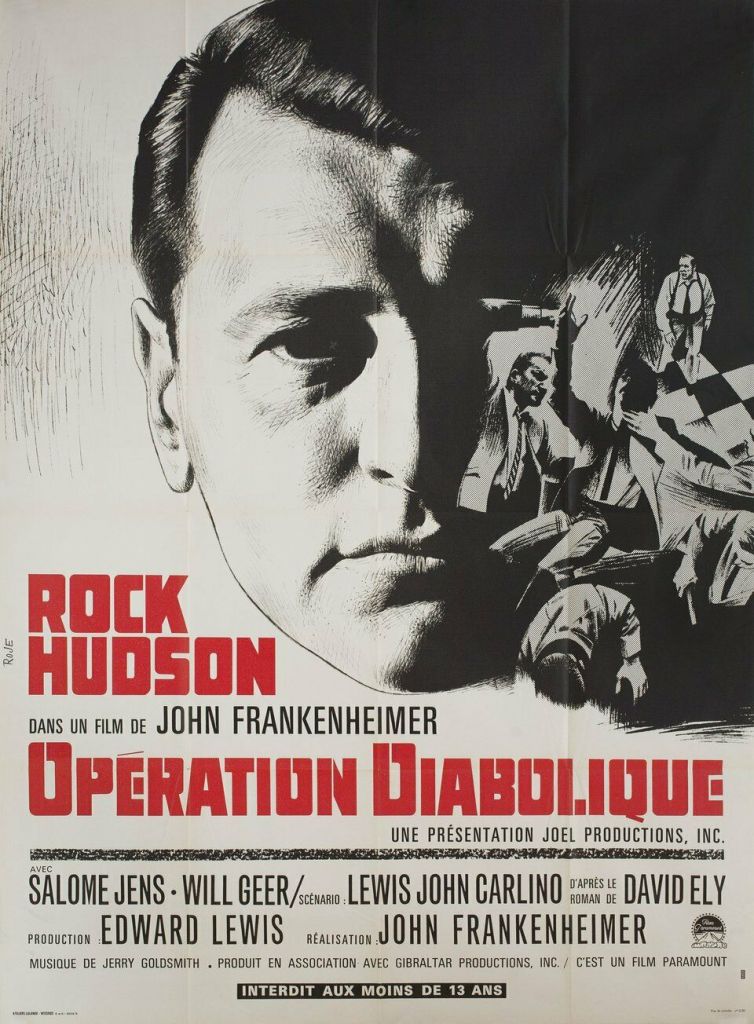
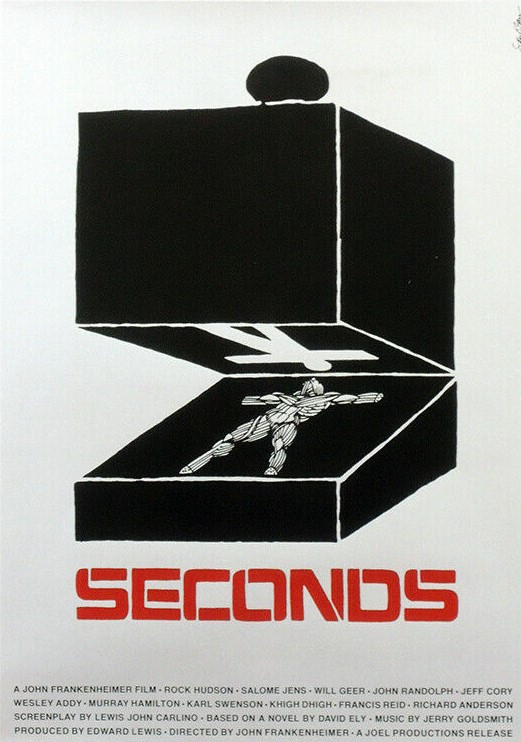
Above: American poster. Below: the French version.

Assailed for his lack of maintenance by Laurie (Ruby Dee), mother of his kids, who subsists on welfare and prostitution, Tank considers informing on Johnny and picking up the $1,000 reward. So the story becomes a question of whether he will succumb to temptation.

But that’s really just a MacGuffin for an insight into the problems facing the poverty-stricken black population and the armed response many feel is the only way to resolve such issues. Several outstanding scenes depict the raw emotions of people trapped in this lifestyle. The opening scene, showing the funeral of Martin Luther King, became a clarion call for violence. Laurie is humiliated by a welfare officer. Police attempting to arrest Johnny are met with a fusillade of bottles.

The case for armed insurrection is made abundantly clear. The black population is continually oppressed, not just by police violence, but being told they lack the skills for a rewarding job. “When you’re born black, you’re born dead.” B.G. rejects the offer of assistance of white civil rights activists. Not all the locals are underdogs. Clarence (Roscoe Lee Brown), with an apartment lined with bookshelves and wearing fine clothes, does very well out of his arrangements with the police and the black welfare officer clearly gets a kick out of his power to possibly disbar Laurie from receiving financial assistance. While it might have proved more incendiary at the time, it’s impossible to miss the injustice portrayed. It was almost a wake-up call for the ruling authorities that there existed a growing underground force determined to achieve equality through violence if necessary. The idea of an organised group, rather than a shambolic mob, is the other clear message.

Any actor would baulk at the prospect of matching the Oscar-winning performance of Victor McLaglen in the Ford original and surely no director would entrust the task to an inexperienced actor like Julian Mayfield whose only previous screen credit was a decade before in Virgin Island (1958). Mayfield finds it impossible to conjure up the pathos required and mostly appears as a bumbling fool.

This is despite the movie going out of its way to make Tank appear more sympathetic. He could easily claim he was blackmailed into informing by wealthy stool pigeon Clarence who holds compromising photographs. But, equally, the brotherhood, should it become aware of Clarence’s activities, would surely come down on him hard. Johnny absolves Tank of responsibility for not participating in the robbery, recognizing that while the man’s bulk was useful in the past, he lacks the mind-set for robbery. And he must stay away from Laurie otherwise she will lose her welfare.

But the rest of the cast is outstanding. Raymond St Jacques (If He Hollers, Let Him Go, 1968) stands supreme as an imposing Malcolm X figure. Roscoe Lee Brown (Topaz, 1969) is persuasive as a confident gay informer. Activist Ruby Dee (The Incident, 1967) is good, too. And there is strong support from Frank Silvera (Guns of The Magnificent Seven, 1969), Max Julien, best known later for The Mack (1973), and in her movie debut Janet MacLachlan giving a hint of the acting skills that would win her an Oscar nomination for Maurie (1973)

Perhaps the most important element of the picture was the screenplay, a collaboration between Julian Mayfield, Ruby Dee and Jules Dassin, the involvement of the first two ensuring that the main targets were well and truly hit. Dassin ensures that the movie never loses its way, tension kept high by the hunt for Johnny, the personal dilemma of Tank and the various confrontations with B.G. Great contemporary score by Booker T.

This is a movie that still stands up, not just because of its fearless delineating of the times, but from the suspicion that not enough has changed in the abject poverty to which so many are condemned.

There’s a very decent print available on Youtube.

The Last Letter from Your Lover (2021) *** – Seen at the Cinema

Oddly enough, this is also straddles 1965 and the present time and falls victim to the same problems of following two storylines. In fact, this is a tad complicated in that not only is present-day journalist Ellie Haworth (Felicity Jones) investigating a romantic mystery from the past but the subject of her inquiry Jennifer Stirling (Shailene Woodley) is also investigating her own romance. Confused, you bet. Jennifer is suffering from that old Hollywood romantic standby – amnesia – and is alerted to her own mysterious past by the discovery of the letters that turn up half a century later in the hands of Ellie.

So really, there’s three storylines to keep up with: the contemporary exploration of the past, Stirling’s journey of self-discovery and in a series of flashbacks in the same period her forbidden romance – given she is already married – with charmer Andrew (Callum Turner). This 1960s is full-throttle glamour, playing out in the classy French Riviera, both Stirling and Andrew looking like they’ve just walked off a catwalk.

That it works surprisingly well is due to the three stories never getting mixed up (as in Last Night in Soho) and that in each period it is driven by detective work. People often forget there is nothing more satisfactory to solve than a romantic mystery rather than tracking down an ubiquitous serial killer. Three of the characters – Andrew, Ellie and her co-opted  investigative partner Rory (Nabhaan Rizwan), an archivist, are absolutely terrific, the actors delivering star turns. Andrew comes over as attractive but deep, a committed financial journalist. On the other hand Jennifer is pretty much a spoiled brat, and in the hands of Shailene Woodley over made-up and looking ill-at-ease in her glad rags. Amnesia has the unfortunate effect of making her wooden.

The 1960s romance follows pretty much the standard Hollywood template that is somehow going to hit an iceberg. By comparison the contemporary slow-burning romance between Ellie and Rory is a joy. She is outgoing, spunky, sexually confident – in a neat reversal she can’t remember the name of the boy she wakes up in bed with – while Rory is an old-fashioned stuck-in-the-mud whom she manages to warm up.

Felicity Jones has been through the Hollywood wringer – earnest roles such as The Theory of Everything (2014) and On the Basis of Sex (2018) mixed in with blockbusters of the Inferno (2016) and Rogue One (2016) variety – but here she is just delightful, playing a very rounded character. Nabhaan Rizwan (The Accident tv series, 2019) is wonderfully endearing. They play exceptionally well off each other, a sort of latter-day Andie McDowell-Hugh Grant.

It would have been a very quiet cinemagoing week for me to end up watching this and I wasn’t going to review it at all except for being reminded of dual-time settings by Last Night in Soho. I have to say I was happily surprised, the various mysteries enough of a hook, the Jones-Rizwan tag team exhibiting true charisma. Hats off to director Augustine Frizzell (Never Goin’ Back, 2018) for recognizing their potential and for keeping the whole enterprise chugging along. It’s one of the few Netflix productions to deliver.

This Sporting Life (1963) ****

What began as the last gasp of the British New Wave working class kitchen sink drama has now after a six-decade gap resolved into a struggle over political and sexual ownership. Macho athlete Frank Machin (Richard Harris) jibes against his paymasters at a Yorkshire rugby league club – in similar fashion to Charlton Heston in Number One (1969) –  while trying to hold sway over widowed landlady Margaret (Rachel Roberts). While documenting the class divide over which British writers and directors obsess, Lindsay Anderson’s debut takes a wry look at power.

Machin belongs to the Arthur Seaton (Saturday Night and Sunday Morning) class of loudmouth boors, determined to take as much as they can, riding roughshod over anyone who gets in their way, even attacking players of his own team. Although a fan favorite, his position at the club still requires backing from the moneyed directors, support that appears go awry when he rejects overtures from Mrs Weaver (Vanda Godsell), wife of a board director (Alan Badel). While Margaret eventually succumbs, her actions fill her with shame, the presents he buys making her feel like a kept woman.

Both Machin and Margaret are the rawest of creatures, forever appearing ready to topple into some emotional crevasse of their own making. At a time when marriage was the rock of society and women had little independence, a woman could dwindle away in face of scorn from neighbours, while a man lacking emotional intelligence would crumble in the face of his own fears.

The non-linear narrative blurs some aspects of the story. There is no reference to Machin’s background save that he was once a miner and still works somewhere unspecified to supplement his footballer’s income. He rejects the paternalism of ageing scout Johnson (William Hartnell) while appears to be seeking to resolve maternal issues, the widow with two small children at least a decade older, and although he could easily afford better accommodation refuses to move out.

His obsession with Margaret is never properly explained, except by her, who sees him as acting like an owner. Equally, Margaret is the opposite of the women in virtually every movie of the period, for whom marriage is the sole ambition. Whether she still grieves over the loss of her factory worker husband, who may have committed suicide, or loathes Machin’s dominant nature is never explained. It might have been better if they had married for unhappy husbands and wives tend to give each other both barrels, emotions never concealed. Or she could be in the throes of an undiagnosed depression – author David Storey suffered from this all his life – expressed as anger.

Machin is the other side of the British Dream – the assumption that anyone who escapes going down the pits or the mindless grind of the factory will automatically enjoy happiness. While Machin revels in his celebrity, he has no idea how to make his life happier. This is in contrast to the other footballers who either enjoy womanizing and drinking or are married or engaged and accept the unwritten rules of the game rather than fighting everyone.

There is plenty grime on show, and the football field has never been so pitilessly portrayed, and as a social document the movie fits in well to the small sub-genre of films depicting working class life, but the picture’s thrust remains that of two opposites who will clearly never meet except in the delusional head of Machin.

Power is demonstrated in various ways. Weaver has the clout to give Machin a hefty signing-on fee against the wishes of the board, Weaver’s wife takes her pick of the footballers to satisfy her sexual needs, Machin believes he is entitled to berate waiters in an upmarket restaurant, while Margaret is demeaned by accepting his present of a fur coat.

As ever with these films of the early 1960s there is a wealth of acting talent. Both Harris and Roberts were Oscar-nominated. Others making a splash in the cast were Alan Badel (Arabesque, 1966), Colin Blakely (The Vengeance of She, 1968), Jack Watson (The Hill, 1965), and if look closely you will spot double Oscar-winner Glenda Jackson (Women in Love, 1969). Future television stalwarts included William Hartnell (the first Doctor Who), Arthur Lowe (Dad’s Army, 1968-1977), Leonard Rossiter (Rising Damp, 1974-1978), Frank Windsor (Softly, Softly, 1966-1969) and George Sewell (Paul Temple, 1969-1971).

Lindsay Anderson (If… 1969) no doubt believed he was making an excoriating drama about the class struggle, but in fact has delivered a classic thwarted love story. David Storey wrote the screenplay based on his own novel.

The Comedy Man (1964) ***

Unemployed actor Chic Byrd (Kenneth More) clings to his sanity through a series of rejections in this realistic portrayal of life as a stage actor. Even humor fails to leaven despair as he fails for the most part to even achieve auditions, reduced to a job as Santa Claus in a department store and acting in television commercials while a friend Julian Baxter (Edmund Purdom) suddenly shoots to fame in the movies.

Chic has never been a success, his name never adorning a West End marquee, trundling round one English repertory theatre after another, living in one tiny leaking apartment after another. And now, on the wrong side of forty, knocking on disillusion’s door, feels life has passed him by. The price of failure is high, another failed thespian Jack (Alan Dobie) commits suicide. Chic still has charm enough to revive an old relationship with fellow actor Judy (Billie Whitelaw) and deflower virgin Fay Trubshaw (Angela Douglas).

It’s a well-rounded character. While living on scraps, he still takes taxis. He pawns valuables. While Judy between acting jobs works as a waitress, he feels that is beneath him. To some extent he has coasted, too many easy love affairs getting in the way of the hard work required to build a serious career.   

There is some sharp observation: sleazy agent (Dennis Price) operating a casting couch and feeling free to maul every girl in sight, even Fay; extras go on strike in a film; rain washes out location shooting; a shocked young girl watches as a man cuts in on her male dancing partner; no female backside within reach remains un-slapped; the platoon of out-of-work actors keep up each others’ spirits.

This was a strange case of life imitating art. Kenneth More’s career was on the slide. From Genevieve (1953) to Sink the Bismarck (1960) by way of Doctor in the House (1954) and Reach for the Sky (1956), More had combined comedic charm with stiff-upper-lip heroics to achieve massive success at the British box office. But his career had gone into tailspin after he offended the boss of Rank, not just one of the top British studios but owner of one of the top cinema chains. He remained under contract to Rank without receiving any work.

With its depiction of life in the raw – plus enough sex and swearing to command an “X” certificate – it should have been a shoo-in for acceptance as part of the British New Wave, for whom work and unemployment were essential elements. It could have revived More’s career, shifted critical and audience perception. But it did neither.

At this point Canadian director Alvin Rakoff was more of a television stalwart than movie maker, but he does elicit a poignant performance from More, fills the background with incident and steers the picture clear of the maudlin. Readers of this Blog will be familiar with Peter Yeldham who wrote the screenplay – from the novel by Douglas Hayes – since he was also responsible for The Liquidator (1965), Bang! Bang! You’re Dead! (1966) and Age of Consent (1969).

Cecil Parker has a cameo as a befuddled ageing actor on the scrounge, supporting actor Norman Rossington (Tobruk, 1967) again makes an impact as a neighbor whose chat-up lines fail to strike a chord with sophisticated actresses, and Frank Finlay appears in a bit part. Billie Whitelaw is excellent as the old flame who acts as Chic’s conscience while Dennis Price takes his usual charm down a seedier road. But it’s More’s film and it is something of an eye-opener even though seen by so few.

Although completed in 1962, the film was shelved for 18 months as original distributor Hal Christie of Albion Films struggled to find a place for it in the release system. More was especially vexed as he had deferred his salary so would not be paid until the film turned a profit which it was never going to do sitting on a shelf. With his career now mostly dependent on independent production, More now , typically, vented his anger on this filmmaking sector complaining to Variety that “they were little men running around in small, stupid, circles”

The picture had cost $500,000 but $300,000 of that came from a loan from the National Film Finance Corporation, a government scheme which had a habit of investing in duds. When it was finally released in 1964, it was ironic that it went out on the lower half of a double bill with another film that had been shelved for even longer – three years – Peter Brooks’ The Lord of the Flies. Doubly ironic, it was Rank that paired them.

This was More’s final starring role so it is an unusual swansong and a shame, really, that he did not attempt this kind of picture in his heyday when it could have expanded his career.

By the way, unless Imdb has changed it since I told them, More does not play a character called “Chick” because his surname is Byrd. He plays a character called “Chic” because that is standard British shortening of the first name Charles, as in Chic Murray.

Three (1969) **

More interesting for the stars involved – in particular Sam Waterston and Charlotte Rampling as well as an ex-fighter pilot, an Australian pop star and a model – than the film itself, which presents a European arthouse take on youngsters freewheeling around Europe looking for their share of the free love purportedly available everywhere.

There’s not really any story, mostly it’s scenery, and whatever tension there is rarely rises to the point of drama. However, it is refreshing to see a picture not steeped in angst that reflects the normality of life rather than superficially-imposed heightened confrontation. On a tour of Italy, American college buddies Taylor (Sam Waterston), the shy gawky one, and Bert (Robie Porter), the better-looking confident one, take up with British girl Marty (Charlotte Rampling). The guys make a pact not to compete for the girl’s attentions, but that idea doesn’t last long. The title suggests she might end up with one – or both. In trying to sell the film, the marketeers felt obliged to make that idea more implicit.

The guys make plays for other girls they meet but seem to find little genuine action and in that sense it is more true to life than other films of the period which suggested sex was there for the asking. But none of the characters are particularly interesting and while that is also more realistic it diminishes enjoyment. The highlight is a naked Taylor attempting to save a girl from drowning in the sea, but in keeping with the film’s tone he is beaten to it by a boat.

There’s not much sign here of the intense dramatic style Oscar nominee Sam Waterston would later bring to the movies. This was his third film after small parts in The Plastic Dome of Norma Jean (1966) and Dick Van Dyke vehicle Fitzwilly (1967) and he wouldn’t hit his stride until The Great Gatsby (1974).

Perhaps the oddest movie fate befell Charlotte Rampling, also a later Oscar nominee. How else to explain that she followed up this picture with Luchino Visconti’s The Damned (1969) and preceded it with Roger Corman’s Target: Harry (1969). With a career that at this point appeared to follow no particular pattern, after making an impact in Georgy Girl (1966) as a libidinous flatmate, she took a small role in The Long Duel (1967) before reaching leading lady status opposite Franco Nero in Italian thriller Sequestro di Persona (1968). Her languid screen persona was turned on its head with The Night Porter (1974).

Who was Robie Porter you might very well ask? And why did he only make two pictures, the other being The Carey Treatment (1972)? He was an Australian pop star, specializing in instrumentals on a steel guitar, with a series of hits including two at number one. He chanced his arm in Britain, without repeating that success, then moved to the U.S. and landed parts in television series Daniel Boone and Mannix. After Three, he returned to the music business, as part-owner of record label Sparmac and producing for the band Daddy Cool.

Other names in Three, in bit parts only, none making any discernible impact in the picture, included model Edina Ronay (daughter of celebrated food critic Egon Ronay) who had appeared in A Study in Terror (1965) and Prehistoric Women (1967). Equally as celebrated, if for other reasons, was Gillian Hills, best known as one of the girls cavorting naked with photographer David Hemmings in Blow Up (1966) and as the titular Beat Girl (1960)

Writer-director James Salter was a genuine Hollywood curiosity. He hit a peak of cinematic activity in 1969, with two other screenplays filmed – Downhill Racer (1969) and The Appointment (1969). This is pretty much a companion piece to Downhill Racer (1969) which has a bunch of professional skiers on a similar scenic tour and often sitting around with not much to do although that film builds in confrontation and a more standard love affair.

Generally considered a “writer’s writer” – i.e. adored by his peers more than the public – his first novel The Hunters (1958), based on his Air Force experiences, was turned into a movie starring Robert Mitchum. He dabbled in documentary film-making, whose impact can be seen in his feature films, but was better known for a short erotic novel A Sport and a Pastime set in Europe. None of his 1969 trio were hits, he ended up in Hollywood limbo, and he didn’t reappear on the movie credits list until Richard Pearce’s sci-fi Threshold (1981) starring Donald Sutherland.   

It’s not a stinker, but it’s not much of anything else either.

Africa – Texas Style (1967) ***

Falling into the unusual category of Saturday afternoon matinee with a message, American cowboy Jim Sinclair (Hugh O’Brian) and sidekick Jim Henry (Tom Nardini) hightail it across the Atlantic to help the wildlife conservation efforts of game rancher Wing Commander Hayes (John Mills) who faces sabotage at every turn by another rancher Karl Bekker (Nigel Green). It combines Hatari!-style action and interesting storylines with Disney-animal-cuteness (a domesticated zebra called Pyjama Tops).

To get the conservation element out of the way – Hayes is concerned that letting animals roam free will result in overgrazing, turning the countryside into a dustbowl and endangering a variety of species. That Hayes is already talking about animals becoming extinct is way ahead of the common perception of Africa at the time. His plan is to round up the wild animals and fence them in, this kind of ranching preventing foodstocks becoming depleted. Bekker’s objection is that wild animals carry infections such as East Coast Fever that will endanger his herd.  

Romantic interest is supplied by the already-engaged nurse Fay Carter (Adrienne Corri) while orphan Sampson (Charles Malinda) tugs at the heart strings. There is a fair measure of authenticity, glorious aerial shots of elephants and buffalo and other species, tribal dances by the Masai while the Sinclair/Henry rodeo-style method of catching wild animals, with lasso rather than giants nets as in Hatari!, ramps up the excitement quotient, not least when Sinclair goes one-on-one with an enraged rhino. As you might expect, there is also ample opportunity for Sinclair to encounter a deadly snake and crocodile and it wouldn’t be an African picture without a stampede.  

Although villainous, Bekker is not without logical argument, not just the fear of infection which would decimate wildlife as much as soil erosion, but his own concerns that taming wild animals would upset the balance of nature, and, on a personal level, the lack of respect for territorial rights. Of course, when push comes to shove, he resorts to rifle and fist to settle  arguments.

Atmospheric, well-made, engaging and at times exciting, there is enough going on here to keep the picture ticking along – a hunt for a lost and bewildered Sinclair, questions about home, and the spectacular wildlife rodeo show. Unlike Born Free (1966) and any other animal picture for that matter although wildlife takes narrative center stage we are not subjected to countless cute four-legged specimens.

Hugh O’Brian (Ambush Bay, 1966) could be a latter-day Tarzan (or more correctly Jungle Jim since he is never in loincloth) but Scottish actress Adrienne Corri (The Viking Queen, 1967) is less jungle adventuress more principled counter to his easy manner. With every chance to rely on the stiff-upper-lip of an English war hero, John Mills (The Family Way, 1966) does anything but and turns in another engaging performance and if you are looking for a decent chap to deliver a conservation message he is definitely your man without being obsessively annoying. Nigel Green (The Skull, 1965) adds to his portfolio of interesting characters as a smooth-talking rough-edged bad guy while Tom Nardini (Cat Ballou, 1965) impresses. Look out for a fleeting glimpse of Hayley Mills  at the start.

Director Andrew Marton, who had been involved in helming The Longest Day (1962) and second unit director of Ben-Hur (1959) and Cleopatra (1963), was something of a wild animal specialist with Clarence, the Cross-Eyed Lion (1965) in the kitty as well as a dozen episodes in total of television series Flipper (1965) and Daktari (1966). But he is at home as much with the human aspects of the story as with the animal. Producer Ivan Tors was a sometime rival to Walt Disney in the family film market with Flipper (1963) and Zebra in the Kitchen (1965) as well as small-screen Flipper and Daktari.

Mistakenly described on imdb as a TV pilot, this was a genuine feature film that happened to produce a television spin-off series Cowboy in Africa. It was screened for the trade in the U.S. on May 5, 1967, reviewed in the feature film section of Variety on May 17, and its U.S. box office figures can be tracked through Variety – opening in 1967 in San Francisco and Kansas City in June, for example, Baltimore in July, Detroit in August and Boston and Louisville in September. In some situations it was double-billed with El Dorado (1967).

CATCH-UP:  John Mills’ versatility can be seen from movies already reviewed in the Blog: The Truth About Spring (1965), Operation Crossbow (1965), The Wrong Box (1966) and The Family Way (1966).

The Interns (1962) ***

Patients are a nuisance to be tolerated on the route to wealth in this superior soap opera that sees young doctors wrestling with ambition and ethics. Although also concluding that impending lofty status will snare them an attractive bride, they find women less biddable than expected, romance proving the trickiest of all procedures.

The main cast of four men and one women are played by a roster of hotly-tipped newcomers, including future Oscars winners and nominees and the elusive Haya Harareet (The Secret Partner, 1961). Director David Swift, accustomed to handling multiple characters in the likes of Pollyanna (1961), keeps the pot boiling and although some storylines lead to obvious conclusions the screenwriters bring sufficient imagination to the various strands.

The story unfolds over the one year the doctors spend in a general hospital, where the patients are liable to be drunk and obstreperous, before taking up residencies elsewhere. As you might expect, the main characters divide into the good and the arrogant. Heading the latter are Alec Considine (Michael Callan) who cheats on girlfriend Mildred (Anne Helm) with older nurse Vicky (Katharine Baird) in order to gain through her connections a residency at a highly prestigious hospital. Matching him in the cocky stakes is John Paul Otis (Cliff Robertson), charming to old ladies but willing to risk his career to bed movie actress Lisa (Suzy Parker). The good guys are Lew Worship (James MacArthur) who is seduced into the supposed backwaters of obstetrics and Sid Lackland (Nick Adams), an all-round good egg who falls for patient Loara (Ellen Davalos).

The most interesting of the young doctors, however, is single mother Madolyn Bruckner  (Haya Harareet) who takes on surgeon Dominic Riccio (Telly Savalas) at every turn. Riccio spends his time berating his charges and in particular has a downer on female doctors. At every encounter, despite his vicious tongue, she refuses to back down.

But it is the patients, in particular Arnold Auer (Peter Brocco) and Loara, who blow a hole in the myth of hospitals. In the best scene in the film, Auer, suffering from a degenerative illness that will turn him into a vegetable, takes over from the doctor in giving his own awful diagnosis. His pleas for clemency from his ordeal, in essence assisted suicide, create an ethical dilemma for the young doctors who did not realize that modern medicine would prolong rather than curtail patient suffering. Auer’s anguished wife Emma (Angela Clarke) flits in and out of the picture as she buttonholes any doctor willing to listen to a new cure she has discovered. While the more hard-hearted doctors can inure themselves to his agony, a savage turn of events finds them all caught up in a situation that could jeopardize their future careers.

Racy image of Olga (Carroll Harrison) adorns the cover of the soundtrack album with music by triple-Oscar-nominee Leith Stevens (“The Five Pennies,” 1959).

Although Loara has an incurable disease and has more or less given up, Lackland’s effervescent good humor and determination that surgery can resolve all health issues brings her hope. If you were in her condition possibly the last thing you would want would be a cheerleading doctor on your side, but in this instance it brings succor and in the doctor’s case forces him to rethink his priorities.

Probably the last thing the doctors – and the audience – expected was to come up against such stubborn free-thinking women. While Bruckner appears to fly the flag for female independence, she has solid support from Lisa who spends most of the picture rejecting Otis’s advances on the grounds that even when he becomes rich he will be too poor for her liking. Eventually, Vicky forces Considine to choose. Shy nurse Gloria (Stefanie Powers) shocks Worship by putting global travel ahead of marriage. But she’s not as shocking as the bespectacled inhibited Olga (Carroll Harrison) who makes a spectacle of herself by losing her inhibitions in flamboyant style at a wild New Year’s Eve party, her disheveled state a key element of promotional artwork.

Although, theoretically, a film about young doctors having a romp, in reality it is a thoughtful and thought-provoking picture, tackling issues that would have been taboo at the time and removing the submissive tag that daunted most movie female characters in the movies.

Those who succeeded in later winning Oscar favor were Cliff Robertson, Best Actor for Charly (1968), and Nick Adams and Telly Savalas, both nominated for Best Supporting Actor, the former in Twilight of Honor (1963) and the latter in The Birdman of Alcatraz (1962). Robertson was the pick of the bunch, a star in his own right graduating from 633 Squadron (1964) and Masquerade (1965) to J.W. Coop (1971) which he also directed. But largely, the stars did not fulfil initial promise. The peak of Michael Callan’s movie career was reprising his role in The New Interns (1964), star in British director Michael Winner’s You Must Be Joking! (1965) and second male lead in Cat Ballou (1965). James MacArthur had a steady movie career before an epic run in television series Hawaii Five-O (1968-1979). Nick Adams switched between film and television before his premature death in 1968.  Haya Harareet made only one more film, The Last Charge (1962).

Although primarily in television, the less-heralded stars enjoyed greater ongoing success. Mainly a strong supporting actor, Telly Savalas had only one stab at a starring role (Land Raiders, 1970) before achieving worldwide fame as Kojak (1973-1978).  Stefanie Powers was television’s The Girl from U.N.C.L.E. (1966-1967) and later Hart to Hart (1979-1984). Buddy Ebsen (who plays the older Dr Sidney Wohl) went straight into a nine-year run of The Beverley Hillbillies

Discover WordPress

A daily selection of the best content published on WordPress, collected for you by humans who love to read.

The Atavist Magazine

by Brian Hannan

WordPress.com Blog

News, Tips & Website Tutorials