Fraulein Doktor (1969) ****

Surprisingly good World War One spy yarn full to bursting with clever ruses and pieces of deception and ending with a stunning depiction of carnage on the Western Front.  Loosely based on the life of Elsbeth Schragmuller, it fell foul on release to British and American hostility over the Germans actually winning anything.

The film breaks down into three sections: the unnamed Doktor landing at the British naval base in Scapa Flow in Orkney to plan the death of Lord Kitchener; a flashback to France where she steals a new kind of poison gas; and finally on the Western Front where, disguised as a Red Cross nurse, she masterminds an attempt to steal vital war plans. She is hampered by her emotions, romance never helpful for an espionage agent, and her addiction to morphine.

Duelling spymasters the British Colonel Foreman (Kenneth More) and the German Colonel Mathesius (Nigel Green) both display callousness in exploiting human life. The films is so full of twists and turns and, as I mention, brilliant pieces of duplicity that I hesitate to tell you any more for fear of introducing plot spoilers, suffice to say that both men excel at the outwitting game.

I will limit myself to a couple of examples just to get you in the mood. Foreman has apprehended two German spies who have landed by submarine on Scapa Flow. He knows another one has escaped. The imprisoned Meyer (James Booth) watches his colleague shot by a firing squad. Foreman, convinced Meyer’s courage will fail at the last minute, instructs the riflemen to load up blanks. Before a shot is fired, Meyer gives up and spills the beans on the Doktor only to discover that Foreman faked the death of his colleague.

And there is a terrific scene where the Fraulein, choosing the four men who will accompany her on her final mission, asks those willing to die to step forward. She chooses the ones not willing to die. When asking one of these soldiers why he stayed back he replied that she wouldn’t want to know if he could speak Flemish if he was so expendable.

The Fraulein is always one step ahead of her pursuers, changing clothes and hair color to make redundant any description of her, and knowing a double bluff when she sees one. In France as a maid she turns seductress to win the trust of scientist Dr Saforet (Capucine) who has developed a new, deadlier, strain of poison gas. It’s unclear whether, appalled at the potential loss of life to her fellow Germans, this is her motivation to turn spy or whether at this point she is already an accomplished agent. In the final section she takes command of the entire operation.

What distinguishes this from the run-of-the-mill spy adventure is, for a start, not just the female spy, how easily she dupes her male counterparts, and that the British are apt just to be as expedient as the Germans, but the savage reality of the war played out against a British and German upper class sensibility. When a train full of Red Cross nurses arrives at the front, the wounded men have to be beaten back; Foreman thinks it unsporting to use a firing squad; a German general refuses to award the Fraulein a medal because Kitchener was a friend of his; and the Doktor’s masquerade as a Red Cross nurse goes unchallenged because she adopts the persona of a countess.

Far from being an evil genius, the Doktor is depicted as a woman alarmed at the prospect of thousands of her countrymen being killed and Germany losing the war. In order to cram in all the episodes, her later romance is somewhat condensed but the emotional response it triggers is given full vent. And there is tenderness in her affair with Dr Saforet, hair combing a prelude to exploring feelings for each other.

Apart from King and Country (1964), The Blue Max (1966) and Oh, What a Lovely War (1969), depictions of the First World War were rare in the 1960s, and the full-scale battle at the film’s climax is exceptionally well done with long tracking shots of poison gas, against which masks prove little deterrent, as it infiltrates the British lines. The horror of war becomes true horror as faces blister and, in one chilling shot, skin separates from bone and sticks to the barrel of a rifle.

If I have any quibbles, it’s a sense that there was a brilliant film to be made here had only the budget been bigger and veteran director Alberto Lattuada (Matchless, 1967) had made more of the suspense. Suzy Kendall (The Penthouse, 1967) easily carries the film, adopting a variety of disguises, accents and characters, yet still showing enough of her own true feelings. Kenneth More (Dark of the Sun, 1968), in more ruthless mode than previous screen incarnations, is excellent as is counterpart Nigel Green (Deadlier than the Male, 1967) but James Booth (Zulu, 1963) has little to do other than look shifty. Capucine (North to Alaska, 1960) has an interesting cameo.

Ennio Morricone (Once upon a Time in the West, 1969) has created a masterly score, a superb romantic theme at odds with the discordant sounds he composes for the battles scenes. Collectors of trivia might like to know that Dita Parlo had starred in a more romantic British version of the story Under Secret Orders (1937) with a German version, using the same actress, filmed at the same time by G.W. Pabst as Street of Shadows (1937), both revolving around this infamous secret agent.

This is far from your normal spy drama. Each of the main sequences turned out differently to what I expected and with the German point-of-view taking precedence makes for an unusual war picture. I enjoyed it far more than I anticipated.

Another freebie on YouTube. I could not find a DVD so you might need to check out secondhand dealers on Ebay.

Deadlier than the Male (1967) ****

Now revealed as the first film seen by Quentin Tarantino – at the age of five.

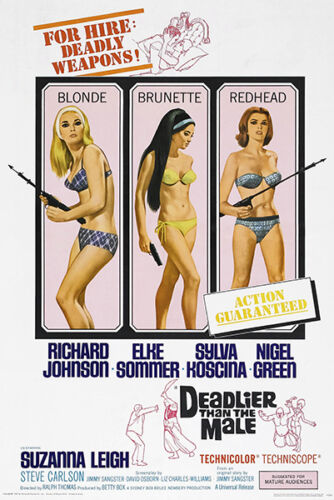
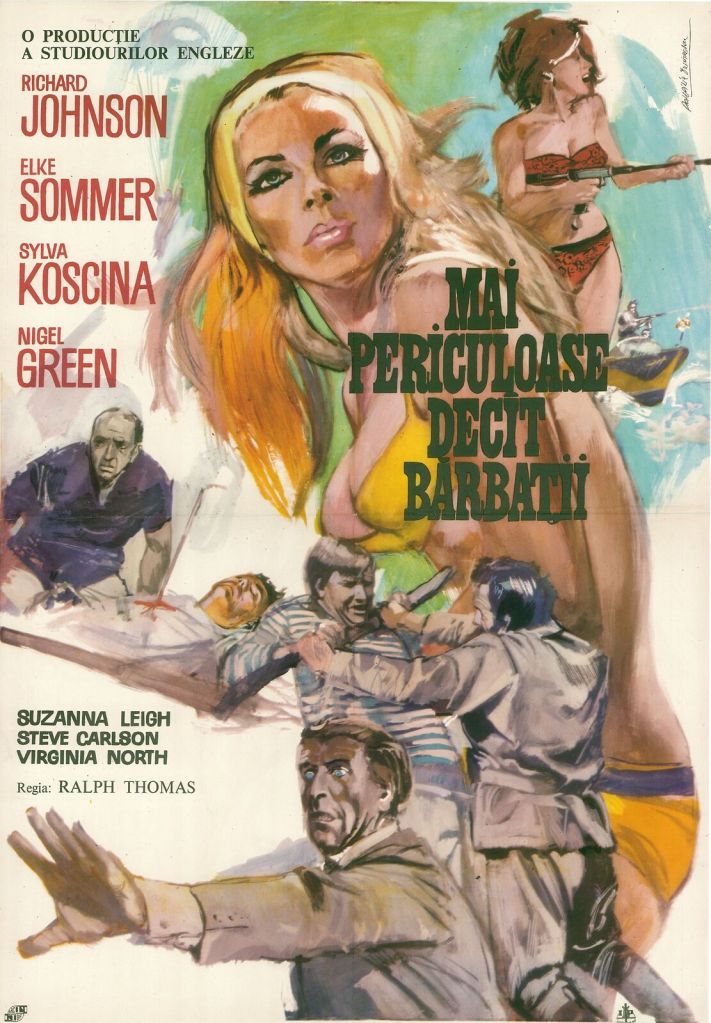
For a movie intended to set up a series character in the vein of James Bond, it was ironic that it was the women who stole the show, not just from their tendency to turn up in bikinis but for their outrageous villainy. Irma (Elke Sommer) and Penelope (Sylva Koscina) are the seductive assassins in the hire of Carl Petersen (Nigel Green) who has designs on an Arab oil empire. On her own Irma dispatches mogul Henry Keller (Dervis Ward) then the pair – emerging from the sea like a pair of latter-day Ursula Andresses – harpoon his colleague Wyngarde (John Stone).   

Soon Hugh Drummond (Richard Johnson), investigating the death of Wyngarde, becomes a target  and that sets him off, with nephew Robert (Steve Carlson) in tow,  to the Mediterranean and the yacht of oil-rich King Fedra (Zia Mohyeddin) where, of course, the girls lie in wait.

Dispensing with the gadgets – except for one item employed by the villainesses – and gimmicks of Bond, but retaining the quips, this is a fun ride with a more down-to-earth leading man – like the early Bonds – smarter girls, a more old-fashioned mystery, a hefty thug Chang (Milton Reid)  in the Oddjob mold, a castle doubling as the villain’s lair, a suave master criminal, some detective work, and a super scene involving giant robotic chess men.

The bickering between Irma and Penelope, who is not just a tad sadistic but a kleptomaniac especially as far as her partner is concerned, coupled with their overweening confidence, makes them much more human than any Bond Girl and the character traits explored have a pay-off at the climax. Equally interesting are the mind games, Drummond vs. Peterson but also Drummond vs. Irma. And that the female baddies see it as points on their scoreboard to seduce Drummond rather than the other way round.

Drummond is every bit as capable a seducer as Bond and equally ruthless, stripping a suspect naked. Petersen is also a clever character, faking his own death and running a very smooth operation, and certainly his recruitment techniques are second to none.

Some ideas were certainly ahead of their time, the chess men are the equivalent of a modern computer game while the human bomb has, unfortunately, entered the modern lexicon and there are enough female serial killers around to prevent anyone believing they are always (to use an outmoded sexist phrase) the gentle sex. However, in the middle 1960s, the concept that women would be partial to murder and torture not to mention repeatedly seducing males went so much against the grain of the male authority figures that the British censor slapped an X-certificate on the movie.

Shakespearian actor Richard Johnson was a one time MGM contract player, but his only previous top-billed outing was the Italian-made The Witch (1966). He certainly made a splash with this character, investing it with a great deal more gravitas than Flint or Helm. The Teutonic Elke Sommer (The Venetian Affair, 1966) is brilliant as one half of the assassin tag-team with a batch of one-liners for every occasion. Sylva Koscina (A Lovely Way To Die, 1968), nose always put out of joint, almost steals the show.  Nigel Green (Tobruk, 1967), while his usual sardonic self, has the playfulness of the rich and powerful.

Steve Carlsen, in his movie debut, doesn’t make much of an impact in a largely lame role. Zia Mohyeddin has a more interesting part as the oil kingpin wanting to help his people. As you can expect in a spy picture there are a host of beautiful women – Suzanna Leigh (The Lost Continent, 1968) a defector, Virginia North, also making her debut, Justine Lord (Night after Night after Night, 1969), and Didi Sydow in her only screen appearance.

The light comedy experience of director Ralph Thomas (Doctor in Distress, 1963) comes is very handy, as his sense of comic timing is excellent, but, perhaps learning from his previous brush with espionage in Agent 8¾ / Hot Enough for June (1964) brings a bigger punch to the action scenes. And it’s a bold ploy to start with an action sequence revolving around Irma and Penelope rather than our star man.

The screenplay was a team effort – Jimmy Sangster (The Devil-Ship Pirates, 1964), taking a break from Hammer duties, David D. Osborn (Maroc 7, 1967) and Liz Charles-Williams, making her screen debut  – all involved.  This was familiar territory for composer Malcolm Lockyer (Five Golden Men, 1967). British pop act The Walker Brothers had a hit with the theme tune.

This is more fun than camp, not a send-up of the genre like Derek Flint and Matt Helm, but a spy picture with a believable leading men and excellent villains. But the plot is more centred on filthy lucre rather than global control and there is a genuine understanding of how businesses work – takeovers, mergers, dirty dealings – though small wonder Petersen would like to be shot of pedantic boardroom nuisances like Bridgenorth (Leonard Rossiter) – wouldn’t we all?

Bulldog Drummond was an international crime-buster invented by “Sapper,” the pen-name of H.C. McNeile. Bulldog Drummond had been a Hollywood mainstay for over four decades, the twenty-plus pictures attracting stars like Ronald Colman (Bulldog Drummond, 1929, and Bulldog Drummond Strikes Back, 1934), Ray Milland (Bulldog Drummond Escapes, 1937), Walter Pidgeon (Calling Bulldog Drummond, 1951) and a young Ralph Richardson (The Return of Bulldog Drummond, 1934). But the notion, in the Swinging Sixties, of tagging any leading man by the moniker of ‘Bulldog’ did not seem like a good idea, so the character underwent wholesale reinvention and his nickname is never mentioned.  

The title comes from a line in a poem by Rudyard Kipling, The Female of the Species. That was the original title of the film and also of a Sapper book.

You can get his on a double bill with the sequel Some Girls Do from Network at a very reasonable price. Will be reviewing Some Girls Do next.

The Scorpio Letters (1967) ***

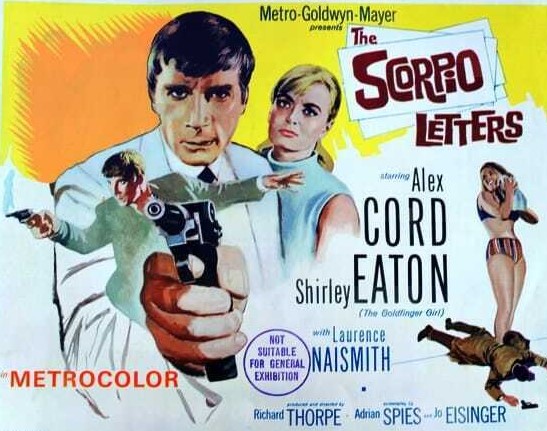
Desultory spy thriller with over-complicated story that’s worth a look mostly for the performance of Alex Cord (Stiletto, 1969). I can’t say I was a big fan of Cord and I certainly didn’t shower him with praise for his role as a disillusioned Mafia hitman in Stiletto. But now I’m wondering if I have been guilty of under-rating him.

Normally, critics line up to acclaim actors if they deliver widely differing performances – Daniel Day-Lewis considered the touchstone in this department after Room with a View and My Beautiful Launderette opened in New York on the same day in 1985. But usually screen persona rarely changes, amounting to little more than a heightened or amalgamated version of the actor’s character or features. Once Charles Bronson, for example, started wearing his drooping mustache he was never seen without.  Actors may grow old, but never bald.

The macho mustachioed Cord of Stiletto is nowhere in sight. In fact, in The Scorpio Letters minus moustache and resisting attempts to reveal his musculature, he is almost unrecognizable. In this picture Joe Christopher (Alex Cord) is flip, resentful, thoughtful, occasionally pedantic, more natural than many of the crop of Hollywood new stars being unveiled at the time, and for once as a transplanted American in London rather scornful of British traditions. There’s a realistic flourish here, too, he is so poorly paid – and on a temporary contract – that he has to take the bus. And although he is an ex-cop fired for brutality, that level of violence ain’t on show here. Virtually the opposite of the character Cord created for Stiletto, I’m sure you’ll agree. So full marks for versatility and talent.

Unfortunately, the rest of the movie is not up to much, at the very bottom of the three-star review category, almost toppling into two-star territory. Christopher is investigating the death of a British agent who was the subject of a blackmail attempt. By coincidence – or perhaps not – another part of British Intelligence is investigating the same death and this brings Christopher into contact with Phoebe Stewart (Shirley Eaton) and eventually they work together to unravel a list of codenames and uncover the conspiracy with a bit of risk to life and limb.

But the pay-off doesn’t work despite all the exposition attempting to build it up and you’re left with a kind of drawing-room drama rather than exciting spy adventure. It’s determinedly London-centric with red buses, red postboxes, Big Ben, and The Horse Guards all putting in an appearance. The scene shifts to Paris and Nice without a commensurate heightening of tension. Despite a couple of neat scenes – a chase held up behind a wedding party, an irate German chef, an interrogation in a wine cellar – it’s much too formulaic.

Cord apart, Shirley Eaton (Goldfinger, 1964) adds some glamour, but her rounded portrait depicts a character with warmth rather than oozing sex. This is the kind of film that should be awash with character actors and up-and-comers but I recognized few names except for Danielle De Metz (The Karate Killers, 1967), Oscar Beregi (Morituri, 1965) and Laurence Naismith (Jason and the Argonauts, 1963).

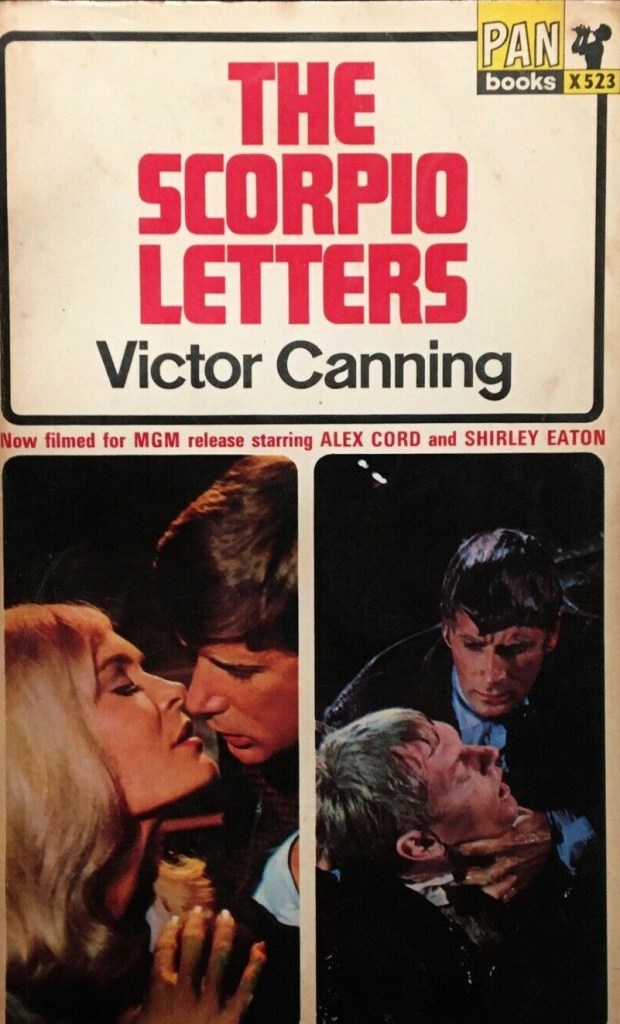
One-time top MGM megger Richard Thorpe (The Truth about Spring, 1965) was coming to the end of a distinguished career which had included Ivanhoe (1952) and Knights of the Round Table (1953). This was his penultimate film. The appropriately-named Adrian Spies (Dark of the Sun, 1968) wrote the screenplay based on the Victor Canning thriller. Making his movie debut was composer Dave Grusin (Divorce American Style, 1967)

Albeit made on a budget of just $900,000, MGM intended the picture for theatrical release but with a short cinema window to make it available for a speedy showing on ABC TV. It was originally scheduled for a May 1967 theatrical release but MGM, contractually obliged to deliver the picture within a specified time to television, could not fit in an American release. So it made its debut in the “Sunday Night at the Movies” slot on February 19, 1967, and was shown in cinemas abroad. Nor was it shown first on U.S. television because the studio believed it to be a disaster. Reviews were positive. Variety (February 22, 1967, page 42) called it “very hip.”

Danger Route (1967) ***

If the producers had not signalled Bond-style ambitions with a big credit sequence theme song by Anita Harris, moviegoers might have come at this with more fitting expectations in the Harry Palmer and John le Carre vein. So although slipping into the late decade spy boom flourish don’t expect villains planning world domination, gadgets or a flotilla of bikinis.

Seth Holt’s bread-and-butter espionage thriller sets government agent Jonas Wild (Richard Johnson) – on his “last assignment” no less after eight licensed murders in five years – to kill off a defector in the far from exotic location of a Dorset country house not realizing that he is also being set up. That his liquidator will be a woman puts the mysterious Mari (Barbara Bouchet) in pole position.  

The Eliminator was the source material for Danger Route.

Wild gains access to the heavily-guarded mansion by seducing housekeeper Rhoda (Diana Dors) but after completing his mission is captured and tortured by Luciana – pronounced with a “k” – (Sam Wanamaker) who explains he is a patsy and that there is a mole in M.I.5. When his boss Tony Canning (Harry Andrews) disappears and another friend is murdered, Wild goes on the run with Mrs Canning (Sylvia Syms) and eventually makes his way back to his bolt-hole in Jersey to solve the mystery.

There is a decent amount of action, including a fight with a guard dog and a battle on a fog-bound yacht. Clever maneuvers abound – a bug is planted in a bandage. Treachery is always just round the corner and there is no shortage of suspects.

The film’s down-to-earth approach is somewhat refreshing after half a decade of spy thrillers and spoofs. Wild doesn’t employ anything more hi-tech than masquerading as a brush salesman to win over Rhoda. And although that relationship ends up in bed, there is no sex, Wild having drugged her to avoid that complication. Tony Canning is nagged by his wife. Wild’s girlfriend (Carol Lynley) is a sweet girl, sexy in a languid rather than overt fashion.  And Luciana takes enormous pride in telling Wild just how stupid he has been.

Sylvia Sims in a ticklish situation.

But that comes with a caveat. The plot doesn’t quite hang together and the movie sometimes fails to connect.

That said, Johnson (Deadlier than the Male, 1967) is excellent, quite an accomplished actor rather than a brand name. Both Barbara Bouchet (Casino Royale) and Carole Lynley (Harlow, 1965) play against type while Sylvia Sims (East of Sudan, 1964) and Harry Andrews (The Hill, 1965) present variations to their normal screen personas. Sam Wanamaker (The Warning Shot, 1967) has a peach of a role and Gordon Jackson (The Long Ships, 1964) and Maurice Denham (The Long Duel, 1967) are afforded small but critical parts. 

This is not easy to come by, so you are best looking for a secondhand copy.

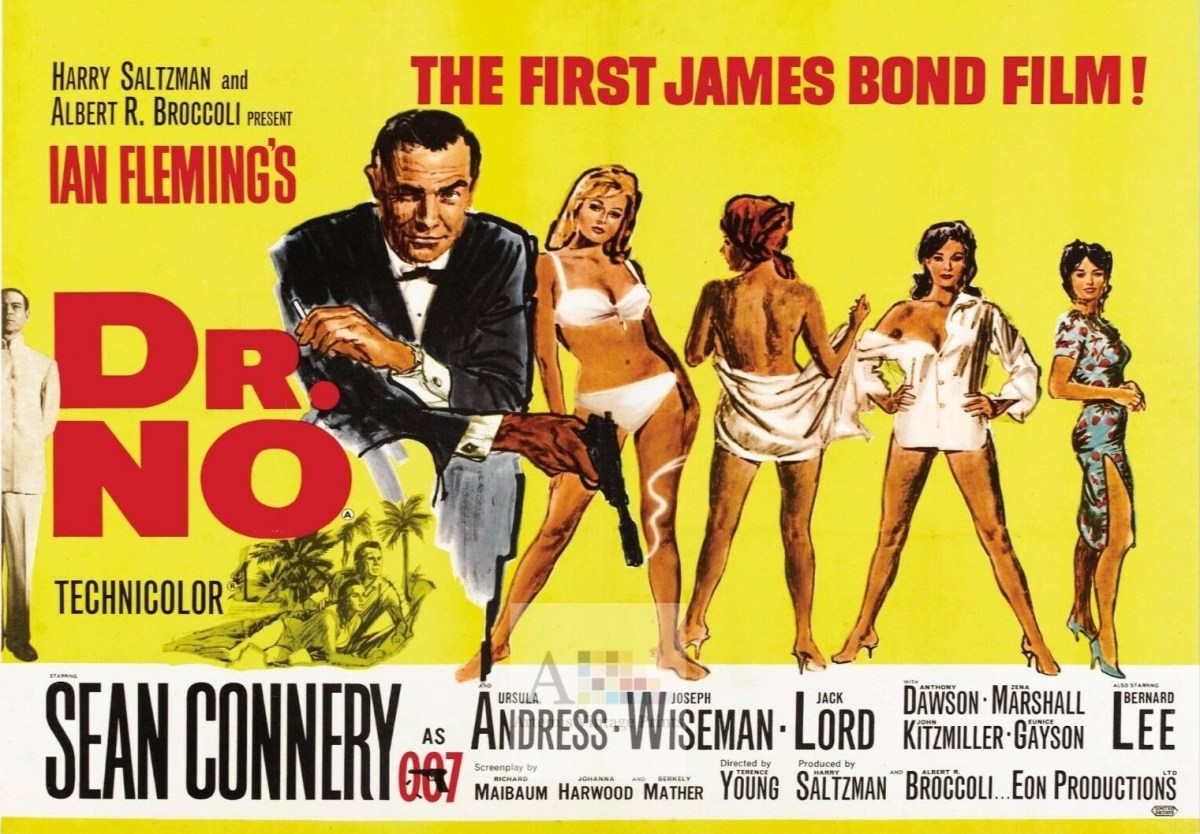
Dr No (1962) *****

Minus the gadgets and the more outlandish plots, the James Bond formula in embryo. With two of the greatest entrances in movie history – and a third if you count the creepy presence of Dr No himself at the beds of his captives – all the main supporting characters in place except Q, plenty of sex and action, plus the Maurice Binder credit sequence and the theme tune, this is the spy genre reinvented.

Most previous espionage pictures usually involved a character quickly out of their depth or an innocent caught up in nefarious shenanigans, not a man close to a semi-thug, totally in command, automatically suspicious, and happy to knock off anyone who gets in his way, in fact given government clearance to commit murder should the occasion arise. That this killer comes complete with charm and charisma and oozes sexuality changes all the rules and ups the stakes in the spy thriller.

 Three men disguised as beggars break into the house of British secret service agent Strangways (Tim Moxon) and kill him and his secretary and steal the file on Dr No (Joseph Wiseman). A glamorous woman in a red dress Sylvia Trench (Eunice Gayson) catches the eye of our handsome devil “Bond, James Bond” (Sean Connery) at a casino before he is interrupted by an urgent message, potential assignation thwarted.

We are briefly introduced to Miss Moneypenny (Lois Maxwell) before Bond is briefed by M (Bernard Lee) and posted out immediately – or “almost immediately” as it transpires – to Jamaica, but not before his beloved Beretta is changed to his signature Walther PPK and mention made that he is recovering from a previous mission. But in what would also become a series signature, liberated women indulging in sexual freedom, and often making the first move, Ms Trench is lying in wait at his flat.

In another change to the espionage trope, this man does not walk into the unknown. Suspicion is his watchword. In other words, he is the consummate professional. On arrival at Jamaica airport he checks out the waiting chauffeur and later the journalist who takes his picture. The first action sequence also sets a new tone. Bond is not easily duped. Three times he outwits the chauffeur. Finally, at the stand-off, Bond fells him with karate before the man takes cyanide, undercutting the danger with the mordant quip, on delivering the corpse to Government house, “see that he doesn’t get away.” 

Initially, it’s more a detective story as Bond follows up on various clues that leads him to Quarrel (John Kitzmiller), initially appearing as an adversary, and C.I.A. agent Felix Leiter (Jack Lord) before the finger of suspicion points to the mysterious Dr No and the question of why rocks from his island should be radioactive. Certainly, Dr No pulls out all the stops, sending hoods, a tarantula, sexy secretary Miss Taro (Zena Marshall) and the traitororous Professor Dent (Anthony Dawson) to waylay or kill Bond.

But it’s only when our hero lands on the island and the bikini-clad Honey Rider (Ursula Andress) emerges from the sea as the epitome of the stunning “Bond Girl” that the series formula truly kicks in: formidable sadistic opponent, shady organization Spectre, amazing  sets, space age plot, a race against time. 

It’s hard not to overstate how novel this entire picture was. For a start, it toyed with the universal perception of the British as the ultimate arbiters of fair play. Here was an anointed killer. Equally, the previous incarnation of the British spy had been the bumbling Alec Guinness in Our Man in Havana (1959). That the British should endorse wanton killing and blatant immorality – remember this was some years before the Swinging Sixties got underway – went against the grain.

Although critics have maligned the sexism of the series, they have generally overlooked the reaction of the female audience to a male hunk, or the freedom with which women appeared to enjoy sexual trysts with no fear of moral complication. Bond is not just macho, he is playful with the opposite sex, flirting with Miss Moneypenny, and with a fine line in throwaway quips.

Director Terence Young is rarely more than a few minutes away from a spot of action or sex, exposition kept to a minimum, so the story zings along, although there is time to flesh out the characters, Bond’s vulnerability after his previous mission mentioned, his attention to detail, and Honey Rider’s backstory, her father disappearing on the island and her own ruthlessness. The insistently repetitive theme tunes- from Monty Norman and John Barry – were innovative. The special effects mostly worked, testament to the genius of production designer Ken Adam rather than the miserable budget.

Most impressive of all was the director’s command of mood and pace. For all the fast action, he certainly knew how to frame a scene, Bond initially shown from the back, Dr No introduced from the waist downwards, Honey Rider in contrast revealed in all her glory from the outset. The brutal brief interrogation of photographer Annabel Chung (Marguerite LeWars), the unexpected seduction of the enemy Miss Taro and the opulence of the interior of Dr No’s stronghold would have come as surprises.

Young was responsible for creating the prototype Bond picture, the lightness of touch in constant contrast to flurries of violence, amorality while blatant delivered with cinematic elan, not least the treatment of willing not to say predatory females, the shot through the bare legs of Ms Trench as Bond returns to his apartment soon to become par for the course.

Future episodes of course would lavish greater funds on the project, but with what was a B-film budget at best  by Hollywood standards, the producers worked wonders. Sean Connery (The Frightened City, 1961) strides into a role that was almost made-to-measure, another unknown Ursula Andress speeded up every male pulse on the planet, Joseph Wiseman (The Happy Thieves, 1961) provided an ideal template for a future string of maniacs and Bernard Lee (The Secret Partner, 1961) grounded the entire operation with a distinctly British headmaster of a boss.

The Courier (2021) **** – Seen at the Cinema

A brilliant example of how to control your material, this low-budget old school espionage picture, virtually a two-hander, based on a true story and set against the 1960s cold War paranoia, delivers thrills against the background of a murky business. Smarmy businessman Greville Wynne (Benedict Cumberbatch) is inveigled into picking up rolls of film from Russian intelligence office Oleg (Merab Ninidze), giving away his country’s secrets in a bid to prevent nuclear war.

An anti-James Bond scenario sees Wynn employing little bits of tradecraft and spending almost every minute fearing capture while he develops a friendship with his foreign counterpart. On the domestic front, the pressure tells on Wynn, already a nervy character and relying too much on alcohol to sustain his own possibly failing business. Wife Sheila (Jessie Buckley) suspects he is engaging in another extra marital affair. Doting father Oleg wilts under the burden of betrayal, hoping that his assistance in the Western cause will lead to a successful defection, aware of the impact on his family if caught.

In the background Wynne’s ruthless handlers, Dickie Franks (Angus Wright) representing MI6 and CIA operative Emily (Rachel Brosnahan), are like circling sharks. While tense enough, this is all straightforward Tinker, Tailor… territory but in the second act the stakes suddenly rise and the movie shoots into quite different, far more realistic territory, that takes its toll on both protagonists.

It’s a very lean film and in concentrating on character rather than extraneous thrills in the manner of other recent offerings like Stillwater, The Night House or Censor, comes up triumphant in terms of plot. And without attempting to impose background through artistry as with Censor perfectly captures the mood of the times. The background characters are all well developed but the unexpected friendship that develops between the two spies and leads to the climax is exceptionally well done.

Oscar nominated Benedict Cumberbatch (The Imitation Game, 2014) drops all his mannerisms to bring alive a fascinating character who has, in any case, in his business life, had to develop an alien persona.  Merab Ninidze (Jupiter’s Moon, 2017) is every bit his equal, living a lie, trying to keep one step ahead of his own suspicious compatriots. Rachel Brosnahan (Change in the Air, 2018) is excellent as the one backroom character with an ounce of empathy and a pithy line in dealing with stuffy Brits and Jessie Buckley (Wild Rose, 2018), adding another decent accent to her collection, adds some pathos.

Director Dominic Cooke (On Chesil Beach, 2017) does an excellent job of marshalling his material and his concentration on character pays off in spades. Versatility could find no better expression than through writer Tom O’Connor who went down a completely different route in his previous movie The Hitman’s Bodyguard (2017).

I do have one slight niggle. When the British were outraged at Burgess, Philby and MacLean and the Americans Klaus Fuchs et al, the arguments given by these various traitors was that, in giving away state secrets, they were merely realigning the nuclear status quo. These characters were all roundly vilified, but not Oleg here. And although the film concentrates on a few exchanges between Oleg and his courier, in reality more than 5,000 military secrets went from Russia to Britain in this fashion.

Subterfuge (1968) ***

Worth seeing just for super-slinky leather-clad uber-sadistic Donetta (Suzanna Leigh) who  delights in torturing the daylights out of any secret agent who crosses her path, in this case Michael Donovan (Gene Barry). She’s got a neat line in handbags, too, the poisonous kind. Two stories cross over in this London-set spy drama. American Donovan is under surveillance from both foreign powers and British intelligence. When his contact comes into unfortunate contact with a handbag, he finds himself on the sticky end of the attention of Shevik (Marius Goring) while at the same time employed by the British spy chief Goldsmith (Michael Rennie) to find the mole in their camp.

The three potential British suspects are top-ranking intelligence officer Col. Redmayne (Richard Todd), British spy Peter Langley (Tom Adams) and backroom underling Kitteridge (Colin Gordon). On top of this Langley’s wife Anne (Joan Collins) adds conscience to the proceedings, growing more and more concerned that the affairs of the secret state are taking too much precedence over her marriage.

The hunt-the-mole aspect is pretty well-staged. Kitteridge always looks shifty, keenly watching his boss twisting the dials on a huge office safe containing top secret secrets. Langley is introduced as a villain, turning up at Shevik’s with the drugs that are going to send the Donovan to sleep for eight hours before being transported abroad in a trunk. But he turns out to be just pretending and aids Donovan’s innovative escape. Charming but ruthless Redmayne is also under suspicion if only because he belongs to the upper-class strata of spies (Burgess, Philby and Maclean) who had already betrayed their country.

In investigating Langley, Donovan fixes on the wife, now, coincidentally, a potential romantic target since her husband is suing for divorce. She is particularly attracted to Donovan after he saves her son from a difficult situation on the water, although that appears manufactured for the very purpose of making her feel indebted. However, the couple are clearly attracted, although the top of a London bus would not generally be the chosen location, in such glamorous spy pictures, for said romance to develop.

As you will be aware, romance is a weak spot for any hard-bitten spy and Shevik’s gang take easy advantage, putting Anne, her son and Donovan in peril at the same time as the American follows all sorts of clues to pin down the traitor.

This is the final chapter in Gene Barry’s unofficial 1960s movie trilogy – following Maroc 7 (1967) and Istanbul Express (1968) – and London is a more dour and more apt climate for this more down-to-earth drama. Forget bikinis and gadgets, the best you can ask for is Joan Collins dolled up in trendy mini-skirt and furs. Barry, only too aware that London has nothing on Morocco or Istanbul in the weather department, dresses as if expecting thunderstorms, so he’s not quite the suave character of the previous two pictures. In this grittier role, he does not always come out on top. But that does not seem to dampen his ardor and the gentle romantic banter is well done.

Joan Collins, in career trough after her Twentieth Century Fox contract ended with Esther and the King (1960), has the principled role, determining that the price paid by families for those in active secret service is too high. No slouch in the spy department himself, essaying Charles Vine in three movies including Where the Bullets Fly (1966), Tom Adams plays with audience expectations in this role. It’s a marvelous cast, one of those iconic congregations of talent, with former British superstar Richard Todd (The Dam Busters, 1955), Michael Rennie, television’s The Third Man (1959-1965), Marius Goring (The Girl on a Motorcycle, 1968) and Suzanna Leigh (The Lost Continent, 1968) trading her usual damsel-in-distress persona for a turn as terrific damsel-causing-distress.

Shorn of sunny location to augment his backgrounds, director Peter Graham Scott (Bitter Harvest, 1963) turns his camera on scenic London to take in Trafalgar Square, the zoo, Royal Festival Hall, the Underground, Regent’s Park with the usual flotilla of pigeons and ducks to fill in any blanks in the canvas.

Catch-Up: Previously reviewed in the Blog are Gene Barry in Maroc 7 (1967) and Istanbul Express (1968), Joan Collins in Esther and the King (1960) and Suzanna Leigh in The Lost Continent (1968).

This is hard to find so your best bet is ebay although it is available on Youtube for free but the print quality is not great.

The Defector (1966) ***

How often does a government hoodwink a morally upright citizen into deceitful action for the cause of the greater good? In this case physicist Professor James Bower (Montgomery Clift) doesn’t need a great deal of urging because what’s at stake are Russian space race secrets and the man selling them is a Russian scientist he knows from translating his books. It’s apparent from the outset that in setting out to make contact in East Germany, he is walking into a trap. It’s moody, and drab in the vein of The Quiller Memorandum (1966), shot in soulless German streets, and of course it is the final performance, after a four-year screen absence, of a frail-looking Clift, an iconic Hollywood star for nearly two decades.

But genres can be confusing. Although tagged as a spy picture it’s not really a spy film. It’s a character study. In fact, two character studies, the other being a far-from-typical communist. And when you get to the end and realize the sacrifice made in order not to compromise principle, it turns into quite a different movie, one with considerably more depth than you might have imagined.

Bower is a rather adept amateur spy, neatly dodging being followed, and capable of nipping between two moving trams to evade pursuit. His instructions lead him to asking for a particular prescription and being sent in apparent haphazard fashion to an intended meeting with Dr Salter (Hans Messemer), his contact. Instead he is led to Counselor Peter Heinzmann (Hardy Kruger). His hotel room is not merely bugged but fitted with electronic instruments to prevent sleep and distort his mind. Meanwhile Heinzmann is engaged in a hawk-vs.-dove battle with  Orlovsky (David Opatoshu) to determine whose methods, the latter preferring torture and brainwashing, would prove the more successful in forcing Bower to betray the whereabouts of the would-be defector. And there is also a doctor’s receptionist Frieda (Macha Meril), with whom romance so obviously beckons your natural moviegoer instinct is to regard her as lure rather than friend.

It’s a chess game, Bower a pawn, with the net growing tighter, imprisoned in more ways than one, being groomed for defection himself. Although there is double cross, triple cross, murder and an excellent Hitchcockian escape/chase, and a final unexpected, very human, twist, it’s far from your typical spy thriller, in general subtle in tone except for the nightmarish hotel scenes. Heinzmann is also a pawn, fighting a system that sees degradation as its most potent weapon and even while a danger to Bower displays humanity.

Clift’s physical state, skin drawn tight over his face, works to the movie’s advantage, turning him into more of a Glenn Ford-type actor, the staunch man-next-door with steely resolve, but not the kind of character you would imagine Elizabeth Taylor or Marilyn Monroe giving a second glance. In fact, since the story calls for him to be suffering from a mysterious malady – hence the need to seek out a pharmacy and doctor in a foreign country – his features endorse this plot point far better than if he had been fit and well.

Quite what the set was like is anybody’s guess given that not only was Clift dead by the time of the film’s release but that Belgian director Raoul Levy (Hail, Mafia, 1965) – better known as the producer of many Brigitte Bardot films and now helming only his second film – had committed suicide.  

If ever there was proof of star power, this is it. Even when the film is meandering and the plot at times impenetrable, Clift exerts an almost hypnotic hold on the viewer. Despite his clear infirmity, the intensity that enraptured audiences from films as disparate as Red River (1948), From Here to Eternity (1953) and The Misfits (1961) has not vanished. Since many scenes are just meetings that scarcely progress the story, it is quite a feat to keep audiences interested. Far from his greatest performance, he still displays screen presence.

He is helped along by Hardy Kruger (Flight of the Phoenix, 1965) in one of his more measured performances, both men sharing the knowledge that in doing good for their country they are betraying themselves. David Opatashu (Guns of Darkness, 1962) is excellent as his  quietly ruthless superior and there should be mention of  Karl Lieffen as the constantly complaining Major. Even as a dowdy East German, Macha Meril (Une Femme Mariee, 1964) still captivates.  Serge Gainsbourg contributed the music.

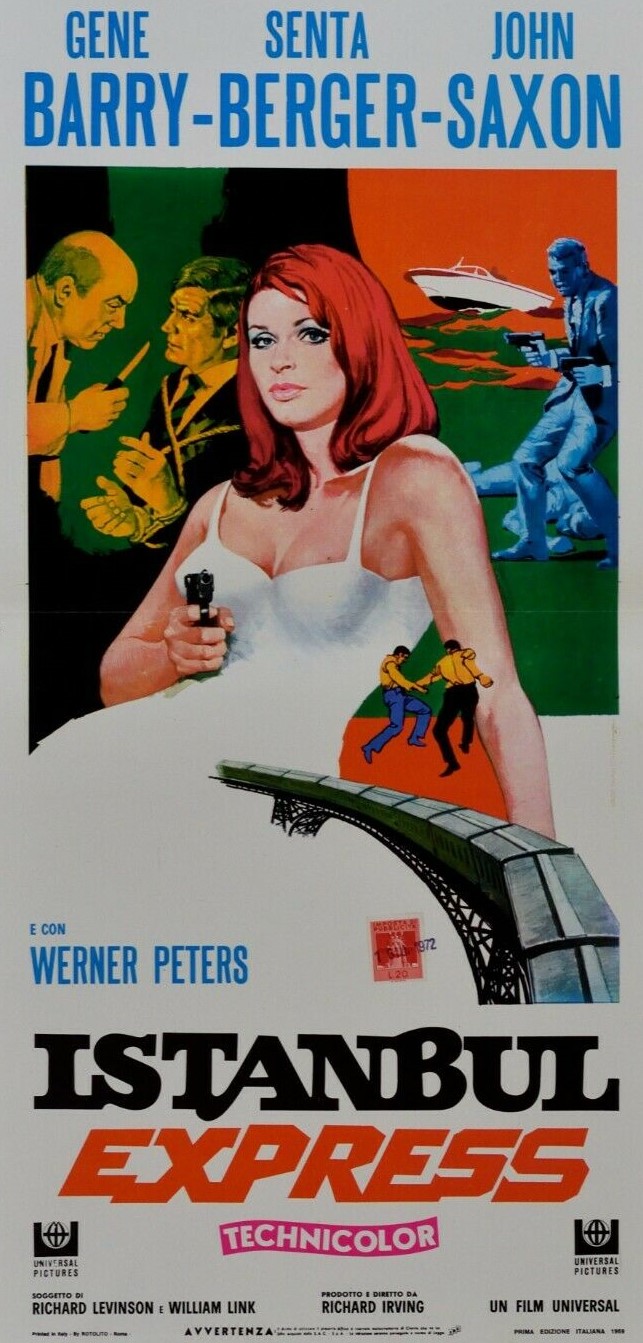
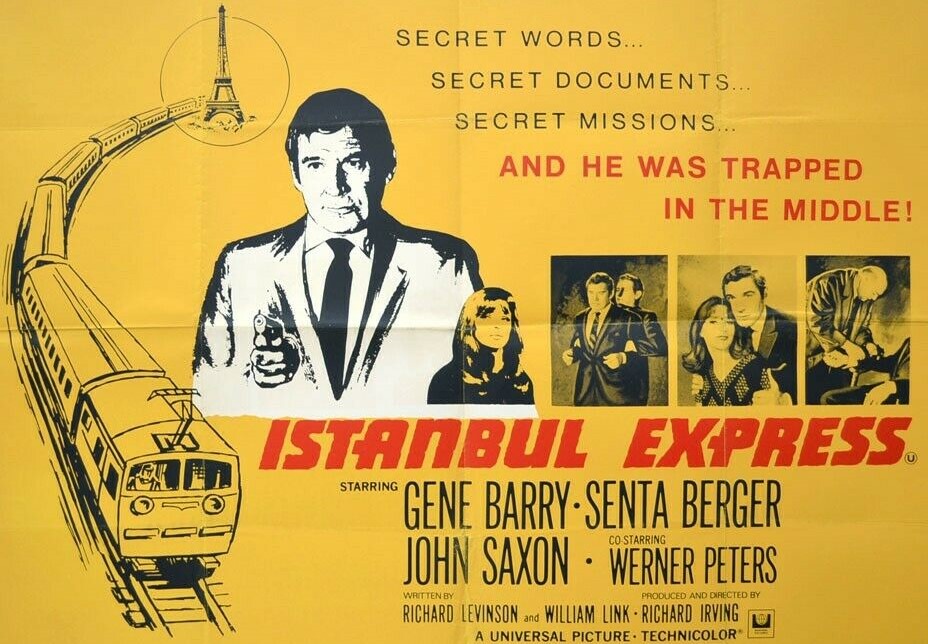
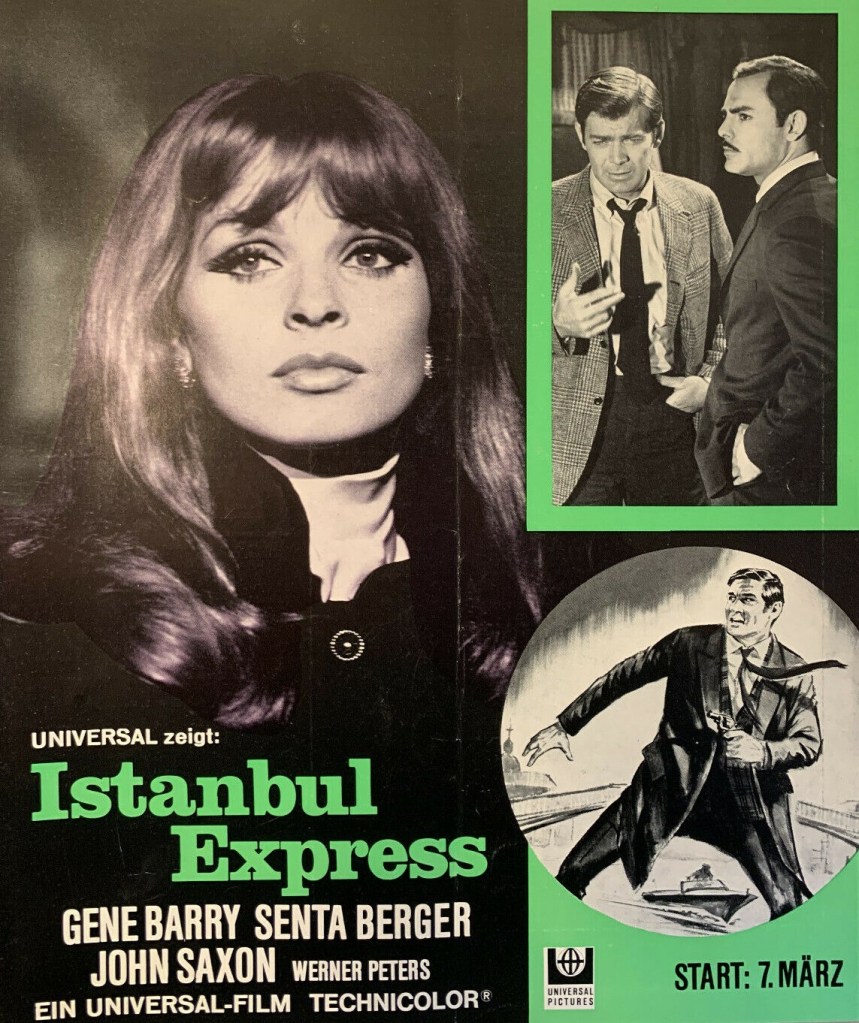
Istanbul Express (1968) ***

Calling this a by-the-numbers spy thriller does this movie no disservice since numbers are crucial to the complicated plot. On the one hand it’s quite a simple set up. Suave high-living art-dealer-cum-spy Michael London (Gene Barry) travels from Paris to Istanbul on the Orient Express to bid for secret papers in a secret auction. The complication: he must pick up the auction money from a bank in Istanbul using a code given to him along the way, each number by a different unknown person. On his side are train security chief Cheval (John Saxon), investigative journalist Leland McCord (Tom Simcox) and colleague Peggy (Mary Ann Mobley). Out to get him are Mila Darvos (Senta Berger) and Dr Lenz (Werner Peters).

The numbers business is an interesting addition to the usual spy picture formula of scenic location – Venice and the Eastern bloc as well as the other famous cities – violence and beautiful, sometimes deadly, women. You spend a good time guessing just how the numbers will be passed on and let me warn you it is sometime by inanimate means while the numbers themselves come with a twist. There’s also a truth serum, bomb threat, a traitor and every obstacle possible put in London’s way to prevent him completing his mission. London is about the world’s worst passenger, always missing the train as it sets off on the next leg of its journey, and requiring alternative modes of transport to catch up. But it’s as much about quick thinking as action and ends with a couple of unexpected twists. And it’s darned clever at times where the numbers are concerned.

Admittedly, the plot is a tad over-complicated but it’s fun to see London wriggle his way out of situations and for Cheval and McCord to turn up unexpectedly to provide assistance.

Gene Barry (Maroc 7, 1967) is little more than his television alter ego from Burke’s Law but he has an easy screen presence, never flustered, tough but charming and a winning way with the ladies. John Saxon (The Appaloosa, 1966) is the surprise turn, on the side of the angels rather than a villain, and equally commanding on screen, and certainly in one of his better roles. Austrian Senta Berger (Major Dundee, 1965) is not given as much screen time as you would like – a long way from being set up as the normal espionage femme fatale – but is certainly a convincing adversary.

This was only a movie if you saw it outside of the United States. There it was shown on television. But it had high production values for a television movie and director Richard Irving, who directed the television feature that introduced Columbo (Prescription Murder, 1968), keeps it moving at a healthy clip.  The numbers idea was probably a television device, allowing the opportunity for timed breaks in the action. Writers Richard Levinson and William Link were a class television act, creating Columbo, and prior to that the Jericho (1966-1967) and Mannix (1967-1975) television series.  

Interestingly, Senta Berger, John Saxon, Gene Barry, Levinson/Link and Richard Irving were all at various points involved in the groundbreaking U.S. television series The Name of the Game (1968-1971).

I had not realized Istanbul Express was a made-for-TV picture until I had finished watching it and in that case found it a superior piece of television and a decent-enough riff on the spy movie. You can catch it on Amazon Prime.

CATCH-UP: Senta Berger has featured in the Blog in The Secret Ways (1961), Sherlock Holmes and the Secret Necklace (1962), Major Dundee (1965), Bang! Bang! You’re Dead! (1966), Cast a Giant Shadow (1966) and The Quiller Memorandum (1966).

Topaz (1969) ****

Authentic, atypical, engrossing, this grittier Hitchcock mixes the realism of Psycho (1960) and Marnie (1964) with the nihilism of The Birds (1963), a major departure for a canon that previously mostly spun on innocents or the falsely accused encountering peril. The hunt for a Russian spy ring by way of the Cuban missile crisis forms the story core but the director is more interested in personal consequence and even the villain suffers heart-rending loss. Betrayal is the other key theme – defection and infidelity go hand in hand.

The tradecraft of espionage is detailed – dead letter drops, film hidden in typewriting spools, an accidental collision that is actually a sweet handover. In a transcontinental tale that shifts from Copenhagen to New York to Cuba to Paris, there is still room for classic sequences of suspense – the theft of secret documents in a hotel the pick – and Hitchcock at times simply keeps the audience at bay by employing dumbshow at key moments.    

In some respects the director was at the mercy of his material. In the documentary-style Leon Uris bestseller (almost a procedural spy novel), the main character is neither the trigger for the plot nor often its chief participant and is foreign to boot. So you could see the sense of employing a cast of relative unknowns, otherwise an audience would soon grow restless at long absences from the screen of a Hollywood star of the caliber of a Cary Grant or Paul Newman. It is a florist (Roscoe Lee Browne) who carries out the hotel theft, a small resistance cell the spying on Russian missiles in Cuba, a French journalist who beards one of the main suspects, not the ostensible main character, French agent Andre Devereux (Frederick Stafford), not his U.S. counterpart C.I.A. operative Michael Nordstrum (John Forsythe) nor Cuban villain Rico Parra (John Vernon).

Unusual, too, is the uber-realism. The main characters are fully aware of the dangers they face and of its impact on domestic life and accept such consequence as collateral damage. It is ironic that the Russian defector is far more interested in safeguarding his family than Devereux. Devereux’s wife (Dany Robin), Cuban lover Juanita (Karin Dor) and son-in-law (Michel Subor) all suffer as a result of his commitment to his country. And that Juanita (Karin Dor), leader of the Cuban resistance cell, is more of a patriot than the Russian, refusing to defect when offered the opportunity. Hitchcock even acknowledges genuine politics: the reason a Frenchman is involved is because following the Bay of Pigs debacle in 1961 American diplomats were not welcome in Cuba.

In terms of bravura Hitchcock, the pick of the scenes are the hotel theft and the death of one of the principals, filmed from above.

I have steered clear of this film for over half a century. I saw it on initial release long before the name Hitchcock meant anything to me. But once it did I soon realized this film did not easily fit into the classic Hitchcock and the critics on whom I relied had always represented it as shoddy goods. So I came to it with some trepidation and was surprised to find it so engrossing.  

Frederick Stafford (O.S.S. 117: Mission for a Killer, 1965) was excellent with an insouciance reminiscent of Cary Grant and a raised eyebrow to match that star’s wryness. John Vernon, who I mostly knew as an over-the-top villain in pictures such as Fear Is the Key (1972), was surprisingly touching as the Cuban bad-guy who realizes his lover is a traitor. And there is a host of top French talent in Michel Piccoli (Belle de Jour, 1967), Philippe Noiret (Justine, 1969) Dany Robin (The Best House in London, 1969) and Karin Dor (You Only Live Twice, 1967).

As you are possibly aware, three endings were shot for this picture and I can’t tell you which I saw without spoiling the plot. If you want to know, read tomorrow’s Blog.

In any case, this is worth seeing more than just to complete a trawl through the entire Hitchcock oeuvre, a very mature and interesting work.

Discover WordPress

A daily selection of the best content published on WordPress, collected for you by humans who love to read.

The Atavist Magazine

by Brian Hannan

WordPress.com Blog

News, Tips & Website Tutorials