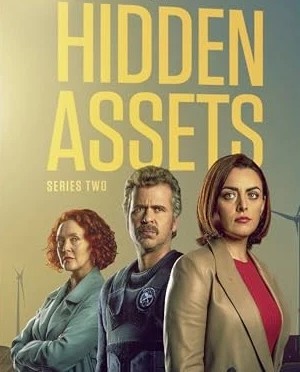
Hidden Assets: Season 1, 2021*** Season 2, 2023**** Season 3, 2025**

Jumping the shark takes a particular blend of over-reach and narrative naivety. Assumptions about what makes a series tick are often misleading. Dramatic changes to personnel and location can both add (as in Season 2) and detract (as in Season 3).

I’ve been binge-watching this Irish-Belgium/Irish-Spanish crime series when I should be knuckling down to viewing more movies from the 1960s. I thought I was onto a winner when the second series proved a vast improvement on the first. That was before I came to the third series. The first two series are connected and I’m just hoping nobody’s of a mind to link the third series to another, as yet unmade, series.
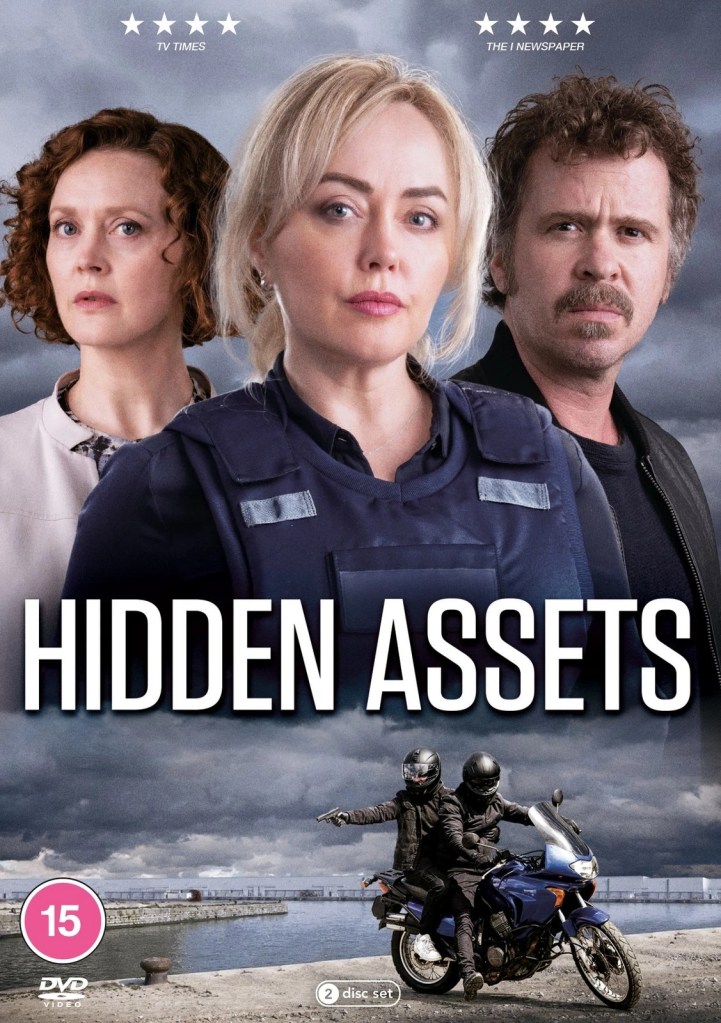
As far as investigation goes, we’re in new territory. The Criminal Assets Bureau in Ireland tracks down the cash made by big-time crooks. Jurisdiction can extend, by mutual consent, to European countries such as Belgium (the first two seasons) or Spain (the third).

What makes the first two, related, series so captivating is that they’re not just about crime but political machination and big business and cover areas like immigration and the rise of the Far Right political parties.

SERIES ONE:

You might wonder how Irish cops end up in Antwerp. The connection is diamonds, Antwerp being famous for them, and gangsters now utilizing them as the easiest way to shift currency away from prying eyes. Irish cop Emer Berry (Angeline Ball) heads up a Criminal Assets Bureau investigation chasing gangster Fionn Brannigan (Peter Coonan).

That leads her to Belgium where she crosses swords and paths with gum-chewing (he’s trying to stop smoking) Belgian cop Christian de Jong (Wouter Hendrickx). He’s on the trail of terrorists whose latest outrage killed 11 people and sent the ratings soaring for Far-Right politician Victor Maes (Steve Geerts). Brannigan turns out to be the estranged brother of Bibi Melnick (Simone Kirby) who runs a huge business in the port of Antwerp.

She’s connected by marriage to dodgy businessman Richard Melnick (Michael Ironside) who wants to privatize the publicly-run port. Bibi gets mixed up in a people-trafficking scam, linked to the terrorist. Takes a heck of a time to entangle most of the proceedings and there’s an ending – a possible connection between the terrorism act and Maes – that lends itself to a sequel.

Bibi is the main victim, losing her job to the ruthless Frances Swann (Karine Vanasse).  The hard yards of policing and inspired use of technology are compounded by sufficient action. But the biggest flaw is Angelina Ball. She just looks disinterested all the way through and given she’s our conduit to the developing tale it’s hard at times to summon up the energy to keep watching.

SERIES TWO:

Ramps up the tempo beginning with Emer Berry having been replaced by high-flying Detective Sergeant Claire Wallace (Nora-Jane Noone) who has the grit, tenacity and emotional input her predecessor lacked. And a huge gender shift of power takes place.

It’s the women who take prime position. Frances Swann looks like a distant relative of Jack Palance or Lee Marvin with those gimlet eyes and she spins the wheel astutely. Bibi Melnick, who looks out for the count, standing to lose her entire family fortune and possibly her son (husband James already collateral damage), pulls out an absolute blinder of a last-minute trick and reveals that she’s a worthy successor in the duping game to the likes of Keyser Soze of The Usual Suspects fame. Even Fionn’s wife Siobhan (Sophie Jo Wasson) isn’t an innocent bystander but well up to ensuring she gets her share of ill-gotten gains.

There’s a disconnect between Wallace and De Jong because she suspects there’s a mole in his side of the operation and that person, in the spirit of entrepreneurism that infects the city, is a woman and delivers, if unintentionally, the coup that knocks the audience for six. And in the background, cleverly playing the conservation card, is another businesswoman who turns out to be in collusion with Bibi. Wallace and De Jong also fall out because he shoots the cornered terrorist and she wanted him alive, not out of the goodness of her heart, but for interrogation purposes.

But this is well-drilled stuff, red herrings, twist and turns, interference by superiors, realpolitik, the harsh stink of dirty dealings plus a side helping of racism and drug running. The stakes are incredibly high, politicians blackmailed by criminals, assassins running amok, cops racing against the clock to prevent another  terrorist explosion, billions of Euros on tap from privatization and another 200 million Euros – Bibi’s father’s hidden wealth – up for grabs. The cops think they have come out on top, outside of the political machinery that they have to put up with, and the audience thinks so too until the final killer scene.

Without the deadweight of Angeline Ball, the second series really flies, all the actors stepping up to the plate, Nora-Jane Noone (Bring Them Down, 2024)  and Wouter Hendrickx (The Class of 2000, 2025) more than hold this together and would be the stars of the show except for sheer cunning they are outdone by Simone Kirby (Kneecap, TV series 2024), who plays an especially clever long game in acting terms, and Karine Vanasse (Cardinal, TV series 2017-2020). Shining among the supporting cast is Cathy Belton (Miss Scarlett and the Duke, TV series 2020-2026).

SERIES THREE:

Begins with a major problem. De Jong was killed in series two so he’s not available and the action switches to Spain. But Detective Wallace (Nora-Jane Noone) is now saddled with two sub-plots. Suddenly, it’s revealed she is a mother with a disgruntled partner. And although she stood calmly by and watched a terrorist get his head blown off in series two – her only emotion  being annoyance that she can’t interrogate him – now she appears to fall apart when a criminal blows his brains out in front of her.

The plot, when it veers from the straightforward drug-running and people-trafficking, is shot through with holes. Wallace, hunting 27 million Euros, heads for Bilbao where the trail leads to Irish crook-gone-legit Anthony Pearse (Frank Laverty) and she becomes embroiled in a local investigation into the murder of a local journalist.

I’m sure all the plots regarding drug-smuggling and people-trafficking have been explored and I sympathize with writers forced to come up with something novel. But not when it’s as barmy as this. Immigrants and drugs are being smuggled in from Africa in the same trucks carrying hazardous waste (the immigrants a side hustle).

Immigrants had been turning up in hospital with the kind of ailments you get from contamination with hazardous waste. But none of the gangsters unloading either immigrants or drugs have been so afflicted, yet the minute Wallace inadvertently steps in a puddle of waste alarm bells start ringing.

The waste is being transported out of Africa for treatment in Bilbao by – wait for it – a medical charity that wants to ensure the waste resulting from its good deeds isn’t left behind. There must be countless dumps, legal or otherwise, in Africa for the stuff, never mind shipping it thousands of miles, at who knows what cost to a struggling charity, to northern Spain (presumably there’s no comparable factory in southern Spain.)

Nora Jane-Noone is hampered by having to switch on the emotions every now and then whereas before she had been as flinty-eyed as the criminals and having to keep a straight face at various denouements involving hazardous waste.  The screen chemistry (not of the romantic kind I hasten to add) that she had with De Jong in the previous two series is not replicated with the Spanish cop played by Inigo Gastesi.

The only saving grace in the third series is a new character, the extremely annoying ambitious Detective Liam Boylan (Donall O’ Healai) who rats on colleagues, steals everyone’s ideas but actually is an ace interrogator and has the knack of getting information out of people where others have failed.

Series three is a series too far but the previous episodes are worth watching.
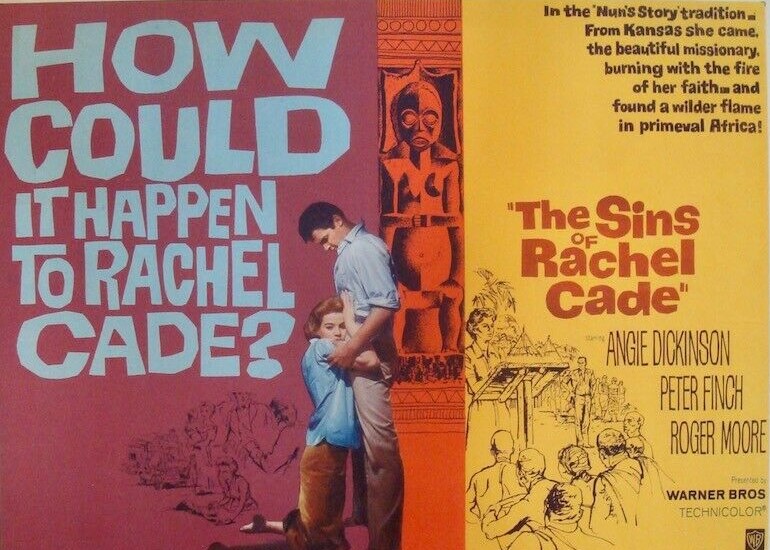
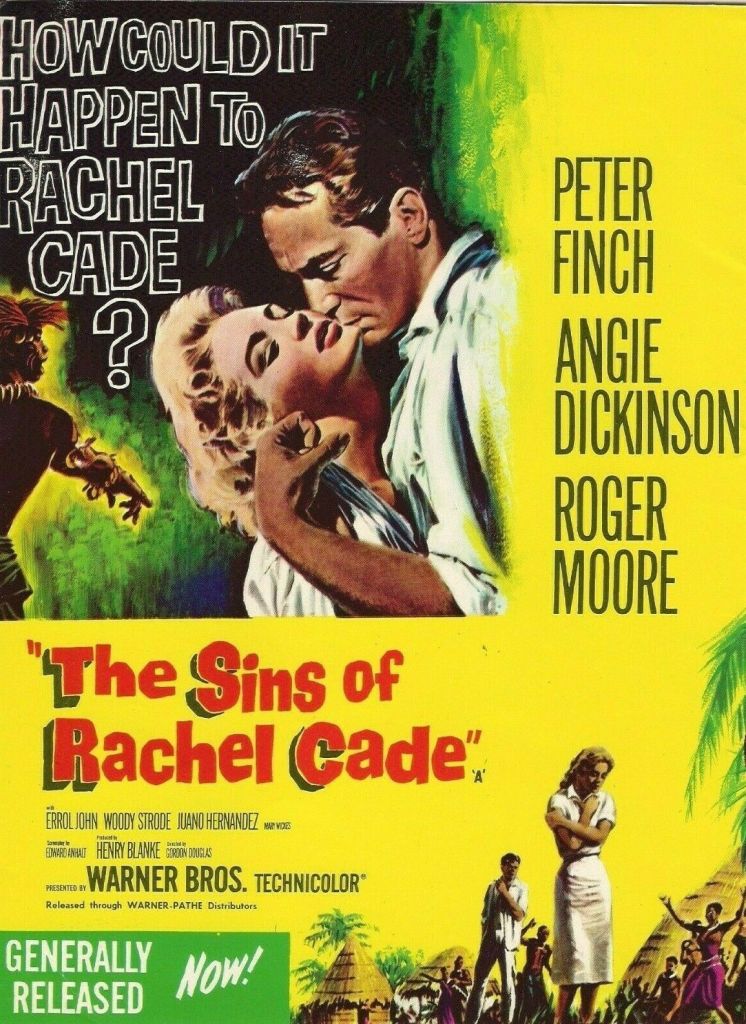
The Sins of Rachel Cade (1961) ***

In her first top-billed role Angie Dickinson (Jessica, 1962) delivers a strong performance as an American nurse/missionary in the Belgian Congo at the start of the Second World War. The usual Hollywood trope of “heathens” needing to be educated by imperialists – from The Bitter Tea of General Yen (1933) and The Keys of the Kingdom (1944) through to The Nun’s Story (1959) – was to some extent turned on its head here.

Just as Rachel Cade (Angie Dickinson) arrives at a hospital in a small village, resident Dr Bikel  (Douglas Spencer) dies. Not only does the hospital have no patients, the local Belgian commissioner Col Derod (Peter Finch) wants her to leave, believing her presence will act as provocation to the local high priest Kalanumu (Juano Hernandez) and witch doctor Muwango (Woody Strode). After standing up to all three, Rachel embarks on refurbishment of the hospital aided by assistant Kulu (Errol John).

Patients remain non-existent until she cures a small boy of appendicitis, as a result of which Muwango places a curse on her that she will lose her Protestant faith and promises the local god will take his revenge on anyone who supports her. Of course, her skills are not infinite and not only is there another boy who dies in her care but she cannot cure – and does not attempt to cure – the infertile third wife of the local chief.

While she warms to her patients and they to her, she cannot come to terms with their acceptance of incest (if a husband is called away, his brother must make love to his wife), polygamy, vaginal mutilation, the sexuality of their dancing and the fact that sin does not exist in their culture. Meanwhile, she distrusts the visions seen by the most convinced of her converts, Kulu.    

When the sexually repressed Rachel rejects Derod’s advances in favour of the  dashing but money-oriented Dr Paul Winton (Roger Moore), thus violating her own teachings, she becomes enmeshed by the principles she holds so dearly and which the Africans refute. A twist in the tale pivots the picture on whom she will marry, the sensible Derod, the cavalier Winton, or retain her own independence in defiance of the standards of the time.  

A battle of the hierarchies – the female nurse and her supporters versus male supremacy – maintains the tension but underneath is a philosophical struggle between the two faiths. The Christian religion which boasts of forgiveness is in the end unforgiving of those who break its moral code, while the African religion does not force onto its believers such ludicrous rules. On top of that is Rachel’s acceptance of her own passion, the realization that love cannot be restrained by commandment, and that men are more likely to betray her.

The reality of imperialist rule is not underplayed but since this predates the Mau Mau uprising in Kenya in the 1950s that precipitated widespread rebellion and Derod can call on soldiers for protection in the Belgian colony and is in fact a generally tolerant (though at times patronising) overseer, political issues remain in the background.

Angie Dickinson gets the movie star build-up in this British trade advertisement.

Director Gordon Douglas (Claudelle Inglish, 1961) keeps the focus on the transition of the naïve American while not ignoring nor appearing to ridicule the rituals and beliefs of the tribe – although a cynic might consider that the sexuality of the dancing, while repellant to Rachel, might be included more with an eye to attracting an audience. Overall, it appears an honest even-sided presentation, with the high priest getting the better of Rachel in arguments over the frailties of Christianity. Angie Dickinson brings conviction to a role that sees her start out a shade saintly until brought back down to earth by human weakness. Peter Finch, by coincidence the leading man to Audrey Hepburn role in The Nun’s Story, fills out his normal stoic screen personality with touches of grief. Roger Moore (Vendetta for the Saint, 1969) had not yet mastered the art of the raised eyebrow and so brought a more rounded performance to his role and is entirely believable as the lover with the mercenary streak.

The pick of the supporting parts is Mary Wickes (Sister Act, 1992) as Derod’s wisecracking housekeeper. Woody Strode (The Professionals, 1966), Scatman Crothers (The Shining, 1980),  Juano Hernandez (The Pawnbroker, 1964) and Errol John (The Nun’s Story)  provide stiff opposition for the incomers.  Edward Anhalt (The Satan Bug, 1965) based his screenplay on the bestseller by Charles Mercer.

CATCH-UP: Featured in the Blog so far are the following Angie Dickinson pictures: Ocean’s 11 (1960), A Fever in the Blood (1961), Jessica (1962), The Chase (1966), Cast a Giant Shadow (1966) and Point Blank (1967).

Fraulein Doktor (1969) ****

Surprisingly good World War One spy yarn full to bursting with clever ruses and pieces of deception and ending with a stunning depiction of carnage on the Western Front.  Loosely based on the life of Elsbeth Schragmuller, it fell foul on release to British and American hostility over the Germans actually winning anything.

The film breaks down into three sections: the unnamed Doktor landing at the British naval base in Scapa Flow in Orkney to plan the death of Lord Kitchener; a flashback to France where she steals a new kind of poison gas; and finally on the Western Front where, disguised as a Red Cross nurse, she masterminds an attempt to steal vital war plans. She is hampered by her emotions, romance never helpful for an espionage agent, and her addiction to morphine.

Duelling spymasters the British Colonel Foreman (Kenneth More) and the German Colonel Mathesius (Nigel Green) both display callousness in exploiting human life. The films is so full of twists and turns and, as I mention, brilliant pieces of duplicity that I hesitate to tell you any more for fear of introducing plot spoilers, suffice to say that both men excel at the outwitting game.

I will limit myself to a couple of examples just to get you in the mood. Foreman has apprehended two German spies who have landed by submarine on Scapa Flow. He knows another one has escaped. The imprisoned Meyer (James Booth) watches his colleague shot by a firing squad. Foreman, convinced Meyer’s courage will fail at the last minute, instructs the riflemen to load up blanks. Before a shot is fired, Meyer gives up and spills the beans on the Doktor only to discover that Foreman faked the death of his colleague.

And there is a terrific scene where the Fraulein, choosing the four men who will accompany her on her final mission, asks those willing to die to step forward. She chooses the ones not willing to die. When asking one of these soldiers why he stayed back he replied that she wouldn’t want to know if he could speak Flemish if he was so expendable.

The Fraulein is always one step ahead of her pursuers, changing clothes and hair color to make redundant any description of her, and knowing a double bluff when she sees one. In France as a maid she turns seductress to win the trust of scientist Dr Saforet (Capucine) who has developed a new, deadlier, strain of poison gas. It’s unclear whether, appalled at the potential loss of life to her fellow Germans, this is her motivation to turn spy or whether at this point she is already an accomplished agent. In the final section she takes command of the entire operation.

What distinguishes this from the run-of-the-mill spy adventure is, for a start, not just the female spy, how easily she dupes her male counterparts, and that the British are apt just to be as expedient as the Germans, but the savage reality of the war played out against a British and German upper class sensibility. When a train full of Red Cross nurses arrives at the front, the wounded men have to be beaten back; Foreman thinks it unsporting to use a firing squad; a German general refuses to award the Fraulein a medal because Kitchener was a friend of his; and the Doktor’s masquerade as a Red Cross nurse goes unchallenged because she adopts the persona of a countess.

Far from being an evil genius, the Doktor is depicted as a woman alarmed at the prospect of thousands of her countrymen being killed and Germany losing the war. In order to cram in all the episodes, her later romance is somewhat condensed but the emotional response it triggers is given full vent. And there is tenderness in her affair with Dr Saforet, hair combing a prelude to exploring feelings for each other.

Apart from King and Country (1964), The Blue Max (1966) and Oh, What a Lovely War (1969), depictions of the First World War were rare in the 1960s, and the full-scale battle at the film’s climax is exceptionally well done with long tracking shots of poison gas, against which masks prove little deterrent, as it infiltrates the British lines. The horror of war becomes true horror as faces blister and, in one chilling shot, skin separates from bone and sticks to the barrel of a rifle.

If I have any quibbles, it’s a sense that there was a brilliant film to be made here had only the budget been bigger and veteran director Alberto Lattuada (Matchless, 1967) had made more of the suspense. Suzy Kendall (The Penthouse, 1967) easily carries the film, adopting a variety of disguises, accents and characters, yet still showing enough of her own true feelings. Kenneth More (Dark of the Sun, 1968), in more ruthless mode than previous screen incarnations, is excellent as is counterpart Nigel Green (Deadlier than the Male, 1967) but James Booth (Zulu, 1963) has little to do other than look shifty. Capucine (North to Alaska, 1960) has an interesting cameo.

Ennio Morricone (Once upon a Time in the West, 1969) has created a masterly score, a superb romantic theme at odds with the discordant sounds he composes for the battles scenes. Collectors of trivia might like to know that Dita Parlo had starred in a more romantic British version of the story Under Secret Orders (1937) with a German version, using the same actress, filmed at the same time by G.W. Pabst as Street of Shadows (1937), both revolving around this infamous secret agent.

This is far from your normal spy drama. Each of the main sequences turned out differently to what I expected and with the German point-of-view taking precedence makes for an unusual war picture. I enjoyed it far more than I anticipated.

Another freebie on YouTube. I could not find a DVD so you might need to check out secondhand dealers on Ebay.

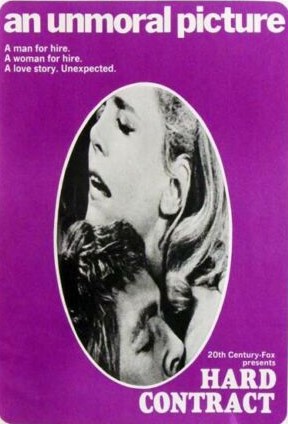
Hard Contract (1969) ***

A hitman movie that verges on the existential is always going to be intriguing. Stone cold killer John Cunningham (James Coburn) manages to keep the world at a distance until he runs into the vibrant Sheila (Lee Remick) in Spain. The film is a curiosity of an admittedly small genre dominated by such disparate offerings as The Killers (1946 and 1964), Yojimbo (1961), Le Samourai (1967) and Stiletto (1969). Here, although Cunningham does bump people off, you never see the violence. We’ve come to expect hitmen to be introspective, but there’s never been anyone as closed-off as Cunningham. No romance in his life, only hookers, no apparent depth, in fact we learn very little about him.

He only runs into Sheila because for a laugh she pretends to be a sex worker. In reality she’s a wealthy divorced socialite running with a fast set that include Adrianne (Lili Palmer) and ex-Nazi Alexi (Patrick Magee) whom she loves to taunt but whose contacts allow Cunningham to be effectively stalked. And as unsavory that might be from today’s perspective, it sheds light both on her power and whimsicality.

There’s an unusual background. Amid the extensive jet-setting in Torremolinos, Madrid and Tangiers, there are reality counterpoints, reflecting the issues of the decade – violent demonstrations with police using water cannon to control the crowds, the American elections and discussions about God, world hunger, the Holocaust, terrorism and population growth.

No doubt the script is wordy, but there’s hardly a word that doesn’t challenge convention. It’s steeped in amorality – a touchstone of the decade – good only occurs “when evil takes a rest” and the world is “immune to murder.” And you certainly get the impression that the rich can confront anything because, not having to live in the ordinary world, they can get away with it. Conversely, this is also one of those films where you wonder who did the wardrobe (Gladys de Segonzac, since you ask, who ran fashion house Schiaparelli in the 1950s) because not only does Sheila sport clothes that would have delighted Audrey Hepburn but Cunningham gets away with wearing a white jacket.

And if Korean vet Cunningham is enigmatic, the insomniac Sheila is cut from a similar cloth, and while a potential source for redemption is as likely to have sex with a casual pickup in a filthy alley. The story does not go quite the way you would expect – Cunningham’s growing dissatisfaction with his profession revealed when he can’t perform in a Brussels brothel. And his mindset allows him to consider mass murder as a solution to an emotional problem he cannot solve.

At core, of course, is whether once Cunningham’s emotional defenses are breached he can continue as a hitman, and  whether Sheila can accept his profession. The stakes rise when it transpires that (like Stiletto made the same year) retirement is not an option.

And for all the seriousness on show, there are some imaginative moments of hilarity – Cunningham’s idea of a love song is “To the Shores of Tripoli” and Adrianne proves determinedly indiscreet. In keeping with the paranoia cycle that was about to explode, you never find out why people are being murdered, or even who they are, far less the group which his boss Ramsay (Burgess Meredith) is fronting.

Far removed from the Derek Flint persona that had turned him into a star, James Coburn delved deeper into the amoral territory he had previously explored in Waterhole 3 (1967). Lee Remick (The Detective, 1968) is sheer madcap delight even when espousing her odd takes on philosophy. Lili Palmer (The Counterfeit Traitor, 1962), who by this point in her career was usually the wife or girlfriend, creates a very original character. Veteran Sterling Hayden had only made one film (Dr Strangelove, 1962) in a decade and is excellent as a contemplative retired hitman. Patrick Magee (The Skull) gives another of his tight-lipped performances. Karen Black (Easy Rider, 1969) has a small role as does Sabine Sun (The Sicilian Clan, 1969).

This marked both the debut and the demise of the directorial career of S. Lee Pogostin, best known at this point as the screenwriter of Pressure Point (1962) and Synanon (1965). In terms of argument over issues it stands comparison with Pressure Point but without that film’s intensity.

I remember being baffled by the picture when it came out and I was a teenager because the action I believed I had been promised never materialized but otherwise I could remember little about it so now it appears as an interesting antidote to the mindless action pictures.  

This is another freebie available on YouTube.

https://www.youtube.com/results?search_query=hard+contract+1969

Discover WordPress

A daily selection of the best content published on WordPress, collected for you by humans who love to read.

The Atavist Magazine

by Brian Hannan

WordPress.com News

The latest news on WordPress.com and the WordPress community.