The Spy in The Green Hat (1966) ***

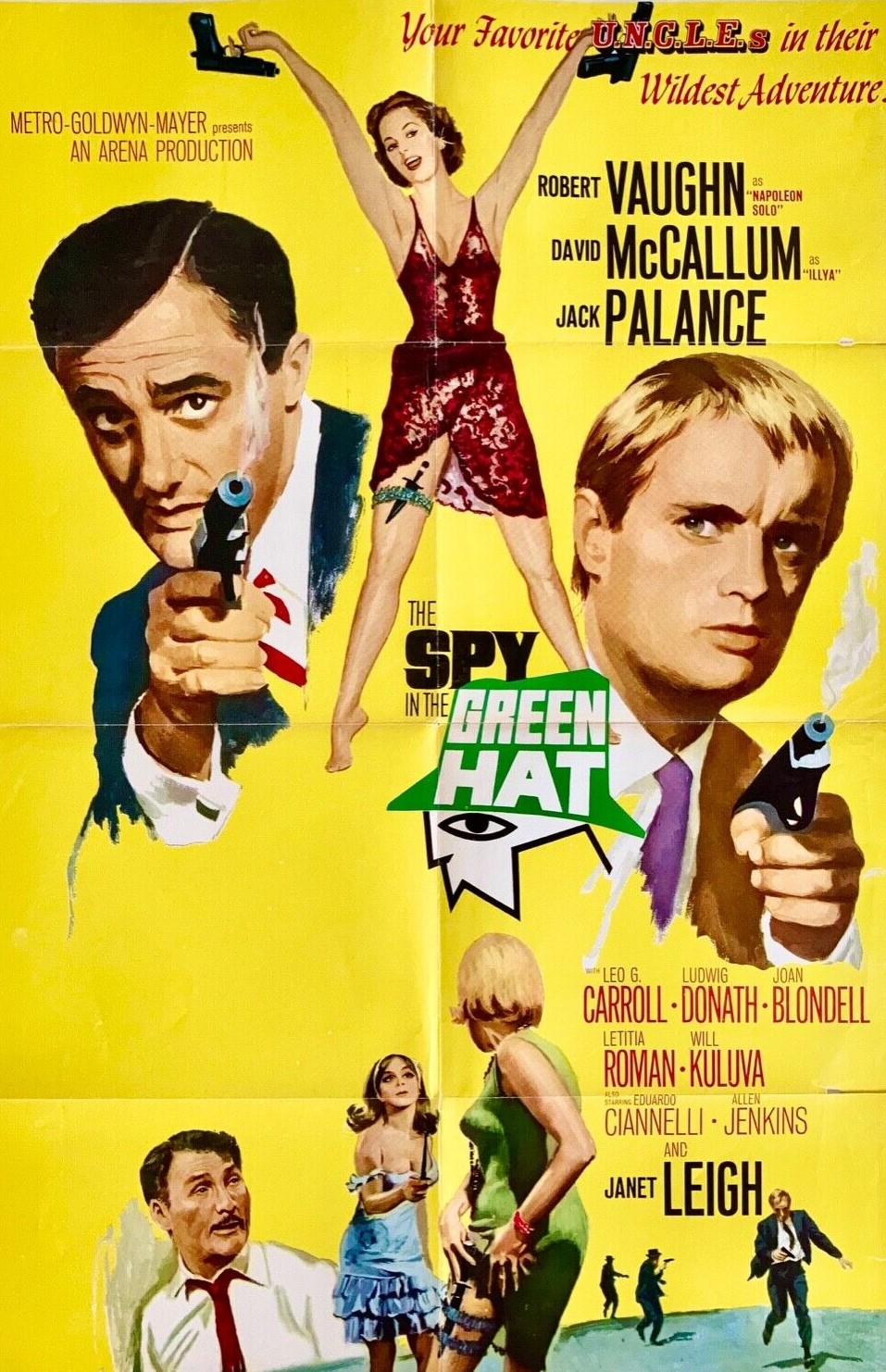
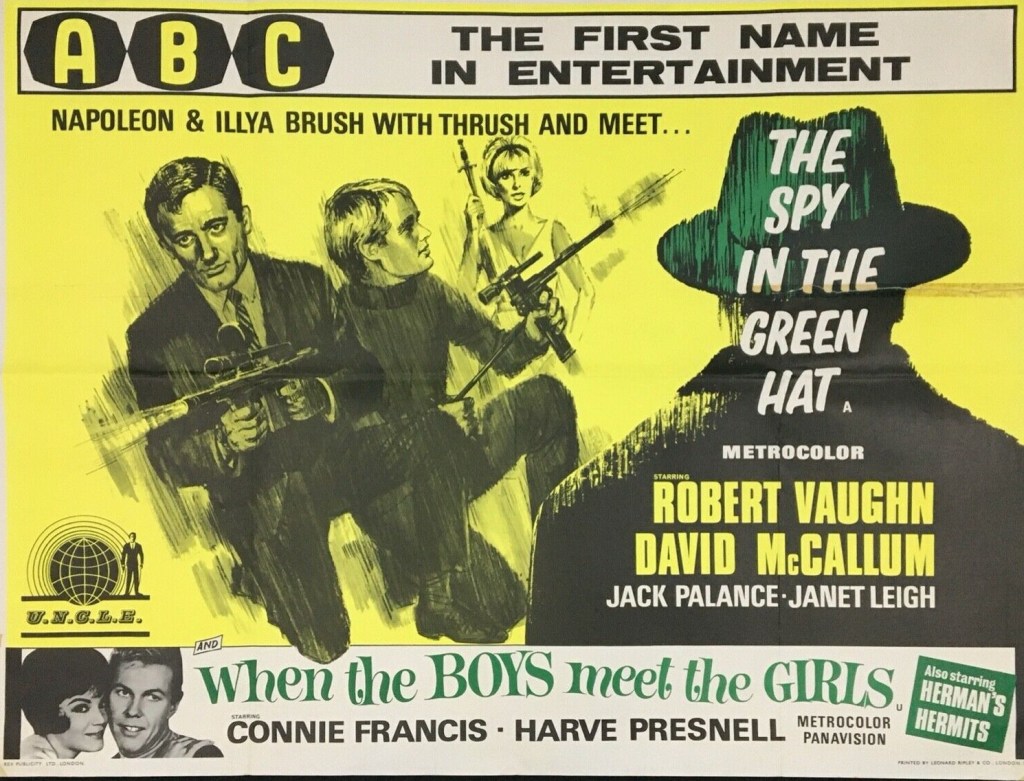
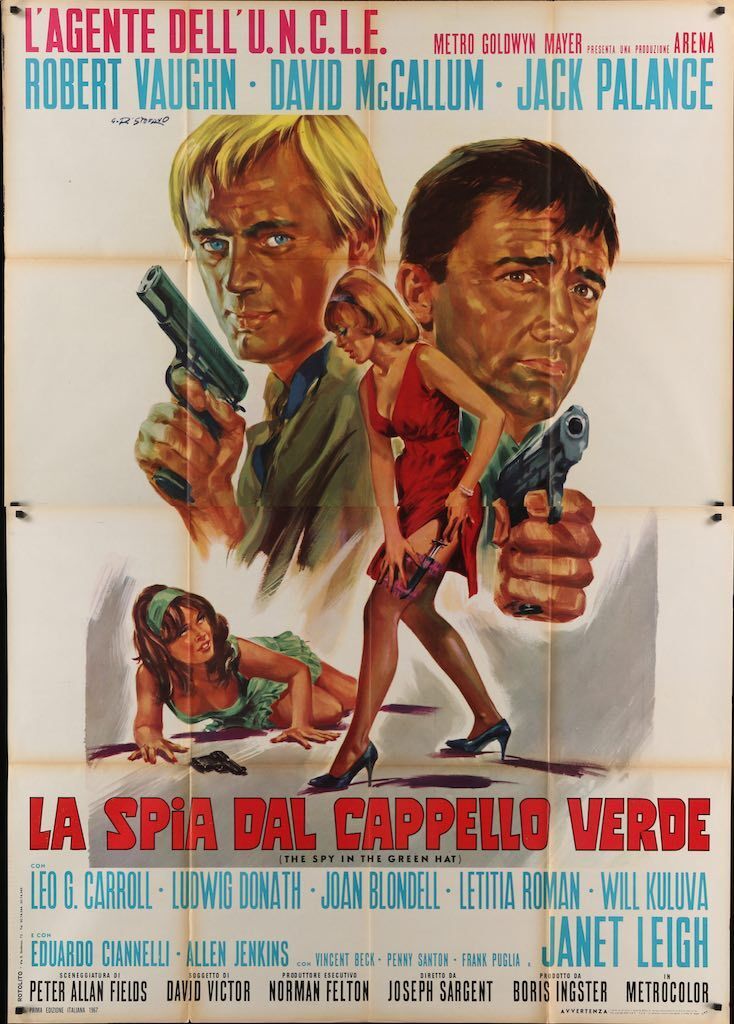
Unable to compete with the influx of big budget espionage pictures, The Man from U.N.C.L.E. throws in the action towel and comes out fighting as a comedy, and a more preposterous storyline you would be hard to find. As if spoofing a genre it helped create, our intrepid heroes find themselves in captivity one way or another, outwitted by a posse of retired Mafia hoods or sadistic females.

Napoleon Solo (Robert Vaughn) and Ilya Kuryakin (David McCallum) can’t even manage a chase, crashing the car in pursuit of former Nazi scientist Dr Von Kronen (Ludwig Donath). The trail leads to Sicily where Solo, again incapacitated, meets the sultry Pia (Leticia Roman) and as a result of a romantic misunderstanding is forced into a shotgun wedding in Chicago by her Mafia uncles, the famed Stilletto Brothers.

Meanwhile, Kuryakin makes the acquaintance of the deliciously sadistic Miss Diketon (Janet Leigh), assistant and masseuse to highly nervous Thrush boss Louis Strago (Jack Palance). The action finally shifts to the Gulf Stream, where Pia is imprisoned and the usual missiles are set to be launched in the presence of head Thrush honcho Mr Thaler (Will Kuluva) in the usual global takeover scenario.

Abandoning any attempt at serious drama, this is just a hoot, a score of sight and visual gags, references to Little Caesar and the St Valentine’s Day Massacre abound. Any time one of our heroes needs speedy access to a villain hideout along comes a guard to be bumped off and uniform purloined. Solo caught hiding under Pia’s bed is let off when discovered by a Thrush operative because he’s not the Uncle agent they are looking for. Not only is Solo constantly whacked over the head, but Kuryakin ends up as the plaything of Miss Diketon.  

Solo and Kuryakin look as if they stepped onto someone else’s parade, trying to keep the narrative on an even keel, while the Mafia gang and Thrush personnel effectively play it for laughs. Pia has Wanted posters of her uncles on her wall on the assumption they are just wonderful guys. Von Kronen gets the hots for Miss Diketon because he admires her skill at torture, although a spurned Miss Diketon turns traitor leading Kuryakin to mutter to Solo when all three meet, “I brought Lucrezia Borgia, you brought the Mafia.”

What makes it work so well are the fabulous performances of the supporting cast. Jack Palance (The Professionals, 1966), completely playing against type, still a villain sure, is a masochistic sweaty bag of nerves. Janet Leigh (Psycho, 1960) camps it up as the deadlier-than-the-male luscious female, dress slit at the thigh to reveal a hidden knife, whose pulse races at the mere thought of the cruelty she can inflict and the slower the better.  Will Kuluva (To Trap a Spy, 1964) is a bonus, the boss who just wants to party and has no idea of the technicalities of firing a missile.

Nobody even bothers to dress it up any more. The missiles look like something you would buy your kid for Xmas, the backdrops are as fake as anything on a backlot. But somehow it all works, as long as you weren’t expecting the original take on The Man from Uncle. And even so, director Joseph Sargent (One Spy Too Many, 1966) adds a few dabs of genuine cinematic icing, characters viewed from the ground-up, a fist fight that’s either in slo-mo or speeded-up freeze frame, the wife (Joan Blondell) of one of the Stiletto Brothers receiving a grapefruit in the mush.

After watching the original movie which came up better than expected in terms of action and spy malarkey, the last thing I anticipated that this would be headed in an entirely different direction. When that quickly became obvious, I feared the worst. Instead, I enjoyed a fun 90 minutes.

Of course, this wasn’t released theatrically in the U.S. just abroad with some added sex and violence, an expanded version, and in color, of a double black-and-white episode of the television series.   

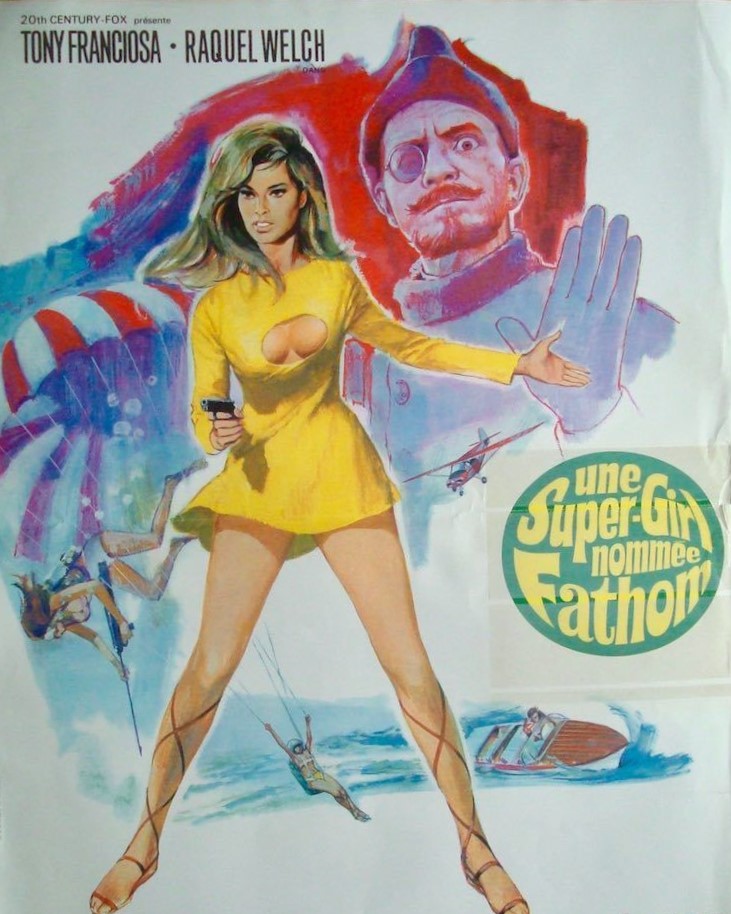
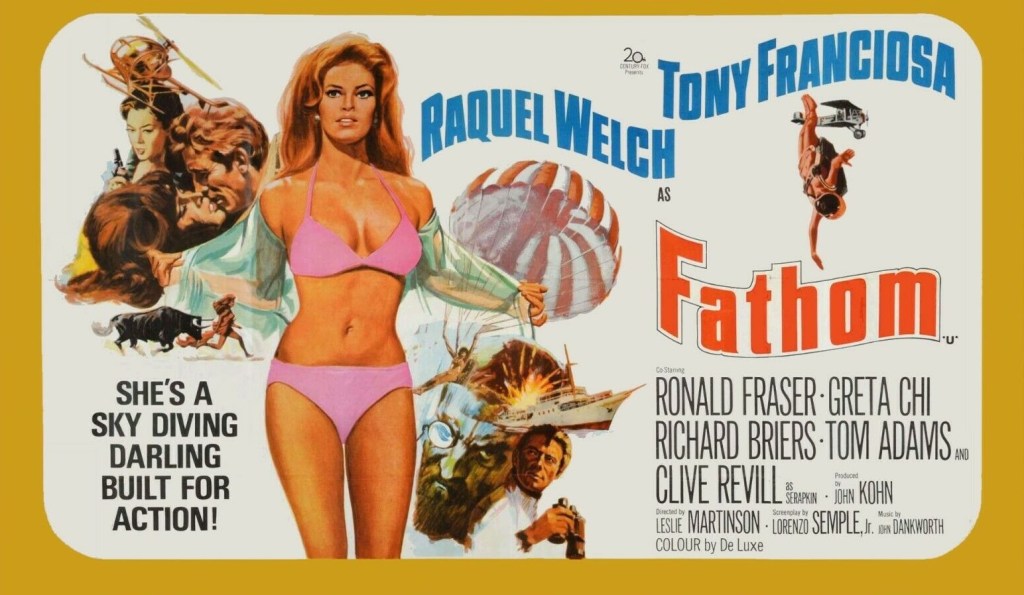
Fathom (1967) ***

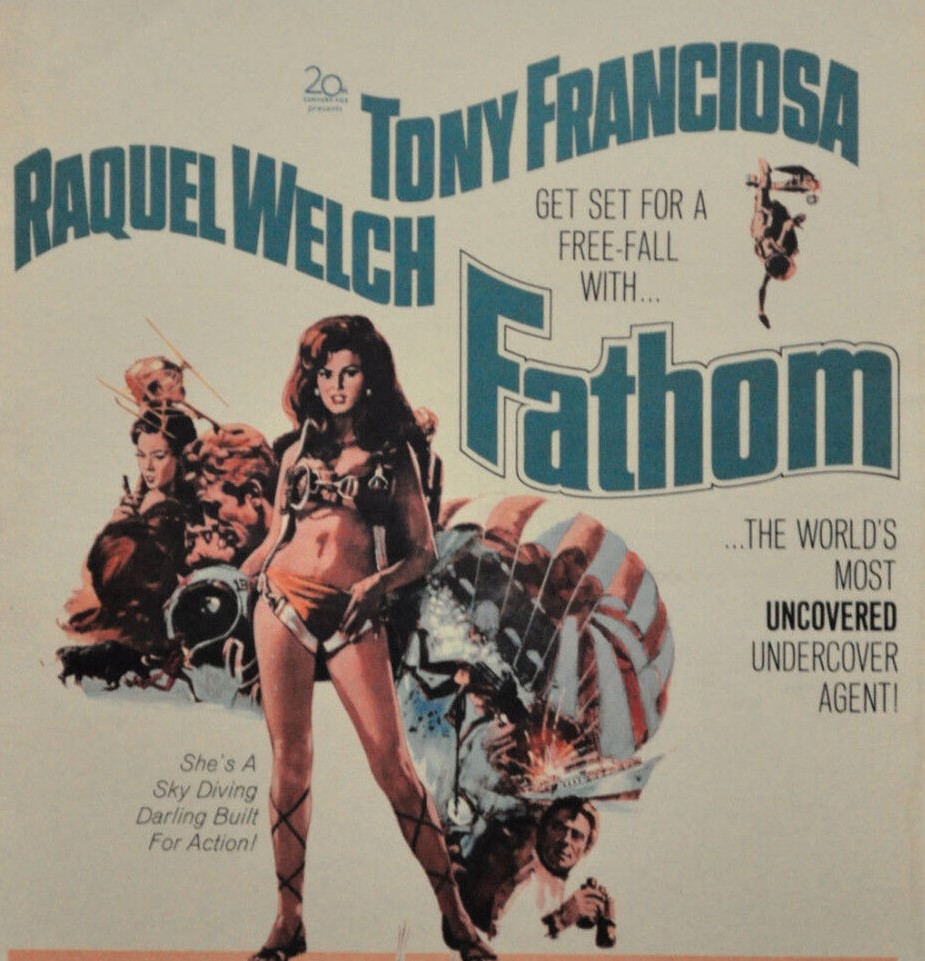
If audiences rallied to the sight of Raquel Welch wearing nothing more than a fur bikini for the entirety of One Million Years B.C. (1966) and a skin-tight suit in Fantastic Voyage (1966)  Twentieth Century Fox must have reasoned they would surely return in droves were the star to spend most of Fathom in a succession of brightly-colored bikinis.

Given such a premise who would care that a sky-diving expert was named after a nautical measurement? Or that Fathom (Raquel Welch) came nowhere near the height indicated by her name? Or that  the character as described in the source material (a novel by Scottish screenwriter Larry Forester) had a distinctly harder edge; murder, sex and drugs among her proclivities.

With Our Man Flint (1966), the studio had successfully gatecrashed the burgeoning spy genre and spotted a gap in the market for a female of the species, hoping to turn Modesty Blaise (1966) starring Monica Vitti and Fathom into money-spinning series. The Fathom project was handed to Batman, The Movie (1966) co-conspirators, director Leslie H. Martinson and screenwriter Lorenzo Semple Jr. (Flash Gordon, 1980).

Female independence was hard-won in the 1960s and there were few jobs where a woman was automatically at the top of the tree. Burglary was one option for the independent entrepreneur (see The Golden Claws of the Cat Girl) and sport was another.

Welch plays an innocent bystander recruited for her top-notch sky-diving skills (her aptitude demonstrated in the opening sequences) to help Colonel Campbell (Ronald Fraser) of British intelligence recover the “Fire Dragon,” a trigger that could explode a nuclear bomb. Her sky-diving skills are required to land in the courtyard of playboy Peter Merriwether (Anthony Franciosa).

That turns out to be baloney, of course, a MacGuffin to point her in the direction of a valuable Chinese heirloom. And then it’s case of double-cross, triple-cross and whatever cross comes next.   

There’s an intriguing mystery at the heart of this picture and a couple of top-class hair-raising moments. In one she is trapped in a bull ring and stunt double Donna Garrett had a few very definite close calls trying to avoid the maddened beast. In another she is stalked at sea by a circling motor boat while being peppered with harpoons. There is also an airplane duel and a ton of great aerial work. A couple of comic sequences are well wrung – Campbell pins his business card to one of the prongs of a pitchfork being brandished with menace by Fathom  while Peter delivers a classic line: “The only game I ever lost was spin the bottle and that was on purpose.”

You could probably determine something about national character from the color of costume different countries chose to show Raquel Welch in.

The biggest problem is that the film veers too far away from the source material which posited the heroine as a much tougher character, one who can despatch bad guys with aplomb. Instead, Fathom is presented almost as an innocent, bundled from one situation to another, never taking charge until the very end. Minus karate kicks or a decent left hook, she is left to evade her predators by less dramatic means. She has a decent line in repartee and by no means lets the show down. However, the idea, no matter how satisfactory to fans of the actress, that Fathom has to swap bikinis every few minutes or failing that don some other curve-clinging item, gets in the way of the story – and her character. Into the eccentric mix also come a millionaire (Clive Revill) and a bartender (Tom Adams).

There’s no doubt Welch had single-handedly revived the relatively harmless pin-up business (not for her overt nudity of the Playboy/Penthouse variety) and had a massive following in Europe where she often plied her trade (the Italian-made Shoot Loud, Louder…I Don’t Understand in 1966 and the British Bedazzled in 1967) but she was clearly desperate for more meaty roles. Those finally came her way with Bandolero (1968) and 100 Rifles (1969) and Fathom feels like a lost opportunity to provide her with that harder edge. 

She’s not helped by the odd tone. As I mentioned she gets into plenty of scrapes and proves her mettle with her diving skills. In the hands of a better director and with a few tweaks here and there it could have been a whole lot better and perhaps launched a spy series instead of languishing at the foot of the studio’s box office charts for that year.  

Anthony Franciosa (Rio Conchos, 1964) , still a rising star after a decade in the business, who receives top billing, doesn’t appear for the first twenty minutes. And then he behaves like a walking advert for dentistry, as though his teeth can challenge Welch’s curves. And some of the supporting cast look like they’ve signed up for a completely different movie. Richard Briers (A Home of Your Own, 1965) – Ronald Fraser’s intelligence sidekick – looks like a goggle-eyed fan next to Ms Welch while Clive Revill (The Double Man, 1967) thinks it’s a joke to play a Russian as a joke. Ronald Fraser (Sebastian, 1968) provides decent support.

But it is certainly entertaining enough and you are unlikely to get bored.

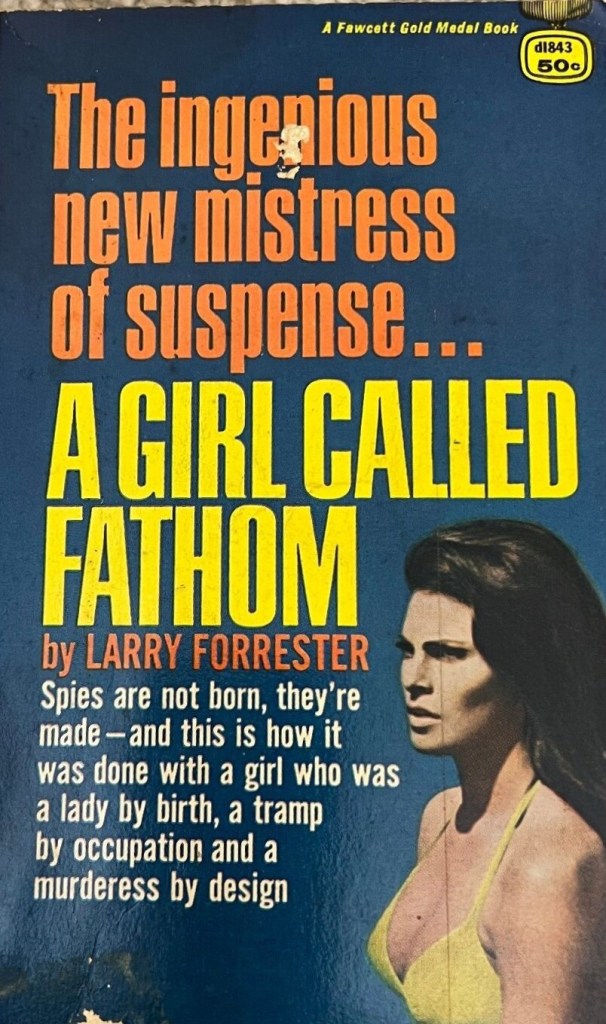
Book into Film: A Girl Called Fathom by Larry Forrester (1967)

The blurb gives the game away. The British paperback published by Pan went: “She was blonde. She was beautiful, she was six foot tall. She’d killed the man who had dragged her to the lowest depths of addiction and lust.” The American Fawcett Gold Medal paperback was more succinct: “lady by birth, tramp by occupation and murderess by design.”

If any of that rings a bell, it was not from the film Fathom (1967) starring Raquel Welch which chose to ignore her background and her venomous skillset. The novel opens with the heroine killing a man in cold blood. He had promised her a film career but turned her into a call girl and heroin addict. Her father, now dead, was in the British secret service.  Once she has committed her first murder, she is immediately kidnapped by a secret organization (C.E.L.T.S. – Counter Espionage Long-Term Security) and trained to become an even more ruthless government-sanctioned killing machine.

Larry Forrester was a Scottish television scriptwriter who had worked on a stack of British series such as Whirligig (1953), Ivanhoe (1958) and No Hiding Place (1960-1964) before publishing his first novel A Girl Called Fathom. His sole screenplay was Tora! Tora! Tora! (1970) after which he concentrated on U.S. television including episodes of Fantasy Island (1980-1983) and Hart to Hart (1983-1984).   

A Girl Called Fathom is split into two. Comprising roughly two-fifths of the book, the first section concentrates on her brutal training and on getting her off drugs. There’s a fair amount of sexual intrigue not to mention sex. But also a lover’s betrayal.  For the final part of her training she is abandoned in the middle of nowhere in scorching heat and barely makes it home. “She had passed over a great divide. She was empty, hard – dehumanized. Alone. She would always be alone.” And then she is forced to kill again.

As was common with this kind of book in the 1960s, it was fast-moving and globe-trotting with plenty of realistic detail to offset the preposterous plot. For the remainder of the book, which shifts location to Europe, Fathom is up against an organization called W.A.R. (World of Asian Revolution) which aims to destabilize the existing world order. Her arch enemy is an American-born Soviet agent (and whip and knife expert) Jo Soon (who turns up in the film Fathom in slightly different form as Jo-May). Fathom’s team must protect French elder statesman Paul-Auguste Valmier whose playboy son Damon (who fantasizes about burning people alive), a friend from her past, is her main contact.

The book is peopled by interesting and occasionally outrageous characters – for example Tin (shades of Iron Man), who has hardly a human bone left in his body; the far-from-harmless Aunt Elspeth; and a sadistic colleague who loves her but dare not let his emotions out lest he loose on her his love of pain. The central plot is driven by a mass of twists and turns, heroine endangerment, fights with knife and gun and fist, traitors (naturally) and the clever idea of killing off the leaders of the free world with a bomb hidden in the coffin of a man worthy of a state funeral being held in Paris.

At the end she is counting the human cost of victory and sees herself as one of the walking wounded, a reject, driven from the herd. The film was apparently based on an unpublished sequel so it’s conceivable that the plot concerning the Chinese heirloom was pulled from that in its entirety. But even so the film’s heroine was neutered, not a patch on the ruthless killer with a sordid past outlined in A Girl Called Fathom.

Operation Mincemeat (2022) **** – Seen at the Cinema

British espionage team embarking on a scheme to fool Adolf Hitler during the Second World War find they are susceptible to deceit and deception in their own lives. What could have been a plodding step-by-step documentary-style picture is given a huge fillip by examination of the lives of those involved. The twists and turns of this extraordinary tale, both in the professional and personal sense, make for a very enjoyable picture. It is no less thrilling for, like The Day of the Jackal (1973), being aware of the outcome.

Planning to invade Sicily in 1943, the Allies are determined to convince Hitler that they are instead more likely to attack Greece. The British come up with “Operation Mincemeat,” a variation on the Trojan horse with the “gift” this time being secret papers referring to the Greek assault that are contained in a briefcase attached to a corpse which washes up on the shores of Cadiz in Spain. The assumption is that the German high command is predisposed to being hoodwinked after having ignored the papers on a genuine corpse that came their way prior to the invasion of north Africa.

Tasked with devising the operation are the accomplished Ewen Montagu (Colin Firth) and the gawky Charles Cholmondeley (Matthew Macfadyen) into whose orbit comes Jean Leslie (Kelly Macdonald) whose persona is used to provide a romantic background for the corpse. Although the project has been given the green light from the highest authority i.e Winston Churchill (Simon Russell Beale) not everyone is in favour and the team face obstacles, since technically the plan comes under the remit of the Royal Navy, from Admiral John Godfrey (Jason Isaacs).

The romantic intrigue that ensues creates sufficient resentment for one member of the team to spy on the other at the behest of the admiral, thus ensuring that those charged with deceiving Hitler through moral means are entering into immoral personal activity.  

But what drives this picture is the detail. Finding the correct type of corpse, ensuring it is preserved and has sufficient water in the lungs to make a convincing drowned man at the same time as creating a suitable legend for the character. Films dependent on the inner workings of espionage science, for want of a better word, do not always work. Enigma (2001), a riveting book, did not translate well onto the screen while The Imitation Game (2014), covering similar territory, did.  Here, the minutiae of minutiae are presented in such detail it is an education, down to the importance of an eyelash, how to extract a letter without breaking the seal on an envelope, and, critically how to judge whether the Germans have examined the material closely enough to ensure they have taken the bait.   

The story has already been told though not in such detail as “The Man Who Never Was” (1956)
but with Hollywood stars Clifton Webb and
Gloria Grahame playing the leads.

And that’s before other twists and turns. The corpse was a down-and-out, abandoned, so it appeared, by all and sundry, until out of the blue his sister arrives to claim the body. The coroner on duty in Cadiz turns out, against all expectations, to be an expert in drowning. The British Attache in Spain must seduce both genders to ensure smooth passage of the secret documents. On the more human side, widows abound, husbands lost in combat. A spy on the British side must be unmasked or rendered harmless. A host of other smaller stories unfold within the larger narrative. Above all lies the tension of the necessity for the operation’s success, failure would mean the deaths of thousands of men on the Sicily beachheads and possibly a thwarted invasion.

Matthew Macfadyen (Succession, 2018-2021) steals the show as the over-sensitive individual with the sense of entitlement that comes from having too big a brain, Oscar-winner Colin Firth (Kingsman: The Secret Service, 2014) the imperturbable figure who finds emotion wreaks havoc, Kelly Macdonald  (Goodbye Christopher Robin, 2017) the secretary drawn deeper into a world where genuine emotion has little place.

The cream of British character actors providing sturdy support include Johnny Flynn (Emma, 2020) as spy writer Ian Fleming, Penelope Wilton (Downton Abbey: A New Era, 2022), Mark Gatiss (The Father, 2020), Alex Jennings (Munich: The Edge of War, 2021), Jason Isaacs (The Death of Stalin, 2017) and Mark Bonnar (Guilt, 2019-2021). ,

Oscar-nominated John Madden (Shakespeare in Love,  19980 directs with something approaching verve, never letting the pace drop, zipping from scene to scene, from the war effort into more intimate moments, without any sign of the tension flagging. In her movie debut Michelle Ashford (The Masters of Sex, 2014-2016) does an excellent job of distilling  Ben McIntyre’s bestselling book.

Sure, this is one of those British pictures in a long line of movies that show the country at its best, generally in the thick of war, but the story is so involving that it merits viewing. It is still showing at the time of writing in British cinemas but in the United States and Latin America it will air on Netflix on May 11.

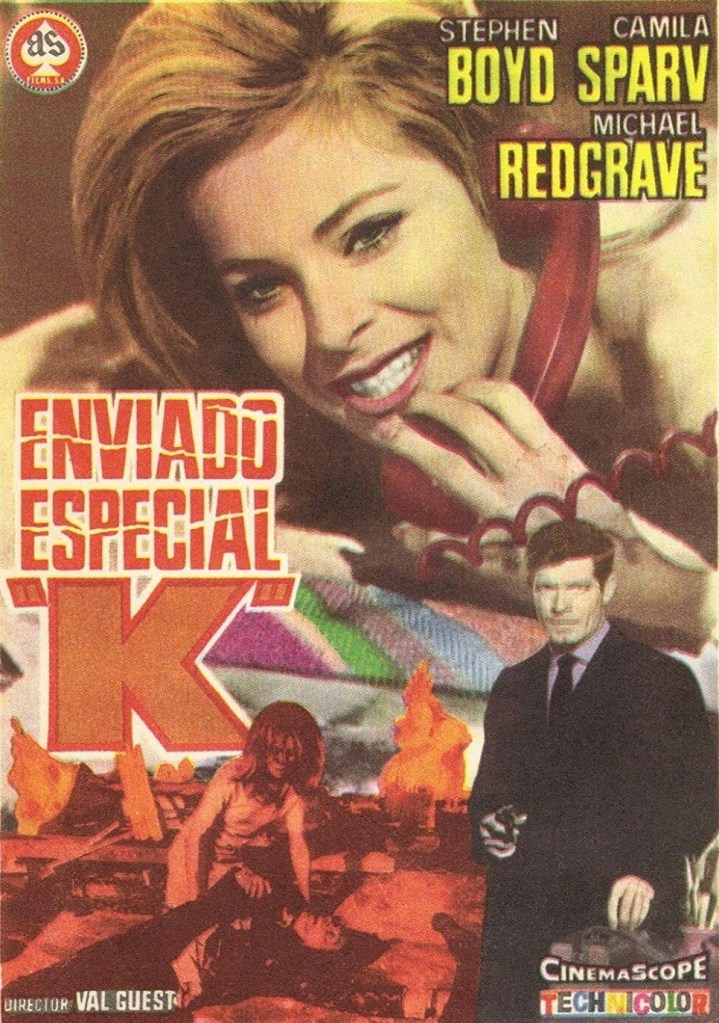
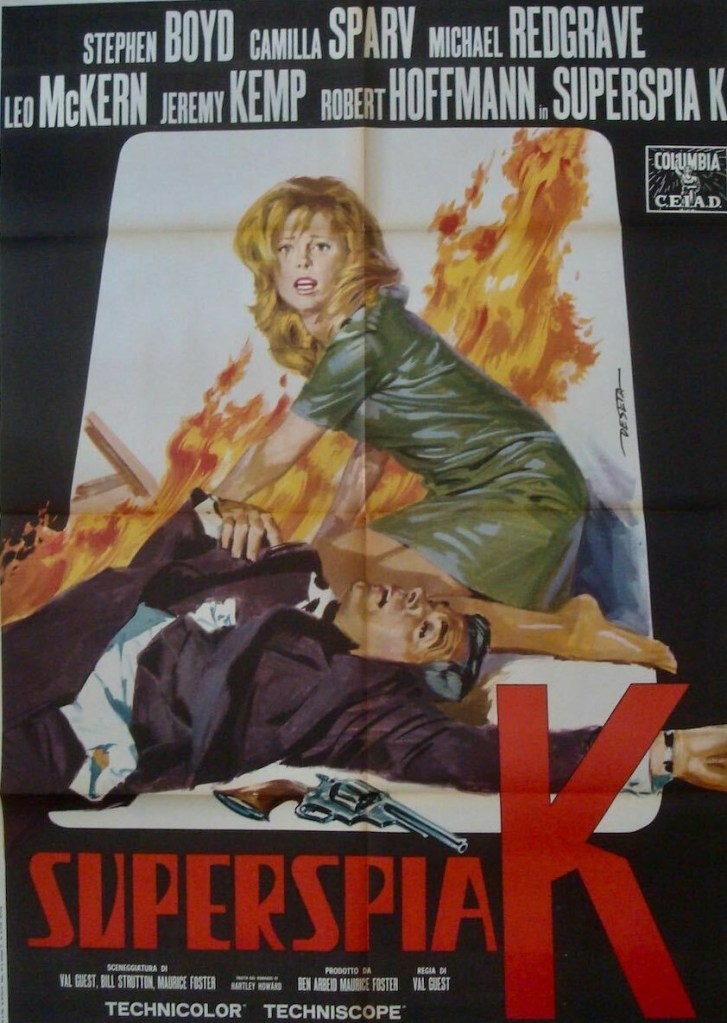
Assignment K (1968) ****

A good notch above the routine spy thriller, this deserves another look. By the mid-1960s the screen was awash with spies so other than trying to invent a new hero in the Matt Helm/Derek Flint vein or revamping older characters such as Bulldog Drummond  or sending up the entire genre in the style of Casino Royale (1967), it was difficult to find a fresh angle.

Assignment K does in some measure succeed, in part by going down the grimy  route of The Spy Who Came in from the Cold (1965), in part by stuffing the picture full of glorious scenery – the Austrian Alps – and in part by turning Stephen Boyd into the kind of spy who has begun to question the entire business. For reasons unspecified, former racing driver turned toy salesman Boyd (The Big Gamble, 1961) is running his own spy operation loosely linked into British intelligence but when the network is compromised his life and that of new love interest Camilla Sparv (Nobody Runs Forever/The High Commissioner, 1968) endangered. Things get trickier when she is kidnapped and he has to save her while not compromising his own agents.

There is enough mystery to keep the plot, uncoiling like Russian dolls, ticking along and the entire effort is underwritten by some decent tradecraft, dead letter drops, microfilm hidden inside cigarette filters and so on. Tension is surprisingly high. And Boyd is surprisingly human, falling properly in love for one thing, not just treating women in the James Bond/Matt Helm fashion as notches on a bedpost, not ice-cool under pressure either, face knotting in fury on occasion, and not so accomplished in the old fisticuffs department. There is less reliance on just sticking out his chin and looking handsome and this is a more assured performance than in The Big Gamble.

Michael Redgrave (The Hill, 1965), Leo McKern (Nobody Runs Forever) and a pre-Please, Sir John Alderton provide decent support though Jeremy Kemp (The Blue Max, 1966) is somewhat subdued. But Boyd is a revelation. Here, his screen charm and charisma are at their best and while he was never going to attract the attention of the Oscar fraternity is entirely believable as a spy coming to wonder at decisions taken.

Sparv, too, is much better than I have ever seen her. Unlike her turn in Murderers Row (1966), her role is not merely decorative and the unfolding romance would work perfectly well just as a love story never mind tucked away in the guise of a spy thriller. There is a lovely demonstration of her acting skill, although an odd one to describe, as she pulls on a bathrobe and shimmies out of the towel underneath; I can’t believe that was ever scripted, but if you watch it you will see what I mean.  Swedish Sparv was often viewed just as another of the decade’s ubiquitous European starlets but in fact she shows genuine acting ability.  

Director Val Guest was usually labelled a “journeyman” despite a repertoire that included The Quatermass Xperiment (1955) and its sequel, Yesterday’s Enemy (1959) and sci-fi The Day the Earth Caught Fire (1961) and he had previous form in this genre with Where the Spies Are (1966) which played more to the comedy gallery and did some work on Casino Royale to boot. Guest was also involved in the screenplay along with two first-timers Bill Strutton and Maurice Foster, the former primarily a television writer, the latter a producer. Guest’s work here falls into the efficient category, but it does zip along at the same time as allowing Boyd and Sparv to develop their characters and make their relationship believable. All in all quite enjoyable.

CATCH-UP: The Blog has reviewed Camilla Sparv in Dead Heat on a Merry-Go-Round (1966) Nobody Runs Forever/The High Commissioner (1968) and Downhill Racer (1969). Stephen Boyd pictures reviewed so far are The Big Gamble (1961), The Fall of the Roman Empire (1964) and The Third Secret (1964).

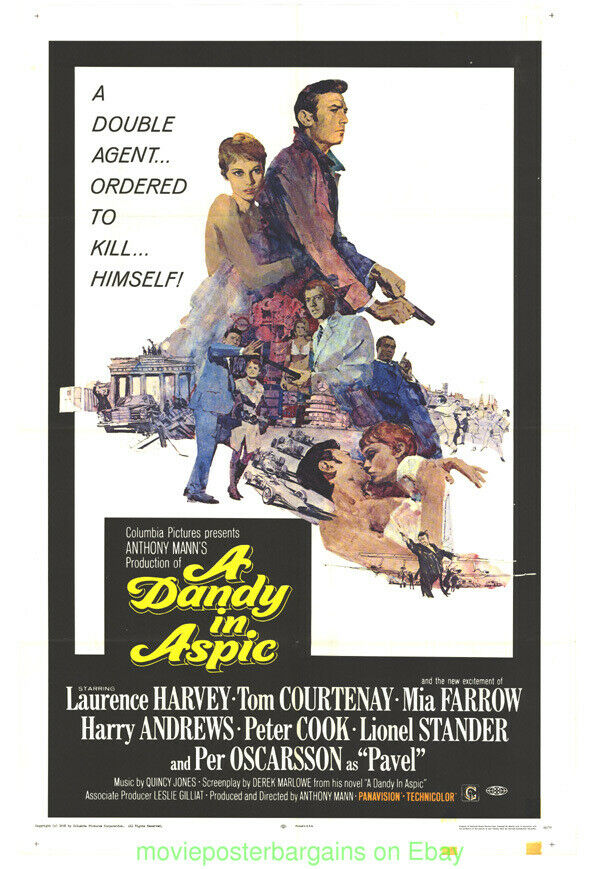
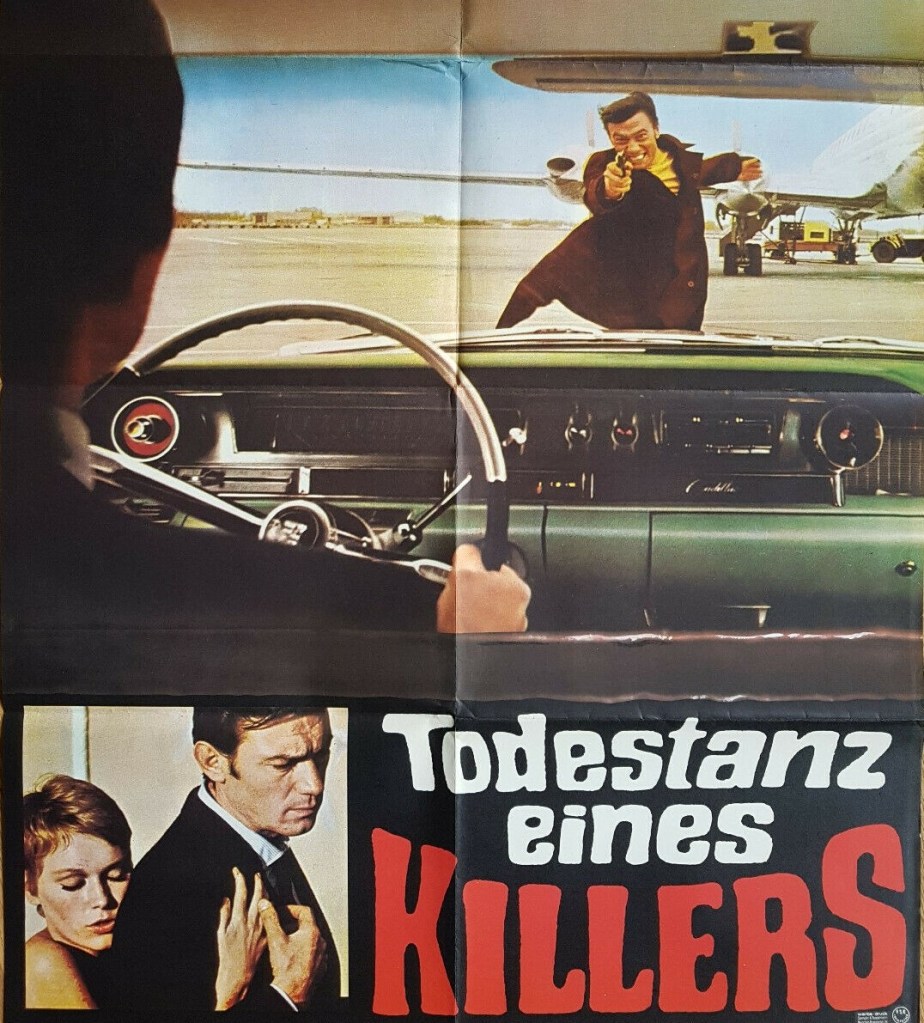
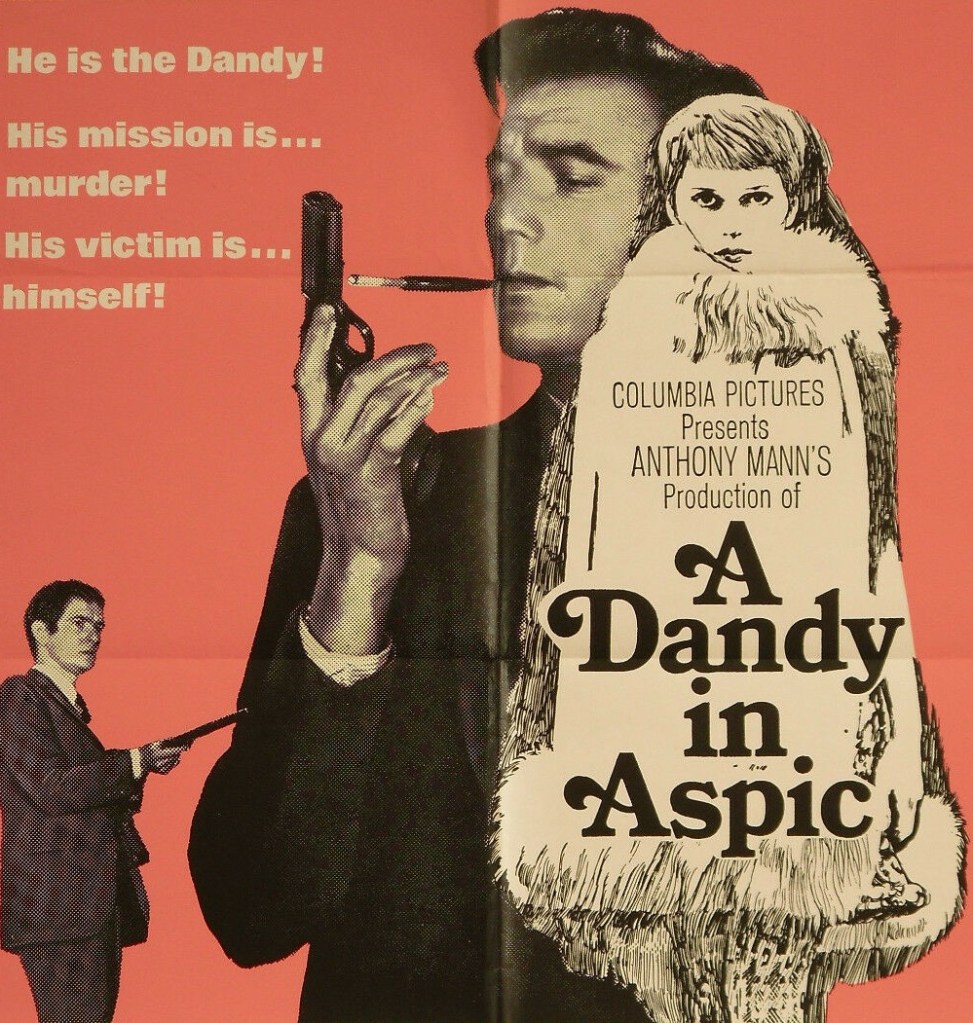
A Dandy In Aspic (1968) ***

Belongs to the “serious spy” genre that exposed the nitty-gritty espionage business, often more concerned with the impact of the job on the spy than on the mission on which they have been sent. The biggest successes came early on – The Spy Who Came in from The Cold (1965), The Ipcress File (1965) and The Quiller Memorandum (1966). A Dandy in Aspic is one of the latest in the series of sad spies and like The Defector (1966) it’s more of a character study than an action picture. The tone is set with the credits, a puppet dangling to the point of being tormented, on a string.

The character in question is Eberlin (Laurence Harvey), a spy who wants to quit and go home. He knows only too well what happens to the burnt-out case, one of his colleagues is a drug addict. Only in this case home is Russia. But the feedback he receives is that nobody back home wants him to quit. His British bosses send him to go to Berlin to assassinate a dangerous Russian spy called Krasnevin. The only problem is, Eberlin is Krasnevin and so begins a game of bluff and double bluff while he fails to uncover the supposed foreign assassin his ruthless British unwanted colleague Gatiss (Tom Courtenay) is helping him locate.

Thrown into the mix is a girl, Caroline (Mia Farrow) a casual pick-up, a photographer he met in London who turned up in Berlin. Happenstance? Perhaps. But there is no such thing for a suspicious spy and to tell the truth even the moviegoer will treat her as just too good to be true even though she is a delightful personality and beautiful to boot. The fact that Eberlin has a girlfriend Miss Vogler (Barbara Murray) doesn’t seem to bother him, spies, as you will know by now, discarding women like old shoes.

If a noose is closing in, it’s a strange one, and feels more like it’s coming from the East rather than the West. He is blocked from taking a trip to East Berlin. Cops are tipped off when he makes contact with someone who could get him over/through the Wall. His Eastern masters seem willing to pay good money to find out the identity of Krasnevin.

It’s all twisted and complex and all sorts of strange characters come out of the woodwork. For no reason at all one sequence is set at a Grand Prix race, one of the drivers paid to cause a distraction to allow someone to be shot. Like The Defector, this is a movie that unravels backwards. Once you get to the end it makes a lot more sense. If you were asked to choose, on the basis of the characters presented, whether the Russians or British had more principles you would be hard put to decide.

Laurence Harvey (The Running Man, 1963) is one of the few actors with the vicious fragility to carry this off. He is coming apart at the seams. He can hold onto his good looks far longer than his mental stability. His rare acts of violence seem petulance. And since we are never allowed inside his head, since he cannot confess his feelings to Caroline, he cannot explain what it’s like to be abandoned by your native country, cast aside like an old lover. It’s left to the audience to work this out for themselves, that a true patriot risking his life for his country is refused sanctuary.

He’s doomed and soon he knows it, nowhere left to run, the sense that the trap is closing and perhaps the few hours spent with Caroline are like a condemned man’s final wishes.

Filmed in bleak London and Berlin, the setting reflects the character’s mindset. There’s a bit too much fancy cinematography and sound effects, but otherwise it’s solid entry into the “more real than reality” subgenre. Director Anthony Mann (The Heroes of Telemark, 1965) died during the making of the film, Laurence Harvey taking the helm for the last two weeks of shooting and post-production so it’s possible this is not quite the film Mann had in mind.

You can see here elements of the documentary style Mann developed in The Heroes of Telemark and it’s possible that when it came to the editing director Harvey accorded himself more prominence than Mann might have, leaving a complex tale more difficult to follow than necessary.

Harvey is very good in the role of the ruthless narcissist, Mia Farrow – she followed this with Rosemary’s Baby (1968) – with a creditable English accent is excellent as the lover though Tom Courtenay (Operation Crossbow, 1965) seems miscast. Excellent support is provided by Lionel Stander (Once Upon a Time in the West, 1968), Harry Andrews (Danger Route, 1967) and Per Oscarsson (Who Saw Him Die?. 1968). Look out for comedian Peter Cook (Bedazzled, 1967) as an unlikely lothario, Barbara Murray (television series The Power Game, 1965-1969) and Calvin Lockhart (Dark of the Sun, 1968).

Behind the Scenes: “Operation Kid Brother / O.K. Connery” (1967)

A new episode in the James Bond legend began on February 23, 1966, when a plasterer from Scotland made an audacious bid for movie stardom. His name was Neil Connery, currently earning $10 a week, shooting for a $5,000 payday as he took part in a screen test in Rome for producer Dario Sabatello (Seven Guns for the MacGregors, 1966) for a film entitled Operation Casbah that would later be tagged Operation Kid Brother (O.K. Connery in Italy).

Sabatello was an experienced producer beginning with The Thief of Venice (1950) starring Hollywood legend Maria Montez. Connery was a skilled laborer living in the four-year shadow of elder brother Sean and with little intention of moving out of that shadow. However, as a result of a work-related incident, he became the subject of a newspaper article and then a radio interview. Nobody was much interested in the reason for the interview – stolen tools – but everyone was impressed by the sound of Neil’s voice. “Sean’s brother spoke exactly like him.”

Archers Assemble! Connery on the bowstring.

The newspaper interview caught the eye of Sabatello, who noted the actor’s likeness to his brother and who flew over to Edinburgh to interview Neil and in so doing becoming aware of his athletic attributes, height and good looks. A month later came an invite for the screen test. Neil’s agent, who had no right to make such a claim, promised that if Neil got the part big brother Sean would play a cameo. For the test, Connery had to “embrace a girl, sing, dance and finally end up in  a hand-to-hand fight with a guy with a knife.” However, the test was so successful that the presence of Sean was not required. Sabatello signed the neophyte actor to a six-picture deal that would generate a six-figure salary if the film turned the Scot into a star.

Italian production giant Titanus sold the world rights (except for Italy) to United Artists, ironically the distributor of the James Bond pictures, thus securing the funding for the $1.2 million three-month shoot that kicked off in Cinecitta in Rome on December 14, 1966. Locations were scheduled to include Monte Carlo, San Remo, Turin, Barcelona, Malaga and Tetuan.

The supporting cast was dominated by actors with a Bond connection including Adolfo Celi, Daniela Bianchi, Anthony Dawson, who had all worked with director Alberto De Martino on Dirty Heroes (1967) and Lois Maxwell and Bernard Lee. Ennio Morricone, another De Martino aficionado, was brought in to do the score.

Affiliates Assemble! Connery with Bond regulars Bernard Lee and Lois Maxwell.

Connery’s boxing training in the British Army came in handy when he had to become an archer. Pulling a bow takes considerable physical exertion. Target practice was held at Adolfo Celi’s house outside Rome. “I had remembered everything about putting the bow down, bringing it up, pull and push, as there was quite a pull on it,” he said. Celi’s arrow managed just a few yards but Connery hit the target. His luck did not hold when filming the real thing in Monte Carlo. Celi’s shot did not go far again but this time Connery’s arrow missed the target.

Although Connery had read the script he was only given his lines in the morning as he went into make-up. He acquitted himself well in the fight scenes, except for one scene which ended with him being taken to hospital.   

The film opened in Britain at the Pavilion in London’s West End on April 25, 1667, with a general release slated for May 5. But it didn’t get a circuit release. That is, it didn’t go out on either of the two main cinema chains, ABC or Odeon, or the lesser Gaumont circuit, so its bookings would have been restricted. It didn’t appear in the United States until November, 1967, having been reviewed without much enthusiasm in Variety which posited “at best the film deserves bottom half bookings”, i.e. the bottom half of a double bill, which means it would play for a fixed rental rather than a percentage.

It did open in first run in a number of city center picture houses in November and December, to occasionally decent but hardly lush box office. Its $20,000 week in Chicago was deemed “good”, as was the $4,000 in Providence, while $13,000 in Philadelphia was considered “brisk” but $5,000 in St Louis considered only “fair.”  There was a first run showing in New York but only at a 600-seater arthouse.

But when it went wider in “Showcase” releases the box office collapsed. In New York it managed only $67,000 from 25 theatres compared to, in the same week, British film The Family Way on $223,000 from 26, and the second week of Point Blank with $145,000 from 25. Business was worse in Los Angeles, just $49,000 from 26 compared to $125,000 from 29 for Barefoot in the Park, and it was dire in Kansas City, only $9,000 from eight houses.

Given the relatively low budget, the film globally may well have broken even but it certainly did not send Neil Connery’s box office status into the stratosphere. He had small parts in two more low-budget movies, The Body Stealers (1969) and Mad Mission 3: Our Man from Bond St (1984) plus some television.

SOURCES: Brian Smith, “Bond of Brothers,” Cinema Retro, Vol 4 Issue 12 2008, p13-19; Allen Eyles, Odeon Cinemas  2, (CTA 2005), p212; Allen Eyles, ABC (CTA, 1993), 123-124; Allen Eyles, The Granada Theatres (CTA 1998)’ p247; Allen Eyles, Gaumont British Cinemas, (CTA 2005), p197; William Hall, “Big Brother Is Watching Him,” Photoplay, June 1967; “International Soundtrack,” Variety, February 23, 1966, p33; “Titanus Sets Pre-Prod Deals for Two UA Pix,” Variety, December 14, 1966, p24; “International Soundtrack,” Variety, December 21, 1966, p24; “Hollywood and British Production Pulse,” Variety, December 28, 1966, p17; Advertisement, Variety, January 4, 1967, p65; “Connery Pix a Family Affair with UA,” Variety, March 8, 1967, p24;  Review, Variety, October 11, 1967, p22; “Picture Grosses,” Variety November 1, November 8, November 15, November 29, December 13, 1967.  

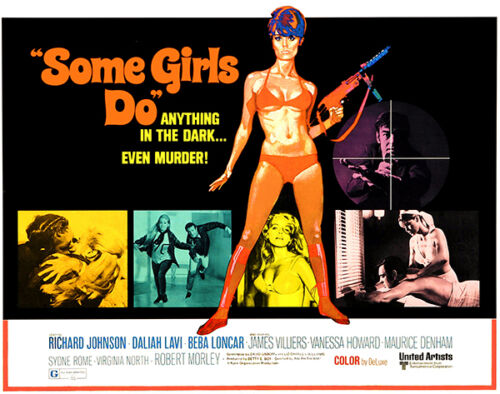
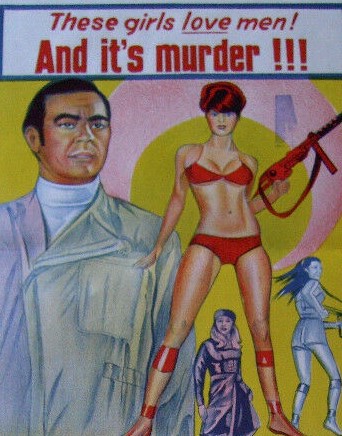
Some Girls Do (1969) ****

Enjoyed this sequel to Deadlier Than the Male (1967) far more than I expected because it sits in its own little world at some point removed from the espionage shenanigans that dominated the decade. Hugh (nee Bulldog) Drummond is neither secret agent nor involved in espionage high jinks, instead employed in the more down-to-earth domain of insurance investigator, albeit where millions are at stake. Although his overall adversary is male, the smooth-talking Carl Petersen (James Villiers), adopting a series of disguises for most of this picture, the real threat comes from a pair of villainesses in the shape of Helga (Daliah Lavi) and Pandora (Beba Loncar – the latter, yes, having her own deadly Box. If anything, this pair are a shade more sadistic than Irma and Penelope from the previous outing.

The sequel doubles up – or doubles down – on the female villainy quotient, Petersen having created a race of lethal female robots who spend their time dispatching scientists working on the world’s first supersonic airliner. Global domination is only partly Petersen’s aim since he also stands to gain £8 million ($134 million today) if the plane doesn’t launch on schedule. Livening up proceedings are Flicky (Sydne Rome), a somewhat kooky Drummond fan who has her own agenda, Peregrine “Butch” Carruthers (Ronnie Stevens), a mild-mannered embassy official assigned bodyguard duties, and chef-cum-informant Miss Mary (Robert Morley).

Villiers has found a way of turning an ultrasound device intended originally to aid cheating in a boat race into something far more dangerous. But, of course, for Helga seduction is the main weapon in her armoury, and Drummond’s first sighting of her – a superb cinematic moment – is sitting on the branch of a tree wielding a shotgun. Equally inviting are the squadron of gun-toting mini-skirted lasses guarding Petersen’s rocky fortress.

The movie switches between Helga, Pandora and the robots raining down destruction and Drummond trying to prevent it. Dispensing with the boardroom activities that held up the action in Deadlier than the Male, this is a faster-moving adventure, with Drummond occasionally outwitted by Helga and calling on his own repertoire of tricks. Dialogue is often sharp with Drummond imparting swift repartee.

The action – on land, sea and air – is a vast improvement on the original. The pick is a motorboat duel, followed closely by Drummond in a glider coming up against a venomous aeroplane and saddled with a defective parachute. And there are the requisite fisticuffs. Various malfunctioning robots supply snippets of humour.

Richard Johnson (A Twist of Sand, 1968) truly found his metier in this character and it was a shame this proved to be the last of the series. Although Daliah Lavi never found a dramatic role to equal her turns in The Demon (1963) and The Whip and the Body (1963) and had graced many an indifferent spy picture as well as The Silencers (1966), she is given better opportunity here to show off her talent. Beba Loncar (Cover Girl, 1968) is her make-up obsessed bitchy buddy. Sydne Rome (What?, 1972) makes an alluring her debut. James Villiers (The Touchables, 1968) is the only weak link, lacking the inherent menace of predecessor Nigel Green.

There’s a great supporting cast. Apart from Robert Morley (Genghis Khan, 1965) look out for Maurice Denham  (Danger Route, 1967), Adrienne Posta (To Sir, with Love, 1967) and in her first movie in over a decade Florence Desmond (Three Came Home, 1950). The robotic contingent includes Yutte Stensgaard (Lust for a Vampire, 1971), Virginia North (Deadlier Than the Male), Marga Roche (Man in a Suitcase, 1968), Shakira Caine (wife of Sir Michael), Joanna Lumley (television series Absolutely Fabulous), Maria Aitken also making her debut, twins Dora and Doris Graham and Olga Linden (The Love Factor, 1969).  Peer closely and you might spot Coronation Street veteran Johnny Briggs.

The whole package is put together with some style by British veteran Ralph Thomas (Deadlier than the Male).

CATCH-UP: Chart through the Blog how  Richard Johnson’s career went from supporting player to star via The Pumpkin Eater (1964), Operation Crossbow (1965), Khartoum (1965) Deadlier than the Male (1967), Danger Route (1967) and A Twist of Sand (1968). Conversely, see how Daliah Lavi went from European star of The Demon (1963) and The Whip and the Body (1963) to Hollywood supporting player in Lord Jim (1965).

Network has this on DVD currently at a bargain price in a double bill with Deadlier Than the Male.

And you can also catch Some Girls Do on YouTube.

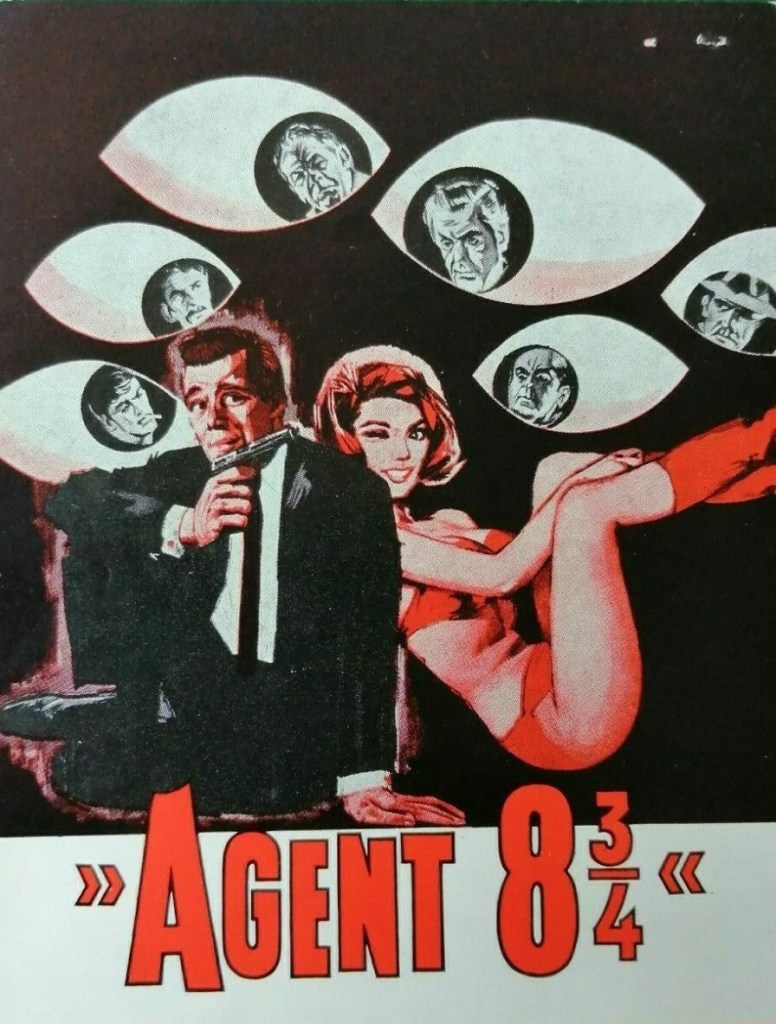
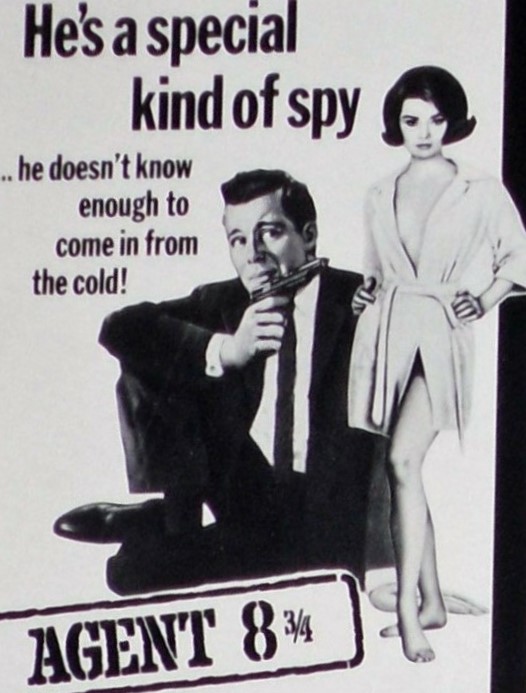
Hot Enough for June / Agent 8 3/4 (1964) ***

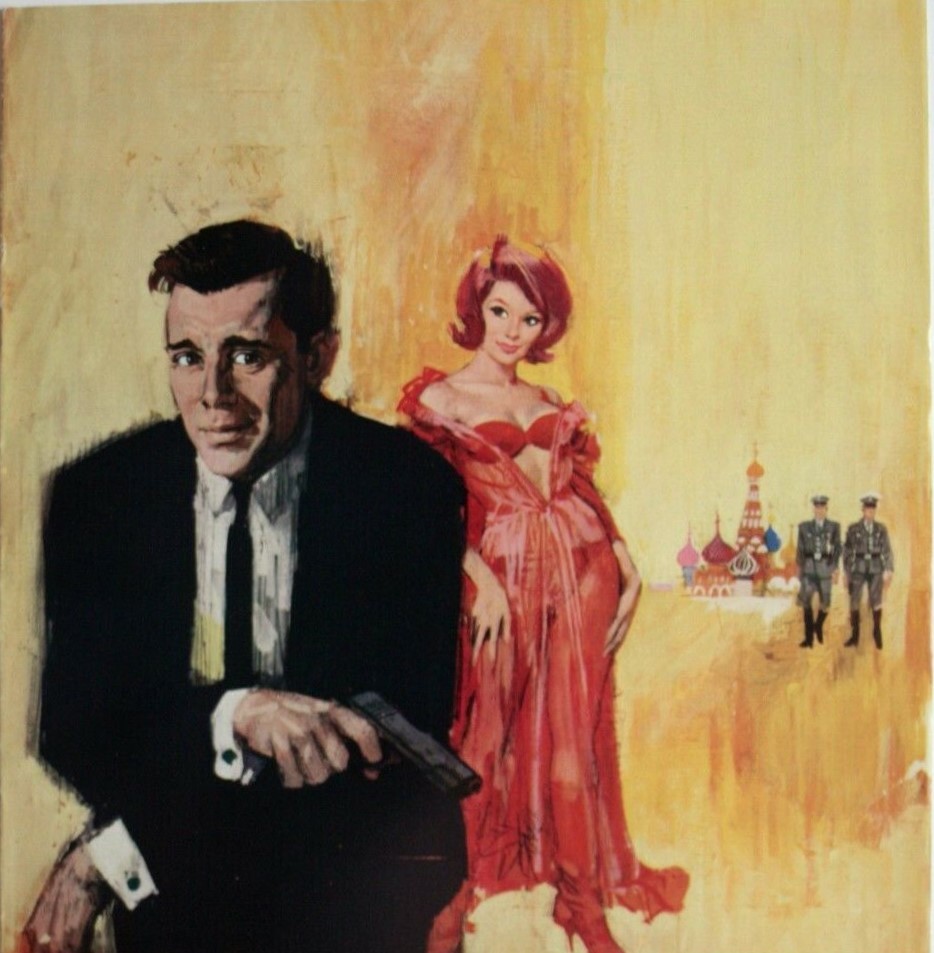
Thanks to his language skills unemployed wannabe writer Nicholas (Dirk Bogarde) is recruited as a trainee executive on a too-good-to-be-true job visiting a Czech glass factory  only to discover that while engaged on what appears a harmless piece of industrial espionage is in fact considerably more serious.  Complications arise when he falls in love with his chauffeur Vlasta (Sylva Koscina) whose father, Simenova (Leo McKern), is head of the Czech secret police.

Eventually, it dawns on Nicholas that he is in the employ of the British secret service headed by Colonel Cunliffe (Robert Morley). Soon he is on the run. Adopting a variety of disguises including waiter, Bavarian villager and milkman he evades capture and makes a pact with Vlasta that neither of them will participate in espionage activities.

The slinky clothing and the image of Bogarde with a gun played up to the James Bond persona,
which is of course completely lacking in the film. While Sylva Koscina is seductive
at the correct moment she is not overtly so.

A chunk of the comedy arises from misunderstandings, Iron curtain paranoia, the destruction of indestructible glass, password complications, Nicholas’s contact turning out to be a washroom attendant, and from the essentially indolent Nicholas being forced into uncharacteristic action. Soon he is adopting the kind of ruses a secret agent would invent to outwit the opposition, including burning the hand of a man with his cigarette and stealing a milk cart.

The romance is believable enough and Vlasta has the cunning to shake off the secret agent shadowing her, although the ending is unbelievable and might have been stolen from a completely different soppy picture. Although Nicholas is clearly in harm’s way several times that is somewhat undercut by the espionage at a higher level being presented as a gentleman’s game.

There are unnecessary nods to 007 and the kind of gadgets essential to Bond films, although none come Nicholas’s way. But these attempts to modernise what is otherwise an old-fashioned romantic comedy largely fail. Taking a middle ground in comedy rarely works. You have to go for laughs rather than plod around hoping they will miraculously appear. And in fact the comedy is redundant in a plot – innocent caught up in nefarious world – that has sufficient story and interesting enough characters to work.

As well as James Bond, the movie tagline referenced “The Spy Who Came in
from the Cold” (1965). The American version of “Hot Enough for June”
appeared with a new title a year after the British release and was
able to take advantage of the film adaptation of the John Le Carre novel.

That the movie is in any way a success owes everything to the casting. Dirk Bogarde, though well into his 40s, still can carry off a character more than a decade younger. He can turn on the diffidence with the flicker of an eyelash. And yet can call on inner strength if required. He is the ideal foil for light comedy, having made his bones in Doctor in the House (1954), reprising the character for Doctor in Distress (1963), while dipping in and out of serious drama such as Victim (1961) and the acclaimed The Servant (1964), released just before this.

In some respects it seems as if two different pictures are passing each other in the night. The Bogarde section, excepting some comedy of misfortune, is played for real while in the background is a bit of a spoof on the espionage drama.

Sylva Koscina (The Secret War of Harry Frigg, 1968) is excellent as the beauty who betrays her country for love. Robert Morley (Topkapi, 1964) and Leo McKern (Assignment K, 1968), although in on the joke, are nonetheless convincing as the secret service bosses.  Look out for a host of lesser names in bit parts including Roger Delgado (The Running Man, 1963), Noel Harrison (The Girl from U.N.C.L.E. 1966-1967), Richard Pasco (The Gorgon, 1964) and stars of long-running British television comedies John Le Mesurier, Derek Fowlds and Derek Nimmo.  

This was the eighth partnership between director Ralph Thomas and Dirk Bogarde, four in the Doctor series but also three serious dramas in Campbell’s Kingdom (1957), A Tale of Two Cities (1958) and The Wind Cannot Read (1958). In themselves the comedies and the dramas were successful, but mixing the two, as here, less so. Lukas Heller (The Dirty Dozen, 1967) wrote the screenplay based on the Lionel Davidson bestseller.

American distributors were less keen on this picture and it was heavily cut for U.S. release and retitled Agent 8¾ presumably in an effort to cash in on the James Bond phenomenon. I’ve no idea what was lost – or perhaps what was gained – by the editing.

The end result of the original version is a pleasant enough diversion but not enough of the one and not enough of the other to really stick in the mind.

The 355 (2022) *** – Seen at the Cinema

Serviceable actioner but proof that if you don’t have a star big enough to front  a shoot-‘em-up then sticking in another three – or four – actresses of equal, middling, or up-and-coming, status won’t do the trick, not if the characters lack the originality of a Bourne or Bryan Mills (Taken, 2008). There’s plenty of bang for your buck, but the story hangs on the old trope of an electronic device that can blackout the world.

I am not sure why Jessica Chastain has never become a bigger box office star. She certainly has the kudos – two Oscar nominationss – and is not shy of taking on difficult subjects (Miss Sloane, 2016) and she’s certainly enjoyed the occasionally leg-up from a series (The Huntsman: Winter’s War, 2015; It Chapter Two, 2019) to boost her box office credentials. But her last venture into the action arena (Ava, 2020) was a box office flop, though possibly you could put the blame on the pandemic. By my count she has been the top-billed star (excluding her X-Men appearance) in her last eight pictures and none have been a hit.

Her presence in the credits would encourage me to stump up my money at the box office but apparently I am in the minority. I could say the same about Penelope Cruz (Parallel Mothers, 2021), the second biggest star here, and while she certainly retains top-billed status in her native Spain, otherwise she is occasionally a female lead but more likely a supporting player.

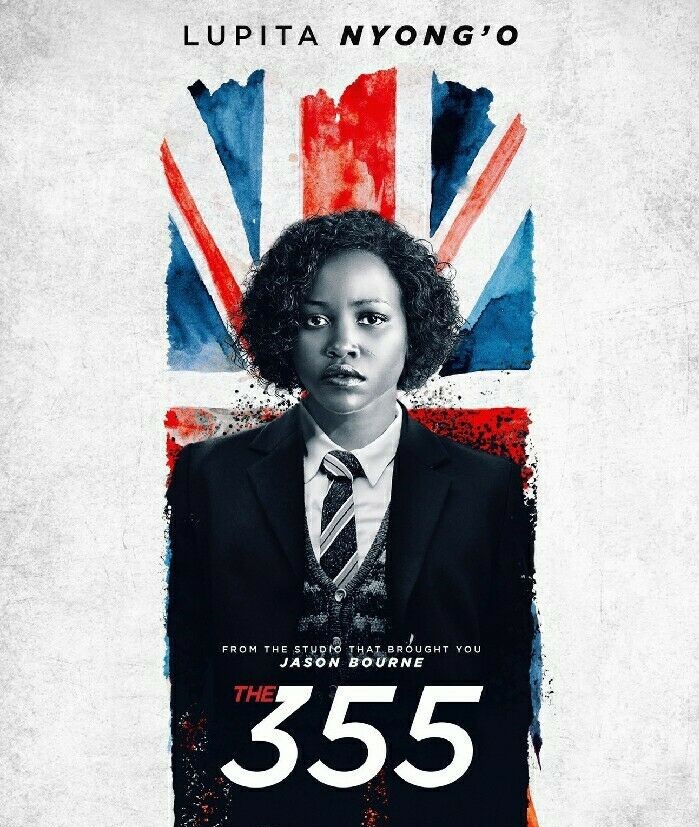
If I had been putting my money on anyone to take the action box office by storm it would be Diane Kruger who has the meanest stare this side of Lee Van Cleef. But she’s gone down this route to no commercial response before in The Operative (2019) and The Infiltrator (2016), neither fulfilling the promise she showed in Liam Neeson crackerjack Unknown (2011). Bingbing Fan, (Cell Phone 2, 2019) another X-Men alumni, has only recently achieved box office success, but in limited markets. Mexican Oscar-winner Lupita Nyong’o – here billed fourth and sporting a British accent – may well have the biggest fan base of the lot having clocked up appearances in three Star Wars pictures, taken top billing in Us (209) and third billing in Black Panther (2018).

But back to our story. On the run from the C.I.A. Mace (Jessica Chastain) teams up with Marie (Diane Kruger), a loner working for the German secret service, and Khadjiah (Lupito Nyong-o), a digital wizard formerly of the British secret service. Bing, who turns up later, represents the Chinese good guys. Graciela (Penelope Cruz) is the rank outsider, a therapist just caught up in the shenanigans. The action rattles through Paris en route to Marrakesh before a final stop in Shanghai. As you might expect, traitors lurk in various corners.

There are plenty shootouts and opportunities for the team to show off their hand-to-hand skills, but the action is slowed down by soap opera, having to spell out all the backstories of the principals, only one of whom, Marie, has anything worth listening to. Far be it for me to complain about too much emotion, but it took us over a dozen movies to learn anything significant about James Bond’s past, Bourne had no idea who he was, and at the other end of the scale Bryan Mills was so emotionally driven from the outset it formed the film’s core. Here, emotional quandary pops up when convenient. A bit of mystery would have helped more and cut a good 15 minutes off an overlong playing time.

As to the title, that is the only thing that is kept hidden to the end and when the revelation is made you realize it won’t mean a damn thing to the vast majority of the audience. As an origin story, I doubt the current box office receipts are sufficient to spawn future episodes. Which is a shame because having dumped all the emotional baggage in this picture, the characters could have focused more straightforwardly on action and story in the next.

Sebastian (1968) ***

Decoding the emotional life of mathematics professor Sebastian (Dirk Bogarde) lies at the heart of a spy thriller mainlining on loyalty and trust. The presence of a flotilla of potential Bond girls has opened this picture up to charges of being a spoof, but I saw the mini-skirted incredibly-bright lasses as being a reversal of the standard secretarial pool. And a supposed  representation of the “Swinging Sixties” would hold true if shot in the environs of Carnaby St  rather than the bulk of locations being arid high-rise buildings. 

In roundabout fashion, intrigued after literally bumping into him in Oxford, Rebecca (Susannah York) is recruited into an espionage decoding department staffed entirely by gorgeous (but brainy) women. Among the older employees is chain-smoking left-winger Elsa (Lili Palmer) whom security chief General Phillips (Nigel Davenport) suspects of passing on secrets. When romance ensues with Rebecca, Sebastian dumps dumb pop singer girlfriend Carol (Janet Munro) who is already having an affair and spying on Sebastian.

Sebastian and girlfriend.

Although there is no actual beat-the-clock codes to be unraveled, tensions remains surprisingly high as in the best Alan Turing/Bletchley manner, breakthroughs are slow. There’s an undercurrent of electronic surveillance, eavesdropping on recruits, bugs planted in the houses of even the apparently most trusted personnel, seeds of distrust easily sowed, codes shifting from numbers to sounds.  The occasional nod to the contemporary, a disco, pop songs, Rebecca doing a fashion shoot in the middle of traffic, is background rather than center stage.

Sebastian, though worshipped by is female staff, is “more whimsical than predatory.” Nonetheless, introspective and often morose, unable to deal with emotions, it falls to Rebecca to take on the task of sorting him out which naturally leads to complications.

Most reviewers at the time complained it was a victory of style over substance, but somehow they managed to overlook the essential questions about trust the picture asked. That said, it does follow an odd structure, the third act dependent on directorial sleight-of-hand.

Rather unique meet-cute: Sebastian, all set to attend a function at Oxford University,
gives Rebecca a word-game test.

Dirk Bogarde (Accident, 1966) is always highly watchable and Susannah York (The Killing of Sister George, 1968) Rebecca catches the eye with an  impulsive, slightly kooky character who turns out to be down-to-earth. Nigel Davenport (The Third Secret, 1964) bring his usual cynical malevolence to the party but with the twist of not knowing whose side he is really on. John Gielgud (The Shoes of the Fisherman, 1968) is a delight. There’s a brief appearance by a pipe-smoking Donald Sutherland (The Dirty Dozen, 1967). Janet Munro (Bitter Harvest, 1963) decidedly rids herself of her Disney persona. Miss World Ann Sidney is one of “Sebastian Girls”

In his second picture after The Shuttered Room (1967) David Greene’s direction is mostly competent but the opening aerial tracking shots set the precedence for occasional bursts of style.  Jerry Fielding supplied the score.

Another freebie on Youtube.

Discover WordPress

A daily selection of the best content published on WordPress, collected for you by humans who love to read.

The Atavist Magazine

by Brian Hannan

WordPress.com Blog

News, Tips & Website Tutorials