Book Into Film – A Girl Called Fathom by Larry Forrester (1967) ***

The blurb gives the game away. The British paperback published by Pan went: “She was blonde. She was beautiful, she was six foot tall. She’d killed the man who had dragged her to the lowest depths of addiction and lust.” The American Fawcett Gold Medal paperback was more succinct: “lady by birth, tramp by occupation and murderess by design.”

If any of that rings a bell, it was not from the film Fathom (1967) starring Raquel Welch which chose to ignore her background and her venomous skillset. The novel opens with the heroine killing a man in cold blood. He had promised her a film career but turned her into a call girl and heroin addict. Her father, now dead, was in the British secret service.  Once she has committed her first murder, she is immediately kidnapped by a secret organization (C.E.L.T.S. – Counter Espionage Long-Term Security) and trained to become an even more ruthless government-sanctioned killing machine.

Larry Forrester was a Scottish television scriptwriter who had worked on a stack of British series such as Whirligig (1953), Ivanhoe (1958) and No Hiding Place (1960-1964) before publishing his first novel A Girl Called Fathom. His sole screenplay was Tora! Tora! Tora! (1970) after which he concentrated on U.S. television including episodes of Fantasy Island (1980-1983) and Hart to Hart (1983-1984).   

A Girl Called Fathom is split into two. Comprising roughly two-fifths of the book, the first section concentrates on her brutal training and on getting her off drugs. There’s a fair amount of sexual intrigue not to mention sex. But also a lover’s betrayal.  For the final part of her training she is abandoned in the middle of nowhere in scorching heat and barely makes it home. “She had passed over a great divide. She was empty, hard – dehumanized. Alone. She would always be alone.” And then she is forced to kill again.

As was common with this kind of book in the 1960s, it was fast-moving and globe-trotting with plenty of realistic detail to offset the preposterous plot. For the remainder of the book, which shifts location to Europe, Fathom is up against an organization called W.A.R. (World of Asian Revolution) which aims to destabilise the existing world order. Her arch enemy is an American-born Soviet agent (and whip and knife expert) Jo Soon (who turns up in the film Fathom in slightly different form as Jo-May. Fathom’s team must protect French elder statesman Paul-Auguste Valmier whose playboy son Damon (who fantasizes about burning people alive), a friend for her past, is her main contact.

British paperback.

The book is peopled by interesting and occasionally outrageous characters – for example Tin, who has hardly a human bone left in his body; the far-from-harmless Aunt Elspeth; and a sadistic colleague who loves her but dare not let his emotions out lest he loose on her his love of pain. The central plot is driven by a mass of twists and turns, heroine endangerment, fights with knife and gun and fist, traitors (naturally) and the clever idea of killing off the leaders of the free world with a bomb hidden in the coffin of a man worthy of a state funeral being held in Paris.

At the end she is counting the human cost of victory and sees herself as one of the walking wounded, a reject, driven from the herd.

The film Fathom was apparently based on an unpublished sequel so it’s conceivable that the plot concerning the Chinese heirloom was pulled from that in its entirety. But even so the film’s heroine was neutered, not a patch on the ruthless killer with a sordid past outlined in A Girl Called Fathom.

A review of Fathom (1967) was published in tandem with this.

Fathom (1967) ***

If audiences rallied to the sight of Raquel Welch wearing nothing more than a fur bikini for the entirety of One Million Years B.C. (1966) and a skin-tight suit in Fantastic Voyage (1966)  Twentieth Century Fox must have reasoned they would surely return in droves were the star to spend most of Fathom in a succession of brightly-colored bikinis.

Given such a premise who would care that a sky-diving expert was named after a nautical measurement? Or that Welch came nowhere near the height indicated by her name? Or that  the character as described in the source material (a novel by Scottish screenwriter Larry Forester) had a distinctly harder edge; murder, sex and drugs among her proclivities.

With Our Man Flint (1966), the studio had successfully gatecrashed the burgeoning spy genre and spotted a gap in the market for a female of the species, hoping to turn Modesty Blaise (1966) starring Monica Vitti and Fathom into money-spinning series. The Fathom project was handed to Batman, The Movie (1966) co-conspirators, director Leslie H. Martinson and screenwriter Lorenzo Semple Jr. (Flash Gordon, 1980).

Female independence was hard-won in the 1960s and there were few jobs where a woman was automatically at the top of the tree. Burglary was one option for the independent entrepreneur (see The Golden Claws of the Cat Girl) and sport was another.

Richard Briers perhaps contemplating The Good Life.

Welch plays an innocent bystander recruited for her top-notch sky-diving skills (her aptitude demonstrated in the opening sequences) to help British intelligence recover the “Fire Dragon,” a trigger that could explode a nuclear bomb. That turns out to be baloney, of course, a MacGuffin to point her in the direction of a valuable Chinese heirloom. And then it’s case of double-cross, triple-cross and whatever cross comes next. Anthony Franciosca, still a rising star after a decade in the business, who receives top billing, doesn’t appear for the first twenty minutes. And then he behaves like a walking advert for dentistry, as though his teeth can challenge Welch’s curves.

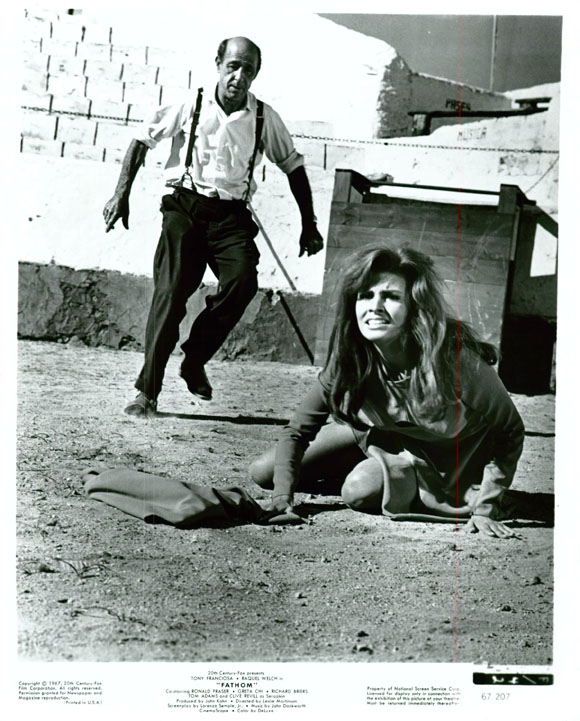
There’s an intriguing mystery at the heart of this picture and a couple of top-class hair-raising moments. In one she is trapped in a bull ring and stunt double Donna Garrett had a few very definite close calls trying to avoid the maddened beast. In another she is stalked at sea by a circling motor boat while being peppered with harpoons. There is also an airplane duel and a ton of great aerial work. A couple of comic sequences are well wrung – Ronald Fraser as the spy chief pins his business card to one of the prongs of a pitchfork being brandished with menace by Welch while Franciosca delivers a classic line: “The only game I ever lost was spin the bottle and that was on purpose.”

Raquel Welch surviving a close encounter with a bull.

The biggest problem is that the film veers too far away from the source material which posited the heroine as a much tougher character, one who can despatch bad guys with aplomb. Instead, Welch is presented almost as an innocent, bundled from one situation to another, never taking charge until the very end. Minus karate kicks or a decent left hook, she is left to evade her predators by less dramatic means. She has a decent line in repartee and by no means lets the show down. However, the idea, no matter how satisfactory to her fans, that she has to swap bikinis every few minutes or failing that don some other curve-clinging item, gets in the way of the story – and her character.

There’s no doubt Welch had single-handedly revived the relatively harmless pin-up business (not for her overt nudity of the Playboy/Penthouse variety) and had a massive following in Europe where she often plied her trade (the Italian-made Shoot Loud, Louder…I Don’t Understand in 1966 and the British Bedazzled in 1967) but she was clearly desperate for more meaty roles. Those finally came her way with Bandolero (1966) and 100 Rifles (1969) and Fathom feels like a lost opportunity to provide her with that harder edge.  

She’s not helped by the odd tone. As I mentioned she gets into plenty of scrapes and proves her mettle with her diving skills but some of the supporting cast look like they’ve signed up for a completely different movie. Richard Briers – Ronald Fraser’s intelligence sidekick – looks like a goggle-eyed fan next to Ms Welch and Clive Revill thinks it’s a joke to play a Russian as a joke. In the hands of a better director and with a few tweaks here and there it could have been a whole lot better and perhaps launched a spy series instead of languishing at the foot of the studio’s box office charts for that year.  

But it is certainly entertaining enough and you are unlikely to get bored.

See the “Book into Film” section for a review of the source novel A Girl Called Fathom.

What the Exhibitor Did

Movie studio publicity teams bombarded exhibitors with gimmicky promotions via the Pressbooks used to publicize movies. Some of the ideas were so outlandish it is easy to imagine that exhibitors’ eyes glazed over at the prospect.

But that would be to misunderstand the character of the cinema manager/owner on the 1960s. They often referred to themselves as “showmen” (ignore the gender slip) because they saw themselves as hustlers of the old school, required to come up with all sorts of schemes to ensure moviegoers were aware of what was showing.

So they weren’t short of coming up with their own ideas.  To promote Billy Wilder comedy The Apartment (1960) with Jack Lemmon and Shirley Maclaine, Loews State in New Orleans set up a replica three-room apartment within the Hurwitz-Minze furniture store in the city. A female model was hired to live there for a week during opening hours. She cooked, washed dishes, watched television and listened to records. “Her daytime routine was complete even to changing her clothes – behind a screen, of course.” The store advertised her presence daily and explained why there was model in the window. The Monteleone Hotel joined in the promotion by providing the model with free accommodation.

Handcuffs were handed out to customers going in to see Psycho (1960) at Proctor’s Theatre in Schenectady, New York, on the basis that it would be advantageous for patrons to handcuff themselves to their seats in case nerves got the better of them and they tried to dash out before the end.

Of course, that was a long way from offering patrons a dead body, raffled off in the intermission between the movies on a midnight horror program, as carried out by the Super 422 Drive-In in Pittsburgh. A dead body was given away – it just turned out to be a turkey.

Exhibitors pushing a horror picture might plant a coffin in the lobby – more effective if there was a hand sticking out – or, as indicative of the terrors that lay ahead, have a white-coated nurse prominently positioned or park an ambulance outside. Certificates of bravery might be issued to attendees.

To promote Macumba Love (1960) – starring Ziva Rodann from The Giants of Thessaly – which featured cannibals and shrunken heads, Loews State in Cleveland put their own shrunken head on display in the lobby behind reducing glass which made it seem even smaller.   

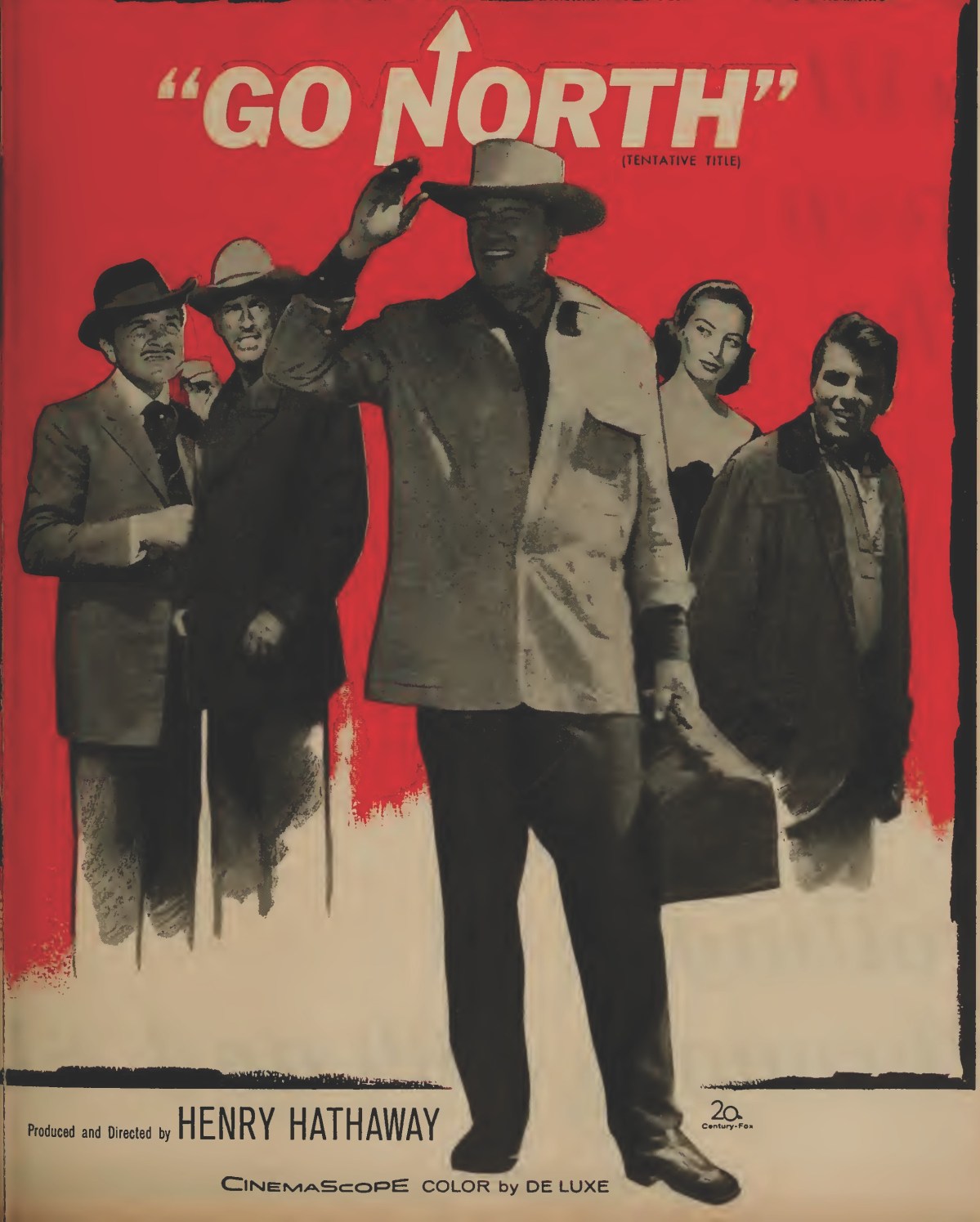
Love takes people the strangest places. Two cycling enthusiasts planning to get married were persuaded by Twentieth Century Fox to travel from New York to Juneau, Alaska, a mere 4,776 miles to promote john Wayne picture North to Alaska (1960).They were paid, of course, and had the honor of being married by the Governor of the state, William Egan. They passed through a hundred towns and cities, stopping off to talk to interested media about their unusual adventure and, in case anyone missed the point, their bikes were plastered with publicity material for the film.

SOURCES: “The Midnight Show,” Box Office, Aug 1, 1960, p64-65; “Girl Keeps House in Window for a Week Prior to Opening of The Apartment,” Box Office, Aug 8, 1960, 118; “Handcuffs Go to Patrons in Advance of Psycho,” Box Office, Oct 3, 1960, 103; “Couple in Bicycle Trip North for To Alaska,” Box Office, Nov 14, 1960, 73.

The Golden Claws of the Cat Girl / La Louve Solitaire (1968) ***

Unless you were a fan of the more permissive pictures at the end of the 1960s or kept a close eye on the gossip columns – or for that matter Playboy magazine – you were unlikely to have come across slinky blonde Daniele Gaubert. A former teen model and supporting actress in a number of French and Italian films at the start of the 1960s, she had a brief brush with Hollywood as Yul Brynner’s girlfriend in United Artists’ Flight from Ashiya (1964) but then married Rhadames Trujillo, son of the Dominican Republic dictator. The year after The Golden Claws of the Cat Girl she starred in Radley Metzger’s provocative Camille 2000 which set pulses racing especially at the censor’s office. Then marriage beckoned again, this time to French Olympic triple gold medallist skier Jean-Claude Killy with whom she made her last picture The Snow Job (1972) also known, depending on where you lived, as The Ski Raiders and The Great Ski Caper.

She only made eighteen movies but The Golden Claws of the Cat Girl is by far the standout. A taut thriller with plenty of twists and stylish action scenes, the French-Italian co-production  was the only film of documentary film maker Edouard Logerau and that background helps shape the movie with many of the most thrilling sequences lacking musical accompaniment.

Female empowerment is not normally associated with crime, given that organized crime is generally organized by men. But burglary is a different matter, lending itself to non-gender-specific individual enterprise. Though there are safes to break, there’s no glass ceiling in this brand of thievery.

Gaubert plays a cat burglar ironically known as “the lone wolf” (as in the original title) who is forced to trade her freedom by stealing a cache of drugs for the police in order to apprehend a criminal mastermind (Sacha Pitoeff). (Maybe this notion inspired Luc Besson’s Nikita.)  Her sidekick is Michael Duchaussoy, seconded from his usual job as an embassy press attache, on the grounds that he can lip-read (which proves more than a gimmick as the plot unfolds).

Given that this was all shot “in camera” – Christopher Nolan’s favourite phrase – without the benefit of CGI or, so it would appear, much in the way of bluescreen, the burglary scenes are pretty impressive. For a kick-off, Gaubert is a sexy as you can get in a skin-tight cat-suit. Furthermore, her character calls on skills from her previous occupation as a trapeze artist. While the director doesn’t match Hitchcock’s in the tension-racking stakes, the sheer verve of the burglary takes the breath away. The first burglary – before she is caught – takes place at a fancy chateau where a party is in full swing (owners in residence less likely to take extra precautions to hide their valuables), Gaubert nips over a wall, slips up a tree,  uses a line thrower (a type of harpoon) to connect tree to building, and then proceeds to walk along the tightrope. Mission accomplished, she zooms off in a sports car, only stopping to remove false tyre treads and strip out of her costume before hiding her ill-gotten gains in a secret compartment at the back of the fridge.

High-wire act for the first burglary.

The police burglary is in an office block. She and the lip-reader are holed up in an apartment opposite watching via a telescope. Although they pass the time in gentle flirtation, especially as she favours revealing outfits, she is not quite as imprisoned as it might seem and is already hatching her own plans to outwit her captors. This burglary is even more dangerous, in the pouring rain for a start, across Parisian rooftops, and involving a trapeze and ropes.

Thereafter, plot twists come thick and fast after this. She escapes to Switzerland, pursued by lip-reader (to whom she has clearly formed an attachment), cops and furious drug runners. Eventually re-captured she agree to another official burglary as a way of finally trapping Mr Big.

The tone is lightened by repartee and some interesting characterization. The lone wolf turns out to have very strong principles that prevent her just running off. Mr Big is a stamp aficionado. A lava lamp is turned into a weapon. Instead of counting to five before killing someone, a bad guy does the countdown according to the number of people diving into a swimming pool. Gaubert fools her captors into thinking they have a flat tyre by dangling her handbag over the edge of the door until it bumps into the tyre and makes the thwock-thwock of a burst tyre. “Survivors give me goose flesh,” quips a thug.

The closest comparison is not Hitchcock but Danger: Diabolik (1968) featuring John Philip Law which has a definite comic book riff. And you might also point to Joseph Losey’s Modesty Blaise (1966) or even, for a self-contained independent woman, to Raquel Welch’s Fathom (1967. But this lone wolf is ice-cold. Blonde is not enough. She is one step ahead of the law and the criminals. There are hints of a tragic past – a trapeze artists requires a partner, for example.

Chase across the rooftops of Paris for the breathless finale.

The last shot has Genault triumphant on a Paris rooftop. There is a nod to Hitchcock (think Rear Window) in the use of a telescopic framing device for many scenes, giving them a voyeuristic aspect. Sure, a bigger budget and a better supporting cast – and perhaps a more obvious romance – might have lifted the picture but Genault’s presence ensures that the film does not lack style. Definitely deserves a more appreciative audience.

The Southern Star (1969) ***

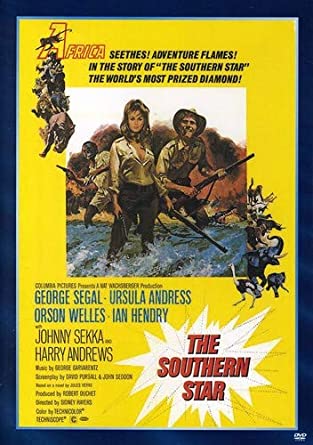
There’s a surprisingly good movie here once you strip out the cliché jungle stuff and the racist elements. The diamond of the title is actually a MacGuffin, just enough to get you started on two parallel tales of revenge.

George Segal is a mining engineer-cum-adventurer and Ursula Andress, daughter of mine owner Harry Andrews, as far from the traditional jungle heroine (except in one regard) as you could get. She saves him from crocodiles, rescues him from jail and quicksand, swims across a hippo-infested river and is a better shot than him (or anybody for that matter) with a rifle. This is female empowerment with a vengeance.

Suspected of stealing the diamond, he is hunted by ranger Ian Hendry, Segal’s love rival, who intends to win Ms Andress back using the simple expedient of killing the thief. Lying in wait is all-purpose rogue Orson Welles who seeks revenge on Hendry. The second unit had a whale of time filming anything that moved –  lions, leopards, zebras, giraffes, buffaloes, monkeys, antelopes, the aforementioned hippos and crocodiles and what looked like a cobra – and at one point everything does move in coordinated fashion if you can call a stampede coordinated.

But the main focus is an Ursula Andress who constantly confounds Segal’s sexist expectations. Docility is her disguise. Anytime she appears to be doing what she’s told you can be sure she’s planning the opposite. While Segal does have his own specific set of jungle skills, he often looks a fool. But they do make a good screen partnership and their dialogue is lively.

Hollywood spent millions of dollars trying to create screen chemistry between various stars and although it seemed to work very well in the industry’s golden age with Clark Gable and any number of MGM female stars, Bogart/Bacall and Tracy/Hepburn and I guess you could chuck John Wayne-Maureen O’Hara into that particular mix, the formula seemed to have gone awry by the 1960s discounting the Doris Day/Rock Hudson combo, big budget romances like El Cid (1961) and Doctor Zhivago (1965) and an occasional home run with whomever Cary Grant was romancing on screen. So it was usually hit-or-miss whether any sparks flew between the stars.

Andress had certainly been a European femme fatale par excellence as seen in Dr No (1962) and The Blue Max (1966), but it was certainly not a given that she would more than hold her own for an entire picture. Segal was nobody’s idea of a romantic leading man although the notion had been given a tryout in The Girl Who Couldn’t Say No (1968) with Virna Lisi. But here the whole enterprise works in an It Happened One Night vein with the supposedly superior male recognizing that perhaps his companion was more than a match.

Harry Andrews and Orson Welles both try to steal the picture, with polar opposite characterizations, Andrews loud and menacing, Welles soft and menacing. You can tell Scottish director Sidney Hayers (The Trap, 1966) was an editor because he cuts for impact and mostly does an efficient job of sticking to the story. Supposedly, Orson Welles directed his own scenes, but that might be to make sure he got to hog the camera. He has enough choice lines and bits of business to keep him happy and gives his venomous character a camp edge.

The casual, incipient, racism is harder to ignore. It is both verbal and physical with Johnny Sekka, Segal’s buddy, who actually has the diamond, bearing the brunt and being brutally whipped.

Despite my reservations, this is well constructed and keeps one step ahead of audience expectation with plenty twists to subvert those, although the music by Johnny Dankworth gets in the way, offering musical cues opposite to what is required.

As it is a jungle picture there is the obligatory heroine’s bathing scene – and to balance the books on that score Segal does whip off his shirt at one point. Except for the clichés, it would have gone higher in my estimation for by and large it is well done and Andress is once again (see The Blue Max) a revelation.   

Nun but the Brave

Setting aside its impact on popular culture and the Austrian tourist industry, The Sound of Music was also responsible for bringing nuns – an admittedly small sub-genre – back into fashion.

Of course, there had been some big hitters getting into the box office habit in the past, most notably The Bells of St Mary’s (1945) with Ingrid Bergman, Deborah Kerr in Black Narcissus (1947), Loretta Young in Come to the Stable (1949), Kerr again in a rather more resourceful mode opposite Robert Mitchum in war drama Heaven Knows, Mr Allison (1957) and Audrey Hepburn in The Nun’s Story (1958). All four actresses (Kerr in the second outing) were Oscar-nominated. But none of the films ushered in a rush of wannabes.

The Sound of Music was viewed as directly responsible for putting nine projects on the starting grid. Leading the charge was Debbie Reynolds as The Singing Nun (1966), MGM’s biopic of the Belgian sister Dominique whose records topped the charts. Columbia chipped in with The Trouble with Angels (1966), directed by Ida Lupino and headlining Rosalind Russell and Hayley Mills, which spawned a sequel also with Russell Where Angels Go, Trouble Follows (1968).

Both were neck-and-neck at the Easter 1966 box office, The Singing Nun having the edge in New York since it opened at the 6,200-seat Radio City Music Hall, where it set a new seasonal record, but the Russell-Mills vehicle more than matched it in other cities.

Nuns also featured in Billy Wilder comedy The Fortune Cookie (1966) with Jack Lemmon and Walter Matthau. Italian comedy The Little Nuns starring Catherine Spaak also benefitted from the upsurge of interest in nuns, earning a late November 1965 release when it was already two years old.

Also in the pipeline producer Ross Hunter was prepping The Heaven Train for Universal from a screenplay by James Lee Barrett (Shenandoah, 1965). Carlo Ponti had wife Sophia Loren in mind to star in Mother Cabrini, about the first American saint. Rhonda Fleming had been announced as the female lead for The Nuns in the Sports Car, an independent film to be made in Paris.

On the foreign horizon was French director Jacques Rivette’s La Religieuse (1966) – released in the United states as The Nun – starring Anna Karina. Luis Bunuel, who had already ventured into this territory with Viridiana (1961), was developing a Mexican picture also to be called The Nun. But La Religieuse hit censor trouble in France where it was initially banned but eventually set the box office wheels spinning at home and in the United States.

While Sally Fields in television’s The Flying Nun (1968) and the Russell Angels sequel kept the pot boiling, producers continued showing interest in films featuring nuns later in the decade. Two Mules for Sister Sara – written by Budd Boetticher and originally slated to be directed by him – was greenlit by Universal in 1967 although not hitting screen until three years later. Mary Tyler Moore played a nun opposite Elvis Presley in Change of Habit (1969) and Robert H. Solo signed a deal in 1969 to make The Devils for United Artists, although, that, too would take a couple of years to surface.

Note: not all these films finally saw the light of day – those with no year specified mentioned ended up shelved.

SOURCES: “Nuns Back In Film Fashion,” Variety, Dec 8, 1965, p11; “Films Sister Act: Or Nun-Such B.O,” Variety, Apr 20, 1966, 22; “Nun Might Go to Cannes,” Variety, Apr 20, 1966, 20;  “Beauregard’s Nun Gets Box Office Religion,” Variety, Sep 27, 1967, 18;  “Prostitute Pose: Nun Was Boetticher Screenplay and Now Universal,” Variety, Oct 4, 1967, 1; “Bob Solo’s 3 for UA,” Variety, Aug 20, 1969, 5.

Genghis Khan (1965) ****

Hollywood was never reined in by the strictures of history, much preferring fiction to fact for dramatic effect, and that’s largely the case here, although the titular hero’s real life remains shrouded in myth.

If you do catch this surprisingly good feature, make sure it’s not one of the many pan-and-scan atrocities on the market. I watched this in the proper Panavision ratio which meant it occupied only one-third of my television screen, but in that format it’s terrific. It’s a bit of an anomaly for a decade that churned out high-class historical epics like El Cid (1961) because this clocks in about a hour short of other films in the genre and there’s no star actor or director to speak of and no Yakima Canutt to handle the second unit action scenes.

Omar Sharif’s marquee value at this point was so low that if you check out any of the original posters you’ll note that his name hardly rates a mention and he also comes at the very end of the opening screen credits. Although this is post-Lawrence of Arabia (1962), it’s pre-Doctor Zhivago (1965), suggesting nobody had a clue how to market his talents.

Director Henry Levin was a journeyman, fifty films under his belt, best known for not a great deal except for, following this, the second and third in the Matt Helm spy series. Given this film was critically ignored on release and since, and a flop to boot, it definitely falls into the “Worth a Look” category. Although there are few stand-out scenes of the artistic variety such as pepper Lawrence of Arabia or El Cid, this is still well put together and Levin shows an aptitude for the widescreen.

The narrative breaks down into three parts – the first section describing Sharif’s enslavement by nemesis Stephen Boyd (the picture’s star according to poster and screen credits) before banding together rival tribes in revolt, the second part a long trek to China, and the third encompassing a final battle and hand-to-hand combat with Boyd. For a two-hour picture it has tremendous sweep, not just the scenery and the battle scenes, but political intrigue, romance, a rape scene and even clever comedy. Sharif is excellent as a leader who believes his glory is predestined, but who has very modern ideas about the role of women.

The best section, oddly enough, is set in China where Sharif engages in a duel of wits with Robert Morley’s distinctively contradictory emperor, but that’s not to detract from the film’s other qualities, the action brilliantly handled, especially the chaos of battle, the romance touching, and the dialogue intelligent and often epigrammatic. Unlike James Mason who makes a calamitous attempt at a Chinese accent, Morley, costume apart, looks as if he has just walked out of an English country house, but his plummy tones belie a very believable character. Telly Savalas and Woody Strode have decent parts as Sharif’s sidekicks, the former unexpectedly bearing the brunt of the film’s comedy. French actress Francoise Dorleac is effective as Sharif’s wife.

Hitchcock stole one of his most famous ideas from Genghis Khan. About the only scene in Torn Curtain (1966) to receive universal praise was a killing carried out to a soundtrack of nothing more than the grunts of assailant and victim. But, here, where the score by Yugoslavian composer Dusan Radic was extensively employed, the rape scene is silent and just as stunning. If the only prints widely available are of the pan-and-scan variety I’m not surprised the film has been for so long overlooked, but if you can get hold of one in the preferred format you will be in for a surprise.      

In the News – August 1960

CLEOPATRA VERSION ONE

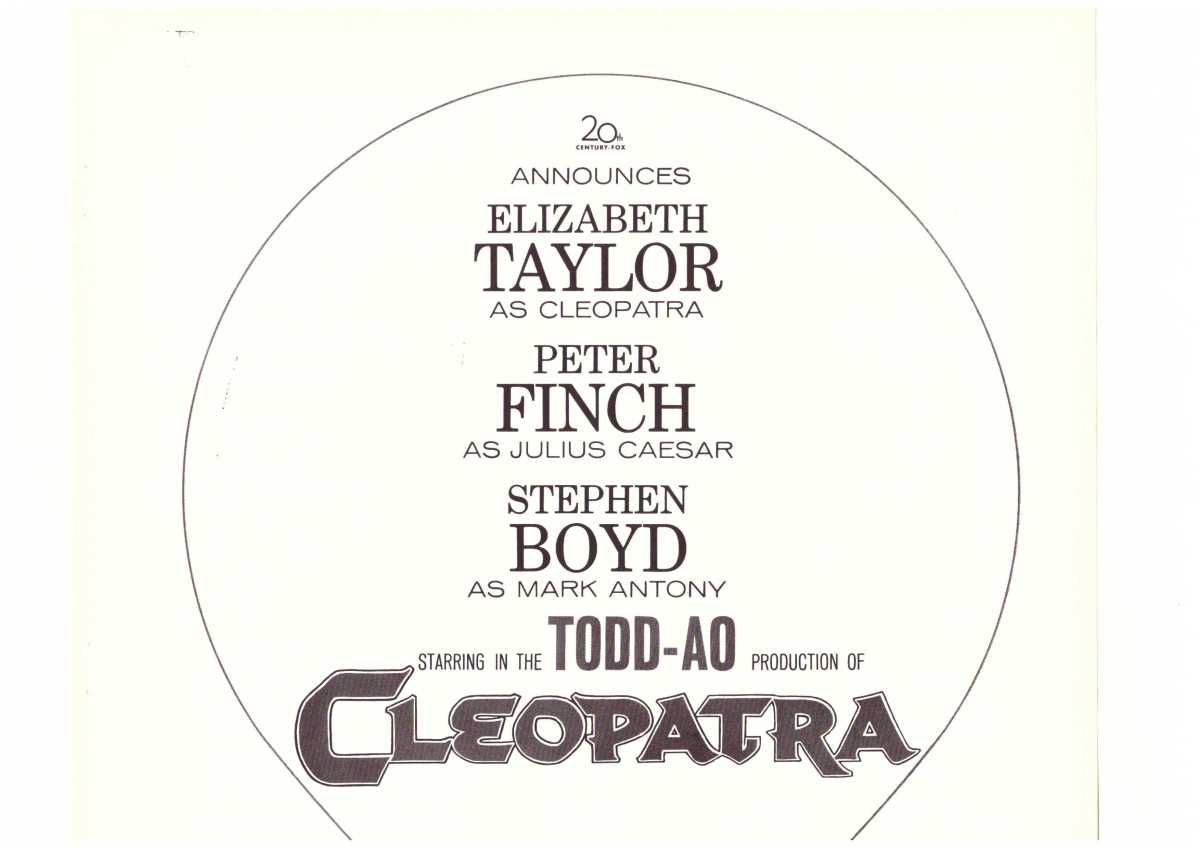
Producer Walter Wanger headed for Britain to oversee the start of production for Twentieth Century Fox’s Cleopatra. Before the movie was bogged down in illness and budget scandals, Elizabeth Taylor’s co-stars in this initial version were Stephen Boyd, fresh from Ben-Hur, and Peter Finch.  Wanger was mulling over taking the production to Egypt where he also intended to film the adaptation of Lawrence Durrell’s Justine. Rouben Mamoulian was the director of Cleopatra. Durrell had written the screenplay for this version. Fox was promising the movie would be on screens in June 1961. Joseph L. Mankiewicz, at this point down as writer of Justine, would later end up in charge of Cleopatra version two with Richard Burton and Rex Harrison replacing Boyd and Finch.

HITCHCOCK FESTIVAL

Although Alfred Hitchcock Festivals would become one of the major reissue talking points of the 1980s and while Rebecca (1940) had been successfully revived in the 1950s, the director’s first major commercial – as opposed to arthouse – retrospective was in the planning stage courtesy of David O. Selznick. He had in mind a rotating double bill based around three features to which he owned the rights – Spellbound (1945) with Ingrid Bergman and Gregory Peck, Notorious (1946) with Bergman and Cary Grant and The Paradine Case (1947) with Peck and Ann Todd. The project would be marketed as an “Alfred Hitchcock Festival.” Interest in the director was at all-time high after the double whammy of the previous year’s North by Northwest and current box office sensation Psycho. The fact that all three movies had already been shown on television was not seen as a deterrent. Selznick aimed to use as a promotional tool that moviegoers could see the pictures without irritating commercial breaks and on a much larger screen than television would afford.

IN THE PIPELINE

Montezuma was scheduled as Kirk Douglas’s follow-up to Spartacus with a budget in excess of the $12 million spent on the slave revolt epic. John Huston would pen the script and director. Douglas would play Cortez with Marlon Brando being wooed for the title role… Darryl F. Zanuck was setting up The Day Christ Died based on the Jim bishop bestseller in competition to George Stevens’ planned The Greatest Story Ever Told… Steve McQueen was planning to make The Captain under his own production company with Henry Fonda and Ernest Borgnine playing major parts… In fact, only The Day Christ Died ever saw light of day and  then only as a television film in 1980.  

IN OTHER NEWS

Critic Bosley Crowther declared war on subtitles, an unusual move for a writer long considered a purist where foreign movies were concerned…Pope John XXIII ordered a permanent projection room with air conditioning to be installed in the Vatican on the third floor of the Apostolic Palace because he liked movies more than his predecessor…La Dolce Vita was the top grossing film of the 1959-1960 Italian season with $1.125 million, well ahead of the closest runner-up Some Like it Hot with $725,000…Universal ordered a record fifty 70mm prints for Spartacus…Charlton Heston was announced as El Cid for the forthcoming Samuel Bronston production…John Wayne held a sneak preview of The Alamo at the 900-seat Aladdin theater in Denver on August 5 with Can-Can kicked off the screen for the night…U.S. movie receipts were up for the first time in five years with the week of July 30 1960  the best since August 4 1956…In Britain, Hercules broke records in 36 of the 39 cinemas in its initial playoff.

SOURCES: “Wanger to Britain as Cleopatra and Justine Both May Shoot in Egypt,” Variety, Aug 3, 1960, p3; “Selznick Plotting Hitchcock Festival,” Variety, Aug 10, 1960, 7; “Kirk Douglas Outlines Plans for Mexican Biopic on Montezuma’s Life,” Variety, Aug 3, 1960, 4; “Zanuck Signs Gallico to Write The Day Christ Died,” Variety, Aug 10, 1960, 10; “Reisner-McQueen- Elkins Co-produce Captain,” Variety, Aug 17, 1960, 4; “Crowther’s Subtitles Must Go Stirs Trades, Uh-Huh but on the Other hand,” Variety, Aug 17, 1960, 4; “Vatican Getting Its Own Projection Room,” Variety, Aug 13, 1960, 13; “Italo Film in sharp Upbeat at ’59-’60 B.O.,” Variety, Aug 24, 1960, 11; “UI’s Big 70M Print Order for Spartacus,” Variety, Aug 24, 1960, 13; advertisement, El Cid, Variety, Aug 3, 1960, 16; “Wayne Sneaks Alamo,” Variety, Aug 10, 1960, 5; “Pictures $82,831,000 Take for Week Jul 30 Best Since Aug 4 1956,” Variety, Aug 10, 1960, 3; “Hercules Sets 36 New House Records out of 39 Spots in England,” Variety, Aug 10, 1960, 10.

Point Blank (1967)****

The Man With Half A Name doesn’t have quite the same ring to it as The Man With No Name. Lee Marvin’s professional thief Walker (first name absent) is a close cousin of the spaghetti western’s amoral gunslinger. But where Leone is disinclined to fill in the emotional blanks in his anti-hero’s story, British director John Boorman, making his Hollywood debut, feels obliged to look for redemptive features in keeping with American tradition.

Along with several unnecessary arty elements, that gets in the way of a brilliant character portrait. The movie also suffers from critical assessment, not in the manner of bad reviews, but from an irrelevant and misleading insistence on discovering  the film’s “true meaning.”

However, where Boorman gets it right, the movie is a cracker. The bursts of brutal explosive violence still shock, Walker a force as unstoppable as The Terminator, while representing the Mafia as a faceless corporation is a stunning concept. Walker refuses to recognize the dictum that there is no honor among thieves and expects repaid the money stolen from him by a Mafia henchman. In his mind payment will come either in cash or retribution. There is double-crossing aplenty, but Walker is ready for it.

Boorman’s palette is fascinating, the grey bleakness of early scenes giving way to yellow (even the pillar in a parking garage is painted yellow) and other colors. And he has learned from Hitchcock how to apply silence and use natural sound effects like footsteps.

But there are some changes to Richard Stark’s original novel that the movie can do without. The introduction of the abandoned Alcatraz, for a start, is an illogical nonsense, cinematically stylistic though it is. Walker, as shown in the original novel is far too clever to allow himself to be led to a place so open to ambush. Nor would he allow himself to be emotionally blackmailed into doing the job that caused the trouble; he would have walked away from someone as unstable as the double-crossing Mal Reese (John Vernon).

The ambiguous ending, where Walker appears to fade away, issues unresolved, also attracted odd critical theories when, having spent ninety minutes demonstrating the gangster’s destructive capacity, it seems more likely to me that the two Mafia gents left alone with him on Alcatraz would be in the greater peril.

That said, the rest of the picture has an inbuilt dynamic and Marvin’s laconic menacing performance is mesmeric. By comparison Major Reisman in The Dirty Dozen was garrulous. The original novel was called The Hunter and Walker ruthlessly stalks his prey even though they are some of the most dangerous men alive. Angie Dickinson is dropped in to provide some emotional core and a scene of him as a younger man courting his wife is along the same lines. Ignore the arthouse elements and run a mile from critical theories and you are in for one hell of a ride.    

The “Psycho” Revolution

It wasn’t just that Alfred Hitchcock broke all the rules in Psycho, turning horror on its head with the shower scene, introducing themes like mother-fixation and cross-dressing and delivering the first bona fide serial killer to American audiences.

He also took on the exhibition business by insisting that nobody was allowed into theaters after the film had started.

This went completely against the way films were normally shown. Patrons were accustomed to entering a movie theater whenever they liked, be it beginning, middle or end and then staying on till they came to the section they had seen before. Hitchcock was effectively calling an end to this practice.

Exhibitors were so used to customers going to the movies as a matter of course, as a regular habit, that few cinemas outside of arthouses and those in city centers even bothered to list start times. Although tacitly endorsed by exhibitors, this system was a menace to business since there was no way of knowing how many people were likely to vacate their seats at any given time and the fact that they did so intermittently interrupted the viewing of those still watching the picture.

Exhibitors were already investigating new methods of keeping their customers, including setting up their own production companies and buying up old films to present as reissues to make up for the shortage of new movies.

The Psycho “see it from the beginning” gimmick was initially viewed as exactly that – a gimmick. But when customers obliged without any particular fuss, standing patiently in line in the lobby or outside while one show vacated, this seemed to many indicative of a change in audience perspective. Many exhibitors wanted to take advantage of the potential to change moviegoing habits.  

“A new concept in motion picture promotion – building appreciation of the merchandise by customers – is being undertaken by segments of the industry,” said Hy Hollinger in Variety. “The idea involves a revolutionary change in the presentation of films in theaters with the industry engaging in a vast educational campaign to indoctrinate the public.”

“The public must be taught to accept starting times,” became a mantra. A more orderly approach would lead to greater appreciation of the films being screened. For once, America wanted to follow the Europe. A system of fixed schedules operated in Europe.

There were already “significant signs that the public prefer to see pictures from the beginning.” Exhibitors had registered more telephone calls asking about start times and more tickets were being sold just prior to the film beginning.

The Psycho sensation had kicked off another experiment. The film was being shown in New York nabes concurrent with its ninth week in first run at the DeMille and Baronet theaters in Manhattan. Usually, films were clear of first run commitments before launching on the circuits.   

And there were yet other changes afoot. Two circuits in New York – Loews and Century – had shifted back the start time of the main feature from 10pm by an hour or more, in the case of Century to a fixed 8.40pm which allowed moviegoers to get home in time for the eleven o’clock news. New York also led the way in combining first run in big Broadway houses with a concurrent booking in an eastside arthouse – Sons and Lovers (the only genuine arthouse offering), Psycho and Portrait in Black among those benefitting from the practice.

In addition, Psycho was considered responsible for another psychological phenomenon. It was asserted by Paramount publicists that the long lines of people standing outside the theater waiting to see the film “plants in people who had no desire to see the picture the seeds of desire to do so.”

Eroding the double bill mentality was also seen as a way of setting a more rigid approach of start times. The double bill was already under pressure because the number of movies being made was much lower than a decade before. Some theaters had taken to augmenting a single bill with a 30-minute short rather than a full feature.

Arthouse audiences had already accepted that the price of their ticket entitled them to only one movie, not two. Single bills allowed a theater more showings during the day, thus increasing potential receipts. When Psycho went into the circuits it was as a single bill with five or six showings scheduled.  

The roadshow was still in its infancy, Ben-Hur and a handful of other films leading the way, although spectacles like Spartacus, Exodus and The Alamo were on the horizon. Roadshows were presented as separate performances so no waste of seating capacity.

Roadshows and a film like Psycho had something else in common that augured well for a future where “grind” was eliminated. People accepted separate performances for roadshow or an uncommonly attractive feature like Psycho because they wanted specifically to see those particular pictures, not because they routinely went to the movies with little regard for what was actually being shown.

In just 38 weeks in a limited number of theaters presenting the picture in a limited number of showings at a set start time, Ben-Hur had already taking $7 million at the box office.  At Loew’s State in New York it had rolled up $1.2 million, in Los Angeles crossed the million-dollar mark and close to that figure in Boston, Chicago, Philadelphia and San Francisco. Psycho was on the way to being one of the biggest grossers of the year.

With Hollywood still battling the encroaching threat of television, and television beginning to snare the first tranche of 1950s movies, it appeared that exhibitors had found a way of guaranteeing survival. But whether these new ideas would be sustained was another story.

SOURCES: Hy Hallinger, “1960 Reasoning: Teach Appreciation, Prepare Public for Single Feature European-Style Fixed Schedules,” Variety, Aug 3, 1960, p3; Brian Hannan, In Theaters Everywhere, A History of the Hollywood Wide Release 1913-2017 (McFarland, 2019), 117-134; “May Shift Main Feature Hour,” Variety, Aug 10, 1960, 13; “Gotham Playoff Revolution,” Variety, Aug 10, 1960, 13; “Re Broadway & Eastside Day-Dating,” Variety, Aug 10, 1960, 13; “Is a Queue Itself Best Form of Sell?,” Variety, Aug 10, 1960, 13.  

Discover WordPress

A daily selection of the best content published on WordPress, collected for you by humans who love to read.

The Atavist Magazine

by Brian Hannan

WordPress.com Blog

News, Tips & Website Tutorials