You wouldn’t figure director Henry Hathaway for a caper movie. He seemed more at home with action, whether that be war (The Desert Fox, 1951), adventure (Legend of the Lost, 1957) or western (Nevada Smith, 1966) although he was a dab hand at film noir (Kiss of Death, 1947). And before the big-budget all-star Oceans 11 entered the equation in the same year as Seven Thieves – and stole much of its thunder – the heist movie ran mostly on B-movie steam such as Rififi (1955), The Killing (1956) and Big Deal on Madonna Street (1958).
And probably judged against other glossy efforts of the 1960s like Topkapi (1964) and Gambit (1967) Seven Thieves would appear on the surface to come up a bit short. No doubt accounting for it being so under-rated. But while this is in itself a neat little thriller the kick comes in the emotional entanglements and a succession of twists at the end that sends it in my book into a higher category.
And it’s so outrageously clever that the mystery of why French-based criminal mastermind Theo Wilkins (Edward G. Robinson) would reach out across the Atlantic Ocean to recruit former jailbird Paul Mason (Rod Steiger) to spearhead the heist of a cool four million dollars from a Monte Carlo casino is not resolved until the end, and in spectacular fashion.
Technically, there are actually only six thieves, the other is an inside man, Raymond (Alexander Scourby), who has fallen for the seductive charms of nightclub dancer Melanie (Joan Collins). Making up the rest of the septet are safe cracker Louis (Michael Dante) and muscle-cum-driver Hugo (Berry Kroeger) with Poncho (Eli Wallach) playing the key role of the pretend crippled, arrogant, irascible millionaire – and contrary to the claims of one poster he is the decoy not Melanie.
Distrust of his team makes Theo bring in Paul, who ruthlessly knocks them into shape, putting into seamless action the plan devised by Theo. Simply put, Poncho is going to act as a distraction by having a heart attack at the gambling table while Paul and Louis climb out a window along a ledge to the casino director’s flat which provides, by means of an elevator, direct access to the underground vaults. Once they’ve stolen the cash, they clamber back along the ledge and hide in the flat where, by this time, Theo, playing the role of Poncho’s personal physician, has taken him. The money will be hidden in Poncho’s wheelchair and removed to a waiting ambulance.
But Paul is a rather suspicious character and wants to know what he’s letting himself in for so in turn works out the weaknesses of his team. Melanie hides behind a façade of high birth, Pancho is too reckless, “measuring danger only in terms of profit,” Hugo prone to unnecessary violence, while Louis has omitted to mention he is terrified of heights, the ledge on which the operation depends standing on a 100ft high cliff.
In some posters, this was promoted as Al Capone (Steiger) vs Little Caesar (Robinson).
The plan relies on Poncho actually appearing to be dead, so dead that the casino director (Sebastian Cabot) will not hesitate, at Theo’s insistence, to shift him out of sight of the rest of the gamblers into his flat. But Complication No 1 is that Poncho doesn’t want to be dead, even if it is a ruse, skeptical of Theo’s plan to convincingly knock him out by means of a carefully measured dose of cyanide. Complication No 2 is that a night club client recognizes Melanie and casts doubt on her credentials as a lady of quality. Complication No 3 is that English physician Dr Halsey (Alan Caillou) questions whether Poncho is as dead as he seems.
But such complications are nothing compared an extraordinary range of twists that raise tension sky-high at the movie’s denouement. I challenge you to guess what these three superbly-conceived twists would be, all of them one by one turning the project on its head, and it rapidly shifts from one direction to another, ending with an unbelievable – and yet so in keeping with the premise – climax.
Attention to character detail lifts this out of the rut, whether it be Theo’s penchant for collecting seashells, Paul resplendent in a white suit, Melanie resisting the blandishments of becoming a kept woman, Raymond trying to climb out the murky depths into which the lure of Melanie has taken him, and a series of subtle relationships, some developing through the robbery, others which began long before the heist working themselves out.
The heist itself is well done, tension kept constant mostly through the failings of the crew and the suspicions of the dupes. All in all an excellent picture.
This was a critical film in the careers of most of the cast. Edward G. Robinson (The Cincinnati Kid, 1965) was handed his first top-billed role in four years. It was a deliberate change of pace for Rod Steiger (The Pawnbroker, 1964). For Eli Wallach, best known at the time for stage work, it was the first of three films that year that would launch him into the higher ranks of top supporting stars; it was followed by The Magnificent Seven and The Misfits. After being leading lady to the likes of Gregory Peck and Richard Burton, this spelled the end of Twentieth Century Fox’s belief in Joan Collins’ star qualities while for Michael Dante (The Naked Kiss, 1964) it was a step up.
Wallach and Dante could be accused of over-acting but Robinson, Steiger and Collins all act against type with considerable effect. Hathaway does a superb job working from a script by Sydney Boehm (Rough Night in Jericho, 1967) based on the Max Catto bestseller.
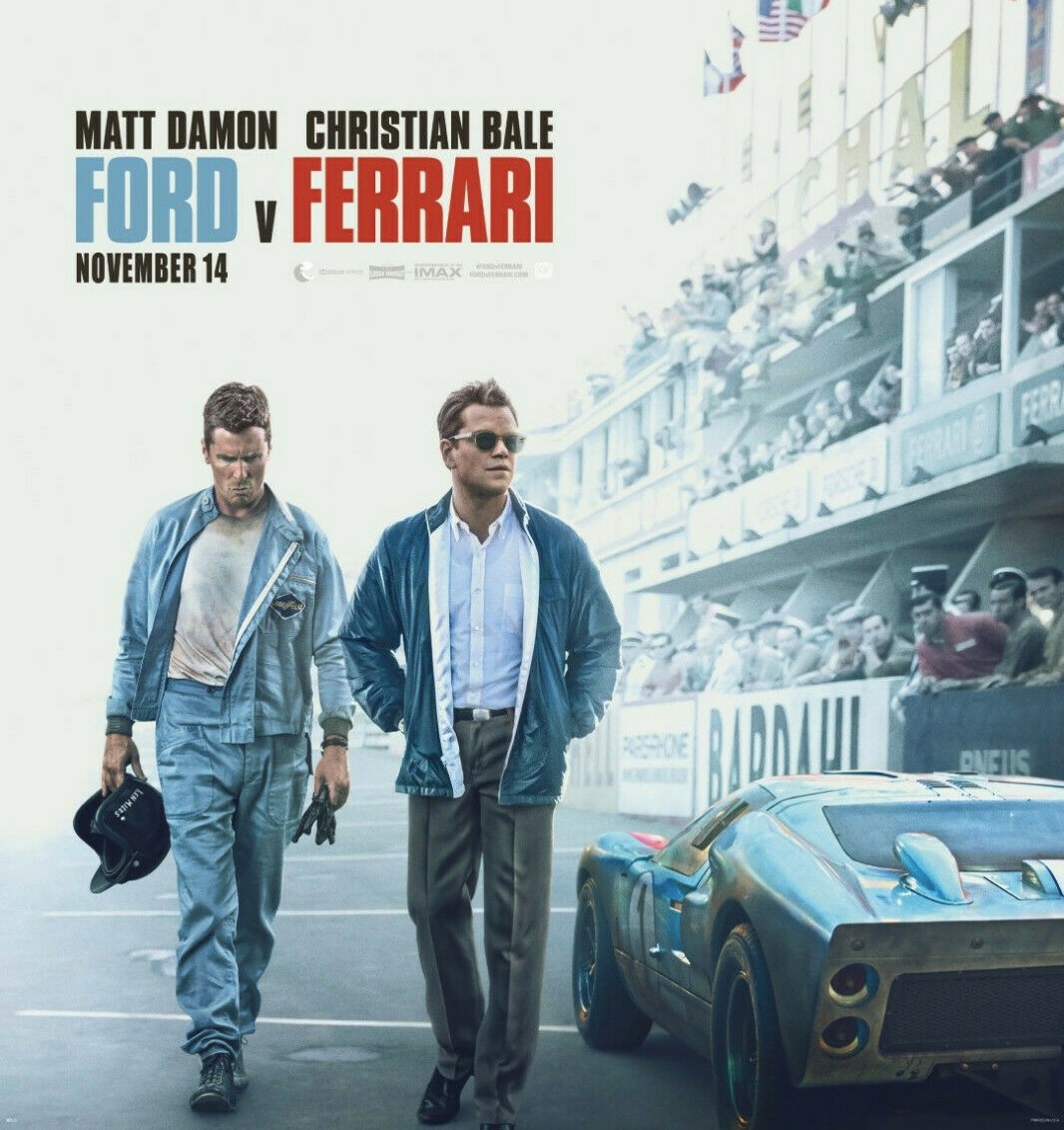
So good that immediately on finishing a screening I pressed the re-watch button. But then this proved such compulsive viewing on original release that I saw it at the cinema four times in as many weeks. High-octane pedal-to-the-metal drama that easily takes the chequered flag from such illustrious predecessors as Grand Prix (1966), Le Mans (1971) and Rush (2103).
Astonishing racing footage is matched by a gripping narrative of ambition and revenge played out at the highest level by a quartet of terrific performances. Henry Ford II (Tracy Letts), humiliated by competitors in the domestic market and thwarted by his plan to take over Ferrari, decides to steal the Italian giant’s crown at Le Mans, the 24-hour race considered then the pinnacle of motor racing achievement rather than Grand Prix.
He hires Carroll Shelby (Matt Damon), the only American winner of Le Mans, who now runs a sports racing construction business and in turn he recruits maverick English driver Ken Miles (Christian Bale). Putting a spanner in the works at every possibly opportunity is oily Ford top executive Leo Beebe (Josh Lucas) who constantly shifts the goalposts because he’s just mean that way or to win commercial advantage. Driven as much by personality conflict as anything else, the narrative pivots on Shelby shouldering the job of placating both big business and his maniac driver while outmanoeuvring all in sight to achieve his goals.
Jargon overload should be the kiss of death but that bold decision to involve the viewer in the minor and major technicalities of motor sport – proven and unproven techniques such as applying strips of paper to a car or battering the car boot with a hammer to increase its capacity and so comply with an arcane rule – pays off big time so that the picture can actually cover in greater depth the reality of running a racing team. Winning can be a matter of millimetres, tiny alterations amounting to massive differences during a race.
And it helps the narrative thrust that Le Mans is a single race rather Grand Prix or Nascar where over a season inevitably attention and excitement will sag. Other races are easily accommodated because they are vital to the end result, either in personal or technical terms. This is the ultimate battle against the odds, not just novice Americans taking on the big boys of Italy, but the ageing driver needing to prove himself again and again and the constructor sometimes giving in, sometimes not, to big business.
It’s pretty difficult to retain audience involvement with the competitors masked up but (as Top Gun: Maverick would later prove) little works better than having your half-hidden driver (or pilot) reveal his emotions by talking to the machine, providing a commentary on the action, though Miles’s favoured expression of “giddy-up” may not qualify as a technical term.
Interestingly enough, the principals are all indifferent, not to say occasionally shady, businessmen, Henry Ford II laboring in the shadow of his father, the repair shop run by Miles shut down by the taxman, Shelby selling the same car over and over to multiple buyers. But this is a richness of character rarely seen in action films, flaws usually restricted to sexual or alcoholic peccadilloes. Nor is there any sign of the old trope of wife/lover unable to watch drivers race, and marriages/relationships buckling under that pressure. Instead Miles’ wife Mollie (Catriona Balfe) rejoices in his skills while Henry Ford II clearly has a string of lovers.
The contrast between the romance and the reality of speed is no better expressed than when Ford is taken for a spin by Shelby or between the devil-may-care and the safe than when Shelby takes control of an aeroplane.
So many internal obstacles, Beebe’s manoeuvrings for a start, remain to be overcome never mind complications on the track that it is pretty much one twist after another with one awful ironic twist left for the climax of the race.
Christian Bale (Thor: Love and Thunder, 2022) picked up most of the acting plaudits, nominated for a Golden Globe, but I thought Matt Damon, Tracy Letts and Josh Lucas ran him close. Damon (The Last Duel, 2021) delivers a restrained performance that occasionally cuts loose to reveal the carefully camouflaged daredevil. Letts (Lady Bird, 2017), better known to me as a playwright, brings the right mixture of arrogance and power. One-time matinee idol Josh Lucas (A Beautiful Mind, 2001) eases back on the shit-eating grin and is one of the most self-righteous business bad guys you could encounter.
Sterling turns also from Jon Bernthal (Those Who Wish Me Dead, 2021) as Lee Iacocca (who later wrote a book about brilliant he was, although there’s little evidence of that here); Catriona Balfe (Belfast, 2021) and Noah Jupe (A Quiet Place, 2018) as her son. Special mentions for Ray Mackinnon (News of the World, 2020) as Shelby’s number two and Remo Girone (The Right to Happiness, 2021) as Enzo Ferrari.
Distinguished career as director James Mangold has enjoyed – from Walk the Line (2005) and 3.10 to Yuma (2007) to Logan (2007) – this has to be the peak, brilliantly bringing the human side into a movie that could easily have concentrated on the machines. He drew on an equally brilliant screenplay by Jez Butterworth (Spectre, 2015), John-Henry Butterworth (Edge of Tomorrow, 2014) and Jason Keller (Escape Plan, 2013).
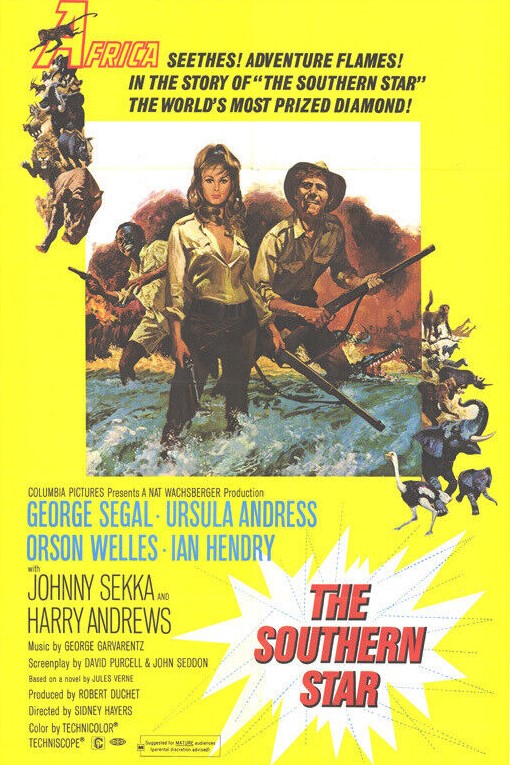
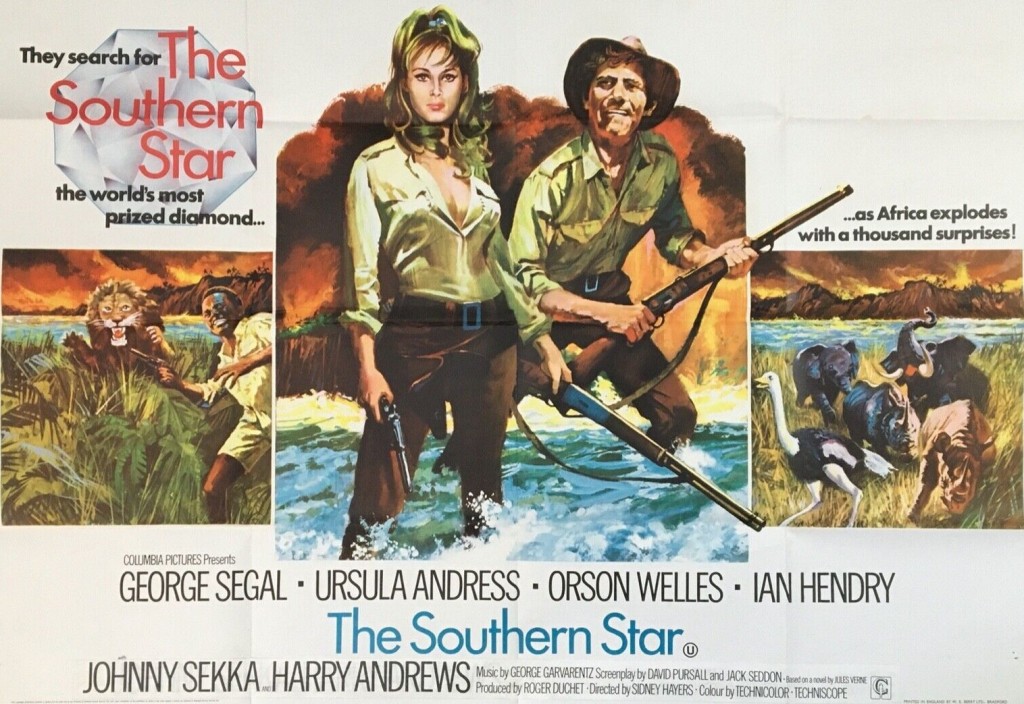
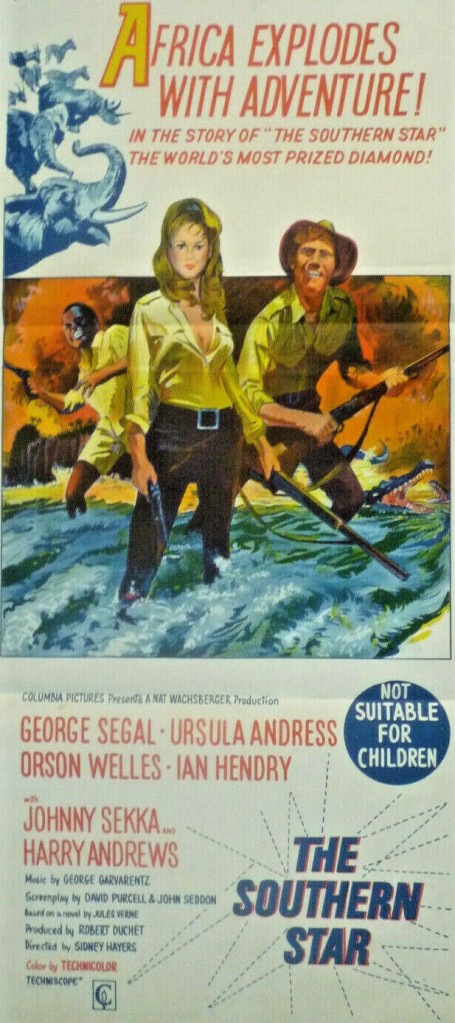
There’s a surprisingly good movie here once you strip out the cliché jungle stuff and the racist elements. The diamond of the title is actually a MacGuffin, just enough to get you started on two parallel tales of revenge.
Dan (George Segal) is a mining engineer-cum-adventurer and Erica (Ursula Andress), daughter of mine owner Kramer (Harry Andrews), as far from the traditional jungle heroine (except in one regard) as you could get. She saves him from crocodiles, rescues him from jail and quicksand, swims across a hippo-infested river and is a better shot than him (or anybody for that matter) with a rifle. This is female empowerment with a vengeance.
Suspected of stealing the diamond, he is hunted by ranger Karl (Ian Hendry), Dan’s love rival, who intends to win Erica back using the simple expedient of killing the thief. Lying in wait is all-purpose rogue Plankett (Orson Welles) who seeks revenge on Karl. The second unit had a whale of a time filming anything that moved – lions, leopards, zebras, giraffes, buffaloes, monkeys, antelopes, the aforementioned hippos and crocodiles and what looked like a cobra – and at one point everything does move in coordinated fashion if you can call a stampede coordinated.
But the main focus is an Erica who constantly confounds Dan’s sexist expectations. Docility is her disguise. Anytime she appears to be doing what she’s told you can be sure she’s planning the opposite. While Dan does have his own specific set of jungle skills, he often looks a fool. But they do make a good screen partnership and their dialogue is lively.
Hollywood spent millions of dollars trying to create screen chemistry between various stars and although it seemed to work very well in the industry’s golden age with Clark Gable and any number of MGM female stars, Bogart/Bacall and Tracy/Hepburn and I guess you could chuck John Wayne-Maureen O’Hara into that particular mix, the formula seemed to have gone awry by the 1960s discounting the Doris Day/Rock Hudson combo, big budget romances like El Cid (1961) and Doctor Zhivago (1965) and an occasional home run with whomever Cary Grant was romancing on screen. So it was usually hit-or-miss whether any sparks flew between the stars.
Andress had certainly been a European femme fatale par excellence as seen in Dr No (1962) and The Blue Max (1966), but it was certainly not a given that she would more than hold her own for an entire picture. Segal was nobody’s idea of a romantic leading man although the notion had been given a tryout in The Girl Who Couldn’t Say No (1968) with Virna Lisi. But here the whole enterprise works in an It Happened One Night vein with the supposedly superior male recognizing that perhaps his companion was more than a match.
Harry Andrews and Orson Welles both try to steal the picture, with polar opposite characterizations, Andrews loud and menacing, Welles soft and menacing. You can tell Scottish director Sidney Hayers (The Trap, 1966) was an editor because he cuts for impact and mostly does an efficient job of sticking to the story. Supposedly, Orson Welles directed his own scenes, but that might be to make sure he got to hog the camera. He has enough choice lines and bits of business to keep him happy and gives his venomous character a camp edge. Matakit (Johnny Sekka), Dan’s buddy, who actually has the diamond, is separately pursued and subjected to racism and being whipped.
Despite my reservations, this is well constructed and keeps one step ahead of audience expectation with plenty twists to subvert those, although the music by Johnny Dankworth gets in the way, offering musical cues opposite to what is required.
As it is a jungle picture there is the obligatory heroine’s bathing scene – and to balance the books on that score Segal does whip off his shirt at one point. Except for the clichés and the racism, it would have gone higher in my estimation for by and large it is well done and Andress is once again (see The Blue Max) a revelation.
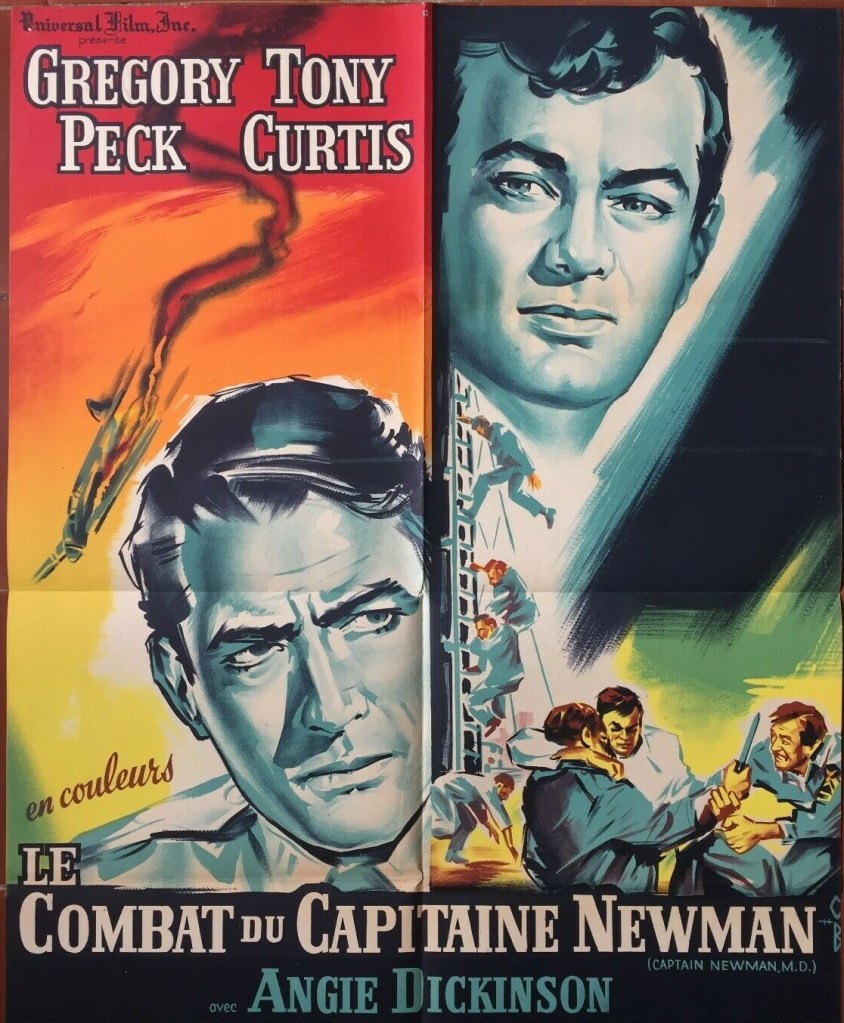
Somewhat lost in the rush to acclaim star Gregory Peck for his Oscar-winning To Kill a Mockingbird (1962), this bold attempt to tackle mental illness among the armed forces deserves reassessment.
Set towards the end of World War Two, psychiatrist Captain Newman (Gregory Peck) heads up a unit addressing the previously ignored mental health issues of U.S. airmen. One of the first to identify post- traumatic stress disorder, Newman employs a whole raft of unusual techniques such as allowing his clients to tend sheep. And he’s not above using romantic sleight-of-hand to woo Lt. Corum (Angie Dickinson), a nurse in a non-psychiatric department, to join his team. Orderly Corporal Leibowitz (Tony Curtis), more of a con artist than a medical professional, is the other key member of the team.
As you might expect, Newman has to battle superiors to allow him to even attempt to cure any of the men under his care since in standard armed forces opinion they are really just cowards trying to duck out of their duty. Given there’s no prescribed treatment for his clientele, Newman basically improvises on a case-by-case basis to get to the heart of what caused mental collapse.
While the movie motors along nicely on the interplay between these three characters – the potential for real romance between Newman and Corum and Newman’s acceptance of Leibowitz’s alternative, more down-to-earth and decidedly un-medical approach – it focuses on three critical cases. Col Bliss (Eddie Albert) suffers from split personality, Capt Winston (Robert Duvall) is catatonic and Corporal Tompkins (Bobby Darin) too bubbly by far.
In dealing with each, Newman adopts a different persona, occasionally entering into the make-believe world of his clients to expose how much of a fiction they are. Stern with some, he is gentle with others and when he appears to go over the score explains he is not shouting at a person but at his symptoms.
And while at time it feels like a mental equivalent of episodes of a hospital soap, the underlying drive, the knowledge that men are hiding from the horrors of war or endure guilt over action they may have taken or are unable to face the consequence of orders they carried out takes this into a different level. Almost all suffer from the standard conviction that they must be cowards. Newman’s task is to make all face up to their fears.
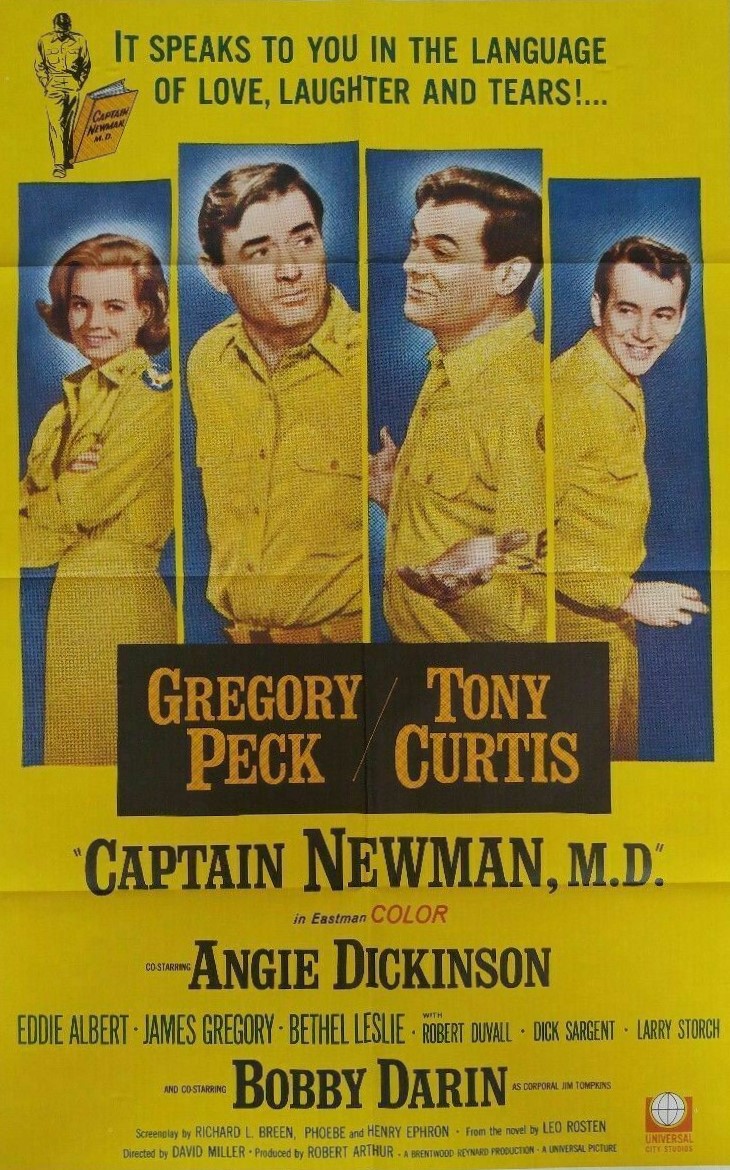
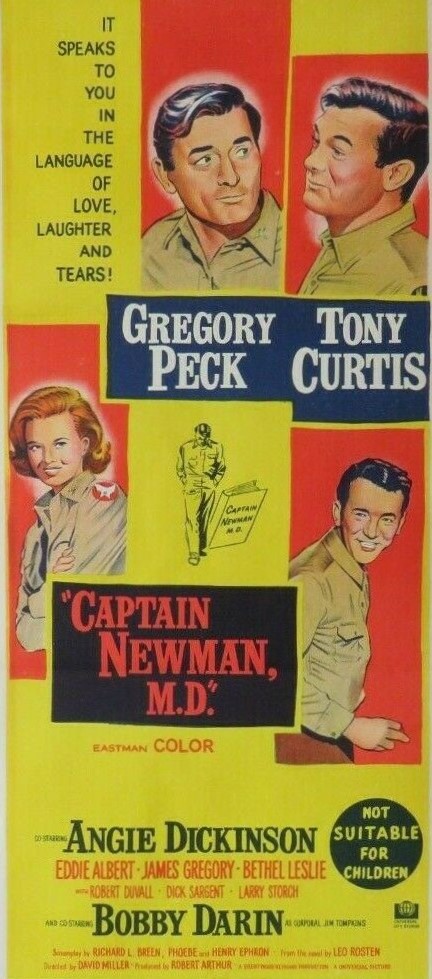
Presumably to overcome fears of audience resistance to the downbeat subject matter, the U.S. poster plain misled the public – “love, laughter and tears” were not much in evidence.
And it’s Corum’s self-appointed job to get under Newman’s skin and in so doing get to the heart of the terrible irony of his role. If he fails and men are discharged without being cured they will be returned to their units while mentally unstable and make decisions that could endanger thousands of men. If he succeeds, he sends men back to face potential death.
Luckily, it’s far from dour. Instead of taking the audience down a medical jargon rabbit-hole, the movie sensibly concentrates of character and humanity. It is filled with brilliant dialogue and whenever Newman appears overwhelmed up pops Leibowitz like the self-appointed class clown to bring events to a cheerier conclusion. Up till the end – a Xmas show by inmates and the arrival of a bunch of Italian POWs – the movie steers well clear of sentimentality and delivers a lucid exploration of the effects of war on the human psyche.
Gregory Peck (Mirage, 1965) is outstanding, not just from the way he adapts his character to suit the situation, but because quite a lot of his role is just to react to what is being said. Most stars would run a mile from being on the receiving end of chunks of dialog and insist on altering the script to make them appear more dynamic. Unlike Atticus Finch who is convinced he can find a solution, Newman knows his detection skills are very basic.
Tony Curtis (The Boston Strangler, 1968) might appear as if inhabiting a custom-made role suited to his natural effervescence and charm, but this is a deeper character than initially seems the case and rather than ride along and enjoy himself he has spells of challenging Newman’s authority. It’s a more subdued role for Angie Dickinson (Jessica, 1962), too, but she also brings a level of seriousness to the part and is integral to the picture’s success.
Bobby Darin (Pressure Point, 1962) was Oscar-nominated but I found his acting over-the-top. Eddie Albert (Green Acres television series 1965-1971) and Robert Duvall (To Kill a Mockingbird), in particular, were more assured. Look out for James Gregory (The Secret War of Harry Frigg, 1968) and former child star Jane Withers.
David Miller (Hammerhead, 1968) strikes the correct tone, leavening the seriousness with humor, but not avoiding the deeper issues. In their final screenplay assignment Henry and Phoebe Ephron (Carousel, 1956), parents of Nora Ephron (When Harry Met Sally, 1989), teamed with Richard L. Breen (A Man Could Get Killed, 1966) for an intelligent screenplay based on the bestseller by Leo Rosten.
What if redemption isn’t enough? When shame is buried so deep inside the psyche it can trigger no release? That’s the central theme of Richard Brooks’ adaptation of Joseph Conrad’s classic novel.
The title character’s shame comes from, as a young officer, abandoning a ship he believed was sinking only to later discover it had been rescued with a cargo of pilgrims who point the finger of blame. He is branded a coward and kicked out of the East India Trading Company, plying his trade among the debris of humanity.
You might think he later redeemed himself by foiling a terrorist plot at great risk to his own life. But that cannot erase his shame. Nor can helping revolutionaries overthrow a despotic warlord (Eli Wallach), enduring torture and again at great risk. What other sacrifice must he make to rid himself of the millstone round his neck?
Writer-director Brooks had a solid pedigree in the adaptation stakes – The Brothers Karamazov (1958), Cat on a Hot Tin Roof (1958), Elmer Gantry (1960) and The Sweet Bird of Youth (1962) – but sometimes you felt the writer got in the way of the director. That’s the case here. There was enough here to satisfy the original intended roadshow customers, great location work, grand sets, length, a big star in Peter O’Toole, but there is no majestic camerawork. There are good scenes but no great sweep and the result is a slightly ponderous film relieved by stunning action, some moments of high tension, the occasional twist to confound the audience and ingenious ways to mount a battle.
Hired killer Gentleman Brown (James Mason) has many of the best lines – “heroism is a form of mental disease induced by vanity” and “the self-righteous stench of a converted sinner” – all in reference to Jim. Everybody has great lines except Lord Jim, as introverted as Lawrence of Arabia, face torn up by self-torture, fear of repeating his original sin of cowardice and convinced he will be cast out again should people discover he had abandoned hundreds of pilgrims.
Apart from the storm at the outset, the central section in the beleaguered village is the best part as Jim finds sanctuary, love and purpose, and conjures up the possibility of burying the past.
Part of the problem of the film is the director’s need to remain faithful to the source work which has an odd construction and you will be surprised at the parts played by the big-name supporting cast of James Mason, Jack Hawkins and Curt Jurgens. Many of the films made in the 1960s were concerned with honor of one kind or another and, despite my reservations about the film as a whole, as a study of guilt this is probably the best in that category, in that this character’s conscience refuses to allow him an easy way out.
Peter O’Toole (Lawrence of Arabia, 1962) is chock-full of anguish but finds it difficult to create a character of similar heroic dimensions to the David Lean picture. James Mason (Age of Consent, 1969) is surprisingly good in an unusual role. Eli Wallach (The Magnificent Seven, 1960) as The General plays a variation of a character he has essayed before.
This may have been a step up the Hollywood ladder but it was backward move in acting terms given Daliah Lavi’s performance in The Demon (1963) – reviewed here some time ago. Her talent is somewhat wasted in an underwritten part. Also in the supporting cast: Curd Jurgens (Psyche ’59, 1964), Akim Tamiroff (TheLiquidator, 1965), Andrew Keir (Quatermass andthe Pit, 1967) and Jack MacGowran (Age of Consent).
Director Richard Brooks was also on screenwriting duties.
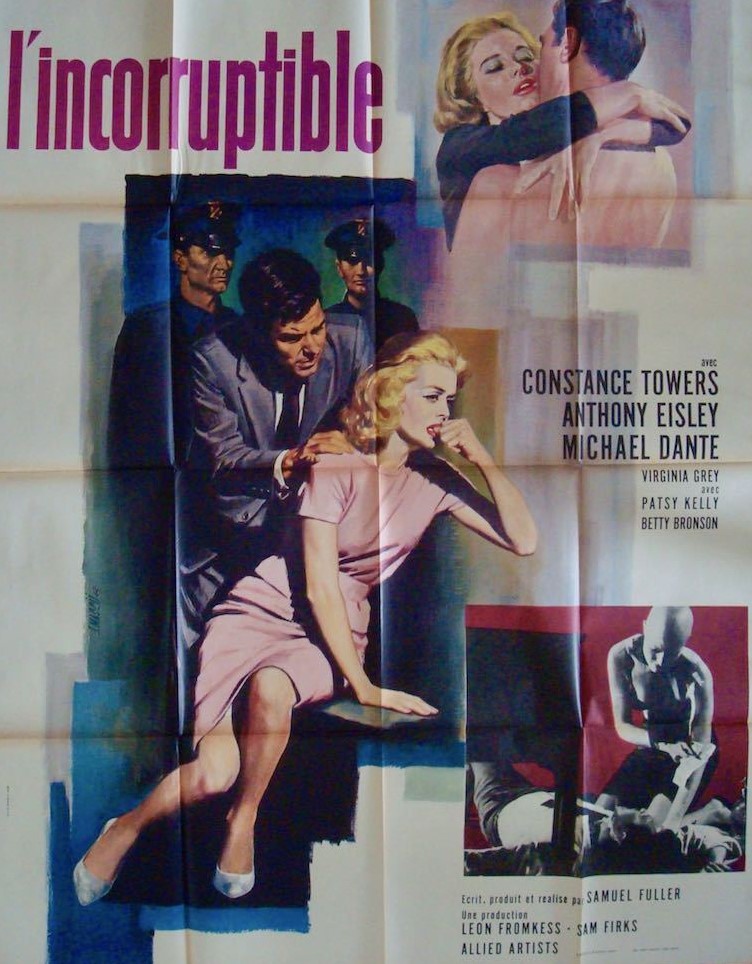
Certainly doesn’t start off as your standard entry to the criminal-trying-to-go-straight mini-genre when a bald woman beats up and robs her pimp. Kelly (Constance Towers), who knows “your body is your only passport,” nonetheless sets out to create a new life for herself as a salesperson (hawking overpriced champagne) in a small town where prostitution is outlawed.
She could easily settle for being the mistress of corrupt cop Griff (Anthony Eisley), but he’s something of a pimp, sending girls-off-the-bus across the river to the joint run by Candy (Virginia Grey). Instead, she takes up nursing, in an institute for crippled children, providing tough love to the kids. In due course, she hooks up the town’s handsome philanthropic millionaire Grant (Michael Dante), a relationship which Griff threatens to wreck.
However, she fesses up to Grant, now her fiancé in double-quick time, about her past and, remarkably, he forgives her. And you think, my goodness, she’s going to get away with it, new life, new career, a job she loves in which she is adored by the kids. You could be tootling along Sentimental Boulevard: Kelly forms the kids into a choir, she coaxes slightly mad landlady Josephine (Berry Bronson) back to reality, determines to make her own wedding dress rather than be beholden to the millionaire, and takes under her wing nurses Buff (Marie Devereux) and Dusty (Karen Conrad) who have fallen victim to life’s traps.
You could be in Movie of the Week territory, another hooker with a heart of gold, except while she’s been turning her life around, there’s the inherent tension that she must fail. But this being a Sam Fuller (Shock Corridor, 1963) picture, Kelly is one tough cookie, outsmarting for a start Griff, who sees her as another in his assembly line of sex workers, and beating up Candy for daring to seduce Buff away from nursing by the promise of big money. Kelly ain’t sentimental. She views herself as a “broken down piece of machinery” with a future beckoning of “nothing but the buck, the bed and the bottle.” This is partly a shrew observation of herself but also of the production line nature or prostitution.
So there’s a catch. And it’s just plain awful. Grant is a paedophile. He has chosen Kelly because, as a sex worker, she is a deviant who will “understand my sickness.” And she’s sickened that despite her best efforts, that’s how she’s viewed, as a woman who would condone such behavior, and that he somehow believes she is complicit, in encouraging young girls from the hospital to visit him. So she kills him.
And then reality strikes with a vengeance. She finds herself embroiled in the worst kind of small town corruption. Griff, who’s gunning for her anyway, refuses to believe her accusation against Grant, his best pal. Candy, who’s also gunning for her, says Kelly planned to blackmail Grant. There’s money missing, so she’s branded a thief as well. And nobody can find the little girl Grant had lined up.
An absolutely terrific film, constantly switching gear, twist after twist, but incredibly humane. There’s probably never been a better portrayal of the working girl, here all shown as vulnerable rather than predatory, as victims caught in a man-made web, and although dealt with in subtle fashion many clearly suffering from mental illness.
Kelly is cultured, reads Byron and Goethe, embraces the classical music education a relationship with Grant promises, but is unusually self-analytical. When she looks in a mirror she’s not seeking physical flaws but shortcomings of character. She understands all too well how men play women. Her tragedy is that when she sets aside her inbuilt cynicism, the man she trusts turns out to be as untrustworthy as they come.
Constance Towers (Shock Corridor) carries the picture, revealing several shades of personality, from hard-bitten woman to tender nurse, from avenger to pragmatic problem-solver. Michael Dante (Harlow, 1965) pulls off the difficult role of being persuasively a good guy gone bad. Veteran Virginia Grey (Jungle Jim, 1948) is all veneer.
But it is Sam Fuller’s movie. He was a triple hyphenate, writer-producer-director, so his vision was never in doubt. The dialog is terrific – the explanation of the title alone is extremely creepy – often cutting to the bone, but the best sequences lack words at all, the black-and-white photography bringing an air of film noir, and for all the striking toughness of the heroine, several moving scenes.
It’s not shocking in Fuller’s normal manner. As I can testify, it suggests to the viewer it’s going one way, and the core terrible act creeps up upon the audience. But it is brilliantly directed, even with a B-picture cast. Pulp reinvented as art. You could possibly argue in its vision and subject matter this was the birthplace of the indie.
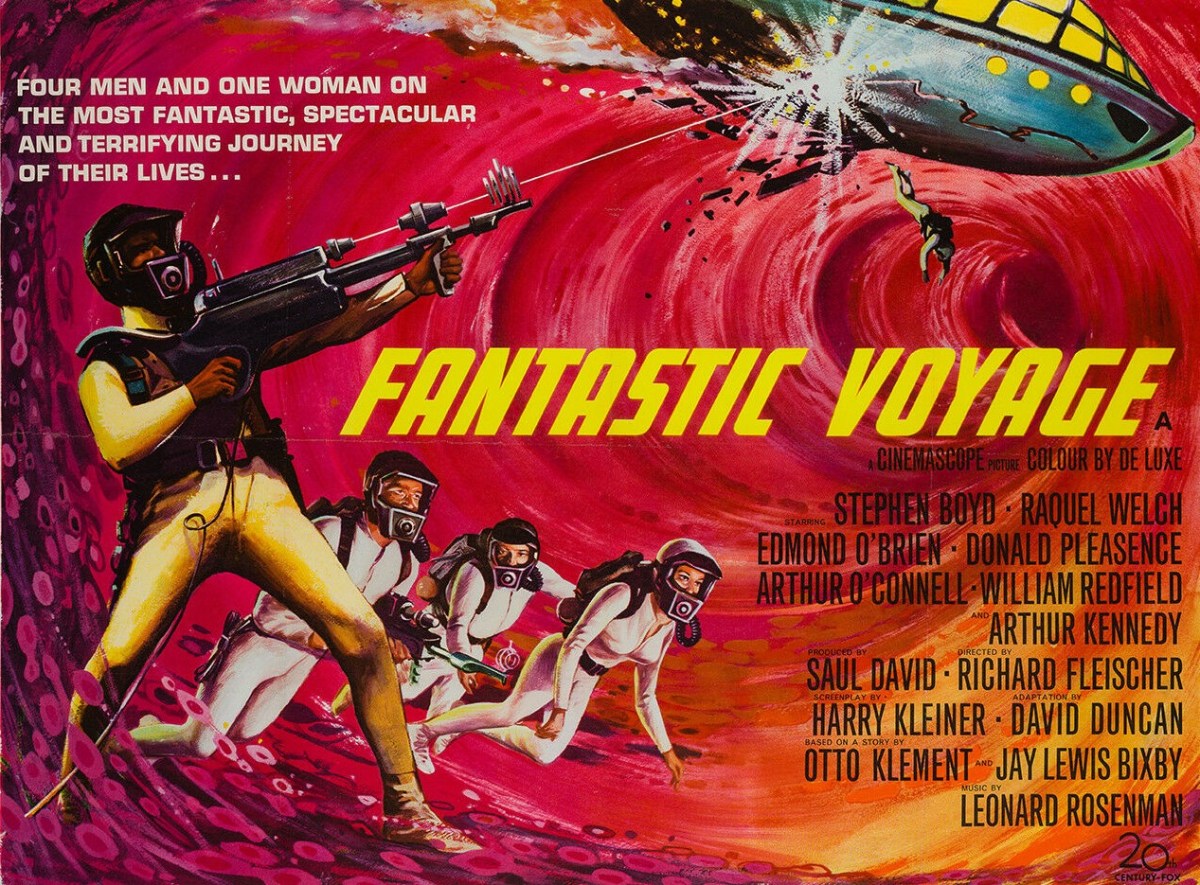
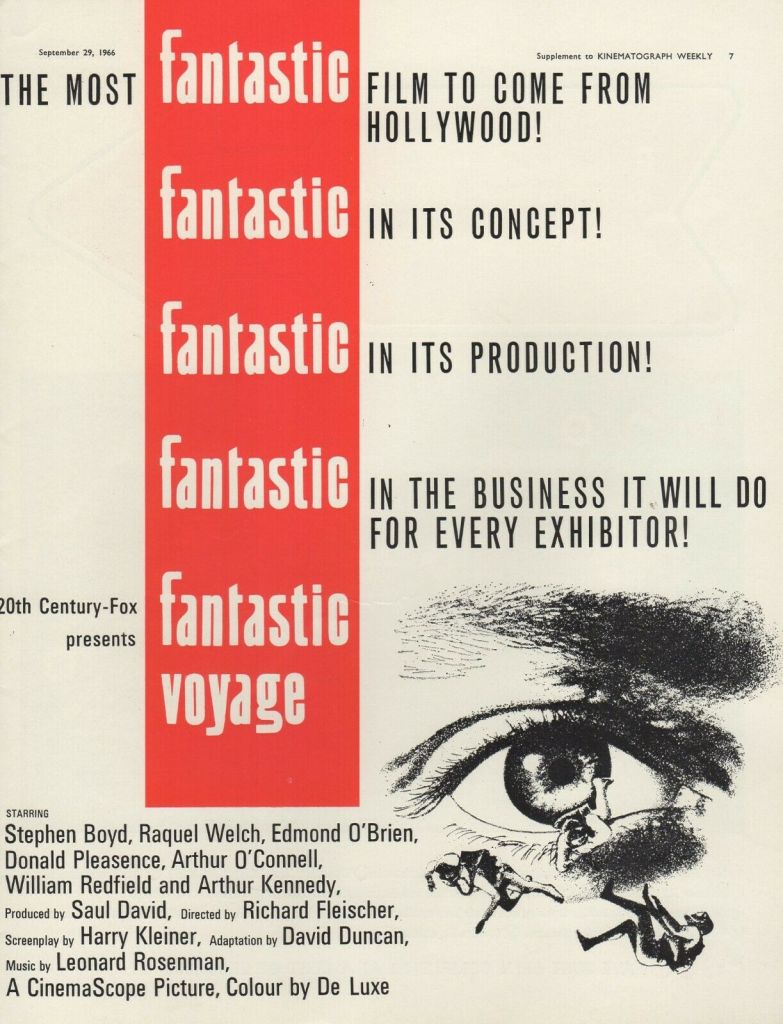
If this had appeared a couple of years later after Stanley Kubrick had popularised the psychedelic in 2001: A Space Odyssey (1968), and with his budget, it might have been a bigger hit. As it is, the ground-breaking sci-fi adventure, going in the opposite direction from Kubrick, exploring the mysteries of the body rather than the universe, is a riveting watch.
Before we even get to the science fiction, there’s a stunning opening 15 minutes or so, a thriller tour de force, the attempted assassination of scientist Dr Jan Bedes (Jean Del Val), vital to the development of embryonic new miniaturization technology, baffled C.I.A. agent Charles Grant (Stephen Boyd) transported to a futuristic building (electronic buggies, photo ID) where he is seconded to a team planning invasive surgery, entering the scientist’s bloodstream and removing a blood clot from his brain. They only have 60 minutes and there’s a saboteur on board.
Heading the mission are claustrophobic circulation specialist Dr Michaels (Donald Pleasance), brain surgeon Dr Peter Duval (Arthur Kennedy) and lovelorn assistant Cora (Raquel Welch). Backing them are up Captain Bill Owens (William Redfield) who designed the Proteus submarine.
The high concept is brilliantly delivered with ingenious improvisations, of the kind we have come to expect from the likes of Apollo 13 (1995) and The Martian (2015) that save the day. I’ve no idea how accurate the anatomical science was but it sounded very convincing to me. There’s a brilliant sequence when the scientist’s heart is slowed down and the heartbeat is reduced to a low thump but when the heart is reactivated the sub literally jumps.
The bloodstream current proves far stronger than imagined, taking them away from their planned route. After unexpectedly losing air, they need to literally suck air in from the scientist’s body. Swarms of antibodies attack. Claustrophobia and sabotage up the ante, not to mention the anxious team overseeing the operation in the control room, the minutes ticking by.
It’s not a fantastic voyage but a fantastic planet, the visualisation of the human interior – at a time when nobody could call on CGI – is as fascinating as Kubrick’s meditations on outer space. They could have landed on a distant planet judging by what look like rock formations. It’s wondrous. Sometimes the world takes on a psychedelic tone. The special effects rarely fail, the worse that occurs is an occasional flaw in a process shot, and a couple of times the actors have to fall back on the old device of throwing themselves around to make it look like the vessel was rocking. The craft itself is impressive and all the gloop and jelly seems realistic. There’s a gripping climax, another dash of improvisation.
The only problem is the characters who seem stuck in a cliché, Grant the action man, Duval blending science with God, Michaels the claustrophobic, an occasional clash of personality. But given so much scientific exposition, there’s little time for meaningful dialogue and most of the time the actors do little more than express feelings with reaction shots. Interestingly enough, Raquel Welch (Lady in Cement, 1968) holds her own. In fact, she is often the only one to show depth. When the process begins, she is nervous, and the glances she gives at Duval reveal her feelings for him. It’s one of the few films in which she remains covered up, although possibly it was contractual that she be seen in something tight-fitting, in this case a white jump suit.
If you are going to cast a film with strong screen personalities you couldn’t do worse than the group assembled. Stephen Boyd (Assignment K, 1968), five-time Oscar nominee Arthur Kennedy (Nevada Smith, 1966) ), Donald Pleasance (The Great Escape, 1963), Edmond O’Brien (Rio Conchos, 1964) and William Redfield (Duel at Diablo, 1966) aren’t going to let you down.
But the biggest credit goes to Richard Fleischer (The Big Gamble, 1961, which starred Boyd) and his Oscar-winning special effects and art direction teams. While not indulging in wonder in the way of Kubrick, Fleischer allows audiences time to navigate through the previously unseen human body simply by sticking to the story. There are plenty of set pieces and brilliant use of sound. Harry Kleiner (Bullitt, 1968) created the screenplay based on a story by Otto Klement and contrary to myth the only part Isaac Asimov played in the picture was to write the novelization.
A joy from start to finish with none of the artistic pretension of Kubrick. This made a profit on initial release, knocking up $5.5 million in domestic U.S. rentals against a budget of $5.1 million according to Twentieth century Fox expert Aubrey Solomon and would have made probably the same again overseas plus television sale.
A genuine all-star cast goes off-piste in what used to be called – and maybe still is – a comedy of manners. A chance encounters at the stately home owned by Victor (Cary Grant), an Earl who makes ends meet by opening up his home to tourists, sees his wife Lady Hilary (Deborah Kerr), who helps make ends meet by selling home-grown mushrooms, fall in love with American oil millionaire Charles (Robert Mitchum).
Victor is far too English and posh to go off in the deep end and after considering allowing her to indulge in an affair until she gets bored, comes up with a strategy to ensure it’s her lover who is shooed away. Hilary’s best friend, the glamorous and often barmy Hattie (Jean Simmons), all Dior outfits and full-on make-up, meanwhile, steps in to attempt to rekindle her romance with former lover Charles.
Needless to say, this scene does not exist in the film.
While it’s peppered with epigrams and clever lines and several twists, what’s most memorable is the acting, the initial scene between Charles and Hilary a masterpiece of nuance, what’s shown in the face opposite to what they say. And there’s another peach of a scene where the most important element is what’s conveyed by a sigh. And by Robert Mitchum of all people, an actor not known for nuance.
But it’s let down by the staginess – it was based on a hit play – the very dated by now notion of showing the comic differences between British and Americans and the pacing. The theatrical element, thankfully, doesn’t resort to farce but with a whole bunch of entrances at unexpected moments you occasionally feel it’s heading in that direction. There are minor attempts to open up the play, a scene in the river, some location work in London and upmarket tourist haunts, but mostly it’s a picture that takes place on a couple of sets.
The British vs American trope just becomes tiresome after a while except that essentially the two men trade cultures, Victor exhibiting the kind of ruthlessness you might expect (in the old cliched fashion) from an American while Charles displays the kind of subtlety you would more likely find in an Englishman.
The pacing’s the biggest problem. The actors deliver lines at such speed that no time is allowed for the audience to laugh. The three British characters are almost manic in their urgency, while the Yank so laid-back he might belong to a different century.
Late on, a couple of subplots brighten up proceedings, a joke played on Hilary by Victor over the contents of a suitcase that she has devised an elaborate cover story to explain, and a betrayal of Hilary by her friend. Devilishly clever though it is, the duel scene almost belongs to a different picture. There’s also an amusing butler Sellers (Moray Watson), a wannabe writer, who believes, as is obvious, he is being under-employed, and pops up when the movie requires straightforward comic relief.
It starts off, via the Maurice Binder (Goldfinger, 1964) credits with babies, occasionally in the buff, unspooling film and indulging in other humorous activities. The only characters established before the plot kicks in are the Earl and the butler, Victor shown as tight-fisted, literally counting the pennies (although, literally, these are actually half-crowns, the price of admission to the stately home), the efficient Sellers revealed as otherwise baffled by life. The joke of a wealthy couple forced to rely on the income from visitors was not even much of a joke by then.
Perhaps what’s most interesting is that this movie essentially about immorality failed to click with U.S. audiences while an equally immoral picture The Apartment (1960) did superb business, the difference less relating to star quality than directorial ability, Billy Wilder’s work always having a greater edge than the confections of Stanley Donen.
It’s the supporting cast – if stars can be so termed – who steal the show. Robert Mitchum (Man in the Middle/The Winston Affair, 1964) is just marvelous, one of his best acting jobs, relying far more on expression to carry a scene. He delivers a masterclass in how little an actor needs to do. Jean Simmons (Rough Night in Jericho, 1967) is also excellent for the opposite reason, an over-the-top mad-as-a-hatter conniving ex-lover with an eye on the main chance. That’s not to say Cary Grant (Walk, Don’t Run, 1966) and Deborah Kerr (The Arrangement, 1969) are not good, just overshadowed, and Kerr’s first scene with Mitchum, where she, too, realizes she is falling instantly in love is remarkably underplayed.
Stanley Donen (Arabesque, 1966) should have done more, pre-filming, to tighten up the script and expand the production. Hugh Williams and Margaret Vyner adapted their own play. It’s entertaining enough but I was more taken by the acting than the picture.
Julie Andrews could not have made a more controversial choice in her bid to prove she was more than a Hollywood goody two-shoes as introduced in her debut Mary Poppins (1964). In the months leading up to release, The Americanization of Emily movie made all the wrong sort of headlines, aligning the innocent Andrews with the unsavory matter of producer Martin Ransohoff (The Cincinnati Kid, 1965) challenging the all-powerful Production Code, the self-censorship system in operation in the United States until the late 1960s.
Ransohoff demanded the right to include four scenes of substantial nudity in the film, at a time when any flashes of skin in mainstream pictures were taboo. He argued that the scenes were “necessary for the farcical overtones of the picture.” But more to the point, he was annoyed that foreign filmmakers, who did not have to abide by the stringent rulings of the Code, could show nudity, sometimes even condoned by censor Geoffrey Shurlock who accepted their artistic validity. Ransohoff railed: “We are losing our market because we allow pictures that are full of nudity done in an artistic manner to play our top houses but we can’t get into them because the Code robs us of our artistic creativity.”
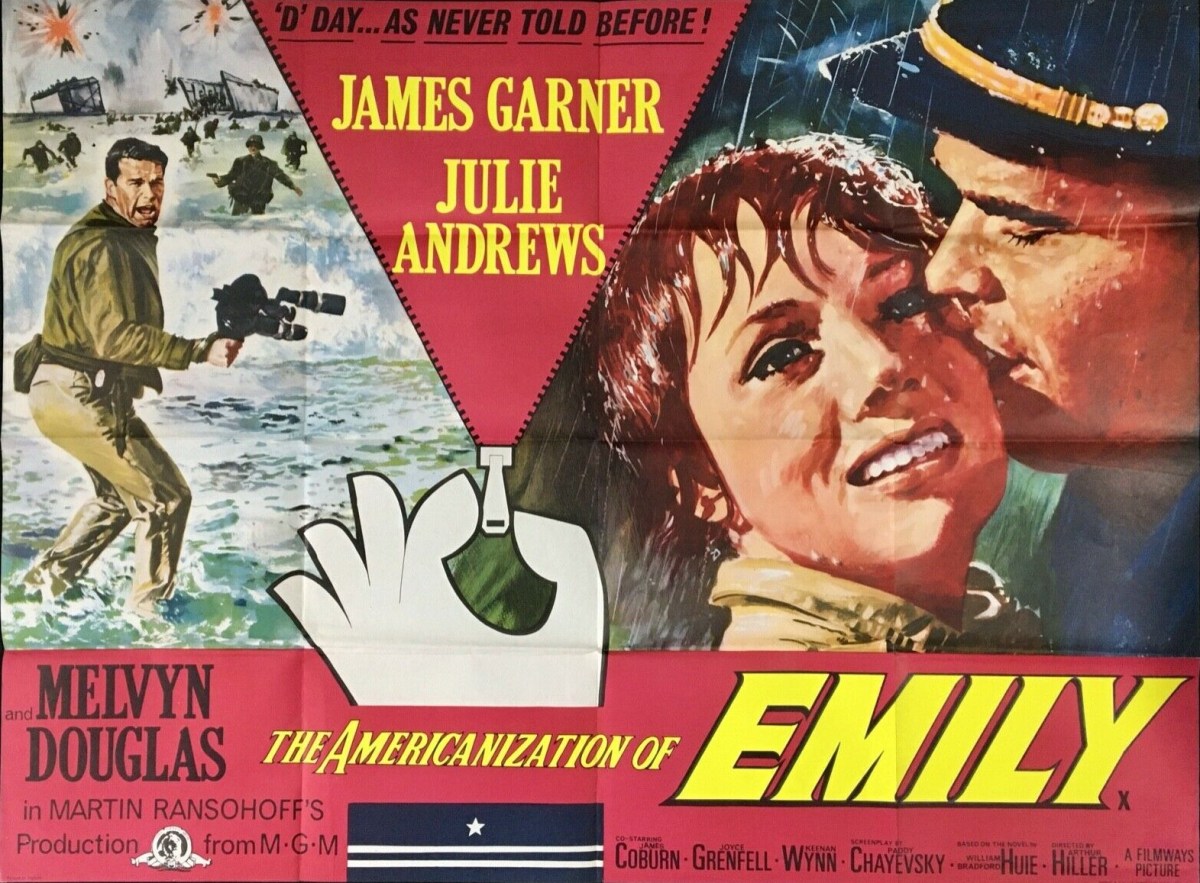
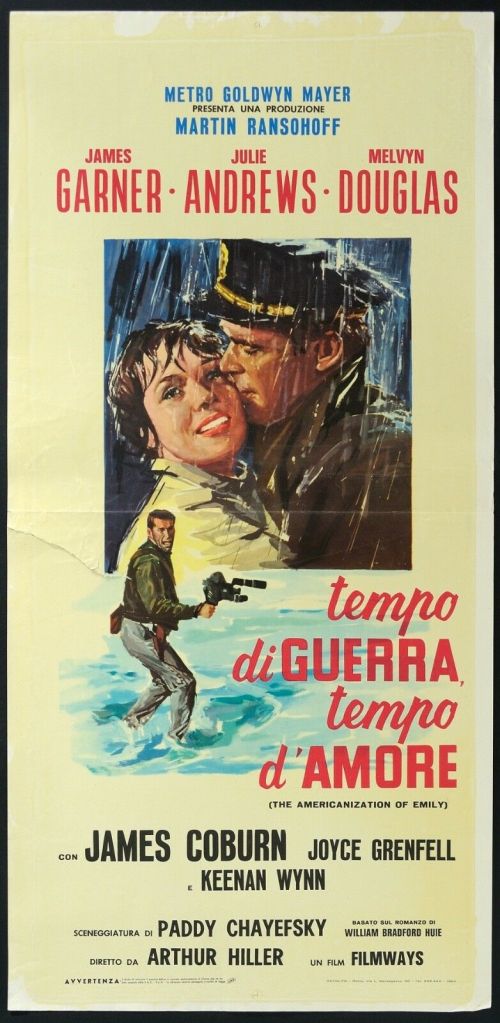
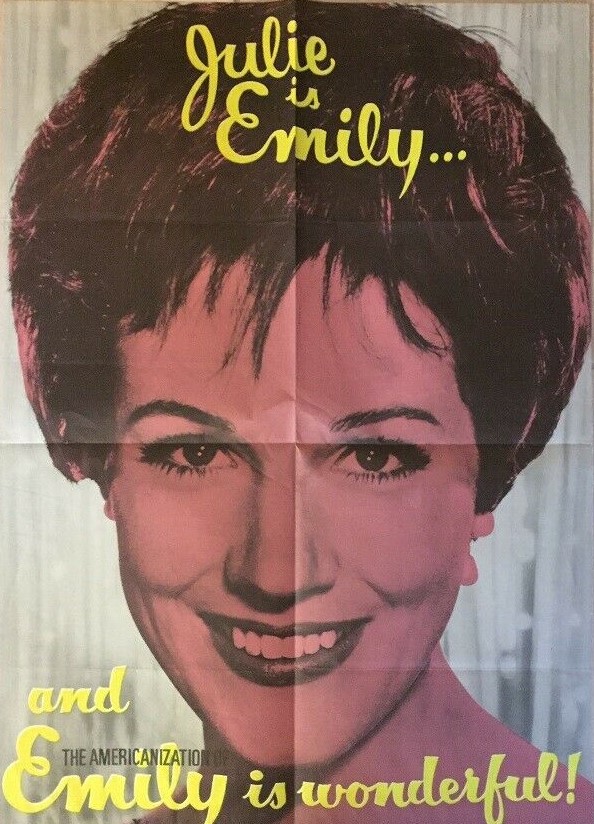
I’m not sure exactly when MGM dropped the “Americanization” element from the title and made Julie Andrews the star by promoting her image more than that of top-billed James Garner.
Faced with a lawsuit from studio MGM for delivering a movie not fit for the Code, Ransohoff conceded he had gone “overboard” with the nudity and that Judy Carne – who later sprang to fame in Rowan and Martin’s Laugh In (1969-1973) – in particular, was “over exposed.” Other actresses named as revealing too much were Janine Gray (The Pumpkin Eater, 1964) and Kathy Kersh in her movie debut. The women were identified in the movie credits as, disgracefully, “Nameless Broad.”
At the outset, such agitation would not have preyed so much on Andrews’ mind as a possibly limitation in her future career, Mary Poppins not due to be unveiled until the summer and few members of the public aware of what a game-changer that would prove for studio and star alike. But once Mary Poppins hit the box office heights, there was every chance the star would quickly lose the adoration of the public if seen to play the female lead in a steamy picture. Ransohoff complicated matters by failing to come out and say whether Andrews was involved in the nude scenes, no matter they were considerably toned down by the time the movie hit cinemas in October 1964. (Had he delayed the picture’s release six months, his approach might have been deemed more acceptable, as, by that time, a flash of breasts had been passed by Shurlock for The Pawnbroker.)
It had been a troubled picture from the start. As early as 1962, Oscar-winner William Holden (The World of Suzie Wong, 1960) had been signed up to star and the movie was due to go before the cameras in London in July 1963 and, following a slight delay, re-scheduled for the next month under the direction of Oscar-winner William Wyler (Ben-Hur, 1959). Production was not quite settled because Andrews was only hired in September 1963. But when Wyler pulled out a month later he was quickly followed by Holden. Andrews was such an unknown quantity that when she signed up, the news did not even receive a headline in Variety, just a few lines at the bottom of a page.
And there were screenplay issues. Norman Rosten had begun work on the adaptation of the William Bradford Huie bestseller in April 1962 only for, 10 months later, the author to be drafted in. But scripting problems would continue until after shooting was complete (see below) with the filmmakers unable to make up their mind about the tone of the picture.
Despite Rosten being assigned, a story later emerged that the book had struggled to reach Hollywood. Huie contended that it had, after all, not been sold to Ransohoff in 1962 and that the sale only occurred later after the author had written the screenplay on spec and sold it to the producer. He tied this up with another contention, little borne out by fact, that producers had turned against buying blockbuster novels in favour of original screenplays.
At that point Ransohoff was on a roll as one of the biggest independent producers in Hollywood, on his slate The Sandpiper, which would appear in 1965, Topkapi (1964), The Loved One (1965), The Wheeler Dealers (1963) and The Americanization of Emily, a fantastic batting average for a neophyte producer. Emily would be his third production, The Sandpiper, with two of the biggest stars in the world, Elizabeth Taylor and Richard Burton, his fourth.
James Garner, who had blown his entire fee of $100,000 from three years’ work on television series Maverick on getting out of his contract with Warner Brothers, had been given a helping hand by Ransohoff, winning second billing behind Kim Novak in Boys Night Out (1962) and Lee Remick in The Wheeler Dealers. Ransohoff gambled Garner was ready to make the jump up to top billing in The Americanization of Emily.
In fact, it would take several years before Garner was considered a proper star, thanks to Support Your Local Sheriff (1969), with the kind of marquee appeal that produced box office commensurate with his fees. In fact, James Coburn was considered a better prospect with a seven-picture deal with Twentieth Century Fox – for whom he would make his breakthrough movie Our Man Flint (1966) – a five-film deal with Ransohoff and Major Dundee (1965) on the starting grid with Columbia.
The three-minute sequence of the D-Day beach landing cost $250,000. It was shot in California, sixty miles north of Hollywood, on a public beach though anyone happening upon the site would possibly be put off by signs proclaiming “Explosives next ½ mile.” The shoot involved 5,000lb of explosives, mostly dynamite and black powder, planted in iron tubs buried in the sand and connected by wires to a central control board. The complicated set-up involved four cameras rolling simultaneously with a 250ft high crane lifting a camera platform into the sky for aerial shots. Another platform was sited in the surf. Special effects expert Paul Byrd was on hand to point out to participants where explosions would occur. Eighty smoke pots were lit, each in an assigned position. Rehearsals soaked James Garner and while he waited for the scene to be set up again he lay down on the beach, still in n his wet clothes, but covered in a towel.
Preparing the segment had taken four months with bulldozers clearing the area. Ransohoff himself climbed into a camera platform to test the rig. Camera positions were selected to capture close-ups of the actors going ashore. To maximize daylight the lunch break was limited to 30 minutes.
Ransohoff, as much a maverick in marketing as in production, took out a double-page advertisement in Variety in July 1964 – nearly four months before the movie opened – to promote the response of the preview audiences. And although the comment cards returned easily promotable lines like “you have a blockbuster on your hand” and “one of those rare films that combine tragedy, comedy and drama properly,” Ransohoff was clearly intending to continue to court controversy by including quotes along the lines of “I’m broadminded but this time you’ve gone too far” and “a disturbing and terrible thing.”
But you couldn’t argue with Ransohoff seeking an alternative marketing strategy with such a recalcitrant publicist as Garner. The actor had a marked aversion to talking about his private life, which, of course, meant the focus would have to shift to his dubious star quality or the controversial scenes. Nothing infuriated journalists more, especially in those days when the media was not so tightly controlled, than to turn up for an interview with an actor who had nothing to say. “My private life is just that and I’ll keep it that way,” he averred.
Quite why the movie took so long to open is not really a mystery. Sneak previews might be followed by a little tweaking but the film would expect to be in cinemas within a month or so, the previews intended to build public awareness and word-of-mouth buzz rather than tell the director where he had gone wrong. But clearly Ransohoff held back in order to capitalize on the box office of Mary Poppins. Despite the wrangling with the Code being over and done with by March 1964 and the preview taking place three months later, the film did not open until October, going wide at Xmas, with the additional purpose of aiming for Oscar voters.
Even as Ransohoff was adding the finishing touches to the advertising campaign, there were doubts about what kind of picture the public would be shown. Four endings were considered, two filmed with Edison (James Garner) dead which turned the movie into a straightforward black comedy, but the other two retained the romantic ending.
The black comedy approach dictated that the unsuspecting Edison (James Garner) was lured to his death on Omaha Beach by the glory-hunting Cummings (James Coburn). With no return from the dead, this left Emily (Julie Andrews) in one version to carry the movie to a dutiful conclusion, commiserating with Admiral Jessup, who had been committed to a mental asylum, while a parade commemorating Edison’s sacrifice and led by the treacherous Cummings took place in the background. This was junked when the parade prove too expensive an addition.
All the other endings kept Edison alive, but in one, partly filmed, Cummings was banished to the North Pole, the producers going as far as to film Coburn with penguins.
The major adjustment in all versions was to present Jessup as off his head when he conceived the plan. That meant the Navy could not be blamed for outrageous publicity-seeking, with the finger instead pointed at a maverick officer, whose decisions could be tempered by his temporary instability.
SOURCES: “Holden’s Americanization,” Variety, May 23, 1962, p11; “Screenplay (Ready to Shoot) Cost-Conscious Producers Goal in Retreat from Pre-Sold,” Variety, January 30, `1963, p3; “Emily Screenplay to Be Done by William Bradford Huie,” Box Office, February 11, 1963, pW1; “Ransohoff’s Big Spurt of Features,” Variety, February 17, 1963, p3; “Ransohoff To Start Five Films in 6 Month Period,” Box Office, June 17, 1963, p27; “Julie Andrews,” Variety, September 11, 1963, p16; “Bill Holden Follows Wyler in Leaving Emily,” Box Office, October 7, 1963, pW2; “Garner Gets Emily Lead,” Box Office, October 14, 1963, p9; Michael Fessier Jr., “Can’t Be Americanized With Duds On,” Variety, November 20, 1963, p5; “Martin Ransohoff To Seek Production Code Seal,” Box Office, November 26, 1963, p6; “Emily and Her Attire Settled,” Variety, March 25, 1964, p5;“Nudies In Emily Are Cut to Get MPAA’s Seal,” Box Office, March 30, 1964, pW4; “Advertisement,” Variety, July , 1964, p14; “Admiral’s Glory Seeking Is Final Ending of Metro’s Emily,” Variety, November 4, 1964, p5; “Mad Film Promotion,” Variety, November 4, 1964, p15; “Promo Credo of Hollywood Actor,” Variety, November 4, 1964, p15; Action on the Beach (1964) MGM promotional featurette.
It’s an immoral job but someone’s got to do it. In wartime, generals need their perks – Winston Churchill with his cigars and champagne the best advocate. And those who supply the perks – Dog-Robbers in American parlance – expect their own perks in the form of a backroom job where they are never exposed to danger. Top U.S. Navy dog-robber in World War Two London on the eve of D-Day is Lt. Commander Edison (James Garner) who can spirit up whisky, steaks, nylon stockings and women, happy even to deliver shoulder massages for boss Admiral Jessop (Melvyn Douglas).
And like the recently-reviewed The Charge of the Light Brigade (1968) what’s mostly on the minds of top commanders is jostling for power, how to win the public relations battle on D-Day and prevent the politicians considering scrapping the service post-war. So Jessup comes up with a brilliant wheeze. What if the first man to die on Omaha Beach was a sailor? Allowing for the construction of a memorial to the “unknown sailor,” a feasible proposition given the Navy demolition unit is scheduled to land on French shores in advance of the invasion force. Edison is enlisted to film the anticipated death.
But Edison, whose brother died at Anzio, is a coward and does everything possible to avoid the job. He struggles to get English girlfriend Emily (Julie Andrews), whose father and brother died in the war, to share his perspective and is counting on buddy Lt. Commander Cummings (James Coburn) to get him out of it. But Cummings has his own ideas and Edison ends up the sacrificial lamb.
And it would be a brilliant black comedy except that, in the interests of a happy ending, Edison, despite being shot on the beach by Cummings, turns up alive.
In that case it becomes a fascinating exploration of the realities of war, the moral and immoral coming to grief in a moral vacuum that ensures that the higher up the food chain the less likelihood there is of dying and, ironically enough, the better opportunity to enjoy, while the masses are on strict rations, the good things of life. Emily would act as the movie’s conscience except that Edison is having none of war’s hypocrisy. He doesn’t want to die for his country and may be following to the letter General Patton’s dictat of making the “other poor bastard die for his country.” He doesn’t so much take a stand against the absurdities of war as stand up for the sanctity of life, in particular his own life, unwilling to fall for the “futile gesture of virtue.”
There’s plenty of what you should and shouldn’t do during wartime, arguments passionately argued for and against duty, though even the self-appointed conscience Emily stops short of turning her nose up at the finer things of life, no matter by what dodgy means they fall her way. that her life teeters on hypocrisy is scarcely explored.
And it does its utmost not to fall into the trap of the wartime romance genre, will-he-won’t-he survive the dangerous mission, precisely because you could never mistake Edison for a hero. And you need a hero not an ordinary joe for that particular genre to work. So what you’re left with is something else entirely, a man brave enough to be seen naked, exhibiting exactly the same lack of scruples in saving his own life as his commanders would employ to have him lose it. It’s kind of complicated that way.
Throw in another get-out clause on behalf of the Allied command, the notion that no high-up would embark on such a selfish vainglorious action, and that Jessup only does so because he is temporarily unhinged after the loss of his wife, when in fact history is littered with generals committing troops to wholesale slaughter for their own reasons.
Ediuon is such a charming character that if you wanted someone to plead the case on behalf of the cowardly you couldn’t make a better choice. The whole idea shouldn’t work at all because it’s only the bad guys, the shifty ones that turn up in every war movie, who carry the cowardice flag. The film is so cleverly structured, with examples of the impact of loss all around, that it’s virtually impossible to vote against Edison. And part of the cleverness is the casting. If such a good egg as Emily can fall in love with Edison it somehow makes him a less despicable character. He’s certainly not as shifty as Jessup who dreamed up the bizarre stunt in the first place or Cummings, intent on exploiting it.
James Garner (36 Hours, 1964) excelled at playing the morally dubious, the cowardly sheriff played for laughs in Support Your Local Sheriff (1969) his biggest box office hit, but this isn’t far short of his very best work, and an exceptionally bold role for a star. Julie Andrews was already trying to move away from her goody-two-shoes debut in Mary Poppins (1965) that would be further enhanced by The Sound of Music (1965) and while her characterisation is not, on the surface, that far away from either role, the depth she displays here, the sorrow and the soulfulness, give this a edgier riff.
Good support from James Coburn (Dead Heat on a Merry-Go-Round, 1966), Melvyn Douglas (Hotel, 1967), Keenan Wynn (Man in the Middle/The Winston Affair, 1964) and Joyce Grenfell (The Yellow Rolls Royce, 1964).
Director Arthur Hiller (Tobruk, 1967) most of the time walks a very fine line but manages to create a very thoughtful movie that humanized what other anti-war pictures failed to make personal. Oscar-winner Paddy Chayefsky (Marty, 1955) based the screenplay on the bestseller by William Bradford Huie (Wild River, 1960).
Another in the mini-genre concerning power politics in the Armed Forces. Would make a good triple bill if teamed with The Charge of the Light Brigade and Man in the Middle.









 The Magnificent 60s