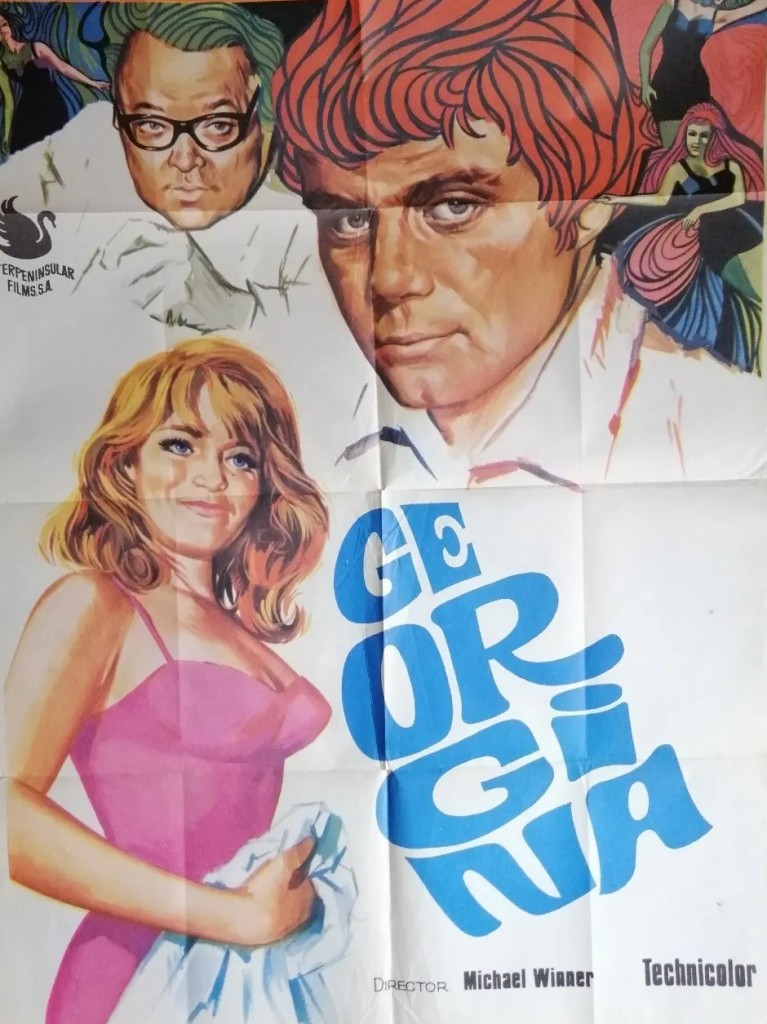
The Appointment (1969) ****

You can see why MGM dumped this. Just as easily as you can see its attraction for star Omar Sharif, his boldest-ever role, completely against type, burying the romantic hero in one fell swoop. It wasn’t just the arthouse pretensions – the absurdly long, by Hollywood standards, long shots held for an insanely long time and the greatest aerial shot, almost to the moon and back, ever devised – that made the studio cut and run faced with the impossibility of selling Omar Sharif as a creepy, repressed guy who drives his wife to suicide.

Luxuriant moustache trimmed to look like a ramrod British colonel, often bespectacled, unmarried middle-aged lawyer Federico (Omar Sharif) takes a fancy to the withdrawn Carla (Anouk Aimee), fiancée of legal buddy Renzo (Fausto Tozzi). She works as a model in a high-class fashion house.

So Federico is shocked to discover that Renzo has dumped her after discovering evidence, somewhat circumstantial it has to be said, that she moonlights as an equally high-class sex worker who takes occasional assignments from antiques dealer Emma (Lotte Lenya). Now that Carla is unencumbered in the marital stakes, Federico undertakes to discover whether the accusation is indeed correct. If not, then he reckons, she might well fall for him, if only on the rebound, after all he is very successful and, despite the geeky haircut and moustache, a handsome dude.

It’s left to your imagination whether Federico actually has sex with the young woman – who “could pass for 17” and arrives clutching schoolbooks – for whom he pays 100,000 lire (around $1,000) but my guess is he does, getting her to pretend he’s her Latin schoolmaster. So that’s the Omar Sharif romantic persona killed off right there and from then on it’s hard to muster any sympathy for the character, every bit as obsessive, say, as James Stewart in Vertigo (1958).

This has a Hitchcockian aura, an atmosphere of stealth and secrecy and chill. He ends up marrying her, turns into a control freak, refuses to let her go out to work, complains about her make-up, asks where she’s been. He gets it into his head that she’s back to her old tricks and rekindles the investigation. She becomes more withdrawn and eventually commits suicide. The ideal ending, the arthouse ending, would have left Federico forever puzzled, not knowing whether he had married a hooker or not, whether, for all his caution, he had been duped. But that’s not the way with what you would otherwise describe as a psychological thriller – calling it a big-budget arthouse picture from a major studio by a relatively unacclaimed (outside of The Pawnbroker, 1964) mainstream director would not be an option – so we get a twist at the end.

This isn’t your usual Italy either, it’s not set in a sun-drenched land with impeccable beaches and ladies wandering around with cleavage abounding. This is the Italy of traffic jams and rain and wind and huge brown waves battering the shore and buttoned-up women.

And audiences have rarely been presented with such a depressing insecure female character. You get the impression she wears fabulous clothes to hide, not glorify, her body. She might come across as playing with Federico, pretending to be asleep when he comes to bed during a romantic weekend on a remote island, the woman way out of his league who wants to keep him at a distance while she makes up her mind. But that interpretation would only be from Federico’s perspective. Otherwise, an attendant viewer would note that she doesn’t seem at all comfortable with life, and that abandoned by one lover without finding out why she can’t risk losing her heart to another.

Had this been made by Visconti or Antonioni (Blow-Up, 1966, went down a similar suspicious route) it might have been acceptable as a distribution vehicle for MGM (after all, they did pump millions into Zabriskie Point, 1970). The odd thing was, the arthouse mob didn’t like it either, showing disdain in the most publicly humiliating manner possible, audiences at Cannes booing it off the screen.

But once you accept the odd premise and equally fall in with the seedy character depicted by Omar Sharif, you begin to feel its power. The daring camerawork is exceptional, some of the scenes in extreme long shot contain as their essence elements of intimacy, and the world’s greatest aerial shot pulls away from the picture’s most romantic scene, as if giving indication of what is not well, rather than enveloping the characters with the usual background of nature at its most rapturous. And it’s pretty much silent, a John Barry theme dips in and out, but scarcely swells when it does, on a rare occasion, appear, so this plays out without much in the way of musical nods to the audience.

Outside of Lawrence of Arabia (1962), this is easily Omar Sharif’s greatest performance. His gamble in parlaying his box office marquee and universal romantic appeal (he appeared in Mayerling, the ultimate romantic tale, the same year) to take on this unappealing role showed a commitment to expanding his screen persona that went unrewarded. Anouk Aimee, anointed one of the screen’s biggest female romantic leads after the unexpected success of A Man and a Woman (1966), is also playing against type.

Sidney Lumet went through a distinctly lean period between The Pawnbroker and his 1970s output – The Anderson Tapes (1971), Serpico (1973), Dog Day Afternoon (1975) – and while The Pawnbroker presented an equally disaffected character he was crying out for your sympathy. You could almost view The Appointment as an exercise in style and the director trying to see, in terms of narrative and character, what he could get away with, and to become the director stars would trust when they wanted to shake up their screen persona – witness Sean Connery as a criminal and Al Pacino as a gay bank-robber.

Critics have avoided this like the plague – three reviews on imdb, only one on Rotten Tomatoes – so if that’s not a sign of being under-rated I don’t know what is.

It’s different for sure but that doesn’t make it any less worth seeing. And it would certainly fit in with the expectations of a contemporary audience.

Goodbye Charlie (1964) ***

Gender switch comedies were a rarity in Hollywood at this point though of course Billy Wilder had scored big with Some Like it Hot (1959) and I’m guessing the possibility of Tony Curtis repeating his drag act was an audience lure for this one. Alas, that wasn’t to be. This goes the other way. Or several other ways. A woman playing a man who is a woman. That would be catnip these days were it a transgender thing, but it ain’t.

Confused? So sex predator Charlie (a male) drowns while escaping enraged husband Sir Leopold (Walter Matthau) only to reappear, re-born or reincarnated (as the producers decide after googling it, sorry, after they look it up in a book) as a naked woman walking along the highway, rescued by the wealthy Bruce (Pat Boone) and delivered to the nearest house, Charlie’s own pad, now occupied by old buddy George (Tony Curtis).

There’s some light comedy as George tries to safely manhandle the unknown woman, clad only in Bruce’s coat (necessitating his later return of course) and gradually the surroundings seem over-familiar to the woman and then, shazam, George works out from what she knows about him that actually she must have returned as a man, also called Charlie (Debbie Reynolds).

A cosmic joke, in other words. The man who preyed upon women returning as a woman. See how he likes it to be on the receiving end of misogyny. But, mostly, he/she lolls around with legs spread like a man, gulps down whisky and is a dab hand at cards. But that’s not where the humor lies, apparently, because the movie moves on quickly from the woman acting the man and into the man-woman discovering all the female tricks of the trade, visiting a beauty parlor and the hairdresser. Charlie discovers it’s not the same fun slapping a woman’s backside – what a revelation – if you’re a woman.

But, basically, the female Charlie decides to become a female version of the male Charlie, the predator, ripping off friends, chasing the big money, trying to seduce Bruce.  So, mostly, it’s one odd plot device after another.

But the sizzle is Debbie Reynolds, not so much the man-woman stuff, but turning into a mean Bette Davis character before your eyes, all hard-edge and shifty moves. There’s sexual tension as well, George initially resisting the woman he knows is or was a man, before finding the attraction too much, and the same going for Bruce. There’s a fair whack of sexual confusion, as the newborn Charlie still finds herself ogling women.

In those far more innocent times, it doesn’t know what it wants to say and lacks the narrative to say it. Audiences had terrific fun with Jack Lemmon and Tony Curtis in Some Like it Hot, but that narrative ploy was bang on, and Lemmon enjoying dressing up as a woman and Curtis having to keep his male instincts at bay while ogling Marilyn Monroe was pure catnip.

Here, Curtis is mostly the foil for Debbie Reynolds and by the time it looks as though they might get it together she is way past behaving like a man and is most definitely a desirable woman so it’s kind of difficult to make this work romantically or humorously.

Perhaps the oddest element is that the signs were already there that it wouldn’t work that well. It started as a Broadway play written by George Axelrod (The Seven Year Itch, which was a Broadway smash) but it barely lasted a dozen weeks on stage. By that time, though, Twentieth Century Fox had splashed out $150,000 for the rights. Still, bigger sums have been buried in the annual accounts.

And I guess when Vincente Minelli (Two Weeks in Another Town, 1962) came on board with a pretty decent cast it seemed at least doable. Like many a lightweight comedy from the decade – Dear Brigitte (1965) for example – it’s keep afloat by a terrific performance by the principal star, in this case Debbie Reynolds (Divorce American Style, 1967). You might spot Ellen Burstyn (The Exorcist, 1973) in an early role.

Take away Debbie Reynolds and it would limp along.

The Pink Jungle (1968) ***

Near miss rather than the spectacular crash dive the poor box office returns suggested. Though it’s scarcely surfaced in five decades. Espionage adventure-cum-treasure hunt is slightly undone by knowing winks to the camera and it won’t take an eagle eye to spot that most of the action doesn’t take place in the jungle at all, although the title is explained in a clever twist at the end.

Shame the script goes AWOL and you might be left lamenting what might have been had it been a hit and the boost it could have given the careers of George Kennedy (Cool Hand Luke, 1967), playing ebulliently against type, and Eva Renzi (A Taste of Excitement, 1967) who proved to have lot more screen charisma than her ensuing roles suggested. Not to mention James Garner (Duel at Diablo, 1966), marquee value taking a hit after a string of flops.   

However, if you can accept James Garner as a fashion photographer, and a gag that sees all three male principals decked in out varying shades of lipstick, and shut out the noise of Garner’s character offering commentary on what is about to happen, it’s a pleasant, non-demanding ride, with a believable central romance.

And I learned diamond arithmetic: five carats equals one gram, 28 grams is one ounce so you’re talking a phenomenal amount for a diamond weighing a few ounces never mind a 20lb haul which is where the endless MacGuffins lead. And if Ann-Margret can elect to shoot a fashion spread against the backdrop of motocross (C.C. and Company, 1970), choosing the South American jungle as the ideal spot for a lipstick advert is scarcely a stretch.

The long-winded tale begins with photographer Ben (James Garner) having his consignment of lipstick confiscated by police chief Ortega (Michael Ansara) who suspects they conceal hidden microfilm from the C.I.A. for rebel insurgents. When model Alison (Eva Renzi) arrives by helicopter that’s promptly stolen by South African illegal diamond dealer Ryderbeit (George Kennedy). The stranded couple repair to the nearest town, followed by the cops and by a pair of thugs, where Ryderbeit connects them to Englishman Capt Stopes (George Rose) who boasts a map leading to the lost diamond haul.

There’s no great reason for Ben to get involved, and the script offers nothing compelling, but let’s go for the ride, so suitably prepared (cigars and whisky essentials apparently) they set off with mules into the desert (yep, no jungle) where the model demonstrates her rodeo skills. There, they encounter Australian McClune (Nigel Green), the supposed deceased partner of Stopes, but he dupes them, leaving them stranded without water or mules, in the desert and heads off to find the loot himself. Of course, that does mean he has to come back the same way so the inevitable shootout, compounded by villains and cops, ensues.

Though determinedly sluggish in parts and the introduction of McClune adding little to the scenario, for the most part, although treading a thin line between cliches, it’s enjoyable enough. Ben is surprisingly handy with his fists, Alison has unusual depths and Ryderbeit is an engaging conman.

For a time there’s a bit of a tussle over Alison, as she’s clearly at times more attracted to the “masterful” adventurer Ryderbeit, a cool dude especially when he demonstrates his dance moves, than the cynical Ben. McClune takes a more predatory interest in Alison. But the growing romance between Ben and Alison is gentle stuff and almost required acting of the highest caliber given that the two actors hated each other according to the scuttlebutt.

Guilty of over-plotting and trying hard not to take the scenario seriously enough, even when it’s clear it won’t work unless that does occur, and that as a previous Garner episode proved, as in A Man Could Get Killed (1966), you can easily skirt around dense narrative and espionage malarkey without getting too bogged down. Over-populated, though, with characters and accents vary.

I’m used to Garner’s schtick by now, but Eva Renzi and George Kennedy were revelations, as was Nigel Green (Fraulein Doktor, 1969) also having a ball as a duplicitous character far removed from his usual ramrod-straight persona.

Oscar-winning director Delbert Mann (Mister Buddwing / Buddwing, 1966) does his best but he could have moved it on a bit for the pace seriously slackens at times. Charles Williams (Joy House, 1964) contributed the screenplay based on the novel by namesake Alan Williams.

Far more enjoyable than I expected and worth it for Renzi and Kennedy.

PREVIOUSLY REVIEWED IN THE BLOG: James Garner in Cash McCall (1960), The Wheeler Dealers (1963), Move Over, Darling (1963), The Americanization of Emily (1964), 36 Hours (1965), The Art of Love (1965), A Man Could Get Killed (1966), Duel at Diablo (1966), Buddwing/Mister Buddwing (1966), Grand Prix (1967), Hour of the Gun (1967), Marlowe (1969); Eva Renzi in Taste of Excitement (1969); George Kennedy in Lonely Are the Brave (1962); Charade (1963), In Harm’s Way (1965), Mirage (1965), Shenandoah (1965), The Sons of Katie Elder (1965), The Flight of the Phoenix (1965), Hurry Sundown (1967), Cool Hand Luke (1967), Bandolero! (1968), Guns of the Magnificent Seven (1969); Delbert Mann directed A Gathering of Eagles (1963), Buddwing/Mister Buddwing (1966), Fitzwilly/Fitzwilly Strikes Back (1967).

C.C. and Company (1970) *

Just terrible. Not even the presence of Ann-Margret (The Swinger, 1966) can save this. Scarcely a single redeeming feature and nothing that might lend itself to shift it into the So Bad It’s Good category. In fact, you would probably put it in a lower class, the So Bad It’s Worse Than You Can Possibly Imagine strata. Little seen for over half a century, and small wonder.

And, boy, did Ann-Margret need a hit after a three-year self-imposed exile in Italy, where she earned big bucks for pictures that hardly got a sniff on the U.S. release circuit, putting an almighty dent in her marquee value. In theory, she should have returned home with a bang, as female lead in a Stanley Kramer production, R.P.M. (1970), the most prestigious picture she had ever been associated with, and easily the best director. But that, riding the counter-culture wave, was a big flop.

This was her second attempt at counter-culture. Motorbike sagas were bankable after the success of Easy Rider (1969) and even as B-pictures had attracted decent audiences for the likes of The Wild Angels (1967) and Run, Angel, Run (1969).

But this was saddled with a terrible star in Joe Namath, and a terrible script by Roger Smith (The First Time, 1969), Ann-Margret’s husband-manager, that puts the wild boys of the highways in a motocross competition, swapping their high-powered bikes for the much smaller Kawasaki engines used in that sport.

If you were American, Joe Namath was a god. If you were foreign, he was a nobody. One of the country’s greatest American football (not soccer!) players, he had made his movie debut in another flop, Norwood (1969). My guess is Ann-Margret was there to help out her husband, also the producer, and beef up the marquee.

But C.C. Ryder (Joe Namath) looks more like an overgrown schoolboy, hulking though he is, than a Hell’s Angel. For the lack of believability he invests in the role you would have done as well with pop star Fabian (Ten Little Indians, 1965).

Anyway, on with the barmy story. So, fashion director Ann (Ann-Margret) has the bright idea, as fashion directors did in those days, of setting up a shoot against the backdrop of a motocross event, kind of like Zabriskie Point (1970) but with bikes. On the way, her car breaks down. The two passing bikers who come to her rescue have something else in mind and she is only saved from rape by the intervention of Ryder.

He belongs to a biking troupe headed by Moon (William Smith), the misogynist’s misogynist, who slaps his women around and sends them out to prostitute themselves on the highways because unlike the enterprising chaps from Easy Rider he’s not got the brains to set up a drugs operation. Then he gets the inspired notion of picking up easy money by sending his guys to compete in the motocross competition because, surely, them being serious motorbike freaks they can beat the hell out of any professional motocross rider who does this for a living.

No doubt audiences will be rooting for the amateurs the way they do for the young kids in other movies that need to put on their own show to save an orphanage or the like.

Naturally, Ryder falls for Ann. Equally naturally, Moon doesn’t like that one bit. And so kidnaps Ann, ensuring Ryder comes to the rescue. Cue a showdown. No doubt we’ll see an almighty battle with chains and wrenches and surely there will be a flashing blade or two as this pair roll around in the dust.

Nope! Let’s just find a handy football stadium and race round the athletic dirt track. That’s bound to be more exciting. You would get more excitement watching goldfish in a bowl.

Theoretically, the combination of Namath and Ann-Margret should have reached the incendiary levels of football star Jim Brown’s sexual tussle with Raquel Welch in 100 Rifles (1969). Nope. Namath has all the screen charisma of a beetle and there’s nothing Ann-Margret can do to help that. You couldn’t have wasted her first nude scene on someone less deserving.

As you might expect, Ann-Margret does get to dance, but for some reason the camera is more focused on Namath who is lacking in the shake-your-booty department.

There is one decent scene and one interesting shot. Unfortunately, the only good scene is the opener, giving a false sense that this might be an interesting picture. It involves Namath “grazing” his way round a supermarket, making up a sandwich from easily available ingredients, even stealing a tissue from a box to wipe his lips. What a rascal, no wonder everyone would be terrified of such a biker. And in the climactic race one of the bikers hits a fence that collapses concertina style.

But that’s it, a 94-minute vanity project that killed off Namath’s movie career and nearly put the kibosh on Ann-Margret’s. You can’t really blame television director Seymour Robbie (Marco, 1973) for failing to improve the material or the stars.  

Sometimes being a completist (in this case following Ann-Marget’s career) has its down side.  

PREVIOUSLY REVIEWED IN THE BLOG: Ann-Margret in State Fair (1962), Viva Las Vegas (1964), Kitten with a Whip (1964), The Pleasure Seekers (1964), Bus Riley’s Back in Town (1965), Once a Thief (1965), The Cincinnati Kid (1965), Made in Paris (1966), The Swinger (1966), Stagecoach (1966), Appointment in Beirut/Rebus (1968), Criminal Affair/Criminal Symphony (1968).

Counterpoint (1968) ****

Absorbing duel of minds between two autocrats obsessed with their own glory and needs and dealing with dissension in the ranks. That it takes place during the Battle of the Bulge turns out to be less of a dramatic hindrance though you maybe have to suspend disbelief in the notion that any resistance fighters might take time out from trying to sabotage Germans to help rescue a bunch of whining, pampered non-combatants with no strategic value whatsoever.

Once you accept that the U.S.O. would deem a classical orchestra the best way to entertain the troops rather than Betty Grable or Bob Hope then you’re halfway there.

Poster that misleadingly apes “The Great Escape” and “The Dirty Dozen”. Naturally, no woman would attempt such an escape without giving everyone a glimpse of cleavage.

Anyway, the Germans launching an offensive in December 1944 by accident capture the classical orchestra led by world-famous conductor Lionel Evans (Charlton Heston). The Germans are under orders to take no prisoners so as not to divert vital troops during this last-stage effort to extend the war, so under the direction of Colonel Arndt (Anton Diffring) the musicians face a firing squad until General Schiller (Maximilian Schell) happens to pop his head out of his window and recognize his hero, Evans.

Death is temporarily averted while Schiller purrs over his captive. But Evans, still high on principle and arrogance, refuses to comply with Schiller’s request to play a concert for him during a delay in the battle as, the Germans, hit by fuel shortage, are unable to continue their campaign and therefore have time on their hands. There ensues the aforesaid duel of minds plus various demonstrations of disloyalty and ruthlessness.

The joy here is the dialog because there’s not much else going on, beyond a half-hearted attempt to escape, and the tension doesn’t rachet up until Evans realizes Schiller is only keeping them alive until the concert, after which they will be turned over to the trigger-happy Arndt, who lacking any subtlety, has already begun to dig a mass grave in full view of the trapped self-proclaimed neutrals.

Teamed up in Britain with the long-lost “The Pink Jungle”, which, as it happens, I’m reviewing shortly.

It’s almost a parade of bon mots as each of the leaders tries to top the other’s sentences, and not in merely a clever manner, but with full-blown fascinating argument, in part about the different outlooks of each country, but also about their contradictions, and it’s a rare movie that can hold your attention just through dialog unless it’s set in a courtroom. But, here, Evans isn’t so much arguing for the suspension of a death penalty, for example, but in a remote high-mindedness complaining that, well, there’s no other word for it, that it’s just “unfair” as if the Geneva Convention has a special clause regarding classical musicians.

Maybe it does, given these are Americans, though not in uniform, which might be a point in their favor. But any commander would be correct in assuming they could, through courageous action, perform an act of sabotage or at the very least, as I mentioned, tie up vital resources.

Matters are complicated because Arndt, less self-indulgent than his superior, goes behind Schiller’s back to rat him out to HQ in Berlin while nameless persons within the orchestra are clearly in cahoots with the Germans. And you can’t blame them either. Arndt believes Schiller’s actions could compromise the attack, the orchestra traitors that Evans’ defiance will get them all killed. Evans is quite happy to sacrifice former lover Annabelle (Kathryn Hays) to keep the German commander, who has taken a fancy to her, happy.

Matters are complicated by the presence in the orchestra ranks of two U.S. soldiers in uniform, who feel duty bound to find a way out, so there’s a bit of the kind of action you’d get in a heist movie where an audience listens to classical music while above them a cat burglar is divesting them of their jewels. Here, the two soldiers are clambering up the innards of a church to the roof to scope out the territory and then attempt escape using a home-made rope made up of scarves and nylons etc.

As it becomes obvious that there is no point in Evans playing for time, the tension and turmoil does increase as that unfilled mass grave beckons. Doesn’t play out the way you’d expect, a couple of neat twists keeping cliché at bay.

But, as I said, the primary interest is the verbal battle between two refined minds convinced they are the most important people on the planet. The only standout scenes not involving Evans concern Schiller’s “seduction” of Annabelle and the playing of the American national anthem by one of the soldiers, planted in the orchestra, who Arndt suspects, from his age (too young to be in such august company unless a musical prodigy), doesn’t fit in.

Charlton Heston (Number One, 1969) and Maximilian Schell (Topkapi, 1964) are both superb as flawed characters. There’s a rare movie appearance for Kathryn Hays (Ride Beyond Vengeance, 1966) and another chance to see Leslie Nielsen (Beau Geste, 1966) before he became comedy catnip.

But it’s the script by James Lee (Banning, 1967) and Joel Oliansky (The Todd Killings, 1971), that really delivers, although I’m guessing that the best lines came directly from the source novel, The General by Alan Sillitoe (Saturday Night and Sunday Morning). Directed by Ralph Nelson (Once a Thief, 1965).

Rare to get a movie that relies so much on script and actors on such top form.

Underrated gem.

PREVIOUSLY REVIEWED IN THE BLOG: Charlton Heston in Diamond Head (1962), 55 Days at Peking (1963), Major Dundee (1965), The War Lord (1965), Khartoum (1966), Planet of the Apes (1968), Number One (1969); Maximilian Schell in Judgement at Nuremberg (1961), Topkapi (1964), Fate is the Hunter (1964), Father Goose (1964), Return from the Ashes (1965), The Deadly Affair (1967), Krakatoa -East of Java (1968); Ralph Nelson directed Soldier in the Rain (1963), Once a Thief (1965), Duel at Diablo (1966) and Soldier Blue (1970).

A Lovely Way To Go / A Lovely Way To Die (1968) ****

Woefully neglected detective thriller with a sparkling script and sexy leading stars exuding screen charisma. Like the celebrated William Goldman-scripted opening to Paul Newman private eye picture Harper (1966), the credit sequence here is at least as innovative in that it appears to be little short of a trailer, a highlights reel showing the audience what lies in store.

Schuyler (Kirk Douglas) is a womanizing cop too handy with his fists, half his arrests making an unexpected detour to hospital. Rena (Sylva Koscina) is the bored young wife of an older millionaire whose idea of fun is to chuck an expensive scarf out of a speeding car forcing her husband to pull up and go back and fetch. When her husband is shot, suspicion falls on Rena, inclined  to dress in revealing outfits for the media, and her playboy boyfriend.

At the behest of attorney Fredericks (Eli Wallach) sporting a rich Southern accent and a with knack for speaking in parables, Schuyler, having resigned from the force one step ahead of being fired, is sent in to provide security and find out whether her alibi stacks up. He soon finds out it doesn’t but by this time he has fallen under her spell. Witnesses disappear, intruders are dealt with, attempts are made on the detective’s life, and the twists come thick and fast. Rena is the arch femme fatale who is a past master in the twisting department – twisting every male within a 50-mile radius round her little finger.

Harper was a throwback to The Maltese Falcon/The Big Sleep but A Lovely Way To Die knocks that shamus tradition on the head. For a start, Schuyler is a high-living high-rolling  character who doesn’t take prisoners. The second time we meet him he has dumped the girl he took to the races for someone he has met when picking up his winnings.  Seducing gorgeous women and dumping them is second nature. This is Douglas as a glorious charmer, a part of his screen persona lost after a glut of more serious pictures like Seven Days in May (1964) and Cast a Giant Shadow (1966). Yugoslavian actress Koscina, often little more than eye candy for most of the decade, had vaulted into the higher echelons after a turn as Paul Newman’s squeeze in The Secret War of Harry Frigg (1968).

An inherent part of the attraction of this picture is how deftly Rena keeps Schuyler at bay. Scriptwriter A. J. Russell (Stiletto, 1969) and director David Lowell Rich (Madame X, 1966) deliver the goods in maintaining the tension in their relationship. There is a wonderful scene where the expectant Schuyler follows her up the stairs of her fabulous mansion and three times he ignores the import of her unmistakable “Goodnight,” his uber-confidence taking him to her door – which she shuts in his face.  

Sure, in some ways it is slick, but it is also taut and realistic, Schuyler does not win all his fights and he eats with the rest of the help at the mansion. And he does some terrific detection so it doesn’t fall short in that department. He is definitely helped by some choice lines – “police methods are sometimes difficult for an amateur to understand” he tells Rena after he brutally deals with an intruder.

Koscina is in her element as the sexy, wealthy suspect, and especially in her banter with Douglas – her main aim to disarm his cockiness. Eli Wallach (The Moon-Spinners, 1964) is also superb, given just enough ham to hang himself, but matching Douglas in arrogance and outgunning the D.A. with his courtroom gymnastics. A couple of the subsidiary characters are well-drawn, a housekeeper who plays the markets.      

For some reason this sank like a stone on its initial outing, audiences perhaps being more attuned to the Bogart-style sleuth, but I found it highly enjoyable and this could be seen as a  taster for anyone familiar with the antics of the star’s son Michael Douglas who found himself in similar territory in Basic Instinct (1992).

Complex tale high on intrigue and sex, well worth a watch.

REVIEWED PREVIOUSLY IN THE BLOG: Kirk Douglas in Strangers When We Meet (1960), Lonely Are the Brave (1962), Two Weeks in Another Town (1962), For Love or Money (1963), Seven Days in May (1964), In Harm’s Way (1965), The Heroes of Telemark (1965), Cast a Giant Shadow (1966), Is Paris Burning? (1966), The Way West (1967), The Brotherhood (1968), The Arrangement (1969); Sylva Koscina in Jessica (1962), Hot Enough for June (1963), Deadlier than the Male (1967), The Secret War of Harry Frigg (1968); Eli Wallach in Seven Thieves (1960), The Misfits (1961), Act One (1963), The Moon-spinners (1964), Kisses for My President (1965), Lord Jim (1965), Genghis Khan (1965), How to Steal a Million (1966).

Eagles over London (1969) ***

Presumably intended to capitalize on/rip-off the same year’s big-budget roadshow The Battle of Britain manages to cram in a pack of action beginning with a tank ambush in Normandy, the Dunkirk evacuation, the Battle of Britain, rooftop shoot-outs, ending up with an audacious attack of RAF High Command by a team of German saboteurs. As notable for technical achievement, split screen – sometimes split diagonally or quartered – in the manner of The Boston Strangler (1968) and The Thomas Crown Affair (1968), shots through various tiny holes, scenes filmed overhead, and a dazzling swirling camera sequence that would normally presage intimacy but here means death.

Somehow manages to squeeze a surprising number of dramatic moments focusing on relationships, a brief nod to homosexuality, and emulating Fraulein Doktor (1969) in giving the Germans credit for astute and effective espionage. Obvious use of stock footage for the air fight sequences, but you wonder what else has been cobbled out of the vaults given the preponderance of scenes requiring massive numbers of extras. Throw in Hollywood veteran Van Johnson (Divorce American Style, 1967)  and a particularly good Cockney sergeant (Renzo Palmer) and it hardly lets up.

So, Captain Stevens (Frederick Stafford) heads up a unit delaying the German blitzkrieg in France in 1940. The Germans, led by Donovan (Francisco Rabal), meanwhile, are in disguise, assuming the identities of dead British soldiers with the intention of infiltrating Britain and destroying its radar installations. Inadvertently, Stevens saves Donovan’s life, thus giving the German accepted entry into British high command. Equally inadvertently Stevens allows the German access to his girlfriend Meg (Evelyn Stewart) who needs a shoulder to cry on. Donovan has his own girlfriend, Sheila (Teresa Gimpera) on tap, an undercover agent working as a barmaid, well-trained at collecting loose talk and seduction.

Elements of giallo keep popping up as the Germans need to embark on a murderous rampage to continue to acquire new identities to keep ahead of the pursuing investigation, one strangulation taking place in a gay sauna. Every now and then we pop into RAF High Command where Air Vice Marshal Taylor (Van Johnson) is helping thwart the German aerial attacks and in the end, since more bodies are required, elects to go into battle himself.

The small screen allows laughable moments – model airplanes crashing into the sea, cardboard radar installations toppling – to pass almost unnoticed since most of the rest of the action is well rendered, the rooftop scene especially, and the other various shoot-outs where – shock to the system – the British are constantly outwitted and outgunned.

Mostly, you’ll note how stylish a concoction this is given the low budget. Excellent sex scene against the background of exploding bombs, the duping of our hero by the enemy, and one terrific scene where Sheila is deemed surplus to requirements, calmly accepting her fate on condition that it’s her lover who pulls the trigger.

This would have been solid support material in English-speaking countries but most likely a main feature in its Italian homeland. Might have even done better if distributors waited until Afred Hitchcock’s Topaz (1969) appeared since he recruited Frederick Stafford as his leading man. Stafford was always under-rated but he keeps this afloat, though the Germans have the more interesting roles, especially Francisco Rabal and Teresa Gimpel. Evelyn Stewart (The Whip and the Body, 1964) has a smaller part.

Not content with introducing far more style and, shall we say, flamboyance, than the material might suggest director Enzo G. Castellari (Any Gun Can Play, 1967) has the audacity to end by using Winston Churchill’s “the few” speech to halt the traffic so the British lovers can catch up with each other.

A classic example of what an interesting director can do with what in other hands would be more mundane material. Not quite sure why it took five screenwriters.

Surprisingly fun watch overloaded with style.

REVIEWED PREVIOUSLY IN THE BLOG: Frederick Stafford in Topaz (1969), Evelyn Stewart in The Whip and the Body (1964), Van Johnson in Divorce American Style (1967).

The Beekeeper (2024) **** – Seen at the Cinema

A franchise is born. John Wick may or may not rise again, Jason Bourne is dead in the water, so the gap exists. True, the new film certainly riffs on elements of that pair, the retired assassin bare mention of whom elicits fearful reaction, who belongs to  a secret government elite, and is jolted into action by someone stupidly preying on  the sole beloved aspect of his lonely life.

Eqaully true, Jason Statham (Meg 2, 2023) is certainly viewed in many quarters as the poor man’s Bruce Willis, but, like Liam Neeson, he is one of the few action actors who you would not want to meet in person, on a dark night; he looks as though he growls in his sleep.

Not an obvious candidate for Imax but then neither was “John Wick 4” and that was certainly an experience in the hi-hat format.

But it touches on themes that will strike a chord – the data mining to which we all involuntarily subscribe and which governments and villains alike will employ for their own purposes; the computer nerd multi-millionaire; the politically powerful with overly entitled offspring; and those in control who discover not every annoying person can be easily swatted away.  

And the beekeeping part turns out also to have meaning, not too much gobbledegook about hives, which is just as well because most people we encounter haven’t a clue how honey is made, least of all pay attention to the intricate structure of that insect’s lifestyle, or that there could be a Queenslayer (and this doesn’t originate from Game of Thrones) whose purpose is to remove a dis-functioning head bee. And just when that metaphor looks as though it’s going to run dry, it turns out to have a deeper meaning.

Just as well, too, that we’re not expecting much finesse from re-awakened assassins. Like John Wick, Adam Clay (Jason Statham) takes no prisoners, but whereas the former confined his murderous activities to the underworld, the latter downs anyone who gets in his way, though in fairness, many of the supposed righteous are in the involuntarily thrall of the country’s justice departments. It helps, too, that F.B.I. investigators, Agents Parker (Emmy Raver-Lampman) and Wiley (Bobby Naderi), while not incompetent, are certainly slovenly and bicker like billy-o, and that Parker is inclined to set aside civil liberties.

So, a scammer steals a couple of million from an elderly woman, who has taken a maternal interest in her beekeeping neighbor. Since she is only caretaker of the cash, which belongs to a charity, in shame she commits suicide. Initially, the number one suspect, Clay has dark forces on his side, too, able to access secret information denied both the F.B.I. and the C.I.A.

And he takes route number one to resolving any issues, turning up at the first scammer operation armed with a couple of cans of petrol and proceeding to drench any employee not smart enough to scarper. That’s, of course, after he’s disabled any security guards so low down the pecking order they wouldn’t even be aware of the name that should strike fear in their hearts.

Luckily, we’ve got retired C.I.A. chief Westwyld (Jeremy Irons) to explain enough about the government’s secret beekeeping operation to keep us on our toes. But quite why he’s involved with said nerdy multi-millionaire Danforth (Josh Hutcherson) is cleverly kept from us until the twists begin to mount. But as in the High Table, he can call in top-level assassins to rid him of an irritant.

There’s some clever comedy, too, as Danforth’s equally geeky underlings don’t quite realize exactly what they’re up against,  even while, like gameboys ramping up to participate in a computer game, they hire muscle. But, most of it is Clay daringly outwitting everyone in his path until he ends up at a Presidential hideaway and the extent of the corruption becomes clear.  

There’s nothing desperately new here, there rarely is, and scarcely an ounce of sophistication (and who cares about that). Remember that even John Wick (before it developed into the High Table malarkey) was a bare-bones riff on Bourne. But who needs anything that original, a believable character is all, because there will always be murk that needs cleaned up, and a hero who can take on all-comers. John Wick One, as I recall, was not such a big initial blockbuster, finding a bigger audience on DVD, and it was only when the makers went back to the well, with a bigger budget and expanded the concept, that it really took off.

I can see the same thing happening here. The big surprise of the weekend was not so much the heavily-promoted Mean Girls doing better than expected, but the scarcely-promoted The Beekeeper doing way better than expected, and when it comes to the foreign markets, the latter will blow the former out of the water, because, overseas, action speaks louder than lyrics.

Not entirely sure why this is so heavily pickled with Brits, but as well as Statham, we have Oscar-winner Jeremy Irons (House of Gucci, 2001) with his silky steely tones, Jemma Redgrave (I’ll Be There, 2003) in her biggest movie role in two decades and Minnie Driver  (Chevalier, 2002) as a hard-nosed slinkily-dressed top cat. I can see all three returning as the series develops.

I’ve a sneaky feeling the role of Parker, grieving daughter going all kick ass, was edited down as it became apparent Statham was going to kick all the ass any audience would need, but Emmy Raver-Lampman (graduating from still-running The Umbrella Academy TV series) brings a good dose of authenticity to the part, avoiding the usual glam-potential-rom set-up.  

It’s in very capable hands, director David Ayer bringing a Fury (2014) directness to proceedings rather than being swamped all-ways-up by character overload as in The Suicide Squad (2016). Kurt Zimmer (Salt, 2010) has all the correct experience to layer this with more than eternal action beats.

Let’s hear it for the bee-busters.

Ten Little Indians (1965) ***

This is more like it. Classic Agatha Christie mystery told in classic fashion but devoid of either of her major sleuths, Hercule Poirot or Miss Marple, and set in the grander equivalent of the country house locale that had become something of a trademark. Here it’s the kind of castle perched atop a mountain, accessible only by cable car unless you have mountaineering skills, that you would need the combined services of Clint Eastwood and Richard Burton to affect a rescue, and as with Where Eagles Dare (1968) the conditions are distinctly wintry.

Ten strangers, including the two servants, have been invited to this retreat by the mysterious Mr Owen. They soon learn they are cut off, telephone lines down, cable car out of commission for a couple of days, nearest village a straight drop 15 miles down a perilous cliff.

All they have in common, as they discover via a taped message delivered by their host, is that they all got away with murder or at the very least a dubious death. There is a private eye on hand, former cop Blore (Stanley Holloway), but he’s lacking in the little grey cells that Poirot put to such clever use in such circumstances. So, like a troupe of actors let down by some stage entrepreneur, they have to get the show on the road themselves, a combined effort to solve the problem.

Not so much why they are gathered here, but why they keep on getting bumped off, and rather in the fashion of the titular song. The movie business wasn’t awash with serial killers though this decade would see nascent interest in this sub-genre, witness Psycho (1960) and The Boston Strangler (1968). But Ms Christie mysteries never really seemed to get going until the death toll had reached multiple figures.

The good element of this kind of movie with a large cast is that each character gets a moment in the sun, here that spotlight largely concerned with what crime they committed for which they were never truly punished. Pop singer Mike (played by pop singer Fabian) gets the ball rolling, explaining that his only punishment for killing someone while driving under the influence was a temporary withdrawal of his license.

And so it goes on, everyone wondering who will be next to be despatched and going from the initial conclusion that Owen is responsible and is hidden somewhere in the house to the obvious one that Owen is one of them. I have to confess I’m easily gulled by the murder mystery and I hadn’t reached that conclusion myself.

The movie’s not necessarily filled with that kind of twist – although there certainly are a good few, some people not as guilty as they might appear, not quite who they appear to be –  more you glancing at the cast list and wondering, by dint of billing or box office pull, who will be next for the chop and unless the director has got the Hitchcock vibe it’s not going to be one of the leads.

So it’s a choice of Hugh Lombard (Hugh O’Brian), secretary Ann Clyde (Shirley Eaton), actress Ilona Bergen (Daliah Lavi), General Mandrake (Leo Genn), Judge Cannon (Wilfrid Hyde White), Dr Armstrong (Dennis Price) and the aforementioned Blore plus servants the Grohmanns (Marianne Hoppe and Mario Adorf). And this isn’t your standard serial killer either with a constant modus operandi that will eventually, through standard detection, trap him or her. Instead, variety is the key. Death by fatal injection, knife, poison, slashed rope.

As the numbers whittle down, and you even feel sorry for the actions of some, the actress, for example, whose husband committed suicide when she left him, the tension mounts. You won’t be on the edge of your seat because there are just too many characters involved for you to become overly concerned with their plight but it’s still has you on the hook. You do want to know whodunit and why and you can be sure Ms Christie, as was her wont, will have some clever final twist.

At least, unlike the later variations on the genre, nobody’s been bumped off because they are too fond of sex, and the violence itself is restrained, almost dignified, and there’s no sign of gender favoritism.

All in all, entertaining stuff, though since by now this kind of murder mystery, given we’ve been through various iterations of Poirot – Albert Finney, Peter Ustinov, Kenneth Branagh et al, not to mention numerous Miss Marples – a lot of this feels like cliché (though that’s a bit like a contemporary audience considering John Ford’s Stagecoach old hat, not realizing this was where many of those western tropes were invented or polished to a high level). And I had to say I had a sneaky hankering for some of the out of left field goings-on of The Alphabet Murders (1965).

Sad to see Hollywood not taking advantage of Daliah Lavi’s acting skills, under-estimated in my opinion after her terrific work in The Demon (1963) and The Whip and the Body (1963). But then this wasn’t Hollywood calling but our old friend producer Harry Alan Towers (Five Golden Dragons, 1967) who specialized in dropping a biggish American name into a B-list all-star-cast.

George Pollock, who helmed this decade’s four Miss Marple movies, enjoys keeping the mystery alive without resorting to a central know-it-all. Everyone cast does what they’re expected to do. Towers wrote the screenplay with his usual partner Peter Yeldham.

Worth considering alongside The Alphabet Murders, but stands up well on its own.  

PREVIOUSLY REVIEWED IN THE BLOG: Hugh O’Brian in In Harm’s Way (1965), Texas: Africa Style (1967); Daliah Lavi in The Demon (1963), The Whip and the Body (1964), Lord Jim (1965), The High Commissioner (1968), Some Girls Do (1969).

The Alphabet Murders (1965) ***

Just about the barmiest idea ever. Just about works. Tony Randall (Bang! Bang! You’re Dead / Our Man in Marrakesh, 1966), a cross between David Niven’s younger brother and a distant relation of Inspector Clouseau, would be nobody’s notion of a perfect Hercule Poirot. But back in the day, Agatha Christie’s famed detective was not a hallowed concept.  

In fact, in movie terms he was pretty much a nobody, not a single big screen appearance in three decades, the forgotten man of cinema sleuths, not a patch on Sherlock Holmes or Maigret who had enjoyed umpteen iterations. So that character, if you like, was there for the taking, up for grabs, not one so sacrosanct it was imprinted on audience minds.

You could do what you liked as long as he had a moustache, spoke with an exaggerated foreign accent and every now and then pointed to his head and mumbled something about little grey cells.

MGM had had some fun and box office success with Christie’s other famous criminal creation Miss Marple in a quartet of low-budget pictures in the light comedy vein starring Margaret Rutherford beginning with Murder, She Said (1961) and clearly believed the same recipe would work wonders with a character generally considered too stiff to work at all.

This is a chucklesome broth, some astute detective work mixed up with all sorts of sight gags. Frank Tashlin (The Glass Bottom Boat, 1966) is at the helm and the writing team of Jack Seddon and David Pursall who reimagined Miss Marple adapt the mystery.

It kicks off with the very contemporary trope of talking to the camera as real-life actor Tony Randall walks off an MGM set and transforms himself into Poirot. Hastings (Robert Morley), who in the novels is more an amiable companion, a kind of Dr Watson, is here portrayed as somebody high up in the British Secret Service trying to whisk Poirot out of the country. Mostly, he acts as a comedy foil.

After being attacked by a beautiful masseuse, Poirot finds himself on the trail of a serial killer who conveniently leaves an ABC London Guide at the scene of the crime and kills in alphabetical order (with a bent for alliteration) which would make the attempt on the detective’s life a bit of an aberration (that even Poirot doesn’t apparently notice). Anyway, the first victim is an Aquabatic, the second Betty Barnard (Grazine Frame). Poirot is on the case by the time the third likely victim Sir Carmichael Clarke (Cyril Luckham) hoves into view.

As luck would have it, a fourth contender Duncan Doncaster (Guy Rolfe) is both psychiatrist to chief suspect Amanda Beatrice Cross (Anita Ekberg) and lover of Clarke’s wife Diane (Sheila Allen). Inspector Japp (Maurice Denham) of Scotland Yard and Poirot are invariably at cross purposes.

The detective has a special set of skills, including cooking to restaurant standard, being able to vanish in a trice, horse-riding, and knocking down two sets of ten-pin bowling pins at the same time.  

That the comedy works is mostly thanks to the likes of Airplane (1980) which has accustomed contemporary audiences to barmy, almost literal sight, gags, faces elongated via shaving mirrors, while a cop elucidates a clever plan we are only shown the back of the map he’s pointing to, a conversation takes place over the sleeping body of a snoring wife, a business card tossed nonchalantly onto a desk ends up in a coffee cup, Hastings is trapped in the trunk of a car with a comely wench

You still get your London tourist features – the docks, bus stops, military parade, horse riding in Hyde Park – but these are invariably set-ups for sight gags. A naked Hastings invades the parade, fog shrouds the docks, Poirot’s horse leaps over (wait for it!) a park bench.

This version of Poirot might be heresy to some, and too jaunty by half, but there’s too much serious detection – and some classic Poirot intuition – to dismiss it as entirely a spoof, and I spent too much time chortling to dismiss it as a waste, so it lands in an odd halfway house, but I suspect that’s very much where Tashlin intended it to land.  

Worth a look if only to suspend your disbelief.

PREVIOUSLY REVIEWED IN THE BLOG: Frank Tashlin’s The Glass Bottom Boat (1966); Tony Randall in Let’s Make Love (1960), Lover Come Back (1961), Send Me No Flowers (1964), Bang! Bang! You’re Dead (1966); Anita Ekberg in 4 for Texas (1963); Robert Morley in Oscar Wilde (1960), Nine Hours to Rama (1963), Hot Enough for June (1964), Of Human Bondage (1964), Topkapi (1964), Genghis Khan (1965), The Loved One (1965), A Study in Terror (1965), Some Girls Do (1969).

Discover WordPress

A daily selection of the best content published on WordPress, collected for you by humans who love to read.

The Atavist Magazine

by Brian Hannan

WordPress.com News

The latest news on WordPress.com and the WordPress community.