Borderlines / The Caretakers (1963) ****

Two sequences set this apart from the mini-cycle of films Hollywood was temporarily producing on the theme of mental illness and the institutions set up to treat it such as the Frank Perry’s empathetic and occasionally lyrical David and Lisa (1962), Robert Rossen’s Lilith (1964) – both essentially romances – and Sam Fuller’s more brutal The Naked Kiss (1964).

Both sequences come early in the picture, setting, visually, the tone. In the first, crusading psychiatrist Dr Donovan MacLeod (Robert Stack) goes onto a ward to see a patient. It’s old-fashioned in the way of hospitals back then, patients in metal-framed beds. But as the camera pulls back, we see it’s not just a ward, it’s so big it’s a warehouse crammed full of sedated mental patients.

In the second scene, chief nurse Lucretia Terry (Joan Crawford) has her female staff in a room kitted out in leotards. And such attire is not for the titillation of the audience, equivalent to the kind of changing room sequence in later films designed to provide glimpses of female flesh. Instead, it’s a judo class. Terry is teaching the nurses how to defend themselves against attack.

The narrative focuses on MacLeod trying to change treatment of mental illness away from sticking patients full of sedatives or submitting them to the ubiquitous electroshock and locking them in a giant warehouse, keeping them well out of sight of the rest of the world who can’t understand why a loved one has gone mad. Terry wants to stick to the current method.

MacLeod crosses verbal swords all the way through with Terry and despite his persuasive tones no sign that she’s going to agree with his new idea of group therapy to attempt to cure those patients who have not yet fully succumbed to their illness, those who are still on the “borderline.”

There’s certainly plenty evidence to back up Terry’s fears that any slacking in security will result in harm to both nurses and patients given that among the group given substantial leeway by MacLeod are those who will try to stab people, set fire to the ward and break the golden rule of entering a male ward.

While the arguments are going on about the need to take a new approach to dealing with mental illness, the main focus is on the ragbag of patients in group therapy, people with much the same bunch of problems – although highly exacerbated – as you’d find within a group on a sinking ship or going to war. Issues with parents, children, sex and alcohol have brought these patients in the national care.  

While there are moving moments, as you’d expect, there is no resolution at the end, and nothing in the way of miraculous cure. The best that can be hoped for is that if huge steps forward are made in patient’s understanding of their illness then perhaps they can be shifted from this appalling warehouse to a day center, spending nights at home, being treated during the day, much of their rehabilitation depending on reconnecting with the world rather than being shut off from it.

Lorna (Polly Bergen) hasn’t recovered from the death of her child, sees every consoling move from husband Jim (Robert Vaughn) as an attempt to instigate sex. Sex worker Marion (Janis Paige) is intent on getting drunk, from cocktails of any item that could contain alcohol, Edna (Barbara Barrie) is mute. New nurse Alison (Diane McBain), coming up against the old school Nurse Bracken (Constance Ford), is given a savage reality check.

Much of the tale is just about permitting the patients humanity, to see each other not as terminal victims of their illness, but to have human contact and interaction with others in the same boat. Naturally, feelings run high and the incidents I have mentioned recognize the dangers inherent in exploring new methods and the freedom that involves.

Joan Crawford (Berserk, 1967), permed within an inch of her life, has a ball as the tough cookie, the Nurse Ratched of her day, and would steal the show except for the sympathetic playing of Robert Stack (The Corrupt Ones/The Peking Medallion, 1967) and for the fact that Janis Paige (Welcome to Hard Times, 1967) is hellbent on stealing the show. It’s left to Polly Bergen (Kisses for My President, 1964) to put in the hard yards of showing the bewilderment and confusion that affects anyone struck down by mental illness.

Hall Bartlett (All the Young Men, 1960) is triple hyphenate here – writer, producer and director – and does a swell job of putting forth the argument without giving in to sentimentality.

Worth a watch.

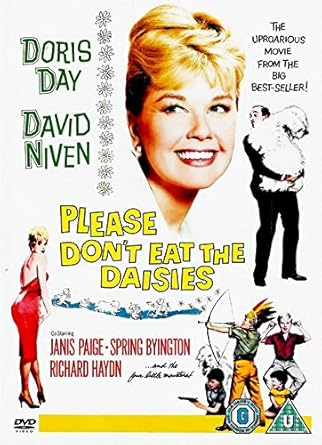
Please Don’t Eat the Daisies (1960) ****

This shouldn’t work at all. The episodic structure breaks all the narrative rules. Doris Day fans should be disappointed as she’s not in typical prim rom-com mode (Pillow TalkThat Touch of Mink), but a mother – and with four kids for goodness sake. And, beyond for some reason a sotto voce rendering of “Que Sera Sera,” she doesn’t sing until late on. Worse, she hardly qualifies as the main character. That privilege falls to David Niven.

But it has charm in buckets, it plays around with the rules, breaking all narrative conventions, setting up traps for the viewer, and the four siblings are superbly realistic, little cute or adorable about them, given their main occupation is dropping water bombs on unsuspected passers-by and, even adopting sedentary positions, can’t help but cause mischief.

Initial focus is on academic Laurence (David Niven), promoted to Broadway critic, making mincemeat of a play produced by best friend Alfred (Richard Haydn), in the process savaging its star Deborah (Janis Paige). He quickly becomes front page news when Deborah’s revenge is captured by a photographer. Fame goes to his head and wife Kate (Doris Day) feels she is losing him.

But then suddenly we switch to the countryside after they swap their New York apartment for a huge house. Cue the usual slapstick caused by holes in floors and the inevitable paint. Laurence’s lofty attitudes rile the locals. But before you know it we’re onto the third storyline, Kate reviving her dancing career by putting on a show with the local dramatic society.

By now we’re also knee-deep in sub-plots. Taxi driver Joe (Jack Weston), budding playwright friend of Kate’s mother Suzie (Spring Byington), weaves in and out of the tale. You are led to expect that his Biblical musical script, initially dismissed by Laurence, is going to play a part, perhaps turning up at the dramatic society, or being reworked by Alfred into a hit. You are almost certainly going to be convinced that Laurence will end up in Deborah’s bed. And you are even more certain that Alfred is going to get his revenge by bringing a huge squad of critics and celebrities to the first night of Kate’s play. Unknown to Laurence, Alfred has passed to Kate a rejected early embarrassingly bad effort by her husband when he harboured ambitions to be a playwright.

That all these set-ups are brilliantly confounded turns the entire movie on its head. And the reversals don’t involve cheating. It’s not a question of bait-and-switch, red herrings or sleight-of-hand, but down to the believable reactions of the characters.

In the middle of this, romance would be taking a back seat except both Kate and Laurence are aware of the growing distance between them so it’s more of a middle-aged love story, marriage on the rocks, but both parties making the same type of mistakes in trying to rectify the situation as in the usual will-she-won’t-she romantic template.  

The central focus could not be more topical – sudden fame, its impact on the lucky person and on those around. And I suppose the newspaper stunt that kicks off Laurence’s sudden notoriety is even more common today.

And I have to mention the kids. One of them gets his head stuck in a chair because “nobody told me not too.” That’s the kind of infuriating children they are, parents driven bonkers trying to anticipate their next unexpected venture. There’s a marvellous scene that pinpoints exactly why this whole picture works – by taking reality as its benchmark: Kate, trying to get ready to go out, is surrounded by apparently docile kids. But one, lying on the couch, has lifted his feet, unseen by her, so that he can tap the bottom of a painting on the wall, swaying it gently from side to side behind her head, just waiting for it to fall off.

Doris Day (With Six You Get Eggroll, 1968) digs a bit deeper than normal into her characterization. David Niven (Guns of Darkness, 1962) acts as if he is in a drama, not a comedy, never playing a scene for laughs, which is why he gets so many. When he does turn on the charm it’s not to seduce but to defuse a situation.

Janis Paige (Welcome to Hard Times, 1967) has a ball as the over-the-top star, posterior a matter of public interest, who is rewarded as much as the rest of the cast with deeper characterization than her initial shallowness could expect. Jack Weston (Mirage, 1965), too, goes through various shades before discovering that he has something unexpected to offer.

There’s a bunch of belly laughs, a joke dog, high-class bitchiness among the cocktail set, and a raft of reversals, but mostly it gets by on charm.

Veteran Charles Walters (Walk Don’t Run, 1966) looks as if he’s having a ball too, pulling the audience in different directions, turning up trumps with every reversal. Isobel Lennart (Fitzwilly / Fitzwilly Strikes Back, 1967) created the cunning screenplay from the book by Jean Kerr.

Discover WordPress

A daily selection of the best content published on WordPress, collected for you by humans who love to read.

The Atavist Magazine

by Brian Hannan

WordPress.com Blog

News, Tips & Website Tutorials