Behind the Scenes: “Two for the Seesaw” (1962)

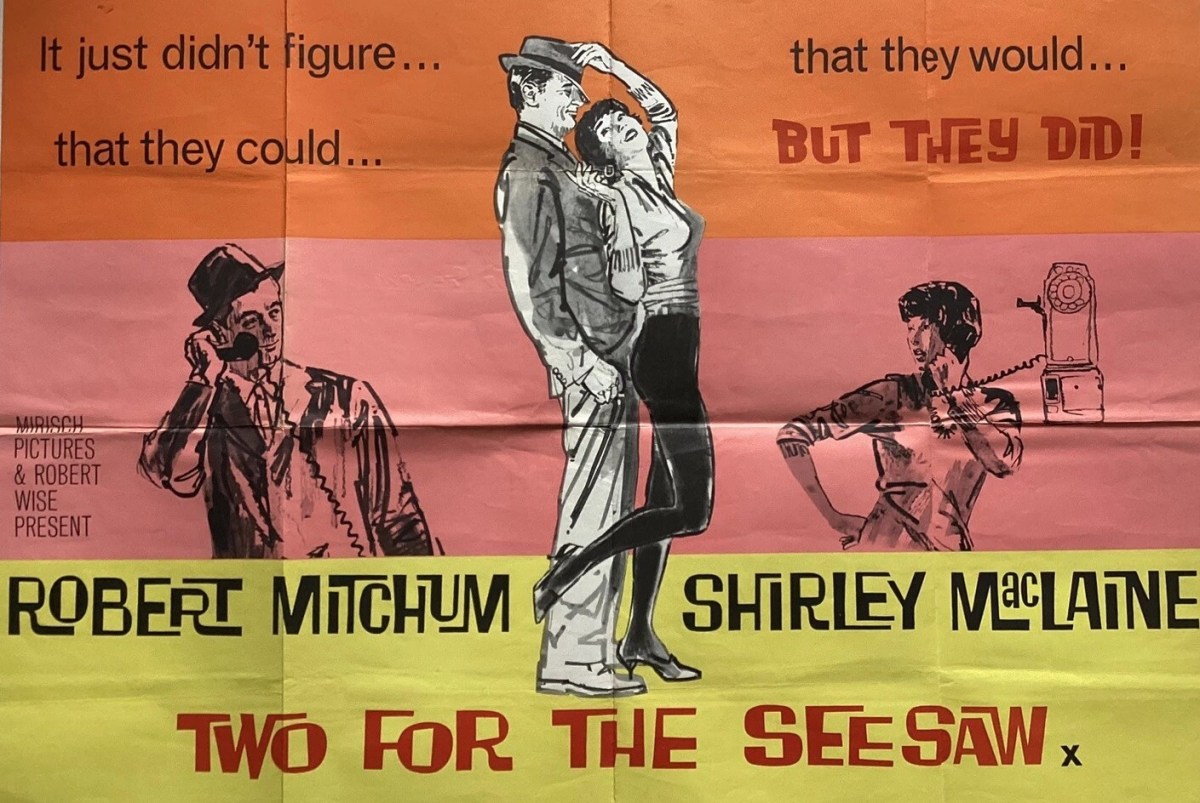
Had already cost a bundle before one foot of film was shot. Mini-major Mirisch Bros, flush from the commercial success of West Side Story (1961), had forked out $600,000 (plus a percentage) for the screen rights to the Broadway hit by William Gibson. (this was $250,000 more than West Side Story fetched). Between another $500,000 (plus percentage) for star Elizabeth Taylor and likely $250,000 for Gregory Peck, the producers were already well over a million bucks out of pocket.

The play had run for nearly two years on Broadway, earning a $570,000 profit, a remarkable sum in those days, and also set records for a touring production. It marked the Broadway debut of both  Anne Bancroft, who won a Tony, and writer William Gibson. They re-teamed for The Miracle Worker both on Broadway and in the 1962 film.

Over-runs on Cleopatra (1963) put paid to Taylor’s involvement, Peck pulled out, temporarily replaced by Paul Newman. Producer Walter Mirisch presumably didn’t think Henry Fonda and Anne Bancroft who’d played the parts on stage had sufficient marquee heft, nor was he keen on Broadway director Arthur Penn, and instead pursued Shirley MacLaine who he’s turned into a star thanks to The Apartment (1960) with Robert Mitchum stepping in for Newman (leaving him free to make the first of his iconic pictures, The Hustler, 1961)  Robert Wise, director of West Side Story and looking for a less onerous gig, signed on to direct.

Despite being filmed on a 60-day schedule, the bulk of it on a sound stage, the budget had rocketed to $3 million, around half of which went on the main players and the screen rights.

Mitchum wasn’t too keen on the role, believing himself miscast from the outset. The lighter touch of James Garner, also considered for the role, might have worked better. Mitchum had turned down the movie twice, suggesting Mirisch would be better off with William Holden or Glenn Ford, for whom repression was a given.

MacLaine was on a roll, signed to a four-picture deal with Mirisch. She was given not one but two roles previously advertised with huge fanfare to have starred Elizabeth Taylor. As well as Two for the Seesaw, Taylor had been primed for Irma La Douce. The Taylor deal came unstuck in part due to her illness but also was attributed to her insistence that a role be found for her husband Eddie Fisher.
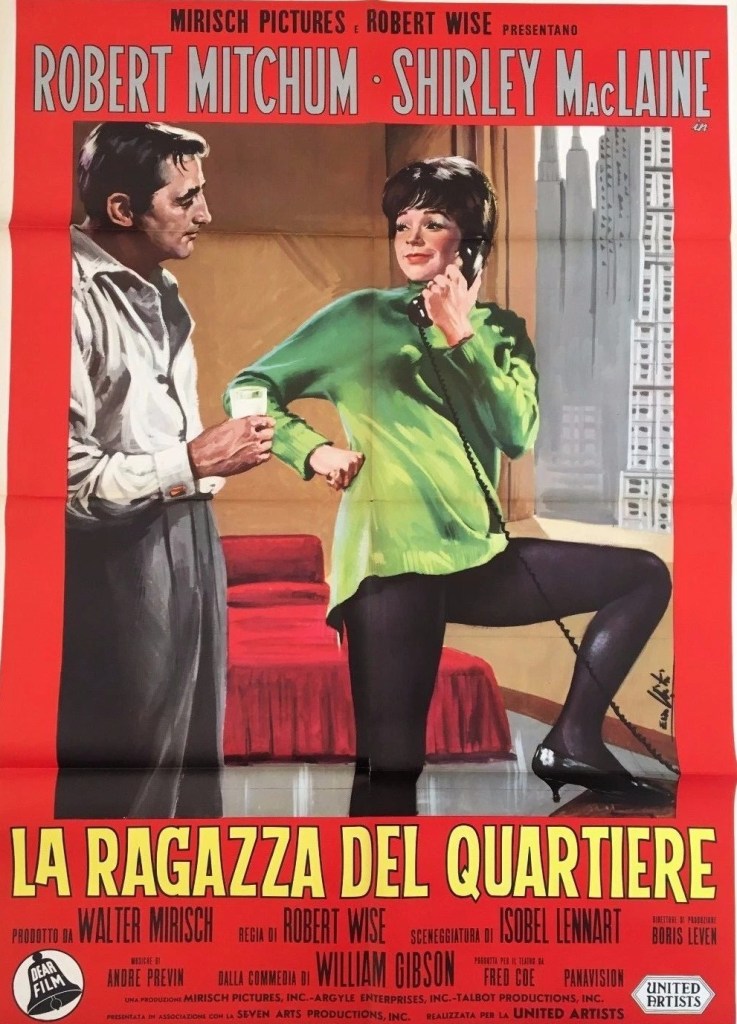
Wise and Mitchum had worked together earlier in their careers, in western Blood on the Moon (1948). And, no, this wasn’t the director hankering after working again with the actor. Noted Wise, “It was one of the few times I went on to a picture where the cast was already set. I don’t think Mitchum was quite right for the part. He was more believable in rougher, outdoor kinds of stuff.”

When they met at rehearsal, MacLaine was already a fan. Seventeen years younger than her co-star, she’d seen all his films, and was thrilled at working with one of her screen heroes. She was amazed at his photographic memory. He never had a problem with his lines. They certainly seemed to be getting on remarkably well for. Recalled Wise, “they got to ribbing and making jokes and making us all laugh so that the biggest problem we had was getting the two of them to settle down and get into the scene.” Added the director, “I had to have a closed set for a while. It was kind of embarrassed over what they were saying to each other. It was pretty spicy kidding, pretty ribald.2

Mitchum, apt to spout poetry, was revelation as a person far removed from his tough guy screen image. He was popular on set, very down to earth, mingling with all the crew and other actors. There was no entourage just a secretary bringing in lunch – and no hard liquor – for everyone.

What was going on between Mitchum and MacLaine was not obvious to everyone. Assistant director Jerome Siegel thought their light-heartedness was just a way of keeping tensions low on the set. “They were very subtle about it. You never saw anything where you could be sure there was a romance going on. but it didn’t surprise me when I did hear about it.” Needless to say, both actors were married at the time.

When Frank Sinatra and writer Malachy McCourt popped in to the set, Mitchum embarked on a drinking session that temporarily halted production, at least for the day. Wise infuriated his stars by using a stopwatch to time a kiss, one that was maybe going on too long with a pair of enamored characters. In his defense, Wise was just wary of the existing screen censorship, during which an overlong kiss would draw censure.

Wise had opened up the play with scenes set on Brooklyn Bridge and other parts accompanied by music suggesting the character was downcast. There’s a clever use of the split screen when the pair are on the telephone to each other.

The movie did well enough in first run New York and other big cities where the play had been performed but response outside those key sites and in the babes was muted. Most critics blamed the miscasting and Wise’s heavy direction.

SOURCES: Lee Server, Robert Mitchum, Baby I Don’t Cry (Faber and Faber, 2001); J.R. Jordan, Robert Wise, The Motion Pictures (BearManor, 2020); “Two Broadway Play Buys,” Variety, July 23, 1958;  “Seasaw Earned $570,000 Profit,” Variety, November 4, 1959; “Shirley MacLaine’s Creamy roles,” Variety, October 26, 1960; “Two for Seesaw Budget at $3-Mil,” Variety, February 14, 1962.

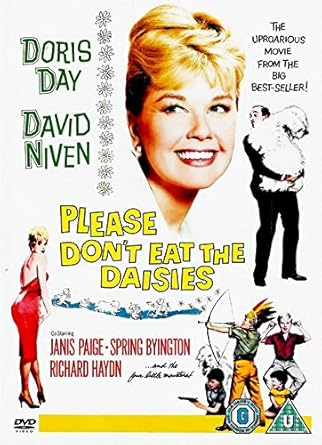
Please Don’t Eat the Daisies (1960) ****

This shouldn’t work at all. The episodic structure breaks all the narrative rules. Doris Day fans should be disappointed as she’s not in typical prim rom-com mode (Pillow TalkThat Touch of Mink), but a mother – and with four kids for goodness sake. And, beyond for some reason a sotto voce rendering of “Que Sera Sera,” she doesn’t sing until late on. Worse, she hardly qualifies as the main character. That privilege falls to David Niven.

But it has charm in buckets, it plays around with the rules, breaking all narrative conventions, setting up traps for the viewer, and the four siblings are superbly realistic, little cute or adorable about them, given their main occupation is dropping water bombs on unsuspected passers-by and, even adopting sedentary positions, can’t help but cause mischief.

Initial focus is on academic Laurence (David Niven), promoted to Broadway critic, making mincemeat of a play produced by best friend Alfred (Richard Haydn), in the process savaging its star Deborah (Janis Paige). He quickly becomes front page news when Deborah’s revenge is captured by a photographer. Fame goes to his head and wife Kate (Doris Day) feels she is losing him.

But then suddenly we switch to the countryside after they swap their New York apartment for a huge house. Cue the usual slapstick caused by holes in floors and the inevitable paint. Laurence’s lofty attitudes rile the locals. But before you know it we’re onto the third storyline, Kate reviving her dancing career by putting on a show with the local dramatic society.

By now we’re also knee-deep in sub-plots. Taxi driver Joe (Jack Weston), budding playwright friend of Kate’s mother Suzie (Spring Byington), weaves in and out of the tale. You are led to expect that his Biblical musical script, initially dismissed by Laurence, is going to play a part, perhaps turning up at the dramatic society, or being reworked by Alfred into a hit. You are almost certainly going to be convinced that Laurence will end up in Deborah’s bed. And you are even more certain that Alfred is going to get his revenge by bringing a huge squad of critics and celebrities to the first night of Kate’s play. Unknown to Laurence, Alfred has passed to Kate a rejected early embarrassingly bad effort by her husband when he harboured ambitions to be a playwright.

That all these set-ups are brilliantly confounded turns the entire movie on its head. And the reversals don’t involve cheating. It’s not a question of bait-and-switch, red herrings or sleight-of-hand, but down to the believable reactions of the characters.

In the middle of this, romance would be taking a back seat except both Kate and Laurence are aware of the growing distance between them so it’s more of a middle-aged love story, marriage on the rocks, but both parties making the same type of mistakes in trying to rectify the situation as in the usual will-she-won’t-she romantic template.  

The central focus could not be more topical – sudden fame, its impact on the lucky person and on those around. And I suppose the newspaper stunt that kicks off Laurence’s sudden notoriety is even more common today.

And I have to mention the kids. One of them gets his head stuck in a chair because “nobody told me not too.” That’s the kind of infuriating children they are, parents driven bonkers trying to anticipate their next unexpected venture. There’s a marvellous scene that pinpoints exactly why this whole picture works – by taking reality as its benchmark: Kate, trying to get ready to go out, is surrounded by apparently docile kids. But one, lying on the couch, has lifted his feet, unseen by her, so that he can tap the bottom of a painting on the wall, swaying it gently from side to side behind her head, just waiting for it to fall off.

Doris Day (With Six You Get Eggroll, 1968) digs a bit deeper than normal into her characterization. David Niven (Guns of Darkness, 1962) acts as if he is in a drama, not a comedy, never playing a scene for laughs, which is why he gets so many. When he does turn on the charm it’s not to seduce but to defuse a situation.

Janis Paige (Welcome to Hard Times, 1967) has a ball as the over-the-top star, posterior a matter of public interest, who is rewarded as much as the rest of the cast with deeper characterization than her initial shallowness could expect. Jack Weston (Mirage, 1965), too, goes through various shades before discovering that he has something unexpected to offer.

There’s a bunch of belly laughs, a joke dog, high-class bitchiness among the cocktail set, and a raft of reversals, but mostly it gets by on charm.

Veteran Charles Walters (Walk Don’t Run, 1966) looks as if he’s having a ball too, pulling the audience in different directions, turning up trumps with every reversal. Isobel Lennart (Fitzwilly / Fitzwilly Strikes Back, 1967) created the cunning screenplay from the book by Jean Kerr.

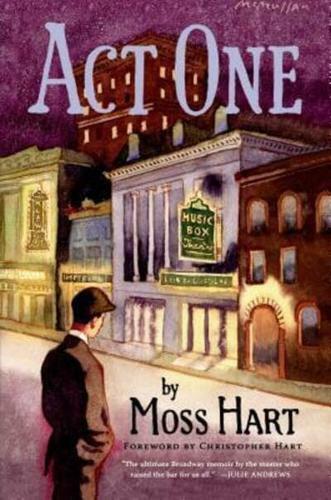
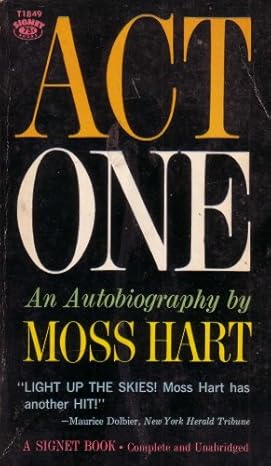
Act One (1963) ****

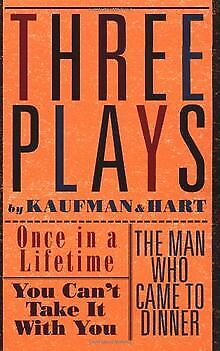
Highly enjoyable and surprisingly good. Could be viewed as a companion piece to Two Weeks in Another Town (1962), swapping movies for Broadway. I have to confess I had only seen the writing team of George S. Kaufman and Moss Hart in the context of movies – Frank Capra’s Oscar-winning You Can’t Take It With You (1938) and The Man Who Came to Dinner (1942). I hadn’t realized these had begun as plays and the movie tells the story of the beginning of their partnership when Kaufman was an established playwright and Hart a neophyte.

Perhaps because this was the only directing gig for Dore Schary, better known as a screenwriter (Boys Town, 1939), producer and head honcho at MGM, there’s none of the melodrama of Two Weeks in Another Town. In fact, except for an occasional appearance by Kaufman’s exasperated wife, there’s hardly a woman in sight and certainly no complicated nuptials or even romance.  It’s basically a two-hander, the relationship between the two writers and their struggle to turn the play Once in a Lifetime (1930) into a hit.

It’s helped along by what must be most subdued and subtle performances in the careers of either George Hamilton (Two Weeks in Another Town) or Jason Robards (Once Upon a Time in the West, 1969). This is easily Hamilton at his finest and it is one of Robards’ better performances. Rather than gung-ho turns, all sturm and drang, emotions out of control, the two actors inhabit their characters. Once only is Hamilton let off the leash, in an unfair tirade against buddie Joe (Jack Klugman) and is far more effective in a scene where he doesn’t say a word, and Schary has employed a film noir technique of leaving a face, apart from the eyes, in darkness, as he comes to terms with the realization he has a hit on his hands.

The story simple enough. In 1929, cigar-maker father out of work, family struggling to cope with the onset of the Great Depression, Hart is a struggling playwright, first five serious works rejected. But turning to a comedy about Hollywood, he strikes gold. Or at least some gold dust. Because a play on paper is scarcely the finished work. Teamed up with a recalcitrant, grumpy, introspective, monosyllabic Kaufman, Hart finds out the hard way just what it takes to turn prospect into success.

Mostly, it’s rewrites. And more rewrites. What’s wrong with the initial play is everything bar the idea. What’s wrong after that is everything they haven’t been able to fix. Gets to the stage where Kaufman – remember, the more experienced one – is ready to quit.

So once Kaufman appears, it’s mostly two guys in a room or backstage trying to sort out a myriad of problems. There’s some nice interaction. Kaufman never eats, so Hart is constantly famished. Kaufman hates Hart’s cigar smoke. Eventually, they come to an agreement, constant food in exchange for extinguishing the cigars (a pipe deemed an acceptable substitute).

There’s a cast of interesting characters, famous producer (Eli Wallach) and Hart’s support network, talented unsung writers and actors (including Archie Leach before he went Hollywood and became Cary Grant, his attraction to females a constant refrain), and a scene-stealing George Segal (The Quiller Memorandum, 1966). At a party we briefly meet the Alqonquin Round Table set, all insufferable and barely a bon mot between them.

Movies about the stage invariably involve an actor so this makes a refreshing change. And most films about writers concern the literary artist rather than the more overtly commercial variety. But I’m guessing the level of endeavour is much the same.

But it’s the lack of grandstanding that makes this work. Rather than lading down characters with tons of dramatic dialogue much of the piece is carried by small bits of business, the fastidious Hart snipping loose threads from a shirt, pressing his trousers under his mattress, the equally finicky Kaufman constantly washing his hands and the scourge of sentimentality. Sure, it’s showtime, so there’s a measure of bitchiness, a marvellous scene where Kaufman imagines a producer’s positivity is intended to put him off.

Unexpectedly excellent acting lifts this. Not easy to find, Ebay would be the best place.

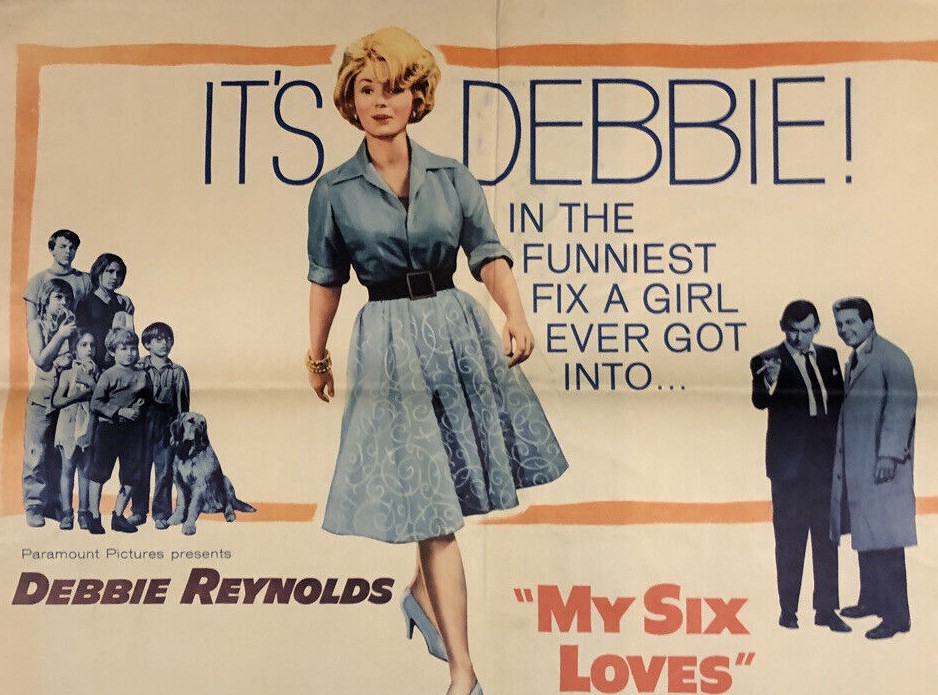
My Six Loves (1963) ***

It was a rite of passage for rising male stars to take second- or third-billing to an established top-billed female. And, more importantly, rein in all attempts at scene-stealing. This is a Cliff Robertson minus the distinctive hunk of hair and lip-chewing of later performances and a David Janssen only beginning to learn the knack of talking out of the side of his mouth. They were probably kicking themselves for the indignity of ending up in such as harmless concoction, but the idea was, if it was a hit, it’d be a leg up the career ladder.

This frivolity, by the way, is probably offensive to a contemporary audience since the thrust of the story is an actress abandoning a successful Broadway career in favor of motherhood. On the other hand it is the very definition of comfort movie.

Janice (Debbie Reynolds), in love with her aggressive and somewhat conniving producer Marty Bliss (David Janssen), collapses at a publicity junket and convalesces at her second home in Connecticut, so far removed from the center of theatrical civilization that she never visits and in consequence the property has been taken over, for their own enjoyment, by her housekeeper and her daughter, who now object to spending a moment catering for their employers. In the grounds lurk a brood, half a dozen orphans taking refuge from their exploitative foster parents.

It doesn’t take long for Janice to sucker herself into taking them into her house, assistant Ethel (Eileen Eckhart) as clueless. On hand offering advice is local minister Jim (Cliff Robertson).  If the kids are a handful, refusing to be separated which entails them all sleeping in the same room, they’ve got nothing on their boisterous hound Butch.

We’re past the halfway mark before it occurs to Janice that she is treading dangerous emotional waters and she jumps at the chance to star in a heavyweight drama by current Broadway playwright kingpin. Meanwhile, smelling a hefty payoff, drunken foster parents Doreen (Mary McCarty) and BJ Smith (Max Showalter) turns up, Jim takes an unrequited romantic interest in his neighbor, Janice discovers her community spirit by helping raise money for charity, one of the kids runs away from hospital, and another has trust issues, leaving the other four with little to do but look cute.

Somehow within all this there’s a cue for a song, “It’s a Darn Good Thing” before Janice has to take the decision to sink or swim with the kids or hi-tail it back to Broadway where the prospect of a Tony beckons.

You’ve probably seen this all before, but somehow – taking the career issue out of the equation – it all works, an overactive ice machine, racing in and out of the school bus, meal-time complications, and wouldn’t you believe it a slice of love. No prizes for guessing the ending.

But it’s testament to Debbie Reynolds (How the West Was Won, 1962) that the movie has an appealing center. Cute kids are ten a penny in Hollywood but an actress able to make believable such an old-fashioned family-friendly tale is hard to come by.  Sure, by today’s standards it’s outdated, but if we can just slip on a retrospective hat, she would not be the first career-minded woman of that decade to find she had ignored her maternal instinct. It might have been better all round if she had found a way to have both career and motherhood but the planet and certainly not Planet Hollywood was not yet on that wavelength.

Of course, it being lightweight ensures none of the other characters have any depth and to their credit neither Cliff Robertson (Masquerade, 1965) nor David Janssen ((Warning Shot, 1967) resorts to showboating, a smart decision because with the charismatic Reynolds taking center stage they could hardly compete. And I have to confess I quite like this early version of Robertson before he was overtaken by a need for weightier roles. He showed a neat comedic touch, had some of the best lines, and proved no slouch in the verbal sparring department. Janssen, too, showed a lot of promise.

Max Showalter (How to Murder Your Wife, 1965) had such a convincing drawl that I was convinced I was watching Strother Martin (Cool Hand Luke, 1967). A good opportunity also to check out distinctive character actors Eileen Eckhart (No Way To Treat a Lady, 1968) and  John McGivern (Midnight Cowboy, 1969)

You can hardly blame famed Broadway director Gower Champion (The Bank Shot, 1974), only too aware of the pressures of maintaining a stage career, for thinking that a life in Connecticut with a bunch of eventually pliant and cute kids would be a welcome alternative. It took three screenwriters to spin this tale – John Fante (Maya, 1966), William Wood (The Lively Set, 1964) and Joseph Calvelli (Death of a Gunfighter, 1969).

Bearing in the mind the aforementioned provisos, not a bad Sunday matinee. Alternatively, come at it from today’s perspective and you will be inclined to rip it to shreds before you give it a chance to be entertaining. You might even consider it a tad more adventurous in its more realistic approach than other multiple-kid pictures like Cheaper than the Dozen (1950) and Yours, Mine and Ours (1968).

Discover WordPress

A daily selection of the best content published on WordPress, collected for you by humans who love to read.

The Atavist Magazine

by Brian Hannan

WordPress.com News

The latest news on WordPress.com and the WordPress community.