Borderlines / The Caretakers (1963) ****

Two sequences set this apart from the mini-cycle of films Hollywood was temporarily producing on the theme of mental illness and the institutions set up to treat it such as the Frank Perry’s empathetic and occasionally lyrical David and Lisa (1962), Robert Rossen’s Lilith (1964) – both essentially romances – and Sam Fuller’s more brutal The Naked Kiss (1964).

Both sequences come early in the picture, setting, visually, the tone. In the first, crusading psychiatrist Dr Donovan MacLeod (Robert Stack) goes onto a ward to see a patient. It’s old-fashioned in the way of hospitals back then, patients in metal-framed beds. But as the camera pulls back, we see it’s not just a ward, it’s so big it’s a warehouse crammed full of sedated mental patients.

In the second scene, chief nurse Lucretia Terry (Joan Crawford) has her female staff in a room kitted out in leotards. And such attire is not for the titillation of the audience, equivalent to the kind of changing room sequence in later films designed to provide glimpses of female flesh. Instead, it’s a judo class. Terry is teaching the nurses how to defend themselves against attack.

The narrative focuses on MacLeod trying to change treatment of mental illness away from sticking patients full of sedatives or submitting them to the ubiquitous electroshock and locking them in a giant warehouse, keeping them well out of sight of the rest of the world who can’t understand why a loved one has gone mad. Terry wants to stick to the current method.

MacLeod crosses verbal swords all the way through with Terry and despite his persuasive tones no sign that she’s going to agree with his new idea of group therapy to attempt to cure those patients who have not yet fully succumbed to their illness, those who are still on the “borderline.”

There’s certainly plenty evidence to back up Terry’s fears that any slacking in security will result in harm to both nurses and patients given that among the group given substantial leeway by MacLeod are those who will try to stab people, set fire to the ward and break the golden rule of entering a male ward.

While the arguments are going on about the need to take a new approach to dealing with mental illness, the main focus is on the ragbag of patients in group therapy, people with much the same bunch of problems – although highly exacerbated – as you’d find within a group on a sinking ship or going to war. Issues with parents, children, sex and alcohol have brought these patients in the national care.  

While there are moving moments, as you’d expect, there is no resolution at the end, and nothing in the way of miraculous cure. The best that can be hoped for is that if huge steps forward are made in patient’s understanding of their illness then perhaps they can be shifted from this appalling warehouse to a day center, spending nights at home, being treated during the day, much of their rehabilitation depending on reconnecting with the world rather than being shut off from it.

Lorna (Polly Bergen) hasn’t recovered from the death of her child, sees every consoling move from husband Jim (Robert Vaughn) as an attempt to instigate sex. Sex worker Marion (Janis Paige) is intent on getting drunk, from cocktails of any item that could contain alcohol, Edna (Barbara Barrie) is mute. New nurse Alison (Diane McBain), coming up against the old school Nurse Bracken (Constance Ford), is given a savage reality check.

Much of the tale is just about permitting the patients humanity, to see each other not as terminal victims of their illness, but to have human contact and interaction with others in the same boat. Naturally, feelings run high and the incidents I have mentioned recognize the dangers inherent in exploring new methods and the freedom that involves.

Joan Crawford (Berserk, 1967), permed within an inch of her life, has a ball as the tough cookie, the Nurse Ratched of her day, and would steal the show except for the sympathetic playing of Robert Stack (The Corrupt Ones/The Peking Medallion, 1967) and for the fact that Janis Paige (Welcome to Hard Times, 1967) is hellbent on stealing the show. It’s left to Polly Bergen (Kisses for My President, 1964) to put in the hard yards of showing the bewilderment and confusion that affects anyone struck down by mental illness.

Hall Bartlett (All the Young Men, 1960) is triple hyphenate here – writer, producer and director – and does a swell job of putting forth the argument without giving in to sentimentality.

Worth a watch.
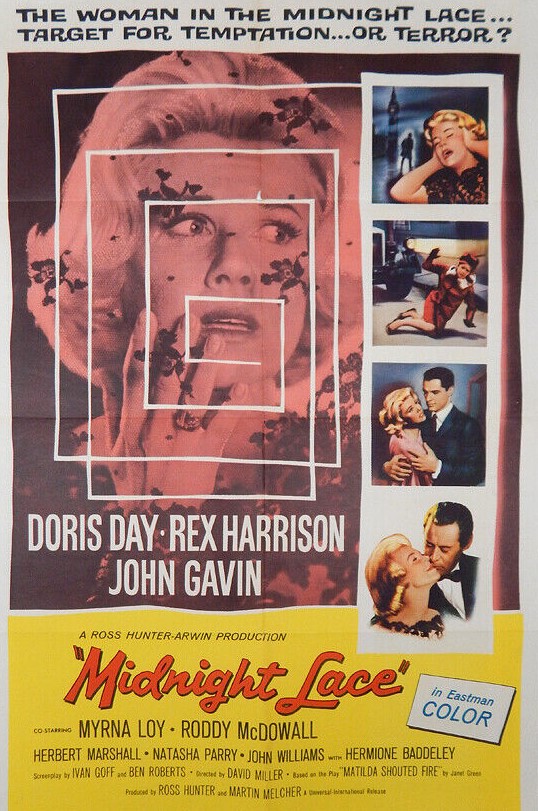
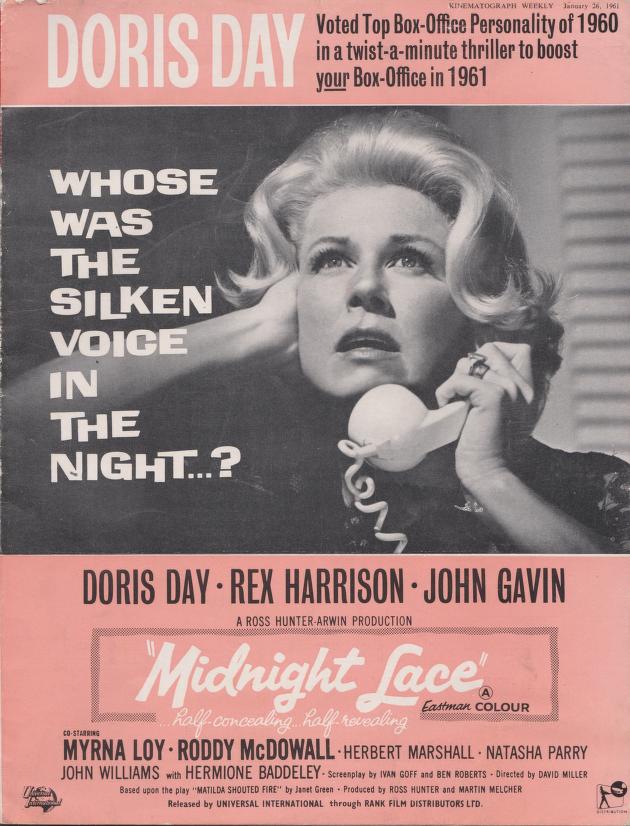
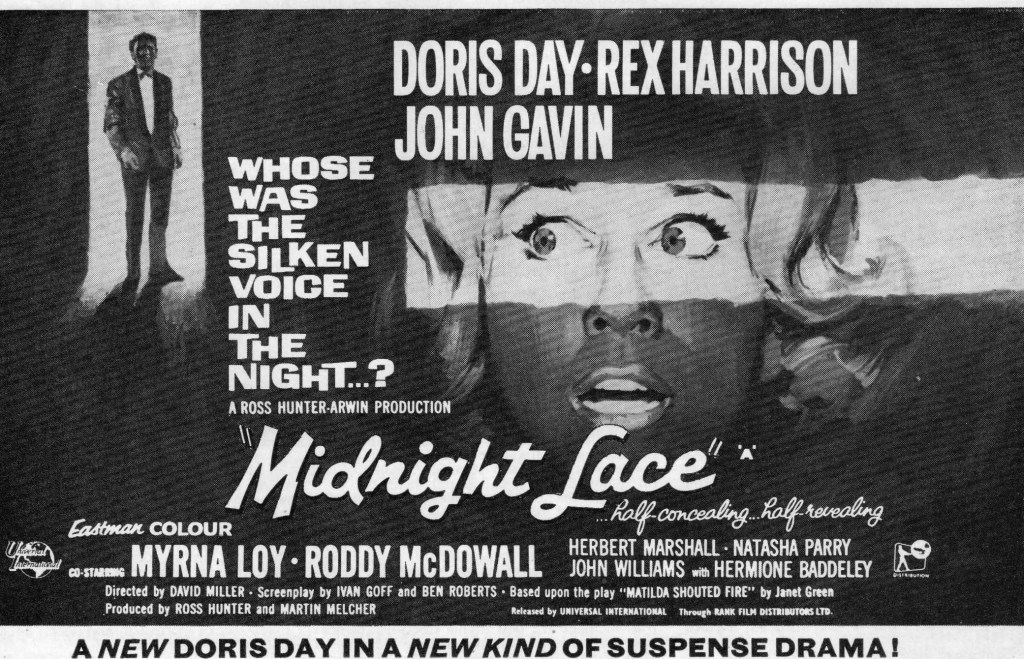
Midnight Lace (1960) ****

Works for the very reason that it shouldn’t – Doris Day’s off-the-scale hysteria. The actress junks her usual screen persona of spunky occasionally lovelorn heroine and channels her abundant physical energy into an exceptionally good portrayal of a woman on the verge of a nervous breakdown.

And, unlikely as it sounds, this a companion piece to David Miller’s later Lonely Are the Brave (1962),which equally presents a discordant character at odds with their surroundings whose inability to settle into the norm precipitates downfall.

Heiress Kit (Doris Day) is being hounded mainly over the telephone by a creepy stalker with a high-pitched voice, threatening to kill her. Before you can say Gaslight, you are casting a suspicious eye on millionaire businessman husband Anthony (Rex Harrison). But that only lasts for as long as it takes for a whole bunch of other suspects to hove into view.

The sinister man in black hat and coat appears too obvious a contender. Others have something off about them or appear at the wrong time and wrong place. Unemployed ne’er-do-well Malcolm (Roddy McDowell) who sponges off his mother, attempts unsuccessfully to tap Kit for funds and makes it plain he won’t be doffing his cap to her. Builder Brian (John Gavin) is over-friendly and, we overhear, makes a lot of phone calls.

And you wouldn’t count out gambler Charles (Herbert Marshall), an executive in Anthony’s firm, which, by the way, has uncovered a bit of fraud. Nor happily-married Peggy (Natasha Perry), Kit’s friend, who turns up in a bus queue the very moment Kit nearly ends up under the wheels of a London bus. And then there’s Aunt Bea (Myrna Loy) who’s arrived from America and seems determined not to take Kit’s side.

Naturally, nobody can allay Kit’s suspicions. The police are the first to suggest she’s going off her head, seeking attention because neglected by her husband.

But this is so well done, Kit jumping at the slightest noise, that you are pretty much convinced it’s going to be one of those films where every incident is imagined, especially since that would be a helluva coup to have an actress of the lightweight caliber of Doris Day to play her.

Whenever anyone else answers the phone it’s to an innocent caller. And when Kit persuades Peggy to pretend she heard the voice, discovery of that ruse appears to seal her doom.

When we’re not stuck in Kit’s head, there are sufficient tense moments to keep the plot ticking along, trapped in an elevator, shadows on a ceiling, faces glimpsed in windows, voices appearing out the fog, whispers behind her back, friends turning against her, every  police ploy a dead end.

Quite why she’s such a giddy character to begin with is never explained, except of course being a millionairess, three months married, with nothing better to do with her time than waltz around in one stunning fashionable outfit after another, life a succession of expensive treats, and whisked off her feet, when he can spare the time, by adoring hubby.

So maybe it’s something as simple as a loved-up wealthy woman finding cracks appearing in her perfect life and in trying to ascertain the cause whirling round faster and faster. There’s certainly no sense of a solid character who could sit down and give herself a good talking-to or transform herself into an amateur sleuth. When the façade breaks, it’s a dam burst.

If at the beginning Doris Day seems already too-wound-up it doesn’t really matter, her lust for life turns very quickly into abject fear as the terrorization becomes only too real. This is a fantastic performance from the actress, woefully under-rated, and the scene where she collapses on the stairs is only too believable.

Rex Harrison (The Happy Thieves, 1962) is excellent in a custom-made role, handsome adoring husband, but every time he clasps her in a sympathetic embrace, the camera lingers on his eyes showing growing fear at her condition. The roster of supporting stars each brings something distinctive to their role, from the wheedling Roddy McDowell (Five Card Stud, 1968), in only his second movie role after eight years of solid television,  the too-good-to-be-true John Gavin (Back St, 1961) and old-timers Myrna Loy (The Thin Man, 1934) as the doubting aunt and Herbert Marshall (The Letter, 1940) as the impecunious gambler.

Director David Miller (Captain Newman, M.D., 1963) moves the camera in disconcerting fashion. You think you’re settled in for a stage-style scene when suddenly the camera whirls away and focuses on one character. The scene in the elevator is exceptionally well-done as is the finale, but possibly his biggest attribute is encouraging Doris Day to just go for it rather than reining in her character the way Hitchcock did for The Man Who Knew Too Much (1956).

The team of Ivan Goff and Ben Roberts (Portrait in Black, 1960) put together the screenplay from the hit Broadway play Matilda Shouted Fire by Janet Green.

I came at this with low expectations, not imagining Doris Day could pull off such a difficult role, and I came away wondering why she had not in consequence been given other opportunities to show off her dramatic skills.

Discover WordPress

A daily selection of the best content published on WordPress, collected for you by humans who love to read.

The Atavist Magazine

by Brian Hannan

WordPress.com Blog

News, Tips & Website Tutorials