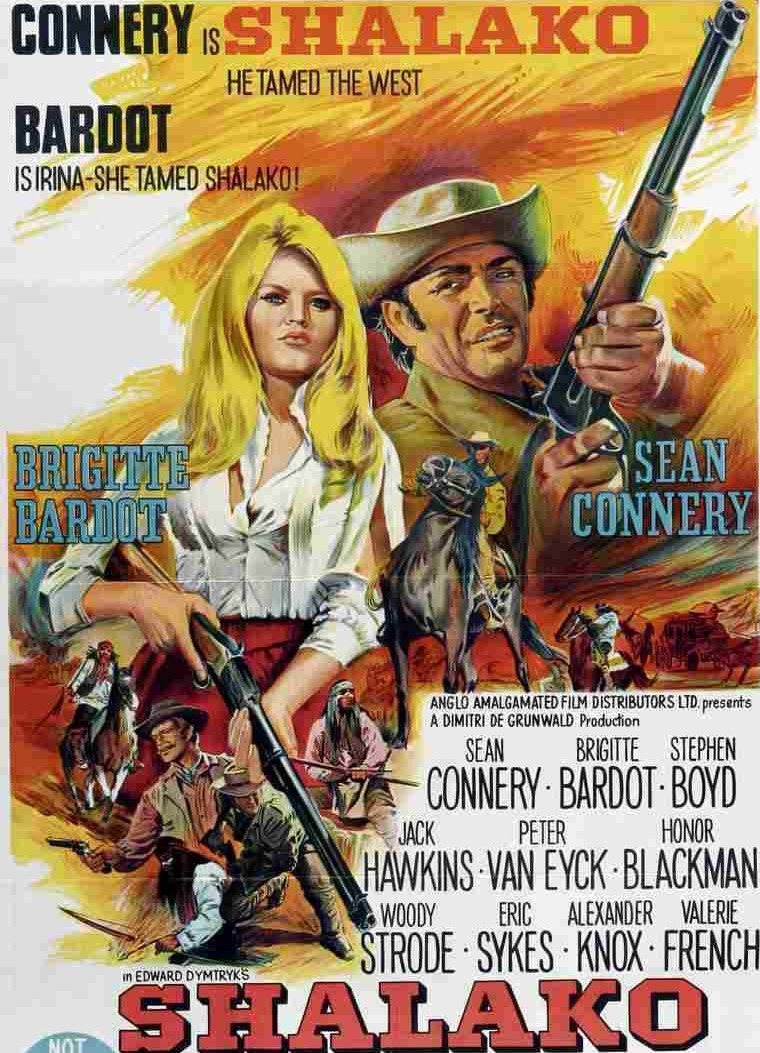
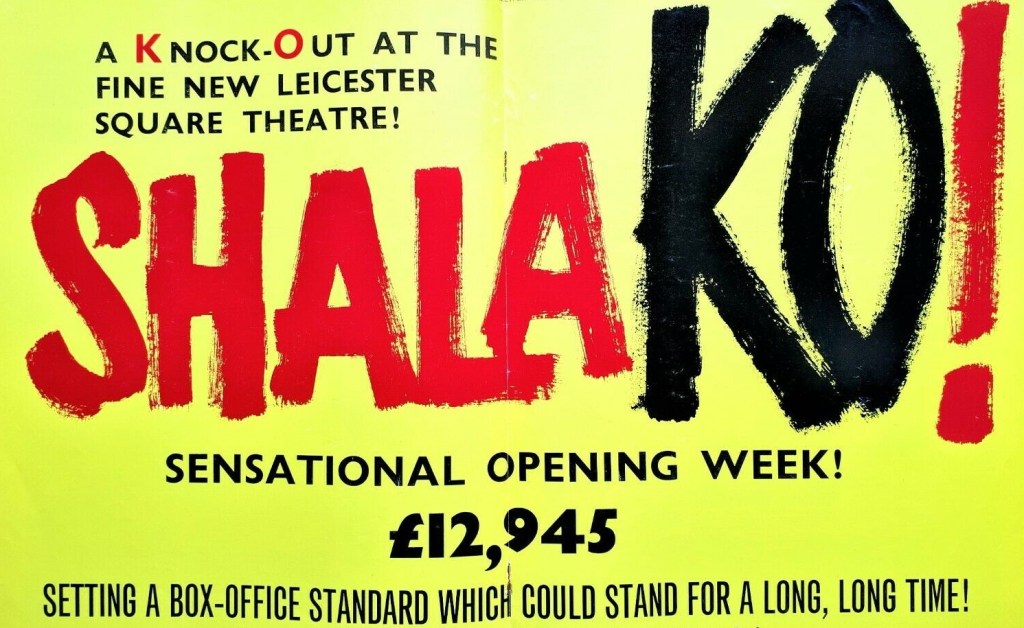
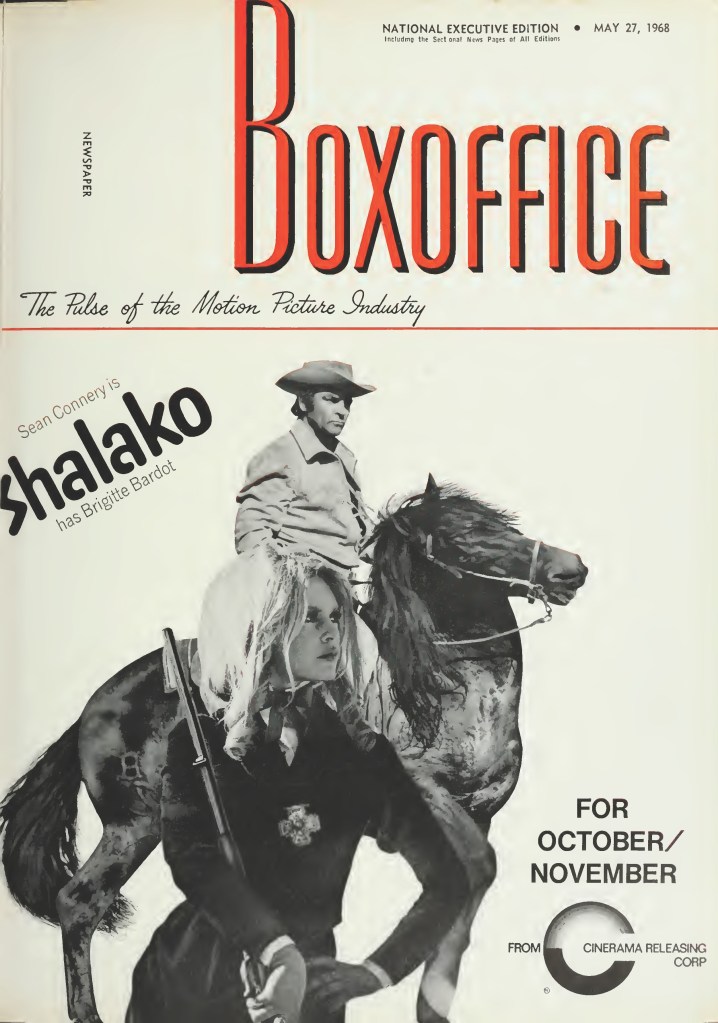
Shalako (1968) ***

It’s a gripping and unusual opening. The jangling noise of metal beating upon metal. A trapped mountain lion surrounded by a posse of unkempt men. The beast driven into a killing zone. The camera ends up on a classy blonde in a top hat, Irina (Brigitte Bardot), drawing a bead on the animal. But as she shoots so does rugged cowboy Bosky (Stephen Boyd) and you can be sure his aim is more deadly. It wouldn’t do to have an upper-class European lady to be mauled to death by a vicious creature just because her ego got the better of her.

Except that’s not the opening. Instead, that’s sacrificed for a dumb theme tune and a few minutes over the credits watching titular hero Shalako (Sean Connery) doing what exactly? Nothing exciting that for sure. We see him riding I guess to prove he can sit as tall in the saddle as the stars of the genre like Alan Ladd, John Wayne, Gary Cooper, James Stewart, as if nobody expected James Bond to be able to complete such a transition. There’s a bit of waking up, more riding, drinking from a dirty stream, and more riding while composer Jim Dale struggles to find lyrics that rhyme with Shalako.

There’s a bit more exposition before Shalako does anything meaningful. We are introduced to a fistful of Europeans on a hunting party complete with butler (Eric Sykes) and guzzling champagne and escorted by a bunch of mean-looking cowboys looking on in envy though I doubt any would acquire a taste for champagne.

Then the real action starts. A bit’s been missed out explaining just why Irina took off on her own with just one man as escort to continue hunting and nobody thought fit to warn her this was Apache country. We know she’s in trouble because her escort is just about dead and Apaches are gathering. Enter Shalako to save the day. The first piece of dialogue between the most handsome man in the world and the screen’s most beautiful woman, a movie made just so Connery, at his Bond peak, and Bardot, in her most expensive picture, could strike sparks off each other,  is hardly something to treasure. It’s almost priceless for its mundanity. “You all right?” grunts Shalako. “Yes,” replies the breathless heroine.

But trust the British to bring that epitome of British moviemaking, the class war, to that most democratic of movie species, the western. It’s ironic that in the country where freedom is a given  – slavery long since abolished in the period this movie was set – members of the hunting party are fettered. Irina is little more than bait. You might as well have staked her out, hoping to snare German aristocrat von Hallstatt (Peter van Eyck). Marriage would cure the financial woes of her debt-ridden sister Lady Daggett (Honor Blackman) and husband Sir Charles (Jack Jawkins). Von Hallstatt doesn’t believe in making romantic overtures, it would be, like so many aristocratic marriages, a contract of convenience; he acquires beauty, she gets wealth.

To complicate matters Lady Daggett has a roving eye which has settled on Bosky, and to complicate matters even further, nobody should be firing rifles, even if only for sport, in Apache territory. It’s not long before the Apaches take umbrage and launch an attack. And it takes even less time for Bosky and his buddies to take off, leaving their charges poorly defended in a makeshift fort.

It takes way too long to sort out all these plot machinations and get to the meat of the story which is finding a way of putting Connery and Bardot together and when they are not the movie trundles along without much in the way of screen sparks. It could have done with an entirely different scenario. Something akin to Soldier Blue (1970) would have worked a treat, with roles reversed of course back to the traditional of experienced male tending the inexperienced female as they battle through enemy territory.

You needed to get this pair together – and quick – for the movie to find any steam at all. As it is, it’s somewhat laborious. While the action sequences are well done and Shalako scores in the western lore department, you wouldn’t have thought a mountaineering subplot could have produced so few thrills, its only purpose, plot-wise, to ensure that von Hallstatt acquires some credibility (he’s the mountaineer) and that the group can reach a plateau whose main attraction, as lovers of westerns will already be aware, is a pool where in the great Hollywood tradition a woman can disport herself half-naked. Shalako, in sneaking up on her, comes across like a bit of a peeping tom.

Sean Connery (The Hill, 1965) is convincing enough as a cowboy. He certainly doesn’t look out of place on a horse but it takes far too long for the expected romance to begin. Brigitte Bardot (Viva Maria!, 1965) is better than you might expect as a sharpshooter, but not quite in the fiery class of a Claudia Cardinale (The Professionals, 1966) or even Maureen O’Hara (The Rare Breed, 1965) and she’s not really given the dialog necessary to fully establish the independence of her character.

Director Edward Dmytryk (Mirage, 1965) does his best with an overly-complicated script and some cumbersome set-pieces and it would have worked far better if a few characters and reams of sub-plot had been chucked aside to bring the stars together quicker. While Connery does the riding and shooting well enough he lacks the grizzled lived-in face of his famed western predecessors and I get a sense of him trying too hard. And, as I said, it wouldn’t have taken much to pep up Bardot.

Having complained about the subsidiary characters, they are all well-drawn. Stephen Boyd (The Big Gamble, 1961) makes on helluva mean cowboy, Honor Blackman (Moment to Moment, 1966) is excellent as a predatory female. Aristocratic pair Peter van Eyck (Station Six Sahara, 1963) and Jack Hawkins (Masquerade, 1965) are the kind of actors who can denote fallen status with facial expression rather than requiring lumps of dialog. But Eric Sykes (The Plank, 1967) is really a British in-joke.

James Griffith and screenwriting partner Hal Hopper had previously worked on Russ Meyer epics like Lorna (1965). The original story came from  a novel by Louis L’Amour (Catlow, 1971).

Out-with his guise as James Bond, Connery – excepting Robin and Marian (1976) and Cuba (1979) – was not one of the screen’s great lovers so this would have been the perfect chance  to hone those particular credentials. But like the entire picture this was a missed opportunity. When the best scene is the brutal suffocation of Honor Blackman and not the two stars canoodling, you can see the target was missed by miles.

Genghis Khan (1965) ****

Hollywood was never reined in by the strictures of history, much preferring fiction to fact for dramatic effect, and that’s largely the case here, although the titular hero’s real life remains shrouded in myth.

If you do catch this surprisingly good feature, make sure it’s not one of the many pan-and-scan atrocities on the market. I watched this in the proper Panavision ratio which meant it occupied only one-third of my television screen, but in that format it’s terrific. It’s a bit of an anomaly for a decade that churned out high-class historical epics like El Cid (1961) because this clocks in about a hour short of other films in the genre and there’s no star actor or director to speak of and no Yakima Canutt to handle the second unit action scenes.

Omar Sharif’s marquee value at this point was so low that if you check out any of the original posters you’ll note that his name hardly rates a mention and he also comes at the very end of the opening screen credits. Although this is post-Lawrence of Arabia (1962), it’s pre-Doctor Zhivago (1965), suggesting nobody had a clue how to market his talents.

Director Henry Levin was a journeyman, fifty films under his belt, best known for not a great deal except for, following this, the second and third in the Matt Helm spy series. Given this film was critically ignored on release and since, and a flop to boot, it definitely falls into the “Worth a Look” category. Although there are few stand-out scenes of the artistic variety such as pepper Lawrence of Arabia or El Cid, this is still well put together and Levin shows an aptness for the widescreen.

The narrative breaks down into three parts – the first section describing enslavement of Genghis Khan (Omar Sharif) by nemesis Jamuga (Stephen Boyd – the picture’s star according to poster and screen credits) – before banding together rival tribes in revolt; the second part a long trek to China; and the third encompassing a final battle and hand-to-hand combat with Jamuga. For a two-hour picture it has tremendous sweep, not just the scenery and the battle scenes, but political intrigue, romance, a rape scene and even clever comedy. Genghis Khan  believes his glory is predestined, but he has very modern ideas about the role of women.

The best section, oddly enough, is set in China where Genghis engages in a duel of wits with the distinctively contradictory Emperor (Robert Morley), but that’s not to detract from the film’s other qualities, the action brilliantly handled, especially the chaos of battle, the romance touching, and the dialog intelligent and often epigrammatic.

Unlike James Mason (Age of Consent, 1969) who makes a calamitous attempt at a Chinese accent, Robert Morley (Some Girls Do, 1969), costume apart and looking as if he has just walked out of an English country house, but his plummy tones belie a very believable character. Stephen Boyd (Assignment K, 1968) shines as the villain of the piece. Telly Savalas (Battle of the Bulge, 1965) and Woody Strode (The Professionals, 1966) have decent parts as Khan’s s sidekicks, the former unexpectedly bearing the brunt of the film’s comedy. French actress Francoise Dorleac (Billion Dollar Brain, 1967) is effective as Sharif’s wife.

Hitchcock stole one of his most famous ideas from Genghis Khan. About the only scene in Torn Curtain (1966) to receive universal praise was a killing carried out to a soundtrack of nothing more than the grunts of assailant and victim. But, here, where the score by Yugoslavian composer Dusan Radic was extensively employed, the rape scene is silent and just as stunning. If the only prints widely available are of the pan-and-scan variety I’m not surprised the film has been for so long overlooked, but if you can get hold of one in the preferred format you will be in for a surprise.      

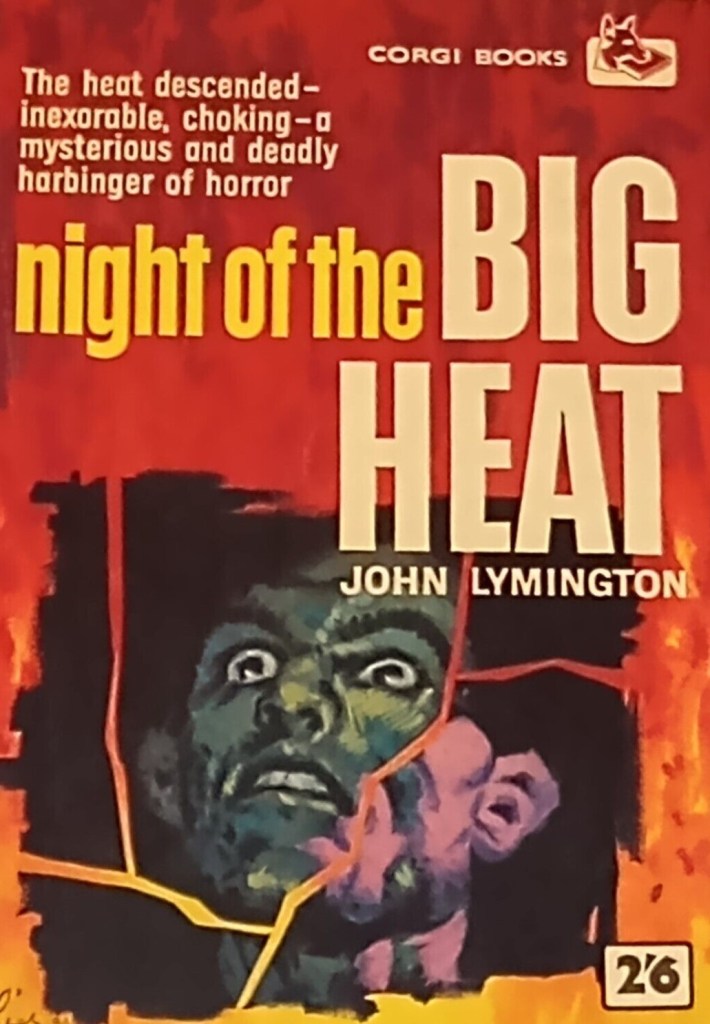
Night of the Big Heat/ Island of the Burning Damned (1967) ***

The Day the Earth Caught Fire (1961) meets War of the Worlds with a nod in the direction of Star Trek.  In the absence of a decent budget director Terence Fisher (Dracula Prince of Darkness, 1966) loads the movie with decent actors and relies of suspense rather than revelation. Ignoring the obvious opportunities for beefcake, partially embraces cheesecake.

While you might anticipate a horde of sweat-soaked men you will be taken by surprise by that most un-English of scenes – delight in a downpour. This is more sensibly located on a remote island rather than a big city and dials down on the preachy stuff, nothing to do with  atomic bombs, but still alien invasion.

Instead of The Old Dark House it’s a very hot English pub in winter – a time when the rest of the country is freezing – where all the characters congregate. We’ve got author Jeff (Patrick Allen), wife and pub landlady Frankie (Sarah Lawson),  local doctor Vernon (Peter Cushing), mysterious guest Godfrey (Christopher Lee), mechanic Tinker (Kenneth Cope) and newly-arrived secretary Angela (Jane Merrow) who has been having an affair with Jeff. 

It’s so hot Angela has to cool off with a lager and lime. The women appear to withstand the heat better than the men who are all in shirtsleeves and soaked through with sweat. Angela’s got the right idea, nipping down to the sea in her bikini, cooling her neck (and cleavage as it happens) with an ice cube.

As well as the unseasonable weather there’s a high-pitched eerie noise that especially afflicts automobile drivers, forcing them off the road. Various characters are despatched before disclosure. There’s a surprisingly vivid slice of sexual competition between the two women for Jeff’s attentions. In an excellent scene the wife works out what’s going by Jeff’s attitude towards Angela.

Naturally, Jeff has little idea how to retrieve the situation and maybe it’s just the acceptable misogyny of the period or maybe Frankie is just a bit dim, but I doubt if many women would be happy to hear husband describe lover as a “common slut” without wondering how often he attracted to such. Luckily, the crisis is much bigger than a marriage being potentially wrecked.

The sight of the eventually sweat-soaked Angela is too much for Tinker resulting in a brutal scene of attempted rape. While the males, except for being overcome by the noise, tended to remain cool, Angela turns hysterical, threatening suicide and murder in turn, but in the context of being shunned by Jeff and attacked by Tinker it’s hardly surprising she’s at the end of her tether.

Turns out the aliens have taken a leaf out of the Star Trek playbook and can beam themselves to Earth and dematerialize and that the endless human search for life among the universe has prodded an alternative life form into action. Seeing Earth as one giant platter of energy, they have landed and started sating their appetites.

It’s a fairly standard premise and exposition is left to Christopher Lee (The Devil Rides Out, 1968) rather than the more obvious choice of Peter Cushing (The Skull, 1965). Audiences expecting Lee and Cushing to be on opposite sides, with the former cast as villain, will be disappointed. Lee takes on the role of scientist that would normally fall to Cushing. He makes a good boffin, snappy, abrupt, remote and luckily without the slightest interest in any of the disporting damsels.

Patrick Allen (Puppet on a Chain, 1970) who spent most of the decade in television, the movies generally only interested in utilising his voice for narration duties (Carry On Up the Khyber, The File on the Golden Goose etc) takes the opportunity to grab the dramatic center, the character who has to work out what’s going on, while given a pair of conflicting love interests to increase the tension.

Jane Merrow (The System/The Girl Getters, 1964) is the surprise. Provided with the only genuine character arc in the picture, she goes from cool, confident, teasing chick to all-get-out-hysterical, but still with several ounces of sense, able to beat off her attacker, and willing to embrace the suicide option rather than being burned alive by invaders. The aliens, you won’t be surprised to learn, are not, despite the build-up, in the slightest bit scary.

But Fisher does a good job and the reason is a watchable low-budget sci-fi shocker.

Soldier Blue (1970) ****

Except for the visceral violence and the gender reversal almost plays like a traditional western, mismatched pair, army private Honus (Peter Strauss) and white squaw Cresta (Candice Bergen), trekking through Indian Country until finally ending up where they started, he at the cavalry fort, she back with her Native American husband Spotted Wolf (Jorge Rivero). Initially viewed as an allegory of Vietnam, specifically the My Lai massacre of 1968, no less powerful for that element not resonating so much.

From the outset this U.S. cavalry troop has little in common with the polished units of the John Ford era, the alcoholic commander, sex-obsessed soldiers, while the Cheyenne are considerably smarter, knocking off the unit not to rescue Cresta but to steal the money being ferried to the fort in order to buy rifles. The soldiers are so raw they don’t even post “flankers” to warn of imminent danger, are taken by surprise and decimated within minutes.

Cresta, who has a better grasp of the terrain, is first to find safety, later joined by Honus. Usually, it’s the male who is dominant, the female weak, needing rescued, tended and escorted home across perilous territory. There’s nothing innocent about Cresta who shocks Honus with her cursing and the way she strips off underwear that will hold her back over their long journey. While he makes his bones, defeating a Kiowa chief in a knife fight and demonstrating his marksmanship by shooting a rabbit, largely it’s down to Cresta to plot their course, tutor the young man in the ways of the wild, and get them out of scrapes.

There’s not much to the plot except them growing closer, eventually huddling together for warmth, while she fills him in on the genocidal tendencies of the U.S. government and how life on a reservation will ruin the indigenous people. But the preachy stuff takes second place to their relationship, the virginal Honus surprised by his own feelings, made more difficult by the fact that his more worldly companion has a fiancé back in camp.  

There’s an interlude of sorts when they are captured by the itinerant Cumber (Donald Pleasance), uncovering and destroying his cache of rifles intended for the Native Americans, and pursued as a result.  

Although theoretically, the action takes place after Little Big Horn in 1876, the references are to the Sand Creek Massacre of 1864. We’re given no backstory as to how Cresta came to be welcomed in the Native American camp and was accepted as the wife of Spotted Wolf, and she is regarded almost as a traitor for succumbing. The narrative drives the audience towards Honus as the shocked observer on one side of the battle and Cresta as part of the Native American camp outnumbered by the massed Cavalry and massacred.

The film is more remembered for the violence than the performances which is a shame because Candice Bergen (The Magus, 1968) is particularly good as the far-from-typical Western woman, not just in her defence of the Native Americans, but in her gutsiness and know-how, and in a superb gender reversal becoming the protector of the male rather than the other way round. Peter Strauss (Hail, Hero, 1969) makes the transition from youth to maturity, from staunch  defender of American policy to outraged witness of its barbarity.

While you would need to track back in history to get the Vietnamese references, you will need little reminder of the atrocities armies can visit on the defenceless. The movie appeared at the same time as Dee Brown’s non-fiction book Bury My Heat at Wounded Knee, the first major work to take a different perspective on the Indian Wars. I’ve just finished reading The Earth Is Weeping by John Cozzens, published in 2016, who had greater access to historical data and presented the story in less black-and-white terms and which would have challenged a narrative that placed Cresta as a loved and loving wife in a Native American camp.

Whichever version you read, the outcome is still the same – unforgivable genocide.

The U.S. commander here, Col Iverson (John Anderson) is a pitiless creature. Once the main Native American force has been wiped out, he does nothing to prevent the subsequent raping and killing, some of the scenes filmed too strong for audiences weaned on the violence of the spaghetti westerns and The Wild Bunch (1969).  

Director Ralph Nelson (Duel at Diablo, 1966) almost employs the bait-and-switch approach, lulling us with minimal violence in a tale of the couple’s journey across the wilderness, before revealing the appalling unstoppable climax. John Gay (No Way to Treat a Lady, 1968) wrote the script based on the Theodore V. Olsen novel Arrow in the Sun.

Still retains its power half a century on.

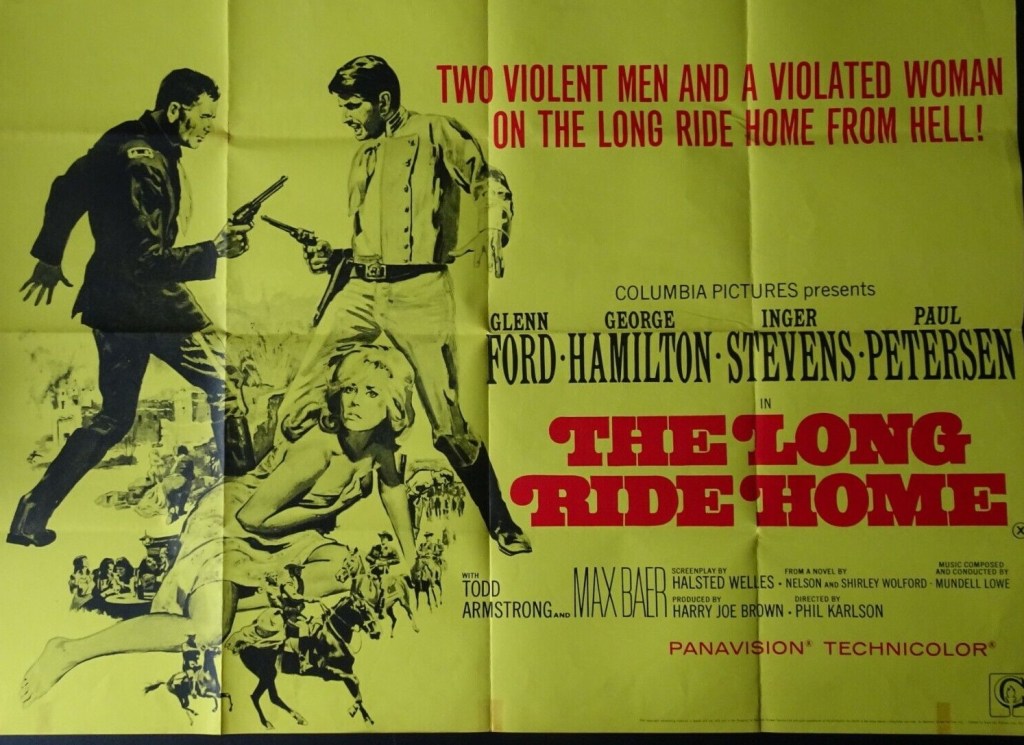
A Time for Killing / The Long Ride Home (1967) ****

The American Civil War is often slotted into the wrong genre. It is not a western. It is a war, with all the inherent wrongheadedness, viciousness and atrocity. We begin with senseless execution and end on a note of humiliating barbarity. Along the way we witness easily the greatest performances in the careers of George Hamilton (The Power, 1968) – a wonder after this how he was ever associated with playboy characters – and Inger Stevens (Firecreek, 1968).

At the tail end of the war in a Confederate POW camp, the disciplinarian commander orders raw recruits to execute an escapee. When they fail to find to the target Major Wolcott (Glenn Ford), witnessed by appalled missionary fiancée Emily (Inger Stevens), steps in to finish the job. In the wake of this Wolcott sends Emily away under escort.

POW leader Captain Bentley (George Hamilton), fully aware the war might end in days, but determined to escape to Mexico and continue the fight, organises a breakout. Instead of sneaking out quietly, in revenge he turns the Union cannons on his captors. And despite being better informed how close the war is to an end, the dutiful Wolcott sets off in pursuit.

Bentley ambushes Emily’s escort, killing the soldiers and stealing their mounts, but promising Emily that as befits a Southern gentleman he will respect her honor. She’s not so innocent of war, anyway, begging Bentley to kill a fatally wounded Union soldier rather than leaving him to the buzzards or, one assumes, marauding Apaches.

Unfortunately, his comrades don’t share that sentiment and when Emily makes the mistake of unloosing her blouse to wet her neck at a stream it inflames their lust. Equally, unfortunately, Emily doesn’t keep to her part of the deal and in attempting to escape hits Bentley a humiliating blow with his own saber.

While unfamiliar with the territory, Wolcott is a pretty good soldier, taking a shortcut over the mountains to cut off their retreat. “How come he knew what we were gonna do before we done it,” wails a Confederate soldier. “Before you even thought it,” snaps the over-confident Emily.

A few miles from the border, the Confederates hole up in a bordello where Bennett finds a despatch announcing the war is over. Ignoring the fact that for the ordinary soldier you couldn’t find a better place to celebrate peace than in a whorehouse, and determined to continue the war, Bennett conceals the information.

In revenge for losing face in front of his soldiers, he (luckily off camera) rapes the half-stripped and bloodied Emily. In the manner of every savage taking advantage of wartime conditions, Bennett tells her, “You think nothing like this can ever happen to you. But you’re lucky because your humiliation will be over soon. You and your major are going to know I won.”

Rape, as currently in the Ukraine and as in many previous conflicts, used as a weapon.

When Wolcott arrives, it’s obvious what has happened and while holding a lid on his own emotions (a Glenn Ford hallmark), once he has proof the war is over, he refuses to give chase. Brutally, he tells her,  “I can see (witness) men die for their country but I can’t see them die for your honor.” It’s Bennett who, oddly, comes to her rescue, opening fire on the Union soldiers, compelling Wolcott, in breach of the rules of war, to cross the border into Mexico in pursuit.

This isn’t a typical Glenn Ford (The Pistolero of Red River/The Last Challenge, 1967) picture where he plays the central character and is scarcely off screen. Here, he disappears for long stretches as the camera focuses on George Hamilton, his squabbling gang and the growing tension between him and Inger Stevens. If you’ve only seen Hamilton in his screen playboy persona, this is a revelation as honor and misguided duty turn into repulsive action.

And this is by far the best performance by Inger Stevens. What she achieved here launched her career, although admittedly as a female lead rather than top-billed star. The emotion her face portrays without the benefit of dialog is quite astonishing. Expecting to be an innocent bystander, unexpectedly thrown into the tumult, physically abused, and then, contrary to her Christian beliefs, she goes from stalwart to victim to, against her Christian principles, showing no sign of turning the other cheek but in full Old Testament mode urging revenge.

The scene when Emily enters a room full of soldiers, attempting to retain some dignity in the face of torn clothes and bloodied face, while acknowledging her humiliation, is stunning. The only scene that comes close to matching its power is at the end, the sequence shot from above, light streaming into a darkened cellar, when, having killed Bennett, Wolcott abandons his potential bride.  

Phil Karlson (The Secret Ways, 1961), a stand-in for original director Roger Corman, does an excellent job of focusing on the brutalities of war, not just the rape and violence, but the recruits, as dumb as they come on both sides, who fail to cope with the pressures. You would have to be fast to spot Harrison Ford (billed as Harrison J. Ford) making his screen debut, but Harry Dean Stanton (Cool Hand Luke, 1967) has a bigger role. Halstead Welles (The Hell with Heroes, 1968) wrote the screenplay based on the novel The Southern Blade by Nelson and Shirley Wolford.

A couple of later westerns might have raided this picture for ideas: continuing the fight in Mexico was the focus of The Undefeated (1969); a constantly carping pair who delight in slaughter evidenced in The Wild Bunch (1969); relentless pursuit a constant theme of 1969 westerns as diverse as Butch Cassidy and the Sundance Kid, True Grit, The Wild Bunch, Mackenna’s Gold and Once Upon a Time in the West.

Regard this as a western and you will be disappointed. Take it more seriously as a war picture and it offers far more. I’m probably being a tad generous in giving it four stars but I was knocked out by the performances of Hamilton and Stevens and a number of excellent scenes, the two in particular mentioned above for example, and the dialogue.

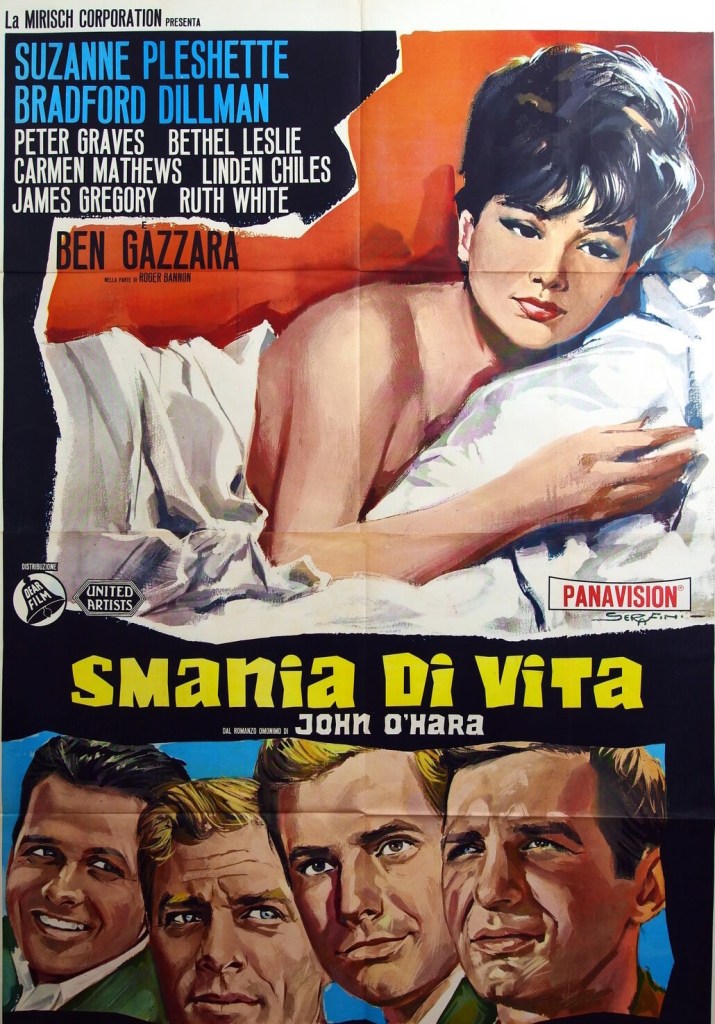
A Rage To Live (1965) ***

There was one in every town: a woman, rich (Sanctuary, 1961) or poor (Claudelle Inglish, 1961) or in between (Butterfield 8, 1960), with a predilection for sex. There were several men in every town, queuing up to take advantage. The woman was inevitably a shameful creature, the men the envy of their peers. You don’t have to look further than Frank Sinatra’s tom-catting in Come Blow Your Horn (1963) or Omar Sharif as the romantic star of the decade with two women in tow in Doctor Zhivago (1965) for an idea of the double standards in play. Welcome to hypocritical Hollywood.

Grace (Suzanne Pleshette), father dead and stuck with a domineering mother, finds escape and fulfilment in sex, and just to give hypocrisy a final tug discovers that while boyfriends are keen to help her explore such physical needs, they take the hump when they discover they might not be the first – or the only. Parents, naturally, are appalled, and discovery of Grace’s antics – and she’s not particularly particular, a passing waiter will do – leads her mother to collapse.

Having confessed to potential husband Sidney (Bradford Dillman) that he will not be marrying a virgin and almost bursting with gratitude that he is willing to overlook her behavior, Grace becomes a farmer’s wife and then a happy mother, until construction owner Roger (Ben Gazzara) comes on strong. She might well have been able to have her cake and eat it but Roger, having fallen in love,  reacts badly to being dumped and it’s only a matter of time before her world implodes.

Made a couple of years later, when the independent woman was being exalted, this would have been a different kettle of fish. Here, the boot on the other foot, the woman who picks and chooses her lovers seemed a step too far for that generation.

Before the big trouble begins, the movie does explore, though somewhat discreetly, the almost taboo notion that a woman might just enjoy sex for the sake of it. Sure, Grace likes being wanted and likes being held, but if she was around today, nobody would bat an eyelid if she just came out and expressed her preference.

Less discreetly, the subject of consensual sex comes up, but not as a question of debate, more as a matter of fact, that when Grace says no she actually means yes. There’s a very uncomfortable moment at the beginning when in a Straw Dogs-scene, though nothing like as violent, Grace appears to welcome a rape. Whether this is as bad as it sounds, or is just Hollywood hiding the blush that a woman would not seek out sex but could only discover its pleasures when forced upon her, is hard to say.

Nor is Grace a walking sex machine. She knows enough about men that she only has to put out feelers and any susceptible male will take the bait. And given the restrained times, she’s got no female pal with whom she can discuss her unseemly desires.

Of course, if this was a man, nobody would be batting an eyelid. Sure, once caught, he’d come up with all sorts of excuses, denials, begging for forgiveness, but an audience would give him a free pass. It’s only because this is a woman that it causes ructions. The movie just about gets close to what does make Grace happy and why she needs the thrill of extra marital sex but by that point the melodrama has taken over and there’s little time left for discussion, what with Roger intent on revenge and another lovelorn wife, mistakenly imagining her husband has fallen victim to Grace’s charms, also on the warpath.

Small town constraints play their part, too. Washing your dirty linen in public the worst of all offences. Author John O’Hara, on whose bestseller this is based – and whose other works Butterfield 8, Ten North Frederick (1958) and From the Terrace (1960) explored similar worlds  – knows only too well that while wealth brings freedom and privilege it comes with chains attached.

And there’s some interesting role reversal, an illicit lover falling in love with a married person normally a starting point for a movie to explore happiness and its opposite rather than being the one act Grace will not tolerate in a lover, she wants strings-free sex, not anything with encumbrance. While Grace would like to act like a man, and has the wealth to shield herself from the worst of the fall-out, as a mother she is extremely vulnerable, and in this particular era could risk losing her child if seen as maternally unfit.

While lacking the sexual combustibility of Elizabeth Taylor or Lana Turner or other Hollywood heartbreakers, Suzanne Pleshette (Nevada Smith, 1966) gives a decent enough performance especially when it comes to her straightforward attitude to sex, aware she might be causing upheaval, but finding it impossible to ignore desire, or imagine a life in which that does not play an impulsive part.

Bradford Dillman (Sanctuary) has less room for character maneuver and is mostly called upon to suck it up. He comes into his own in the movie’s latter stages when bewilderment at betrayal and public humiliation clashes with continued love for his wife. Ben Gazzara (The Bridge at Remagen, 1969), trademark leer and smug face kept in check, has a showier role especially when the violent aspects of his character explode.

Director Walter Grauman, while better known for war picture 633 Squadron (1963), had just come off another picture dealing with female trauma (Lady in a Cage, 1964) and does quite a decent job here, the camera intensely focusing on the leading actress and then as the tragic outcome unfolds drawing away from her. There’s one great piece of composition. He had used tree branches and the countryside to frame Grace and Sidney at the height of their love. And he does the same again when Grace is abandoned.

Asks some difficult questions without quite getting to grip with the real subject of female sexuality. There was a sense that Hollywood was just on the cusp of accepting the independence of women, but didn’t want to go the whole hog just yet, because, apart from anything else, where would it leave the guys?

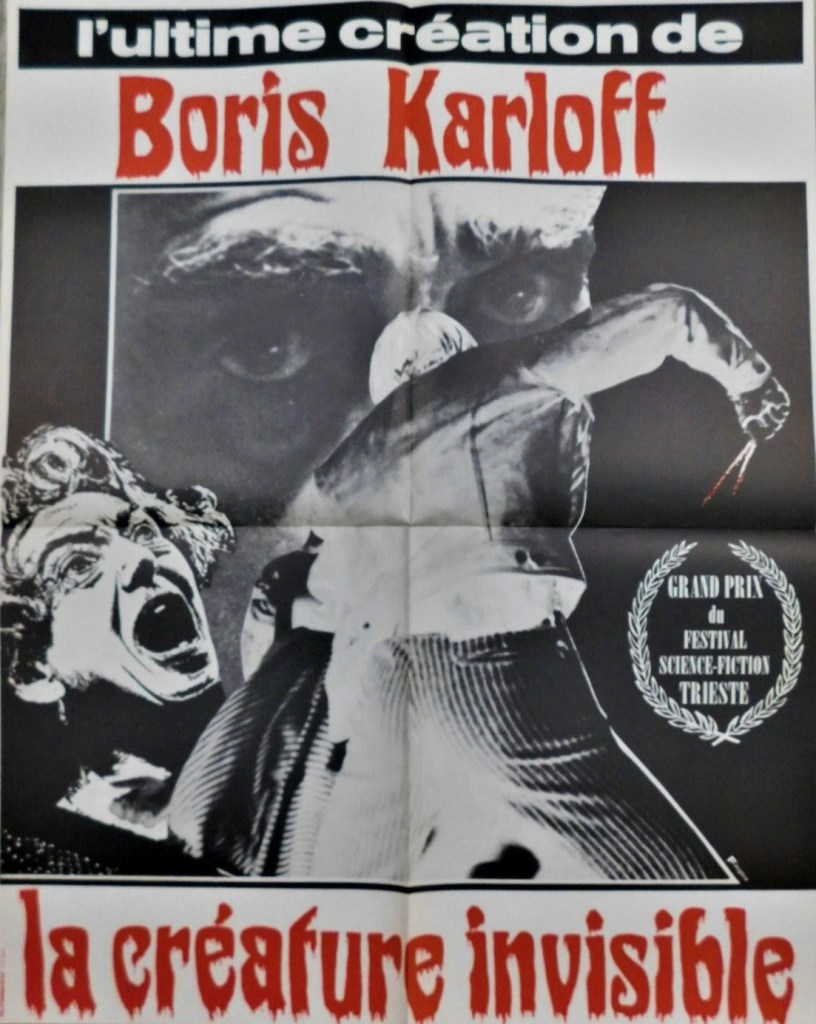
The Sorcerers (1967) ***

I should point out before we go any further there’s a Raquel Welch connection. Husband Patrick Curtis was a producer and La Welch is down as an assistant producer, at a time when the pair were setting up their own production company Curtwel. Hard to see where Raquel would have fitted in but wouldn’t it have been sensational to have her as the devious mastermind?

The concept is better than the execution. There is an inconvenient truth about science. Successful experiments often require guinea pigs. Brain-washing was one such scientific notion, generally seen as an invention of those dastardly Communists a la The Manchurian Candidate (1962) although The Mind Benders (1963) suggested it was as common in the British halls of academe. As indicated by the title here brain washing could be termed  modern-day witchcraft.

But where government scientists could hide behind the greater good, personal advantage is the notion here. And it did make me wonder how many scientists took vicarious pleasure in seeing guinea pigs doing their bidding, enjoying the power to inflict change on the potentially unwilling.

Professor Monserrat (Boris Karloff) and wife Estelle (Catherine Lacey) have invented a machine that through hypnotism can alter a subject’s mind in the longer term, make them prone to acts of savagery. Their chosen target is young man-about-town Mike (Ian Ogilvy). Bored with gorgeous girlfriend Nicole (Elizabeth Ercy) and ripe for adventure he is despatched on an orgy of violence, rape and murder.

What makes this potentially fascinating is that while the Professor draws back from the experiment, Estelle wants to continue. The sadistic female was coming into her own during this decade, Elke Sommer and Sylva Koscina as a deadly tag-team in Deadlier than the Male (1967), Suzanna Leigh in Subterfuge (1968), but these were sidekicks, pawns in the control of devious men.

Estelle wins a battle of wills against her husband and his weak opposition fails to deter her from authorizing ever more despicable acts, as if she is unleashing her own pent-up aggression. Not only can she control her husband but she is in command of the virile young Mike. Sensibly, the film stops short of setting her up as a James Bond-style megalomaniac, but there is something more infernal in committing these acts from a small run-down apartment rather than some underground space-age cavern.

Turning Boris Karloff into a bad guy tripped up by conscience is a neat casting trick. But making him prey to his initially subservient wife is a masterstroke. Her violence is gender-neutral, as happy to force Mike into battering a work colleague as attempting to rape a young woman.

And there is also a sense of the old taking revenge on the young. The old have been left behind in a Swinging London awash with discos and barely-existing morals. Why shouldn’t old people tap into base desire, and better still, not have to lift a finger, their victim carrying the can for every deed. 

It’s stone cold creepy. And would  been a much tighter – and scarier – picture if director Michael Reeves (Witchfinder General, 1968) had not wasted so much time with the dull youngsters, complete with pop groups performing in a nightclub. Ian Ogilvy (Witchfinder General) doesn’t bring much to the party, no more than your standard good-looking young fellow.  

Boris Karloff (The Crimson Cult, 1968) is much better value especially when excitement at his new discovery wears off and he realizes he is playing second fiddle to his wife. For once, there’s nothing inherently evil in him. But Catherine Lacey (The Servant, 1963) is easily the pick, delivering a well-judged performance, assisting her husband in his endeavors until the time is right to take over. You might spot Susan George (The Straw Dogs, 1971) and Sally Sheridan, both a Fu Manchu and Bond girl. Tom Baker (Witchfinder General) co-wrote the script with Reeves.

Provides more to ponder than actually appears on the screen.

Accident (1966) ****

Intellect can present as powerful a sexual magnetism as wealth. And for young women, unlikely to come into the orbit of powerful movie magnates or wealthy businessmen, they are most likely to experience abuse of power in academia, especially in top-notch universities like Oxford and Cambridge or Harvard and the Sorbonne.

Young students, unsure of their place in the world, depend on praise for their self-esteem. To be on the receiving end of flattery from a renowned scholar, a young person (males included) might be willing to overlook other unwanted attention. For young women and men accustomed to being assessed on looks alone this might be a drug too powerful to ignore.

The British system ensured that potential prey was delivered to potential predators. As well as attending lectures, each student was allocated a tutor and could spend a considerable amount of time with them in private in congenial surroundings behind closed doors. And since essays marked by tutors played a considerable element in an overall mark, there was plenty of opportunity for transactional sex.  

And it was easy for women to think they wielded the sexual power. I once employed a woman who boasted that she had seduced her university tutor, little imagining that that took any opposition on his part, and that, in reality, she was just another easy conquest.

So you might be surprised to learn that when this movie about inappropriate behavior in a university of the caliber of Oxford appeared, nobody gave a hoot about the grooming and exploitation of young Austrian Anna (Jacqueline Sassard) by two professors, Stephen (Dirk Bogarde) and Charley (Stanley Baker).

The story is told in flashback in leisurely fashion. Hearing a car crash outside his substantial house in the country, Stephen finds inside the vehicle an injured Anna and her dead boyfriend William (Michael York). Then we backtrack to Anna’s arrival in Oxford, and how the love quadrangle is created. The presence of William suggests Anna has predatory instincts, but there is no sign of sex in their relationship, rather that he is forever frustrated at being kept on a leash and clearly suspecting he is losing out to others.

Stephen, a professor of philosophy, no higher calling in academe, endless discussion on the meaning of life manna to every student, has a purported happy home life, wife Rosalind (Vivien Merchant) pregnant with their third child. He’s no stranger to infidelity, reviving an affair with the estranged daughter Francesca (Delphine Seyrig) of a college bigwig (Alexander Knox).

But he can’t quite make his move on Anna, despite idyllic walks in the fields and their hands almost touching on a fence. The uber-confident Charley, novelist and television pundit in addition to academic celebrity, has no such qualms and seduces her under the nose of his friend and sometime competitor.

When opportunity does arise for Stephen it does so in the most horrific fashion and, that he takes advantage of the situation, exposes the levels of immorality to which the powerful will stoop without batting an eyelid.

The web Stephen is trying to weave around his potential victim is disrupted by William and Charley and if any anguish shows on Stephen’s face it’s not guilt at the grief he may cause or about his own errant behavior but at the prospect of losing a prize.

Director Joseph Losey (Secret Ceremony, 1968) sets the tale in an idyllic world of dreaming spires, glasses of sherry, tea on the lawn, glorious weather, punting on the river, old Etonian games, the potential meeting of minds and the flowering of young intellect.  The action, like illicit desire, is surreptitious, a slow-burn so laggardly you could imagine the spark of narrative had almost gone out.

Stephen is almost defeated by his own uncontrolled desire, taking advantage of his wife entering hospital for childbirth, the children packed off elsewhere, to have sex with Francesca, not imagining that Charley will take advantage of an empty house.

And the young woman as sexual pawn is given further credence by the fact that at no point do we see the events from her perspective.

Anguish had always been a Dirk Bogarde (Justine, 1969) hallmark and usually it served to invite the moviegoer to share his torment. So it’s kind of a mean trick to play on the audience to discover that this actor generally given to playing worthy characters is in fact a sleekit devious dangerous man. Of course, the persona reversal works very well, as we do sympathise with him, especially when relegated to second fiddle in the celebrity stakes to Charley and humiliated in his own attempts to gain television exposure.

Stanley Baker (Sands of the Kalahari, 1965) was the revelation. Gone was the tough guy of previous movies. In its place a charming confident winning personality with a mischievous streak, a far more attractive persona when up against the more introspective Bogarde.

Jacqueline Sassard (Les Biches, 1968) is, unfortunately, left with little to do but be the plaything. There’s an ambivalence about her which might have been acceptable then, but not now, as if somehow she is, with her own sexual powers, pulling three men on a string. In his debut Michael York (Justine, 1969) shows his potential as a future leading man.

You might wonder if Vivien Merchant (Alfred the Great, 1969) was cast, in an underwritten part I might add,  because husband Harold Pinter (The Quiller Memorandum, 1966) wrote the script and Nicholas Mosley, who had never acted before, put in an appearance because he wrote the original novel.

Losey, a critical fave, found it hard to attract a popular audience until The Go-Between (1971) and you can see why this picture flopped at the time despite the presence of Bogarde and Baker. And although it is slow to the point of infinite discretion, it’s not just a beautifully rendered examination of middle class mores, and a hermetically sealed society, but, way ahead of its time, and possibly not even aware of the issues raised, in exploring abuse of power, a “Me Too” expose of the academic world.

The acting and direction are first class and it will only appear self-indulgent if you don’t appreciate slow-burning pictures.


Bandolero (1968) ****

Darkest – and possibly the most under-rated – western of the decade featuring a top-class cast playing against type, down-and-dirty in its depiction of the itinerant cowboy, an ending you won’t see coming and if it’s not a heretical notion close cousin to the later The Wild Bunch (1969).

Gang of outlaws led by Dee (Dean Martin), condemned to death for robbing a bank, is rescued by his brother Mace (James Stewart) posing as a hangman.  While a posse led by Sheriff Johnson (George Kennedy) is in hot pursuit and the outlaws kidnap as potential hostage recently widowed Maria (Raquel Welch), Mace, sauntering through the deserted town, indulges in a bit of larceny himself.

All head for Mexico, a pitiless region, where the posse are picked off by bandits, the outlaws directed by the native Maria towards a small town which turns out to offer no safety at all. While there’s plenty action, this is more character-based. Mace and Dee are on the Civil War divide, the former (still sporting his Union uniform) riding with General Sherman, the latter with the Confederate Quantrill’s Raiders, despised by Mace as nothing more than glorified killers.

And while they are both outlaws, Mace blaming his situation on the Civil War, they are divided too by a sense of honor, Mace making it a point of principle never to harm women or children, Dee, far removed from any sense of himself, guilt-ridden, past caring, and lonely, can’t remember the last time he was with a woman he respected.

Sheriff Johnson is in pursuit in part due to unrequited love for Maria. Quick to action  in a professional capacity, he is tongue-tied in her presence. Nor has the newly-wealthy Maria much need of a male protector. A whore since the age of 13 to provide for her extended family, sold into marriage nd acceptance that for security not love, she has been, ironically, set free by violent robbery. Dee’s gang views Maria as plunder, rape imminent should the brothers turn their backs. While Maria has little interest in another male protector she finds herself attracted to Dee.

Mace is mostly peacemaker, prodding his weaker sibling into responsibility, trying to instil into him the kind of code by which the likes of The Wild Bunch swore, but, still on the shifty side himself, concealing from the others the loot from his own robbery. But where The Wild Bunch are essentially sanctified by Peckinpah, especially with their hypocritical codes of honor and their unlikely redemption, the lives of Dee and Mace are unfulfilled, lawful or lawless drifters enjoying little of life.

There’s an ambivalence to Mace, theoretically a law-abiding rancher, but apparently turning outlaw on a whim. We are introduced to an impoverished Mace being ripped off for food and accommodation, spending the night in an overcrowded bunkhouse, his Unionist uniform doing him no favors two years after the end of the Civil War in Confederate Texas. He appears less prone to violence but we are not privy to how he persuaded a hangman to part with his outfit. And he’s a mean hand with a rifle, helping his brother escape his pursuers.

You might wonder just how Mace came to be an outlaw when he witters on so often about his God-fearing mother and his upbringing on a farm and you always have the sense he’s part of that woeful Hollywood creation, the “good” outlaw, as if there was such a thing, certainly no sign of him dispersing ill-gotten gains to the poor. He might just be as deluded as his brother.

Of the three, Maria is the most clear-sighted, no qualms about her behaviour, and,  provided with weaponry, perfectly capable of defending herself. Mexican bandits offer her no clemency either, assuming that, escorted by gringos, she has abandoned the land of her birth, or just because any woman is prey.

So it’s a perfect onion of a western, layers upon layers, the pursued needing to defend themselves not just against the pursuers, but bandits lying in wait, and within their supposed close-knit community the brothers guarding against fellow outlaws and protecting the  woman.  

James Stewart (Shenandoah, 1965) played many a tough guy at the reinvention of his career in the early 1950s in Anthony Mann westerns, and while his characters often displayed venal qualities they were not outlaws. Career-wise this was a dicey role for an established western hero. That he brings the common touch that was the hallmark of his original screen persona to this characterisation of an outlaw with a code of honor does not disguise the fact that he is still an outlaw.

Dean Martin had essayed a really mean bad guy in Rough Night in Jericho (1967) but again this was his debut as an outlaw, and a conflicted one at that, enjoying the boost to his self-esteem that leadership brings, but finding himself enmeshed with the dregs of society, and certainly not on the look-out for any acts of kindness or redemption. This is a beautifully nuanced performance especially when he realizes Maria is responding to him.

Raquel Welch (Fathom, 1967) in what amounts to her first major film opposite two Hollywood legends more than holds her own. Not able to rely upon her overt sex appeal as in her previous outings, she portrays an upstanding women, abused by men in the past, determined not to take that route in the future. Alone of all the characters, having accepted her fate at an early age, she has developed a self-esteem not sacrificed to circumstance. The whore and the outlaw might be the oldest trope in the book but it works very well here as two characters find solace in each other.

George Kennedy (Cool Hand Luke, 1967), more accustomed to playing tough guys, leavens his portrayal by appearing idiotic with women. This, too, is a departure for Andrew V. McLaglen. Anyone aware of Shenandoah or The Undefeated (1969) will be familiar with his dexterity for widescreen composition, but here he tamps down on that stylistic device, concentrating more on group reaction and interaction. James Lee Barrett (Shenandoah) wrote the biting script based on a story by producer Stanley  Hough.  

While there’s plenty action it’s not a rip-roaring western, too much character involvement for that, but certainly ranks as one of the top westerns of the decade.

Apologies again for the premature appearance of the blog “Behind the Scenes: Bandolero!” but that will definitely appear tomorrow.

Welcome to Hard Times (1967) ****

Director Burt Kennedy’s record with westerns was very much hit or miss. This revisionist effort is one of the former though it could as easily tipped into the latter, beginning with a shrill soundtrack that telegraphs every incident and the no-name villain. And you might also wonder if irony had taken such a hold of settlers that they would actually name their town “Hard Times” when there was a gold strike over the hills.

Anyway, this is certainly a town that lives up to its name. Can’t have been more than a dozen houses, a saloon of course, but it’s the muddiest place west of No Name City (Paint Your Wagon, 1969) and the meanest to hove into view since High Noon, with the townspeople in thrall not to an entire gang, but one nameless stranger (where have we seen that before).

The Man from Bodie (Aldo Ray), as he is known, is the bad guy from Hell. He shoots anyone who stands up to him like Fee (Paul Birch) or shows the slightest dissent like undertaker Hanson (Elisha Cook Jr) and rapes Fee’s girlfriend Flo (Ann McCrea) before dumping her corpse on the saloon stairs.  

Will Blue (Henry Fonda), lawyer not lawman, hasn’t the guts to stand up to him, but comes the closest of the cowardly bunch. When The Man has done as much rampaging as a tiny town will allow he burns it to the ground. Most people leave, but Blue,  having done too much running in his life, decides to stay to look after Fee’s orphaned son Jimmy (Michael Shea).

If Blue’s vengeful Oirish girlfriend Molly (Janice Rule) also remains it’s mostly to hate him for abandoning her to the madman – Blue had used her to distract the Man but then retreated when the going got tough leaving her to be raped at will. She sets up her own League of Desperadoes, recruiting new arrival Jenks (Warren Oates) and the orphan, to tackle the bad guy on his inevitable return.

Meanwhile, a mobile unit of sex workers, complete with tent, turns up to service the nearby gold workers.  Their entrepreneurial boss Zar (Keenan Wynn) spots opportunity and helps Blue rebuild the town. Of course, everyone’s just waiting for Bodie Man to return.

Anyone that’s likeable or got anything approaching character is killed off at the start, so we’re left with an unlikeable, ambivalent, but realistic, crew. For all his later hi-falutin’ principles and pioneer spirit, Blue is still a coward who, to save his own skin, sacrificed Molly. Hoping to redeem himself by acting as surrogate father to Jimmy doesn’t result in him winning any respect from Molly.

This is one raped woman who found out the man on whom she was depending was no protector. Why should she ever love him again? And she’d be crazy to put her life in his hands once more. Of course, she could have got herself her own shotgun or pistol and ambushed Brodie Man when he took another shine to her, but instead she plays pretty please with Jenks, which is understandable, and the young Jimmy, which is deplorable.

That the sex worker magnate becomes one of the town’s foremost citizens might cleave closer to the bone than many viewers would like, but corruption was as endemic in America then as it presumably is now.

And it begs the question when all those pioneers headed out West how many of them were scum like Bodie Man? And how did the settlers think law-and-order was going to work out?

On the downside we have a villain, who, not content with killing and raping, demonstrates just how mean he is by smashing whisky bottlenecks because he hasn’t the patience to extract the cork with his teeth. Fee is dumb enough to take on the bad guy with a bit of log. Molly’s Irish accent is all over the place. And we could do with less music. And there’s a climactic twist that belonged to a horror film and is not only completely out of place but undoes the realistic tone by providing a somewhat sanctimonious ending.

But if you are expecting a movie along High Noon lines, with the good guy beating the bad, and winning the town’s respect, then you will be disappointed. On the other hand if you come prepared for one of the darkest westerns of the decade where the terrorizing outlaw exerts such fear that the townspeople, in defending themselves, pull down the shades between good and evil, then you will be amply rewarded.

The boldness of director Kennedy (The War Wagon, 1967) in reimagining the West as a place of venal proportions should be applauded. The direction might take a wrong turn here and there but the aim is effective. Henry Fonda (Firecreek, 1968) is good as ever and although I could do without the awful accent Janice Rule (Alvarez Kelly, 1966) is superb as the vengeful woman refusing Blue forgiveness and willing to use a youngster as a weapon.

A sound supporting cast includes Keenan Wynn (Warning Shot, 1967), Edgar Buchanan (Move Over, Darling, 1963), Janis Paige in her final movie outing, John Anderson (5 Card Stud, 1968) in a double role, Aldo Ray (The Power, 1968) and Warren Oates (The Wild Bunch, 1969).

Kennedy wrote the screenplay form the book by E.L. Doctorow.

Will make you flinch but worth a look.

Discover WordPress

A daily selection of the best content published on WordPress, collected for you by humans who love to read.

The Atavist Magazine

by Brian Hannan

WordPress.com News

The latest news on WordPress.com and the WordPress community.