Faces in the Dark (1960) ***

Had his been tagged “From the Makers of Vertigo”, it might have immediately attracted a greater immediate audience and been treated these days with more critical reverence. But Vertigo wasn’t the cult film it is now, so the names of the authors of the source book, Pierre Boileau and Thomas Narcejac, would have no promotional value.

Throw in a stunning score by Mikis Theodarakis (Zorba the Greek, 1964) and a top-line cast including Swedish bombshell Mai Zetterling (Only Two Can Play, 1962), cult character actor John Ireland (The Ceremony, 1963) and an early role for Nanette Newman (The Wrong Box, 1966) plus a gender switch on the traditional gaslighting plot and you have makings of a classy little number.

When an experiment goes wrong, ambitious arrogant businessman Richard Hammond (John Gregson) is blinded. To help him recuperate wife Christiane (Mai Zetterling) flies him off to their luxurious Cornwall retreat where, to ensure is mind isn’t overloaded with business concerns, she switches off the phone. Along for the ride are his sponging brother Max (John Ireland), business partner David (Michael Denison), housemaid Janet (Nanette Newman) and chauffeur Clem (Tony Wright).

When things are not what they seem – the cat has suddenly lost its tail, a peach plant has disappeared from the garden, he smells pine, hears church bells – he believes he is going insane. Doesn’t take long before he realizes this is not a haven, but a trap. Sounds providing the greatest clues, he hears a giveaway clicking, indicating the presence of David, in his wife’s bedroom when the partner is meant to be a hundred miles away.

His brother has also disappeared, believed dead, and when his wife gives the help the night off and he is left in the house with the lovers is convinced they are trying to poison him and refuses to eat any food. Given sounds are so important, there’s one brilliant scene, where, having escaped, he discovers none of the locals can understand what he’s saying, and not because he’s gabbling either. But that’s such a clever plot point, I wouldn’t be a spoiler.

So you’ve got tension fairly climbing the walls .

The only downside is that Richard is such an unlikeable character – not a poor soul like Audrey Hepburn in Wait until Dark (1967) – that it’s hard to summon up the sympathy an audience requires for such a story to properly work. Theoretically, he’s just a driven man, whose genius is being blocked by the cynical bankers, but from the outset he’s full of bluster and nasty put-downs, and has everyone in the factory he owns on edge.

Anger at his condition and fear that insanity or failure lies ahead puts him in a constant rage and, heavily sweating for no particular medical reason, he’s not the most charismatic of screen characters. Even though his reaction would fit with a successful businessman failing to come to terms with the calamity, those elements, which might have evoked greater sympathy, are somewhat adrift when they get tangled up with the plot.

Director David Eady (The Verdict, 1964) does his best to compensate. The music, as mentioned, helps, throbbing piano rather than screaming violins. And there a couple of neat visuals, the swirling smoke of the credit sequence reappearing to devastating effect in one sequence. But, mostly, he lines up reasons for Richard to begin to question his sanity and believe he is being duped – he can’t read documents he must sign and as the only part of his handwriting that stands up is his signature suspects his impoverished brother will write a larger sum on a cheque he signs.

And since most of this unfolds through the mind of Richard, the director plays fair with the audience. There are no nods and winks about the nature of the relationship between wife and partner. Even though she confides in David that she’s planning to leave Richard, there’s no indication that it’s for the partner.

So this is more like a detective story and, as with Vertigo, featuring an obsessive character driven mad by obsession, both led on by the devious, and having to piece together a strange amalgam of clues.

John Gregson (The Frightened City, 1961), normally essaying more stoical characters, overacts, but the others do the opposite. Mai Zetterling is convincing and former British matinee idol Michael Denison plays against type (he wouldn’t make another movie for 30 years). Nanette Newman shows promise while John Ireland reins in the surliness. Ephraim Kogan (in his sole movie credit) and John Tully (who didn’t get another movie credit for the decade) wrote the screenplay.

Effective thriller ripe for a remake.

Catch it on Amazon Prime or DVD.

https://amzn.to/3RoBDfb

Riot (1969) ***

Stand-Off might be a more apt title but that’s not going to sell many tickets. After taking over the wing of a prison, not a great deal happens except for character development. As it turns out the threat of a riot is intended merely as a ruse to cover an attempted break-out.

Inmate Cully (Jim Brown) is the first to point out to escape mastermind Red (Gene Hackman) the deficiencies of his plan. For a start, they are in the middle of the desert and without transportation and food, neither of which is handy or arranged, they are likely to find the wilderness a worse prison. Secondly, there’s a hell of a lot of digging to do, a tunnel long enough to allow them to emerge on the other side of the walls.

And thirdly, and most presciently, most of the prisoners don’t give a fig about organizing a break-out. They are simpler souls, wanting to enjoy a brief moment, even if still incarcerated, of freedom, happy to glug down gallons of home-made brew, watch drag acts for entertainment and slit the throats of the guards taken hostage.

It’s ironic that Cully and Red begin acting like prison warders, defending the hostages against the most vicious of the inmates, guarding them as they take a walk of shame to a hideout, and chucking into solitary the most depraved of the prisoners. The prison break, when it finally comes, is exceptionally well done by director Buzz Kulik (Villa Rides, 1968) .

A small hole in the sun-parched earth becomes bigger until a furry head like a groundhog appears and the outside of the prison walls is viewed from the perspective of a potential escapee.

The ultimate sex’n’violence double bill.

But, mostly, it’s a long haul of tension. Red holds the officials at bay with not just the hostages but a set of demands for better treatment, triggering a bout of negotiation and talking to the media. As in female-starved male-dominated pictures like The Flight of the Phoenix (1965) and The Dirty Dozen (1967), women are shunted in by devious means, in the former via a mirage, in the latter through the sex workers smuggled in prior to the mission. Here, Cully dreams of landing by helicopter beside a pool of beautiful bikini-clad women who rush to worship him.

Although Cully and Red don’t exactly see eye-to-eye and for the picture to work of course must bury their differences and work together, the pair don’t rack up the confrontation required for this movie to zing. Cully is somewhat laid-back and Red uses his fingers rather than his fists or loud voice to make points. You kind of wished there was more sign of imminent explosion.

Sure, there are setbacks, and having to change plan and improvise on the spot. The stakes are only really raised when the vacationing prison governor returns and dumps the softly-softly approach of his stand-in, telling the prisoners in no uncertain terms that he will happily murder ten prisoners for each hostage killed, storm the wing and gas them all. The end shows exactly what level of brutality he is capable of.

But, meanwhile, we are left dancing around a bunch of fairly cliché characters, the prisoners in for short terms who don’t want to participate, the lifers wanting brief respite, the killers denied the opportunity to kill, the men who hide their sexual desires under the more acceptable cross-dressing.

Rioting is actually thin on the ground. In fact, Red has to do the opposite. Prevent everyone getting out of line because that will precipitate assault by the prison guards. Keeping everyone happily penned up for the time it takes to complete the tunnel is more Red’s plan than letting the prisoners loose to run riot.

That said, both Jim Brown (100 Rifles, 1969) and Gene Hackman (The Gypsy Moths. 1969) are impressive. Brown reins in the tough-guy act, holding sway in soft-spoken manner, while Hackman brings out more elements of the screen persona that would win him an Oscar a couple of years later for The French Connection.  Naturally, Hackman, in retrospect, attracts the kudos but in reality I think this is a step-up for Brown and he is not acted off the screen. (The pair had appeared together in The Split, 1968).

One of the flaws, I would hazard, is that this kind of picture should have been the break-out vehicle for rising stars – as with The Magnificent Seven (1960), The Great Escape (1963), and The Dirty Dozen – but in that department it’s sorely lacking and I think the picture overall suffers as a result.

Given he knows more than the audience where the story is headed Buzz Kulik (The Warning Shot, 1967) does well to concentrate on the friction between Brown and Hackman. James Poe  (The Bedford Incident, 1965) wrote the screenplay from the Frank Elli book.

Men under pressure are not under enough pressure to make it zing.

https://amzn.to/3tjAHAG

Madison Avenue (1961) ***

Surprisingly effective feminist angle. Unusual for the suave salesman to get his come-uppance from two vulnerable women, but that’s the case here, in an expose of the “build-up” (what we’d call “hype” these days) techniques of the public relations business, an area of advertising generally considered one step below the Mad Men of popular television. Fancy bars and cocktail dresses put in an appearance but, mostly, this deals with the grittier end.

This was pretty much the end of the mainstream Hollywood career for Dana Andrews. Still best-known for Laura (1944) and The Best Years of Our Lives (1946) and for some key film noir titles, this was his last major top-billed role. He wouldn’t make another movie for four years and anyone coming to him in this decade would associate him with supporting roles in the likes of The Satan Bug (1965) and Battle of the Bulge (1965).

So this is, possibly unexpectedly, a performance to savor, for he is hardly the hero, more the kind of character who might turn up in a contemporary movie, with questionable motives to go along with his decided charm (look no further than Leonardo DiCaprio in Killers of the Flower Moon). Though hardly murderous, he is ruthless and doesn’t care who he brings down in achieving his objectives.

After losing his job for purportedly (an accusation unproven but going with the territory) trying to steal the major client, Associated Dairies, of his boss, J.D. (Howard St John), top executive Clint (Dana Andrews) plans to get his revenge in rather sneaky fashion, by turning round its poorly-performing subsidiary Cloverleaf. He targets the dowdy owner, Anne Tremain (Eleanor Parker), of its failing advertising firm, promising her client a big editorial splash in a big newspaper courtesy of journalist girlfriend Peggy (Jeanne Crain).

Anne’s the first beneficiary of his PR skills, reinventing her as a glamorous, power-dressing, more confident advocate of the persuasion industry. He inveigles himself into her arms, at the expense of Peggy. He aids the idiotic owner of Cloverleaf, Harvey (Eddie Albert), who spends all his time in the office playing with model airplanes. (From today’s perspective, he’s something of a savant, predicting these machines – think drones – could one day form part of the delivery contingent.)  

To show just how damn clever he is, Clint “builds up” Harvey into the kind of self-made-man that has politicians purring, and brings Clint back into the winners circle. Unfortunately, the only way to get right in is through deviousness, a bit of back-stabbing here and there, dropping anyone who’s outlived their usefulness. But he’s not as clever as he thinks, lacks the business acumen of Anne, who’s denied him a share of her growing business, and therefore any real power base.

The women take unkindly to being used, Anne now the one doing the tossing-aside. For her revenge, Peggy writes an article that digs the dirt on him. Neither of these women would fall into the femme fatale category, though once all glammed-up Anne could pass for one had she required violence rather than business dexterity to exact her revenge.

Though both, unusually for the times, hold top positions in their businesses – Peggy’s a high-flying journalist working the Washington beat – they are presented initially as easy meat for a man capable of exploiting their vulnerabilities. Clint keeps Peggy on the back foot by failing to turn up for dates or presenting Anne as a rival for his affections.

This is an era where, purportedly, all women wanted was a ring on their finger, and to hang with being landed with an unsuitable man. But both Anne and Peggy upend that stereotype, seeing through the creature who’s come calling. In a western, audiences would have the satisfaction of seeing this kind of despicable character being shot. Here, they get to see him cringe, and be humiliated by women who have come to their senses. Albeit there’s a “happy” ending, that only occurs after some begging by the predator.

It suffers from too many long sequences, and by its determination to go down the satire route in exposing the seamier side of the public relations business. But there are some classic moments, such as when Harvey, tumbling through a prepared speech, has to suddenly wing it and finds his real voice.

But watching Anne get the measure of Clint and seeing him brought to heel by both women suggests the kind of ahead-of-its-time come-uppance that sets this up as an early feminist venture.

Eleanor Parker (The Sound of Music, 1965) and Jeanne Craine (Queen of the Nile, 1961) are both superb as women coming to their senses and this is a quite superb last top-billed hurrah from Dana Andrews. This was also the final outing for director H. Bruce Humberstone (Desert Song, 1953). Former newspaperman Norman Corwin (The Story of Ruth, 1960) and Richard P. Powell (Follow That Dream, 1962) based the screenplay on the best seller by Jeremy Kirk.

Resonates on the feminist front.

The Name of the Game Is Kill (1968) ***

Surprisingly effective thriller headlined by Jack Lord (Dr No, 1962) and providing Susan Strasberg (The Sisters, 1969) with a more complex role than hitherto.

Hungarian drifter Symcha (Jack Lord) hitches a lift in the desert with Mickey (Susan Strasberg), one of three sisters living with their mother (T.C.Jones) and running a filling station in a backwater. And before you can say Bates Motel, it’s clear not all is right. Youngest sister Nan (Tisha Sterling) keeps a rattler and a tarantula as pets and has the awkward personality trait of tending to set cats on fire.

Oldest sister Diz (Collin Wilcox Patton) eyes up the visitor for herself, even though Mickey is clearly hell-bent on him and is short in the fiancé department, her last boyfriend mysteriously disappearing. There’s more than a hint of the later The Beguiled (1970) in that each of the girls, Nan the most blatant, Diz the most persistent, shows keen sexual interest in the visitor.

And there’s some mystery, too, about the dead father. Everyone has a different tale to offer: he was murdered and incinerated by the mother; he committed suicide; he was run over by Nan. It’s this take-your-pick element that throws Symcha, though, admittedly, his brain might be addled after surviving a hit-and-run. Three days in a coma and all he has to show for it is a plaster on his head. He would need to be dumb, or just lusting after Mickey, to return to the house after that.

He makes no bones about being incapable of love, after witnessing friends and family slaughtered after the Hungarian Revolution of 1956. He “wants” her, but doesn’t commit to love. Mickey, in the manner of such romantics, reckons he’ll soon fall into a swoon over her. “Don’t let your past ruin our future,” she opines, in one of several good lines in the picture. “You have a sick mind,” Mickey tells Diz. “No,” she retorts, “I have a sick sister.” The bulk  of the good lines are the family taking verbal chunks out of each other so tension is kept high.

Mostly, Symcha’s job is to act like an involuntarily detective, getting close enough to each of the women to let them spill their secrets, though he’s less adept at working out what’s the truth. Is Mickey a “cheap lay” or virginal? Did Julio, the aforementioned fiancé, disappear once he realized what he was letting himself in for, or was he done away with?

And Symcha’s even less adept at looking after himself. There’s a kind of clever gender switch here. It’s usually the girl who’s foolish enough to return to the haunted house, or who doesn’t recognize danger, or who lets love (in this case, lust) get in the way of rational decision.

Family here is the disturbing element. Anyone attempting to break it up – by heading for San Francisco for example with one of them – is viewed as a threat.

You’ll probably guess the ending from two unnecessary giveaways at the beginning and a flaw in the make-up department, but, in fact, though the poster pleads with you not to give away the ending, it doesn’t say which ending it’s referring to. For this ends with a bang, three twists in quick succession. And don’t be tempted to switch off before the final freeze-frame (I always did wonder where Butch Cassidy and the Sundance Kid, 1969, got that idea).

Swedish director Gunnar Hellstrom (Just Once More, 1962) cleverly plays with expectations. He has you thinking, from the way Symcha makes his intentions clear, and from his wandering eye, that he’s the predator descending on a bunch of vulnerable women. He’s got that strong masculine air. He’s soft-voiced, too, and that carries a greater aura of confidence (ask Clint Eastwood) than a loud-mouth more physically-dominant specimen. But it soon becomes clear he might have stumbled into a web.

Jack Lord is more impressive than I expected and if he hadn’t gone straight from this into a dozen years of Hawaii Five-O (1968-1980) he might have blossomed into a decent male lead in the movies. Susan Strasberg gets to run up an entire scale of acting notes, showing that she is far more accomplished and deserved more than just supporting roles.

But everyone gets their moment in the sun. Tisha Sterling (Coogan’s Bluff, 1968) is good, a mixture of  temptation personified and dangerous instinct. Collin Wilcox Paxton (The Baby Maker, 1970) as the dominant sister sometimes overacts to express that character trait, but that’s not to the movie’s detriment as sometimes it is a bit too low-key. Screenwriter Gary Crutcher (The House of Zodiac, 1969) ran with the rattler notion in Stanley (1972).

Would have been more suspenseful minus the early give-aways.

Damn good for a B-picture.

Catch it on Amazon Prime.

https://amzn.to/3uNCxdo

Morgan! / Morgan, A Suitable Case for Treatment (1966) ***

While Hollywood was capable of dealing with mental illness head-on in pictures like Frank Perry’s David and Lisa (1962), Sam Fuller’s Shock Corridor (1963) and Robert Rossen’s Lilith (1964), the British were more inclined to take an alternative approach. The titular characters of Billy Liar (1963) and this film dealt with awkward reality by creating a fantasy world.  

Morgan (David Warner in his first starring role), is a failed artist and virulent communist who cannot come to terms with being divorced by rich Leonie (Vanessa Redgrave) who is planning to marry businessman Napier (Robert Stephens). Morgan forces his way back into his wife’s house and attempts to win her back with nothing stronger than whimsicality and when that fails resorts to kidnap.

And it is clear that she shares his fancy for furry animals, responding to his chest-pounding gorilla impression with tiny pats of her own chest. For a slim guy, Morgan makes a believable stab at a gorilla, shoulders hunched up under his jacket, chest stuck out. And he has an animal’s sense of smell – detecting his rival’s hair oil. 

The tone of the film is surreal. Had David Attenborough been a big name then you could have cited him as one of director Karel Reisz’s influences, such was his predilection for inserting wildlife into the proceedings, not just primates but giraffes, a hippo, a peacock and a variety of other creatures. Some are comments on Morgan’s state of mind but after a while it becomes monotonous. The film is clearly intentionally all over the place, the class struggle also taking central stage, but it’s hard work for the viewer. If you had stuck in some psychedelia, the fantasy would have made as much sense as The Trip (1967).

Having said that, towards the end of the picture there is an extraordinary image – possibly stolen from the opening of La Dolce Vita – of Morgan in a straitjacket hanging from a crane. Had that been the film’s starting point, it might have dealt more demonstrably with the subject matter.  The whimsy is all very well but the focus on external animals does little to illuminate Morgan’s internal struggle and mental descent.

At this stage of his career, David Warner (Perfect Friday, 1970) exhibited a core instability, although later he was adept at ruthless villains. You could argue he is too charming for the role.

Vanessa Redgrave (Blow-Up, 1966), in her second film and her first starring role, steals the picture, winning her first Oscar nomination (in the same year as sister Lynn for Georgy Girl). She is made of gossamer. Still attracted to a man she knows will only bring her pain, she is far from your normal leading lady. There is a touch of the Audrey Hepburn in her ethereality but she portrays a completely genuine soul, not a manufactured screen personality. Robert Stephens (The Prime of Miss Jean Brodie, 1969) adds a welcome hard core to the frivolity.

But Karel Reisz (Saturday Night and Sunday Morning, 1960) misses the spot. Distinguished British playwright David Mercer adapted his own BBC television work from 1962.

Could have done with taking a step back from the material and offered a more objective assessment.

https://amzn.to/3GIA5HL

The Gorgon (1964) ***

This impressive Hammer conspiracy-of-silence slow-burner, more thriller than horror, features the triumvirate of Christopher Lee (The Devil Ship Pirates, 1964), Peter Cushing (The Sword of Sherwood Forest, 1960) and Barbara Steele (Dracula, Prince of Darkness, 1966) in untypical roles. Lee and Cushing, of course, had locked horns before, namely in Hammer’s reimagining of the classic Dracula, with the former the charismatic fiend and the latter his nemesis.

Dr Namaroff (Peter Cushing) is a  doctor in an unnamed European turn-of-the-twentieth-century police state who knows more than he is letting on about seven inexplicable deaths in five years and the possibility of a 2,000-year-old myth coming to life and taking on a human form. And with quite a human side, jealous when his assistant Carla (Barbara Shelley) falls for a younger man, Paul (Richard Pascoe). Professor Karl Meister (Christopher Lee) appears late in the day to investigate.

Director Terence Fisher, who had shepherded the studio’s Dracula, Frankenstein, the Mummy and Dr Jekyll franchises through the starting gate, builds up the atmosphere with full moons, haunting voices, fog, sudden sounds, drifting leaves and an abandoned castle forever in shadow. The camera is often a weapon of stealth. Shock is kept to a minimum, fleeting ghostly apparitions and a finger falling off a corpse. Given the limitations of special effects in this era, that was a smart move.

Far better to concentrate on fear of impending doom, a man knowing he is turning to stone, a woman living in terror of being taken over by the phantom. The title gives away the story somewhat – even if you didn’t know the Gorgon was a mythical monster with a headful of snakes and the ability to turn people to stone, that is soon explained. 

Death remains the trigger for action, the suicide of an artist after he has apparently murdered his pregnant girlfriend bringing his father onto the scene and then his brother accompanied by Lee. But all investigation hits a wall of silence after Inspector Kanof (Patrick Troughton) refuses to instigate detection.

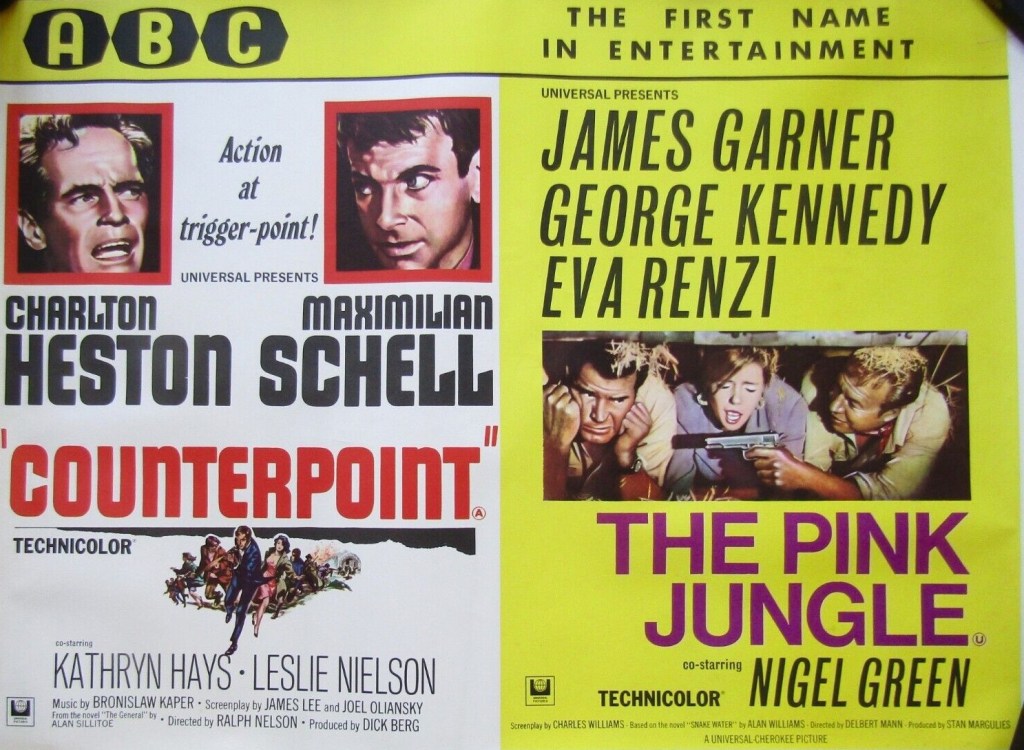
The Hammer double bill was a common feature in British cinemas. It also meant Hammer didn’t need to share box office receipts with another company.

At the heart of all the relationships is betrayal. The artist leading his girlfriend on, Namaroff willing to endanger Carla, whom he professes to love, rather than revealing the truth. Even Carla spies on the brother, with whom she is falling in love, in order to gather information for Namaroff. 

Forgive the pun, but Shelley steals the picture. An amnesiac, a victim and finally the lure, she remains enigmatic, a whisper of a woman. It is a haunting portrayal far removed from Hammer’s traditional cleavage queens. This is a very human character who nonetheless must stand guard over herself. Shelleye, here a gentle beauty, initially introduced as merely the love interest, becomes central to the story but without sucking up all the available horror oxygen by over-acting.   

Cushing embroiders his character with little touches, smoking a cigarette in a holder, for example, but Shelley’s character, her distrust of herself, shows in every move she makes.

You would need a heart of stone to be unmoved.

https://amzn.to/41dZqD3

The Trip (1967) ***

Give any neophyte (word of the week!) independent film director a camera and a small budget ($100,000 in this case) and they might well have come up with something like this. Has the feel of being an advert for promoters of LSD who felt they had to play fair and show the potential downside. Meanwhile, they can jam in an absolute phantasmagoria of imagery and sit back and wait for Stanley Kubrick to rip off some of their ideas and give the whole head-spinning malarkey some credence for the conclusion of 2001: A Space Odyssey.

If there’s a story, it’s as thin as they come. Commercials director Paul (Peter Fonda), trying to understand himself better, and why, for example, wife Sally (Susan Strasberg) has left him for another man, enlists the help of self-help guru John (Bruce) to guide him through an LSD trip. The notion that there are drug guides comes as a surprise to me, and this feels like the kind of the warning you get on the side of cigarette packets, although quite what guidance anyone can expect while under the influence is anybody’s guess. If you’re high as a kite, it’s unlikely you’re on an even enough keel to do what you’re told.

Anyway, off we go. And lo and behold, before you can utter the words “groovy” or even “psychedelic,” suddenly the screen is invaded with all sorts of images, coming so quick and fast that even the ones that might makes sense – i.e. indicating paranoia – get little time to settle before the next appear. Some of the images look like they’re offcuts from an AIP horror picture, haunted houses, medieval backdrops, torture, people being mummified or hanged or drowned or all three (maybe all at once).

And from there it’s an easy step into being dazzled by headlights or climbing a cliff or running through a desert or being chased by masked men on horseback and hearing high-pitched giggling. Some of the images, while dreamlike, remain realistic, such as topless body-painted go-go dancers. And the oddest image of a woman in curlers eating a chicken leg in a laundromat feels easily like something out of a bizarre dream when in fact it isn’t.

Some stuff you might expect. Items like an orange are experienced with more intensity. And Paul is disembodied when he observes people making love. Sometimes you’re looking through a kaleidoscope, other times it’s with grim clarity. Strobe lights, hallucination, add to the dreamy expressionistic quality. Not sure the movie had much to say except drugs can be fun – or not. But, inevitably, the imagery, instead of assisting with characterization, gets in its way.

Looks strange to see so many hippies with short hair. Peter Fonda, Dennis Hopper and Jack Nicholson (here only in his capacity as the screenwriter) would come together with greater effect in Easy Rider (1969). This resembles nothing more than an audition for the later film but directed by someone (Hopper) with a bit more sense, adding a proper narrative and cutting the tripping down to the minimum.

Roger Corman (The Secret Invasion, 1964) directed but Susan Strasberg (The Sisters, 1969), Bruce Dern (Castle Keep, 1969)  and Dennis Hopper have such small parts they are almost only there to add marquee value. Not quite the ode to counter culture envisaged.

Shows how difficult it is to film the unfilmable.

https://amzn.to/3Rz1mCW

The Trouble with Angels (1966) ****

Shocking Fact No 1: director Ida Lupino was the only female director working in Hollywood at this time. And she hadn’t worked in features for over a decade. Her previous picture, The Bigamist (1953), was her fifth. And while she had continued to find work in television, the movie business shunned her. What was perhaps more shocking, as I pointed out in my book When Women Ruled Hollywood, was that in the period 1910-1919 more women worked as directors in Hollywood than at any time since and that it was a woman, Alice Guy, rather than Melies, who actually made the first narrative movie. Worst of all, despite being a major box office hit, this was Lupino’s last picture.

Shocking Fact No 2: this didn’t turn Hayley Mills into a major adult star. Oh yes, she made the transition – and how – in The Family Way later that year, a British romantic drama that saw her shed her clothes. Big hit in Britain, not so well-received in the USA. Her career then took an odd turn, into thrillers like Twisted Nerve (1968) and Endless Night (1972).

Not exactly demure. Marching band outfit takes the grey out of the convent uniform.

I say an odd turn because if there was any better demonstration that the actress had properly developed her comedy chops I’d yet to see it. Sure, Disney had used her in comedy, but that was mostly routine stuff. Here, she revealed an emotional maturity lacking in her previous work and, to some extent, in her future movies.

And, in part, because Lupino keeps her away from big dramatic moments, relying entirely on her facial expression to reveal character development. I am surprised that, at this point, with Doris Day’s box office allure dimming, that nobody saw Mills as her natural successor. She had the same puckish demeanor and she deftly handled comedy. Give her a few years and she would have been a natural for such polished items as Barefoot in the Park. You get the feeling there was more natural ability that was left untapped.

Anyway, on with the show.

This is just a delight. It shouldn’t work at all, certainly not for a modern audience accustomed to sharply-honed laugh lines. But it’s so cleverly constructed, in covering a three-year period, it could easily have been a string of loosely-connected episodes rather than a picture with an underlying narrative that mostly takes place beneath the surface.

Orphan Mary (Hayley Mills) has been dumped by rich playboy uncle (Kent George) in a  convent boarding school that looks more like a medieval fortress than anything else. She teams up with the equally unhappy Rachel (June Harding), whose parents are at least indulgent, and together they torment the life out of the nuns and other kids, pouring detergent into tea-pots, setting off fire alarms, charging their schoolmates for an illicit guided tour of the convent, developing their smoking habits, breaking everything in sight. One scheme goes so badly awry the nuns have to take shears to a face mask.

Throughout all of this, she comes up against a tough Mother Superior (Rosalind Russell) who comes across like Miss Jean Brodie, minus her dangerously progressive side, but ever ready with a quip, able to tackle any emergency, though Mary drives her to distraction. While set in her ways, the nun does sail close to the wind, kitting out the girls in red cheerleader outfits in order to give them an unfair advantage in a marching band competition.

Any other director would have made the marching band competition the climax of the movie. I was fully expecting it to take up the final third, as pupils with little musical ability work hard and discover they can improve enough to win the competition and in so doing find out some platitudes about themselves. Instead, every episode is kept short and sweet, often the pay-off delivered in unexpected manner, for example, that we discover the girls have won when Mother Superior takes the opportunity to gloat over her rival headmaster (Jim Hutton). Or a section where teenage girls sent to buy their first bra go wild trying on all sorts of outrageous outfits that in other hands could easily have been expanded is ended sharply by Mother Superior holding up the plainest item and ordering two dozen of them.

It fairly skates along. But every now and then it dramatically slows down. And for what? Pretty much nothing at all. Just Mother Superior taking a quiet moment to herself amid all the hurly burly of running a school and dealing with mischief. But gradually, in those quiet moments, she is joined, at a distance, by a staring Mary, wondering about the nun’s inner  calm.

Ida Lupino’s color palette is extraordinary. Sure, it’s nuns, so we can expect a lot of black and white. But Lupino avoids the temptation to compensate with huge swathes of color. Instead, for most of the film, the girls are decked out in grey. So when splashes of yellow or pink or red appear they are distinctive. Only as the girls grow older does more color emerge.

The wry Rosalind Russell (Gypsy, 1962) is on top form. Instead of attempting to dominate, she nips in and steals scenes with her dry delivery. She shifts from indominable to maternal and eventually engages the psychological attention of Mary in a superb scene about her own life.

In that sense Hayley Mills has her work cut out to hold her own against such an accomplished professional, which she achieves through her own delivery, but much more through facial expression. This was June Harding’s only movie. But look out for Camilla Sparv (Assignment K, 1968) in her movie debut and a cameo from Gypsy Rose Lee.   

Terrific direction for Ida Lupino – watch for example how the camera closes in on characters – from screenplay by Blanche Hanalis (Where Angels Go Trouble Follows! 1968) from the bestseller by Jane Trahey.

As old-fashioned as they come and a joy to watch.

Catch it on YouTube – the first link is rent or buy, the second one is free but punctuated by adverts.

https://www.youtube.com/watch?v=37FnvNp2EYc

The Heroes of Telemark (1965) ****

Stellar World War Two mission picture, replete with tension and thrilling ski chases, told with some style, and with a conscience, probing the issue of civilian collateral damage.  Sensibilities were not so inflamed at the time when the US, as demonstrated in Oppenheimer (2023), dropped the atomic bomb on Japan, causing the deaths of hundreds of thousands of non-military personnel. Here, at stake are the 6,000 townspeople who live around the plant housing the German experiments into heavy water, the alternative method for building an atom bomb.

When the safety of the entire world is in the balance, and death is doled out by remote bombers, thousands of feet up, with no close-up of the carnage, it appears far more acceptable than when you are planting a bomb on a ferry boat, knowing you are possibly consigning all the passengers to drowning.

That’s the climax of this well-plotted and well-constructed quite thrilling last picture from director Anthony Mann (The Fall of the Roman Empire, 1964) – he died during the making of A Dandy in Aspic (1967) so that cannot be fully ascribed to him and in any case this is a much better send-off.

Probably old-school British and Hollywood pictures were to blame for depicting scientists as stuffy individuals, allowing work to overrule romance. But as Oppenheimer demonstrated, that was not always the case and here we are introduced to top Norwegian egghead Rolf (Kirk Douglas) when he is stealing an illicit fumble with an employee in the darkroom.

The Germans are racking up production of heavy water, aiming to produce – drip by endless drip – 10,000lb of the stuff in double quick time. Norwegian saboteurs led by Knut (Richard Harris) hitch a ride by boat to Britain to inform the Allies of the danger. The obvious solution is to bomb the hell out of the factory, despite the impact on the civilian population.

But that fails. Plan B, dropping 50 highly-trained British commandos, into snow-covered Norway, comes a cropper when the plane crashes. A beautifully-filmed sequence, by the way, in extreme long shot, with one character at the front to provide perspective, a burst of flame at the far end of the white landscape.

So the saboteurs have to do it for themselves, the reluctant Rolf forced into action since he’s the only one, purportedly, who knows where to place the plastic explosive around the tanks holding the heavy water. The Norwegians shoot themselves in the foot by, in limiting the potential civilian casualties, only aiming to blow up the water tanks not the entire factory. Turns out the clever Germans have their own Plan B, other tanks already assembled which can be quickly fitted in the event of such sabotage.

Now with the plant more heavily guarded, access is impossible, and the only chance to stop the consignment of heavy water reaching Germany is to stop it getting there, by blowing up the train carrying the materiel as it crosses the fjord by ferry. Had this sabotage taken place in Germany, nobody would have given two hoots about the passengers, collateral damage be hanged. But this being Norwegians, Rolf feels duty bound to remain on board rather than escape, and formulate a plan to minimize the casualties.

I’m not sure how true that aspect is, it feels like something intended to present the main characters in a less ruthless light, although in reality the bombs were positioned and timed to help make survival easier.

Although told in semi-documentary style a la the same year’s Operation Crossbow, In Harm’s Way and Battle of the Bulge, with the aforementioned sensibilities to the fore, and the re-firing of romance between Rolf and divorced wife Anna (Ulla Jacobsen), the ruthless Nazi habit of executing hostages any time one of their soldiers is killed or even attacked, a traitor in the camp, open hostility between Rolf and Knut and stunning ski sequences that are the equal of anything in the James Bond canon, this is a riveting watch.

Must have been one of the cheapest music scores and screenplays on record given how often the director dispensed with both dialog and music during the lengthy sabotage scenes. When dialog was permitted, it was often sharp or humorous.

There was no stiffer upper lip in Hollywood than that of Kirk Douglas (The Brotherhood, 1968) though his hard-nosed demeanor is alleviated by romance and his efforts to minimise civilian casualties. Richard Harris (This Sporting Life, 1963) always seemed ready to explode. Ulla Jacobsen (Zulu, 1964) and Michael Redgrave (Assignment K, 1964) bring some class to the supporting roles.

Tremendous piece of direction by Anthony Mann, as adept at the action and building tension as handling the personality clashes between the principals and the intimacy of romance. Ivan Moffat (Tender Is the Night, 1962) and Ben Barzman (The Blue Max, 1966) wrote the screenplay based on a memoir by Knut Haueklid and the novel But for These Men by John Drummond.

A fitting last hurrah for Anthony Mann.

https://amzn.to/3Rz0azh

Pretty Boy Floyd (1960) ***

The makers of Oppenheimer (2023) and Napoleon (2023) cast light on the major problem of a biopic – what to leave out. Here, no such problem was actually countenanced. Hell, they just threw everything in – some job given the lean running time. That does mean, however, some mighty info dumps, as we are filled in on the gangster’s past and present. Not much of his life goes unturned.

There was a spate of gangster pictures around the turn of the decade. The success of Machine Gun Kelly (1958) starring Charles Bronson, The Bonnie Parker Story (1958) and Al Capone (1959) spurred a hot lead deluge the following year including Murder Inc (Lepke), Ma Barker’s Killer Brood, Pay or Die, The Rise and Fall of Legs Diamond and Pretty Boy Floyd. In 1961 came Mad Dog Coll, Portrait of a Mobster (Dutch Schulz) and King of the Roaring 20s (Arnold Rothstein).

But if you thought this would lead to a noir revival, think again. Nobody would give finesse the time of day. Not with so many facts to pack in. And to explain – love of power and ambition the only psychological insight available – why of all the millions of Americans brought to their knees by the Great Depression Floyd was one of the few who turned to violent crime. His own saving grace – if it can be called that, given the length of the murder sheet – is his Robin Hood-ism, he gives way a lot of his stolen loot

We pick up Pretty Boy Floyd (John Ericson) towards the end of his short-lived boxing career – by which time he’s already been sent away for five years by Sheriff Blackie (Jason Evers), annoyed the gangster had taken up with his sister. Floyd now beats up the husband of his lover, works on the oil rigs but loses his job for concealing his criminal record. Returning to Oklahoma, he discovers his father has just been shot by a character called Grindon, who got away with the crime.

He tries to go straight but is turned down for a loan by the bank. He locates Grindon and ices him. Partnering with hood Shorty Walters (Peter Falk), he enters the bank-robbing business, but Shorty’s loud mouth gets them caught. On the way to prison, they escape and rob the bank that refused him a loan.

He heads for Kansas City because until the FBI came along you could commit a crime in one state and vanish over the border to another knowing you were out of the original jurisdiction and couldn’t be tracked down. He finds another married woman, Lil Courtney (Joan Harvey), to romance, but the husband wants to turn him in for the reward, by now substantial. Returning to Oklahoma and teaming up with the vulnerable childhood pal Curly (Carl York), he gets into his stride, robbing a bank every two weeks.

You get the picture. This is biopic at full throttle. Every “I” is dotted and every “t” is crossed and still we don’t get any real idea what made him tick beyond he was as mad as hell and wasn’t going to take it anymore. I could have got all of this from a book.

The one ace fact I learned was where the term “kiss of death” comes from. Apparently, if you committed a crime against the mob – such as killing someone you were paid to rescue – you were put on trial before three Mob guys. The verdict had to be unanimous and was decided thus: a gun was passed between the three men, if each of them picked up the pistol and kissed it you were a dead duck.

The problem with all the gangster pictures is they all end the same way. Nobody is long for this world and nobody can evade justice.

This is straightforward stuff, shot on a tiny budget, and except for the info dumps and pausing here and there for a spot of philosophy/psychology or sympathy, tears along at a fair old pace. That’s very much on the plus side. On the minus side is the lack of depth and you would have to say lack of acting.

It’s not much of a stretch for John Ericson (The Money Jungle, 1967) to look mean, but he’s closer to James Dean than Charles Bronson. Peter Falk (Machine Gun McCain, 1969) is generally perceived as the standout but my money is on Barry Newman (Vanishing Point, 1970) as Floyd’s trainer and later criminal partner. Shame Joan Harvey (Hand of Night, 1962) only made three pictures, as she excels in a small part.  

The whizz-bang approach from writer-director Herbert J. Leder (It!, 1967) ensures that, like Napoleon, you need Google open to check out the flood of names racing towards you. You might be baffled and confused, but never bored.

Worth it for the “kiss of death.”

Discover WordPress

A daily selection of the best content published on WordPress, collected for you by humans who love to read.

The Atavist Magazine

by Brian Hannan

WordPress.com Blog

News, Tips & Website Tutorials