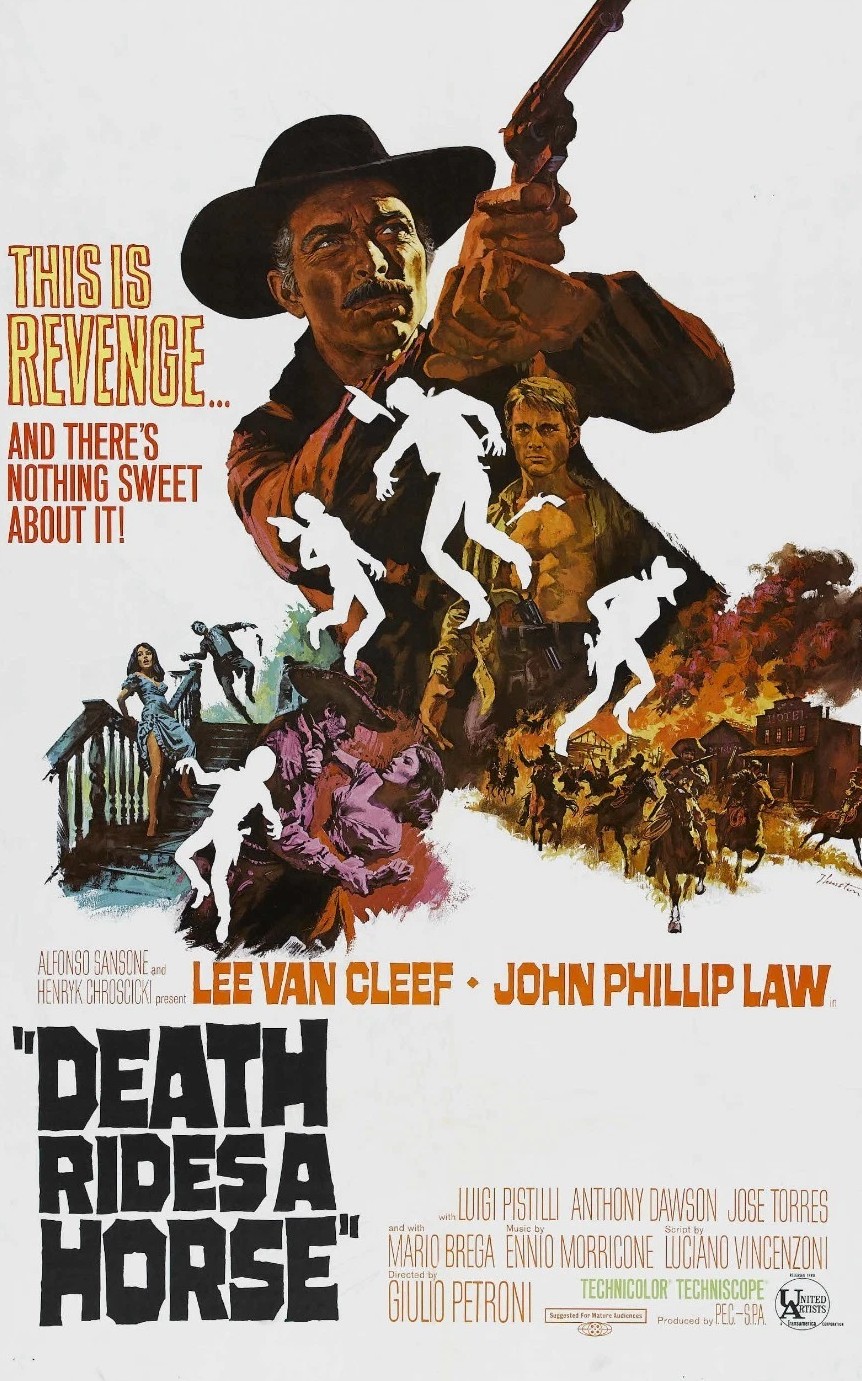
Although Once Upon a Time in the West (1969) is my all-time favorite western and although the first X-certificate movie I sneaked into as a teenager was The Good, the Bad and the Ugly (1966/1968), I never had much interest in spaghetti westerns. For a start, by the time I started my serious cinemagoing – bear in mind I grew up in towns without picture houses – the spaghetti western sub-genre was long gone.
So I was surprised to find how stylish and intriguing this little number was. People had odd ideas about style: they think it’s about capturing a vista at sunset or the way a director moves the camera or some effect gained from the cinematography. But there are other, as important, aspects. And two, perhaps the smallest of the effective ingredients, are on show here.
The first comes with the opening shot. Some cowboys are braving torrential rain. Now movie rain doesn’t behave the same way as real rain. It’s directed and its force depends on something else beyond nature. It’s too consistent in the way that real rain isn’t. So to convince us that these dudes are enduring a storm, director Giulio Petroni has set up on the very edge of the screen a lamp that moves, twisting one way and the other as the wind shifts direction, flaring up and flickering down depending on the position it holds. That little thing was what it took to convince me this was a storm.
The second thing was the editing. Again, critics intend to focus on some unusual aspect. Fast-cutting, for example, as in The Wild Bunch (1969) or cutting between a match and a sunrise (Lawrence of Arabia, 1962)) or from one pillow to another in separate households (Zee & Co, X Y & Zee, 1972). But actually the biggest benefit of good editing is to keep the story moving and not waste time
So here we cut from our blue-eyed anti-hero Bill (John Philip Law) being told to meet a bad guy in his office. Next thing, Bill is entering a darkened room. Automatically, you think this is a trap, that he’s going into villainous saloon owner Cavanaugh’s (Anthony Dawson) office. Instead, he confronts the other anti-hero, criminal Ryan (Lee Van Cleef), just released from prison after 15 years. And without any dialog to otherwise explain the situation, we understand immediately from previous interaction that Bill has been hired by the bad guy to kill Ryan.
There’s countless examples of this kind of editing where action sets the tone rather than dialog, although in the latter regard some of the lines are filled with edge.
Bill and Ryan really should be working as a team. They both want revenge on the same gang of outlaws, Bill because, as a child, he witnessed the gang murder his family and rape his mother and sister, and Ryan because he was fitted up for the robbery the gang committed. But both want the sole satisfaction of carrying out the revenge.
Ryan is something of a mentor to the greenhorn, a skilled gunslinger without the smarts necessary to hold his own. Ryan constantly shows Bill how much he still has to learn about looking after himself and the teaching comes with sharp consequence, Bill left horseless on two occasions and having to tramp miles into the nearest town.
So they get in each other’s way. Bill kills Cavanaugh without realizing that the only reason the businessman is still alive is that Ryan wants reparation from him of $15,000 – $1,000 for each of the years he spent in prison. And now he saddles Bill with that debt.
Ryan knows exactly who he’s hunting down but Bill has to do it the hard way, following a series of clues, personal elements of the masked guys who slaughtered his family, someone who wears distinctive spurs, another with a tattoo on his chest and so on.
This proves a particularly good twist on the older guy-younger guy narrative device so often used in Hollywood. The rivalry rarely cools, Bill taking simple revenge on Ryan at any opportunity.
Eventually, they do agree to work together after Bill works out that Ryan was one of the gang, except that the older man arrived too late to take part in the massacre but just in time to save Bill from being consumed by a raging fire.
The last twist is saved for the climax.
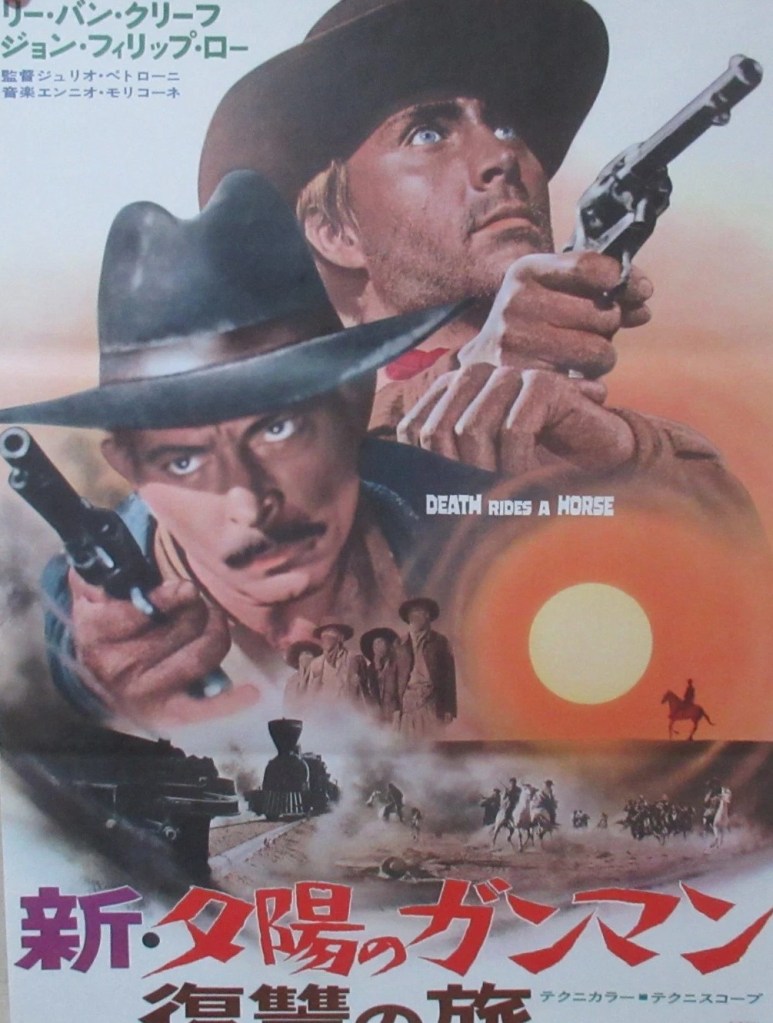
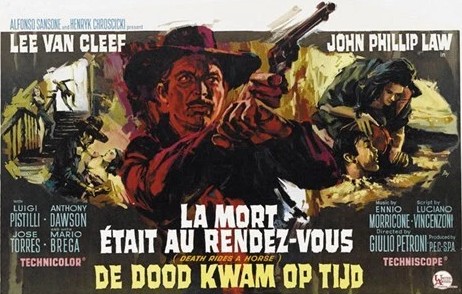
United Artists waited until Sergio Leone’s “Dollars” trilogy had opened the box office doors in America before pushing this out in 1969 (hence the odd dating). Lee Van Cleeef essays a more considered version of his Man in Black persona from For a few Dollars More (1965/1967). John Philip Law (Barbarella, 1969) would never work out, unlike George Peppard, say, that the intensity of his gaze and the blueness of his eyes distracted from his acting.
Put me in mind to check out some of the other spaghetti westerns directed by Guilio Petroni such as A Sky Full of Stars for a Roof (1968). Written by Luciano Vincenzoni (The Good, the Bad and the Ugly).
Well worth a look.


Went to see this without any expectations. The opening was very original and creative. This stirred my attention and the result was a surprisingly entertaining n exciting western. Surprise both Cleef n Law were not together in another.
LikeLiked by 1 person
Would have thought it merited a sequel. It was constantly original.
LikeLike