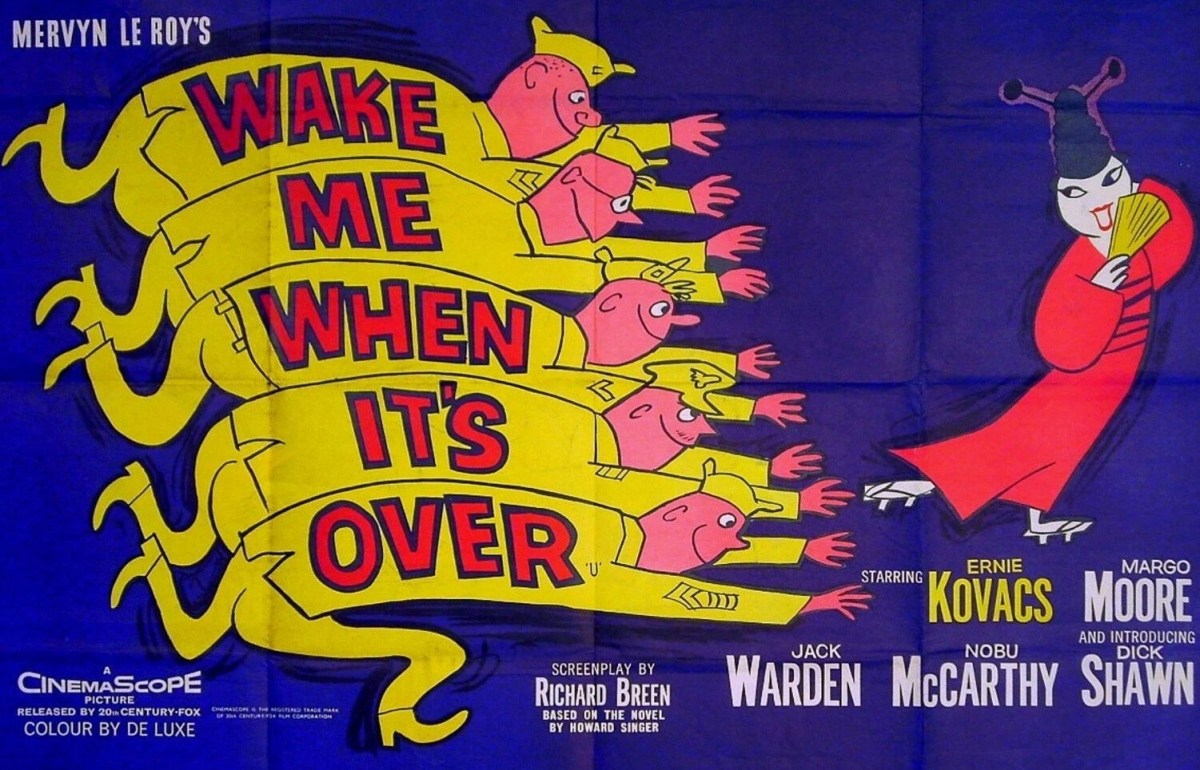
Wake Me When It’s Over (1960) ***

You could scarcely find a better example of the pleasant undemanding fare that constituted Hollywood’s bread-and-butter than this mild comedy. It takes 20 minutes to even get to first base, setting our hero on his journey to a distant land, and another 20 minutes before the narrative sets out a purpose, from which various romantic and dramatic complications can arise. It doesn’t boast any stars.

If top-billed Ernie Kovacs (North to Alaska, 1960), in his third movie (and first as the headline act) had any marquee attraction it was to a television audience following his output in various comedy shows, but those would carry no weight abroad.  The second-billed Dick Shawn (A Very Special Favor, 1965) carried even less appeal. He was best known as a guest star liable to pop up on television shows. Both comics were an acquired taste, belonging to the avant-garde, so their styles were not guaranteed to necessarily go down well. Not like, for example, more established comedians such as Bob Hope or Jerry Lewis.
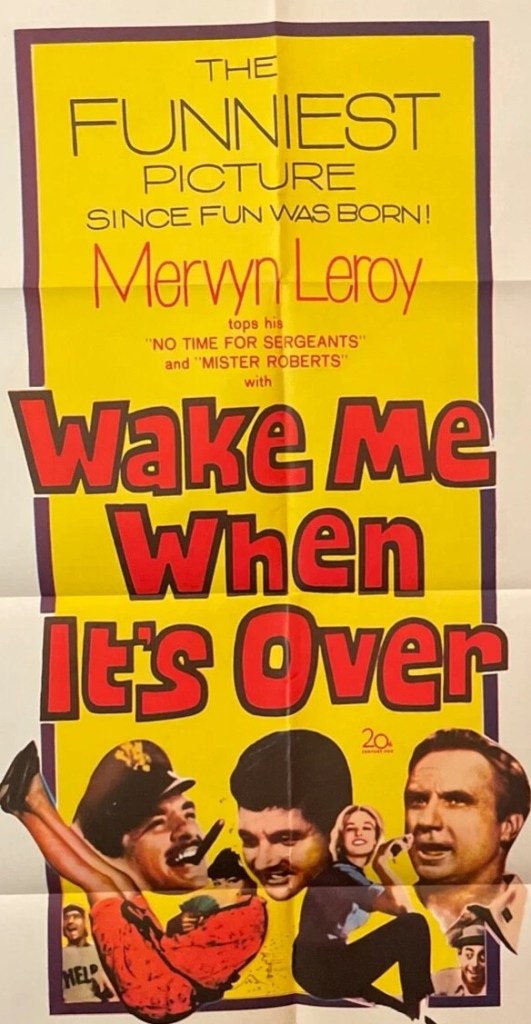
The public was even less familiar with female lead Margo Moore (The George Raft Story, 1961). She only made three movies in total, this being the middle one.

This probably was greenlit thanks to director Mervyn Leroy who had helmed two very successful service comedies, Mister Roberts (1955), replacing John Ford, and No Time for Sergeants (1958), both based on hit Broadway plays.

Through a bureaucratic error, unassuming Gus Brubaker (Dick Shawn) is re-drafted into the U.S. military and dispatched to a remote island near Japan where, this being in the aftermath of the Korean War, there is nothing for the soldiers to do except laze around. Capt Stark (Ernie Kovacs), the unit commander, is as intent on doing nothing as anyone else.

Brubaker hits on the idea of utilizing the natural hot springs of the area to build a hotel using materials acquired very cheaply in order to capitalize on this wonder, offering hot spa treatments to visitors and recuperating soldiers.
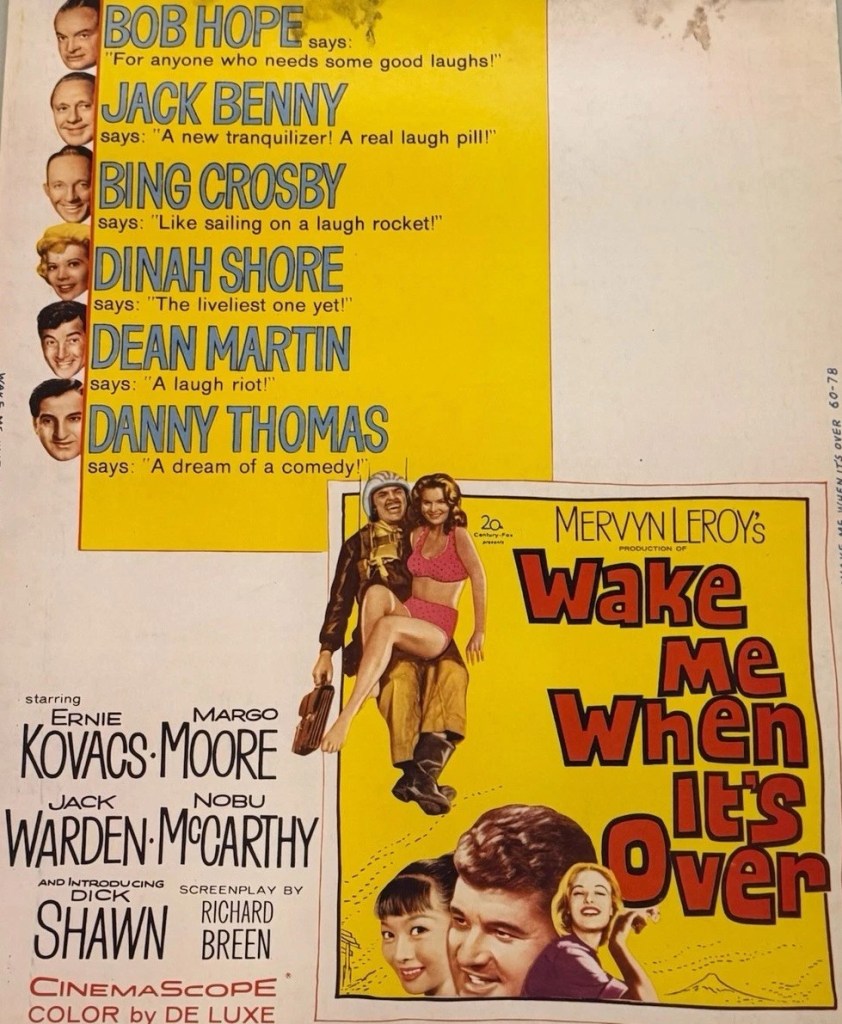
The soldiers, including resident medic Capt Farrington (Jack Warden), sign on, seeing it as a business opportunity, involvement in which, somehow, does not run contrary to military regulations. Just when you’re waiting for the picture to develop some snap – it’s not going to be romance between Brubaker and Ume (Nobu McCarthy), daughter of the local mayor, because he’s already happily married to Marge (Noreen Nash) – up pops Lt Nora McKay (Margo Moore), bringing a female sensibility to the project and in charge of hiring the 40 local women to staff Hotel Shima.

With Brubaker off limits, it’s up to Stark and McKay to make romantic hay, though that ultimately encounters complication. Building the hotel would be the modern equivalent of a corporate team building operation because the solders soon revert to proper military ways and bond.

But word misleadingly gets out that far from being known for its healing properties, the hotel is actually a front for sexual encounters and Brubaker is court-martialed, leading to all sorts of shenanigans. After being found guilty, he is let off the hook due to the original bureaucratic error that led him to be re-drafted in the first place.

Once it gets going – and that’s quite a long time – it turns into harmless enjoyment and the two stars have ample opportunity to show they are not run-of-the-mill comedians. There are some good visual jokes, The cans of beer Brubaker has dropped in a pool to cool explode to demonstrate the water is actually a hot spring, the MacGuffin of the piece. On finding himself on the island, Brubaker plans to immediately submit a request to leave. The filing cabinet for a simple request is half-full, the one seeking a transfer full and the one demanding he be viewed as a special case overflowing.

Charming in its own way. Didn’t turn anyone into a star but proved that Hollywood could make this kind of small picture – what we’d call a “sleeper” – with enough going on to maintain interest.  

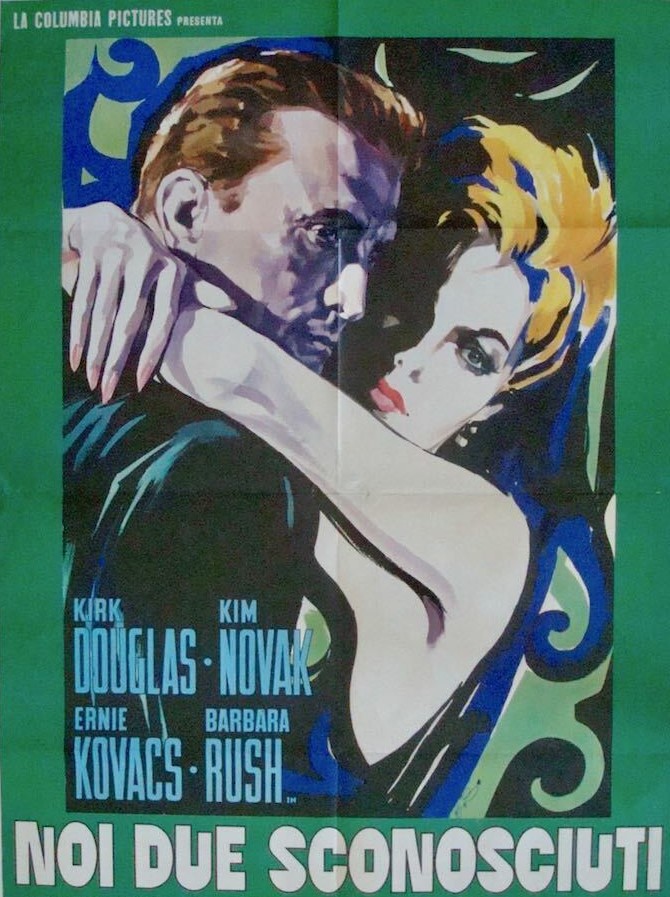
Strangers When We Meet (1960) ****

Something of a gamble for Kirk Douglas. Unlike son Michael – sexually voracious on screen (and in real life, apparently) in hits like Fatal Attraction (1987) and Basic Instinct (1992) – Douglas Snr had spent the Fifties primarily as an action star. Should romance feature, it was generally incidental. In several of his most successful movies – 20,000 Leagues under the Sea (1954) and Paths of Glory (1957), there’s either nary a female in sight or, Lust for Life (1956),  he’s useless with the opposite sex.   

In pictures where passion was core, The Bad and the Beautiful (1952) and The Secret Affair (1957), he was the leading man – to Lana Turner in the former and Susan Hayward in the latter – as opposed to the top-billed star. So he had a good deal of catching up to do. It’s generally forgotten, also, that Burt Lancaster took top billing in Gunfight at the OK Corral (1957) and The Devil’s Disciple (1959) and that Douglas had received top billing more recently usually when his company was helping foot the bill, as in Paths of Glory and The Vikings (1958).

Kim Novak, on the other hand, was the sex symbol du jour, second only to Marilyn Monroe in the provocative stakes, molten on screen, leading astray the likes of William Holden (Picnic, 1954), Frank Sinatra (Pal Joey,1957) and James Stewart (Vertigo, 1958).  

That Douglas and Novak strike sparks off each other in this classy well-written tale of illicit love is largely because as much as Douglas emotes passion Novak plays down her inherent sexiness. But it’s unusual for a number of reasons. Female equality, for one, creativity, artistic fulfilment, for another.   

Architect Larry (Kirk Douglas) feels trapped in building routine houses until he persuades unhappy novelist Roger (Ernie Kovacs), imprisoned in the restricted world of bestsellers and lacking critical approval, to invest in an avant-garde house. You couldn’t say Larry is in an unhappy marriage but hard-headed wife Eve (Barbara Rush) tends to trample on his dreams in her pursuit of money. Eve believes their marriage is a partnership in every sense, demanding an equality unusual for the era, a situation hammered home by Roger’s misogynistic treatment of his girlfriend.

Maggie’s (Kim Novak) marriage is arid, husband Ken (John Bryant) lacking passion. Although beautiful, Maggie is insecure and shy. Cold, too, according to her mother Mrs Wagner (Virginia Bruce),  who has been condemned for having an affair. But there’s an early hint that Maggie has taken a similar route, being pestered on the phone.

Larry does all the running after catching Eve’s eye on the school run. Larry, who works from home, can use the excuse of meeting potential clients to slip out at night. Ken is so uninvolved in his wife’s life he doesn’t care if she pops out of an evening, disinterested when she dons revealing nightwear, unable to countenance that she might be meeting another man. Both Larry and Maggie are liberated by their affair, especially as she gives more credence to his artistic abilities than his wife.

We’re pretty much in Douglas Sirk territory, the wealthy suburbs and a simplified color palette with every housewife capable of turning into a hostess at the drop of an invitation to cocktails. You can imagine how this is going to end, but it doesn’t go that route, not even when the affair is rumbled by unlikely lothario Felix (Walter Matthau). There’s Larry’s ambition to take into account, and whether the prospect of building an entire town can match up to the excitement of an affair.

Director Richard Quine (who was Novak’s lover at the time) was on a roll – Bell, Book and Candle (1958), also with Novak, It Happened to Jane (1959) starring Doris Day and The World of Suzie Wong (1960) on the horizon. His direction is mostly spot-on, especially in keeping Novak’s overt sexiness under wraps, and a couple of times scenes really spark.

Felix’s failed seduction of Eve – male arrogance leading him to believe she will enter into adultery to square things up – ends in a stunning composition, the man standing dominant over the female as if rape is the next thing. The crisis scene between husband and wife is played by Eve walking away from the camera.

Solid melodrama with excellent performances all round. Judging from the box office, audiences agreed that Douglas and Novak clicked. Evan Hunter (The Birds, 1963) wrote the screenplay based on his bestseller.

Worth a look for the complexity brought to a standard tale.

Discover WordPress

A daily selection of the best content published on WordPress, collected for you by humans who love to read.

The Atavist Magazine

by Brian Hannan

WordPress.com Blog

News, Tips & Website Tutorials