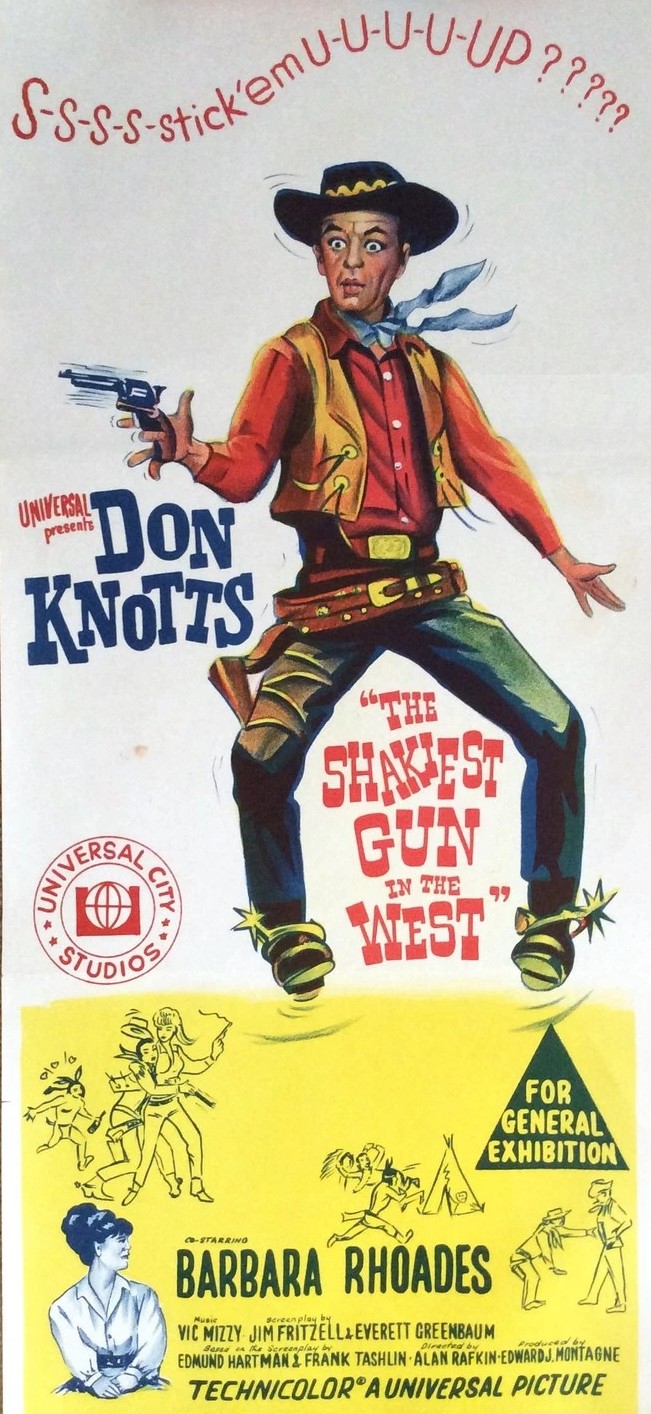
Don Knotts (The Incredible Mr Limpet, 1964) was an acquired taste, relying overmuch on permafrozen goggle eyes and physical comedy. Despite the best efforts of The Great Race (1965) and It’s A Mad, Mad, Mad, Mad World (1963) and the reissues of Buster Keaton, Charlie Chaplin and Laurel and Hardy classics – perhaps because of this surfeit of slapstick – it would take a very special comedian to make as big an impression.
Bob Hope had gone down the cowardly cowboy route before in The Paleface (1948) and Son of Paleface (1952) and in fact this is pretty much a remake of The Paleface, substituting newcomer Barbara Rhoades (Don’t Just Stand There, 1968) in her sophomore outing as “Bad Penny” Penelope instead of Jane Russell as the more famous Calamity Jane. So it’s not a comparison a comedian would generally welcome – to be matched up against Bob Hope.
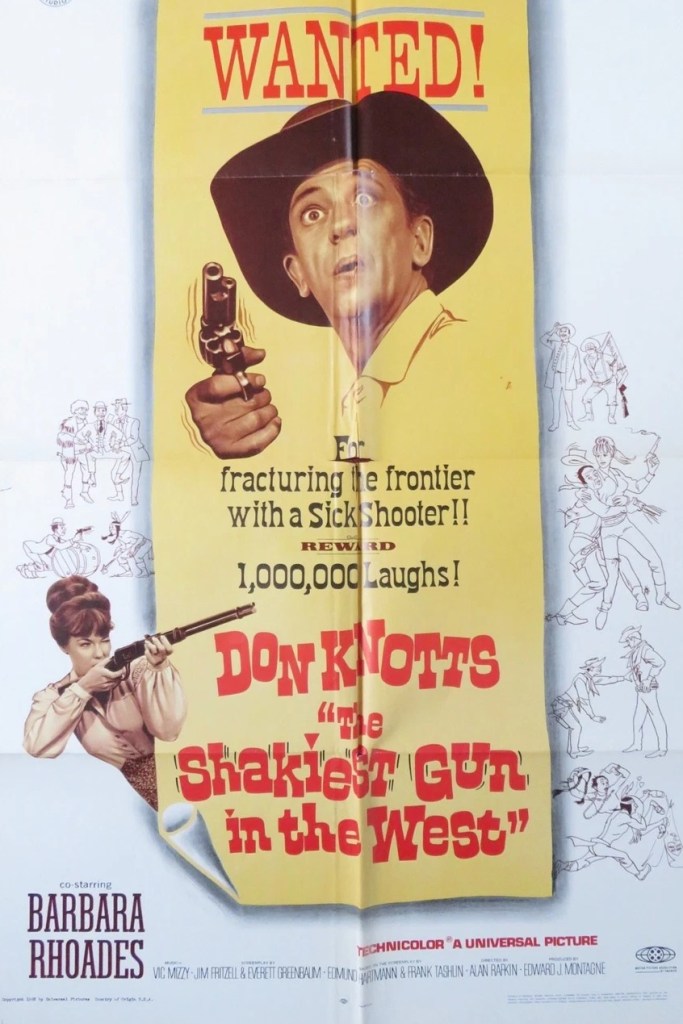
What distinguished Hope’s coward was that he always believed he was catnip to the ladies. Don Knotts was under no such illusions.
The story just reruns The Paleface – mild-mannered dentist Jesse Heywood (Don Knotts) is teamed up with sharpshooting criminal Penelope (Barbara Rhoades) to winkle out villains smuggling guns to Native Americans. The twist is that as part of the woman’s cover she’s been married off to the hapless dentist – for the simple reason that wagons trains won’t accept single women. Needless to say, their expectations of marriage differ.
While she manages to avoid intimacy, Jesse becomes acclaimed as a hero during a Native American attack, oblivious to the fact that it’s his wife who’s been doing all the shooting. That singles out Jesse as the undercover agent but he’s again saved by Penelope.
Eventually, he learns the truth but not in time to save Penelope who’s been kidnapped by the Rev Zachary Gant (Don “Red” Barry) and his sidekick Matthew Basch (Jackie Coogan) who have been smuggling weapons inside boxes of Bibles. When Jesse goes to the rescue it’s on the assumption Penelope’s marksmanship will save the day. However, she’s whisked out of the way and Jesse is forced to do his own gunfighting.
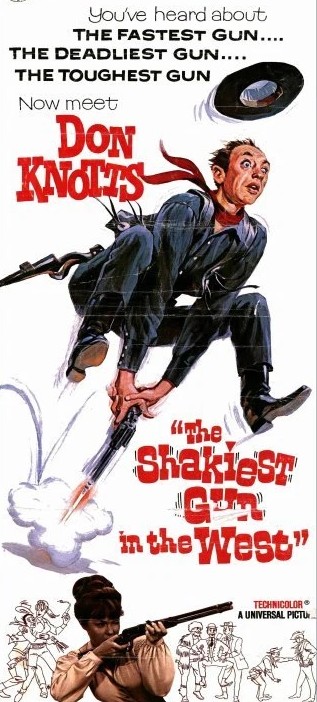
Even so, it’s not his skills with a gun that retrieve the situation, rather his dentistry, as he fixes the teeth of the Native American chief.
This relies far more on set pieces than the Bob Hope effort. Hope was able to draw the cinema audience towards him, a skill which Knotts lacks, so the humor results from the more obvious. However, there are a few scenes that don’t rely on Knotts. In one it’s the background character of a railway porter laden down with bags who snags the laffs.
Fear is a Knotts trope. During a stagecoach robbery he literally goes stiff with fear and has to be carried stiff as a piece of wood back into the stagecoach. Absent-minded, goofy, way out of his depth and not just with women, is the comedian’s schtick. Even when he develops a swagger following his deluded belief that he’s a six-gun ace, it’s the dumbest swagger ever.
Luckily, nobody’s trying to steal the scenes. The rest of the cast is drawn from more serious timber. You might be more pleased to see veteran Jackie Coogan (A Fine Madness, 1966), one-time child star, and B-western icon Don “Red” Barry (Alvarez Kelly, 1966) in more than their usual bit parts and to catch Pat Morita (The Karate Kid, 1984) in his sophomore venture.
Unfortunately, neither Knotts not Barbara Rhoades can come close to their predecessors.
Directed by Alan Rafkin – who had directed Knotts in The Ghost and Mr Chicken (1965) – from a screenplay by the team of Jim Fritzell and Everett Greenbaum (The Ghost and Mr Chicken) based on The Paleface written by Frank Tashlin (Caprice, 1967) and Edward Hartmann (The Sword of Ali Baba, 1965).
I’d been very much aware of Don Knotts as I moseyed around 1960s cinema but, fearing disappointment, had steered clear. This will suffice, I think.
Easy on the eye as long as you keep your comparisons to yourself.