The Lion (1962) ***

For such a harmless picture The Lion raises a couple of troubling issues. The first concerns the titular beast. Doubt if you’d get the authorities these days to greenlight a movie where a pre-pubescent girl was in such close proximity to a full-grown lion. Having as a safety measure two sharpshooters on the sidelines out of camera range, as director Jack Cardiff did here, might not cut it.

Secondly, we’ve got censor double standard. I remember my shocked parents forbidding me from seeing Zulu (1964), a massive hit in Britain, on account of the toplessness of the indigenous females. The censor didn’t slap an X-certificate on that sequence on the assumption that such nudity, in the context of tribal tradition, wouldn’t apparently incite the lewd male gaze. Had this been white breasts on show, in whatever tradition, the censor would not have been so lenient, signifying an inherent racism. Here, surprisingly, we’ve also got female toplessness, somewhat more discreet than Zulu, but coming as a surprise to your reviewer.

Perhaps the oddest feature of the picture is the contradictory message: Africa is wonderful but it’s not the place to bring up a young girl. Certainly not one who embraces the wildness with considerably more conviction than a passing wildlife tourist. As the imdb stub puts it: the young girl Tina (Pamela Franklin) must be brought “back to civilization.”

And there’s a distinctly old-fashioned tint to a storyline that demands the appearance of her father Robert (William Holden), long divorced from wife Christine (Capucine), as the firm male hand required to drag his estranged daughter back to said civilization. Christine’s current partner John (Trevor Howard), grizzled poacher-turned-gamekeeper, former big game hunter now eking out a living as a game warden, appears more sanguine about the girl’s lifestyle but less welcoming to the visitor. Tina has raised the wild lion King from a cub and as their bond is intense she is reluctant to give him up.

Disney would have taken a different approach, buffing up the cuter aspects. That the studio could show adult and child perspective in tandem is instanced by Pollyanna (1960) and in the later The Jungle Book (1967) solved the problem of a young boy becoming too involved with his wild playmates by having an intriguing young girl tempt him away. Or a touch of the Born Free (1966) playbook might have seen Tina simply mutate from childhood to an adult job in the animal preservation business

Instead, playing out in almost literal fashion, are two human male beasts battling it out (though not physically, unfortunately) over the mother with the needs of the child seemingly swept to one side as the love triangle takes hold.

The best scenes concern Robert and Tina, especially her early disinterest in his presence, and her later delight at leading him a wild dance through the jungle and seeing how his terror of her lion pal equates with her complete lack of fear. While John’s role is to keep a grip on poaching, he’s not so friendly to the animals, almost determined to torment them by running his jeep recklessly at or around them to elicit maddened response and alarm the visitor with their wildness rather than their apparent, at a distance, docility.

Perhaps the lack of a punch-up ensures this movie never catches fire. There’s quite a perplexing sub-plot that dictates the outcome. The son  of the local tribal chief has his eye on Tina and during the aforementioned tradition it’s clear the young girl wants to participate in the frenzied dance courtship ritual.

But this kind of tradition is at the polar opposite of civilization as is the tradition that an old man, succumbing to fatal illness, should be left out in the wild to die. Christine intervenes to save him. Meanwhile, believing his father dead, the son sets out to achieve manhood by killing the lion and in the ensuing tangle John kills both young man and lion. The tribal response to the death of their new chief goes unrecorded but Bullit’s action drives Tina towards her parents. With the lion dead, it’s a lot easier to winkle the girl away from Africa and back to civilization.

Plenty of wildlife for your buck, but plot and characters are not a patch on Hatari! (1962) or The Last Safari (1967). William Holden, whose yen for making movies as far away from the U.S. tax authorities as possible was destroying his career, is good value as the estranged father and if you are looking for smouldering then Trevor Howard (The Long Duel, 1967) is your man. Capucine would tee up with Holden – the pair had an affair – again in The 7th Dawn (1964) but she was more effective in the later picture than here.

Jack Cardiff (Girl on a Motorcycle, 1968) directs from a script by Irene and Louis Kamp (The Sandpiper, 1965) based on the bestseller by Joseph Kessel (L’Armee des Ombres/Army of Shadows, 1969).

Might have preferred the Disney version.
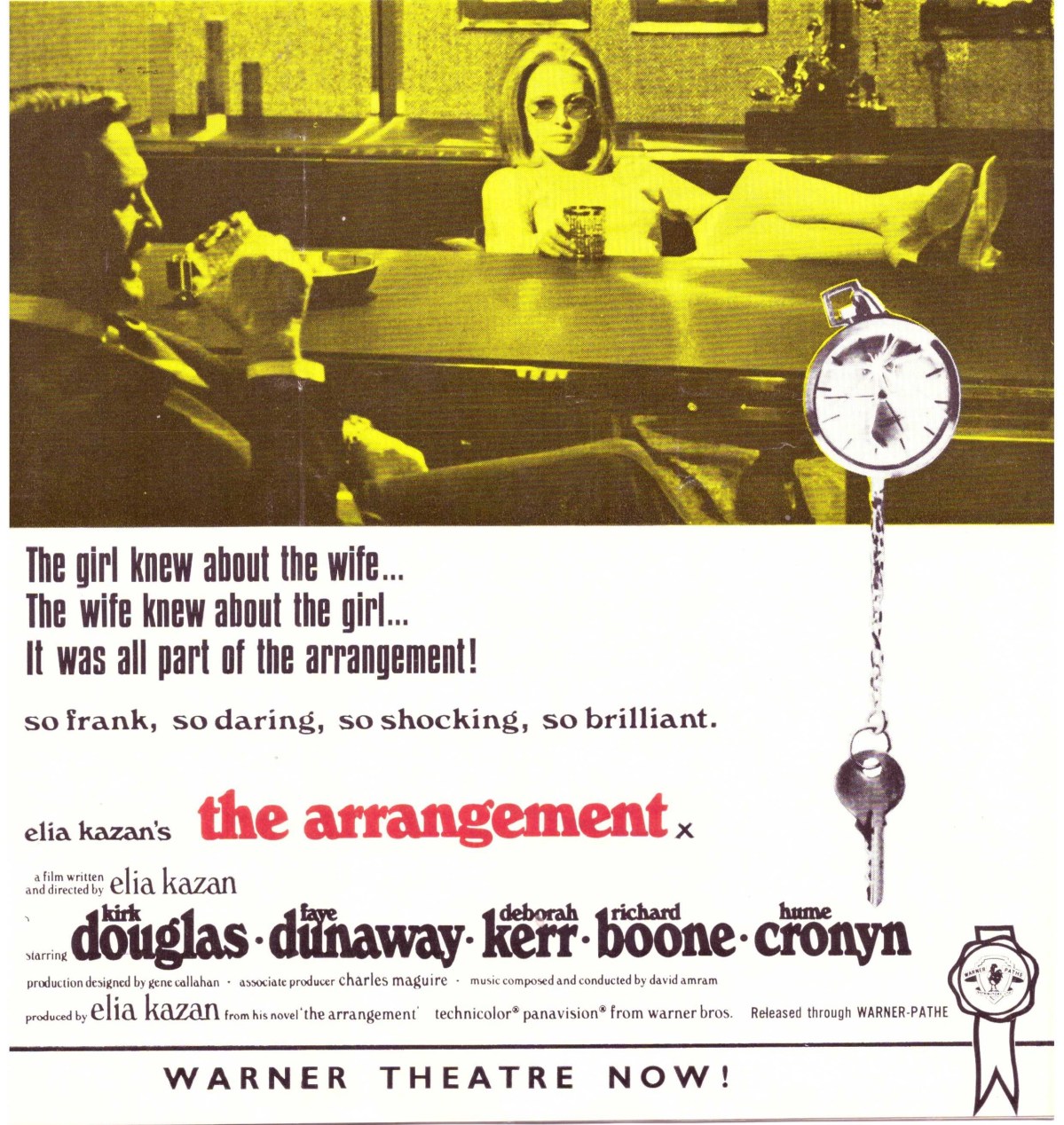
The Arrangement (1969) ***

It might have been better if director Elia Kazan had handed over the screenwriting chores for this adaptation of his bestseller about the midlife crisis of advertising man Eddie Anderson (Kirk Douglas). As director he over-angsts the pudding. Anderson’s attempts to juggle wife Florence (Deborah Kerr) and mistress Gwen (Faye Dunaway) coupled with growing disgust at selling a new brand of cigarettes, Zephyr (“The Clean One”), in a way that pointedly avoids their cancer potential, leads to a suicide attempt. 

During convalescence he determines to quit the advertising world and go back to his first love, writing, but in fact he ends up sabotaging his career. Florence represents impossible seduction and conscience. Slinky, in dark glasses, hot-tempered rather than submissive or demure, she accuses him of self-deception in his job. The picture flits back and forth between his various choices – different job, return to wife, settle down with mistress, or what seems his ideal world, cossetted by both Gwen and Florence.

Gwen is an excellent study of the modern woman (of that fast-changing period, I hasten to add), who needs a man for sex but not necessarily love, and can use the opposite sex as ruthlessly as any man. What she actually requires in her real life is quite different to what she seeks in the fantasy love she enjoyed with Anderson, sex on the beach, the buzz of controlling a high-powered man. Florence could be seen as an old-fashioned portrait of the adoring wife except for capturing so well the bewilderment of betrayal.

Kazan conjures up some wonderful images: the tension before the suicide attempt as Anderson plays chicken between two trucks, Gwen emerging wet from the pool to eat dangling grapes or with her legs up on Anderson’s desk, Anderson’s mother lighting votive candles in her house before using the same match for her cigarette, Kerr’s futile attempts to win back her fallen husband, Anderson flying solo.

In parts well-observed and directorially savvy, quick cuts between the present and the past, however it sinks beneath its own self-indulgence. My guess is that author Kazan could not bear to kill off a single one of the characters he had created for his acclaimed novel and the upshot is a vastly over-populated picture, few of whom cast any real light on Anderson’s predicament. So we are not only introduced to mother, dying father, brother, sister-in-law and  analyst but priest and a bucket of clients and guys from the office. And there are some plot oddities – Anderson gets time off apparently to write journalistic pieces – and what is clearly intended as hard-hitting satire of the advertising world does not come off.

Dunaway (Bonnie and Clyde, 1967) is the standout as Gwen, living life according to her own rules, and with an unexpected vision of domesticity but Deborah Kerr (Prudence and the Pill, 1968) does pain like nobody else and is extremely convincing. Strangely enough, I didn’t go much for Douglas (Seven Days in May, 1964). He could have been leading a cavalry charge for all the range of emotions he exhibited. Douglas is no Montgomery Clift (Wild River, 1960), James Dean (East of Eden, 1955) or Marlon Brando (On the Waterfront, 1954) who was Kazan’s first choice. Kazan had not made a picture in six years and it had been eight years since his last hit Splendor in the Grass (1961). Not quite out-of-touch in concept and delivery, nonetheless it was shunned by the Oscar fraternity.

An odd one distinguished by Deborah Kerr and Faye Dunaway.

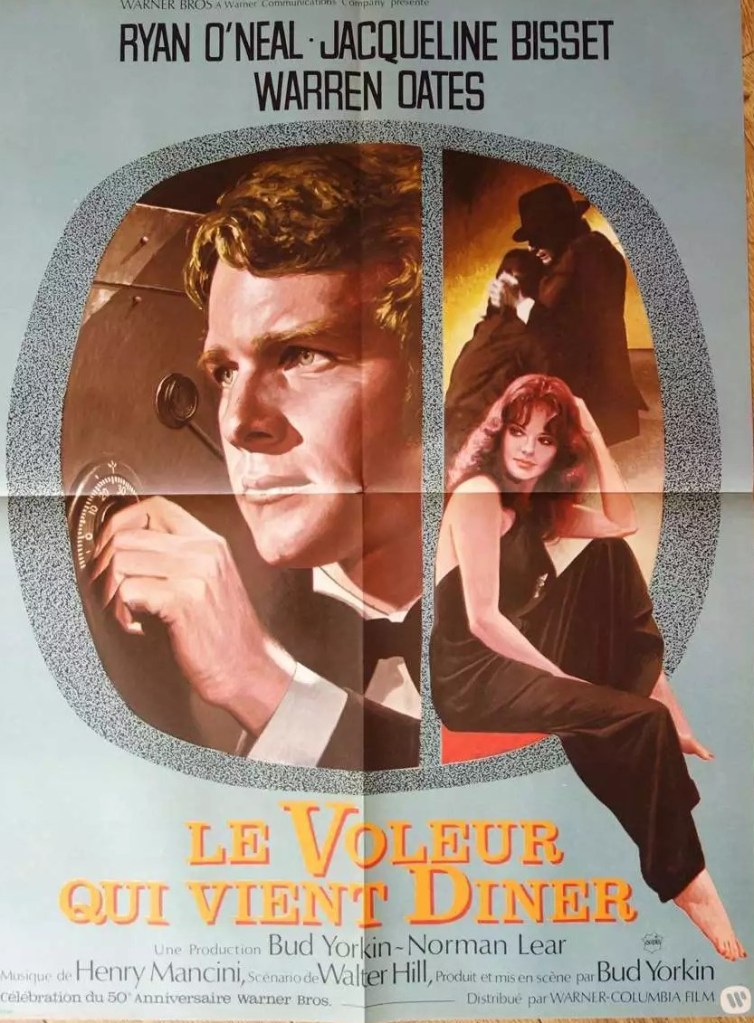
The Thief Who Came to Dinner (1973) ****

Very unusual entry into the cat burglar subgenre since it plays like a bromantic version of The Thomas Crown Affair (1968), investigator and investigated striking up some sort of relationship, though with an elegant dame on the sidelines to take care of the jewel thief’s sexual needs. Might be surprised to see Bud Yorkin – better known at the time for comedy – helming this classy thriller and Walter Hill, not yet known for tough thrillers, relegated to screenplay duties.

Webster (Ryan O’Neal) quits his job as a computer geek to go into the thieving business. He’s pretty business-like about it, too, setting up a deal with fence Deams (Ned Beatty) before he gets started, and none of this no honor among thieves nonsense. The first break-in, to the house of politician Henderling (Charles Cioffi),  delivers a handy bonus of uncovering documents relating to corruption so Webster’s able to blackmail the victim into providing him with an entrée into high society where he can scope the jewellery on show at various parties, and where he meets Laura (Jacqueline Bisset) who appears to be in the same line of work, if at a much lower level.

We never see Laura at work and mostly she hovers in the background, there’s no angst in this relationship, she’s the kind of thief who steals because she’s the bored kind of rich gal looking for kicks. Most of the thieving is interesting one way or another. On his first gig, though Webster had invested in one of those devices that hold onto the glass once you’ve nefariously released it from the frame, he’s so inexperienced the glass breaks.

Instead of quieting guard dogs with doped meat, he sends in a bitch to distract them. He has to deal with illicit lovers turning up in the middle of a robbery. And, of course, with an amazing diamond on show, he just has to organize a way of stealing it.

So with Laura not providing any of the tension, not the usual refusal to become entangled with a criminal, not just the normal lovers’ tiffs, it’s left to insurance investigator Dave (Warren Oates) to provide the friction. He’s not the confident, cocky, kind of detective and it’s diligence that leads him to consider Webster his main suspect. And so begins the cat-and-mouse element, the cat often subverted since Webster knows when he’s being tailed and can lead Dave a merry dance. But, mostly, Webster seems to enjoy the battle of minds.

Webster, and a psychiatrist would have a field day here, leaves a calling card at every robbery in the shape of a chess move, guaranteed to get him the headlines he presumably craves of “The Chess Burglar Strikes Again” variety, which only serves to ratchet up the pressure on the supposed incompetence of his pursuers.

Dave has the bright idea of getting a chess expert Zukovsky (Austin Pendleton) to take the thief up on the game, thus introducing a splendid subsidiary character primarily for comic effect, Zukovsky unaware that Webster’s moves are plotted by computer.

Dave and Webster do spend a lot of time together one way or another, Webster even visiting the detective when he’s hospitalized, and an element of mutual respect evolves. Once their relationship is established, Laura has less to do than be an accomplice, arranging ingenious escapes and so forth, so she’s not entirely out of the picture.

But the most interesting relationship is certainly between thief and ersatz cop. There are some excellent individual scenes, most of the thefts contain some unique element, the confrontations between the two principals play out like a low-key chess game, while the originally cocky Zukovsky, initially relishing the publicity, is reduced to fury at being beaten by an amateur. Webster’s ex-wife (Jill Clayburgh) relishes the change in his personality.

But mostly this is Ryan O’Neal (The Big Bounce, 1969) at the top of his game. No smirking and no screwball comedy. He’s given a well-developed character to play – physically fit, able to hold his own in the boxing gym, capable of cutting a deal with underworld figures – and the screenplay cleverly withholds the one element that all crime movies fall down on, the explanation of why anyone would turn to crime, so Webster weaves a sense of mystery. Jacqueline Bisset (The Detective, 1968) makes an excellent partner. And this is a stripped-down Warren Oates (The Wild Bunch, 1969), eliminating the meanness or exuberance that were his screen trademarks. Jill Clayburgh (An Unmarried Woman, 1978) has a cameo.

Bud Yorkin, who at the time was producer of the top three television comedies on U.S. television, foregoes comedy for tension and thrills. Walter Hill (48 Hrs, 1982) sneaks in some of the elements that would later become trademarks.

Great watch.

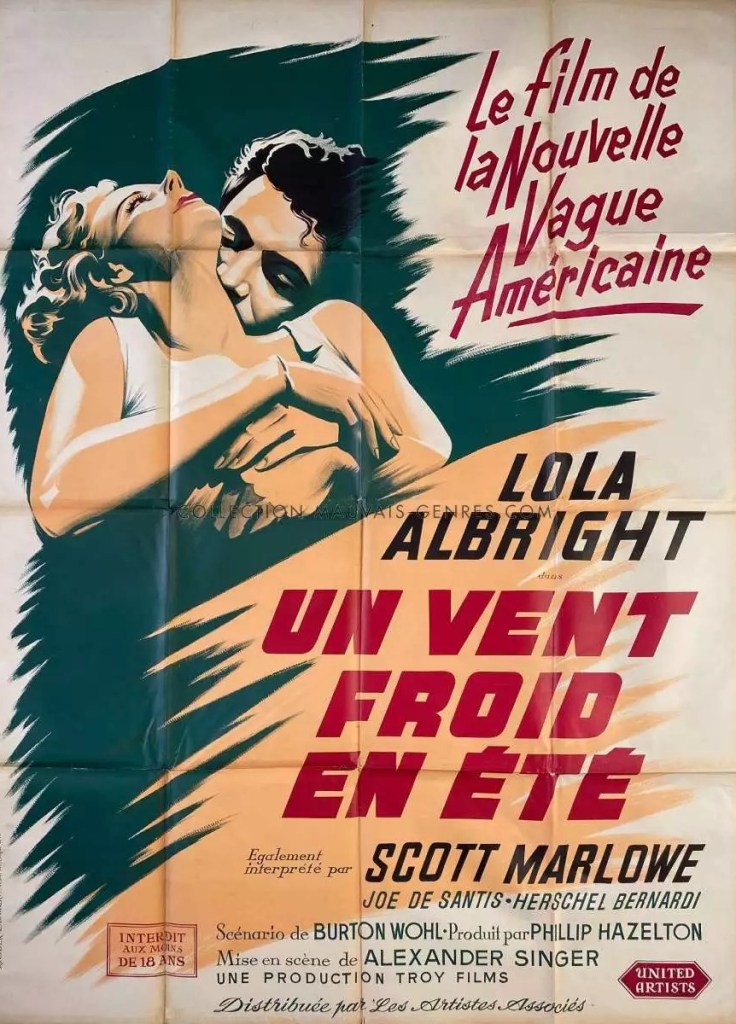
A Cold Wind in August (1961) ***

Touching low-budget B-movie shot in black-and-white of a young man receiving his sexual education from an older woman. Motherless Vito (Scott Maxwell), the son of an apartment block super, is seduced by the older Iris (Lola Albright), three-time divorcee, looking for a son to mother. 

This is not the transactional sex of The Graduate, and seduction is too strong a description for the yearning Iris whose advances are sensual and romantic, stroking Vito’s head, trapping his hand with her foot, and there is nothing clandestine about their affair either, no false names on a hotel register. They dally in the park, eat hotdogs, and he buys her flowers. 

But as he experiences love for the first time, he also experiences more difficult emotions like jealousy and finds it difficult not just to cope with what seems like another man in her life, the wholesaler Juley (Herschel Bernardi), but the fact that she treats him with such contempt. Spoiler alert – well, not really, because you know from the off this is not going to turn out well – the affair ends when he discovers she is a stripper. And while she is left bereft, he now appears more attractive to girls his own age.

In contrast to the powerful emotions stoked up when the pair are together, director Alexander Singer (Psyche ‘59) fills us in on the rest of Vito’s humdrum life, working for his father during the school holidays, goofing off with his pals, and generally failing to make headway with girls his own age.  But Iris’s life is not humdrum. Although she has a rule not to work in her own area, she breaks that to accommodate her estranged husband, whom she seems to tolerate, while at the same time drinking herself into oblivion to avoid any moves from Juley. Nor is she ashamed of her profession. It is an act, a job like any other, and provides her with a nice apartment.

Small wonder she treats men with contempt. Perhaps what she falls in love with is untainted innocence. In some senses she is adrift, at other times in full command. And her love for Vito is convincing.

It is full of incidentals. He gulps down ice-cream, she teaches him to drink one sip at a time, without being patronizing the father (Joe De Santis) tries to educate him to honor his inner feelings.

Lola Albright (Peter Gunn television series) carries off a difficult role very well indeed. Without laughs to help him out as it did Dustin Hoffman in The Graduate, Scott Maxwell is believable both as the youth growing into adulthood and the youth wanting to remain a youth with no adult responsibilities. The low-key performance of Joe De Santis is worth a mention.

While the picture no doubt attracted attention for the risqué material, which would have certainly given the Production Code pause for thoughts, it provided a more rounded picture than was normal at the time of a woman working in the sex industry, even if only in the stripping department. Iris did not fall into any of the cliches. She is presented as a woman first and foremost rather than a stripper.   

Alexander Singer sticks to the knitting and doesn’t come unstuck. John Hayes (Shell Shock, 1964) wrote the screenplay based on the Burton Wohl bestseller.

Unusual variation on the theme.

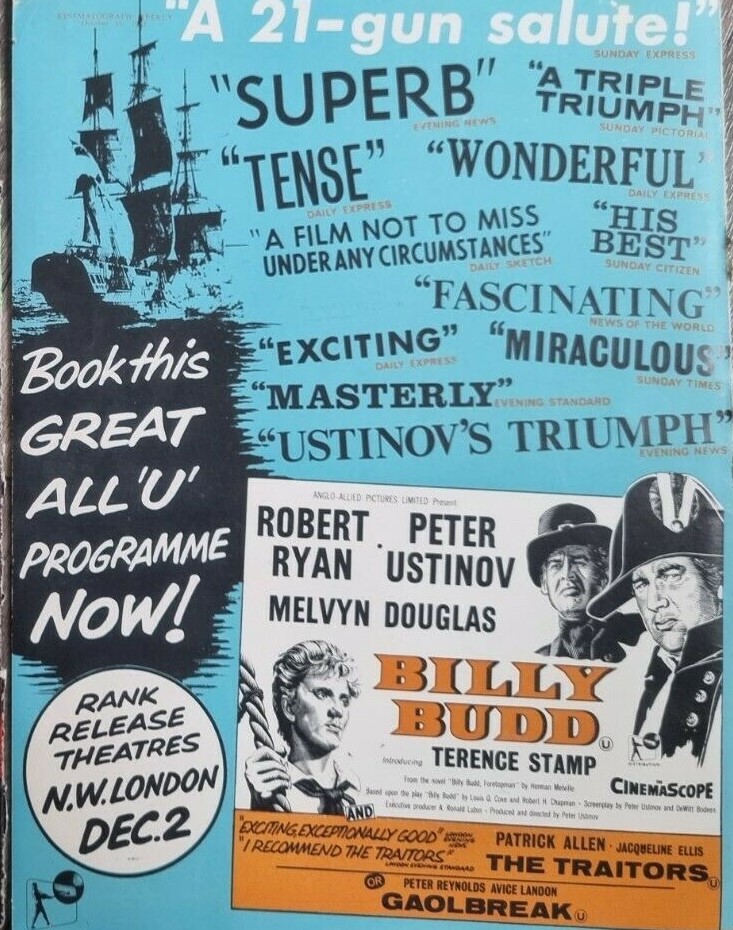
Billy Budd (1962) ***

Unfairly muscled out by lavish roadshow Mutiny on the Bounty (1962) but covering similar territory minus sailors going off-piste on a South Pacific island. Peter Ustinov outranked fellow triple hyphenates Billy Wilder (writer, producer, director) and John Wayne (actor, producer, director) in that he could add acting to his other skills (writer, producer, director) and in some respects he was actually better remembered as a noted raconteur on late night television shows. I was surprised to discover he was actually well versed in the directing malarkey by the time he came to helm Billy Budd, four previous excursions dating from the late 1940s and most recently Romanoff and Juliet (1961). He was better known at this point as an Oscar-winner for Spartacus (1960). He would win another for Topkapi (1964) and go on to direct another three pictures.

Billy Budd is a claustrophic affair that you’ll need a bit of a history lesson to understand. The British Navy had two methods of recruiting sailors. The first was the more honest, awaiting a supply of volunteers. The second, the most dodgy legal proces ever invented, involved grabbing any likely candidate and forcing – “pressing”- them into service. Normally, this caper took place on land and gangs of recruitment officers did the business, hence the term “press gang.”

However, I was unaware that in times of war – this is set during the Napoleonic War – the British Navy could board any passing merchant vessel and commandeer any of its crew. In this case,  Captain (actually Post Captain if you’re being technical about it) Vere (Peter Ustinov) hijacks only one sailor, Billy Budd (Terence Stamp).

Quite why it’s only this singleton is never explained. There are a couple of other irregularities that run against making this a tight ship in terms of narrative construction. The first is, that in the first of two critical incidents, our otherwise charming and chatty Budd is suddenly struck dumb with a stammer, the first time such an affliction has put in an appearance. The second is that, in consequence, Budd strikes an officer, the bullying Master-at-Arms Claggart (Robert Ryan) who hits his head while falling and dies.

Now even I know, and I’m hardly a naval scholar, that striking an officer is punishable by death. The fact that Claggart has a Capt Bligh disposition, inclined to find any opportunity to bring out the lash, makes no difference to the outcome. So while it seems that court martial provides dramatic scope, here the outcome is never in doubt. This isn’t Queeg on The Caine Mutiny, which is a more complicated affair, where the captain’s sanity is questioned.

So where the narrative should have built up in intensity, it largely flounders and depends (successfully as it happens) on audience appreciation of Budd as an innocent abroad.

That said, like Mutiny on the Bounty, it reveals the remarkable lack of recourse to any higher authority on ship should the highest authority either carry out or endorse cruelty. The minute he’s on the ship Budd is exposed to the sadistic will of Claggart who has condemned a sailor to a pitiless flogging for reasons that cannot be explained. Budd soon learns that Claggart has accomplices who will sabotage a crew member’s gear so that he will be put on a report, accumulation of sufficient black marks resulting in automatic flogging without interference from the captain.

While Vere is hardly in the Capt Bligh category and most of the time comes across as relatively amiable, our introduction to him is firing a shot across the bows of a merchant ship that doesn’t want to stop in case its crew is press ganged. He is quite ready to invoke the rules to get what he wants and is enough of a disciplinarian that the crew kowtow to him. He might feel a touch of remorse that Budd is the sacrificial lamb  to the Royal Navy’s rule of law, but he’s hardly going to go against procedure.

So mostly what we’ve got is the acting. Terence Stamp (The Collector, 1965), in his debut, was Oscar-nominated and you can see why and in some senses this is the career-defining role before acting affectations and mannerisms took over. Robert Ryan (The Wild Bunch, 1969) is very effective as the sinister Claggart. And there are a host of other British names to look out for – David McCallum (Sol Madrid/The Heroin Gang 1968), Ray McAnally (Fear Is the Key, 1972), Paul Rogers (Three into Two Won’t Go, 1969) and Niall McGinnis (The Viking Queen, 1967)  among the foremost.

Ably directed by Ustinov who wrote the screenplay with Dewitt Bodeen (Cat People, 1942) based on the original Herman Melville novel and a stage adaptation by Louis O. Coxe and Robert H. Chapman.

Worth seeing for Stamp’s performance.

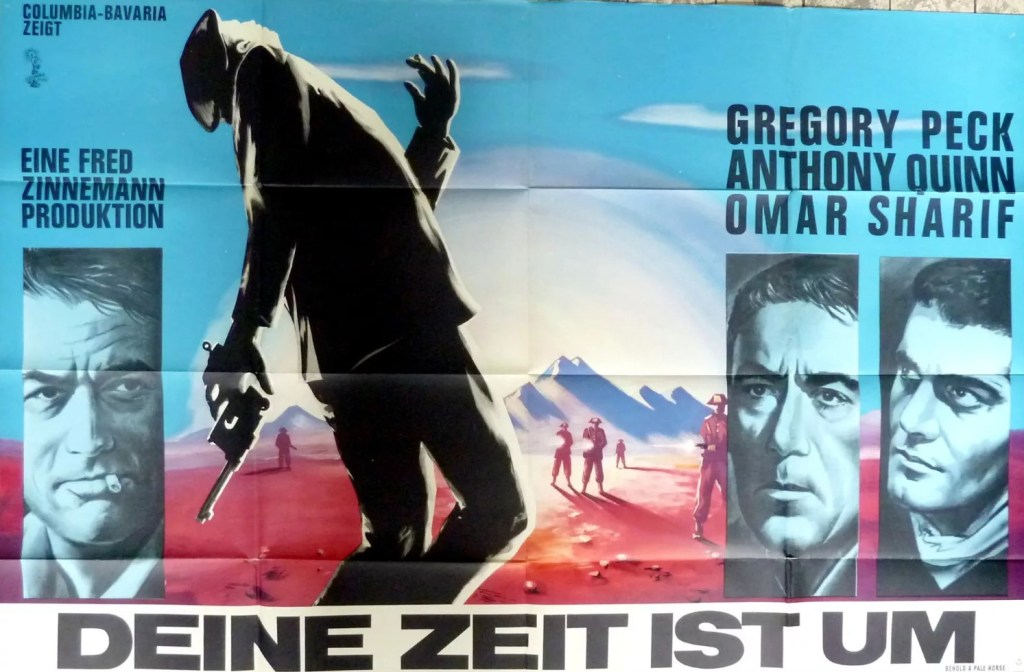
Behold a Pale Horse (1964) ***

Old causes never die but they do go out of fashion and interest from movie audiences in the issues surrounding the Spanish Civil War had fallen from the peak when they attracted artists of the caliber of Ernest Hemingway and Pablo Picasso. But passions surrounding the conflict remained high even 20 years after its conclusion as indicated in this Fred Zinnemann (The Sundowners, 1960) drama.

Manuel Artiquez (Gregory Peck) plays a disillusioned guerilla living in exile in France, who has ceased raiding the Spanish border town under the thrall of corrupt Captain Vinolas (Anthony Quinn). Artiguez has two compelling reasons to return home – a young boy Paco asks him to revenge the death of his father at the hands of Vinolas and his mother is dying. But Artiquez is disinclined to do either. Heroism has lost its luster. He has grown more fearful and prefers to live out his life drinking wine and casting lustful glances at young women.

In France he enjoys a freedom he would be denied in Spain. He is not hidden. Ask anybody in the street where he lives and they will tell you. This is a crusty old soldier, unshaven, long past finding refuge in memories, but not destroyed either by regret. There is a fair bit of plot, some of it stretching incredulity. The action sequence at the end, conducted in complete silence, is very well done, but mostly this is a character piece.

This is not the upstanding Gregory Peck of his Oscar-winning To Kill a Mockingbird. He is a considerably less attractive character, burnt-out, shabby, grizzled, lazy, easily duped, unwilling to risk his life to see his mother. We have seen aspects of the Anthony Quinn character before but he brings a certain humanity to his villain, bombastic to hide his own failings, coarse but occasionally charming, suitably embarrassed when caught by his wife visiting his mistress and praying earnestly to God to deliver Artiquez into his hands. Omar Sharif has the most conflicted character, forced by conscience to help an enemy of the Church.

However, two elements in the picture don’t make much sense. Paco tears up a letter (critical to the plot) to Artiquez which I just cannot see a young boy doing, not in an era when children respected and feared their elders. And I am also wondering what was it about Spain that stopped directors filming it in color. This is the third Spain-set picture I have reviewed in this blog after The Happy Thieves and The Angel Wore Red. For the first two I can see perhaps budget restrictions being the cause, but given the stars involved – Rex Harrison and Rita Hayworth in the first and Ava Gardner and Dirk Bogarde in the second – hardly facing the production dilemmas of a genuine B-picture.

But Behold a Pale Horse was a big-budget effort from Columbia and while black-and-white camerawork may achieve an artistic  darkness of tone it feels artificial. This was never going to be the colorful Spain of fiestas and tourist vistas but it would have perhaps been more inviting to audiences had it taken more advantage of ordinary scenery.

J.P. Miller (Days of Wine and Roses, 1962) adapted the film from the novel Killing a Mouse on Sunday by Emeric Pressburger who in tandem with Michael Powell had made films like Black Narcissus (1947) and The Red Shoes (1948). The film caused calamity for Columbia in Spain, the depiction of Vinolas with a mistress and taking bribes so upset the authorities that all the studio’s movies were banned.   

The L-Shaped Room (1962) ***

Has contemporary bite, given half the picture is about abortion, banned in Britain at that time and the Pill yet to come on-stream. Being a single mother was an equally unwelcome tag unless you were a widow, in which case you were shrouded with respectability.

Pregnant French lass Jane (Leslie Caron) has decided to hang on in Britain rather than face the shameful ordeal of returning home. She knows who the father is, Terry (Mark Eden), to whom she lost her virginity in a week-long affair in Cornwall, but she’s not planning to hustle him into a shotgun wedding and you get the idea that, at 27, her virginity was weighing heavily on her.

Ending up in a bedsit in London – the titular room a landlord’s clever way of turning one decent-sized room into two smaller ones, each with a share of the window – she is clearly au fait with a British legal loophole that permits termination should pregnancy damage her mental health. And there were enough Harley St doctors to mentor her through such a loophole, for a fee of course.

It’s the briskness of Dr Weaver (Emlyn Williams) that puts her off. She has another go, later on, this time with black market pills from one of her neighbors, but they don’t work. Meanwhile, she has fallen in love with aspiring writer Toby (Tom Bell) and divines, correctly, that he won’t want to bring up another man’s child. In the end, she has the baby and scarpers back to France to face the music.

On the face of it an ideal candidate for the “kitchen sink” mini-genre that was pervasive at the time, but actually much more rewarding than many of the genre with dealt with male anger. This is much more about acceptance, without being craven or abject about it.

And there’s much to enjoy in director Bryan Forbes’ understated style. Half the time you could imagine you were in noir from the use he makes of the commonplace manner in which lights in staircases generally went off after a minute or so (not so much an energy-saving device as a money-saving one for the landlord) and he makes clever play of these sudden changes. There are also, unusual for the time, disembodied voices – the camera on Jane as she mounts the stairs, the voice her out-of-sight landlady Doris (Avis Bunnage). And every now and then the camera glides from her room into that of her neighbor, jazz trumpeter Johnny (Brock Peters) who can hear everything through the paper-thin walls, her morning retching and her night-time love-making with Toby.

How Johnny does find out about her baby is beautifully done, the best sequence in the movie. She works in a café where Johnny eats each night and she’s set a little table for him with a flower in a bottle. But he doesn’t turn up. She suspects, for no real reason except the worst, that he’s in the basement making out with one of the sex workers, but it’s Johnny (who had always been a good friend) who tells her that, from a sense of his disgust, he has let her boyfriend know the truth.

Like Darling (1965), this is a fascinating portrait of a woman making the wrong decisions. But Jane lacks Diana’s power. She’s not helpless exactly, and certainly has a good line in getting rid of unwanted attention. Her motives are not entirely clear. She wasn’t in love with Terry and for a long time she fends off Toby. She deludes herself into believing that Toby’s love for her will overcome his distaste that she is carrying another man’s child. That’s when she takes the pills.

You could kind of get the impression, however, that the real reason for Jane’s predicament is so that the actress can follow in the footsteps of Greta Garbo, Katharine Hepburn et al to wallow in grief. But it’s more subtle than that. She hasn’t been thrown aside by a callous male. She had made a decision to lose her virginity without considering the consequences and now that there is consequence changes her mind in impulsive fashion on how to deal with it.

Surrounding this central tale are some snapshots of life in a tawdry rooming-house. Two of the occupants are gay, Johnny and faded actress Mavis (Cicely Courtneidge), the landlady has a succession of gentlemen friends, while in the basement Sonia (Patricia Phoenix) works as a prostitute.

Leslie Caron (Guns of Darkness, 1962) was nominated for an Oscar and won a Bafta and a Golden Globe. The film was nominated for a Bafta and a Golden Globe. Tom Bell (Lock Up Your Daughters!, 1969) is good as the struggling writer. And Brock Peters (The Pawnbroker, 1964) has a peach of a part.

Director Bryan Forbes (Deadfall, 1968) wrote the script from the Lynne Reid Banks bestseller.

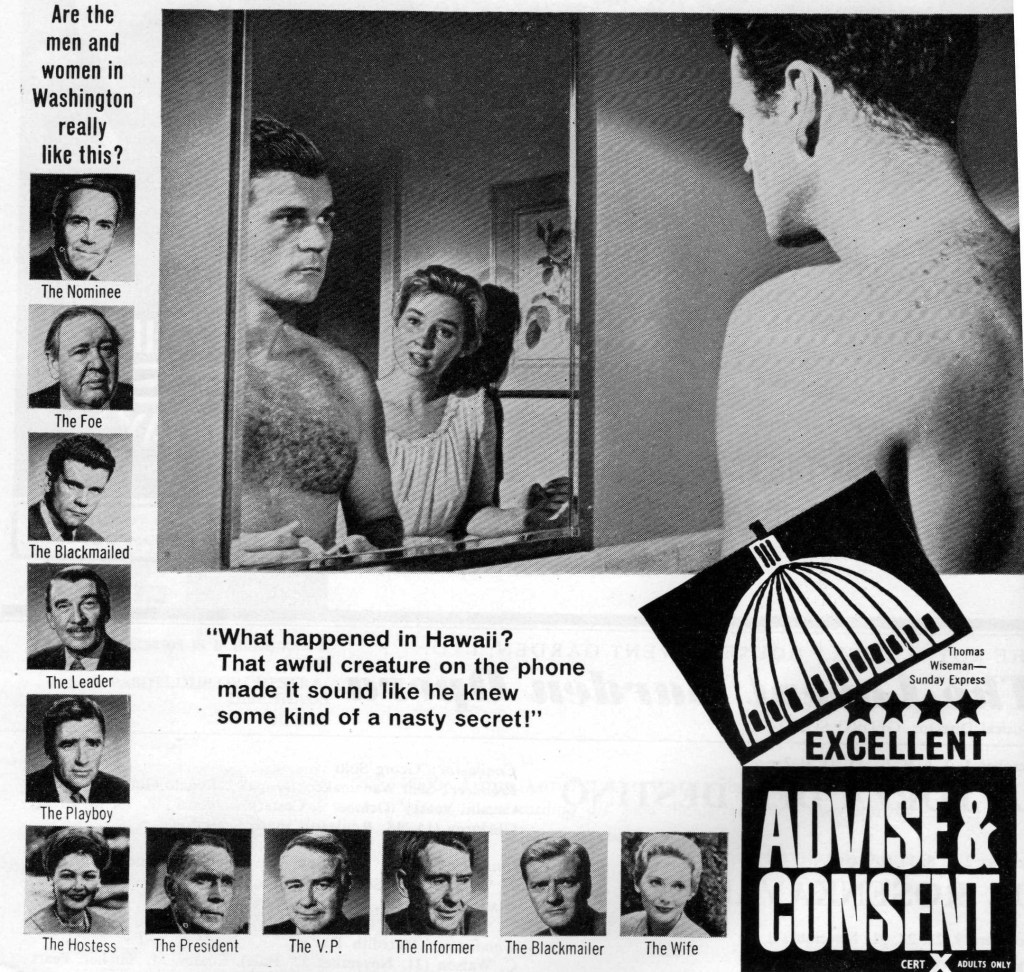
Advise and Consent (1962) ****

Excoriating engrossing political drama in which the unscrupulous take the moral high ground and the principled are destroyed. In other words, the reality of power – gaining it and keeping it and all the skullduggery that involves. And it has resonance in today’s cancel culture for it is minor indiscretions from the past that bring down the most upstanding of the species.  

Theoretically, director Otto Preminger (Hurry Sundown, 1967) broke one major taboo in touching on the subject of same-sex relationships. But in reality he took an even bolder step from the Hollywood perspective of giving center stage in the main to older players. Many  had first come to the fore in the 1930s or earlier – Walter Pidgeon (Turn Back the Hours, 1928), Lew Ayres (All Quiet on the Western Front, 1930),  Charles Laughton (Oscar winner for The Private Life of Henry VIII, 1933) Franchot Tone (Oscar nominated for Mutiny on the Bounty, 1935), Henry Fonda (You Only Live Once, 1937).

This was the kind of all-star cast you used to get in 1960s big-budget pictures filling out supporting roles. But in this ensemble drama, they all, at various times, hold the floor. And this approach lent the movie greater authenticity. Even if few viewers today recognize any, that, too, works in the movie’s favor, giving it an almost documentary feel.

Movies about politics are never heavy on plot, so if you’re looking for a thriller in way of All the President’s Men (1973) go elsewhere. It has more in common with The Trial of the Chicago Seven (2020) with multiple viewpoints and opposing perspectives. What the best movies about politics have in abundance is repartee. Virtually every exchange is a verbal duel, the cut and thrust, the slashing attack, the parry, sometimes the knockout blow delivered through humor.

Given politicians spend most of their lives making speeches, even the shortest of sentences, even the bon mots, have a polished ring. And that, frankly, is the joy of this picture, brilliantly written by Wendell Mayes (Anatomy of a Murder, 1959) from the Allen Drury bestseller. In some respects the plot is almost a MacGuffin, a way into this labyrinthine world, where characters duck and dive like a more elevated breed of gangster

A lesser director would have given in to the temptation of filming these duels in close-up.  Instead, Preminger’s direction is almost stately, keeping characters at bay.

A seriously ill President (Franchot Tone), distrusting his feeble Vice-President Harley Hudson (Lew Ayres), decides to fill the vacancy for Secretary of State with highly-principled Senator Robert Leffingwell (Henry Fonda). This not being the beginning of the President’s term, he can’t just do what he wants, his nomination must go before a committee and then face a vote in the Senate.

The Senate Majority Leader Bob Munson (Walter Pidgeon) isn’t too happy with the idea, seeing Leffingwell as a dove, likely to appease the growing Soviet threat. Others on the committee, namely Senator Brigham Anderson (Don Murray) feel the same and the committee hearing has the tone of an interrogation. The fine upstanding Leffingwell parries well until Senator Seabright Cooley (Charles Laughton) introduces a witness Herbert Gelman (Burgess Meredith) who says Leffingwell belonged to a Communist cell, an accusation Leffingwell denies.

Twist number one: Leffingwell has lied on oath. He confesses this to a friend Hardiman Fletcher (Paul McGrath) who then stitches up the witness. The committee apologies to Leffingwell, which means he is a sure thing for the post, but Cooley smells a rat and starts his own investigation. Leffingwell tries to get out of the job but the President won’t allow this. The Majority Leader and Anderson are let in on the secret, the former willing to accommodate the President but the latter outraged and planning to thwart the nomination when it reaches the voting stage at the Senate. Anderson comes under pressure, phone calls to his wife about something that went on in Hawaii.

And so the stage is set. The pressure builds on Anderson. The President becomes more unwell, making the appointment of Leffingwell more crucial. Aware of Anderson’s intentions, the Majority Leader starts whipping up votes, with Cooley doing the same for the opposition. Machinations take over.  And for a movie that was initially light on plot, and it ends with three stunning twists, and proving once and for all there is nothing quite so standard as the self-serving politician.

This was the first movie for several years for Henry Fonda (Broadway and television his refuge) and for society hostess Gene Tierney (Laura, 1945) who suffered from mental health problems and the last screen appearance of Charles Laughton. The acting is uniformly excellent and the direction confident and accomplished. 

A slow-burner for sure, but a fascinating insight into the less savory aspects of politics and the human collateral damage.  

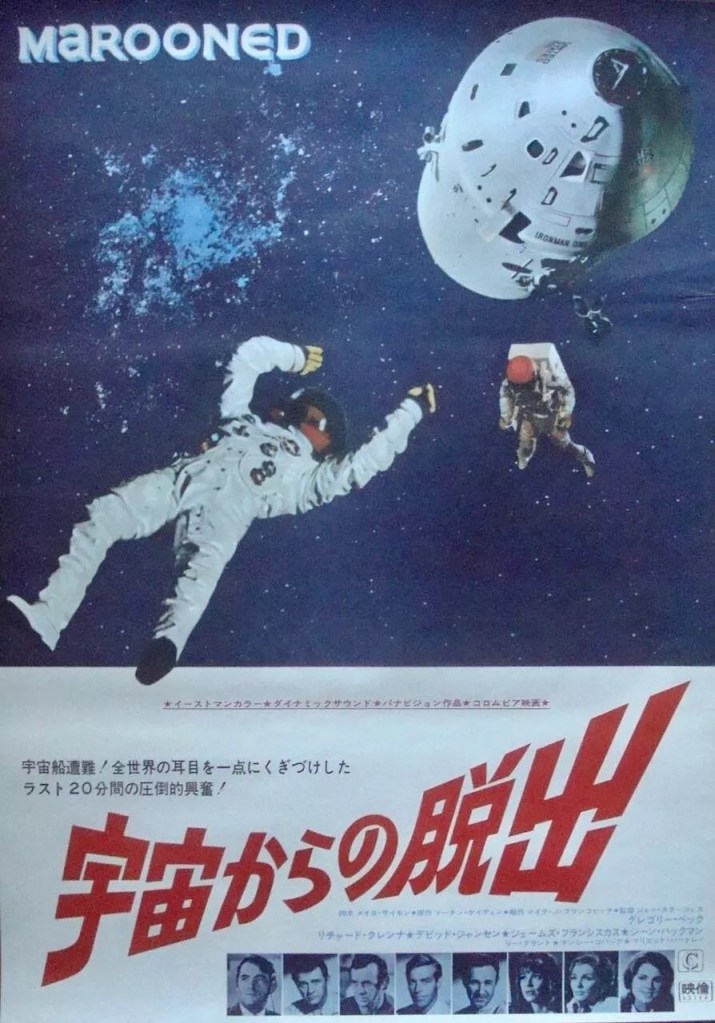
Marooned (1969) ****

The forgotten one. Left out in the cold by audiences and critics alike in the late 60s sci fi boom by the more audacious 2001: A Space Odyssey (1968), Barbarella (1968) and Planet of the Apes (1968). And that’s a shame because it’s by far the most realistic (to the nth degree) of the space movies. Audiences growing up with astronauts saving their own skins with ingenious maneuver – sling shot and whatnot – in Apollo 13 (1995) and The Martian (2015)  might be shocked by the harsh reality of space travel as evidenced here. Astronauts are little more than helpless creatures in a tiny box with ground control in obsessive control. It’s salutary that escape was the audience mindset even after the Challenger Space Shuttle disaster of 1986.

Nobody thought to tell audiences to buckle up because they were in for a hell of a ruthless ride back in the day, but this one really should come with a warning.

Casting makes this work – when it shouldn’t. It’s full of those kind of actors who scarcely move their lips and rarely engage in extraneous facial movement. You can hear director John Sturges issuing instructions: to Gregory Peck, keep those brows knitted; to David Janssen, keep your head lowered and keep with the muttering; to Richard Crenna, don’t move a muscle; to Gene Hackman, limit that trademark chuckle to just once. Why this shouldn’t work is because the big star isn’t in the goldfish bowl of the shuttle cockpit, and since there’s none of the get-to-know-the-crew backstory of The Right Stuff (1983) or Apollo 13 there’s nobody to really root for, especially as the crew is just siting there, doing (by instruction) nothing and awaiting their fate. Which, by the way, which is constantly spelled out, is to suffocate from lack of oxygen.

But there’s a reason Gregory Peck’s on the ground and not in space. Because he’s the one making the life-and-death decisions.

This is by far Gregory Peck’s toughest role. He pulled out of Ice Station Zebra (1968) because he didn’t like the slant of the character, and since then he’d been in typical upstanding heroic mode in The Stalking Moon (1968), Mackenna’s Gold (1969) and The Chairman (1969). Here he’s the king of data management and crisis control, the most ruthless, heartless sonofa you’d ever encounter, not willing to take a risk on greenlighting a rescue mission because the computer says no. The weaselling PR-speak that’s all about saving the space program and making allowance for collateral damage is nothing compared to his terrible delivery of news to one of the wives that her husband is dead. She collapses with emotion, he puts the phone down.

If you’re geek-minded, you’ll give this five stars because there’s information overload. “Go” and “Mark” are the most commonly used words. And in case you can’t judge from the visuals what’s going on, there’s usually some television commentator voice-over to help you out.

So, the Ironman One mission hits trouble when its retro rockets refuse to ignite for return to Earth after several months in space. They’ve got 40 hours or so to effect a rescue before the oxygen runs out for crew members Jim Pruett (Richard Crenna), Buzz Lloyd (Gene Hackman) and Clayton Stone (James Franciscus). The crew are forbidden to try any stunts themselves because any exertion will use up valuable oxygen.

Plan by chief astronaut Ted Dougherty (David Janssen) to mount a rescue operation via an untried spaceship XRV (smaller than a helicopter, by the way) is vetoed as too risky by NASA boss Charles Keith (Gregory Peck) until the President, terrified of public reaction, overrules him. With time running out the impending launch is hindered by an approaching hurricane. But then, in the only nod to ingenuity, someone suggests taking off in the eye of the hurricane, when wind force will be zero.

Meanwhile, up in space, the three stalwarts are slowly coming apart. Buzz, the toughest-looking of the trio, is worst affected, screaming his head off as the prospect of dying looms. Then they are faced with a terrible decision. With the rescue delayed, there’s not enough oxygen to see them through, so one has to sacrifice himself.

I told you it was brutal stuff. About the last 30 minutes are not about whether they can be saved, but who will die and how, the impact of asphyxia on the brain spelled out by resident boffin Clayton. By this point anything they do will almost certain sabotage any rescue and they’re in cloud cuckoo land as Keith tries to keep them in line.

While there’s certainly information overload and a few questionable scientific decisions (can you really open a hatch straight into space?), the reality of the drama more than holds the enterprise together. The realpolitik, the callous use of the wives to go along with the company line as they watch their husbands suffer before their very eyes, the management of potentially bad news, was perhaps a shock for audiences back in the day but would be accepted more easily by contemporary moviegoers.

The acting is first class. Gregory Peck never attempts to lighten his load, to make his character less unattractive and appease his following. David Janssen (Warning Shot, 1966) is as solid as ever. Gene Hackman (The Gypsy Moths, 1969) is the pick of the crew but Richard Crenna’s (Midas Run, 1969) less showy disintegration packs a punch. Lee Grant (The Big Bounce, 1969) is the standout among the wives.

Much as Sturges lets the computerspeak run away with itself, he doesn’t flinch when it comes to the really tough scenes. Written by Mayo Simon (I Could Go On Singing, 1963) from the Matt Caidin source novel.

Under-rated. Worth a look.

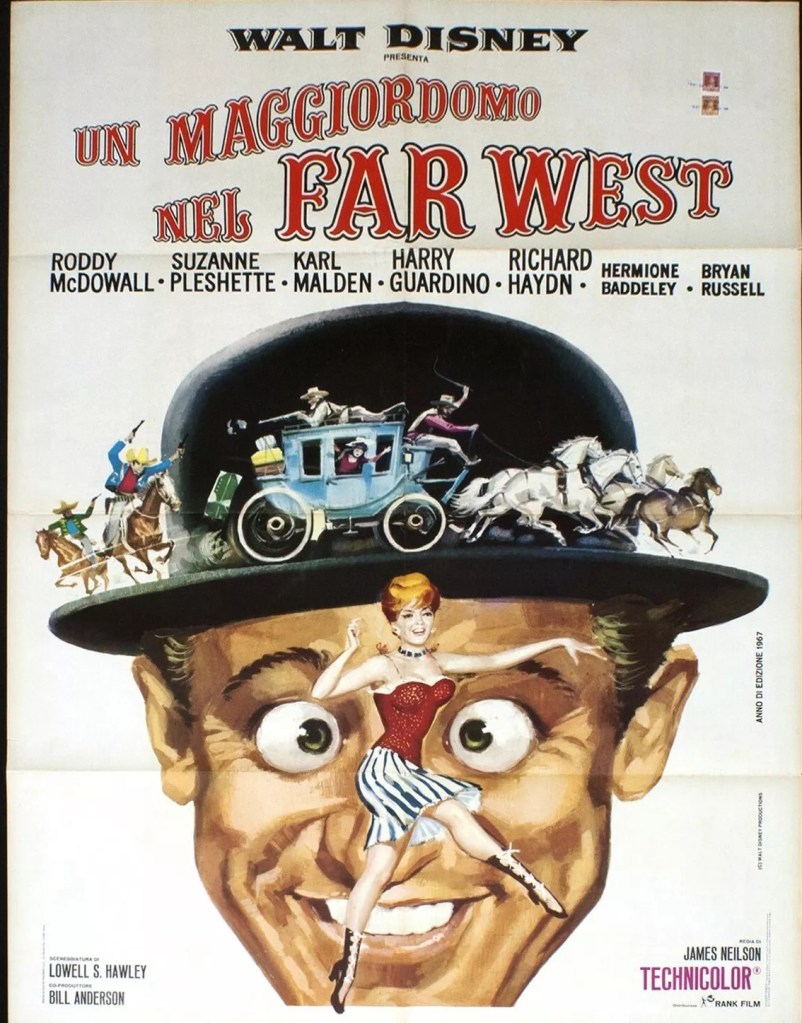
The Adventures of Bullwhip Griffin (1967) ***

All studios believed in their brand name. That the sight of the  MGM lion or the Twentieth Century Fox searchlight or the Paramount mountain represented a quality mark that would buffer expectation and reassure an audience they were not going to be rooked. That might have been the case decades before when the Warner Brothers logo might mean gangster pictures or socially aware movies or MGM, with more stars than there are in heaven, pictures with top-notch talent, or Universal determined to scare the pants of you with its horror catalog.

But that was no longer the case, most studios so desperate for survival that they would fork out for whatever trend seemed most likely to make money and the industry lurched from western to musical to adventure and back again whenever a big hit appeared. The only studio which still retained genuine marquee appeal was Disney. As studios dipped into more unsavory fare, according to the older generation, and the prospects of sending your children to the movies without having to check out the picture in advance diminished, a Disney film was a guarantee of fret-free entertainment.

Throughout the decade adults as much as kids swarmed to the Disney repertoire. In 1961 the studio scored a box office triple whammy when The Absent-Minded Professor, The Parent Trap and Swiss Family Robinson took three of the top four slots in the annual box office race. In the following years Bon Voyage (1962), Moon Pilot (1962), Son of Flubber (1963), In Search of the Castaways (1963), The Sword in the Stone (1964), The Misadventures of Merlin Jones and especially Mary Poppins (1964) kept the studio buoyant, not to mention the string of pictures starring Hayley Mills and a stack of animated classics it could reissue at the drop of a hat.  

Disney ruled the lightweight world, its films often driven by a simple plot device. And as the rest of the industry coveted sex and violence, exhibitors relied on Disney to bring in the kids (and adults) during holiday periods. It would end the decade on a whopping high with The Love Bug (1969).    

Here, the ploy is as old as the hills, a fish out of water, in this case an English butler. Disney had rung the changes on that particular sub-genre through the governess in Mary Poppins, steadfastly ignoring a trend towards more sinister servants as demonstrated by The Servant (1963) and The Nanny (1965). But Disney did have the ability to hook name actors for its child-friendly movies, here Roddy McDowall (Lord Love a Duck, 1966), Oscar-winner Karl Malden (Nevada Smith, 1966) and Suzanne Pleshette (A Rage to Live, 1965).   

If you are expecting whiplashing escapades of the Indiana Jones variety, you will be in for a disappointment. Eric Griffin (Roddy McDowall) is the aforementioned butler escorting a child Jack (Bryan Russell) on a treasure hunt through the gold fever American West. When his charge runs away, Griffin finds the boy stowing away on a ship. The ever-genteel Griffin has skills that see him through any situation, working as cook on the ship, setting up his stall as barber on the mainland, and occastionally employing a devastating right hook to knock seven bells out of giant bully Mountain Ox (Mike Mazurki).

The plot, such as it is, revolves around recovering a treasure map stolen by swindler Judge Higgins (Karl Malden) and eventually when the movie needs some zap the feisty Arabella Flagg (Suzanne Pleshette), Griffin’s bankrupt employer who as it happens fancies the bulter, turns up.

There’s enough action to keep the picture on a steady keel, a storm at sea, a stagecoach hold-up, prizefight and a climactic town-wrecking fire. There are, perhaps surprisingly, a few choice lines.

But there’s a misinterpretation at the center of the movie so it’s as well its made with kids in mind. The fish-out-of-water notion would play better if historically movies fielded idiot butlers rather than ones who tended to take command when things get tough, though it’s unliklely kids would be aware of previous entries in the sub-genre. So, theoretically, it’s a surprise when Griffin outfights the lummox and outwits the swindler.

If the kid isn’t cute enough there are compensations elsewhere, a decent support in Harry Guardino (The Pigeon That Took Rome, 1962) and Hermione Baddeley (Harlow, 1965). Roddy McDowall at least is in a movie that suits his screen persona and deceptively languid acting style while Suzanne Pleshette takes a feminist slant to the Wild West. Whether British comedian Tony Hancock – he was sacked during filming – would have added much to the proceedings is open to debate.

It’s worth remembering that, outside of Hayley Mills offerings, Disney comedies of this period revolved around adults coping with bizarre situation. This doesn’t quite have the gimmicks that drove Son of Flubber, The Ugly Dachshund (1966, also headlining Pleshette) and Lt Robin Crusoe U.S.N. (1966).

Adequately directed by James Neilson (Dr Syn Alias the Scarecrow, 1963) from a screenplay by Lowell S. Hawley (Swiss Family Robinson) drawn from the novel The Great Horn Spoon! by Sid Fleischmann.

I remember seeing this as a kid and feeling pretty content coming out of the cinema, so since it did what it says on the tin, I’m loathe from an adult perspective to take it to pieces.

A movie that says – lighten up!

Discover WordPress

A daily selection of the best content published on WordPress, collected for you by humans who love to read.

The Atavist Magazine

by Brian Hannan

WordPress.com Blog

News, Tips & Website Tutorials