Contemporary audiences will be familiar with the jukebox picture. Moviegoers attending biopics of Queen or Elton John can be guaranteed a greatest hits package and if the narrative isn’t driven by problems facing rock superstars nobody is really bothered by an over-confected storyline such as Mamma Mia (and sequel) as long as the soundtrack is filled with beloved classics. On top of that we have the modern phenomenon of Event Cinema where cinemagoers pay to see a live performance, mostly plays, but Andre Rieu taking care of anyone who requires live music.
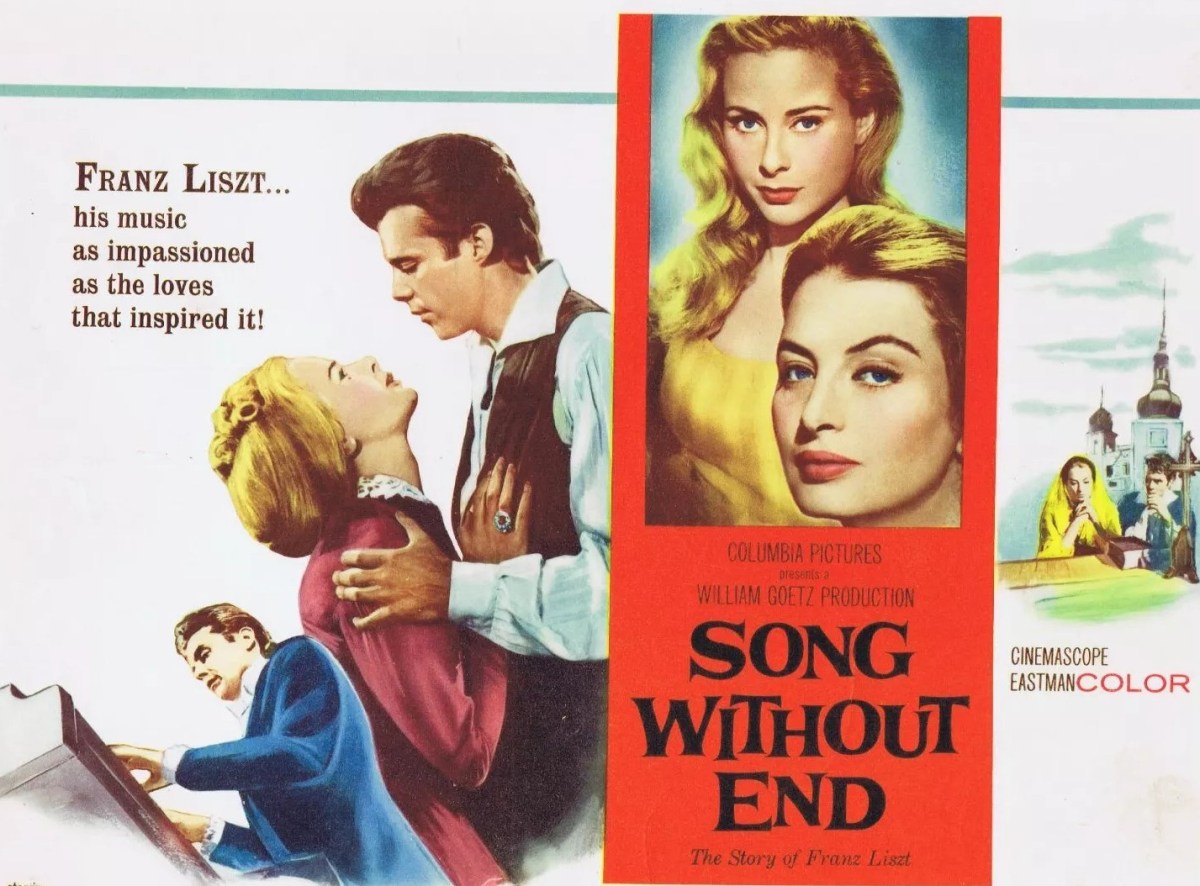
Song without End is more liberal than most when it comes to the music choices. As well as focusing on the tunes of Hungarian composer Franz Liszt, it also takes time out for snatches of Chopin or Wagner. These days a star like Dirk Bogarde would be a shoo-in for an Oscar nomination for all the training he put in to prove he could actually play the piano – and in demonic style – rather than showing him knocking out a couple of chords before cutting away to his face or any other shot of the piano except one involving his fingers.
And that’s both the plus and minus point of the movie. Plenty sequences of the maestro at the piano to satisfy the most ardent fan, plenty shots, too, in cutaway, of audiences, that element mostly boring until we are shown the rabid female fans who created the term “Lisztomania.” But the music comes at a price. Unless you are a big fan of the composer you’re faced with the same scene over and over again. Yes, he plays different compositions, and not always his own, and although the fingers move to different keys on the instrument, still it’s nothing but a guy sitting at a keyboard for ages.
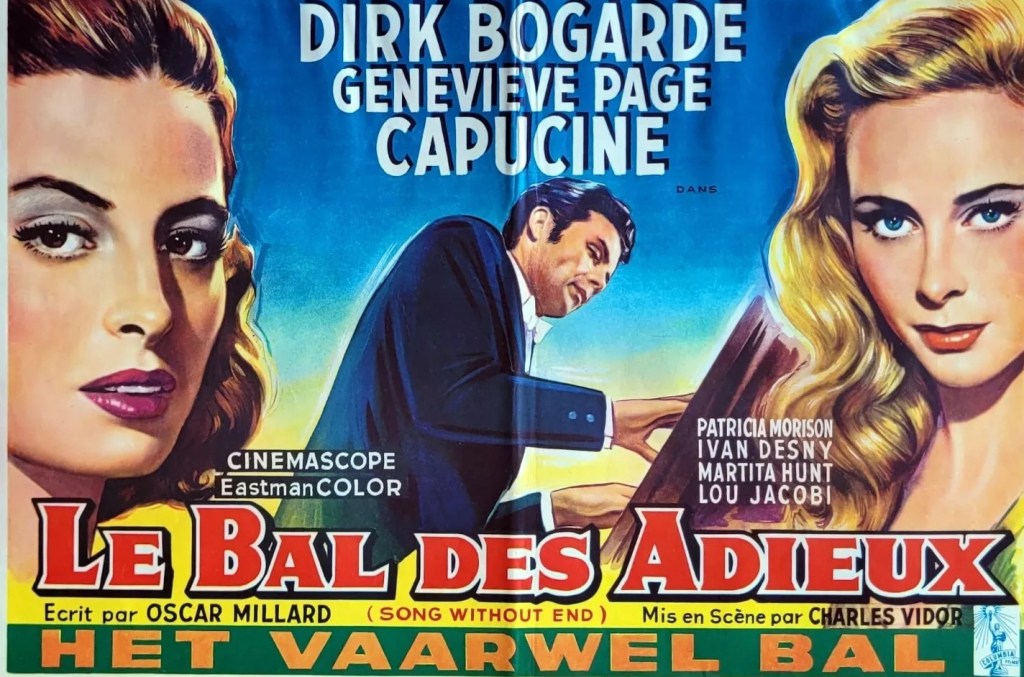
So, if the music does it for you, a joy. Otherwise, not so much going on or could be explored in any great depth at the time. Franz Liszt (Dirk Bogarde) was a bit of a lad – when the picture opens he’s living with married woman Marie (Genevieve Page), a countess, and is about to dump her for married Carolyne (Capucine), a Russian princess. Outside of his adultery, the main storyline is him making the transition from pianist to composer. And he helps along newcomer Richard Wagner (Lyndon Brook) – they became great friends until Wagner married Liszt’s daughter, though that’s outwith the movie’s remit.
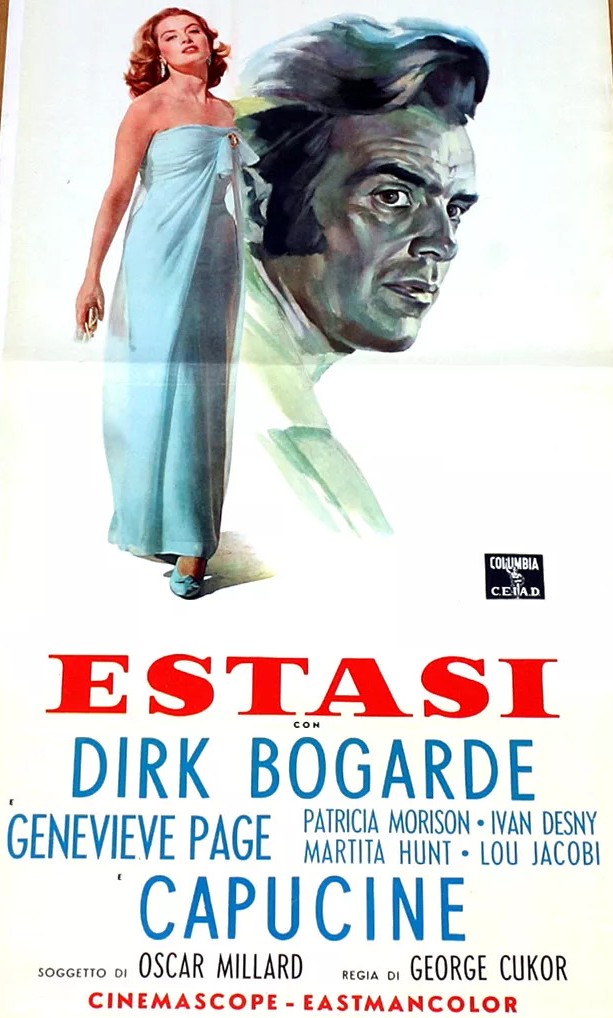
George Cukor gets the directorial credit on this poster.
But he’s something of a contradiction – zest for the high life with buddies Chopin (Alex Davion) and George Sand (Patricia Morison) countered by religious ideals (not shared, it transpires, by the countess). Liszt is very much the “artiste”, given to flouncing around, and having a hissy fit with the Czar of Russia for keeping him waiting. You could surmise that Tom Hulce modelled his portrayal of Mozart in Amadeus (1984) on this kind of charismatic character. Slap him in a pair of tight-fitting trousers, and given his good looks and flowing locks, and you’d have a modern day rock god. .
You’ll not be surprised to learn the movie gives a wide berth to the way he developed music; he was credited with several technical innovations. If you knew what you were looking for, probably you’d pick them out from his performances. He fair batters that piano as if trying to extract every last conceivable note.
This was something of a departure for British star Dirk Bogarde (Victim, 1961). His standard screen person was more prim, tight-lipped, straight-laced, repressed, so this feels like a monumental release, a cathartic moment. He’s certainly put in the work to come across as a proper piano player. The head-tossing and flouncing and heart-breaking is a doddle by comparison.
Columbia French starlet Capucine (The 7th Dawn, 1964), an MTA, made her debut with the kind of icy performance that became her fallback.
Columbia had been trying to make the picture for a decade and it nearly fell at the final hurdle. Director Charles Vidor, who had helmed A Song to Remember (1945) about Chopin, died soon after filming began. George Cukor (Justine, 1969) took over, adding trademark lushness and altering the ending, but, critically, giving Vidor sole credit. Oscar Millard (The Salzburg Connection, 1972) handled the screenplay.
Bogarde is pretty good, especially on the piano stool, and the music is terrific. So, ideal for music lovers not expecting much else. Bit of a let down for the general audience with not so much in way of narrative to get your teeth into.
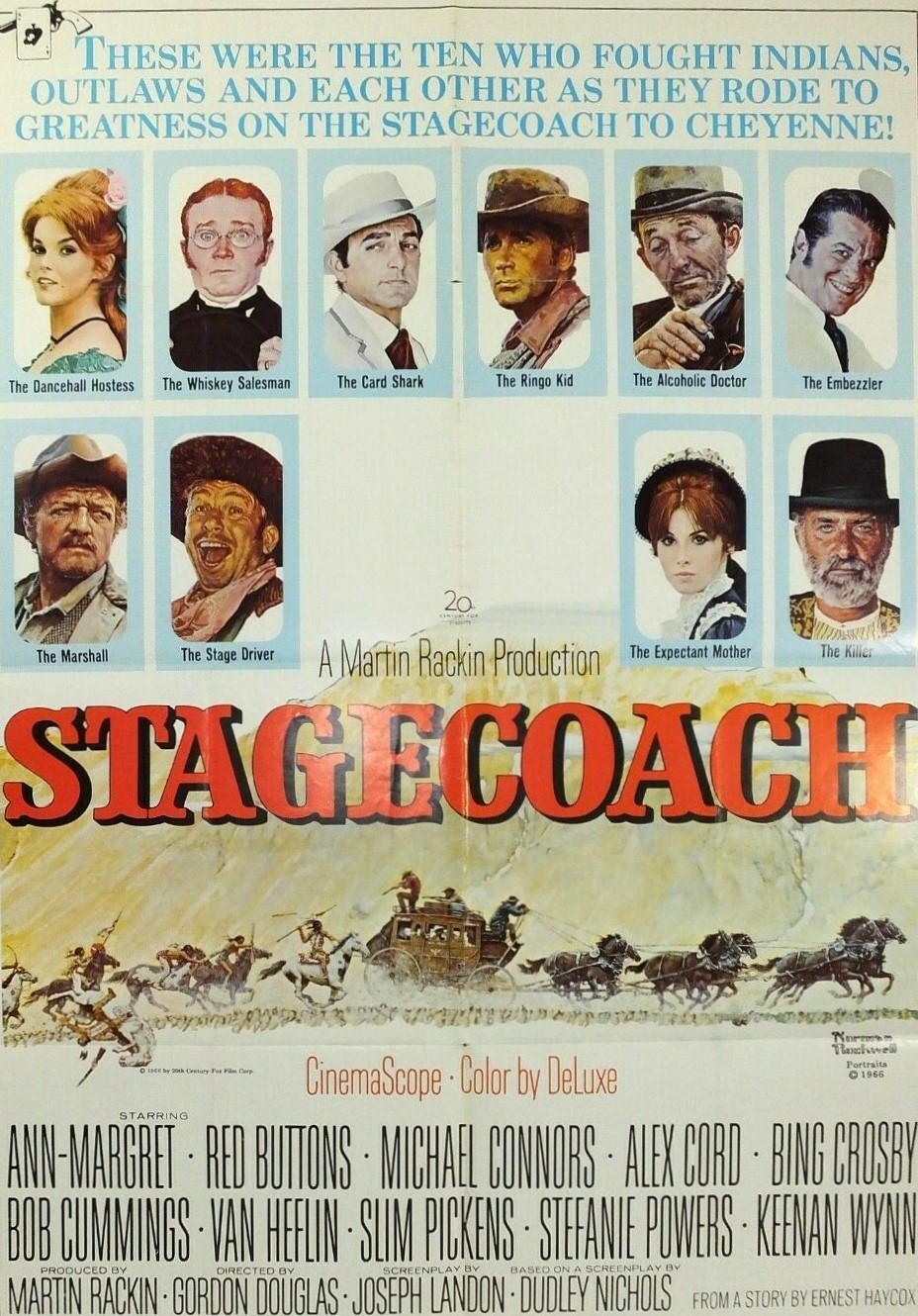
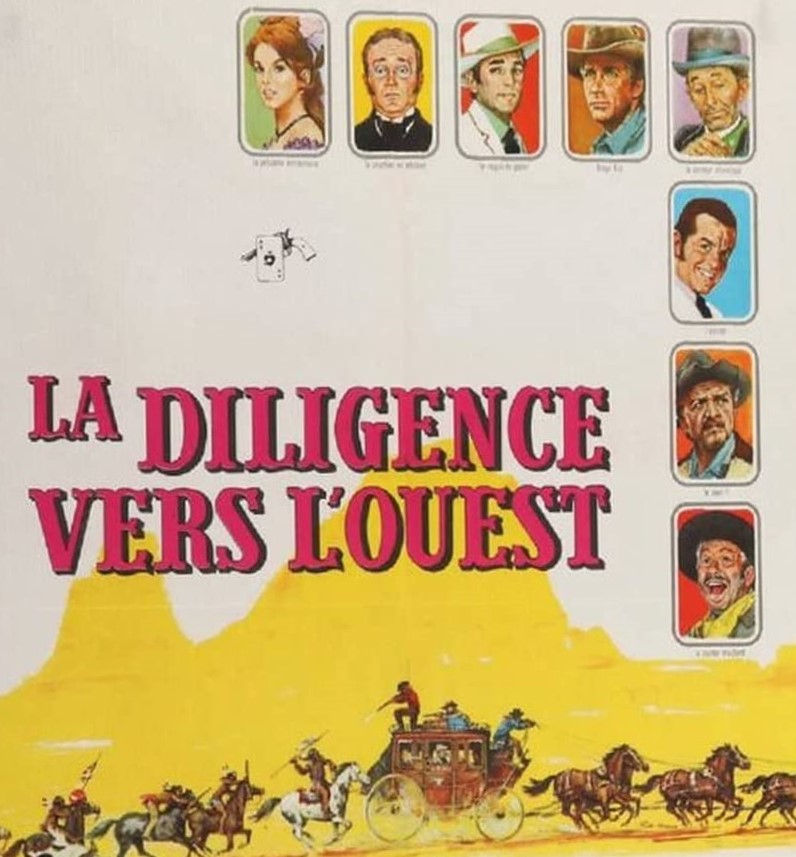
It’s probably sacrilege to admit that I quite enjoyed this. Also it’s been so long since I’ve seen the John Ford original that I could remember very little of the specifics and I haven’t seen the remake before so this was just like watching a new movie. Basically, it’s the story of a group of six passengers taking the stagecoach to Cheyenne for different reasons who are joined by an escaped murderer and shepherded along by the driver and a town marshal. There is some excellent action but mostly it’s a relationship picture, how the characters react to one another and their response to crisis.
Good-time girl Dallas (Ann-Margret) is on the run, banker Gatewood (Bob Cummings) is hiding a stash of stolen money, alcoholic doctor Boone (Bing Crosby) is penniless, liquor salesman Peacock (Red Buttons) is a coward, gambler Hatfield (Mike Connors) has Civil War secrets, pregnant Lucy Mallory (Stefanie Powers) is meeting her cavalry husband in Cheyenne. The ornery Buck (Slim Pickens) is the driver and Curley (Van Heflin) is riding shotgun and when he comes upon stranded escaped murderer the Ringo Kid (Alex Cord) promptly arrests him.
The passengers have heard rumors of the Sioux on the warpath. The audience knows it’s not a rumor because the picture starts with the Sioux slaughtering camped cavalry. Soon enough, the passengers know it, too, coming across a patrol dead at a staging post, and of course they are soon battling for their lives when ambushed.
The drama unfolds as the characters confront each other or their own weaknesses. Dallas, who has a high old time as a saloon girl, is way out of her depth in respectable company, feeling out of place even dining with the others, hiding the secret of her affair with the married Gatewood. Ringo coaxes her along, bringing her out of her shell, giving her back self-respect, and of course falling in love. Curley, with his eyes on the $500 reward for bringing Ringo in, has no intention of letting the gunslinger take his revenge in Cheyenne on Luke Plummer (Keenan Wynn) who killed his family. Boone and Peacock are the most fun, the doctor spending most of his time separating the salesman from his cargo of booze.
There are endless permutations with a story like this, the kind of material that was mined in the disaster movies of the 1970s like Airport (1970) and The Towering Inferno (1974), a group of disparate characters forced to battle for survival. The action is only part of the deal. The picture only truly works if the characters are believable. For that, you need a heap of good acting. The audience could certainly rely on old dependables like Bing Crosby (The Road to Hong Kong, 1962) in his big screen swansong, Van Heflin (Shane, 1953), Red Buttons (Oscar-winner for Sayonara, 1957), Robert Cummings (Saboteur, 1942) and cowboy picture veteran Slim Pickens to put on a good show. But the main dramatic load was to be carried by relative newcomers Ann-Margret and Alex Cord.
Ann-Margret has made her name with sassy light-hearted numbers like The Pleasure Seekers (1964) and had only just stepped up to the dramatic plate with Once a Thief (1965). This was Alex Cord’s sophomore outing after Synanon (1965) and he was stepping into some mighty big boots, the odds stacked against him playing the role John Wayne made famous – and which turned John Wayne into a star.
Amazingly, the casting works. Ann-Margret moves from feisty to restrained, meek to the point of being cowed, and for most of the film, far removed from the false gaiety of the saloon, seeks redemption. The trouble-making minx emerges only once, to knock the wind out of Mrs Mallory, but, after taking a tumble down the humility route, gradually steers her way towards a better self, preventing Gatewood from causing chaos, nursing Mallory and inching her way towards true feelings for Ringo. As in the best movies, it’s not for her to open up about her woeful life but for another character, in this case Ringo, to identify her flaws: “What you doin’ about your scars, you got ‘em even if they don’t show…when you goin’ to stand up and stop crawlin’?” When they finally kiss it is one of the most beautiful tender kisses you will ever see and most of that is down to Ann-Margret’s reaction.
I had already taken back all my reservations about Alex Cord’s acting skills that were mostly due to his moustachioed performance in Stiletto (1969) after seeing him in The Scorpio Letters (1967) and this is another completely different portrayal. As much as he can deliver on the action front, it’s in the dramatic scenes that he really scores, gentle, vulnerable, caring. He certainly matches the Duke’s trademark diffidence in terms of romance. There’s a point where the camera just holds on their faces to nine depth of expression and we are not disappointed.
Gordon Douglas (The Detective, 1968) is the director who had the gall to take on the remake, and he delivers a character-sensitive picture shaded with action. Written by Joseph Landon (Von Ryan’s Express, 1965) based on the original by Dudley Nichols and Ernest Haycox.
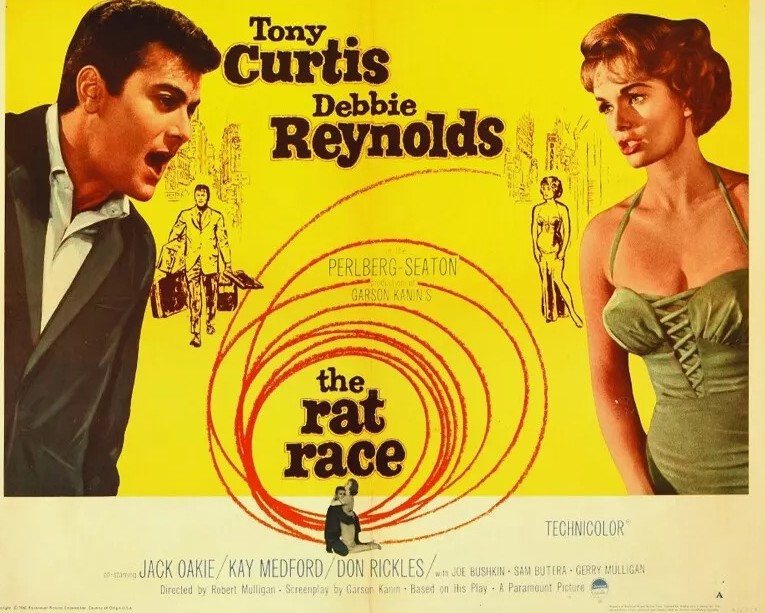
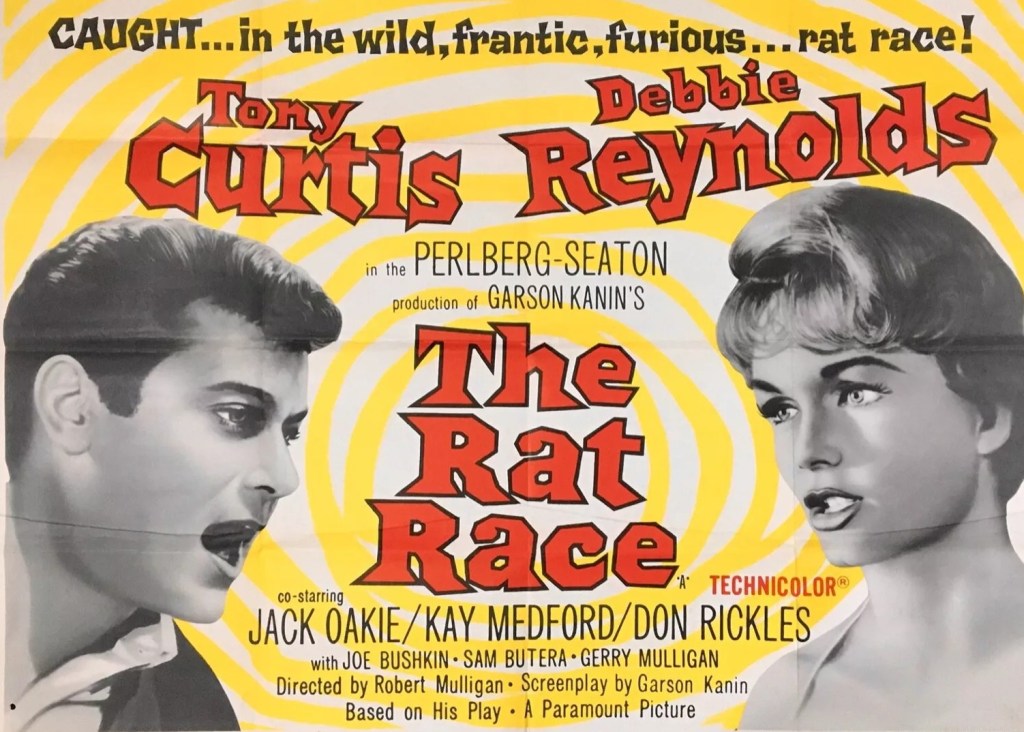
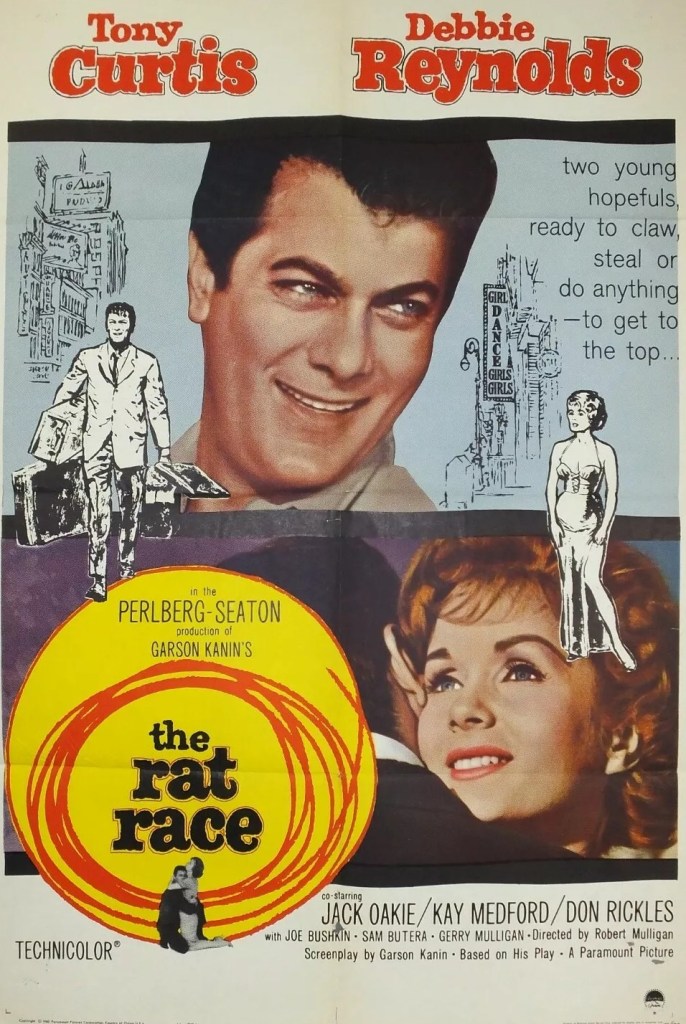
Surprisingly hard-edged tale with Debbie Reynolds giving the performance of her career and with a steely contemporary relevance. Snookers the audience into thinking it’s a standard romance, mismatched characters thrown together by circumstance, various rows and incidents to keep them apart before the expected happy ending. If screenwriter Garson Kanin had held his nerve, there wouldn’t be the get-out of a happy ending. As it is though, a formidable drama that doesn’t pull its punches.
From the title I expected a movie set in the world of big business, but instead we’re looking down on the lowest tiers of the entertainment business and, effectively, it’s a piece about the price paid for dreams. There are laffs, some good one-liners, but even these have a sourness to them.
Pete (Tony Curtis) leaves Milwaukee for New York seeking fame and fortune as a saxophonist, not realizing he’s more likely to join the thousands of out-of-work musicians already resident, dreams dashed but determined to avoid the ignominy of going home with their tails between their legs, not just to face the mundane life that awaits but seared through with the guilt of failure. Through circumstance he ends up sharing an apartment with model-cum-dancer Peggy (Debbie Reynolds), who’s already given up on her dream once, but couldn’t stand more than a few minutes of the home she’d clearly been desperate to leave.
Peggy is clean out of modelling assignments and hasn’t made it to Broadway, either, not even to a chorus line. Instead, she earns not much of a living as a taxi dancer, more innocent than it would be now in the era of the lap-dancer but still seedy enough with roving male hands. She’s paid to dance with complete strangers, the kind of deadbeats unlikely to ever get on the dance floor with a beautiful woman in the normal course of events.
She’s about to lose her phone, but not above leading on the creepy repairman (Norman Fell) to believe he’s onto a promise should he give her a break. Only pride prevents her solving her financial problems – as well as not making her rent she owes cash to her sleazebag boss Nellie (Don Rickles) – by going down the sex worker route.
Pete thinks he’s got the smarts but in fact he’s afflicted with dumbness and gets ripped off for a mink coat made of cat fur and then loses a complete set of brand-new musical instruments to another scam. When he’s thrown the lifeline of a gig on a cruise ship, Peggy stumps up to buy him a new sax and the requisite tux. She’s paying for this with a promise to Nellie to enter the prostitution game, not quite spelled out as that but as close to the knuckle as you’re going to get in this era, the kind of soft-soap approach that worked for Butterfield 8 (1960).
When Peggy fails to deliver, Nellie humiliates her in the worst possible way. Beginning with her jewellery he strips her down to undergarments to show how much he owns her and just how good he is at playing hardball. It’s a gut-clenching scene. Sure, you know there’s not going to be any nudity, not in this period before the Production Code got flattened, but even so, it works extraordinarily well, especially as clearly Peggy doesn’t know just how far he will go and that he might not, in his quiet fury, be above turning her out into his club starkers.
Meanwhile, to ensure we get to the ending that audiences expected, Pete, on board the ship, has been ignoring any other romantic opportunities, and sending her a heartfelt letter a day, which she appears determined to ignore, knowing that the “rat race” isn’t the kind of world that accommodates long-term romance.
Suffice to say, when Pete manages to bail her out, that changes her mind, though the genuine Peggy would still have balked, knowing that, with their levels of talent, they were only going to become more wasted by lack of fulfilment.
So, yeah, happy ending, but you feel that’s been grafted on to allow audiences to take the rest of the tougher storyline. The MeToo campaign has exposed the pitfalls of the entertainment business, so what happens to Peggy wouldn’t come as a surprise to a contemporary audience.
By this point Debbie Reynolds (Goodbye Charlie, 1964) wasn’t known for drama, more for a spunky or sparky screen persona in a series of lightweight comedies or romances, this showed Hollywood what it was missing. Tony Curtis (Goodbye Charlie) had proven he could do comedy or drama and here he mostly plays it straight.
Director Robert Mulligan (The Stalking Moon, 1968) is probably responsible for maintaining the harder edge. This was originally a Broadway number, so I doubt if the sharpness would have worked so well in that medium. Garson Kanin (Where It’s At, 1969) and an uncredited John Michael Hayes (Nevada Smith, 1966) knocked out the screenplay based on the former’s play.
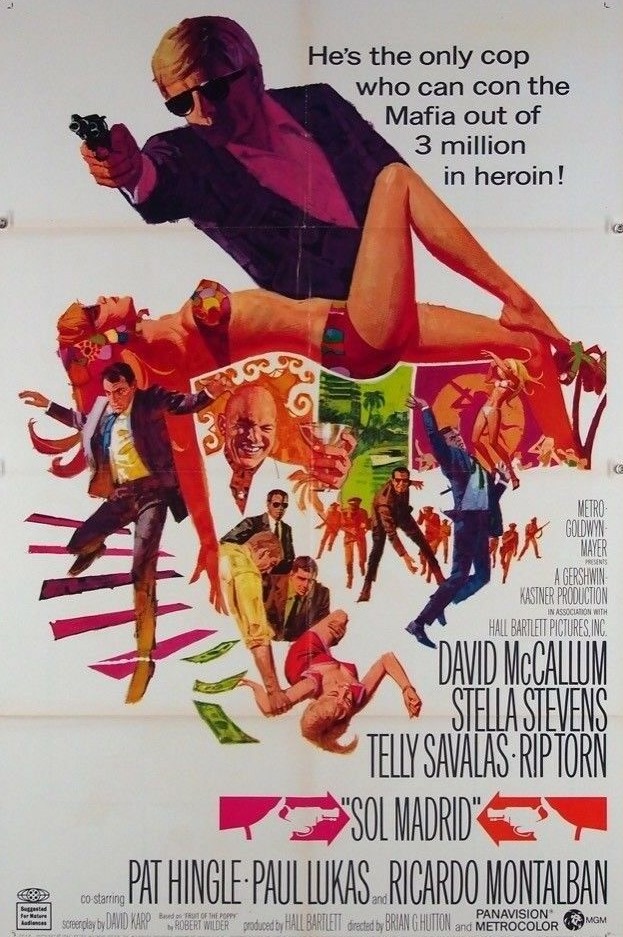
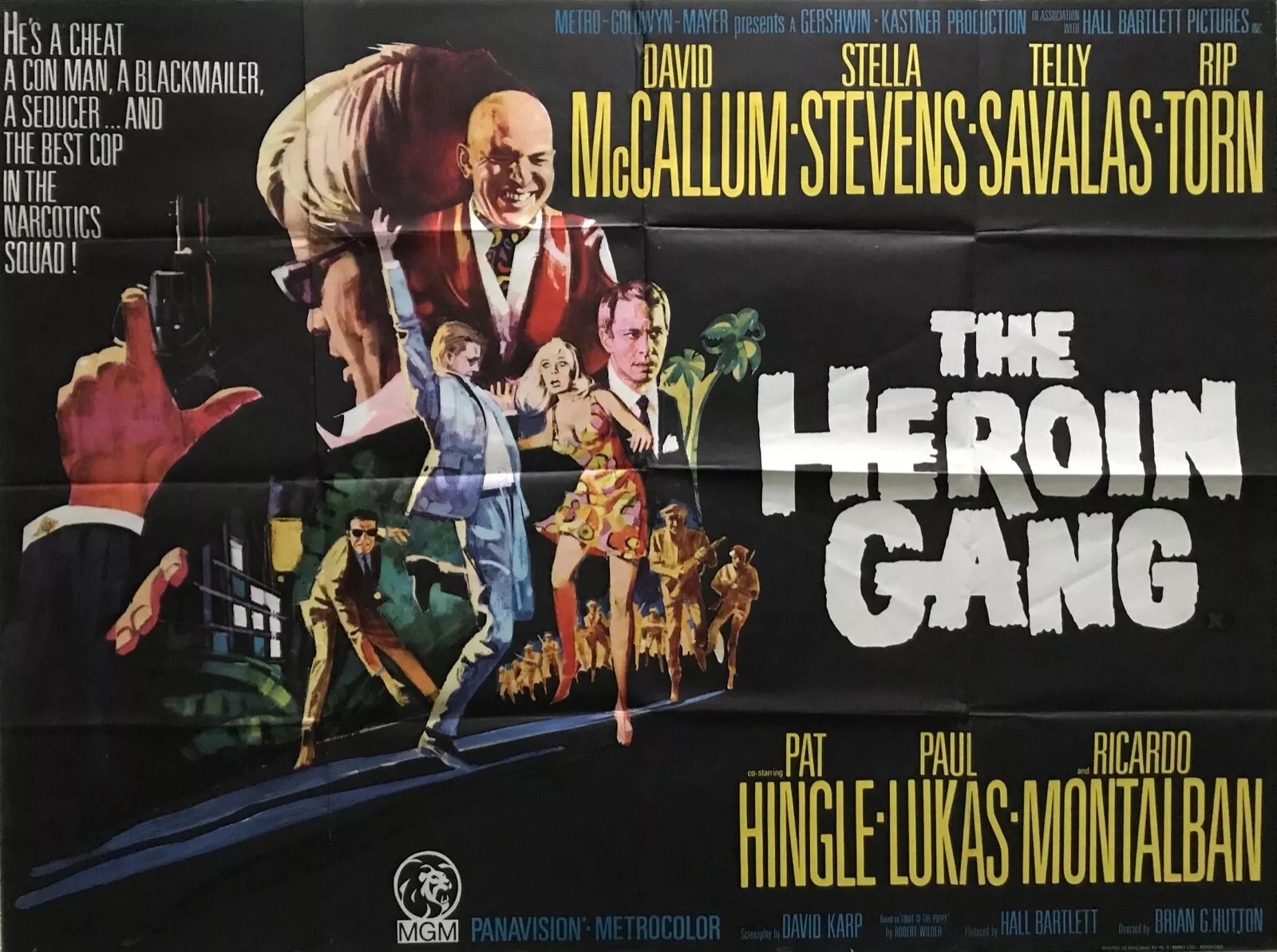
Was it David MacCallum’s floppy-haired blondness that prevented him making the jump to movie action hero because, with the ruthlessness of a Dirty Harry, he certainly makes a good stab at it in this slightly convoluted drugs thriller? Never mind being saddled with an odd moniker, the name devised surely only in the hope it would linger in the memory, Sol Madrid (David MacCallum) is an undercover cop on the trail of the equally blonde, though somewhat more statuesque, Stacey Woodward (Stella Stevens) and Harry Mitchell (Pat Hingle) who have scarpered with a half a million Mafia dollars. Mitchell is the Mafia “human computer” who knows everything about the Cosa Nostra’s dealings, Woodward the girlfriend of Mafia don Villanova (Rip Torn).
Sol tracks down Woodward easy enough and embarks on the audacious plan of using her share of the loot, a cool quarter of a million, to fund a heroin deal in Mexico with the intention of bringing down both Mexican kingpin Emil Dietrich (Telly Savalas) and, using the on-the-run pair as bait, Villanova. A couple of neat sequences light this up. When Sol and Woodward are set upon by two knife-wielding hoods in a car park, he employs a car aerial as a weapon while she taking refuge in a car watches in terror as an assailant batters down the window. Sol has hit on a neat method of transferring the heroin from Tijuana to San Diego and that is filled with genuine tension as is the hand-over where Sol with an unexpected whipcrack slap puts his opposite number in his place.
Meanwhile, Villanova has sent a hitman to Mexico and when that fails turns up himself, kidnapping Woodward and planning a degrading revenge. Most of the movie is Sol duelling with Dietrich, suspicion of the other’s motives getting in the way of the trust required to seal a deal, with Mitchell, who has taken refuge in Dietrich’s fortified lair, soon being deemed surplus to requirements. Various complications heighten the tension in their flimsy relationship.
Sol Madrid is Dirty Harry in embryo, determined to bring down the gangsters by whatever means even if that involves going outside the law he is supposed to uphold, incipient romance with Woodward merely a means to an end.
David MacCallum (The Great Escape, 1963) certainly holds his own in the tough guy stakes, whether trading punches or coolly gunning down or ruthlessly drowning enemies he is meant to just capture, and trading steely-eyed looks with his nemesis.
It’s a decent enough effort from director Brian G. Hutton (Where Eagles Dare, 1968), but is let down by the film’s structure, the expected confrontation with Villanova taking far too long, too much time spent on his revenge with Woodward, for whom audience sympathy is slight. Just at the time when Hollywood was exploring the fun side of drug taking – Easy Rider just a year away – this was a more realistic portrayal of the evil of narcotics.
It is also quite prescient, foreshadowing both The Godfather Part II (1974) in the way Villanova has modernised the organisation, achieving respectability through money laundering, and the all-out police battles with the Narcos. And there is a bullet-through-the-glasses moment that will be very familiar to fans of The Godfather (1972), and you will also notice a similarity between the feared Luca Brasi and the Mafia hitman Scarpi (Michael Conrad) here.
The action sequences are excellent and fresh. Think Madeleine cowering in terror as the car window is battered in No Time to Die (2021) and you get an idea of the power Hutton brings to the scene of a terrified Woodward hiding in the car. Incidentally, you might think MacCallum was more of a secret agent than a cop with the cold-blooded ruthlessness with which he dispatches his enemies.
Stella Stevens (Rage, 1966) is the weak link, too shrill and not willing to sully her make-up or hair when her role requires degradation. Her role is better written (“I never met a man who didn’t want to use me”) than Stevens can deliver and she gets a clincher of final one. Telly Savalas (The Dirty Dozen, 1967) surprises by delivering a playful villain, though the trademark laugh is in occasional evidence whereas Rip Torn is all villain. Ricardo Montalban (Madame X, 1966) is Sol’s Mexican sidekick and Paul Lukas, a star of the Hollywood “golden age”, puts in a fleeting appearance. Written by David Karp (Che!, 1969) and Robert Wilder (The Big Country, 1958).
Proved a winner for Brian G. Hutton – next gig Where Eagles Dare. Less so for David MacCallum – next outing The Mosquito Squadron (1969).
The Eady system at its worst. I’ve been singing the praises of quite a few of these British crime B-movies, made to take advantage of the Eady Levy cashback system and a Governmental dictat that cinemas had to show a certain proportion of British-made features. Generally, they were intended to fill the supporting feature slot, providing cinemas with a double feature. In the course of writing this Blog, I’ve uncovered a few minor gems, brisk, well-directed thrillers, good acting not necessarily essential.
The best this has to show for it is the ruthlessness of British spy chiefs in using an innocent couple as bait for foreign spies. Otherwise, beyond the initial twist, it’s too desultory for words, with too much time – even in a 60-minute feature – spent on too little.
American oilman Bill Martin (Paul Maxwell), flying back to London from Baghdad, agrees to carry a coded message for Jack Carter (Antony Wager), a casual British acquaintance. On landing at Heathrow Bill discovers Jack has been murdered. He’s accosted by a couple of cops, taken to a seedy hotel to wait for a fellow called Oliver, accepting all this oddness because he assumes he’s delivering a message for British Intelligence. After handing over the message he makes the mistake of telling Oliver that not only did he read the message, although failing to decode its content, but, having a photographic memory, had committed it to his brain.
Cue imprisonment. He escapes only because someone attempts to kill him and in turning the tide finds a way out. He flees to girlfriend Barbara (Clare Owen) and she whizzes him in a nifty sports car to her Uncle John (Colin Tapley) who knows somebody who knows somebody and it soon emerges that the fellow called Oliver was actually a fellow called Sharp (John Arnatt), a spy of unknown affiliation.
Assuming the bad guys would still want to eliminate our hero, the real Oliver (Reginald Marsh) reckons this is too good an opportunity to miss – the end justifying the means and all that rather than the more traditional British notion of fair play – and gets Bill and Barbara to agree to act as bait to trap the spies.
This doesn’t go as neatly as the good guys might expect and the baddies make further attempts on the couple’s lives and finally manage to kidnap them and take them out to sea with the intention of dropping them overboard. Luckily, the Brits are able to call in the Coastguard – armed for the occasion – to intercept and it all ends happily.
There’s not enough of anything to keep this moving – scarcely a red herring – and there’s about a dozen characters who flit in and out, various thugs, a top thug called Warner (Alan Tilvern), a femme fatale Ruth (Anita West) who is given no chance to exert her femme fatale wiles, and sundry MI5 and FBI characters and various others along the way. From the amount of time spent focusing on the belly dancer (Mia Karam) in the Baghdad hotel, you might have expected that she would have a role to play because she had more screen time than Ruth.
Nobody went on to greater things. Canadian Paul Maxwell (Man in the Middle / The Winston Affair, 1964) specialized in playing Americans in British films and television, even had a running part in soap opera Coronation Street and if you look closely you’ll see him pop up in A Bridge Too Far (1977).
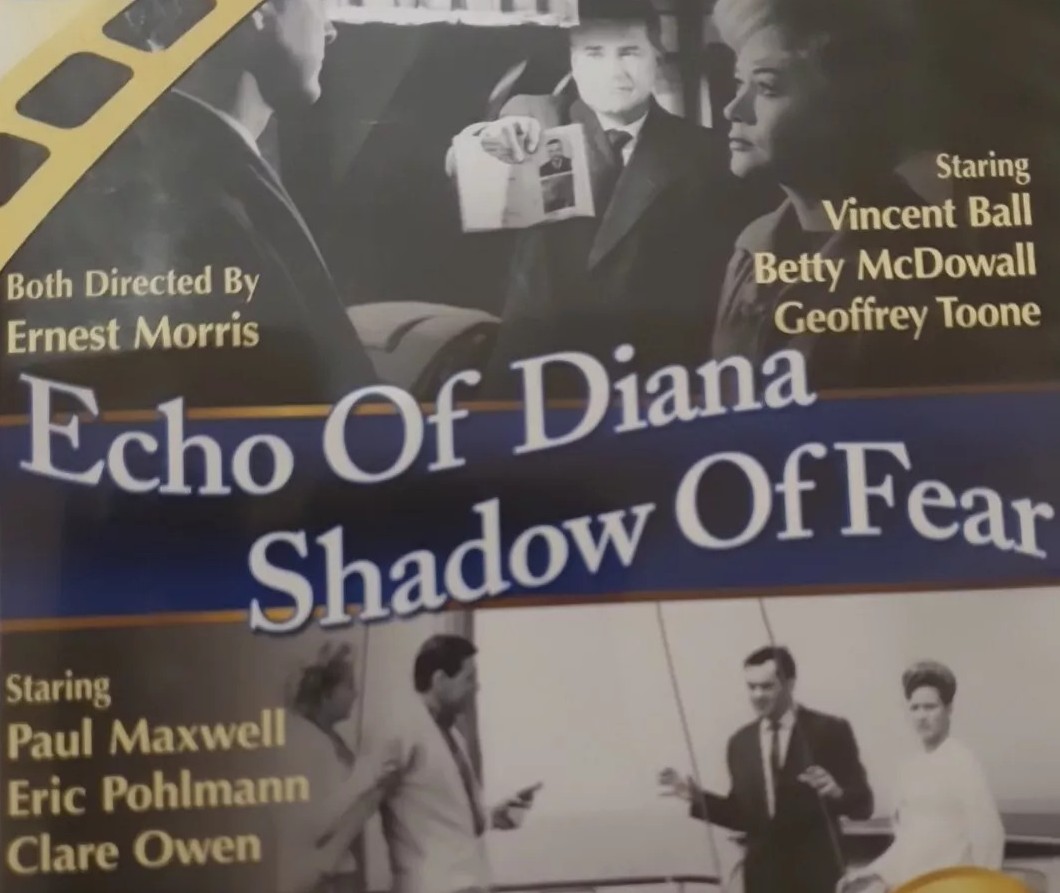
Director Ernest Morris (Echo of Diana, 1963) can’t do much with the script by Ronald Liles (Night of the Big Heat, 1967) and Jim O’Connolly (Smokescreen, 1964) based on a tale by T.F. Fetherby.
I deserve a slap on the wrist. I wrote an enormous book (250,000 words including notes) on the history of movie reissues, revivals, encore premieres, call them what you will, and I didn’t know there was, at least in Britain, a constant source of reissue on a weekly basis, namely the “Sunday Cinema” program.
In Britain in the 1960s, movies ran from Monday to Saturday (Mon-Wed/Thu-Sat if a split week) not the current system of Friday to Thursday. So it made little sense to tag on a Sunday as the last day of a run unless the cinema was involved in roadshow presentation. On Sundays, cinemas, if they opened at all, tended to show older movies, revivals of horror pictures or ones with a sensationalist slant.
Sunday showings were a contentious issue anyway. According to the Sunday Entertainment Act of 1932, cinemas could only show movies on Sundays subject to certain conditions. The first of which was that cinema owners had to agree to give over a certain percentage of their takings to charity. And not even a charity of their choice, but one chosen by the local authority. Secondly, they could not, should they wish, show movies all day, or from the usual starting point of between 1pm and 2pm, in case that got in the way of children attending Sunday School. Though, theoretically, cinemas could open from 4pm, most cinemas restricted showings to one full program in the evening. Lastly, should enough of the local populace object to Sunday opening, that could put a stop to the process.
On the other hand, there was one advantage to Sunday opening. Operators paid a flat fee for movies, not a percentage of receipts as they did for the rest of the week. That made it a lot easier to work out costs and potential profits, i.e. whether it was worthwhile opening at all.
With the downturn in cinema attendances in part triggered by the availability of movies on television – in Britain there was a five-year restriction but few pictures except for Bond films and certain roadshows and big hits could resist the temptation of the extra cash that television could bring – cinemas were annoyed at still having to give money to charity and by the end of the decade the government nullified that condition.
There was a ready supply of older movies available on a non-percentage basis. Programs invariably comprised double bills, though often the complete program ran well under three hours.
I did a survey of suburban cinemas in my home town of Glasgow, Scotland, over three separate months – January, June and October – in 1969 and found that certain films were in constant circulation through the year.
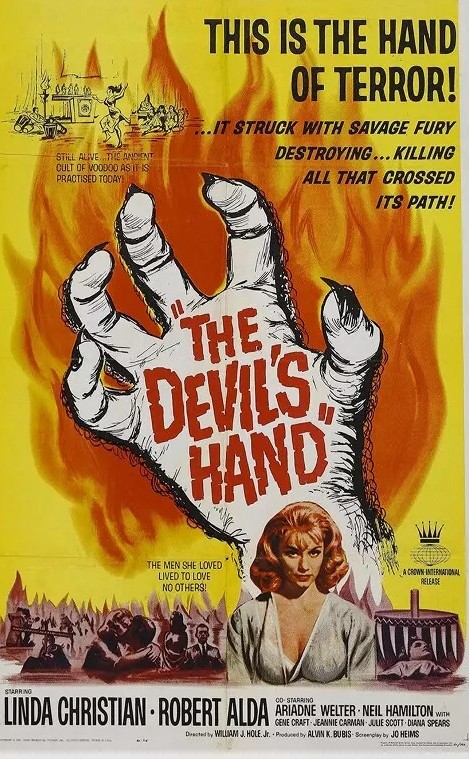
Hammer’s The Gorgon (1964) starring Christopher Lee, Peter Cushing and Barbara Shelley was shown variously with thriller Recoil (1953), occult The Devil’s Hand (1961) and sci fi 20 Million Miles To Earth (1957). But The Devil’s Hand was also the support for several bookings of horror portmanteau Twice Told Tales (1963) with Vincent Price and Recoil I found supporting The Curse of the Mummy’s Tomb (1964).
Blood beasts were on the rampage. You could choose from Roger Corman’s Night of the Bloodbeast (1958) supporting Cage of Doom (aka Terror from the Year 5000, 1958) or Revenge of the Bloodbeast plus peplum/horror mash-up Goliath and the Vampires (1961). Edgar Allan Poe was represented by The Raven (1963), TheMasque of the Red Death (1964) and The Fall of the House of Usher (1960), all the main feature, all headlining Vincent Price. City of the Dead (1960) went out variously with Screaming Skull (1958) and Cage of Doom
Other popular items included Italian occult item Sexy Party (aka Death on the Fourposter, 1964) coupled with Search for Venus and British exploitationer Beat Girl (1961) doubled up with sci fi Unearthly Stranger (1965)
It wasn’t all horror and sci fi. Gangsters occasionally put in an appearance – The Bonnie Parker Story (1958) on a killing spree with Charles Bronson as Machine Gun Kelly (1958). Westerns were rare but there was room for James Stewart in The Far Country (1954) teamed with Louis L’Amour’s Taggart (1964) and Robert Wagner in White Feather (1955) paired with exploitationer The Young Sinners (aka High School Big Shot, 1959). Just as out of place were the ultra daring, but censor-permissible, Nudes of the World (1962), espionage picture Death Is a Woman (1966) and Alan Ladd in Hell Below Zero (1954).
But what horror or sci fi aficionado could resist Invasion of the Hell Creatures (aka Invasion of the Saucer Men, 1957) and She Demons of the Swamp (aka Attack of the Giant Leeches, 1959)? Or The Brain Machine (1955) coupled with Strangler of the Swamp (1945)? Or A Bucket of Blood (1959)/ The Evil Force (aka 4D Man, 1959)?
Despite her proven marquee pull Claudia Cardinale in French-made Swordsof Blood (aka Cartouche, 1962) played second fiddle to, variously, Italian-made Perseus vs the Monster (aka Perseus the Invincible, 1963) and The Exterminators (aka Coplan FX 18, 1965).
You could catch up with – or enjoy again – such fare as The Brain Eaters (1958), The Day the World Ended (1955), The Amazing Colossal Man (1957), Deborah Kerr in The Innocents (1961), Joan Fontaine in The Witches (1966), Jack the Ripper (1959), The Sorcerers (1967) with Boris Karloff and Barbara Shelley as Cat Girl (1957).
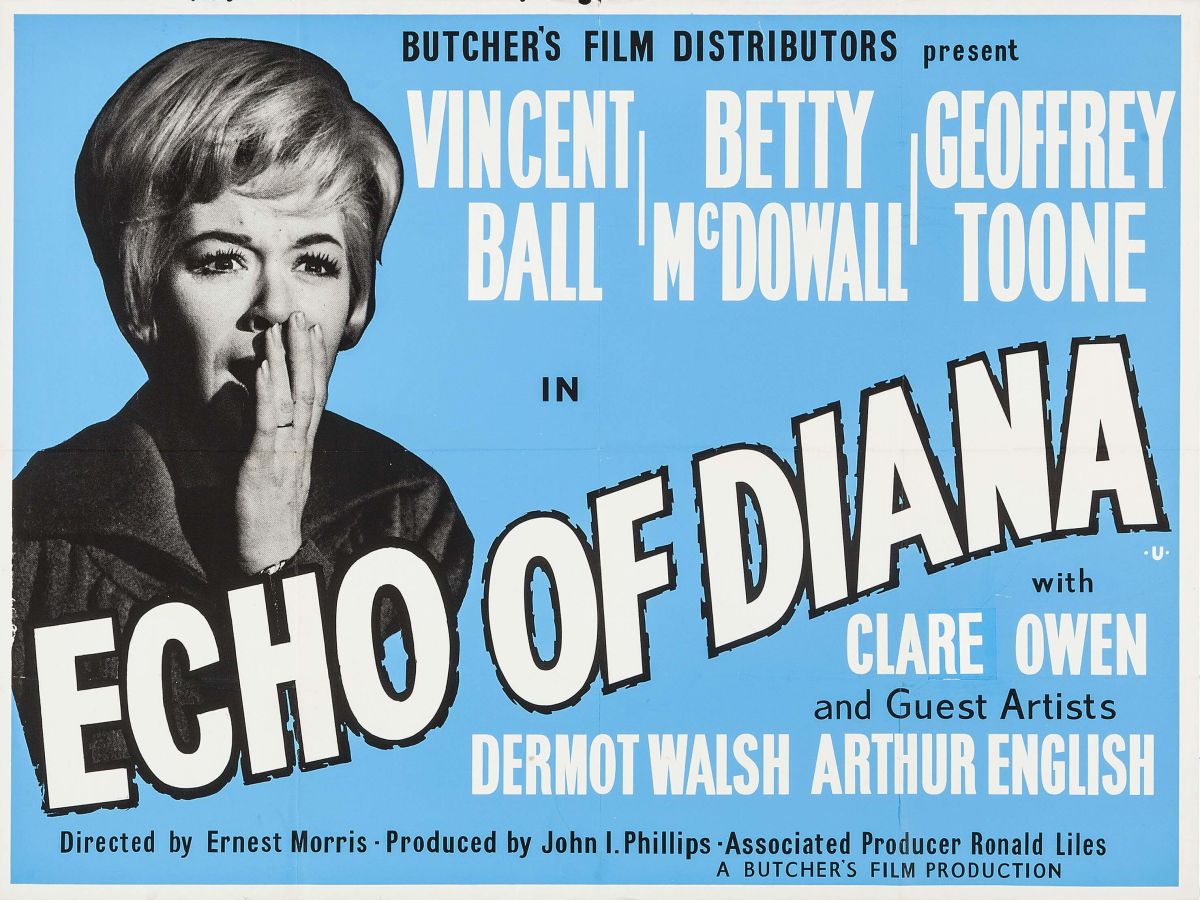
Minor British B-picture gem, though more for the exquisite narrative and tsunami of twists than the acting. And while not being one of those devious arthouse farragoes spins the starting point as the climax. Also, very prescient, heavily reliant of the espionage tradecraft that would later become de rigeur.
On the day she learns of her husband’s death in a plane crash in Turkey, Joan (Betty McDowall) finds an intriguing reference to the dead man in the “Personal Column” of The Times newspaper signed by “Diana.” Suspecting a mistress or skulduggery, her friend Pam (Clare Owen), a former fashion editor, investigates and triggers trouble. Joan’s flat is burgled, they are accosted by dubious police, the dead man’s effects are foreign to Joan, the receptionist at a newspaper makes a mysterious phone call.
Fairly quickly, Joan and Pam fall in the purlieu of British espionage chief Col Justin (Geoffrey Toone) who puts them in touch with suave journalist Bill (Vincent Ball), an old colleague of the husband, whose apartment has also been tossed, and who has taken a shine to Pam. The women are somewhat surprised when a murder is hushed up but that’s the least of the espionage malarkey. Mysterious contacts, equally odd points of contact, disguises (though mostly this runs to a blonde wig), code names, double agents, phone tapping and mail drops leave the women somewhat befuddled but they play along and with that British bluffness, not quite aware they are acting as decoys to draw out a crew of foreign spies headed by a rough fella called Harris (Basil Beale).
Halfway through it seems her husband might not be dead after all, but, according to the Turkish ambassador, Joan might need to head off to Turkey or thereabouts and certainly other interested parties want her out of the country.
And it being British, and nobody wanting to take the whole thing seriously, especially since the James Bond boom had not begun in earnest, the drama is offset by some pointed comedy: the proprietor of an accommodation address business has a side hustle in porn mags, one of the contacts is annoyingly punctilious, one promising lead turns out to be a very grumpy old man, another lead results in a race horse called Diana in a grubby betting shop where they are rooked by another old guy.
But it’s lavished with twists: double-crossers double-crossed, misleading clues, bad guys far cleverer than good guys, the wrong person in the right car, kidnap, unexpected occurrence. Pretty contemporary, too, with much of the action driven by telephone calls. But something of an ironic climax, the notice in the newspaper having legitimate espionage purpose.
The action is so pell-mell, Joan and Pam scarcely have time to draw breath, never mind give vent to heavy emotion, the best we are afforded is a moment when Joan doesn’t know “whether she’s wife or widow.” But that’s just as well. We are in B-movie land with a B-movie class of actors, probably recognizable to audiences then as the kind of actors who never managed a step up.
Vincent Ball did best, a long-running role in BBC TV series Compact (1962-1965), male lead in skin flick Not Tonight, Darling (1971) and decades of bit parts. You might have caught Betty McDowell in First Men in the Moon (1964) or The Omen (1976). Clare Owen was female lead in Shadow of Fear (1963) and had a part in ITV soap Crossroads (1965-1972).
Directed by Ernest Morris (Shadow of Fear) from a script by Reginald Hearne (Serena, 1962). You’d say a better script than a movie, and with better casting might have taken off, but, still, very satisfying supporting feature for the times.
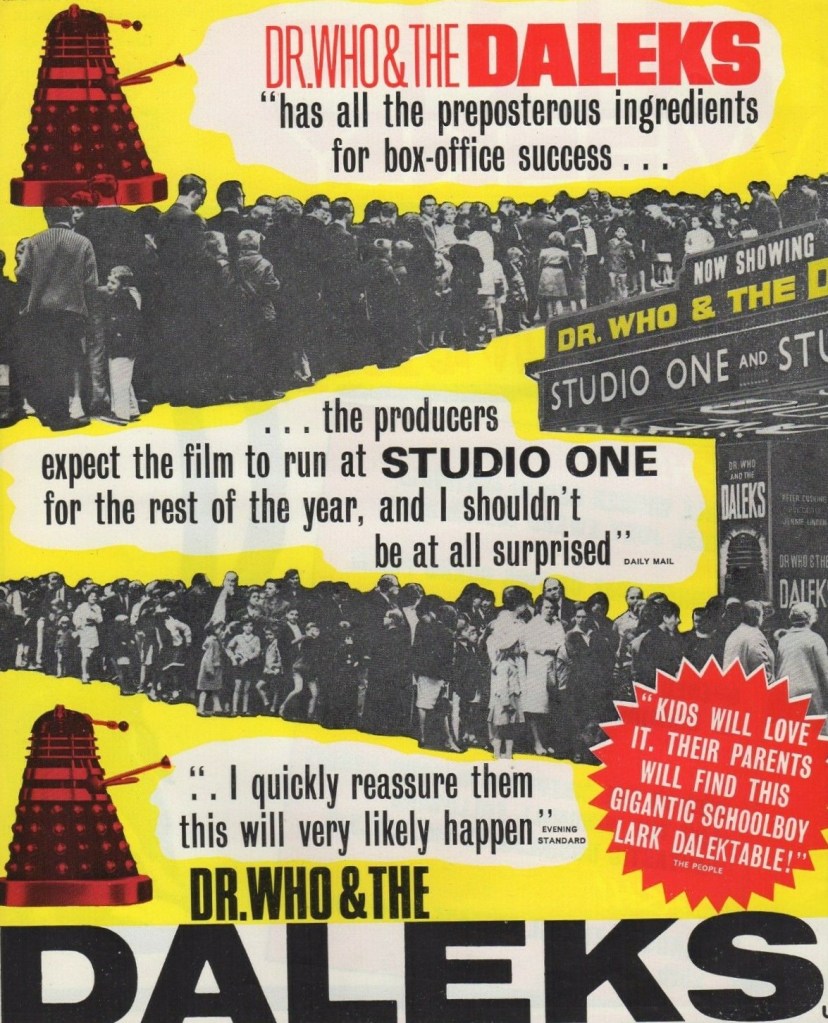
The maiden voyage of the time-travelling Tardis is triggered by some unexpected pratfall comedy. On board are the venerable doctor (Peter Cushing), his intrepid great-granddaughter Susan (Roberta Tovey) and a fearful pair, granddaughter Barbara (Jennie Linden) and accident-prone Ian (Roy Castle). They land on a petrified planet ruled by the robotic Daleks with menacing electronic voices.
The malfunctioning Tardis forces them to investigate an abandoned city but they are quickly imprisoned, the steel robots determined to discover why the earthlings should be immune to the radiation that has consumed this planet after nuclear war. Meanwhile, the planet’s remaining inhabitants, the Thals, are planning an uprising.
Budget restrictions ensure that menace is limited, even as the characters endure a heap of traditional obstacles such as swamp and rocky outcrop. Adults who did not grow up in the 1960s when the BBC television series took Britain by storm and apt to come at this without the benefit of nostalgia will certainly look askance at the sets and costumes. And it doesn’t possess the so-bad-it’s-good quality of some 1950s sci-fi pictures. But since it was primarily made for children, then perhaps it’s better to watch it with a younger person and gauge their response – of course, that may be equally harsh from someone brought up on the modern version of the series or already immersed in superheroes.
On the plus side, it does move along at a clip. Roberta Tovey (A High Wind in Jamaica, 1965) charms rather than annoys as the plucky grand-daughter even if her grandfather has mutated from the sterner figure of the television series into an eccentric inventor. Peter Cushing (The Skull, 1965) is only required to ground the production which he does adequately. The innate comic timing of comedian Roy Castle, in his leading man debut, brings a light touch to proceedings as the bumbling boyfriend and generates some decent laughs. Jennie Linden (Women in Love, 1969) has little to do except look scared.
Oddly enough, it was American Milton Subotsky who, in opportunistic fashion, brought the project to the big screen, although the BBC had a track record of providing product that might make such a leap, The Quatermass Experiment in the 1950s the leading example. He wrote the screenplay and acted as producer and had previously worked with Cushing on Dr Terror’s House of Horrors (1965) and was about to embark on horror masterpiece The Skull the same year. He has approached the material with some reverence and the fact that the budget allowed for hordes of Daleks rather than being seen one or two at a time as on the television probably made some child’s day.
Scottish director Gordon Flemyng (The Split, 1968) would make the leap to Hollywood on the back of this picture and its sequel the following year and you can see what made studios have faith in his ability – he deals with multiple characters, works quickly on a low budget and delivers an attractive picture that was a box office hit.
I suspect that audiences will divide into those who watch the film with nostalgia-colored spectacles, those who think it only as good as a bad episode of Star Trek and those who adore any low-budget sci-fi movie.
Charm was in short supply in the 1960s. Sure, for a period you still had Cary Grant but David Niven was as often to be found in an action picture (The Guns of Navarone, 1961) or a drama, and others of the ilk, like Tony Curtis, veered more towards outright comedy. Britain had something of what would today be called a “national treasure,” admittedly a term more likely to be accorded females of the standing of Maggie Smith or Judi Dench; maybe a space might be found for the idiosyncratic Ralph Richardson. Dare I put Leslie Phillips into contention for such an honor?
Once into his mellifluous stride and with his trademark appreciation of female beauty, “Ding dong!” a more welcome remark than the more common “Cor!” or “Strewth” or sheer inuendo, Leslie Phillips, not so well known perhaps in the USA and foreign parts, would fit that definition. He had charm in spades.
Unfortunately, you could split his career into those roles where “ding dong” entered the equation and those it did not. This is one of those, and I have to confess I’m both disappointed and delighted. Dissatisfied because the charm appeared part of his screen persona, but pleased whenever I found out he wasn’t tied down to it and could essay other characters just as well.
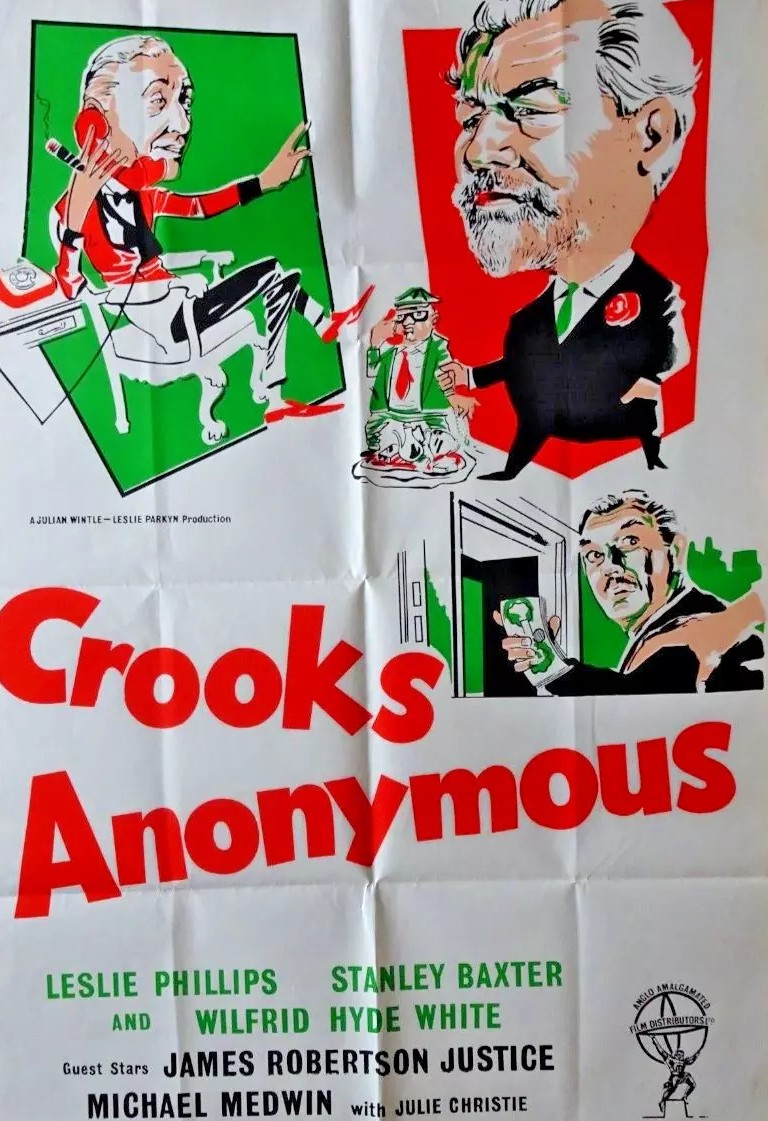
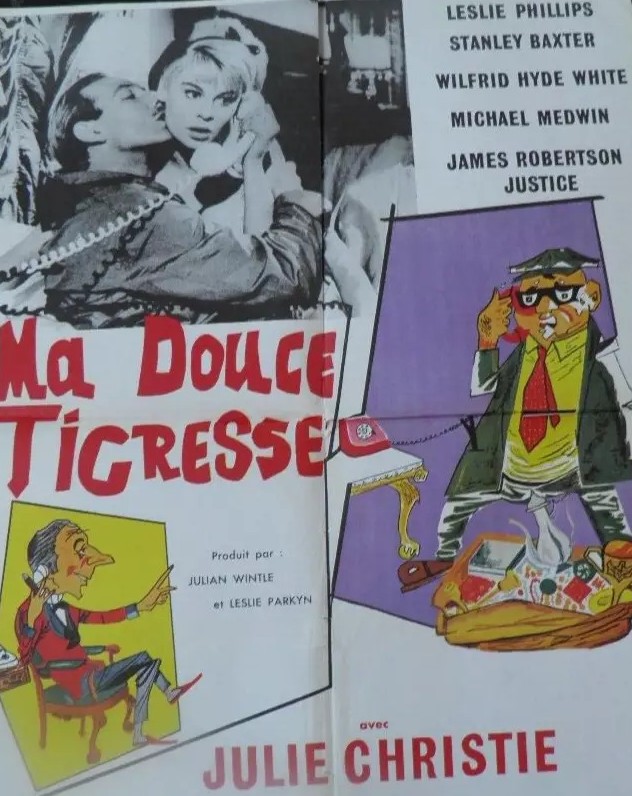
Here, here’s shifty criminal Dandy, whose only redeeming feature is that somehow he has acquired a beautiful girlfriend, stripper Babette (Julie Christie), who, despite her profession
appears to have steered cleared of seediness and insists he goes straight before she consents to marriage. And that would be fine, except what can Dandy do when faced with such obvious temptation and jewels left idly on a counter in a jewellery?
When she catches him out, he is sent to the criminal version of Alcoholics Anonymous where he is at the mercy of a particularly sadistic “guardian angel” Widdowes (Stanley Baxter – in a variety of disguises). He is locked in a cell full of safes. Food, cigarettes etc are hidden inside the safes, so to eat and satisfy his smoking habit, he must open them. The logic, presumably, is that he will grow sick and tired of opening so many safes for so little reward.
Maybe it’s the hidden punishments – a touch of electrocution and various other booby traps – that do the trick. Or, it could be the glee of Widdowes. When Dandy finds cigarettes, they come without any means of lighting them. He pleads with Widdowes to point him in the direction of a safe containing means of ignition.Replies the “angel”, “I’m glad you asked that because I’m not going to tell you.”
There’s a whole raft of comedy skits revolving around temptation, mostly involving Widdowes in one guise or another. And when the movie stays with Widdowes and a bunch of other reformed criminals, it fairly zips along. But once Dandy is released and plot rears its ugly head it falls back on more cliché elements.
Dandy manages to go straight, employed as a Santa Clause in a department store, while Babette decides to give up her job so both can start afresh. Unfortunately, temptation raises its ugly head to the tune of a quarter of a million pounds and all those goody-two-shoes reformed criminals line up to take a crack at it. The twist, which you’ll already have guessed, is that they have to break into the vault again to return the money they have stolen.
Scottish comedian Stanley Baxter was going through a phase of attempting to become a movie star and was given a fair old crack at it – The Fast Lady (1962) and Father Came Too (1964) followed, the former with both Philips and Christie, the latter with just him.
But what was obvious from Crooks Anonymous was that Baxter was better in disguise – and the more the merrier – than served up straight. He steals the show here where in the other movies his character is more of an irritant.
A well-meaning Leslie Phillips somehow snuffs out the charm and there’s not enough going on between him and Babette when he’s full-on straightlaced. Heretical though it might be, there’s not enough going on with Julie Christie either to suggest she might be Oscar bait. Here’s she’s just another ingenue.
Wilfrid Hyde-White (P.J. / New Face in Hell, 1967), another who generally traded on his charm (in a supporting category of course), is also in the disguise business, so he steals a few scenes, too. James Robertson Justice (Father Came Too) would have stolen the picture from under the noses of Baxter and Phillips had he been given more scenes.
Directed by Ken Annakin (Battle of the Bulge, 1965) from a screenplay by Jack Davies and Henry Blyth (Father Came Too).
I might have preferred Phillips in “ding dong” persona, but this works out okay, especially in the scenes set in the criminal reform school.
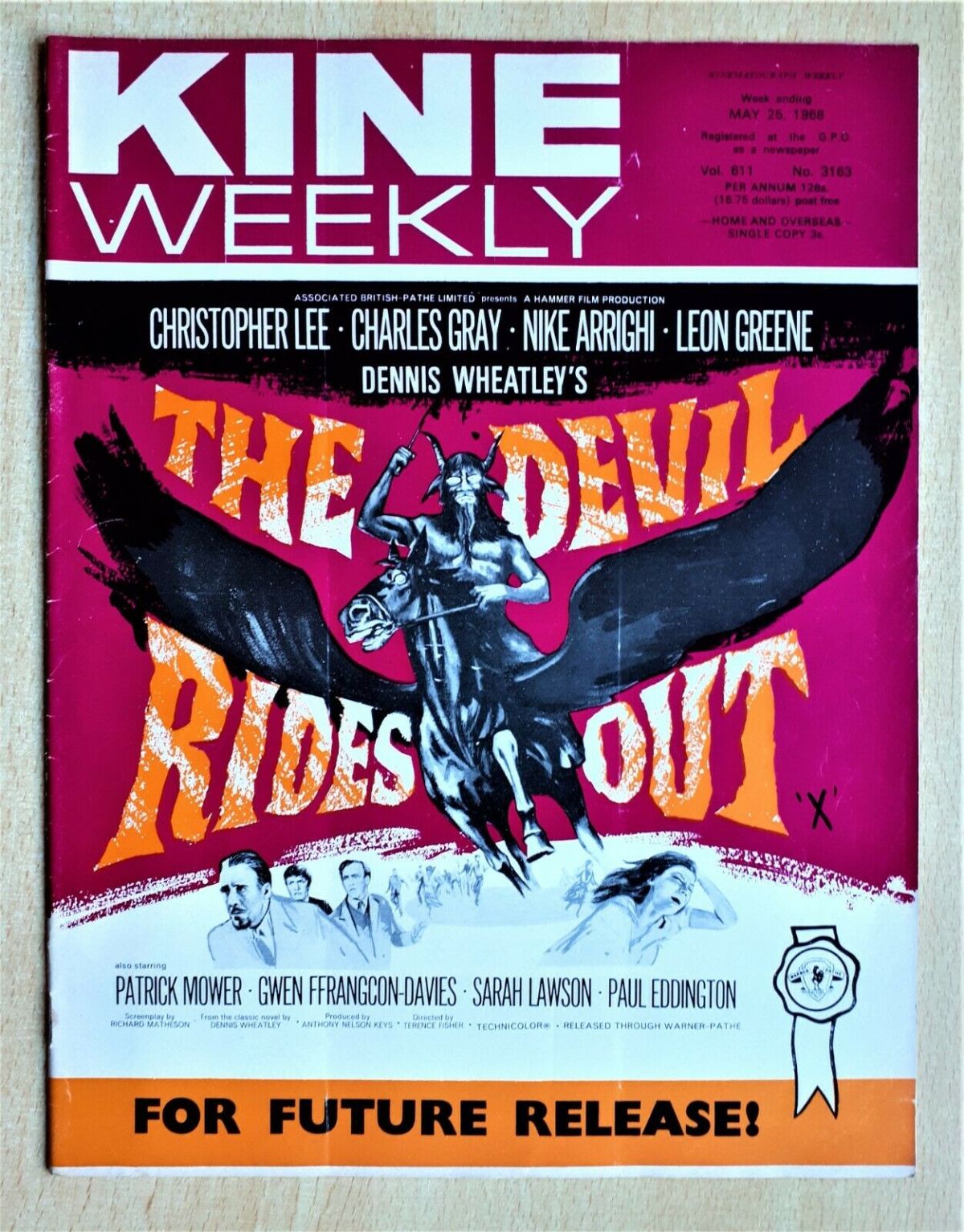
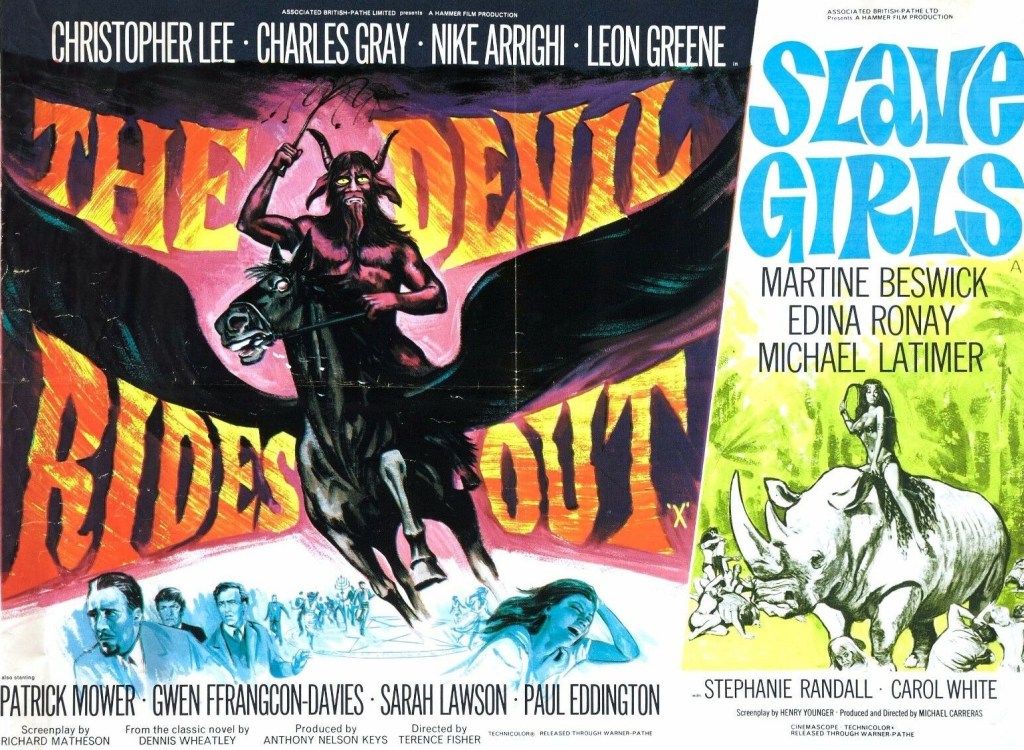
Strong contender for Hammer’s film of the decade, a tight adaptation of Dennis Wheatley’s black magic classic with some brilliant set pieces as Nicholas de Richleau (Christopher Lee) battles to prevent his friend Simon (Patrick Mower) falling into the hands of satanist Mocata (Charles Gray).
Initially constructed like a thriller with Simon rescued, then kidnapped, then rescued again, plus a car chase, it then turns into a siege as Richleau and friends, huddled inside a pentagram, attempt to withstand the forces of evil. Sensibly, the script eschews too much mumbo-jumbo – although modern audiences accustomed to arcane exposition through MCU should find no problem accommodating ideas like the Clavicle of Solomon, Talisman of Set and Ipsissimus – in favour of confrontation.
Unlike most demonic pictures, de Richleau has an array of mystical weaponry and a fund of knowledge to defend his charges so the storyline develops along more interesting lines than the usual notion of innocents drawn into a dark world. In some senses Mocata is a template for the Marvel super-villains with powers beyond human understanding and the same contempt for his victims. And surely this is where Marvel’s creative backroom alighted when it wanted to turn back time. Though with different aims, De Richleau and Mocata are cut from the same cloth, belonging to a world where rites and incantations hold sway.
While special effects play their part from giant menacing tarantulas and the Angel of Death, the most effective scenes rely on a lot less – Simon strangled by a crucifix, Mocata hypnotizing a woman, a bound girl struggling against possession. Had the film been made a few years later, when Hammer with The Vampire Lovers (1970) and Lust for a Vampire (1971) increased the nudity quotient, and after The Exorcist (1973) had led the way in big bucks special effects, the black mass sequence would have been considerably improved.
The main flaw is the need to stick with the author’s quartet of “modern musketeers” which means the story stretches too far in the wrong directions often at the cost of minimizing the input of de Richleau. In the Wheatley original, the four men are all intrepid, but in the film only two – de Richleau and American aviator Rex van Ryn (Leon Greene) – share those characteristics. At critical points in the narrative, de Richleau just disappears, off to complete his studies into black magic. Where The Exorcist, for example, found in scholarship a cinematic correlative, this does not try.
Christopher Lee (She, 1965), pomp reined in, is outstanding as de Richleau, exuding wisdom while fearful of the consequences of dabbling in black magic, both commanding and chilling. Charles Gray (Masquerade, 1965) is in his element, the calm eloquent charming menace he brings to the role providing him with a template for future villains. The three other “musketeers” are less effective, Patrick Mower in his movie debut does not quite deliver while Leon Greene (A Challenge for Robin Hood, 1967) and Paul Eddington (BBC television’s Yes, Minister 1980-1984) are miscast. Nike Arrighi, also making her debut as love interest Tanith, is an unusual Hammer damsel-in-distress.
Hammer stalwart Terence Fisher (The Gorgon, 1964) creates a finely-nuanced production, incorporating the grand guignol and the psychological. Screenwriter Richard Matheson (The Raven, 1963) retains the Wheatley essence while keeping the plot moving. A few years later nudity was no longer be an issue and Hollywood injected big bucks in horror special effects, so with those constraints in mind the studio did a devilish good job.
BOOK INTO FILM
Dennis Wheatley was a prolific bestseller producing three or four titles a year, famous for a historical series set around Napoleonic times, another at the start of the Second World War and a third featuring the “four modern musketeers” that spanned a couple of decades. In addition, he had gained notoriety for books about black magic, which often involved series characters, as well as sundry tales like The Lost Continent. Although largely out of fashion these days, Wheatley set the tone for brisk thrillers, stories that took place over a short period of time and in which the heroes tumbled from one peril to another. In other words, he created the template for thriller writers like Alistair MacLean and Lee Child.
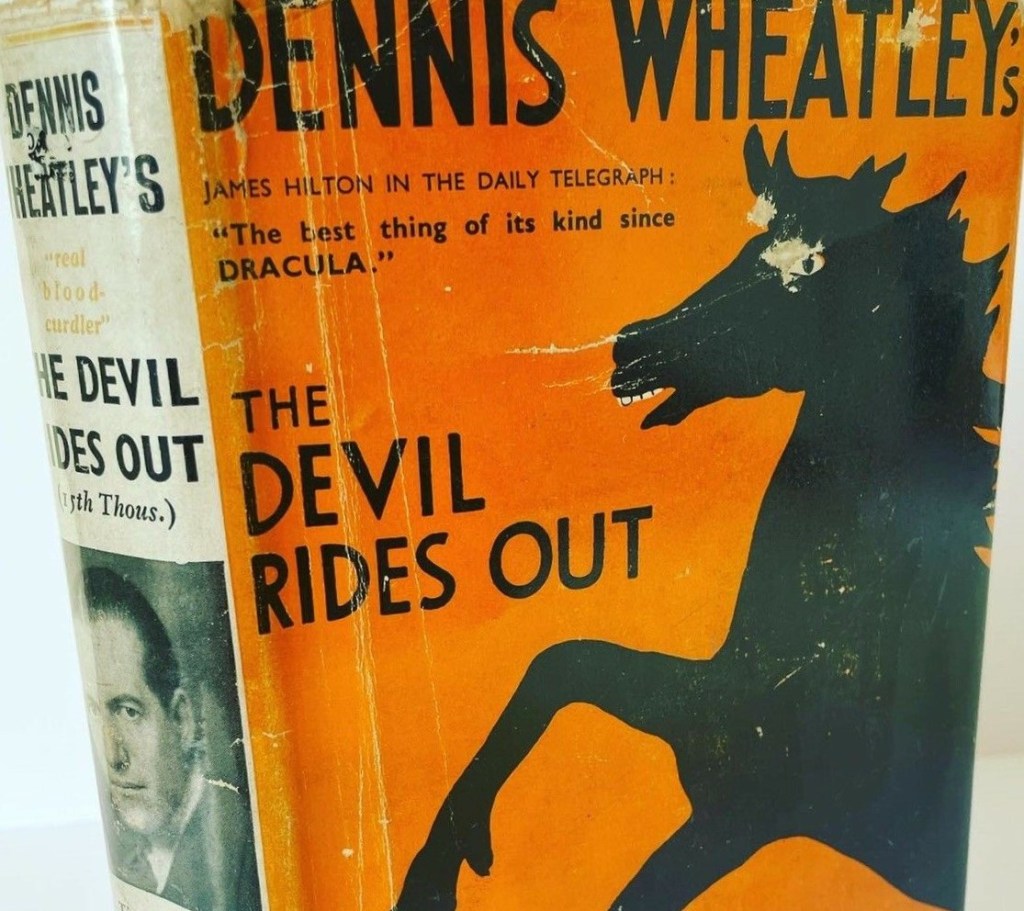
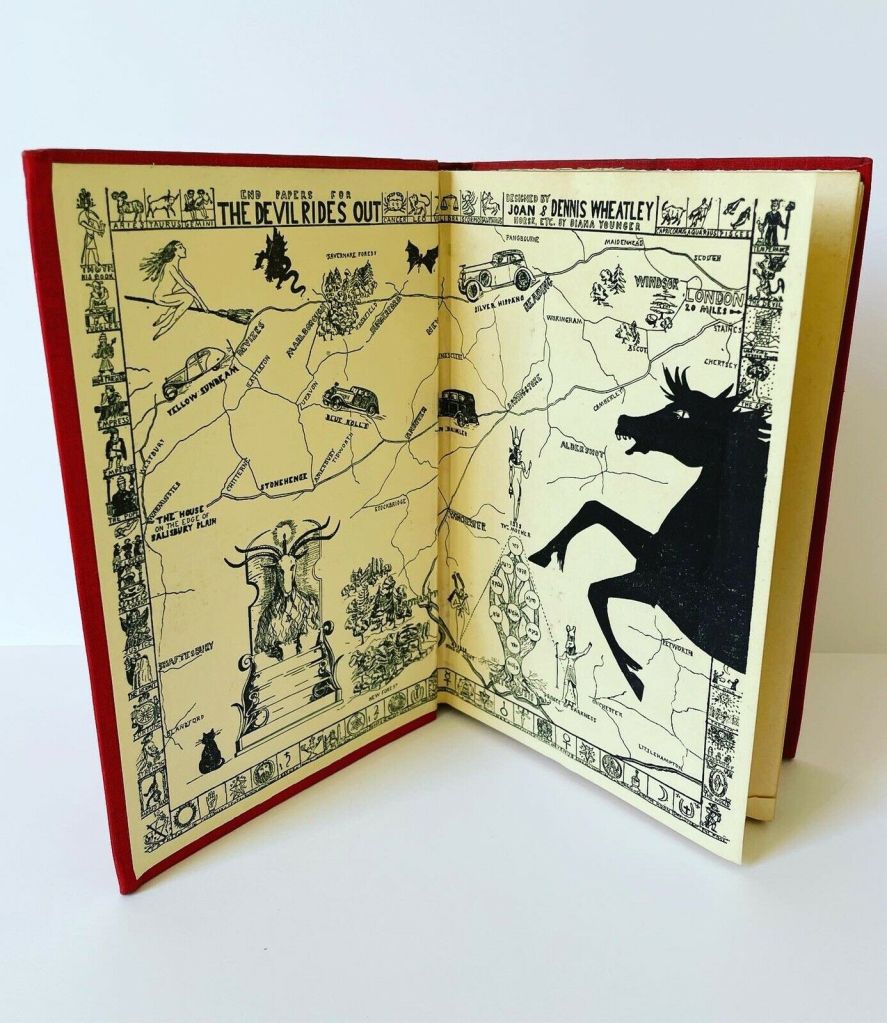
The Devil Rides Out, his fourth novel, published in 1934, featured the “musketeers” involved in his phenomenally successful debut The Forbidden Territory (1933), and introduced readers to his interest in the occult. Although of differing temperaments and backgrounds his quartet – the Russian-born Duke De Richleau (Christopher Lee in the film), American aviator Rex Van Ryn (Leon Greene) and wealthy Englishmen Richard Eaton (Paul Eddington) and Simon Aron (Patrick Mower) – are intrepid. And while screenwriter Richard Matheson stuck pretty much to the core of the Wheatley story, the film was hampered by the actors. The laid-back Paul Eddington hardly connects with the Wheatley characterization and Patrick Mower is too young for Aron.
As with the book, the story moves swiftly. Worried that Aron is dabbling in the black arts, De Richleau and Van Ryn go haring down to his country house where they meet black magic high priest Mocata (Charles Gray) and discover tools for satanic worship. And soon they are embroiled in a duel of wits against Mocata, climaxing in creating a pentagram as a means of warding off evil.
In order not to lose the audience by blinding them with mumbo-jumbo the script takes only the bare bones of the tale, bringing in the occult only when pivotal to the story, and that’s something of a shame. A modern audience, which has grown up on enormously complicated worlds such as those created for Game of Thrones and the MCU, would probably have welcomed a deeper insight into the occult. While out-and-out thrillers, Wheatley’s novels also contained copious historical information that he was able to dole out even when his heroes were in harm’s way. The Devil Rides Out is not a massive tome so it’s a measure of the author’s skill that he manages to include not just a condensed history of the occult but its inner workings. Every time in the film De Richleau goes off to the British Library for some vital information, his departure generally leaves a hole, since what he returns with does not always seem important enough to justify his absence.
But then the screenwriter was under far more pressure than a novelist. In some respects, this book like few others demonstrated the difference between writing for the screen and writing for a reader. With just 95 minutes at his disposal, Matheson had no time to spare while Wheatley had all the time in the world. Wheatley could happily leave the reader dangling with a hero in peril while dispatching De Richleau on a fact-finding mission, the action held up until his return. It’s interesting that Matheson chose to follow Wheatley’s characterization of De Richleau, who didn’t know everything but knew where to look. Matheson could easily have chosen to make De Richleau all-knowing and thus able to spout a ton of information without ever going off-screen.
But here’s where the book scores over the film. The reader would happily grant Wheatley his apparent self-indulgence because in the book what he imparted on his return, given the leeway to do so, was so fascinating. There are lengthy sections in the book which are history lessons where De Richleau gives readers the inside track on the satanic. In the opening section, once De Richleau and Van Ryn have rescued Aron, the author devotes a full seven pages to a brief introduction to the occult that leaves the reader more likely to want more of that than to find out how the story will evolve. He has hit on a magic formula that few authors ever approach. To have your background every bit as interesting as the main story is incredibly rare and it allowed Wheatley the opportunity to break off from the narrative to tell the reader more about the occult, which in turn, raised the stakes for the characters involved.
Dennis Wheatley
Effectively, there was too much material for a screenwriter to inflict upon an audience ignorant of the occult. Some decisions were clearly made to limit the need for lengthy exposition. But these often work against the film. For example, Mocata wants the Talisman of Set because it bestows unlimited power with which he can start a world war, but in order to accomplish that he needs to find people with the correct astrological births, namely Simon and Tanith. But this element is eliminated from the story, making Mocata’s motivation merely revenge. Matheson also removed much of the historical and political background, replaced the swastika as a religious symbol with the more acceptable Christian cross, and deleted references to Marie’s Russian background. Her daughter Fleur becomes Peggy. Matheson also treats some of the esoteric light-heartedly on the assumption that seriousness might be too off-putting.
Overall, the adaptation works, you can hardly argue with the movie’s stature as a Hammer classic, but the more you delve into the book the more you wish there had been a way for much of the material to find its way onscreen and to inform the picture in much the same way as the depth of history and character backstory added to Game of Thrones.