Steve McQueen had little trouble identifying with this role. He was the Hollywood contender, trying to knock current kingpin Paul Newman off his perch, and in Norman Jewison’s tense, often heart-stopping, drama he has the ideal vehicle. For the most part this is a winner-take-all face-off, as much a showdown as any western shootout, in darkened rooms under the harsh light of a New Orleans poker table between a rising star always referred to as The Kid (Steve McQueen) and the unofficial world champion, the urbane cigar-smoking Lancey Howard (Edward G. Robinson).
Broadened out in the initial stages to include scenic diversions – the Mississippi at dawn, a cockfight, some jazz – plus romance and intrigue, this is essentially pure sport, a game of stares, where bluff holds the ace and women exist on the perimeter only to fill in the time before the next hyped-up encounter. There’s no trophy to be won, not even glory, just the right to call yourself “The Man.” The Kid feels the pressure of punching above his weight, Lancey of getting old.
Farmer’s daughter and arty-wannabe Christian (Tuesday Weld) is the Kid’s main squeeze until she gets between him and his game. When she takes off, he makes do with Melba (Ann-Margret), girlfriend of dealer Shooter (Karl Malden) who was somewhat preoccupied with giving the Kid more than a helping hand to satisfy the vengeful Slade (Rip Torn), a rich businessman.
Although it finally comes down to a confrontation between the Kid and Lancey, subordinate characters like sweating poker player Pig (Jack Weston) and stand-in dealer Ladyfingers (Joan Blondell) help dissipate the tension. But in fact anything that occurs only seems to increase the tension as it comes down to the one big final hand.
This is McQueen (The Magnificent Seven, 1960) in transition, from the loner in The Great Escape (1963) to an actor exuding charisma and on top of his acting game. While on the face of it little more than a sporting lug, the Kid is an appealing character, engaging with a little shoeshine boy, winning over Christian’s truculent parents with what appears a card trick but is actually a demonstration of the phenomenal memory necessary to excel in his chosen field. There’s a winsome child in there among the macho persona. The poker face that McQueen developed would become one of his acting traits over the years.
Edward G. Robinson (Seven Thieves, 1960) gives a rounded performance as the reigning poker champ accepting emotional loss as the price for all his financial gains. Tuesday Weld is an appealing waif. Karl Malden (Pollyanna, 1960) essays another tormented soul and Rip Torn (Judas in King of Kings, 1961) a sleazy one. Also look out for a host of great character actors including Jack Weston (Mirage, 1965), Oscar nominee Joan Blondell (Advance to the Rear, 1964) and Jeff Corey (Once a Thief, 1965) plus composer and bandleader Cab Calloway.
Ann-Margret, all eye-shadow and cleavage, is in her best man-eater form. But, thankfully, there is more to her character than that. It is unclear whether she simply latches on to a potential winner or is pimped out by Shooter, but just hooking up with that older man (i.e. Shooter) makes her interesting, since looks are far from his attraction. Her ruthlessness is spelled out in simple fashion. She is determined to win, cheating at solitaire and she slams the wrong pieces into a jigsaw just for the satisfaction of making it look complete. You can sense a depth in this character which the film does not have time to fully explore.
Although often compared to The Hustler (1962), and in many eyes considered both its inferior and a crude rip-off, this is in some respects a greater achievement. At least in The Hustler, there actually was action, players moving around a pool table, clacking balls racing across the surface. Poker is all about stillness. Any gesture could give away your thoughts. Unlike any other sport, poker requires silence. There is no roaring crowd, just people dotted round the room, some with vested interest if only through a wager, some wanting to say they were there when a champion was toppled.
So the ability to maintain audience interest with two guys just staring at each other, interspersed with minimal dialog, takes some skill. Building that to a crescendo of sheer tension is incredible.
The first four pictures of Canadian director Norman Jewison (Send Me No Flowers, 1964) did not hint at the dramatic chops, confidence, composure and understanding of pacing required, especially as he was a last-minute replacement for Sam Peckinpah, to pull this off. That he does so with style demonstrated a keen and versatile talent that would come to the boil in his next three films: The Russians Are Coming, The Russians Are Coming (1966), In the Heat of the Night (1967) and The Thomas Crown Affair (1968).
The former blacklisted Ring Lardner Jr. (Tracy-Hepburn comedy Woman of the Year, 1942) was credited with his first screenplay since The Forbidden Street in 1949 and he shared the chore with another iconic figure, Terry Southern (Dr Strangelove, 1964), basing their work on the original novel by Richard Jessup. Not sure who contributed the classic line: “Read ’em and weep.” Mention should be made of a terrific score by Lao Schifrin.
This film had everything. The cast was pure A-list: Oscar winner Audrey Hepburn (Breakfast at Tiffany’s, 1961) and Oscar nominee Albert Finney (Tom Jones, 1963). The direction was in the capable hands of Stanley Donen (Arabesque, 1966), working with Hepburn again after the huge success of thriller Charade (1963). The witty sophisticated script about the marriage between ambitious architect Mark Wallace (Albert Finney) and teacher wife Joanna (Audrey Hepburn) unravelling over a period of a dozen years had been written by Frederic Raphael, who had won the Oscar for his previous picture, Darling (1965). Composer Henry Mancini was not only responsible for Breakfast at Tiffany’s – for which he collected a brace of Oscars – but also Charade and Arabesque. And the setting was France at its most fabulous.
So what went wrong? You could start with the flashbacks. The movie zips in and out of about half a dozen different time periods and it’s hard to keep up. We go from the meet-cute to a road trip on their own and another with some irritating American friends to Finney being unfaithful on his own and then Hepburn caught out in a clandestine relationship and finally the couple making a stab at resolving their relationship. I may have got mixed up with what happened when, it was that kind of picture.
A linear narrative might have helped, but not much, because their relationship jars from the start. Mark is such a boor you wonder what the attraction is. His idea of turning on the charm is a Humphrey Bogart imitation. There are some decent lines and some awful ones, but the dialogue too often comes across as epigrammatic instead of the words just flowing. It might have worked as a drama delineating the breakdown of a marriage and it might have worked as a comedy treating marriage as an absurdity but the comedy-drama mix fails to gel.
It’s certainly odd to see a sophisticated writer relying for laughs on runaway cars that catch fire and burn out a building or the annoying whiny daughter of American couple Howard (William Daniels) and Cathy (Eleanor Bron) and a running joke about Mark always losing his passport.
And that’s shame because it starts out on the right foot. The meet-cute is well-done and for a while it looks as though Joanna’s friend Jackie (Jacqueline Bisset) will hook Mark until chicken pox intervenes. But the non-linear flashbacks ensure that beyond Mark overworking we are never sure what caused the marriage breakdown. The result is almost a highlights or lowlights reel. And the section involving Howard and Cathy is overlong. I kept on waiting for the film to settle down but it never did, just whizzed backwards or forwards as if another glimpse of their life would do the trick, and somehow make the whole coalesce. And compared to the full-throttle marital collapse of Who’s Afraid of Virginia Woolf (1966) this was lightweight stuff, skirting round too many fundamental issues.
It’s worth remembering that in movie terms Finney was inexperienced, just three starring roles and two cameos to his name, so the emotional burden falls to Hepburn. Finney is dour throughout while Hepburn captures far more of the changes their life involves. Where he seems at times only too happy to be shot of his wife, she feels more deeply the loss of what they once had as the lightness she displays early on gives way to brooding.
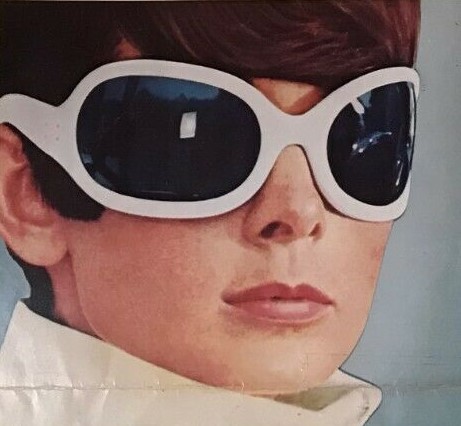
Hepburn as fashion icon gets in the way of the picture and while some of the outfits she wears, not to mention the sunglasses, would not have been carried off by anyone else they are almost a sideshow and add little to the thrust of the film.
If you pay attention you can catch a glimpse, not just of Jacqueline Bissett (Bullitt, 1969) but Romanian star Nadia Gray (The Naked Runner, 1967), Judy Cornwell (The Wild Racers, 1968) in her debut and Olga Georges-Picot (Farewell, Friend, 1968). In more substantial parts are William Daniels (The Graduate, 1968), English comedienne Eleanor Bron (Help!, 1965) woefully miscast as an American, and Claude Dauphin (Grand Prix, 1966).
Hepburn’s million-dollar fee helped put the picture’s budget over $5 million, but it only brought in $3 million in U.S. rentals, although the Hepburn name may have nudged it towards the break-even point worldwide.
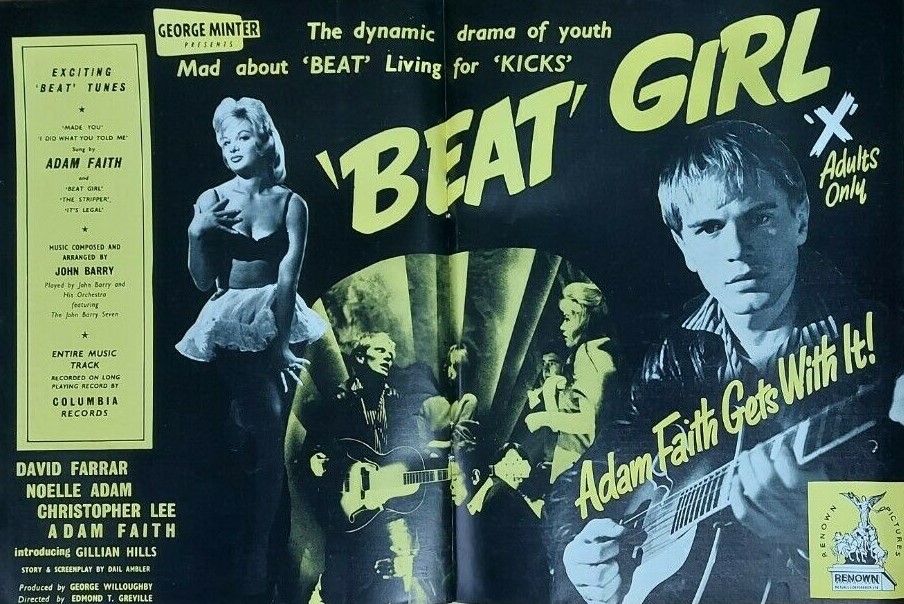
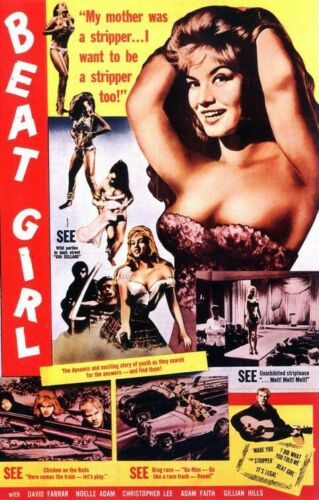
More social document than drama, but that aspect somewhat diluted by the moviemakers’ attempts at exposing rebellious youth while taking for granted more sordid adult behavior. Sold under the exploitation banner – “this could be your teenage daughter” – narrative flow is interrupted now and then to showcase Adam Faith’s singing and to accommodate a few striptease acts. Probably more interesting is the array of new talent on show.
Spoiled teenager Jennifer (Gillian Hills) heads for the wild side of town to experience the beatnik lifestyle in Soho coffee shops and cellars. That there’s no drugs involved and that alcohol is considered “square” – as for that matter is violence – may come as a surprise to students of the period. Apart from one episode of road-racing and playing “chicken” along a railway track, most of the time the gang listen to music or go dancing until Jennifer gets it into her head that joining a striptease show might give her life the thrill it is missing.
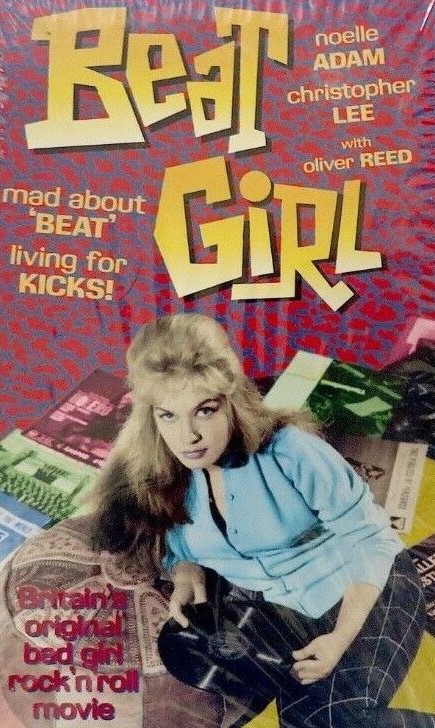
VHS cover.
This is prompted by the discovery that her new too-young stepmother Nichole (Noelle Adams) has been a stripper and most likely a sex worker in Paris before marrying wealthy architect Paul (David Farrar), cueing a round-robin of confrontations. Strangely enough, from the narrative perspective, none of the young bucks appear romantically interested in the provocatively-dressed Jennifer and so it is left to creepy club owner Kenny (Christopher Lee) to make a move.
The gaping hole left by lack of narrative drive is not offset by immersion in the beatnik or striptease scene. Back in the day the British censors took the editing scissors to the striptease but although restored versions available now contain nudity you are left wishing that there was some lost element to the beatnik sections that would have given the picture the energy it required.
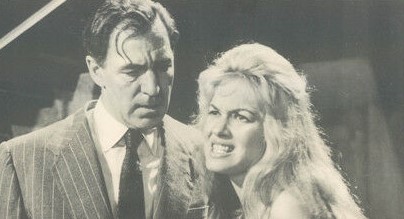
Gillian Hills (Les Liaisions Dangereuses, 1959), comes over as a cross between Brigitte Bardot and Diana Dors without having an ounce of the sex appeal of either. All pout and flounce, she is unable to inject any heart into her two-dimensional character, although given her youth and inexperience this was hardly surprising. Former British star David Farrar (Black Narcissus, 1947) was coming to the end of his career and in a thankless role as a frustrated father could do little to rescue the project.
Father and headache of a daughter – David Farrar and Gillian Hills.
French actress Noelle Gordon (Sergeant X of the Foreign Legion, 1960) could have been Jennifer’s mother given her own tendencies towards wiggle and pout but at least she makes a stab at trying to overcome her step-daughter’s hostility.
In the main, the picture’s delight is bringing to the fore a whole chorus of new faces. Pick of the supporting cast is Shirley Anne Field (Saturday Night and Sunday Morning, 1960) who doesn’t just have a knowing look but looks as if she knows what’s she doing acting-wise. Making his movie debut was teen pop idol Adam Faith, who had made his name playing in coffee bars. He had already notched up a couple of number one singles, but doesn’t quite set the screen on fire. Peter McEnery (The Fighting Prince of Donegal, 1966) plays his inebriated pal. You can also spot Oliver Reed (Women in Love, 1969), Julie Christie (Doctor Zhivago, 1965), Claire Gordon (Cool It, Carol, 1970) and Nigel Green (Jason and the Argonauts, 1963).
Perhaps the most important debut belonged to composer John Barry. He had already been working with Adam Faith. Barry’s music for the film was the first British soundtrack album ever released, reaching number eleven on the charts, and opening the doors for future soundtrack albums, not least of which was the rich vein of theme tunes produced by Barry in the next few years.
French director Edmond T. Greville, who brought little panache to the subject matter, would redeem himself with his next picture The Hands of Orlac (1960).
This doesn’t fall into the “so-bad-it’s-good” category, nor has it been unfairly overlooked, and probably is better known as an example of the kind of exploitation B-picture that the Americans do so much better and a reminder that, except on rare occasions such as The Wild One (1953), older moviemakers seem incapable of capturing the essence of youth.
Novelizations were the hidden secret of 1960s Hollywood. While the decade is better known for widescreen 70mm roadshows, James Bond and the spy deluge, the musical and western revival and the start of the American New Wave, the novelization revolutionized the way films were marketed. By the end of the decade virtually every film released was accompanied by a book tie-in, either a bestseller sold to Hollywood, or a film script turned into a paperback / soft cover book.
At the start of this boom, around 1960, studios virtually gave away screenplays to publishers and allowed them to turn them into novels in return for the marketing angle they could provide. “Producers looked at tie-in books primarily as an exploitation aid not a source of income,” explained Patricia Johnson of paperback specialist Gold Medal Books in 1962. “Motion picture companies with no more – and often much less – than a rough script are being besieged by droves of publishers vying for the right to novelize original scenarios.”
The novelizations were usually short – about 60,000 words – and therefore attractively priced for the reading public but they could sell as many as half a million copies. But except in particular circumstances, studios allowed the rights to go to publishers for minute amounts of money. And for one simple reason – marketing. Half a century before social media, there was little advance promotion of movies. The week they were about to be released would see a flurry of advertising, but in general little promotion before that. Even journalists who had attended the press junkets I mentioned in a previous Blog would concentrate their articles into the week of release.
“What a publisher does for a film concern,” said Johnson, “is it creates a nationwide market, a popular anticipation of a film before it would ordinarily be more than a vague glimmer in the public consciousness.” The 125,000 outlets for books included not just bookstores but locations that targeted passing trade with extensive foot traffic. Newsstands in the street, hotel lobbies, railroad stations, department stores, airports and drugstores all boasted racks of paperback books with glossy covers, informing potential moviegoers of forthcoming films. Studios wanted to take advantage of the promotional device that bestsellers turned into movies could generate. For studios they represented an early marketing tool. Incorporating the movie advert or photos of the stars raised awareness of a forthcoming picture long before the first advert had appeared in a newspaper or billboard.
Robert Bloch cashed in on his “Psycho” fame to turn his original screenplay for The Couch into a novel.
One of the earliest novelizations was for Rat Pack heist picture Ocean’s 11 (1960) – pictured at the top of this page – and it showed the format to which publishers readily adhered. As you might expect, the cover featured a still from the movie incorporating the main stars, but there was also, by dictat of the Writers Guild of America (the screenwriters union), mention of the original scriptwriters in the same size of typeface as the authors who had carried out the novelisation.
Very rarely did the original screenwriter undertake this task. For a start, most considered it beneath their dignity. But, secondly, they got paid anyway. The screenwriter automatically received one-third of the fee a publisher paid the studio and the same share of royalties. By the mid-1960s the WGA was negotiating for a set fee of $6,000 (about $50,000 equivalent now) so a nice amount for no work but less appetising for a full-time screenwriter to do the whole job.
Bellah’s novel “The Valiant Virginian” was the inspiration for the TV series “The Virginian.”
But there were exceptions. Robert Bloch decided to turn his original screenplay The Couch (1961) into a novel. But then he had the experience of Psycho (1960) behind him. Prior to the 1960 Hitchcock film, his novel had only sold only 4,000 copies in hardback. The success of the film shifted 500,000 copies in paperback. Bloch must have reckoned his name emblazoned on the cover – and gaining sole credit, fee and royalties – would be more financially beneficial. Western author James Warner Bellah undertook the novelizations of his screenplays for Sergeant Rutledge (1960), A Thunder of Drums (1961) and The Man Who Shot Liberty Valance (1962).
But neither would have been as assiduously wooed by publishers as the team of Arthur C. Clarke and Stanley Kubrick who were jointly credited for the novelization of 2001: A Space Odyssey. An extremely unusual aspect of this deal was that the novelization appeared first as a hardback. Although based on a Clarke short story, and despite the fact that Clarke was considered one of the greatest names in science fiction, on the writing side movie and book were promoted as joint efforts. Delacorte-Dell forked out a $150,000 advance for the hardback with a 15% royalty rate. Clarke/Kubrick refused to allow the hardback publisher a share of the paperback spoils for which they negotiated a 12-15% royalty, way above the norm.
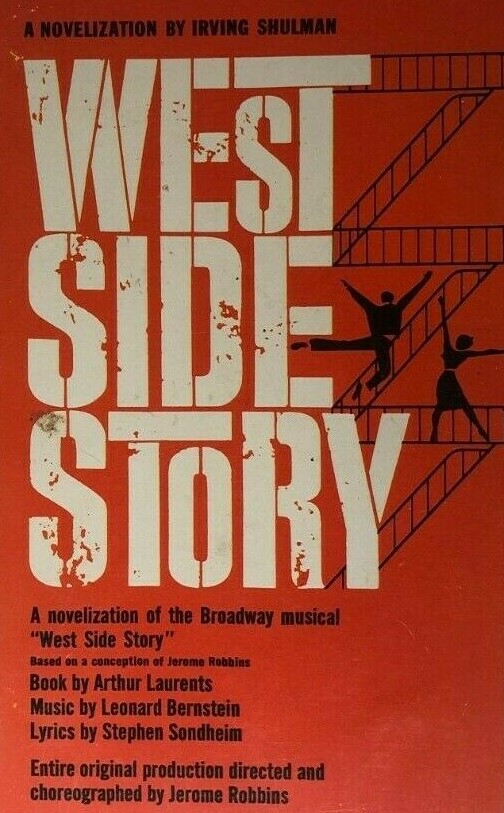
Note how many credits for the original musical were carried on the cover.
Occasionally the novelization would be undertaken by an author famous in their own right, such as when another sci fi giant Isaac Asimov took on the task of writing the book based on the script of Fantastic Voyage (1966). Famed western writer Louis L’Amour was handed the novelization of James Webb’s script for How the West Was Won (1963). Irving Shulman was a well-known novelist when called upon to turn West Side Story (1961) and The Notorious Landlady (1962) into novels. Screenwriter Adela Rogers St John (The Girl Who Had Everything, 1953) novelized King of Kings (1961). Sci fi writer Robert W. Krepps churned out novelizations for historical epics El Cid (1961) and Taras Bulba (1963), comedy Boys Night Out (1962) and westerns Stagecoach (1966) and Hour of the Gun (1967). Crime writer Jim Thompson novelized James Lee Barrett’s script of western The Undefeated (1969).
Some who took the novelization coin later made their name as bestselling authors in the own right. Marvin H. Albert – later known for the “Tony Rome” private eye novels that were filmed starring Frank Sinatra – was a relatively unknown journeyman writer when he became the go-to author for comedy novelizations, lending his name to the books of Come September (1961), Lover Come Back (1962), Move Over Darling (1963), The Pink Panther (1963), The Great Race (1965) and Strange Bedfellows (1965). Similarly, David Westheimer, a year before he published the bestselling Von Ryan’s Express, knocked out the book of Days of Wine and Roses (1962) from the J P Miller screenplay.
But mostly the novelizations were produced by journeymen such as Richard Wormer (Operation Crossbow, 1965), Alan Caillou (Khartoum, 1966), Ed Friend (Alvarez Kelly, 1966), John Burke (Privilege, 1967), Richard Meade (Rough Night in Jericho, 1967), Ray Gaulden (Five Card Stud, 1967), Jackson Donahue (Divorce American Style, 1967), Michael Avallone (Krakatoa-East of Java, 1968) and Joseph Landon (Stagecoach, 1966).
Publishers were not above picking over the spoils of decades-old scripts. Borden Deal was hired to novelize an un-made 1933 script written by Theodore Dreiser, author of An American Tragedy; Johnny Belinda (1948) was novelized in 1961. There were other departures. When writer-director S.Lee Pogostin received a $10,000 advance to novelize his own Hard Contract (1969) the book that appeared comprised the original script with stage directions and filmic addenda, in part due to the success of Butch Cassidy and the Sundance (1969) which was published as a screenplay rather than being novelized.
No genre was safe. Even musicals were plundered for their appeal to the book-reading public or for moviegoers wanting another way of reliving the film they had seen or getting a flavor of a picture they might consider seeing. As well as West Side Story and The Music Man (1962), there were novelizations of My Fair Lady (1964), Funny Girl (1968) and Paint Your Wagon (1969), an unexpected bestseller thanks to Clint Eastwood and Lee Marvin on the cover.
It wasn’t all plain sailing. Hollywood was notoriously lax when it came to release dates, the opposite of the publishing industry for whom such dates were sacrosanct. So a publisher could have put a great deal into organizing the delivery of hundreds of thousands of copies of a novelized title into over a hundred thousand outlets only for the book to molder away on the shelves waiting for a movie which arrived months late – or never at all. Or the movie might undergo a last-minute title change leaving publishers trying to flog a picture nobody had heard of.
SOURCES: “3-Yr Advance Campaign for King of Kings,” Hollywood Reporter, July 5,1961, p2; “Book Notes,” Hollywood Reporter, October 27, 1961, p9; “Book Notes,” Hollywood Reporter, December 5, 1961, p11; Patricia Johnson, “Ego, Yes, Indecision Often, But Love That Hollywood,” Variety, January 10, 1962, p42; “How the West Was Won with L’Amour,” Hollywood Reporter, January 26, 1962, p10; “Book Notes,” Hollywood Reporter, December 5, 1961, p11 “Book Notes,” Hollywood Reporter, January 17, 1962, p7; ; “Willson Novelizing Script,” Hollywood Reporter, February 5, 1962, p3; “Book Notes,” Hollywood Reporter, April 3, 1962, p8; “Book Notes,” Hollywood Reporter, August 15, 1962, p7; “Roger Lewis, Phil Langner and Corp Ready Garrick Production Slate,” Variety, November 13, 1963, p19; “Crossbow Books Tie In with Picture Release,” Box Office, May 31, 1965, pA2; “Stagecoach Screenplay To Become Paperback,” Box Office, March 14, 1966, pA1; “Signet Print Paperback of Cinerama Khartoum,” Box Office, June 13, 1966, pA1; “Divorce American Style Film and Book Tie-Up,” Box Office, June 20, 1966, p12; “Inside Stuff – Pictures,” Variety, August 10, 1966, p24; “Anti-Brush-Off of Writers,” Variety, November 16, 1966, p11; “Gold Medal Books to Print Alvarez Kelly Paperback,” Box Office, September 12, 1966, pA1; “Four Paperbacks Are Set On New Universal Films,” Box Office, September 19, 1967, pA2; “Sci Fi Award Goes To 20th-Fox for Voyage,” Box Office, September 26, 1966, pSW2; “Paint Your Wagon Set for Novelization,” Box Office, October 6, 1969, pA2; “The Undefeated Is Now Available in Paperback,” Box Office, November 3, 1969, pA2; “Inside Stuff – Pictures,” Variety, January 1, 1969, p23; “Advertisement, Krakatoa East of Java,” Box Office, November 17, 1969, p13-18; “Wagon Tie-In into Second Printing,” Box Office, December 1, 1969, pA2; “Marooned Printed in Paperback,” Box Office, December 15, 1969, pA1.
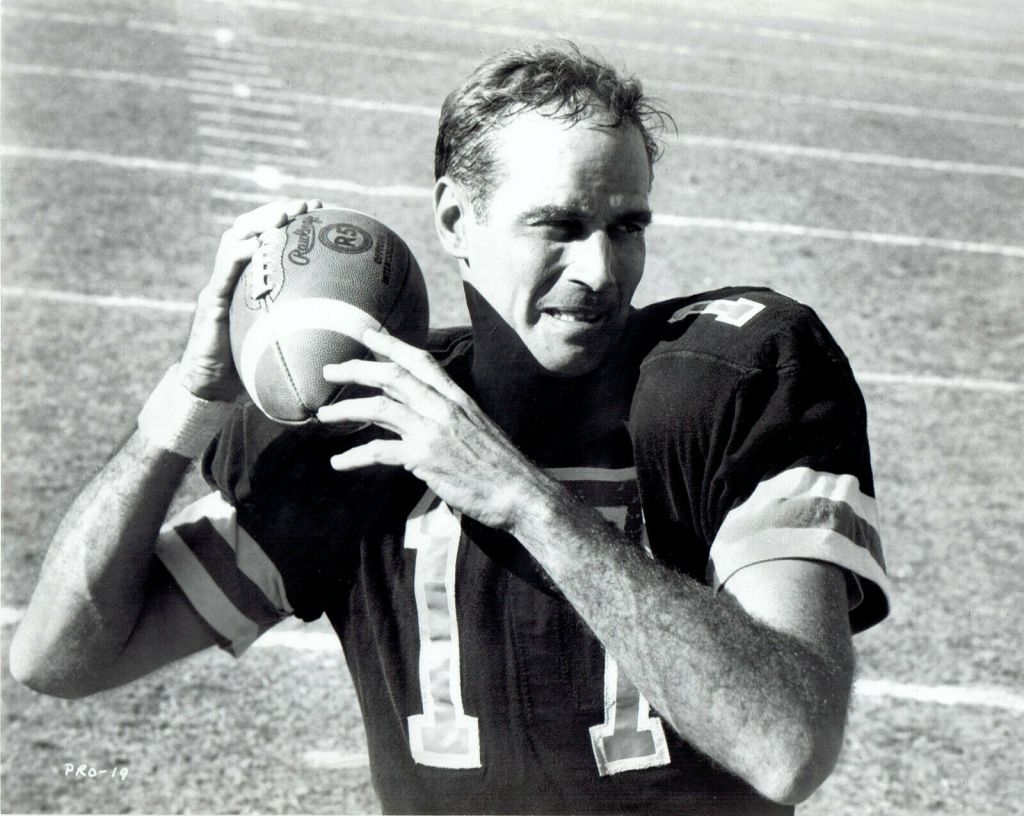
Quite possibly Charlton Heston’s best performance – as an ageing pro footballer refusing to bow down to the inevitable. Ron Catland (Heston) has much in common with Ned Merrill (Burt Lancaster) in The Swimmer (1968) as characters who believe they have been let down by the American Dream. And like that picture, plot is in short supply, it’s mostly a character study with sideswipes at the realities and inanities of American football.
An injury puts star quarterback Catland’s career in doubt. The media write him off, younger quarterback Kelly (Richard Elkins) is waiting in line, while former colleague Ritchie Fowler (Bruce Dern) offers him a job in his car leasing business, or he could opt for a second career in computers, but Catland wants the only life he has ever known to go on forever.
There’s nothing inherently likeable about Catland. In fact, he’s downright mean most of the time, in part because of the falsity of his profession, management buttering you up when it’s contract time, then on your back once you have re-signed. He’s got a hero’s arrogance, has ignored from the outset the coach’s instructions, at odds with independent fashion-designer wife Julie (Jessica Walter), no children to shore up their marriage. Hardly surprising he drifts into another affair, “an occupational hazard” his wife calls it, this time with the fey Ann (Diana Muldaur) who owns a tennis shop.
VHS cover
You are probably familiar with the kind of football picture which climaxes with a last-minute touchdown or the more realistic movies like North Dallas Forty (1979) or the superlative Any Given Sunday (1999) where nonetheless the focus is on winning and characters are ramped up for dramatic effect. Or you might imagine Hollywood had been routinely churning out football movies like Knute Rockne All-American (1940) and Jim Thorpe All American (1951) for decades. But strangely enough the movie industry had not focused on this particular sport for well over a decade until the NFL documentary They Call It Pro Football (1967) and comedy Paper Lion (1968).
Number One sets out to set the record straight on the reality of being a football hero. And it’s by far the most realistic of the species. For every good-looking gal wanting to pass him a note on a napkin in a restaurant there are plenty fans turning on him for refusing to sign an autograph. For every sports reporter writing a puff piece, there are others tearing him to pieces in print.
The documentary-style approach by director Tom Gries (100 Rifles, 1969) serves the film well. This is a different kind of football team to the later fictional depictions. It’s a lonely life for a start. The players are rivals, not comrades. There’s little camaraderie. The dressing room is like a morgue. No practical jokes and tomfoolery. No over-the-top team talk by the coach and thank goodness no padre who pretends to walk every aching mile in their shoes. Any exhortation is almost a plea. Injury is mostly ignored. Legs are constantly strapped up. And when your career is over you might be reduced to bumming a loan from a current star. The politics are brutal.
New Orleans Saints cooperated with the production so the game scenes come across well though not obviously with the razzamatazz of Any Given Sunday and Heston has the physique for a sportsman. Primarily a television writer, David Moessinger (The Caper of the Golden Bulls, 1967) only crafted two films and this, the second and last, was an unusual effort, as the character twists and turns trying on the one hand to escape the cage of his career and on the other determined to squeeze the last drop out of his golden imprisonment.
Catlan still sees himself (at the age of 40, no less – but younger than today’s legendary Tom Brady) as the best quarterback in the business and simmers with anger that his body is letting him down and that he has nothing in place to fill the gap that abandoning the game will create. Underneath the volatility is a hole of pain. There’s no sense either that he has enjoyed his time at the top, just that it has always one way or another been a struggle.
Heston and Gries took a different approach to the western Will Penny (1968) and here they do the same to the sports picture. Although the movie was marketed with Heston as an aggressive individual, in fact it calls for a far wider range of emotions from Heston, and for this part he delivers in spades. Jessica Walter (Grand Prix, 1966) gives as good as she gets, Bruce Dern (Hang ‘Em High, 1968) as the fast-talking salesman who got out of the game in good time and Diana Muldaur (The Swimmer, 1968) are excellent. But this is Heston’s film. But it’s more of a reflective piece, none of the dramatic highs and lows of other football pictures, instead it is true to the cynicism and human exploitation of the game.
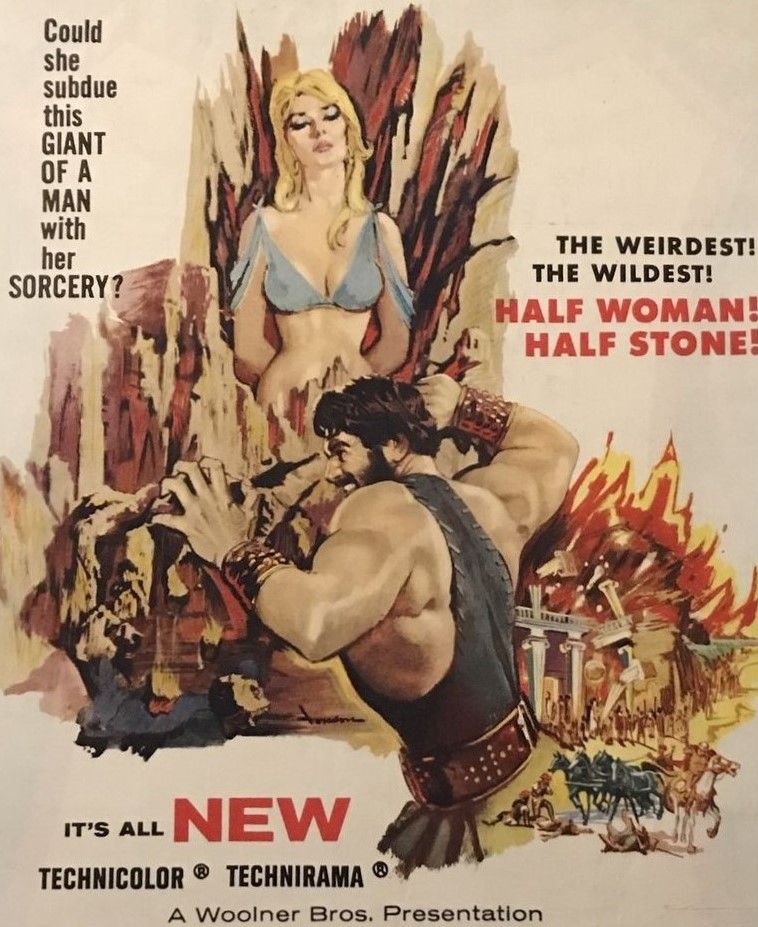
Something of a cult in the peplum vein in which Hercules (Reg Park), wanting to enjoy domestic life with his wife and son, is instead drugged by Androcles, King of Thebes (Ettore Manni), and spirited away by ship to Atlantis whose Queen Antinea (Fay Spain) is intent on global domination and the resurrection of the dethroned god Uranus to his rightful place in the heavens.
This isn’t your normal Hercules, not that keen on demonstrating his physical prowess, preferring to sleep or lie around. It’s not your normal ship either. Androcles, unable to persuade his Senate to properly fund the expedition, has crewed his vessel with renegades who are inclined to abandon Hercules on the nearest island And unbeknownst to Hercules, his son has come along for the ride.
Of course, nothing goes according to plan and Hercules is soon shipwrecked on an island where he finds Ismene (Laura Efrikian) imprisoned in rock as a sacrifice to the gods. Rescue never being simple, Hercules has to first withstand fire then tackle in quick succession snake, lion, eagle and a giant lizard. Ismene turns out to be Antinea’s daughter and the Queen, rather than being delighted at her return, is appalled, for, according to the way the ancient world works with all its prophecies and religious ritual, the girl must be sacrificed to prevent the destruction of Atlantis.
Nor is Atlantis your usual kingdom. Even setting aside the peculiarities that mark the Greek world, this is a place where abnormality rules. Hercules finds Androcles, whom he believed died in the shipwreck, but it turns out to be a vision, or some kind of shape-shifting being. The Queen believes she can subjugate nature and has a tendency to throw those who disappoint her into an acid bath. There is a fiery rock that controls life and death.
Like most of the peplum output, you have to accept a standard of production lower than the Hollywood norm, and the terrifying beasts sent to test the hero are not at all convincing, but on the plus side are feats of imagination that mainstream American studios would never conjure up, unless it was something that fitted into the swashbuckling genre. You pretty much have to go with the flow and accept what is offered in terms of narrative oddity. Bear in mind, too, that there is no one dressed in as skimpy or revealing a costume as suggested by the poster.
You also need to be get hold of a good copy. Several versions are available, some for free, where the colors are so washed out you can hardly determine what is going on never mind enjoy the costumes, creatures and sets as intended. This was filmed in Technirama 70, shot in 35mm but blown up to70mm widescreen for exhibition, so should generally be of a high technical standard – this was the process used by Spartacus (1960).
It’s not a film to fit into the so-bad-it’s-good category, but of course imagination too often exceeds budget which renders the filmmaking somewhat random at times and like the bulk of the peplums acting skill is not at a premium. As you might expect, the British-born Reg Park was a bodybuilder first – three times winner of the Mr Universe title – and an actor second. He played Hercules another three times and Maciste once but outside this narrow comfort zone made no other films. But he was Arnold Schwarzenegger’s inspiration, so that was probably enough.
American Fay Spain (The Private Life of Adam and Eve, 1960) never got beyond bit parts as a B-movie bad girl and television, although she was seen in The Godfather: Part II (1974). Italian Laura Efrikina made her debut here and you would later spot her as Dora in the Italian television mini-series David Copperfield (1966).
Director Vittorio Cottafavi was steeped in peplum, from The Warrior and the Slave Girl (1958) to Amazons of Rome (1961) but although he worked consistently in television made only one other piocture, 100 Horsemen (1964).
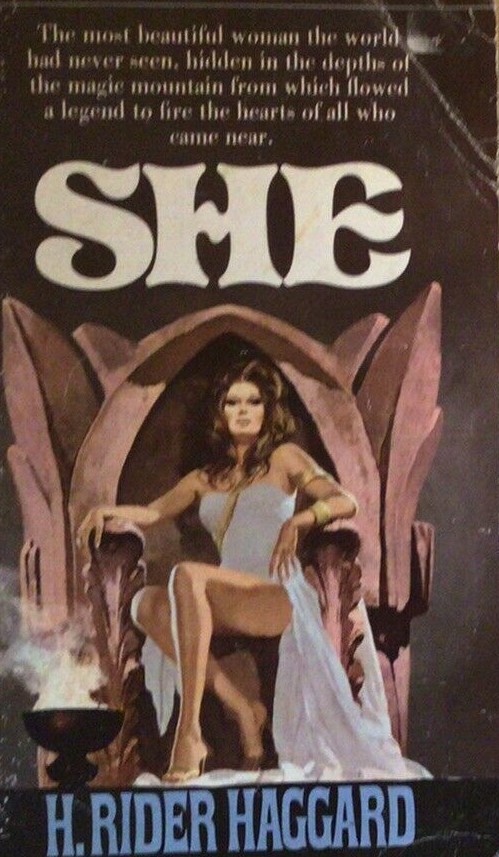
Sequels boomed in the 1960s mainly thanks to multiple spy spin-offs in the James Bond/Matt Helm/Derek Flint vein but for every From Russia with Love (1963) and In Like Flint (1967) there was a more tepid entry like Return of the Seven (1966). One of the prerequisites of the series business was that the original star reappeared. But Ursula Andress who played the title character in Hammer’s She (1966) declined to reprise the role.
John Richardson did return from the first picture but in a different role, as the immortal Killikrates within the lost city of Zuma. So Hammer brought in Andress lookalike statuesque Czech blonde Olinka Berova (The 25th Hour, 1967), even emulating the Swiss star’s famous entrance in Dr No (1962), although instead of coming out of the sea Berova is going in and substituting the bikini with bra and panties, but the effect is much the same.
Story, set in the 1960s, has supposed Scandinavian Carol (Berova) mysteriously drawn south against her will driven by voices in her head conjuring up the name Ayesha. We first encounter her walking down a mountain road in high heels only to be chased through the woods by a truck driver. It transpires she has unusual powers, or someone protecting her has, for the lorry brake slips and the truck crushes the driver. Next means of transport is a yacht owned by dodgy drunken businessman George (Colin Blakely) and before you know it she is in Algeria, assisted by Kassim (Andre Morrell) who attempts to forestall those trying to control her mind, but to no avail.
Philip (Edward Judd), whose character is effectively “handsome guy from the yacht,” follows as she continues south and eventually the pair reach Kuma, where she is acclaimed as Ayesha aka She. Kallikrates’ immortality depends upon her with some urgency crossing through the cold flames of the sacred fire. There’s a sub-plot involving high priest Men-hari (Derek Godfrey) promised immortality for returning Ayesha to Kuma and further intrigue that comes a little too late to help proceedings. You can probably guess the rest.
There’s no “vengeance” that I can see and certainly no whip-cracking as suggested in the poster. Berova, while attractive enough, lacks the screen magnetism of Andress and the mystery of who Carol is and where she’s headed is no substitute for either pace or tension and Berova isn’t a good enough actress to convey the fear she must be experiencing. The script could have done without weighting down the Kuma high priests with lengthy exposition explaining the whys and wherefores. Neither a patch on the original nor the expected star-making turn for Berova, this is strictly Saturday afternoon matinee fare and the slinky actress, despite her best sex-kitten efforts, cannot compensate.
Director Cliff Owen (A Man Could Get Killed, 1966) assembles a strong supporting cast, headed by Edward Judd (First Men in the Moon,1964) and Colin Blakely (a future Dr Watson in Billy Wilder’s The Private Life of Sherlock Holmes, 1970). You can also spot Andre Morrell (Dark of the Sun, 1968), George Sewell (who later enjoyed a long-running role in British television series Special Branch, 1969-1974) and television regular Jill Melford.
Hammer made a substantial number of changes for its version of She. For a start, H. Rider Haggard’s novel was published in 1886, three decades before the time in which the film which took place at the end of World War One. While the three main characters – Horace Holly (Peter Cushing in the film), his manservant Job (Bernard Cribbins) and the younger Leo (John Richardson) – remain the same, their relationships are significantly different, in that in the book Holly is the legal guardian of Leo.
The book is far more Indiana Jones than sheer adventure, the journey into the unknown instigated by a piece of parchment and a translation of a potsherd from the fourth century B.C. In the film the spur towards the journey into the unknown is a vision. But in the book the adventurers already know before they set off that ancient Egyptian high priest Kallikrates found Ayesha and the sacred flame and was killed by her because he loved another.
Unlike the film the book has no trek through the desert either which renders them hungry, thirsty and exhausted and leads to visions of Ayesha for Leo. Instead, they are shipwrecked. And their peril comes from swamps and wild animals such as lions and crocodiles. In fact, the filmmakers clearly resisted the opportunity to include one of the tropes of jungle adventure, namely a wild animal battle, in this case crocodile vs. lion, which was a feature of the book.
While they shoot a water buck for food, nonetheless they do later face exhaustion, only rescued by the sudden appearance of an Arab, who mentions She-Who-Must-Be-Obeyed and arranges for them to be transported in litters to a mysterious land in the heart of African darkness. This land is rich and fertile, with herds and plenty of food.
Two important elements introduced here shape the book but are ignored in the film. The first is that Leo, seriously ill at this point – and not capable of being strung up for the movie’s sacrifice – remains ill for the rest of the book so that it is Holly who enjoys most of the encounters with Ayesha. Secondly, and a rather advanced notion for the times, the women in this country are independent, neither considered chattels nor subordinate to men, and are free to choose their own lover. But it is only now that Leo meets Ustane (Rosenda Monteros) rather than in the film which brought them together almost immediately. Here, they also meet Billali (Christopher Lee) whom Holly rescues from a swamp.
With Leo still ill, it is Holly who first encounters Ayesha, who dresses as she will in the film, in a gauzy white material. In the writer’s eyes her beauty lay in her “visible majesty” as well as more obvious physical features, which could not be dwelt on at such length in a Victorian novel. Holly falls in love with her on the spot, even though he is “too ugly” to be considered a potential suitor, and learns of the fate of the earlier Killikrates and also catches a glimpse of her bemoaning her fate, imprisoned in immortality for two thousand loveless years.
“It is hard for a woman to be merciful,” proclaims Ayesha as she puts to death the villagers. Throwing them down the pit was invented by the screenwriters. By this point Leo is nearly dead and only saved by a phial administered by Ayesha. She also decrees that Ustane must die because “she stands between me and my desire.” In the film it is Leo who intervenes to attempt to save Ustane. But in the book it is Holly. He blackmails Ayesha, threatening to reveal her secret, that she had killed Killikrates in the past. Ustane claims she has taken Leo as her common-law husband. Ayesha promises to spare Ustane if she will give up her claim to Leo and go away. But Ustane refuses. In the book, there is an astonishingly visual and terrifying scene where, in revenge, Ayesha claws at Ustane’s black hair, leaving there the imprint of three white fingers.
It is the film that introduces the element of palace intrigue, with rebellious subjects and Billali believing he is entitled to immortality. That is not in the book.
When Leo finally wakes up, he is reunited with Ustane, but Ayesha catches them and kills Ustane, not by throwing her down the pit, but by her magic power. Despite being appalled, Leo cannot resist Ayesha. Even so, he is fully aware of his predicament, believing he has been “sold into bondage” and forced to love a murderess. But when she enters the sacred flame – naked, it has to be said, in the book, which was an exceptionally daring image for that era – she dies.
Holly in the book is more a narrator than a protagonist and shifting the emphasis more squarely back to Leo suits the film’s dramatic purpose. There was no real reason the film could not have followed the thrust of the book except that it would perhaps cost more costly to bring a jungle and swamps to life than a desert and arid mountains. More importantly, perhaps, was the need to introduce the physical Ayesha more quickly than in the book.
It is worth pointing out that the concept of She-Who-Must-Be-Obeyed was not so alien to British readers. After all, when the book was published, the country was ruled by a woman, Queen Victoria. And although democracy had reduced elements of her absolute power, the people still had to bow down before her. In addition, the British celebrated the rule of a previous female monarch, Queen Elizabeth I, who had been an absolute ruler, in the days before there was any notion of democracy and Parliament, and in those days anyone who opposed such a figure was liable to meet as swift a death as that meted out by Ayesha.
It’s better to come at this as a drama rather than the thriller it was marketed as. That the name of George Schaefer, the last to make a movie of the directors who shot to fame in television in the 1950s, is attached should be indication that this is character- and issue- rather than action-driven. It’s more about people being sucked into the system, about the vulnerable members of society, who, whether cop or criminal, have no recourse to some kind of higher power to sort their lives out. As such, it’s a satisfying drama.
A-list male stars playing emotionally vulnerable characters was a growing trend in the late 60s. Think of Burt Lancaster in The Swimmer (1968) and Kirk Douglas in The Arrangement (1969) – all reviewed in the Blog, incidentally. Here top Washington detective Frank Matthews (George Peppard) goes through the personal and professional wringer, suspecting wife Adele (Jean Seberg) of an affair then becoming a suspect himself in a murder case. Underlying these plot-driven aspects is an exploration of the political issue of civil liberties, in particular the constitutional rights of criminals, setting this up as one of the earliest law’n’order movies, a trope that would take center stage in films like Dirty Harry (1971).
At a peak of professional success, having been awarded a medal and promoted to consultant on a subcommittee on Law and Order headed by Senator Augustus Cole (Paul McGrath), Matthews’ ethics come under scrutiny when alleged murder/rapist Paul Sanderson (Robert F. Lyons), whom Matthews had arrested, is freed on a technicality thanks to the efforts of civil liberties attorney Woodrow Wilson King (Richard Kiley).
Matthews appears distracted much of the time trying to keep track of his wife’s whereabouts. After delivering a speech in Baltimore, he walks the streets in a fug of depression. Meanwhile, King is disturbed by the fact that a man he clearly believes guilty refuses to seek psychiatric help. The question in the audience’s mind is where he will strike next. There’s an excellent scene in King’s office where his secretary Liz (Marj Dusay), delighted at the lawyer’s success in overturning Sanderson’s case, instinctively pulls away from the freed man.
When Adele and lover are murdered in Matthews’ bed, he finds himself on the opposite side of the law, undergoing the kind of treatment he has meted out to so many criminals, quickly aware that circumstantial evidence could find him guilty. Front-page news himself now, suspended from his job by a quick-to-judge senator, emotionally isolated and a laughing stock, he retreats further inside himself. Naturally, he evades subsequent arrest, setting out to track down the killer himself, that leads him into the murkier depths of society from which emotionally-abused villains easily spring.
Other issues are explored in passing, the independent woman for a start, whether it is wanting to have her own career and not play the stay-at-home wife or considering it fair game – as with Gwen (Faye Dunaway) in The Arrangement – to upturn accepted morality and take a lover.
But the focus remains squarely on Matthews struggling to cope with life running away from him, falling deeper into despair and into the maw of the criminal justice system which has the knack of bending its own rules. He has never been the saintly cop and there are moments where violence seems the best option, although not the vicious kind later espoused by Inspector Harry Callaghan. It’s ironic that the only solid detection the cop does in the first part of the film is tracking down his wife’s whereabouts.
George Peppard (Tobruk, 1967), generally a much-maligned actor, excels in a part where he can neither charm his way into an audience’s heart, nor confide in someone else about his marital problems, nor resort to action to define his character. That his pain is all internalised shows the acting skills he brings to bear. Oddly enough Jean Seberg (Moment to Moment, 1966), a specialist in emotional pain, takes a different path, coming across as a devious minx, keeping Matthews on the hook while enjoying relations with an ex-lover, whose career, as it happens, has panned out a lot better than her husband.
I only knew Richard Kiley, an American theatrical giant and primarily in the 1960s a television performer, through that mention in Jurassic Park (1993), but he is solid as the attorney who has qualms about releasing a prisoner he knows is guilty. Robert F. Lyons, making his movie debut, brings jittery danger to the unbalanced criminal. Look out also for Charles McGraw (The Narrow Margin, 1952) as the cop determined to take Matthews down and Frank Marth (Madigan, 1968) as the subordinate who gives the suspect too much leeway – to his cost. Madeleine Sherwood (Hurry Sundown, 1967) is excellent as the disturbed, needy mother.
George Schaefer, at this point a four-time Emmy award-winner, specialized in thought-provoking drama such as Inherit the Wind (TV, 1965) and Elizabeth the Queen (TV, 1968). This fits easily into that pattern. The title is a giveaway, too, referring to the pendulum swinging, “perhaps too far,” from all-powerful police to the rights of the accused taking prominence.
This was the only screenplay from Stanley Niss, who died shortly after the film’s release. He was also the producer. And better known as the writer-producer of television series like Jericho (1966-1967) and Hawaiian Eye (1959-1961).
Catch-Up: George Peppard pictures reviewed in the Blog are Breakfast at Tiffany’s (1961), Operation Crossbow (1965), The Blue Max (1966), Tobruk (1967), and P.J. / New Face in Hell (1968).
A genuine curiosity, disowned by all concerned, removed from star Burt Reynolds’ Wikipedia page, the first picture to be directed by nobody, tarred with the infamous Alan Smithee director credit. Equally infamous as one of those “we can make two films at the same time” numbers.
Hard to see what got everyone so angry since, though on the lightweight side, and with an over-fondness for montage, it is a small town romance played out on a very mundane, not glossy, Hollywood location shoot, and of immense interest for demonstrating what Burt Reynolds could do before he fell down the “good ol’ boy” rabbit hole.
Story is simple enough and, of course, from the romantic perspective, age-old. Boy meets girl, then what? Rob (Burt Reynolds) is an unglamorous sheep rancher in a little place called Moab who takes a temporary job as a driver when the producers of a real-life Hollywood picture called Blue (1968) – itself an infamous western starring Brit Terence Stamp and Joanna Pettet – descend on the area for a location shoot. Jean (Barbara Loden) is pretty, but equally unglamorous, with a behind-the-scenes role in the picture as an editor. Rob is a notorious local womanizer so initially Jean is seen as just another notch on his belt. But then things get serious and in a surprise twist it becomes clear that it is he who is the notch on the belt, a casual pick-up for an out-of-town girl.
There’s a lot of interesting stuff here for the movie buff. The boring reality of how films get made, for a start, all shown in passing, fake horses, guys knee deep in a river pushing the mounted camera along, set decoration, the ever-present megaphone, watching the dailies. And there’s a few nuggets, a couple of quick lessons in the art of editing.
As if auditioning for a beefcake picture, Reynolds takes every opportunity to reveal his muscular torso, naked in a river (twice), out in the fields, but in reality showing quite a different side to the later tough guy persona, quite sweet, really, in many ways, with moments where the actor summons up deep feelings. He’s charismatic but in a gentle fashion. In the way of small towns, the romance is played out over coffee cups, pinball machines, ten-pin bowling alleys and rodeo with little in the way of sparkling dialog although hardly a sunset goes by without being pointedly utilized.
There’s a wonderful romantic score by Ken Lauber (Heart of the West, 1975) which I must mention because there’s hardly a foot of film without any music. But that’s not to this film’s detriment. It’s unashamedly an old-fashioned love story (not the one where someone dies, though). There’s some lush cinematography from Willam A. Fraker (The Fox, 1967) Some directorial technical aspects are worth mentioning, too, a credit sequence that cleverly uses a rearview mirror, a five-minute montage central to the romance and a one-minute montage composed of still shots a full year before George Roy Hill adopted the same idea for Butch Cassidy and the Sundance Kid, and in a nod to John Ford the final shot echoes the opening.
Director Jud Taylor worked his entire career in television (episodes of Dr Kildare and the original Star Trek among his 68 credits) and no doubt saw this as his bid for the big-time. But studio Paramount didn’t like his original version of the movie and he didn’t like what happened when it was re-edited, so he took his name off it. The rules of the Directors Guild of America prevented a movie being released minus a directorial credit so a compromise was reached whereby the name of “Alan Smithee” was employed.
The movie was stuck in the vault and shown on television in 1973 – in the wake of Deliverance (1972) – which accounts for that being taken as the official release date by imdb. (It’s also down as a western by imdb so you can discount that as well, unless Reynolds watching irrigation counts.)
Burt Reynolds had mixed feelings about the movie. At the time he was a potential rising star and not much more with only the little-seen Operation C.I.A. (1965) and Navajo Joe (1966) in the locker but 100 Rifles (1969) on the horizon. At various times he was reported as wanting to buy it to prevent it being shown and other times clearly regarding it as a little gem. Perhaps it was experience of a film going off the rails that inspired Barbara Loden to make sure she had complete control over her next picture – she was writer-producer-director of Wanda (1970).
In retrospect, it’s hard to see what the furore was about. It’s hardly god-awful. This is a nice wee film with interesting performances by both Reynolds and Loden and of course the opportunity to see Reynolds in a chrysalis, the macho man held at bay, allowing the sensitive performer to emerge.
Hard to find as you can see from the attempt at a link way below but it does crop up on ebay and here and there on television – in Britain you might be able to catch it on the Talking Pictures channel – and here’s an 80-second snippet from it.