Director John Sturges blows apart all the conventions of the genre and boy does he enjoy playing with the audience in this Alistair Maclean pandemic thriller. Hero Barrett (George Maharis) takes fifteen minutes to arrive and the second main character General Williamson (Dana Andrews) another thirty minutes. We shift from docu-drama to pure detection to a manhunt that is way ahead of its time. General Williamson marshals an air-sea-land operation that pulls a dragnet so tight it seems the villains cannot escape – but that is just another device to throw the audience off track.
Most spy/thrillers take place in glorious color or in noir night, but here we are either in broad desert daylight, with vistas so wide and dirty brown nothing can escape the camera, or in murky twilight where anyone could get away, so that when we reach Los Angeles civilization is like a lush new world. In the arid desert water is like an oasis of blue.
Barrett is a pretty good investigator so it’s quite wordy in places but discovery drives forward the narrative. By now quite a lot of the bad guys in this kind of thriller (e.g. James Bond) were narcissists, delighted to step into the spotlight and take on the good guys, but once again Sturges lets us nibble on this juicy bone before yanking it away. The bad guy may be well known but has left no trace on the public records of the day.
There are a few standout scenes: Barrett entering the bug vault in full Hazchem outfit with every squeak of his accompanying hamster setting the viewer on edge; newsreel footage of roads littered with corpses; a roadblock played for laughs. And some neat twists – a phone ringing inside a locked house is easily answered because everyone also has a phone beside the pool, and in the noir tradition ex-flame Ann turns up too often for coincidence. That kind of playing on expectation goes, too, for Ed Asner (The Venetian Affair, 1966) who tones down his usual belligerence to a whispers.
Barrett is always behind the eight ball, never getting the drop on the opposition, and unlike James Bond, who always makes time for a dalliance of two, he’s a more down-to-earth hero and you can see why Sturges steered clear of the more obvious likes of Steve McQueen who would have demanded more action scenes to preserve his screen persona.
There’s a bit overmuch exposition at the start and especially once the picture picks up pace but that said the tension remains taut.
Maharis is excellent as the smart detective but former Hollywood superstar Dana Andrews (Laura, 1944) steals the show as the tight-lipped general. Anne Francis (Girl of the Night, 1960) proves a spunky girlfriend while Richard Basehart (Voyage to the Bottom of the Sea series, 1964-1968) has a plum as the chief scientist.
James Clavell (The Great Escape, 1963) and Edward Anhalt (Becket, 1964) devised the screenplay from the Alistair Maclean thriller – written under his pseudonym Ian Stuart.
More interesting for the stars involved – in particular Sam Waterston and Charlotte Rampling as well as an ex-fighter pilot, an Australian pop star and a model – than the film itself, which presents a European arthouse take on youngsters freewheeling around Europe looking for their share of the free love purportedly available everywhere.
There’s not really any story, mostly it’s scenery, and whatever tension there is rarely rises to the point of drama. However, it is refreshing to see a picture not steeped in angst that reflects the normality of life rather than superficially-imposed heightened confrontation. On a tour of Italy, American college buddies Taylor (Sam Waterston), the shy gawky one, and Bert (Robie Porter), the better-looking confident one, take up with British girl Marty (Charlotte Rampling). The guys make a pact not to compete for the girl’s attentions, but that idea doesn’t last long. The title suggests she might end up with one – or both. In trying to sell the film, the marketeers felt obliged to make that idea more implicit.
The guys make plays for other girls they meet but seem to find little genuine action and in that sense it is more true to life than other films of the period which suggested sex was there for the asking. But none of the characters are particularly interesting and while that is also more realistic it diminishes enjoyment. The highlight is a naked Taylor attempting to save a girl from drowning in the sea, but in keeping with the film’s tone he is beaten to it by a boat.
There’s not much sign here of the intense dramatic style Oscar nominee Sam Waterston would later bring to the movies. This was his third film after small parts in The Plastic Dome of Norma Jean (1966) and Dick Van Dyke vehicle Fitzwilly (1967) and he wouldn’t hit his stride until The Great Gatsby (1974).
Perhaps the oddest movie fate befell Charlotte Rampling, also a later Oscar nominee. How else to explain that she followed up this picture with Luchino Visconti’s The Damned (1969) and preceded it with Roger Corman’s Target: Harry (1969). With a career that at this point appeared to follow no particular pattern, after making an impact in Georgy Girl (1966) as a libidinous flatmate, she took a small role in The Long Duel (1967) before reaching leading lady status opposite Franco Nero in Italian thriller Sequestro di Persona (1968). Her languid screen persona was turned on its head with The Night Porter (1974).
Who was Robie Porter you might very well ask? And why did he only make two pictures, the other being The Carey Treatment (1972)? He was an Australian pop star, specializing in instrumentals on a steel guitar, with a series of hits including two at number one. He chanced his arm in Britain, without repeating that success, then moved to the U.S. and landed parts in television series Daniel Boone and Mannix. After Three, he returned to the music business, as part-owner of record label Sparmac and producing for the band Daddy Cool.
Other names in Three, in bit parts only, none making any discernible impact in the picture, included model Edina Ronay (daughter of celebrated food critic Egon Ronay) who had appeared in A Study in Terror (1965) and Prehistoric Women (1967). Equally as celebrated, if for other reasons, was Gillian Hills, best known as one of the girls cavorting naked with photographer David Hemmings in Blow Up (1966) and as the titular Beat Girl (1960)
Writer-director James Salter was a genuine Hollywood curiosity. He hit a peak of cinematic activity in 1969, with two other screenplays filmed – Downhill Racer (1969) and The Appointment (1969). This is pretty much a companion piece to Downhill Racer (1969) which has a bunch of professional skiers on a similar scenic tour and often sitting around with not much to do although that film builds in confrontation and a more standard love affair.
Generally considered a “writer’s writer” – i.e. adored by his peers more than the public – his first novel The Hunters (1958), based on his Air Force experiences, was turned into a movie starring Robert Mitchum. He dabbled in documentary film-making, whose impact can be seen in his feature films, but was better known for a short erotic novel A Sport and a Pastime set in Europe. None of his 1969 trio were hits, he ended up in Hollywood limbo, and he didn’t reappear on the movie credits list until Richard Pearce’s sci-fi Threshold (1981) starring Donald Sutherland.
It’s not a stinker, but it’s not much of anything else either.
If the screenwriters had faithfully adapted the book it would be death by centipede that faced James Bond in his bed. Never mind that a centipede would be nobody’s idea of a scary creature, the insect would have been impossible to replicate on screen. The idea of a poisonous spider being slipped under Bond’s covers was filched from Honey Rider’s past. In the film she recounts how she killed a rapist with a knife, but in the book she employed a black widow spider.
Nor would the idea of Dr No making his fortune from bird shit (guano) seem to carry much appeal, so that was changed for the film, and that forced an alteration to the ending as well for Ian Fleming has the villain drowning in a pile of guano. And in that context, Strangways’ investigation of the island relates to rare spoonbills (a type of birds) not rocks.
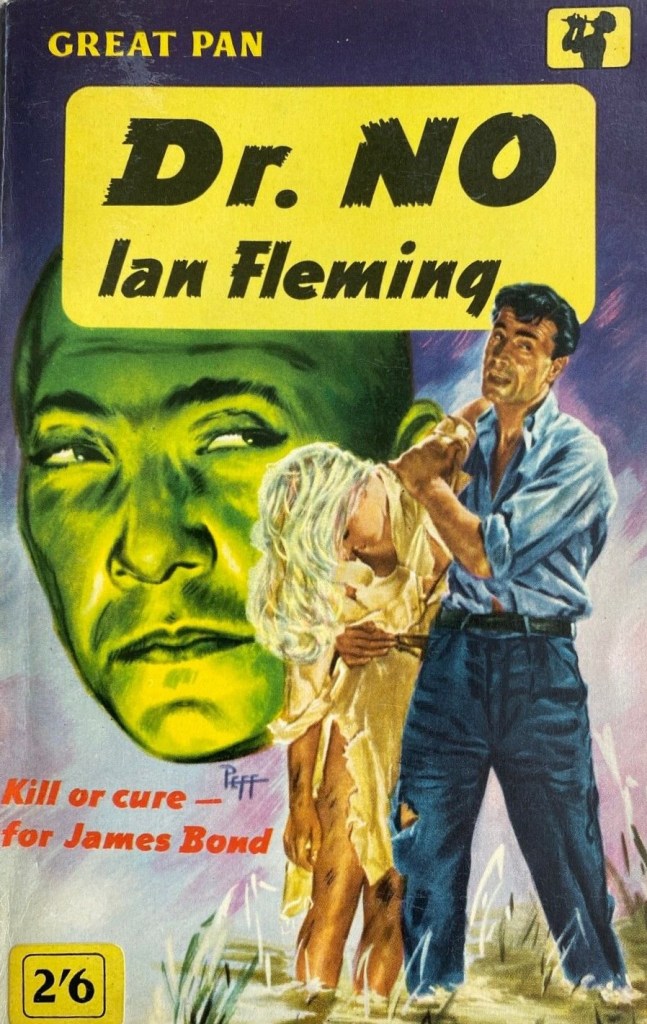
Original British paperback edition prior to the movie being made
So the myriad team of screenwriters –Richard Maibuam (The Day They Robbed the Bank of England, 1960), Johanna Harwood (Call Me Bwana, 1963), Berkely Mather (The Long Ships, 1964), Wolf Mankowitz (The Day The Earth Caught Fire, 1961) and director Terence Young – chopped, changed and invented to turn the sixth James Bond novel into the first James Bond film. In publication sequence, this followed From Russia with Love in which Bond had a particularly dangerous encounter with Rosa Klebb, and at the start of the Dr No episode has been recuperating from being poisoned. The Jamaican mission is seen as something of a convalescence, a way to ease Bond gently back into the field, a trip so lacking in urgency that three weeks have passed since the disappearance of Strangways and his secretary.
Naturally, the scriptwriters have to cut to the chase more quickly than that, hence Bond being despatched immediately. Needless to say, there is no dalliance with a certain Ms Trench, that being a screenwriters invention, along with the scene in the casino, inserted in order to punch up the Bond screen legend. Not only is there no dodgy chauffeur waiting for Bond at the airport but Quarrel is introduced immediately as an ally not an opponent. While the female photographer is a genuine freelance, she does scrape Quarrel’s face with a broken flashbulb and delivers a warning about Dr No.
Bond’s tradecraft extends to closely examining the basket of fruit in his room and sending off samples for analysis, and finding they contain cyanide. But the book contains no Professor Dent, Felix Leiter or Miss Taro, and no other attempts (beyond the centipede) on Bond’s life so the story in some respects moves more straightforwardly towards the mysterious island.
Original U.S. paperback edition prior to the movie being made
As with the film, Bond arrives on the island with Quarrel. But Honey Rider does not appear in dazzling style out of the waves. Bond first catches sight of her from the back. But she is nude and has a broken nose, two provisos that would not go down well either with the censor or a cinematic audience. Much of their dialogue, including the stuff about learning from encyclopedias comes from the book, but her backstory is completely different. Instead of her father being a marine zoologist, he is dead and her once-wealthy family destitute, leaving her to fend for herself, and considering entering prostitution to make a decent living.
The arrival of Dr No’s speedboat and the ensuing gunfire, the destruction of her boat, the chase and the “Dragon” all come from the book, as does Dr No’s million-dollar aquarium, his steel hand, and the opulence of the prisoners’ accommodation. However, there being no radiation in the plot for the book, there is no requirement for them to be stripped naked once captured.
But in the matter of the clear sexual attraction between Bond and Rider, the book and the film are at variance. In the original Fleming version, Rider, although initially resisting his overtures to the extent of dumping cold beans on his hand, is soon making the running, inviting him to share her sleeping bag, an offer which he rejects. Surprisingly, the usually rampant Bond further resists her allure once inside the Dr No compound on the grounds that he has to “stay cold as ice to have any chance of getting out of this mess.”
The screenwriters come up with completely different plot for the climax while incorporating some elements of the book’s ideas. While Dr No remains the same power-mad maniac, his plan is to turn the island into the most important technical intelligence center in the world with the ability to take control of U.S. rockets and point them at London.
Deeming Bond and Rider as mere irritants, Dr No intends to use them for a sadistic experiment, pegging out Rider in the path of a swarm of crabs and putting Bond through a terrifying obstacle course. Although Bond does escape through a grille and encounter both heat and water, in the book he also has to cope with a giant tarantula and squid before stealing a crane, sending Dr No to his doom and shooting his way out.
In the film we briefly see Rider tethered to stakes awaiting the crab onslaught before Bond races to the rescue. But, in reality, in the book Dr No’s assumption that death by crabs would be a terrifying ordeal is somewhat misplaced. As Rider points out, she never felt in any danger because crabs are simply not carnivorous. But both book and novel are agreed – they do have sex at the end.
While the screenwriters use elements of the book it is primarily their inventions that turn the novel into an instant screen classic, defining Bond for generations to come. You can almost count the action beats, whether a chase or a fight or mere confrontation, with sex or humor providing welcome respite, but all moving in the same direction of creating a feel for a new type of character and a new kind of film.
United Artists almost had to give away this picture in the United States in order to gain bookings. Astonishingly, it was the picture the studio felt it could not sell. And for good reason – the studio hated it. “To them it was a B-picture,” recalled producer Harry Saltzman. “They said Hammer made the same kind of picture for one-third of the price.”
Dr No, produced on a miserly budget of $840,000 – $40,000 over budget – had triumphed in London after snagging an opening run in 1962 at the Leicester Square Theatre primarily because the cinema needed to fulfil its quota of showing British pictures. Although it set a London box office record that would stand for more than a decade and proved a huge draw throughout Britain, U.S. studio United Artists had been burned once too often by British films that did well at home only to flop spectacularly in America.
Since box office statistics began to be gathered in earnest in the 1930s only a handful of British pictures mustered the $1 million in rentals required for entry into the annual list of box office champions. The bulk of the Ealing comedies had not made the grade, nor had such diverse successes as Doctor in the House (1954), Reach for the Sky (1956), Room at the Top (1959) and Saturday Night and Sunday Morning (1960). American audiences rejected British films as too slow, technically backward, and with accents it was often impossible to understand. Putting together an advertising, public relations and marketing package for them could easily cost as much as the film itself.
“When we had an answer print ready there were about eight people from United Artists including (chairman) Arthur Krim who came to see it,” Saltzman told Variety a quarter of a century later. “We started the film at 10am and when it was over a few minutes before twelve the lights came up and nobody said anything except a man who was head of the European operation and he said, ‘the only good thing about the picture is that we can only lose $840,000.’ Cubby (Broccoli) and I were just shattered,” confessed Saltzman.
That didn’t stop Saltzman and Broccoli embarking on their own campaign to raise awareness. They went right to the heart of the American exhibition community, taking space at the annual Show-a-Rama event in Kansas City in March, bringing along Sean Connery and models to represent the Bond girls. In addition, around the same time UA held a sneak preview in New York attended by the likes of Johnny Carson, Zsa Zsa Gabor and Rudy Vallee i.e. not that high-falutin’ an audience but at least the festivities were filmed and broadcast on NBC Monitor and Armed Forces Radio. Sean Connery also featured in a 12-minute segment in the middle of ABC Sunday Night at the Movies.
The Bond promotional bandwagon set up shop for a couple of days each in New York, Chicago and Los Angeles between March 7 and March 15 and pulled in journalists from the surrounding areas. There was also a touring show comprising 150 stills. And the marketeers had some success in targeting exhibitors through the trade magazines although the two-page article featuring in Box Office attempted to interest exhibitors on the basis of a marketing campaign in Connery’s native Scotland, which hardly seemed to be ideally suited. Nor did the marketing team really care what tricks exhibitors pulled to bring in the customers – for no particular reason one cinema employed a safe-cracking stunt even though the film’s story did not lend itself to that.
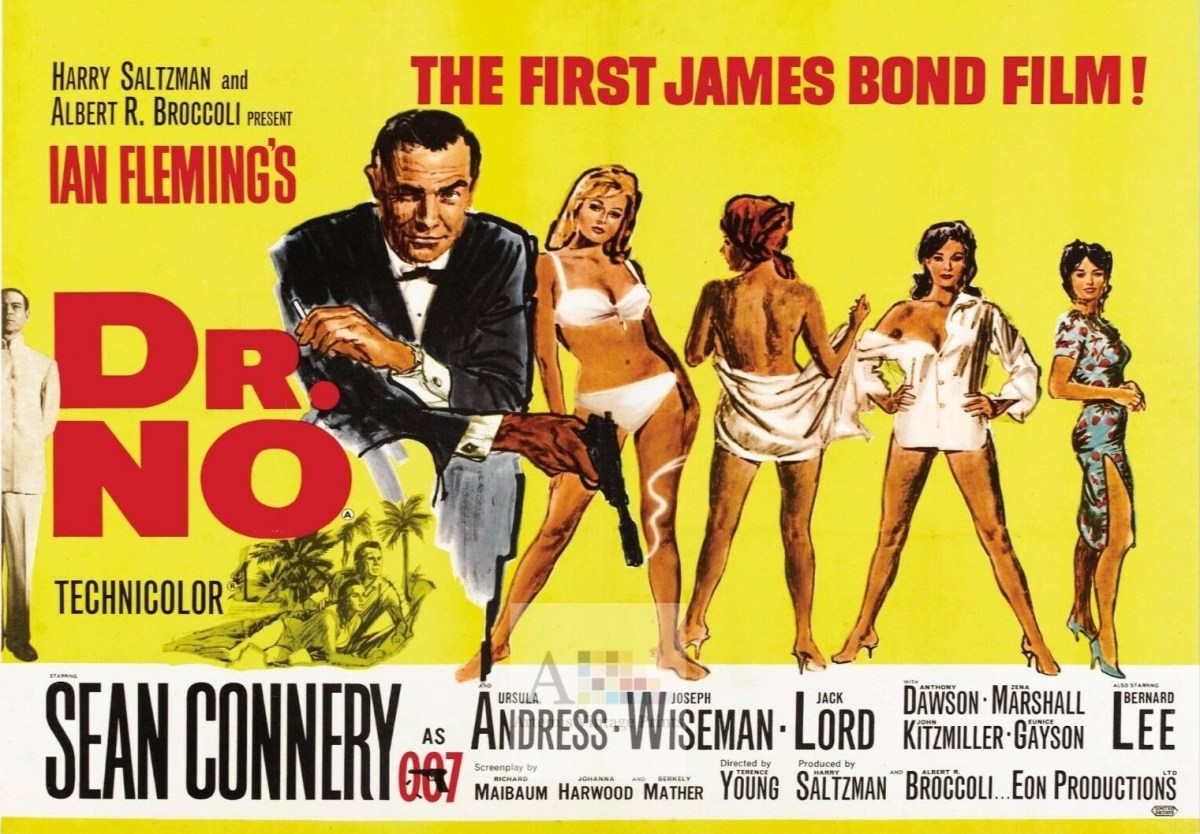
Dr No’s biggest marketing tools were photos of Ursula Andress in a bikini and copies of the Ian Fleming novels which since 1961 had the endorsement of President John F. Kennedy. Cheap paperbacks sold in drug stores and newsstands had created greater awareness of the character as well as acting as unpaid advertising for the forthcoming film.
But, basically, that was as much – or as little – as the film had going for it. In effect, no great marketing energy.
As it happened, exhibitors were beginning to organise their own marketing programs – “box office building campaigns” – and the Bond team were able to convince exhibitors in the Midwest and Southwest to kick off the idea with Dr No.
That meant shifting away from the conventional release pattern where a film opened in one cinema in a big city and then fanned out week-by-week to smaller venues and towns. Instead it was everywhere all at once which meant it cannibalized its own audience since it could not be held over in any cinema for a further week because the prints were already scheduled elsewhere.
Although most historians pinpoint New York as the launch pad for Dr No, United Artists did not want to risk the picture potentially flopping in that territory. According to Harry Saltzman the first commercial showing, effectively a trial run, was in Atlanta, Georgia, where it ran for eleven weeks and was considered a success. But not enough for UA to consider shifting its release strategy. A movie that launched anywhere other than New York was considered a dodgy proposition.
From May 8 it was launched in 450 cinemas in the Midwest and southwest. This was the same release strategy as had been employed on another film about which UA had its commercial doubts – The Magnificent Seven (1960) – and that had turned into a flop. It opened in New York in June in 18 cinemas including two in the city centre, the Astor and the Murray Hill, both arthouses.
But here’s the kicker.
In order to get the bookings, United Artists had to dramatically lower its asking price.
Normally new pictures were sold to exhibitors on a 50/50 basis – meaning the studio received 50 per cent of the gross. “The funny things is,” recalled Saltzman, “they booked it for 30 percent. The theaters took it at first because they got it for 30 per cent.” That meant UA sold Dr No to cinemas on the basis that any exhibitor booking the picture would retain 70 per cent of the gross.
This was not unheard-of. In fact, it was often the standard deal for foreign movies going into arthouses. But arthouse pictures with the occasional exception of a La Dolce Vita were usually hard sells to a very finite audience. James Bond was anything but.
As a result of this approach, the movie did not register particularly well on the annual box office rankings. In fact, it placed 42nd. Not a disaster, but not a particularly brilliant showing. However, that did not represent the film’s true appeal. Had it been sold on a 50/50 basis, the rentals would have been high enough to pitch it just outside the Top 20, which would been seen as a genuine success. On the other hand, if UA had not been so generous in handing the exhibitors the bigger share of the box office, perhaps it might have elicited far fewer bookings and the James Bond story might have been completely different.
SOURCES: “United Artists Sell Campaign in Its Dr No Film,” Box Office, February 25, 1963, p10; “Festivities Mark Dr No Sneak Preview in New York,” Box Office, March 11, 1963, pE-2; “450 Situations Play Dr No at Opening,” Variety, April 3, 1963, 19; “Producer Saltzman Faces Big Decision on 2nd James Bond Thriller,” Variety, April 25, 1962, p13; “Feature Reviews,” Box Office, April 1, 1953 pA-11; “Showmandiser: Premiere Showmen Say Yes to Dr No, Ticket Buyers Too,” Box Office, April 29, 1963, pA1; “Harry Saltzman Recalls Early Coolness to Bond Features,” Variety, May 13, 1987, p57; “Dr No in 17 Theatres,” Box Office, May 27, 1963, pE-8; “Picture Grosses,” Variety, June 5, 1963, p10; “Smash Business General for 4-Day Holiday,” Box Office, June 10, 1963, pE-2; “Box Office Barometer,” Box Office, June 17, 1963, pA3; “Safe Crackers Invited,” Box Office, June 24, 1963, pA3.
Minus the gadgets and the more outlandish plots, the James Bond formula in embryo. With two of the greatest entrances in movie history – and a third if you count the creepy presence of Dr No himself at the beds of his captives – all the main supporting characters in place except Q, plenty of sex and action, plus the Maurice Binder credit sequence and the theme tune, this is the spy genre reinvented.
Most previous espionage pictures usually involved a character quickly out of their depth or an innocent caught up in nefarious shenanigans, not a man close to a semi-thug, totally in command, automatically suspicious, and happy to knock off anyone who gets in his way, in fact given government clearance to commit murder should the occasion arise. That this killer comes complete with charm and charisma and oozes sexuality changes all the rules and ups the stakes in the spy thriller.
Three men disguised as beggars break into the house of British secret service agent Strangways (Tim Moxon) and kill him and his secretary and steal the file on Dr No (Joseph Wiseman). A glamorous woman in a red dress Sylvia Trench (Eunice Gayson) catches the eye of our handsome devil “Bond, James Bond” (Sean Connery) at a casino before he is interrupted by an urgent message, potential assignation thwarted.
We are briefly introduced to Miss Moneypenny (Lois Maxwell) before Bond is briefed by M (Bernard Lee) and posted out immediately – or “almost immediately” as it transpires – to Jamaica, but not before his beloved Beretta is changed to his signature Walther PPK and mention made that he is recovering from a previous mission. But in what would also become a series signature, liberated women indulging in sexual freedom, and often making the first move, Ms Trench is lying in wait at his flat.
In another change to the espionage trope, this man does not walk into the unknown. Suspicion is his watchword. In other words, he is the consummate professional. On arrival at Jamaica airport he checks out the waiting chauffeur and later the journalist who takes his picture. The first action sequence also sets a new tone. Bond is not easily duped. Three times he outwits the chauffeur. Finally, at the stand-off, Bond fells him with karate before the man takes cyanide, undercutting the danger with the mordant quip, on delivering the corpse to Government house, “see that he doesn’t get away.”
Initially, it’s more a detective story as Bond follows up on various clues that leads him to Quarrel (John Kitzmiller), initially appearing as an adversary, and C.I.A. agent Felix Leiter (Jack Lord) before the finger of suspicion points to the mysterious Dr No and the question of why rocks from his island should be radioactive. Certainly, Dr No pulls out all the stops, sending hoods, a tarantula, sexy secretary Miss Taro (Zena Marshall) and the traitororous Professor Dent (Anthony Dawson) to waylay or kill Bond.
But it’s only when our hero lands on the island and the bikini-clad Honey Rider (Ursula Andress) emerges from the sea as the epitome of the stunning “Bond Girl” that the series formula truly kicks in: formidable sadistic opponent, shady organization Spectre, amazing sets, space age plot, a race against time.
It’s hard not to overstate how novel this entire picture was. For a start, it toyed with the universal perception of the British as the ultimate arbiters of fair play. Here was an anointed killer. Equally, the previous incarnation of the British spy had been the bumbling Alec Guinness in Our Man in Havana (1959). That the British should endorse wanton killing and blatant immorality – remember this was some years before the Swinging Sixties got underway – went against the grain.
Although critics have maligned the sexism of the series, they have generally overlooked the reaction of the female audience to a male hunk, or the freedom with which women appeared to enjoy sexual trysts with no fear of moral complication. Bond is not just macho, he is playful with the opposite sex, flirting with Miss Moneypenny, and with a fine line in throwaway quips.
Director Terence Young is rarely more than a few minutes away from a spot of action or sex, exposition kept to a minimum, so the story zings along, although there is time to flesh out the characters, Bond’s vulnerability after his previous mission mentioned, his attention to detail, and Honey Rider’s backstory, her father disappearing on the island and her own ruthlessness. The insistently repetitive theme tunes- from Monty Norman and John Barry – were innovative. The special effects mostly worked, testament to the genius of production designer Ken Adam rather than the miserable budget.
Most impressive of all was the director’s command of mood and pace. For all the fast action, he certainly knew how to frame a scene, Bond initially shown from the back, Dr No introduced from the waist downwards, Honey Rider in contrast revealed in all her glory from the outset. The brutal brief interrogation of photographer Annabel Chung (Marguerite LeWars), the unexpected seduction of the enemy Miss Taro and the opulence of the interior of Dr No’s stronghold would have come as surprises.
Young was responsible for creating the prototype Bond picture, the lightness of touch in constant contrast to flurries of violence, amorality while blatant delivered with cinematic elan, not least the treatment of willing not to say predatory females, the shot through the bare legs of Ms Trench as Bond returns to his apartment soon to become par for the course.
Future episodes of course would lavish greater funds on the project, but with what was a B-film budget at best by Hollywood standards, the producers worked wonders. Sean Connery (The Frightened City, 1961) strides into a role that was almost made-to-measure, another unknown Ursula Andress speeded up every male pulse on the planet, Joseph Wiseman (The Happy Thieves, 1961) provided an ideal template for a future string of maniacs and Bernard Lee (The Secret Partner, 1961) grounded the entire operation with a distinctly British headmaster of a boss.
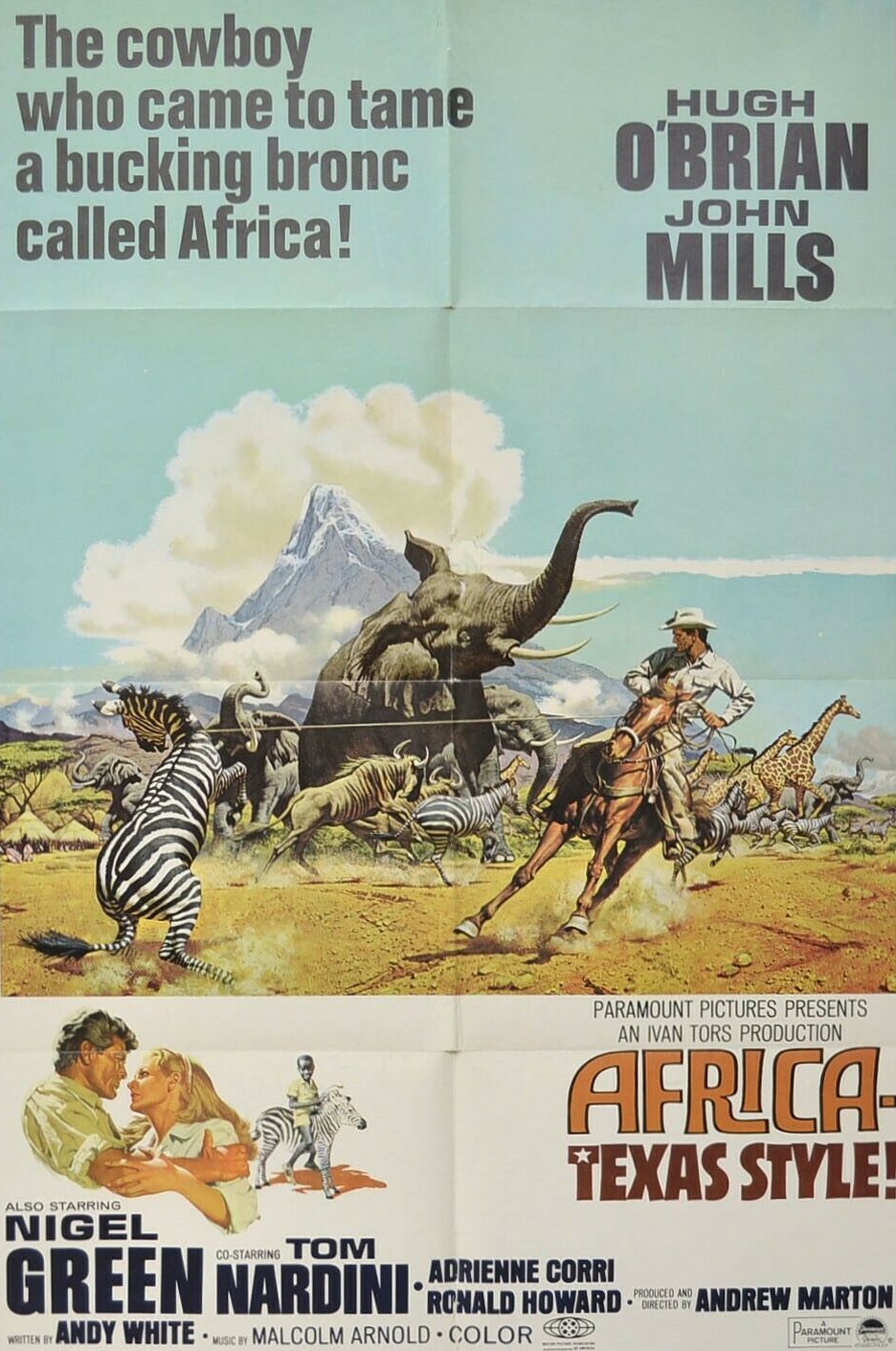
Falling into the unusual category of Saturday afternoon matinee with a message, American cowboy Jim Sinclair (Hugh O’Brian) and sidekick Jim Henry (Tom Nardini) hightail it across the Atlantic to help the wildlife conservation efforts of game rancher Wing Commander Hayes (John Mills) who faces sabotage at every turn by another rancher Karl Bekker (Nigel Green). It combines Hatari!-style action and interesting storylines with Disney-animal-cuteness (a domesticated zebra called Pyjama Tops).
To get the conservation element out of the way – Hayes is concerned that letting animals roam free will result in overgrazing, turning the countryside into a dustbowl and endangering a variety of species. That Hayes is already talking about animals becoming extinct is way ahead of the common perception of Africa at the time. His plan is to round up the wild animals and fence them in, this kind of ranching preventing foodstocks becoming depleted. Bekker’s objection is that wild animals carry infections such as East Coast Fever that will endanger his herd.
Romantic interest is supplied by the already-engaged nurse Fay Carter (Adrienne Corri) while orphan Sampson (Charles Malinda) tugs at the heart strings. There is a fair measure of authenticity, glorious aerial shots of elephants and buffalo and other species, tribal dances by the Masai while the Sinclair/Henry rodeo-style method of catching wild animals, with lasso rather than giants nets as in Hatari!, ramps up the excitement quotient, not least when Sinclair goes one-on-one with an enraged rhino. As you might expect, there is also ample opportunity for Sinclair to encounter a deadly snake and crocodile and it wouldn’t be an African picture without a stampede.
Although villainous, Bekker is not without logical argument, not just the fear of infection which would decimate wildlife as much as soil erosion, but his own concerns that taming wild animals would upset the balance of nature, and, on a personal level, the lack of respect for territorial rights. Of course, when push comes to shove, he resorts to rifle and fist to settle arguments.
Atmospheric, well-made, engaging and at times exciting, there is enough going on here to keep the picture ticking along – a hunt for a lost and bewildered Sinclair, questions about home, and the spectacular wildlife rodeo show. Unlike Born Free (1966) and any other animal picture for that matter although wildlife takes narrative center stage we are not subjected to countless cute four-legged specimens.
Hugh O’Brian (Ambush Bay, 1966) could be a latter-day Tarzan (or more correctly Jungle Jim since he is never in loincloth) but Scottish actress Adrienne Corri (The Viking Queen, 1967) is less jungle adventuress more principled counter to his easy manner. With every chance to rely on the stiff-upper-lip of an English war hero, John Mills (The Family Way, 1966) does anything but and turns in another engaging performance and if you are looking for a decent chap to deliver a conservation message he is definitely your man without being obsessively annoying. Nigel Green (The Skull, 1965) adds to his portfolio of interesting characters as a smooth-talking rough-edged bad guy while Tom Nardini (Cat Ballou, 1965) impresses. Look out for a fleeting glimpse of Hayley Mills at the start.
Director Andrew Marton, who had been involved in helming The Longest Day (1962) and second unit director of Ben-Hur (1959) and Cleopatra (1963), was something of a wild animal specialist with Clarence, the Cross-Eyed Lion (1965) in the kitty as well as a dozen episodes in total of television series Flipper (1965) and Daktari (1966). But he is at home as much with the human aspects of the story as with the animal. Producer Ivan Tors was a sometime rival to Walt Disney in the family film market with Flipper (1963) and Zebra in the Kitchen (1965) as well as small-screen Flipper and Daktari.
Mistakenly described on imdb as a TV pilot, this was a genuine feature film that happened to produce a television spin-off series Cowboy in Africa. It was screened for the trade in the U.S. on May 5, 1967, reviewed in the feature film section of Variety on May 17, and its U.S. box office figures can be tracked through Variety – opening in 1967 in San Francisco and Kansas City in June, for example, Baltimore in July, Detroit in August and Boston and Louisville in September. In some situations it was double-billed with El Dorado (1967).
CATCH-UP: John Mills’ versatility can be seen from movies already reviewed in the Blog: The Truth About Spring (1965), Operation Crossbow (1965), The Wrong Box (1966) and The Family Way (1966).
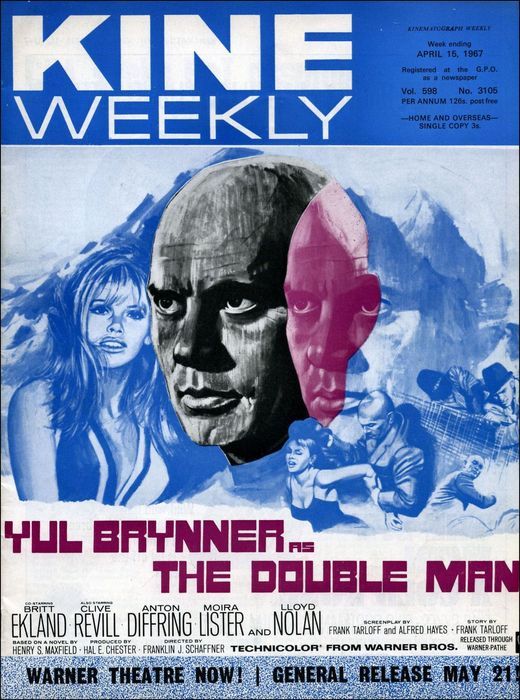
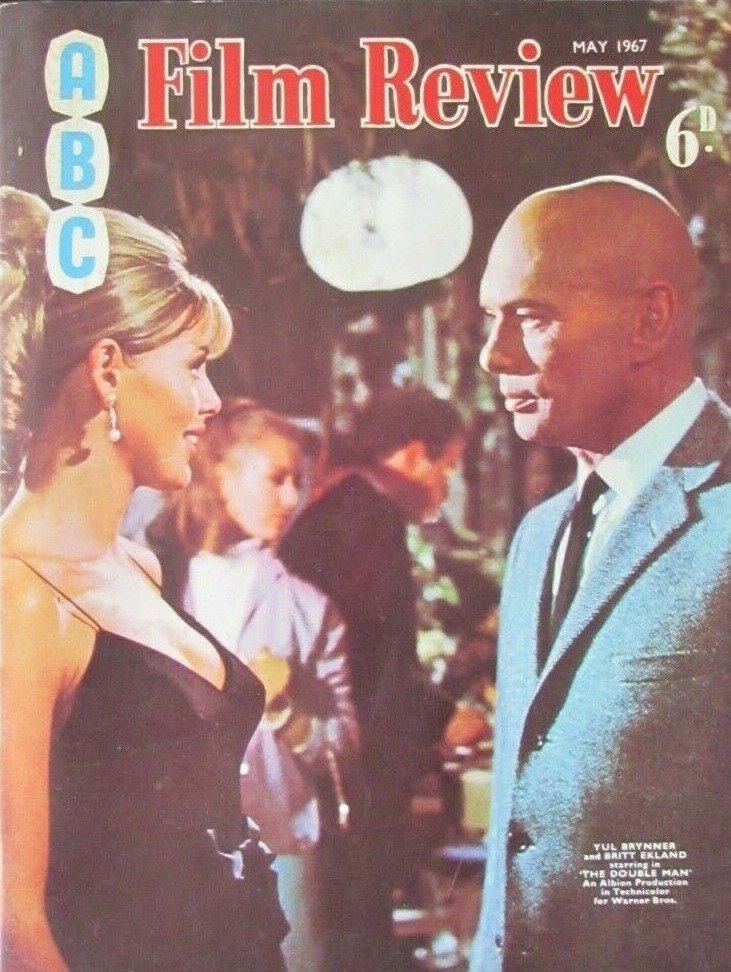
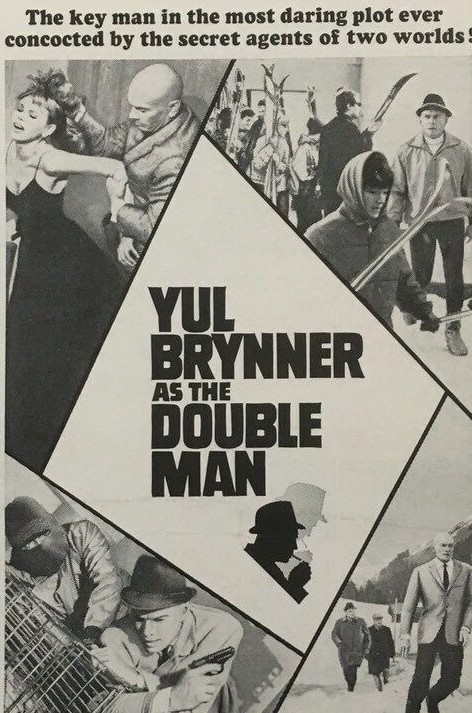
A bit more action and this could have been a John Wick-style winner because C.I.A. agent Dan Slater (Yul Brynner) is a big-time bad ass, all steely stare and resolve, and no time for anyone who gets in his way as he investigates the unexpected death of his son in the Austrian Alps.
It’s probably not this picture’s fault that any time a cable car hovers into view I expect to see Clint Eastwood or Richard Burton clambering atop all set to cause chaos, or any time a skier takes off down the slopes anticipate some James Bond malarkey. Luckily, director Franklin J. Schaffner (Planet of the Apes, 1968) avoids inviting comparison in those areas but rather too much reliance on the tourist elements of the ski world puffs out what would otherwise be a tighter storyline. And he also sets too much store by loud music to warn the audience of impending danger.
Slater is out of the ruthless espionage mold and, convinced on paltry evidence that his son has been murdered, determines to track down the perpetrators. There is a reversal of the usual plot in that those he asks for help are unwilling to give it, retired agent Frank Wheatly (Clive Revill) and chalet girl deluxe Gina (Britt Ekland) who initially views him as an older man to be fended off but turns out to have the vital information he seeks.
There’s a lot of tension but not much action and today’s modern vigilante would have beaten the information out of anybody who crossed his path rather than taking Slater’s path. Despite this, the relentless tone set by Slater ensures violent explosion is imminent. To be sure, you will probably guess early on, from the appearance at the outset of some Russians, that Slater is heading into a trap, but the reasons are kept hidden long enough.
There are some excellent touches. Slater’s boss (Lloyd Nolan) has a nice line in keeping his office underlings in check, chalet hostess (Moira Lister) is all style and snip, the Russian Col. Berthold (Anton Diffring) clipped and menacing. And the skiing sequences that relate to the picture are well done while the others are decently scenic.
It’s a shame that Brynner is in brusque form for it gives Britt Ekland in a switch from her comedy breakthroughs not enough to do. Revill is excellent as the former agent who has had his fill of espionage and dreads being pulled back into this murky world. Producer Hal E. Chester clearly spent more on this than on The Comedy Man (1964) but with varying results, top-notch aerial photography but dodgy rear projection. And there are some screenwriting irregularities, such as why conduct the son’s funeral before the father is present.
Catch-Up: Yul Brynner performances previously reviewed in the Blog are The Magnificent Seven (1960), Escape from Zahrain (1962), Flight from Ashiya (1964), Invitation to a Gunfighter (1964), Return of the Seven (1966) and Villa Rides (1968). Britt Ekland movies already covered are: The Happy Thieves (1961), The Night They Raided Minsky’s (1968), Machine Gun McCain (1969) and Stiletto (1969).
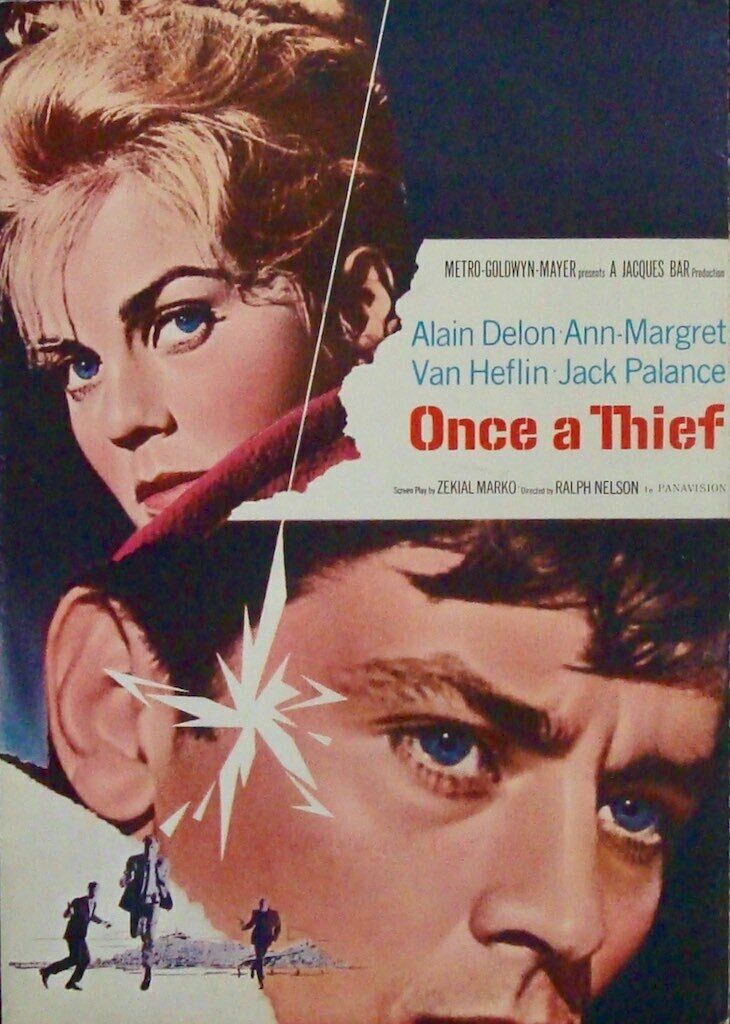
Latter-day film noir gem with terrific cast filmed in black-and-white and often at night that crams into a taut storyline different slants of the themes of the con-going-straight, the vendetta and the double-cross. While Hollywood at this point had imported platoons of foreign beauties in the Sophia Loren-Elke Sommer vein, there had been less interest in the male of the species with the exception of a small British contingent and possibly Omar Sharif, on whom the jury was still out.
MGM was gambling on Frenchman Alain Delon (The Leopard, 1963) to alter industry perceptions at the same time as pushing new contract star Ann-Margret (The Pleasure Seekers, 1964) along more dramatic lines away from the glossy puffery that had made her name and which relied more upon her physical assets than acting potential. Had she continued in this vein, her career would certainly have taken a different turn.
Eddie Pedak (Alain Delon), former minor hood turned San Francisco truck driver, is happily married to Kristine (Ann-Margret) with a young daughter they both adore. But tough cop Mike Vido (Van Heflin), with a reputation for brutality, is determined to pin a murder on him in revenge for purportedly being shot by him early in Eddie’s previous career. Eddie manages for a time to resist the overtures of brother Walter (Jack Palance) to participate in a million-dollar diamond. But when he loses his job, that changes.
While the robbery naturally takes center stage, that’s not actually the dramatic highlight. Instead, it is the Eddie-Kristine relationship. Instead of Eddie being the usual down-on-his-luck ex-con, he has clearly turned his life around, so much so he can afford a $500 down payment on a small boat. A loving father, he accepts without rancor when his daughter interrupts a night-time lovemaking session. And he’s stylish, too, wearing an iconic sheepskin jacket and driving a snazzy 1931 Ford Model A roadster. Kristine just wants a normal home life, desiring domesticity above all else, but swallowing her pride when she needs to go out to work in a night club to make ends meet, for a time rendering the unemployed Eddie a house husband.
But Eddie is not all he initially seems. His tough streak has not been smothered by the good life. In a brilliant Catch-22 situation he gets violent when an employment benefits clerk refuses to accept that Eddie was fired from his job, instead believing his employer’s claim that he resigned – the former triggering relief payment, the latter zilch. But that’s nothing to the beating he inflicts on Kristine when, pride injured that he is not the breadwinner, he discovers the skimpy costume she wears for her job.
Adding to the unusual mix are Vido and Walter, the former’s brooding presence somewhat undercut by the fact that in middle age he still lives with his mother, the latter while a big-time gangster letting nothing get in the way of strong fraternal feeling for Eddie. You won’t be surprised to learn that double cross is in the air, not when Walter employs a creepy sunglass-wearing henchman Sargantanas (John Davis Chandler) who appears to have more than a passing interest in little girls. The climax, which contains both emotional and dramatic twist, involves redemption and sacrifice.
Delon has played the cold-eyed ruthless but romantic character before, but here adds depth from his paternal commitment and as a man turned inside out by the system.
Ann-Margret is the revelation, truly believable as mother first, sexy wife second, and her anguish in the later parts of the picture showcase a different level of acting skill to anything she previously essayed. This role immediately preceded her man-eater in The Cincinnati Kid (1965) which attracted far more attention and considerably bigger box office and it would have been interesting to see how her career might have panned out had Once a Thief been the critical and commercial triumph. She probably did not attain such acting heights again until Carnal Knowledge (1971). And I did wonder, as with Daliah Lavi (The Demon, 1963) before her whether her acting skills were too often overshadowed in the Hollywood mindset by her physical attributes.
Van Heflin (Cry ofBattle, 1963) is excellent as the cop tormented by the idea that a villain is walking free, Jack Palance (The Professionals, 1966) is good as always and character actor Jeff Corey (The Cincinnati Kid) puts in an appearance as Vido’s whip-cracking boss. This marks the debut of Tony Musante (The Bird with the Crystal Plumage, 1970). Watch for a cameo by screenwriter Zekial Marko, who wrote the original book.
This represented another change of pace for director Ralph Nelson, Oscar-nominated for the Lilies of the Field (1963) and also known for box office comedy hit Father Goose (1964). His use of an experimental extremely light-sensitive camera eliminated the bulky lighting commensurate with filming at night, bringing freshness and greater freedom to those scenes. His natural gift for drama ensured that the emotional was given as much prominence as the action. Racial awareness was demonstrated by the opening scene in a jazz club where African Americans were clearly welcome, hardly the norm at that time.
The picture was shot on location in San Francisco including Nob Hill, Chinatown and Fisherman’s Wharf. To add authenticity, Nelson employed as extras or in bit parts people famed for different reasons in the area. There was Armenian Al Nalbandian who owned the Cable Car flower store on Union Square. William ‘Tiny’ Baskin was a highly successful diamond cutter, owner of the city’s biggest diamond collection – because of his size he was ideal to play a night club bouncer. The North Beach night club provided cameos for Big Al and resident jazz drummer Russell Lee, who both play themselves. Local singer Toy Yat Mar plays the woman murdered at the start of the film. Also appearing were piano player Jimmy Diamond, bus driver Wed Trindle and belly dancer Shereef.
Mention again of a terrific score by Lalo Schifrin, especially the bold drum solo that played out over the credit sequence. Schifrin’s work on the film was showcased in a featurette aimed at schools and colleges. Russell Lee’s drumming so impressed Ralph Nelson that the opening credits were rewritten around his drum solo.
Catch-Up: Alain Delon has featured in the Blog in reviews for Lost Command (1966), Is Paris Burning? (1966), The Girl on a Motorcycle (1968) and Farewell, Friend (1968); check out also Ralph Nelson’s Duel at Diablo (1966) and Ann-Margret in The Cincinnati Kid (1965).
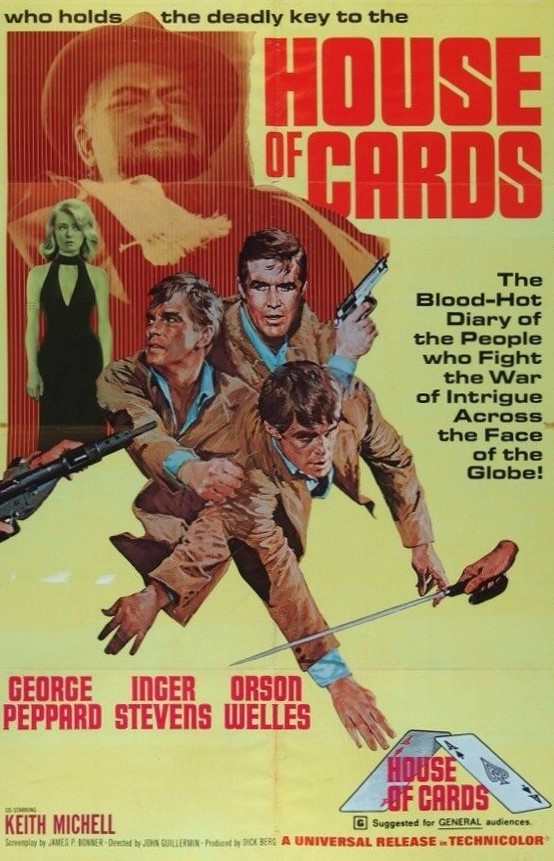
American boxer Reno Davis (George Peppard) stumbles on an international conspiracy when hired by rich widow Anne de Villemont (Inger Stevens) in Paris to look after her eight-year-old son Paul (Barnaby Shaw). All roads eventually lead to Rome and a showdown with arch-conspirator Leschenahut (Orson Welles) in this thriller which throws in a couple of measures of Gaslight (1944) and, more obviously, North by Northwest (1959) to the extent of Anne being an icy blonde of the Eva Marie Saint persuasion and the couple, on the run, sharing a compartment on a train.
The boy’s previous tutor has been murdered. After months in a sanatorium, Anne, paranoid about her son being kidnapped, is in virtual house arrest in the family mansion, watched over by arrogant psychiatrist Dr Morillon (Keith Michell) who has diagnosed her as unstable, neurotic and a danger to the boy.
After an assassin on a bridge on the River Seine takes potshots at Reno and Paul, Reno is framed for murder but escaping from the police returns to the mansion to find it empty, the furniture covered in dust sheets. I half-expected Reno to be told that the job was all in his imagination and that Anne did not exist, but instead finds out that mother and son have been taken to a castle in Dijon, in reality a fortress with a platoon of armed guards. Only Paul has been already been transported to Italy. So it’s attempted rescue, imprisonment, escape, fistfights, chase, clever moves and countermoves, twists and double twists as Reno and the still icy Anne head for Rome.
In among the mayhem are a few humorous moments, a play on the Trevi fountain scene from La Dolce Vita, a monk mistaken for a killer, a bored girl only too happy to be taken hostage, an over-familiar American who gives away valuable secrets because he mistakes Reno for a co-conspirator, Dr Morillon making the error of treating Reno as a servant. And characters involved in assisting escape extract a high price, one seeking financial reward, another that her husband be killed in the process. There is also a flirtatious but spiky maid Jeanne-Marie (Perette Pradier) and a couple of excellent reversals.
Reno is somewhat innovative in the weaponry department, the hook of a fishing rod, for example, while the son is rather handy with a pistol. But given the opposition are armed with machine guns, knives and swords that seems only fair.
George Peppard continues the excellent run of acting form that started in Tobruk (1967) and P.J. / New Face in Hell (1968), developing his own niche, dropping the innate arrogance of The Blue Max (1965) and Operation Crossbow (1965), no chip on the shoulder. Here he is a good bit more attractive as a screen presence, a nice line with the ladies, more than able to take care of himself, a sprinkling of wit, completely at ease. Inger Stevens comes off well though her psychological problems and concerns for her son get in the way of any burgeoning romance with Peppard. But she has quite a range of emotions to get through, from wondering if she is mad, to dealing with the controlling family, and letting go of her son enough to allow the boy to bond with Reno, and despite her vast wealth down-to-earth enough to see a toothbrush as an essential when on the run.
Orson Welles (Is Paris Burning?, 1966), as ever, looms large over everything, with dialogue so good you always have the impression he improvised on the spot. Keith Michell, a couple of years away from international fame in BBC mini-series The Six Wives of Henry VIII (1970), does a very good turn as the psychiatrist.
John Guillermin, who directed Peppard in The Blue Max and P.J., has a lot to do to keep the various balls in the air, especially keeping track of a multiplicity of characters. The screenwriting team of Harriet Frank Jr. and Irving Ravetch (Hud, 1963) pulled this one together from the novel by Stanley Ellin. Francis Lai’s memorable score is worth a mention, with distinctive themes for various parts of the story.
Eva Renzi (Funeral in Berlin, 1966) was originally down for the part of Anne and Italian actress Rosemary Dexter (Romeo and Juliet, 1964) has a small part.
Catch-up: The Blog previously reviewed George Peppard in Breakfast at Tiffanys (1961),The Blue Max (1965), Operation Crossbow (1966), Tobruk (1967), P.J (1968) and Pendulum (1969); John Guillermin directed The Blue Max (1965) and P.J; Orson Welles was seen in Is Paris Burning? (1966) and The Southern Star (1969).
Patients are a nuisance to be tolerated on the route to wealth in this superior soap opera that sees young doctors wrestling with ambition and ethics. Although also concluding that impending lofty status will snare them an attractive bride, they find women less biddable than expected, romance proving the trickiest of all procedures.
The main cast of four men and one women are played by a roster of hotly-tipped newcomers, including future Oscars winners and nominees and the elusive Haya Harareet (The Secret Partner, 1961). Director David Swift, accustomed to handling multiple characters in the likes of Pollyanna (1961), keeps the pot boiling and although some storylines lead to obvious conclusions the screenwriters bring sufficient imagination to the various strands.
The story unfolds over the one year the doctors spend in a general hospital, where the patients are liable to be drunk and obstreperous, before taking up residencies elsewhere. As you might expect, the main characters divide into the good and the arrogant. Heading the latter are Alec Considine (Michael Callan) who cheats on girlfriend Mildred (Anne Helm) with older nurse Vicky (Katharine Baird) in order to gain through her connections a residency at a highly prestigious hospital. Matching him in the cocky stakes is John Paul Otis (Cliff Robertson), charming to old ladies but willing to risk his career to bed movie actress Lisa (Suzy Parker). The good guys are Lew Worship (James MacArthur) who is seduced into the supposed backwaters of obstetrics and Sid Lackland (Nick Adams), an all-round good egg who falls for patient Loara (Ellen Davalos).
The most interesting of the young doctors, however, is single mother Madolyn Bruckner (Haya Harareet) who takes on surgeon Dominic Riccio (Telly Savalas) at every turn. Riccio spends his time berating his charges and in particular has a downer on female doctors. At every encounter, despite his vicious tongue, she refuses to back down.
But it is the patients, in particular Arnold Auer (Peter Brocco) and Loara, who blow a hole in the myth of hospitals. In the best scene in the film, Auer, suffering from a degenerative illness that will turn him into a vegetable, takes over from the doctor in giving his own awful diagnosis. His pleas for clemency from his ordeal, in essence assisted suicide, create an ethical dilemma for the young doctors who did not realize that modern medicine would prolong rather than curtail patient suffering. Auer’s anguished wife Emma (Angela Clarke) flits in and out of the picture as she buttonholes any doctor willing to listen to a new cure she has discovered. While the more hard-hearted doctors can inure themselves to his agony, a savage turn of events finds them all caught up in a situation that could jeopardize their future careers.
Racy image of Olga (Carroll Harrison) adorns the cover of the soundtrack album with music by triple-Oscar-nominee Leith Stevens (“The Five Pennies,” 1959).
Although Loara has an incurable disease and has more or less given up, Lackland’s effervescent good humor and determination that surgery can resolve all health issues brings her hope. If you were in her condition possibly the last thing you would want would be a cheerleading doctor on your side, but in this instance it brings succor and in the doctor’s case forces him to rethink his priorities.
Probably the last thing the doctors – and the audience – expected was to come up against such stubborn free-thinking women. While Bruckner appears to fly the flag for female independence, she has solid support from Lisa who spends most of the picture rejecting Otis’s advances on the grounds that even when he becomes rich he will be too poor for her liking. Eventually, Vicky forces Considine to choose. Shy nurse Gloria (Stefanie Powers) shocks Worship by putting global travel ahead of marriage. But she’s not as shocking as the bespectacled inhibited Olga (Carroll Harrison) who makes a spectacle of herself by losing her inhibitions in flamboyant style at a wild New Year’s Eve party, her disheveled state a key element of promotional artwork.
Although, theoretically, a film about young doctors having a romp, in reality it is a thoughtful and thought-provoking picture, tackling issues that would have been taboo at the time and removing the submissive tag that daunted most movie female characters in the movies.
Those who succeeded in later winning Oscar favor were Cliff Robertson, Best Actor for Charly (1968), and Nick Adams and Telly Savalas, both nominated for Best Supporting Actor, the former in Twilight of Honor (1963) and the latter in The Birdman of Alcatraz (1962). Robertson was the pick of the bunch, a star in his own right graduating from 633 Squadron (1964) and Masquerade (1965) to J.W. Coop (1971) which he also directed. But largely, the stars did not fulfil initial promise. The peak of Michael Callan’s movie career was reprising his role in The New Interns (1964), star in British director Michael Winner’s You Must Be Joking! (1965) and second male lead in Cat Ballou (1965). James MacArthur had a steady movie career before an epic run in television series Hawaii Five-O (1968-1979). Nick Adams switched between film and television before his premature death in 1968. Haya Harareet made only one more film, The Last Charge (1962).
Although primarily in television, the less-heralded stars enjoyed greater ongoing success. Mainly a strong supporting actor, Telly Savalas had only one stab at a starring role (Land Raiders, 1970) before achieving worldwide fame as Kojak (1973-1978). Stefanie Powers was television’s The Girl from U.N.C.L.E. (1966-1967) and later Hart to Hart (1979-1984). Buddy Ebsen (who plays the older Dr Sidney Wohl) went straight into a nine-year run of The Beverley Hillbillies.