Maroc 7 (1967) ***

With a string of Swinging Sixties fashion models providing the requisite bevy of beauties, a gang of thieves, a Moroccan heist, superb locations, great cast and a touch of archaeology with secret chambers and a long-lost relic thrown in, this splendid espionage frolic proves a welcome return to big screen top billing for Gene Barry after nearly a decade in television in Bat Masterson (1958-1961) and  Burke’s Law (1963-1966).

Something of a cat burglar himself, Simon Grant (Barry) infiltrates a gang which uses fashion as a cover and whose ingenious speciality is to steal famous heirlooms and replace them with fake ones in the assumption that on their departure from a foreign country the customs officers will not be able to tell the difference. Louise Henderson (Cyd Charisse) and Raymond Lowe (Leslie Phillips) head up the gang while Claudia (Else Martinelli) may or may not be in on the act.

Her dalliance with Simon suggests an inclination towards the right side of the law but the fact that she has been involved with the pair for so long sets up the intriguing notion that she is stringing the American agent along. Initially, she rejects Simon’s advances until told by Louise to comply and pump him for information leading to one of the movie’s best lines (and innuendo that a British audience in particular would adore). Says Simon: “We haven’t done much about pumping but maybe that will come later.”  Doubts also surround the intentions of Michelle Craig (Alexandra Stewart).  On their trail is Inspector Barrada (Denholm Elliott).

There is mystery aplenty and a fair quotient of punch-ups, romance, shoot-outs and murder while the unearthing of the hidden treasure is less heist amd more straightforward Indiana Jones. The fashion is the icing on the cake. The Moroccan fashion shoots are more than merely decorative, or an excuse to bare the charms of the gorgeous models. Instead, the shoots would not disgrace Vogue or any of the other glossy magazine temples to haute couture, with that Sixties focus on fabulous clothes, genuine location and outlandish hairstyles.

On top of that, several of the stars are either playing against type or out of their comfort zones. Legendary Hollywood dancer Cyd Charisse famed for such classic musicals as The Bandwagon (1953) and Silk Stockings (1957) sets such fluff aside to essay a criminal mastermind, whose cunning often gets the better of Simon. Leslie Phillips (Crooks Anonymous, 1962), better known as a charming Englishman with an eye for the ladies, is as ruthless a photographer as he is a criminal. Director Gerry O’Hara (The Pleasure Girls, 1965) has managed to get both Phillips and Denholm Elliott to drop their standard methods of delivery, usually embracing a drawl, making their characterisations a good bit more fresh than normal. Phillips was clearly intending to make some kind of career change since he was the producer.

Gene Barry makes a perfect entrance as an adventurer-spy, as confident in his seduction techniques without women falling at his feet like James Bond, with a nice line in self-deprecation and more than able to look after himself. Before being side-tracked by television, Barry had shown movie star potential in War of the Worlds (1953) and Thunder Road (1958) and now he delivers on that earlier promise. Elsa Martinelli (Hatari!, 1962) is the femme fatale who may or may not wish to play that role, keeping the audience completely on edge as to which side of the law she is likely to come down on. Added bonuses are Alexandra Stewart (Only When I Larf, 1968), Angela Douglas (Carry On Screaming!, 1966), Tracy Reed (Hammerhead, 1968), dancer Lionel Blair (A Hard Day’s Night, 1964) and Maggie London.

The Hitman’s Wife’s Bodyguard (2021) ****

Contrary to all my expectations – and the opinions of the Rotten Tomatoes critical aggregate – this was a blast. The over-the-top tongue-in-cheek action thriller is dominated by Salma Hayek who acts as a glorious foil to the bickering bad boys. Had she not been so well established, this would have been a career-making turn. It might yet give her a fresh burst of cinematic life away from the serious stuff to which she has previously devoted her screen life.

This movie follows the new rule for sequels, in that often these days they are better than the original. I had not been so taken with The Hitman’s Bodyguard (2017), which basically turned on the old idea of a mismatched duo with a more straightforward storyline.

This time round, disgraced bodyguard Michael Bryce (Ryan Reynolds) is forced out of a very brief self-imposed retirement by Sonia Kincaid (Salma Hayek), who had small role in the original, to rescue husband Darius (Samuel L. Jackson) from gangsters. The main plot is straightforward enough – Greek shipping tycoon Aristotle Papadopolous (Antonio Banderas) plans to hold Europe to ransom after the EU imposes financial sanction on his native country by knocking out all digital communication throughout the continent. Interpol agent Bobby O’Neill (Frank Grillo) forces the trio to work together to foil the plot.

But there are a host of wonderful, and occasionally surprisingly emotional, subplots. For a Start Sonia is desperate to become a mother with question-marks about Darius’s ability or wish to make her pregnant. Bryce has vowed to give up violence and we get to meet his father, a legendary hitman (Morgan Freeman) who adds surprising complications to the story. Bobby O’Neill is constantly at odds with boss Crowley (Caroline Goodall) and can barely understand a word spoken by Scottish interpreter Ailso (a very dry Alice McMillan). Aristotle once had a thing for Sonia and his chief bodyguard Magnusson (Tom Hopper) is by far the coolest bodyguard on show.

The action just batters along, fueled by various plot twists, and there is hardly a pause for breath as the hitmen and their adversaries destroy a ton of Europe’s most attractive cities. There are also plenty of laugh-out-loud moments. There’s nothing remotely serious about the plot beyond personal issues facing the trio and that the preposterousness reaches high-octane levels only adds to the fun. If it’s not a shoot-out, it’s a chase. If the trio are not killing each other, they are trying to save each other. And there is a surprise ending which may trigger another sequel.

Salma Hayek (Oscar-nominated for Frida, 2002) at full throttle both emotionally, vocally and in murderous mode steals the picture. She delivers some hilariously salty dialogue in amongst the profanity and proves no slouch in the cunning department. All guns blazing is her default. Ryan Reynolds (Deadpool, 2016) I found to be surprisingly good, too, a long way from the cocky screen persona he has inhabited of late, most of the time here emotionally vulnerable, in part due to his current antipathy towards violence but also from childhood demons, and spending most of the time taking one beating after another, once so convincingly dead that hitman and wife callously dump his overboard.

Samuel L. Jackson (Glass, 2019) could play this kind of role in his sleep but he, too, is given some emotional depth. Only Antonio Banderas (The Mask of Zorro, 1998) overplays his role. Caroline Goodall (Hunter Killer, 2018) is great as the crisp authority figure and Frank Grillo (Point Blank, 2019) as the eternal underling. It’s great to see Oscar-winner Morgan Freeman (The Shawshank Redemption, 1994) back in action – and more action than you might initially expect – and there is a cameo from Richard E. Grant (Withnail and I, 1987).

Patrick Hughes reprises his directorial duties, respectively, from the original and turns in a fresh take.

I caught this on my weekly Monday Night at the Cinema outing, catching films on the big screen before they are belittled on the small screen.

Readers’ Top 30

I’ve been writing this Blog now for one year, beginning July 2020, so I thought I’d take a look at which posts proved the most popular (in terms of views) with my readers. So here’s the annual top 30 films, ranked in order of views.

  1. The Secret Ways (1961) – Richard Widmark and Senta Berger – making her Hollywood debut – behind the Iron Curtain in gripping adaptation of the Alistair Maclean thriller.
  2. Ocean’s 11 (1960) – Frank Sinatra, Dean Martin, Sammy Davis Jr. and the Rat Pack in entertaining heist movie set in Las Vegas.
  3. It’s Not All Rock’n’Roll (2020) – remarkable documentary about the other side of the music business as ageing rocker Dave Doughman tries to keep his dreams alive.
  4. Age of Consent (1969) – British actress Helen Mirren makes her movie debut as the often naked muse for painter James Mason in touching drama directed by Michael Powell.
  5. The Venetian Affair (1966) – Robert Vaughn shakes off his The Man from Uncle persona in taut Cold War thriller also starring Elke Sommer as his traitorous wife and Boris Karloff in a rare non-horror role.
  6. The Golden Claws of the Cat Girl / La Louve Solitaire (1968) – French cult thriller starring Daniele Gaubert as sexy cat burglar forced to work for the government.
  7. Pharoah / Faron (1966) – visually stunning Polish epic about the struggle for power in ancient Egypt.
  8. The Swimmer (1968) – astonishing performance by Burt Lancaster as a man losing his grip on the American Dream.
  9. Stiletto (1969) – Mafia thriller with hitman Alex Cord and and illegal immigrant girlfriend Britt Ekland hunted by ruthless cop Patrick O’Neal.
  10. The Naked Runner (1967) – after his son is taken hostage businessman Frank Sinatra is called out of retirement to perform an assassination.
  11. Marnie (1964) – Sean Connery tries to reform compulsive thief Tippi Hedren in Alfred Hitchcock thriller.
  12. Our Man in Marrakesh / Bang! Bang! You’re Dead (1966) – Entertaining thriller sees Tony Randall and Senta Berger mixed up in United Nations plot involving the likes of Klaus Kinski and Herbert Lom.
  13. The Happening (1967) – Anthony Quinn locks horns with Faye Dunaway and a bunch of spoiled rich kids in kidnapping yarn.
  14. Dark of the Sun / The Mercenaries (1968) – Rod Taylor and Jim Brown head into the heart of darkness in war-torn Africa with a trainload of diamonds and refugees including Yvette Mimieux.
  15. The Guns of Navarone (1961) – men-on-a-mission Alistair Maclean World War Two epic with all-star cast including Gregory Peck, David Niven, Anthony Quinn, Anthony Quayle, Stanley Baker, Irene Papas, James Darren and Gia Scala.
  16. The Sicilian Clan (1969) – three generations of French tough guys – Jean Gabin, Lino Ventura and Alain Delon – clash in Mafia-led jewel heist.
  17. 4 for Texas (1963) – Frank Sinatra and Dean Martin as double-dealing businessmen in highly entertaining Robert Aldrich Rat Pack western starring Ursula Andress and Anita Ekberg.
  18. Five Golden Dragons (1967) – Innocent playboy Robert Cummings becomes enmeshed with international crime syndicate led by Christopher Lee, George Raft and Dan Duryea.
  19. Duel at Diablo (1966) – James Garner and Sidney Poitier team up to protect Bibi Andersson in Ralph Nelson western.
  20. Move Over Darling (1963) – after years marooned on a desert island Doris Day returns to find husband James Garner just married to Polly Bergen.
  21. Pressure Point (1962) – prison psychiatrist Sidney Poitier is forced to treat paranoid racist inmate Bobby Darin.
  22. Wonder Woman 84 (2020) – in one of the few films to get a cinematic screening during lockdown, Gal Gadot returns as mythical superhero to battle supervillain Kristen Wiig.
  23. Genghis Khan (1965) – Omar Sharif as the Mongol warrior who conquered most of the known world, tangling with rival Stephen Boyd and Chinese mandarin James Mason on the way.
  24. A Fever in the Blood (1961) – Warner Bros wannabes Efrem Zimbalist Jr, Angie Dickinson, Jack Kelly and veteran Don Ameche in tough political drama.
  25. The Prize (1963) – Paul Newman and Elke Sommer investigate murder in the middle of the annual Nobel Prize awards in Sweden.
  26. In Search of Gregory (1969) – wayward Julie Christie embarks on pursuit of Michael Sarrazin who may – or may not – be a figment of her imagination.
  27. Justine (1969) – Dirk Bogarde and Michael York become entangled in web woven by Anouk Aimee in corrupt pre-World War Two Middle East.
  28. The Girl on a Motorcycle (1968) – singer Marianne Faithful in a hymn to the open road and sexual freedom.
  29. Blindfold (1965) – psychiatrist Rock Hudson and dancer Claudia Cardinale in highly entertaining mystery thriller about missing scientists.
  30. Hammerhead (1968) – secret agent Vince Edwards and goofy Judy Geeson on the trail of evil mastermind Peter Vaughn.

My Five-Star Picks for the First Year of the Blog

It’s a been a fabulous year for watching the movies and my pictures of the year (the first full year of the Blog running from July to June, I hasten to add) make up an eclectic collection ranging from historical epics, dramas and westerns to horror, thrillers and comedy. Although this is my chosen decade, many of the films I was seeing for the first time so it was interesting to sometimes come at a film that had not necessarily received kind reviews and discover for one reason or another cinematic gems. There was no single reason why these pictures were chosen. Sometimes it was the performance, sometimes the direction, sometimes a combination of both.

The westerns I most enjoyed came from either ends of the decade – John Wayne and Rock Hudson in magnificent widescreen spectacle The Undefeated (1969) and Yul Brynner, Steve McQueen, Charles Bronson, James Coburn and the team in The Magnificent Seven (1960).

There was another ensemble all-star cast in J. Lee Thompson war film The Guns of Navarone (1961) one of the biggest hits of the decade with Gregory Peck, Anthony Quinn, David Niven, Stanley Baker et al.

Horror brought a couple of surprises in the shape of Daliah Lavi as the Italian peasant succumbing to The Demon (1963) and Peter Cushing menaced by The Skull (1965).

Not surprisingly perhaps Alfred Hitchcock headed the ranks of the five-star thrillers, but surprisingly to some, this was in the shape of Marnie (1964) with Sean Connery and Tippi Hedren rather than some of his decade’s more famous / infamous productions.  Heading the romantic thrillers was the terrifically twisty Blindfold (1965) with Rock Hudson and Claudia Cardinale teaming up to find a missing scientist. The Sicilian Clan (1969) proved to be a fine heist picture in its own right as well as a precursor to The Godfather with a topline French cast in Alain Delon, Lino Ventura and Jean Gabin.

Only one comedy made the five-star grade and what else would you expect from Billy Wilder’s Some Like It Hot (1959), slightly outside my chosen remit of films from the 1960s, but impossible to ignore the chance to see Marilyn Monroe, Tony Curtis and Jack Lemmon strutting their stuff on the big screen. For the same reason I had the opportunity to re-evaluate Ridley Scott’s Oscar-winning historical epic The Gladiator (2000) that gave Hollywood a new action hero in Russell Crowe. Stylish contemporary sci-fi chiller Possessor (2000), from Brandon Cronenberg,  was another one seen on the big screen, one of the few in this year of the pandemic.

Most people would certainly put Paul Newman as prisoner Cool Hand Luke (1967) in this elevated category but, to my surprise, I found several other dramas fitted the bill. The clever sexy love triangle Les Biches (1968) from French director Claude Chabrol made his name. Burt Lancaster turned in a superlative and under-rated performance in the heart-breaking The Swimmer (1968) about the loss of the American Dream. Rod Steiger, on the other hand, was a hair’s-breadth away from picking up an Oscar for his repressed turn as The Pawnbroker (1964).

Two films set in the Deep South also made the list – Marlon Brando in Arthur Penn’s depiction of racism in small-town America in The Chase (1966) with an amazing cast also featuring Jane Fonda and Robert Redford, and Michael Caine as a more than passable arrogant southerner in Otto Preminger’s Hurry Sundown (1967) opposite rising star Faye Dunaway. Dennis Hopper and Peter Fonda’s hymn to the freedom of the motorbike in Easy Rider (1969) turned into a tragic study of attitudes to non-conformity.

For only eighteen films out of a possible two hundred to make the cut indicates the high standards set, and I am looking forward to as many, if not more, brilliant films in the year to come.

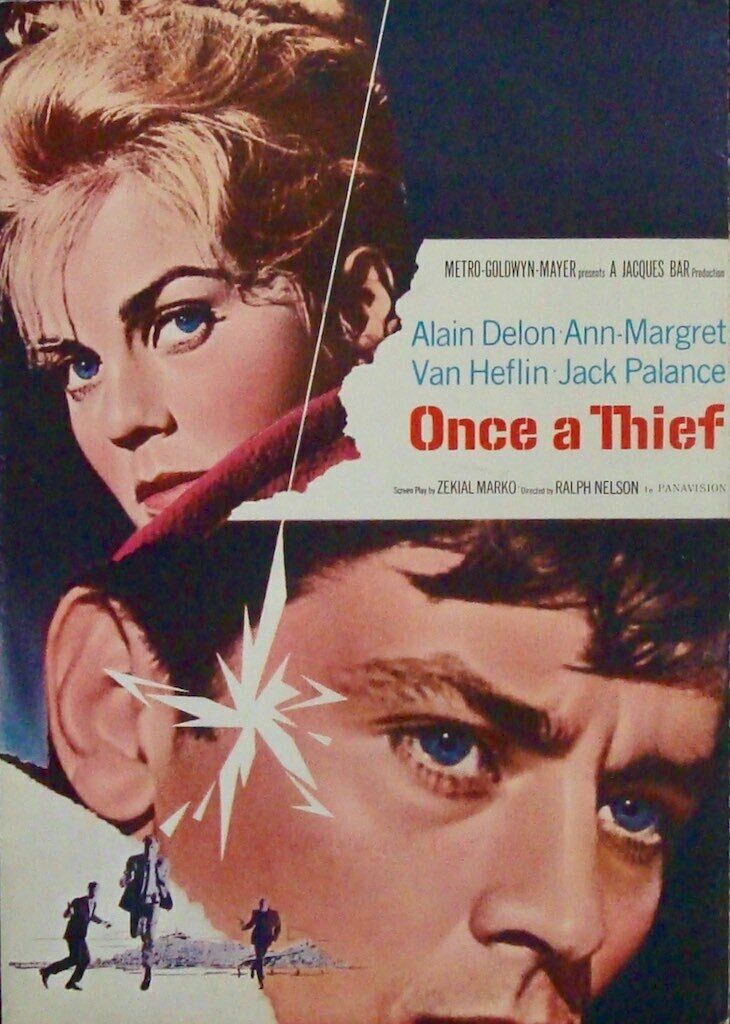
Farewell, Friend / Adieu L’Ami (1968) ****

This heist picture made Charles Bronson a star, though, like Clint Eastwood a few years previously, he had to go to Europe, in this case France, to find an audience appreciable of his particular skill set. This was such a box office smash in France that it was the reason that Once upon a Time in the West (1968), a major flop virtually everywhere else, turned into a huge hit in Paris. After a decade as a supporting actor, albeit in some quality offerings like The Magnificent Seven (1960), The Great Escape (1963) and The Dirty Dozen (1967), Bronson developed a big following, if only initially in Europe.

Farewell, Friend could also lay fair claim to stealing the title of  “first buddy movie” from the following year’s Butch Cassidy and the Sundance Kid (1969) because, apart from the heist that is central to the story, it is essentially about the forging of a friendship. But it wasn’t released in the U.S. for another five years, in the wake of Bronson’s Hollywood breakthrough in The Valachi Papers (1972), and then under a different title, Honor Among Thieves.

And you can see why it was such a star-making vehicle. Bronson goes toe-to-toe with France’s number one male star Alain Delon (The Sicilian Clan, 1969). He had the walk and the stance and the look and he was given acres of screen time to allow audiences to fully appreciate for the first time what he had to offer. Like Butch Cassidy, the duo share a lot of screen time, and after initial dislike, they slowly turn, through circumstance and the same code of honor, into friends.

Dino Barran (Alain Delon) is the principled one, after a final stint as a doctor in the French Foreign Legion originally turning down overtures from Franz Propp (Charles Bronson) to become involved in a separate major robbery. Propp is an unsavory customer, making his living as a small-time thief who uses a stripper to dupe wealthy marks. Barran plans to rob a corporation’s safe during the three-day Xmas holiday of two million dollars as a favor to the slinky widow Isabelle (Olga Georges-Picot) of a former colleague, for whose death he retains guilt. Propp more or less barges his way into the caper.

It’s a clever heist. Isabelle gets Barran a job as a company doctor whose office is next door to the giant vault. But there’s a twist. Surveillance reveals only three of the seven numbers required to open the combination to the vault. But Barran reckons three days is sufficient to try out the 10,000 possible permurations.

Barran and Propp despise each other and pass the time playing juvenile tricks, locking each other into a room, stealing all the food from the one dispensing machine, winding each other up, while they take turns trying different combinations. But it opens after only 3,400 attempts and they face a shock. The vault is empty. They have been set up to take the fall for a previous robbery that must have been completed before the building closed for Xmas.  

And there’s no way out. They are in lockdown, deep in a basement. The elevators can only be opened by a small squadron of guards upstairs. Food long gone, they are going to run out of water. If they use a lighter to see in the dark, or build a fire to get warm, the flames will eat up the oxygen they need to survive in the enclosed space. So the heist turns into a battle for survival and brute force attempts to escape before the building re-opens and they are discovered, exhausted and clearly guilty.

But that’s only the second act. There is a better one to follow, as their friendship is defined in an unusual manner. And there are any number of twists to maintain the suspense and tension. Butch Cassidy and the Sundance Kid were close friends when that western began. Here, we see the evolution of a friendship between two forceful characters who express their feelings with their fists.

Delon was a known quantity, but Bronson really comes to the fore, more than holding his own against a top star who oozed charisma. This is Bronson in chrysalis, the emergence of the tough guy leading man screen persona that would turn him into one of the biggest stars in the world. Surprisingly, given his later penchant for the monosyllabic, here he does a lot of talking, perhaps more actual acting than he ever did later when his roles tended to fall into a stereotype.

He has the two best scenes, both character-defining, but in different ways. He has a little scam, getting people to gamble on how many coins it would take for an already full-to-the-brim glass to overflow when a certain number of coins were dropped in. While this is a cute trick, it’s that of a small-time con artist, but watching it play out, as it does at critical moments, is surprisingly suspenseful. The second is the strip scene which shows him, as a potential leading man, in a very poor light, and although thievery is the ultimate aim, it is not far short of pimping, with Bronson standing back while the woman (Marianna Falk) is routinely humiliated. It’s the kind of scene that would be given to a supporting actor, for whom later redemption was not on the cards. It says something for Bronson’s command of the screen and the development of his character that by the end of the picture the audience has long forgotten that he could stoop so low.

It is a film of such twists I would not want to say much more for fear of giving away too much, suffice to say that Olga Georges-Picot (Je T’Aime, Je T’Aime, 1968) and her friend, mousy nurse Dominique (Brigitte Fossey, in her grown-up debut), are also stand-outs, and not just in the sense of their allure.

Director Jean Herman, in his sophomore outing, takes the bold step of dispensing with music virtually throughout, which means that during the critical heist sequence the audience is deprived of the usual musical beats that might indicate threat or suspense or change of mood, but which has the benefit of keeping the camera squarely on the two leading characters without favoring either. Most pictures focusing on character rely on slow-burn drama. In the bulk of heist pictures, characters appear fully-formed. Here, unusually, and almost uniquely in the movie canon, character development takes place during an action film.

Top French thriller writer Sebastian Japrisot (The Sleeping Car Murder, 1965) was responsible along with Herman for the screenplay. Japrisot was a key figure in the French movie thriller scene, churning out, either as original novels or original screenplays, A Trap for Cinderella (1965), Rider on the Rain (1970) and The Lady in the Car with the Glasses and the Gun (1970).

Even without Bronson, this would have been a terrific heist picture. With him, it takes on a new dimension.

Blindfold (1965) *****

Hugely enjoyable superior addition to the romantic thriller genre with charismatic stars and a touch of screwball comedy. Dr Stone (Rock Hudson), a psychiatrist with such commitment issues he is dubbed “Bluebeard” by the media, is recruited by General Prat (Jack Warden) of the National Security Council to prevent former patient Arthur Vincenti (Alejandro Rey) falling victim to an international scientist-kidnapping ring. Getting to the patient, a plane and car ride away, requires the titular blindfold so Stone has no idea where he is. When Vincenti attacks Stone as a traitor, Prat explains the scientist has been brainwashed.

Ballet dancer Vicky (Claudia Cardinale) engineers an accidentally-on-purpose meet-cute in Central Park by running her bicycle into Stone’s horse but when, to nurse her injury, he carries her into his office she steals the scientist’s file. Turns out her artistic skills are somewhat lower than ballet, she is a go-go dancer, but she is the scientist’s brother whom she claims has been kidnapped. Stone is arrested and to get out of another sticky situation announces he is engaged to Vicky.

Complications are added when the C.I.A and F.B.I. enter the equation as well as a very suspicious cop Harrigan (Brad Dexter) with an inferiority complex, a couple of shady homburg-wearing hoods and new patient Fitzpatrick (Guy Stockwell), who, all, in one way or another, hound Stone and Vicky. The couple’s relationship is one of those on-again off-again romances which come with the territory. Soon, of course, Stone doesn’t know who to believe.

Bearing in mind we still have to get to the geese, the alligators and a mule called Henry, the witty, inventive script delivers on all fronts. Both Stone and Vicky are believable characters, and Stone’s psychiatric skills are not just window dressing – the kind of tony job associated with innocents thrust into peril. He uses his proficiency to get out of scrapes and eventually solve the mystery. Despite her glamor-girl persona, Vicky is the opposite of the sleek high-living characters often shoehorned into this kind of picture, a down-to-earth lass living in a brownstone with her mama and papa. Both leads turn out to be handy with their fists and in Vicky’s case her high-kicking feet.

And the comedy, rather than getting in the way or looking ridiculously out of place, aids and abets the storyline. It falls into three distinct camps. There is repartee not just between Stone and Vicky but Stone’s secretary (Anne Seymour) operates a sideline in dry quips. Slapstick comes mainly in the form of a fire extinguisher employed as a weapon and Stone nearly losing his trousers scaling a fence. Bureaucratic brick walls that hint of paranoia come close to classic black comedy. Not to mention some visual gags – “undie dummies” anyone – and some neat reversals.

This is Hudson at his very best and while often confused is never flustered, and without recourse to the double-takes that appeared so essential in any previous film with a comedic element. His character is assured, self-aware, thoughtful (he has to be to think things out), and very human. Cardinale is more than a match, a nice girl in the wrong line of work, passionate, determined and very warm. Director Philip Dunne find dramatic reasons to reveal her famous assets in body stocking, leotard and underwear, but in reality it is her smile that is the killer.

Dunne (Lisa, 1962) keeps up a cracking pace. He had a hand in the screenplay, adapted from the novel by Lucille Fletcher (Sorry, Wrong Number, 1948), one-time wife of composer Bernard Herrmann. Here, incidentally, the music is by Lalo Schifrin. Among the decade’s romantic thrillers this is out-ranked only by Charade (1963).

Nobody (2021) ****

Blistering stylish thriller in the Taken (2008) / John Wick (2014) tradition sees former secret service badass Hutch Mansell (Bob Odenkirk) trying to live a normal suburban life with wife Becca (Connie Nielsen) and two kids while working as a nerdy book-keeper in a small factory, the kind, should the need arise and with the right skill set, that can be turned into a fortress.  

Devised by John Wick writer Derek Kolstad, this is a more realistic twist on the sub-genre he helped create. Where John Wick and indeed Bryan Mills (Taken) tend to often escape pretty unscathed from violent episodes, Hutch is beaten black and blue. But like John Wick he wants to keep the past buried. And he would do except he gets mixed up with two inept burglars and from that encounter segues into a confrontation with the Russian mob, the head of which Yulian (Aleksey Serebryakov) is a candidate for the all-time gangster hall of fame as well as the oddball hall of fame since he fancies himself as a nightclub singer.  

Interestingly, it’s clear that living the boring life is guaranteed to turn your marriage stale and that relationship only recovers when Hutch gets his mojo back. Unusually, too, Hutch spends a good deal of his time trying to make or keep the peace, preferring compromise to a bullet tsunami. But you know what these Russians are like!

Like John Wick, we enter a completely new world of assassins and their codes and the way they operate – attacking a man in his own home a mortal sin – and Hutch can call on a bundle of characters who know their way around, including his father David (Christopher Lloyd) and unspecified relative Harry (RZA) not to mention a mixture of hard-asses like Eddie (Michael Ironside) and upper-class Brit with the usual unusual moniker in this case The Barber (Colin Salmon).

In his sophomore outing Russian director Ilya Naishuller (Hardcore Henry, 2015), while delivering a sufficient quota of fisticuffs and shootouts, brings a certain flair to the proceedings, Hutch as reliant on whatever pieces of metal prove handy as well as the normal selection of firearms and a more extensive supply of weaponry, committing violence to the unlikely accompaniment of classics from the American musicals songbook like “The Impossible Dream” and “You’ll Never Walk Alone.”

Naishuller has gathered a wonderfully eclectic cast with Connie Nielsen sprung back to leading lady status after bit parts in Wonder Woman (2017) and Justice League (2017). As if to remind myself of the emotional quality she brings to the movies, I happened to see her on the same day in a big-screen revival of Gladiator (2000) – part of my weekly cinematic triple bill. And you’re gonna love the reincarnation of Christopher Lloyd (Back to the Future, 1985), probably the only shotgun-toting inhabitant of an old folks home, off the big screen since 2018 and really without a decent movie role in nearly a decade.  

If you only know Bob Odenkirk from playing sleazeball lawyer Jimmy McGill in the television series Breaking Bad (2009-2013) and its offshoot Better Call Saul (2015-2021) and you wondered how he was ever going to break away from that typecasting, here’s the answer in spades. This is such a transformation you would forget he was ever McGill.

Nobody didn’t exactly hit the ground running when it was released in the U.S. in March during the pandemic but it will gradually build up a following on streaming and DVD and it’s almost certainly going to turn into a series. Remember, the first John Wick didn’t pack the commercial punch of the sequel. But once the word gets round, Nobody will attract a healthy fanbase.

Don’t miss this – highly recommended.

Not sure when the DVD is out but if you miss it in the cinema, you can get your order in now.

Dr Syn, Alias The Scarecrow (1963) ****

The mysterious masked Scarecrow was the creepiest character thus far put on celluloid by Disney. A lot of the action takes place at dusk so it is soaked in crepuscular atmosphere. Filmed against the sky, every horse seems to thunder past. Gallows swing ominously. Coupled with a strong storyline and clever ruses by alter ago the mild-mannered clergyman Dr Syn (Patrick McGoohan), this is one for the Under-Rated Hall of Fame.  

While the character has antecedents in folk-hero Robin Hood, the Scarecrow is more rooted in the brutal reality of Britain in the mid-1700s when to fund a host of foreign wars King George taxed already-impoverished peasants to the hilt, making smuggling essential to survival. The Scarecrow is not just the underworld kingpin but has operational skills a spy would be proud of, coded messages, secret rendezvous et al.  

Ruthless General Pugh (Geoffrey Keen), sent to rid the countryside of this menace, makes no bones about putting the squeeze on the wives of villagers to force them into providing the information he requires. Outwitted from the off by Dr Syn, the infuriated general begins torching houses. Helped unwittingly by local squire and judge Thomas Banks (Michael Hordern), the general acquires an informer Joseph Ransley (Patrick Wymark).

This is not the bucolic England of Robin Hood or other historical yarns of Hollywood invention featuring glorious scenery and ample female cleavage. Here, a barmaid is likely to use a meat cleaver to defend herself. This was also the era of press gangs, where government-appointed hoodlums would raid a village and carry off young men as unwilling recruits for the Royal Navy. It was a time of imminent insurrection, the King’s subjects in the North American colonies on the point of sedition. And when money – or its lack – infected every area of society.       

Although like any super-hero the Scarecrow occasionally comes to the rescue, the movie is distinguished by the fact that is more often Dr Syn who subverts the General through cunning subterfuge. Victory through force of arms is impossible since violence visited on the king’s troops would result in a multiplication of their numbers. So it is more a battle of wits. In addition, the Scarecrow faces a dilemma – how to punish a traitor with such severity his authority is never questioned again while at the same time upholding the principles of Dr Syn. Just how these issues and others are resolved make for a very involving picture.

Minor subplots – a romance between the squire’s daughter and an officer, a deserter from the Navy and the presence of an American (Tony Britton) – serve the main story. So the narrative remains taut. And, interestingly, that hangs upon what characters have to lose rather than gain. It is not about greed but survival.

For a Disney picture there is considerable directorial vigor, not just the depiction of the smuggling and pounding hooves accompanying peril or escape, but two terrific trial scenes, a masterly escape conducted in the complete absence of on-screen music and, of course, the terrifying vision of the Scarecrow himself.

The acting has a sterling quality. While Michael Hordern was a stage star, the film primarily called upon actors who later achieved fame on British television programs. Patrick McGoohan headlined The Prisoner (1967-1968), George Cole was in Minder (1979-1994), Patrick Wymark and Alan Dobie in The Plane Makers (1963-1965) Geoffrey Keen in Mogul (1965-1972), and Tony Britton in Robin’s Nest (1977-1981). McGoohan had a previous television incarnation as Danger Man  (1960-1961) and Cole had been a con man in the St Trinian’s films. You can also spot in small roles Kay Walsh, a former British leading lady, and a young Richard O’Sullivan, later star of Man About the House (1973-1976).

Director James Neilson was a Disney favorite, having helmed Moon Pilot (1962), Bon Voyage! (1962) and Summer Magic (1963). But these were all lightweight features and it is to his credit he met the challenge of turning Dr Syn, Alias the Scarecrow into a dramatic actioner. British writer Robert Westerby (The Square Ring, 1953), who also created the source material for Kali-Yug, Goddess of Vengeance (1963),  fashioned the screenplay from the books of William Buchanan and Russell Thorndike

Although Disney had cannibalized the Davy Crockett television series in the 1950s, stitching together episodes for feature films, this was something of a reversal. As part of its The Magical Wonderful World of Disney U.S. television program the studio had shown The Scarecrow of Romney Marsh as a three-part mini-series while Dr Syn, Alias the Scarecrow was released as a movie in Britain.  

You will need to go onto ebay or other secondhand sources to find the movie. The television mini-series can be found below.

Reboot Rodeo: Cruella (2021) ** and Spiral (2021)***

Cruella (2021)

Should have X-Certificate written all over it to prevent millions of kids being duped by a cynical marketing ploy that has nothing at all to do with the beloved children’s book or the animated version of 101 Dalmatians (1961) or even the 1996 live-action revamp. Under the pretense of an origin story for villainess Cruella De Ville that is more The Devil Wears Prada than Batman Begins, Disney throws a heap of cartoon characters at a big-budget picture in the hope that it can generate a new series.

Even Emma Stone’s characterization of Cruella sinks under a series of grimaces and clamped lips as she struggles to switch from put-upon orphan deserving of our sympathy to some kind of vengeful criminal mastermind. The two-dimensional earlier cartoon has a good bit more depth than this. Cruella’s nemesis The Baroness (Emma Thompson) is little more than a caricature of an English toff. Cruella is saddled with the comic henchmen from the book – Horace (Paul Walter Hauser) and Jasper (Joel Fry) – while the Baroness has a bunch of one-dimensional sycophants. and a trio of teeth-baring spotty dogs rewiring their inner rottweiler. For the most part there is more going on with the costumes than with the characters, but watching a face-off between dueling fashionistas , more image than substance, soon palls.

Once the comedy is reliant on searching dogshit for jewels, rats let loose at a party, and pulling hairs from people’s noses you can see a picture that has fast run out of ideas. And this is all a pity because there is a decent germ of an idea here since orphan Cruella turns out to be every bit as psychotic as her mysterious mother, presenting the character with the choice of which path to follow. The scenario would have worked a lot better if it had been a stand-alone picture and not one that had its genesis in 101 Dalmatians and just had the guts to go down the dark side that the story clearly requires.

And all of this basically to set up a sequel as this one ends with a composer tinkling out the “Cruella De Ville” theme tune from previous films and the dogs from the original novel, Pongo and Perdita, making an appearance as puppies. As it stands it’s a pantomime where you want to hiss the villain for spoiling a good story.

Spiral: From the Book of Saw (2021)

I was never a big fan of torture porn nor for that matter of Chis Rock, too loud and brash for my liking, but oddly enough they make a compelling combination in this unusual idea for a reboot. This is pretty much a police procedural, corruption the background beat, with torture – or at least the victims – providing the clues. I was astonished to realize Rock (Bad Company, 2002) is now in his mid-50s and that could certainly account for the loss of some of his manic energy but the rest I have to admit is down to the emergence of a genuine acting talent.

Like the Russell Crowe character in American Gangster (2000) or Al Pacino (1973) in Serpico he is what cops appear to hate – incorruptible – so he is loner detective Zeke Banks until newbie detective William Scheck (Max Minghella) is forced upon him. Whatever horrific crimes are now being committed appear to point to a past when Banks’s father Marcus (Samuel L. Jackson) was king cop. and to his relationship with Zeke’s current boss (Marisol Nichols).

You could view this as a cynical attempt to revive a series well past its best, and these genre mash-ups rarely work, but in this case, mostly thanks to Rock, it has all the makings of an entirely new series.

As ever, the deaths are inventive and gory. But the gory bits are well sign-posted so you can skip past them and catch up on the detective elements. Max Minghella (Horns, 2013), who has been off the movie screen for over half a decade, makes a good comeback and for once a Samuel L. Jackson character has some depth. Marisol Nichols makes a strong impression also, given that she had mostly been a television player. Perhaps as interesting as the jump taken by rock is that director Darren Lynn Bousman, who has three previous Saw outings in his portfolio, has not just managed to refresh the idea but devoted as much attention to the various detectives as to the gore.

The Woman in the Window (2021) *

I stopped watching this mid-drivel so don’t count on me for a balanced assessment. But it does point up the dangers of the current Netflix obsession. In the cinema, no matter how bad a picture, I would always stay to the end.  Particularly with Netflix’s movie joblot I found myself switching off in frustration that it was ever given the green light. I bet, though, Twentieth Century Fox were delighted to have been able to offload it onto Netflix, which provides no acceptable measure of audience response, rather than watching it sink like a stone at the movie box office.

It’s also a cautionary tale about the problems of snapping up a bestseller supposedly in the Gone Girl (2014) and The Girl on a Train (2016) vein, both featuring as here an unreliable narrator, without working out how such fiction might translate to the screen. Buying bestsellers is usually an astute piece of business from the Hollywood perspective. Both the novels mentioned sold in excess of 20 million copies. Even if only 10 per cent of the book buyers went to see the movie, you are talking about $20 million already at the box office. If it’s 20 per cent, then that’s a flat $40 million, and so on.

Bestsellers tended to get snapped up quickly, often in pre-publication, and although they might come with riders attached relating to copy sales, generally you are looking at a movie sales tag of around $1 million. That’s a tiny fraction of the cost of any movie budget with the double bonus that readers will more than offset the purchase price and that the bestseller angle provides an easy marketing hook.

I go to the movies once a week and watch at least two films and sometimes as many as four. And I pay to go. I buy my ticket rather than, as a movie critic, gaining free access. So I’m a sucker for almost anything and if you’ve been reading my Blog you’ll see that I have a pretty high tolerance level and enjoy a wide variety of pictures. So it takes a lot for me to get a downer on a particular movie.

So what’s gone wrong here? The book pivoted on the notion that the protagonist Anne Fox (Amy Adams), imprisoned by agoraphobia in her apartment, views the world through the prism of old Hollywood movies. So old pictures inform much of the writing, they are referenced all the time, almost in the sense of “what would Humphrey Bogart do.” That’s just not an option for a movie, so we are only given a few glimpses of films like Spellbound and they do not play any part in explaining her mental state.

So then it’s basically a re-run of Rear Window (1954) with instead of voyeuristic proclivities being deemed acceptable because it’s James Stewart doing the peeking we have what is effectively a creepy “cat lady” (minus the cats of course) who moons around her apartment drinking. She employs a psychiatrist but he’s redundant in movie terms because we already know she’s loopy and we don’t need to be told that, and that no matter what she did it’s not going to make us look upon her with any more kindness. Why? Because she has a singularly unattractive personality.

Amy Adams (Arrival, 2016) can normally be relied upon to deliver a good performance, but she is hopeless, generating not an ounce of sympathy for her predicament, not helped by going spare at kids doing nothing more dangerous than enjoying Halloween. But she’s not alone in producing audience antipathy. Of the couple across the street whom she spies upon, Jane Russell (Julianne Moore) has obnoxiousness down to a tee while husband Alistair (Gary Oldman) is over-the-top. And if an audience can’t find anyone to like it’s not going to like the film. 

For a film boasting two Oscar-winners – Gary Oldman for Darkest Hour (2017) and Julianne Moore (Still Alice, 2014) – plus six nominations for Adams and one for Jennifer Jason Leigh and stars Anthony Mackie and Wyatt Russell from current television mini-series The Falcon and the Winter Soldier (2021), this is a hatful of talent waiting for a rabbit to jump out and perform a miracle cure on a thriller with no thrills. A packet of exposition gets in the way of audience involvement and director Joe Wright (Pride and Prejudice, 2005) fails to make any headway in the Hitchockian department.

Perhaps the most bizarre aspect of his movie car crash is that its timing could not be more apposite. A film about not being able to go out during a pandemic that confined global populations to their homes should have struck some kind of chord. Of course, it’s been sitting on the Twentieth Century Fox (now rebranded as “20th Century Movies”) shelf since 2019 and it might have been better for all concerned had it stayed there.

Catch this on Netflix.

Discover WordPress

A daily selection of the best content published on WordPress, collected for you by humans who love to read.

The Atavist Magazine

by Brian Hannan

WordPress.com News

The latest news on WordPress.com and the WordPress community.