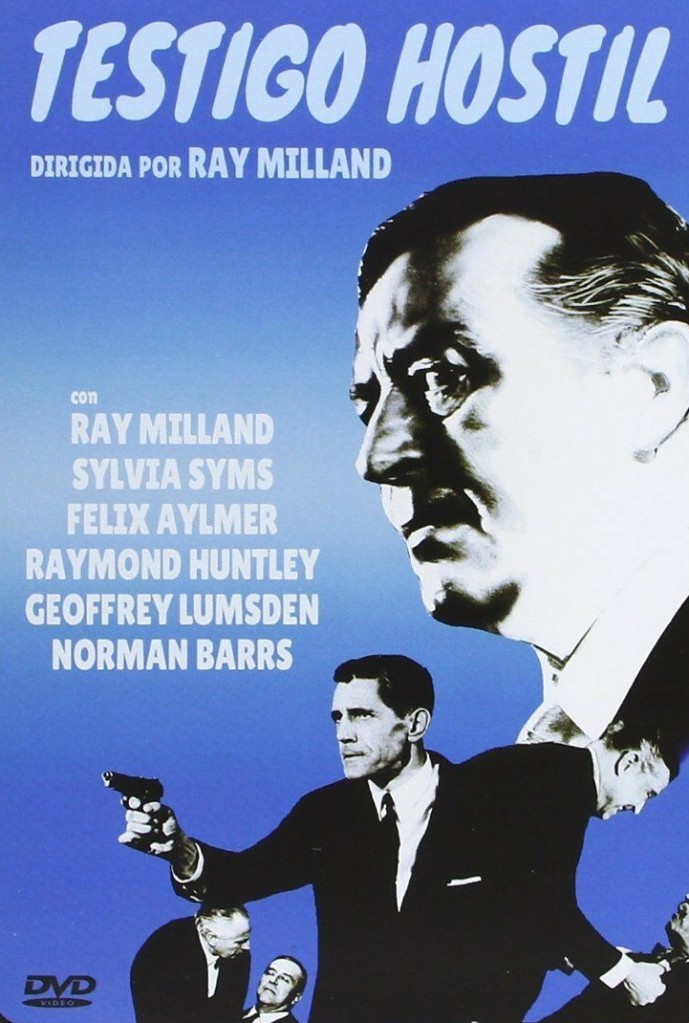
Sherlock Holmes and the Deadly Necklace (1962) **

Sir Arthur Conan Doyle would be turning in his grave. Workmanlike at best, awful at its worst, or a “so-bad-it’s-good” candidate? Christopher Lee goes through the motions, there’s an oddly inserted heist, the continuity goes haywire, and the deduction would not have troubled a child. Even the great sleuth having to match nemesis Moriarty in cunning fails to lift this turgid tale. Despite being made in Germany, all the actors, save Senta Berger, appear injected with a fatal dose of stiff upper lip.

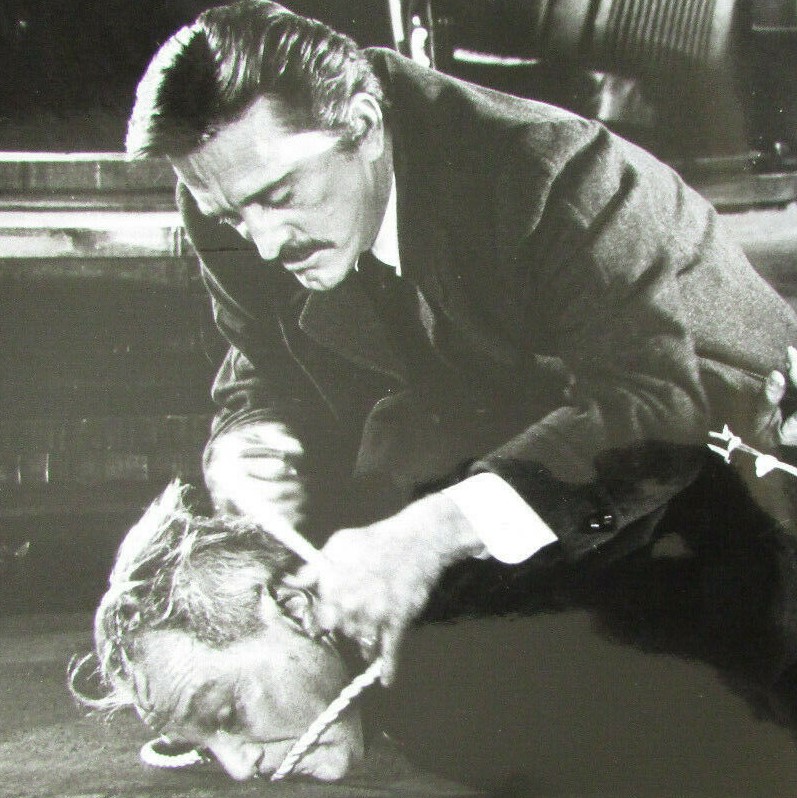
A corpse in the water alerts Sherlock Holmes (Christopher Lee) to the presence of Moriarty (Hans Sohnker) who is hunting Peter Blackburn (Wolfgang Lukschy) who has appropriated Cleopatra’s necklace from an archaeological dig. This takes them to Hampshire where corpses abound but the necklace is gone. Holmes burgles Moriarty’s apartment and steals back the necklace which is sent, in heavily protected police van, to an auction house. Holmes outwits Moriarty by infiltrating the heist the villain has planned.

The best scene comes at the beginning when boys throw stones at something floating in the Thames only to discover it’s a corpse. After that, you can choose from any number of bad scenes. Where do you start? The disguises? Holmes is first seen wearing a false nose to pass himself off as dock worker. An eyepatch is enough to convince Moriarty’s henchmen that Holmes in one of their kind. Bare-handed, Holmes kills an obviously plastic snake. To find out what Moriarty is up to, they listen down a chimney!

The deduction is so awful Dr Watson (Thorley Walters) could have done it. A dying man who manages to whisper one word is unable to whisper two and instead still has the strength to flap his hands in a way that any child in the audience familiar with shadow play would have known signaled a bird. Holmes follows bloody footsteps over grass in the darkness. The hands of a corpse are too calloused to be a high-class gentleman. And that’s as much of the detective’s genius as is on show. Moriarty, who is meant to be ever so bright, offers Holmes £6,000 a year to enter into a criminal partnership with him.

Did I mention the continuity? Holmes, in docker’s disguise, turns up outside his apartment lying on the pavement calling for help. Wounded, perhaps? A bit of a joke? We never find out. Once inside, he just turns back into Sherlock Holmes. In the middle of the Hampshire countryside,  Scotland Yard’s Inspector Cooper (Hans Neilsen) turns up in a trice.

The film has also been dubbed so the performances are all flat except that of Ellen Blackburn (Senta Berger), the only character who injects emotion into the picture. Everybody else is wooden. Christopher Lee bases his entire interpretation of Holmes on his costume, deerstalker prominent and always puffing on his pipe. Austrian Senta Berger at least shows promise and manages to project some personality into her small part.

Made in a Berlin studio, with some location work in Ireland, this German-made movie has a screenplay by Curt Siodmak (The Wolf Man, 1941), purportedly based on the Conan Doyle tale The Valley of Fear. British director Terence Fisher (Sword of Sherwood Forest, 1960) is generally assumed to have helmed this project but the actual credits on the picture have him sharing duties with Frank Winterstein, so perhaps Fisher can be absolved of the complete blame.  

The so-bad-it’s-good category had obviously not been invented in the early 1960s so this picture was shelved in Britain for six years, although shown in Germany and France before then.

CATCH-UP: If you’ve been tracking the often subtle performances – for a glamour queen – of Senta Berger through the Blog, you can also check out my reviews of The Secret Ways (1961), Major Dundee (1965), Cast a Giant Shadow (1966), The Quiller Memorandum (1966), and Bang! Bang! You’re Dead (1966). If you’re a Berger fan or fast becoming one to can see one of her later performances in Istanbul Express (1968) which, by coincidence, is reviewed tomorrow.

A Study in Terror (1965) ****

Excepting Sherlock Holmes and the Deadly Necklace (1962) and The Hound of the Baskervilles (1959) the world’s most famous fictional detective had been absent from the big screen for over two decades so it seemed an inspired decision to set him on the trail of the world’s most infamous serial killer – Jack the Ripper. The result is high-class comfort food – the first of the series made in color – classic deduction coupled with barbaric murders in a fog-bound London replete with cobbled streets, Dickensian urchins and sex workers apop with cleavage and corset. Throw in sensitivity towards the abject poverty of the period, female exploitation and a nod towards an upper-class cover-up and you have a movie with a surprisingly contemporary outlook.

This is a tougher Holmes, handy with his fists, sporting a spring-loaded knife in his walking stick. The investigation draws in the Prime Minister (Cecil Parker) and the Home Secretary (Dudley Foster) as well as Sherlock’s pompous brother Myron (Robert Morley) and the ubiquitous Inspector LeStrade (Frank Finlay).

Pretty quickly it is Suspects Assemble. Due to a scalpel being the murderer’s instrument of choice, doctors are immediately implicated, the most likely candidate the philanthropic Dr. Murray (Anthony Quayle) who operates a soup kitchen. Publican Max Steiner (Peter Carsten), with a sideline in blackmail, is another possibility. And there is the mysterious disinherited son of a lord, Michael Osborne who has married sex worker Angela (Adrienne Corri).

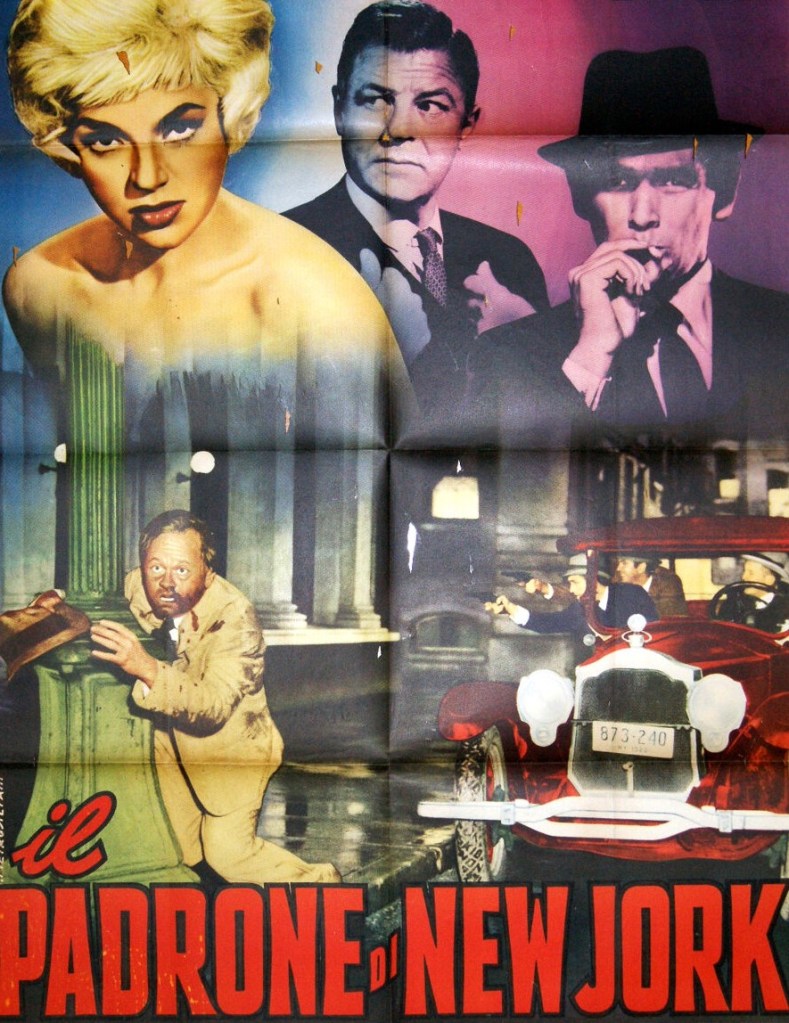
The Italian ad campaign combined a more conservative Sherlock Holmes
with exploitative illustrative detail.

As ever, the plot is complicated by red herrings and sleights of cinematic hand. But the highlight of a Holmes picture is the sleuth’s mastery of deduction based on clues missed by the ordinary mortal and every now and then the story comes to a halt to allow time for the detective to demonstrate genius. Occasionally he dons a disguise. And thoroughly enjoyable these scenes are before he gets down to the main business of uncovering the killer.

A Study in Terror introduces social depth to the Holmes saga. When the crimes focus the media spotlight on Whitechapel, Dr. Murray draws attention to the constant “murder by poverty” ignored by the state. Female exploitation is of course the norm in the sex worker business and small wonder that such women are easy targets for the Ripper and although that is an overdone trope in this case a different angle comes into play. 

Shakespearian actor John Neville (Oscar Wilde, 1960) handles the main character with considerable aplomb with Donald Houston (The Blue Lagoon, 1949) as his often baffled sidekick Watson. Robert Morley (Genghis Khan, 1965) is a splendid Mycroft although Anthony Quayle (East of Sudan, 1964) fails to nail down his Scottish accent.

The considerable supporting cast includes Judi Dench making her second film appearance, Barbara Windsor of Carry On fame, John Fraser (Operation Crossbow, 1965), John Cairney (Jason and the Argonauts, 1963), Peter Carsten (Dark of the Sun, 1968),  singer Georgia Brown (Nancy in the original stage production of Oliver!), Edina Ronay (The Black Torment, 1964), Corin Redgrave (The Girl with the Pistol,1968), former British leading lady Kay Walsh (Oliver Twist, 1948) and future television comedy writer Jeremy Lloyd (Are You Being Served?, 1972-1985).

The picture was unusual in that it was not drawn from the existing Holmes canon but as an original devised by Derek and Donald Ford (The Black Torment), the former going onto a more extensive career as a director of British sexploitation pictures such as Suburban Wives (1972). Production company Sir Nigel Films had been set up as an official vehicle to exploit the Holmes legacy.

Director James Hill (The Kitchen, 1961) had won an Oscar for the short Giuseppina (1960) and was a year away from his breakthrough Born Free. Given the low-budget this is a highly watchable picture.

Flick Vault has this for free on Youtube or if you want to own it forever there’s a DVD.

Topaz (1969) ****

Authentic, atypical, engrossing, this grittier Hitchcock mixes the realism of Psycho (1960) and Marnie (1964) with the nihilism of The Birds (1963), a major departure for a canon that previously mostly spun on innocents or the falsely accused encountering peril. The hunt for a Russian spy ring by way of the Cuban missile crisis forms the story core but the director is more interested in personal consequence and even the villain suffers heart-rending loss. Betrayal is the other key theme – defection and infidelity go hand in hand.

The tradecraft of espionage is detailed – dead letter drops, film hidden in typewriting spools, an accidental collision that is actually a sweet handover. In a transcontinental tale that shifts from Copenhagen to New York to Cuba to Paris, there is still room for classic sequences of suspense – the theft of secret documents in a hotel the pick – and Hitchcock at times simply keeps the audience at bay by employing dumbshow at key moments.    

In some respects the director was at the mercy of his material. In the documentary-style Leon Uris bestseller (almost a procedural spy novel), the main character is neither the trigger for the plot nor often its chief participant and is foreign to boot. So you could see the sense of employing a cast of relative unknowns, otherwise an audience would soon grow restless at long absences from the screen of a Hollywood star of the caliber of a Cary Grant or Paul Newman. It is a florist (Roscoe Lee Browne) who carries out the hotel theft, a small resistance cell the spying on Russian missiles in Cuba, a French journalist who beards one of the main suspects, not the ostensible main character, French agent Andre Devereux (Frederick Stafford), not his U.S. counterpart C.I.A. operative Michael Nordstrum (John Forsythe) nor Cuban villain Rico Parra (John Vernon).

Unusual, too, is the uber-realism. The main characters are fully aware of the dangers they face and of its impact on domestic life and accept such consequence as collateral damage. It is ironic that the Russian defector is far more interested in safeguarding his family than Devereux. Devereux’s wife (Dany Robin), Cuban lover Juanita (Karin Dor) and son-in-law (Michel Subor) all suffer as a result of his commitment to his country. And that Juanita (Karin Dor), leader of the Cuban resistance cell, is more of a patriot than the Russian, refusing to defect when offered the opportunity. Hitchcock even acknowledges genuine politics: the reason a Frenchman is involved is because following the Bay of Pigs debacle in 1961 American diplomats were not welcome in Cuba.

In terms of bravura Hitchcock, the pick of the scenes are the hotel theft and the death of one of the principals, filmed from above.

I have steered clear of this film for over half a century. I saw it on initial release long before the name Hitchcock meant anything to me. But once it did I soon realized this film did not easily fit into the classic Hitchcock and the critics on whom I relied had always represented it as shoddy goods. So I came to it with some trepidation and was surprised to find it so engrossing.  

Frederick Stafford (O.S.S. 117: Mission for a Killer, 1965) was excellent with an insouciance reminiscent of Cary Grant and a raised eyebrow to match that star’s wryness. John Vernon, who I mostly knew as an over-the-top villain in pictures such as Fear Is the Key (1972), was surprisingly touching as the Cuban bad-guy who realizes his lover is a traitor. And there is a host of top French talent in Michel Piccoli (Belle de Jour, 1967), Philippe Noiret (Justine, 1969) Dany Robin (The Best House in London, 1969) and Karin Dor (You Only Live Twice, 1967).

As you are possibly aware, three endings were shot for this picture and I can’t tell you which I saw without spoiling the plot. If you want to know, read tomorrow’s Blog.

In any case, this is worth seeing more than just to complete a trawl through the entire Hitchcock oeuvre, a very mature and interesting work.

The Split (1968) ***

You could not have a more explosive start. In the wake of the seismic slap Sidney Poitier delivered to an arrogant white man in In the Heat of the Night (1967) heist mastermind McClain (Jim Brown) bursts out of the traps by: picking a down-and-dirty knuckle-duster of a fight with hardman Bert (Ernest Borgnine); ramming a limo driven by Harry (Jack Klugman); locking technical wizard Marty (Warren Oates) in an electronic cell; and bracing marksman Dave (Donald Sutherland). It turns out these are all auditions for a $500,000 robbery from the Los Angeles Coliseum during a football match. Nonetheless, the point is made. Despite explanation for the ferocity it scarcely masks the fact that here was a hero unwilling to take any crap from anybody.

The Split follows the classic three acts of such a major crime: recruitment, theft, fall-out. Gladys (Julie Harris) sets up the daring snatch, entrusting a down-on-his-luck McClain –   attempting reconciliation with divorced wife Ellie (Diahann Carroll) – with pulling together a gang with particular sets of skills. The clever heist goes smoothly, the cache smuggled out in a gurney into a stolen ambulance, itself hidden in a truck, and spirited away to Ellie’s apartment until the ruckus dies down.

But someone else has a different plan. The stolen money is stolen again. McClain, responsible for its safekeeping, is blamed for its loss, while he suspects all the others. Adding to the complications is a corrupt cop (Gene Hackman). So it’s cat-and-mouse from here on in, McClain dodging bullets as he attempts to clear up the mess, find the loot and evade the cops.  

British release in a double bill with “Woman without a Face
originally released in the U.S. as “Mister Buddwing.”

The title refers to the way the way the money is intended to be shared out but it could as easily point to a film of two halves – recruitment/robbery and fall-out. The first section has several stand-out moments – a split-screen credit sequence, Marty’s desperate strip inside the cell to prevent the electronic door closing, an asthma attack mid-robbery, the beat-the-clock element of the heist, Dave’s targeting of tires to create the massive gridlock that facilitates escape. Thereafter, the tension grows more taut, as the thieves fall out with murderous intent.

One of the joys of the picture is watching a bunch of actors on the cusp. Jim Brown (The Dirty Dozen, 1967) was in the throes of achieving a stardom that would soon follow for Hackman (Bonnie and Clyde, 1967), Sutherland (also The Dirty Dozen) and Oates (Return of the Seven, 1966). Brown is tough and cynical in the Bogart mold, a loner with lashings of violence in his locker. Of the supporting cast, Sutherland’s funny maniac, complete with mordant wit, is the pick and he has the movie’s best line (“The last man I killed for $5,000. For $85,000 I’d kill you seventeen times.”) Hackman reveals an intensity that would be better showcased in The French Connection (1971) and Borgnine, Oscar-winner for Marty (1955) reverts to his tough guy persona. Having said that, you only get glimpses of what they are capable of.

Making the biggest step-up is Scottish director Gordon Flemyng whose last two pictures were Dr Who and the Daleks (1965) and Daleks’ Invasion Earth A.D. 2150 (1966). He helms the picture with polish and confidence, allowing the young bucks their screen moments while wasting little time in getting to the action and pulling off a mean car chase.

Crime writer Richard Stark’s (pseudonym of Donald E. Westlake) was careful to sell the rights to his books one-by-one so that no single studio could acquire his iconic thief Parker. That accounted for him being renamed Walker in Point Blank (1967), Edgar in Pillaged (1967) and McClain in The Split, which was based on Stark’s The Seventh (that fraction being the character’s share of the loot).

Return to Sender (1963) ***

The B-film’s B-film. Where American B-pictures invariably focused on sleaze, sci-fi, horror or violence, their British counterparts often exuded class with solid acting, clever plots, excellent though simple sets and good composition. Edgar Wallace, the world’s most prolific writer, had regained sudden popularity thirty years after his death, and movies made from his works made ideal subjects for B-pictures fed into the British double-bill system. His thrillers are all story, racing along with twist after twist.

On the verge of being arrested for fraud, high-class businessman Dino Steffano (Nigel Davenport) hits on blackmail as a means of forcing investigator Robert Lindley (Geoffrey Keen) to drop the case. He sets up associate Mike Cochrane (William Russell) to fake photographs involving sexy Lisa (Yvonne Romain) and Lindley in compromising positions. So Lisa, pretending to hold vital evidence, lures him to her flat where this can be staged.

Meanwhile Lindley’s daughter Beth (Jennifer Daniel) chats up Cochrane after overhearing him asking questions about her father’s cottage. Cochrane has history with Lindley, an 18-month prison sentence the result of a previous encounter. He also resents Steffano over previous double-dealing and is planning to take his own revenge while carrying out the master plan.

I doubt if you will be able to see the twists coming. Suffice to say, nothing is what it seems. The closer Lindley gets to uncovering the mystery, the darker it becomes and the more danger he appears to be in. Even when characters reveal their plans, you can be sure they will have a different one up their sleeve. Steffano’s exceptional charm masks his ruthlessness. While Lindley is dogged, he is no match for the slinky Lisa who can play the vulnerable female with ease. Artist Beth treasures her independence so much that it takes her down some devious alleys, especially when trying to pump Cochrane for information. And it all leads to a terrific climax, involving further twists and double-dealing.

Most of this is played out in classy apartments with log fires burning and Steffano drinking brandy and smoking cigars, or on a yacht, or Lindley’s equally splendid chambers.

The cast are either up-and-coming movie stars or destined for small-screen fame. Many of these Edgar Wallace thrillers would prove stepping stones for new talent.

Nigel Davenport (The Third Secret, 1964) is the pick and would become an accomplished supporting actor in films like Play Dirty (1969). Yvonne Romaine had already made a splash in The Frightened City (1961) and would go on to play the female lead in Devil Doll (1964) and The Brigand of Kandahar (1965). Geoffrey Keen (Dr Syn, Alias The Scarecrow, 1963) would make a bigger impact on television in Mogul (1965-1972). As would William Russell (The Great Escape, 1963) who went on to become a long-running sidekick of Dr Who (1963-1965). Jennifer Daniel became a horror favorite with the female lead in The Kiss of the Vampire (1963) and The Reptile (1966).  

Making his movie debut director John Hales clearly benefits from a couple of decades as an editor in films like The Seventh Veil (1945) and Village of the Damned (1960) and he nips quickly from one scene to another to keep the plot ticking along while showing some gift for framing characters within a scene.  

I should point out you will easily find flaws. Strictly speaking, if you know your British police procedural, Lindley would not be an investigator, and it would not be too hard to find strains of implausibility showing. But that should not detract from this enjoyable movie.

British studio Anglo Amalgamated churned out these Edgar Wallace thrillers as double-bill fodder and, even though compromised in the budget department, they were generally well-made. Wallace was a brand-name, the country’s best-selling author on account of his 200-plus novels, most still in print long after his death, and a byword for a good read. American networks edited the features down to fit into a television series. So if you are hunting these down make sure you get the original features rather than the edited versions.

You could try this sampler on Amazon Prime but if you like what you see you would be better to buy one of the box sets.

Seven Golden Men (1965) ****

Very stylish caper picture that dispenses with the recruitment section, the ingenious hi-tech robbery accounting for the first half, escape and double-cross the second, a slinky Rosanna Podesta (the eponymous Helen of Troy, 1956, in case you’ve forgotten, and also appearing in Sodom and Gomorrah, 1962) an added attraction/distraction. The Professor (Phillippe Leroy), in bowler hat and umbrella, orchestrates the gold bullion theft from an uber-secure bank using hidden microphones, cameras and a host of electronic equipment, the inch-perfect heist organized to mathematical precision and timed to the second.

His team, disguised as manual workers, dig under the road, don scuba gear to negotiate a sewer, drill up into the gigantic vault and then suck out the gold bars using travelators and hoists. Giorgia (Podesta), sometimes wearing cat-shaped spectacles, a body stocking and other times not very much, causes the necessary diversions and plants a homing device in a safety deposit box adjacent to the vault. Occasionally her attractiveness causes problems, priests in the neighboring block complaining she is putting too much on show.

It’s not all plain sailing. A cop complains about the workmen working during the sacrosanct siesta, a bureaucrat insists on paperwork, a radio ham picks up communication suggesting a robbery in progress, the police appear on the point of sabotaging the plan.

But the whole thing is brilliantly done, the calm professor congratulating himself on his brilliance, Giorgia seduction on legs. The getaway is superbly handled, the loot smuggled out in exemplary fashion, its destination designed to confuse. Then it is double-cross, triple-cross and whatever-cross comes after that, and with every reversal no idea what is going to happen next. It is twist after twist after twist. Some of the criminals are slick and some are dumb so as well as the high drama there are moments of exquisite comedy.

Italian writer-director Mario Vicario (The Naked Hours, 1964) handles this European co-production with considerable verve and although, minus the normal recruitment section, we don’t get to know the team very well except for The Professor and Giorgia each is still given some little identity marker and in any case by the time they come to split the proceeds we are already hooked. Frenchman Phillippe Leroy (Castle of the Living Dead, 1964) is the standout as a mastermind in the British mold, a stickler for accuracy, calm under pressure, working with military discipline. Podesta (also The Naked Hours) has no problem catching the camera’s attention or playing with the emotions of the gang  to fulfill her own agenda. The gang is multi-national – German, French, Italian, Spanish, Portuguese, Irish – with only Gabriel Tinti likely to be recognized by modern audiences.

And there is a terrific score by Armando Trovajoli (Marriage Italian Style, 1964) that changes mood instantly scene by scene. One minute it is hip and cool jazz, the next jaunty, and then tense.

If ever a picture was pure cult, this is it.

Maroc 7 (1967) ***

With a string of Swinging Sixties fashion models providing the requisite bevy of beauties, a gang of thieves, a Moroccan heist, superb locations, great cast and a touch of archaeology with secret chambers and a long-lost relic thrown in, this splendid espionage frolic proves a welcome return to big screen top billing for Gene Barry after nearly a decade in television in Bat Masterson (1958-1961) and  Burke’s Law (1963-1966).

Something of a cat burglar himself, Simon Grant (Barry) infiltrates a gang which uses fashion as a cover and whose ingenious speciality is to steal famous heirlooms and replace them with fake ones in the assumption that on their departure from a foreign country the customs officers will not be able to tell the difference. Louise Henderson (Cyd Charisse) and Raymond Lowe (Leslie Phillips) head up the gang while Claudia (Else Martinelli) may or may not be in on the act.

Her dalliance with Simon suggests an inclination towards the right side of the law but the fact that she has been involved with the pair for so long sets up the intriguing notion that she is stringing the American agent along. Initially, she rejects Simon’s advances until told by Louise to comply and pump him for information leading to one of the movie’s best lines (and innuendo that a British audience in particular would adore). Says Simon: “We haven’t done much about pumping but maybe that will come later.”  Doubts also surround the intentions of Michelle Craig (Alexandra Stewart).  On their trail is Inspector Barrada (Denholm Elliott).

There is mystery aplenty and a fair quotient of punch-ups, romance, shoot-outs and murder while the unearthing of the hidden treasure is less heist amd more straightforward Indiana Jones. The fashion is the icing on the cake. The Moroccan fashion shoots are more than merely decorative, or an excuse to bare the charms of the gorgeous models. Instead, the shoots would not disgrace Vogue or any of the other glossy magazine temples to haute couture, with that Sixties focus on fabulous clothes, genuine location and outlandish hairstyles.

On top of that, several of the stars are either playing against type or out of their comfort zones. Legendary Hollywood dancer Cyd Charisse famed for such classic musicals as The Bandwagon (1953) and Silk Stockings (1957) sets such fluff aside to essay a criminal mastermind, whose cunning often gets the better of Simon. Leslie Phillips (Crooks Anonymous, 1962), better known as a charming Englishman with an eye for the ladies, is as ruthless a photographer as he is a criminal. Director Gerry O’Hara (The Pleasure Girls, 1965) has managed to get both Phillips and Denholm Elliott to drop their standard methods of delivery, usually embracing a drawl, making their characterisations a good bit more fresh than normal. Phillips was clearly intending to make some kind of career change since he was the producer.

Gene Barry makes a perfect entrance as an adventurer-spy, as confident in his seduction techniques without women falling at his feet like James Bond, with a nice line in self-deprecation and more than able to look after himself. Before being side-tracked by television, Barry had shown movie star potential in War of the Worlds (1953) and Thunder Road (1958) and now he delivers on that earlier promise. Elsa Martinelli (Hatari!, 1962) is the femme fatale who may or may not wish to play that role, keeping the audience completely on edge as to which side of the law she is likely to come down on. Added bonuses are Alexandra Stewart (Only When I Larf, 1968), Angela Douglas (Carry On Screaming!, 1966), Tracy Reed (Hammerhead, 1968), dancer Lionel Blair (A Hard Day’s Night, 1964) and Maggie London.

The Hitman’s Wife’s Bodyguard (2021) ****

Contrary to all my expectations – and the opinions of the Rotten Tomatoes critical aggregate – this was a blast. The over-the-top tongue-in-cheek action thriller is dominated by Salma Hayek who acts as a glorious foil to the bickering bad boys. Had she not been so well established, this would have been a career-making turn. It might yet give her a fresh burst of cinematic life away from the serious stuff to which she has previously devoted her screen life.

This movie follows the new rule for sequels, in that often these days they are better than the original. I had not been so taken with The Hitman’s Bodyguard (2017), which basically turned on the old idea of a mismatched duo with a more straightforward storyline.

This time round, disgraced bodyguard Michael Bryce (Ryan Reynolds) is forced out of a very brief self-imposed retirement by Sonia Kincaid (Salma Hayek), who had small role in the original, to rescue husband Darius (Samuel L. Jackson) from gangsters. The main plot is straightforward enough – Greek shipping tycoon Aristotle Papadopolous (Antonio Banderas) plans to hold Europe to ransom after the EU imposes financial sanction on his native country by knocking out all digital communication throughout the continent. Interpol agent Bobby O’Neill (Frank Grillo) forces the trio to work together to foil the plot.

But there are a host of wonderful, and occasionally surprisingly emotional, subplots. For a Start Sonia is desperate to become a mother with question-marks about Darius’s ability or wish to make her pregnant. Bryce has vowed to give up violence and we get to meet his father, a legendary hitman (Morgan Freeman) who adds surprising complications to the story. Bobby O’Neill is constantly at odds with boss Crowley (Caroline Goodall) and can barely understand a word spoken by Scottish interpreter Ailso (a very dry Alice McMillan). Aristotle once had a thing for Sonia and his chief bodyguard Magnusson (Tom Hopper) is by far the coolest bodyguard on show.

The action just batters along, fueled by various plot twists, and there is hardly a pause for breath as the hitmen and their adversaries destroy a ton of Europe’s most attractive cities. There are also plenty of laugh-out-loud moments. There’s nothing remotely serious about the plot beyond personal issues facing the trio and that the preposterousness reaches high-octane levels only adds to the fun. If it’s not a shoot-out, it’s a chase. If the trio are not killing each other, they are trying to save each other. And there is a surprise ending which may trigger another sequel.

Salma Hayek (Oscar-nominated for Frida, 2002) at full throttle both emotionally, vocally and in murderous mode steals the picture. She delivers some hilariously salty dialogue in amongst the profanity and proves no slouch in the cunning department. All guns blazing is her default. Ryan Reynolds (Deadpool, 2016) I found to be surprisingly good, too, a long way from the cocky screen persona he has inhabited of late, most of the time here emotionally vulnerable, in part due to his current antipathy towards violence but also from childhood demons, and spending most of the time taking one beating after another, once so convincingly dead that hitman and wife callously dump his overboard.

Samuel L. Jackson (Glass, 2019) could play this kind of role in his sleep but he, too, is given some emotional depth. Only Antonio Banderas (The Mask of Zorro, 1998) overplays his role. Caroline Goodall (Hunter Killer, 2018) is great as the crisp authority figure and Frank Grillo (Point Blank, 2019) as the eternal underling. It’s great to see Oscar-winner Morgan Freeman (The Shawshank Redemption, 1994) back in action – and more action than you might initially expect – and there is a cameo from Richard E. Grant (Withnail and I, 1987).

Patrick Hughes reprises his directorial duties, respectively, from the original and turns in a fresh take.

I caught this on my weekly Monday Night at the Cinema outing, catching films on the big screen before they are belittled on the small screen.

Readers’ Top 30

I’ve been writing this Blog now for one year, beginning July 2020, so I thought I’d take a look at which posts proved the most popular (in terms of views) with my readers. So here’s the annual top 30 films, ranked in order of views.

  1. The Secret Ways (1961) – Richard Widmark and Senta Berger – making her Hollywood debut – behind the Iron Curtain in gripping adaptation of the Alistair Maclean thriller.
  2. Ocean’s 11 (1960) – Frank Sinatra, Dean Martin, Sammy Davis Jr. and the Rat Pack in entertaining heist movie set in Las Vegas.
  3. It’s Not All Rock’n’Roll (2020) – remarkable documentary about the other side of the music business as ageing rocker Dave Doughman tries to keep his dreams alive.
  4. Age of Consent (1969) – British actress Helen Mirren makes her movie debut as the often naked muse for painter James Mason in touching drama directed by Michael Powell.
  5. The Venetian Affair (1966) – Robert Vaughn shakes off his The Man from Uncle persona in taut Cold War thriller also starring Elke Sommer as his traitorous wife and Boris Karloff in a rare non-horror role.
  6. The Golden Claws of the Cat Girl / La Louve Solitaire (1968) – French cult thriller starring Daniele Gaubert as sexy cat burglar forced to work for the government.
  7. Pharoah / Faron (1966) – visually stunning Polish epic about the struggle for power in ancient Egypt.
  8. The Swimmer (1968) – astonishing performance by Burt Lancaster as a man losing his grip on the American Dream.
  9. Stiletto (1969) – Mafia thriller with hitman Alex Cord and and illegal immigrant girlfriend Britt Ekland hunted by ruthless cop Patrick O’Neal.
  10. The Naked Runner (1967) – after his son is taken hostage businessman Frank Sinatra is called out of retirement to perform an assassination.
  11. Marnie (1964) – Sean Connery tries to reform compulsive thief Tippi Hedren in Alfred Hitchcock thriller.
  12. Our Man in Marrakesh / Bang! Bang! You’re Dead (1966) – Entertaining thriller sees Tony Randall and Senta Berger mixed up in United Nations plot involving the likes of Klaus Kinski and Herbert Lom.
  13. The Happening (1967) – Anthony Quinn locks horns with Faye Dunaway and a bunch of spoiled rich kids in kidnapping yarn.
  14. Dark of the Sun / The Mercenaries (1968) – Rod Taylor and Jim Brown head into the heart of darkness in war-torn Africa with a trainload of diamonds and refugees including Yvette Mimieux.
  15. The Guns of Navarone (1961) – men-on-a-mission Alistair Maclean World War Two epic with all-star cast including Gregory Peck, David Niven, Anthony Quinn, Anthony Quayle, Stanley Baker, Irene Papas, James Darren and Gia Scala.
  16. The Sicilian Clan (1969) – three generations of French tough guys – Jean Gabin, Lino Ventura and Alain Delon – clash in Mafia-led jewel heist.
  17. 4 for Texas (1963) – Frank Sinatra and Dean Martin as double-dealing businessmen in highly entertaining Robert Aldrich Rat Pack western starring Ursula Andress and Anita Ekberg.
  18. Five Golden Dragons (1967) – Innocent playboy Robert Cummings becomes enmeshed with international crime syndicate led by Christopher Lee, George Raft and Dan Duryea.
  19. Duel at Diablo (1966) – James Garner and Sidney Poitier team up to protect Bibi Andersson in Ralph Nelson western.
  20. Move Over Darling (1963) – after years marooned on a desert island Doris Day returns to find husband James Garner just married to Polly Bergen.
  21. Pressure Point (1962) – prison psychiatrist Sidney Poitier is forced to treat paranoid racist inmate Bobby Darin.
  22. Wonder Woman 84 (2020) – in one of the few films to get a cinematic screening during lockdown, Gal Gadot returns as mythical superhero to battle supervillain Kristen Wiig.
  23. Genghis Khan (1965) – Omar Sharif as the Mongol warrior who conquered most of the known world, tangling with rival Stephen Boyd and Chinese mandarin James Mason on the way.
  24. A Fever in the Blood (1961) – Warner Bros wannabes Efrem Zimbalist Jr, Angie Dickinson, Jack Kelly and veteran Don Ameche in tough political drama.
  25. The Prize (1963) – Paul Newman and Elke Sommer investigate murder in the middle of the annual Nobel Prize awards in Sweden.
  26. In Search of Gregory (1969) – wayward Julie Christie embarks on pursuit of Michael Sarrazin who may – or may not – be a figment of her imagination.
  27. Justine (1969) – Dirk Bogarde and Michael York become entangled in web woven by Anouk Aimee in corrupt pre-World War Two Middle East.
  28. The Girl on a Motorcycle (1968) – singer Marianne Faithful in a hymn to the open road and sexual freedom.
  29. Blindfold (1965) – psychiatrist Rock Hudson and dancer Claudia Cardinale in highly entertaining mystery thriller about missing scientists.
  30. Hammerhead (1968) – secret agent Vince Edwards and goofy Judy Geeson on the trail of evil mastermind Peter Vaughn.

My Five-Star Picks for the First Year of the Blog

It’s a been a fabulous year for watching the movies and my pictures of the year (the first full year of the Blog running from July to June, I hasten to add) make up an eclectic collection ranging from historical epics, dramas and westerns to horror, thrillers and comedy. Although this is my chosen decade, many of the films I was seeing for the first time so it was interesting to sometimes come at a film that had not necessarily received kind reviews and discover for one reason or another cinematic gems. There was no single reason why these pictures were chosen. Sometimes it was the performance, sometimes the direction, sometimes a combination of both.

The westerns I most enjoyed came from either ends of the decade – John Wayne and Rock Hudson in magnificent widescreen spectacle The Undefeated (1969) and Yul Brynner, Steve McQueen, Charles Bronson, James Coburn and the team in The Magnificent Seven (1960).

There was another ensemble all-star cast in J. Lee Thompson war film The Guns of Navarone (1961) one of the biggest hits of the decade with Gregory Peck, Anthony Quinn, David Niven, Stanley Baker et al.

Horror brought a couple of surprises in the shape of Daliah Lavi as the Italian peasant succumbing to The Demon (1963) and Peter Cushing menaced by The Skull (1965).

Not surprisingly perhaps Alfred Hitchcock headed the ranks of the five-star thrillers, but surprisingly to some, this was in the shape of Marnie (1964) with Sean Connery and Tippi Hedren rather than some of his decade’s more famous / infamous productions.  Heading the romantic thrillers was the terrifically twisty Blindfold (1965) with Rock Hudson and Claudia Cardinale teaming up to find a missing scientist. The Sicilian Clan (1969) proved to be a fine heist picture in its own right as well as a precursor to The Godfather with a topline French cast in Alain Delon, Lino Ventura and Jean Gabin.

Only one comedy made the five-star grade and what else would you expect from Billy Wilder’s Some Like It Hot (1959), slightly outside my chosen remit of films from the 1960s, but impossible to ignore the chance to see Marilyn Monroe, Tony Curtis and Jack Lemmon strutting their stuff on the big screen. For the same reason I had the opportunity to re-evaluate Ridley Scott’s Oscar-winning historical epic The Gladiator (2000) that gave Hollywood a new action hero in Russell Crowe. Stylish contemporary sci-fi chiller Possessor (2000), from Brandon Cronenberg,  was another one seen on the big screen, one of the few in this year of the pandemic.

Most people would certainly put Paul Newman as prisoner Cool Hand Luke (1967) in this elevated category but, to my surprise, I found several other dramas fitted the bill. The clever sexy love triangle Les Biches (1968) from French director Claude Chabrol made his name. Burt Lancaster turned in a superlative and under-rated performance in the heart-breaking The Swimmer (1968) about the loss of the American Dream. Rod Steiger, on the other hand, was a hair’s-breadth away from picking up an Oscar for his repressed turn as The Pawnbroker (1964).

Two films set in the Deep South also made the list – Marlon Brando in Arthur Penn’s depiction of racism in small-town America in The Chase (1966) with an amazing cast also featuring Jane Fonda and Robert Redford, and Michael Caine as a more than passable arrogant southerner in Otto Preminger’s Hurry Sundown (1967) opposite rising star Faye Dunaway. Dennis Hopper and Peter Fonda’s hymn to the freedom of the motorbike in Easy Rider (1969) turned into a tragic study of attitudes to non-conformity.

For only eighteen films out of a possible two hundred to make the cut indicates the high standards set, and I am looking forward to as many, if not more, brilliant films in the year to come.

Discover WordPress

A daily selection of the best content published on WordPress, collected for you by humans who love to read.

The Atavist Magazine

by Brian Hannan

WordPress.com News

The latest news on WordPress.com and the WordPress community.