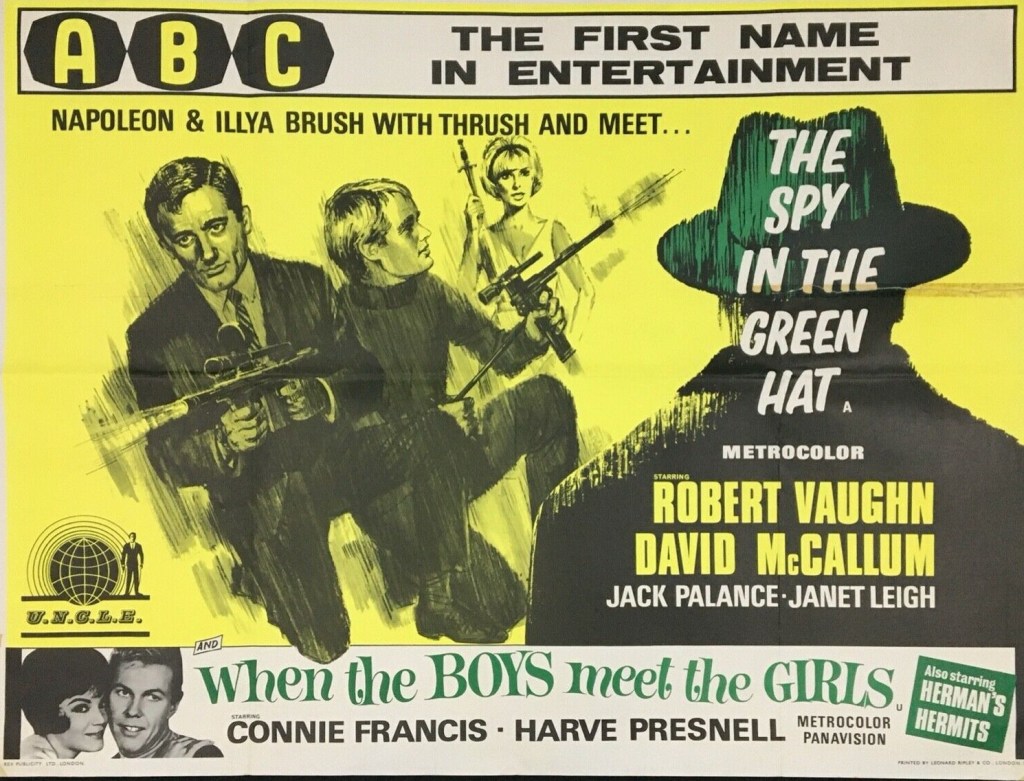
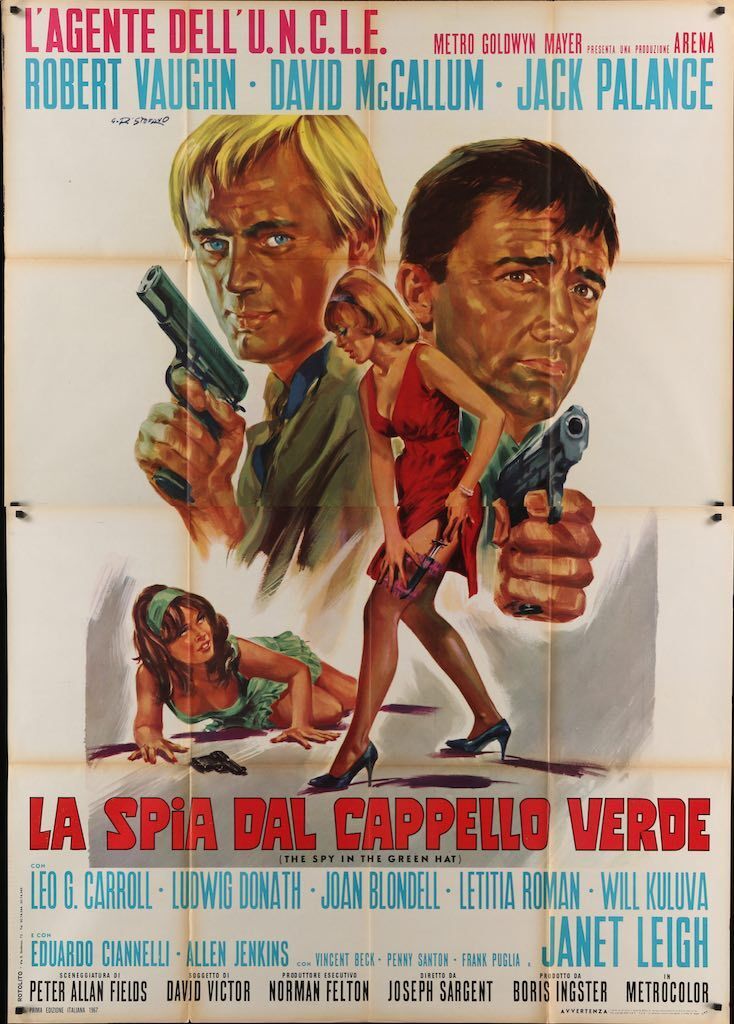
The Spy in The Green Hat (1966) ***

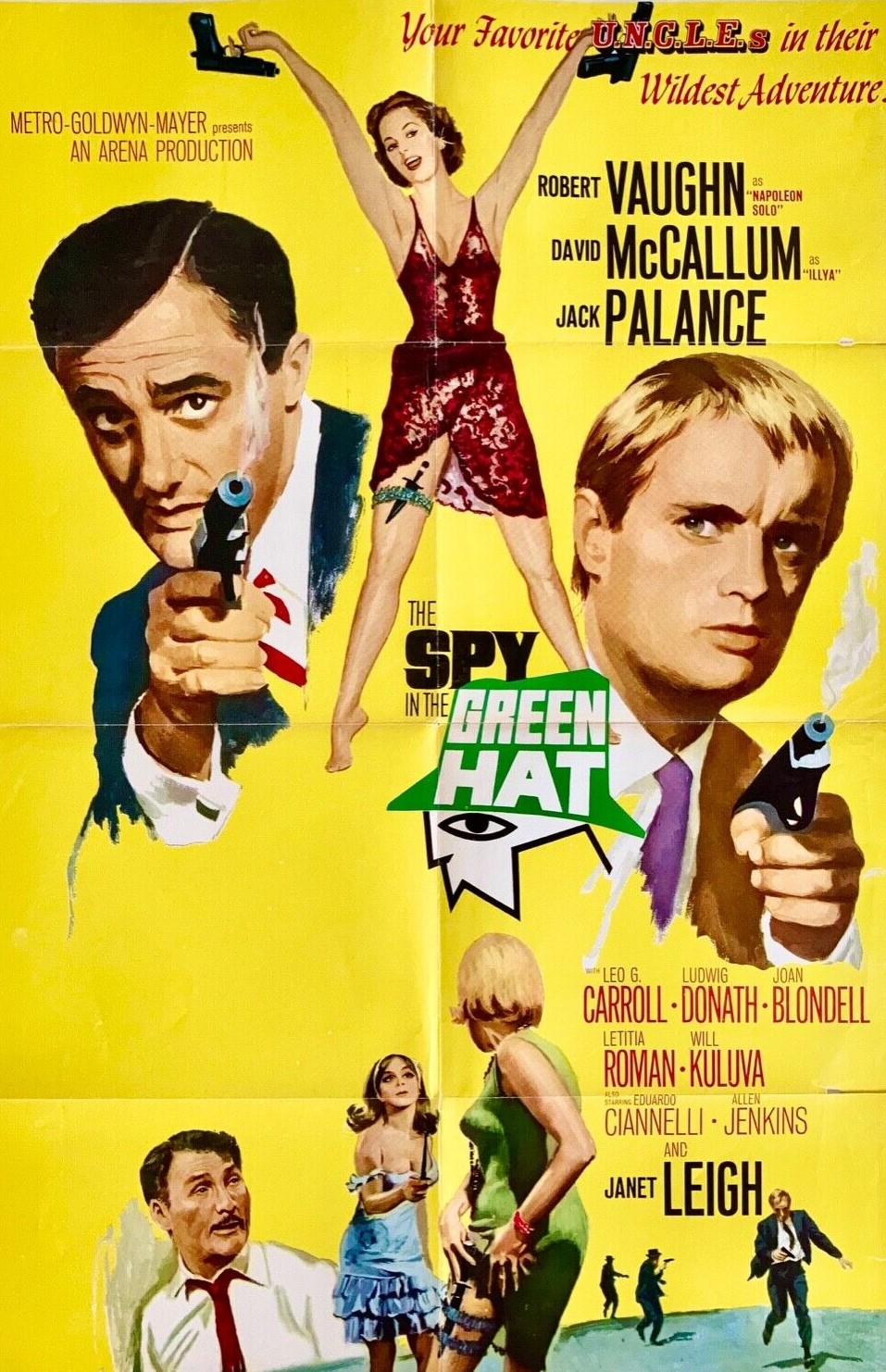
Unable to compete with the influx of big budget espionage pictures, The Man from U.N.C.L.E. throws in the action towel and comes out fighting as a comedy, and a more preposterous storyline you would be hard to find. As if spoofing a genre it helped create, our intrepid heroes find themselves in captivity one way or another, outwitted by a posse of retired Mafia hoods or sadistic females.

Napoleon Solo (Robert Vaughn) and Ilya Kuryakin (David McCallum) can’t even manage a chase, crashing the car in pursuit of former Nazi scientist Dr Von Kronen (Ludwig Donath). The trail leads to Sicily where Solo, again incapacitated, meets the sultry Pia (Leticia Roman) and as a result of a romantic misunderstanding is forced into a shotgun wedding in Chicago by her Mafia uncles, the famed Stilletto Brothers.

Meanwhile, Kuryakin makes the acquaintance of the deliciously sadistic Miss Diketon (Janet Leigh), assistant and masseuse to highly nervous Thrush boss Louis Strago (Jack Palance). The action finally shifts to the Gulf Stream, where Pia is imprisoned and the usual missiles are set to be launched in the presence of head Thrush honcho Mr Thaler (Will Kuluva) in the usual global takeover scenario.

Abandoning any attempt at serious drama, this is just a hoot, a score of sight and visual gags, references to Little Caesar and the St Valentine’s Day Massacre abound. Any time one of our heroes needs speedy access to a villain hideout along comes a guard to be bumped off and uniform purloined. Solo caught hiding under Pia’s bed is let off when discovered by a Thrush operative because he’s not the Uncle agent they are looking for. Not only is Solo constantly whacked over the head, but Kuryakin ends up as the plaything of Miss Diketon.  

Solo and Kuryakin look as if they stepped onto someone else’s parade, trying to keep the narrative on an even keel, while the Mafia gang and Thrush personnel effectively play it for laughs. Pia has Wanted posters of her uncles on her wall on the assumption they are just wonderful guys. Von Kronen gets the hots for Miss Diketon because he admires her skill at torture, although a spurned Miss Diketon turns traitor leading Kuryakin to mutter to Solo when all three meet, “I brought Lucrezia Borgia, you brought the Mafia.”

What makes it work so well are the fabulous performances of the supporting cast. Jack Palance (The Professionals, 1966), completely playing against type, still a villain sure, is a masochistic sweaty bag of nerves. Janet Leigh (Psycho, 1960) camps it up as the deadlier-than-the-male luscious female, dress slit at the thigh to reveal a hidden knife, whose pulse races at the mere thought of the cruelty she can inflict and the slower the better.  Will Kuluva (To Trap a Spy, 1964) is a bonus, the boss who just wants to party and has no idea of the technicalities of firing a missile.

Nobody even bothers to dress it up any more. The missiles look like something you would buy your kid for Xmas, the backdrops are as fake as anything on a backlot. But somehow it all works, as long as you weren’t expecting the original take on The Man from Uncle. And even so, director Joseph Sargent (One Spy Too Many, 1966) adds a few dabs of genuine cinematic icing, characters viewed from the ground-up, a fist fight that’s either in slo-mo or speeded-up freeze frame, the wife (Joan Blondell) of one of the Stiletto Brothers receiving a grapefruit in the mush.

After watching the original movie which came up better than expected in terms of action and spy malarkey, the last thing I anticipated that this would be headed in an entirely different direction. When that quickly became obvious, I feared the worst. Instead, I enjoyed a fun 90 minutes.

Of course, this wasn’t released theatrically in the U.S. just abroad with some added sex and violence, an expanded version, and in color, of a double black-and-white episode of the television series.   

See How They Run (2022) **** – Seen at the Cinema

Kind of film that needs sold on word-of-mouth and a slow platform-release rather than being bundled out to fill the distribution gap. Let the audience sing its praises first before slinging it out in wide release. Because this is a definite audience-pleaser, a fun whodunit. Though a limiting factor might be that appeal may be restricted to those of a certain age familiar with  The Mousetrap. I wouldn’t bet my last dollar, either, on modern young audiences even having a clue who Agatha Christie was, or responding to a picture set in dull, dull, Britain in a year -1953 – when there was a significantly more glorious event that might have suited better the average Downton Abbey moviegoer: the coronation of the recently-deceased Queen Elizabeth II.

Delightful pastiche on the detective story, too much to suggest it’s a piss-take on Knives Out or the latest big-screen veneration of Hercule Poirot, but it certainly has enough going for it even if none of those connections are eventually made. Certainly, there’s some sly humor in scoring points for mentioning, a la Murder on the Orient Express, that the initial murder could have been committed by all the suspects.

Basically, out of favor war hero and alcoholically-inclined cop Inspector Stoppard (Sam Rockwell) is saddled with rookie Constable Stalker (Saoirse Ronan) – two in-jokes right there, John Stalker being a very prominent British cop, playwright Tom Stoppard the author of The Real Inspector Hound – to investigate the death of Yank Leo Kopernick (Adrien Brody), in London to turn Agatha Christie’s famed play into a movie for real-life producer John Woolf (Reace Shearsmith) who made The African Queen (1951).

Virtually everyone associated with the play becomes a suspect. These include pompous playwright Mervyn Cocker-Norris (David Oyelowo), the play’s petulant producer Petula “Chew” Spencer (Ruth Wilson), real-life actor Richard Attenborough (Harris Dickinson) and even Agatha Christie (Shirley Henderson) is not above a bit of poisoning. Throw into the mix that the cops have assigned the bulk of their resources to tracking down the 10 Rillington Place serial killer – another in-joke, Attenborough playing the murderer in that movie.

One of the movie’s delights is that whereas both Stoppard and Stalker have considerable personal issues, we discover them in passing, and neither character makes a meal of them. Instead, their screen charisma works a treat, Stoppard dogged and the earnest Stalker inclined to jump the gun.

Even the “all-star-cast” is a spoof on films like “Death on the Nile.” The title was a popular one, movies in big-screen or small using it in 1955, 1964, 1984, 1999 and 2006.

The stage shenanigans are a hoot, puffed-up pride and ruthless machinations powering many of the sub-plots. There’s some pretty clever sleight-of-hand not to mention occasional cinematic avant-garde and there’s no shortage of laughs and that out-dated comedy fall-back – slapstick. The climax is particularly excellent, in part because it is a notion immediately discarded as the denouement of the proposed movie version of the play, one that succinctly critiques the differences between British and Hollywood approaches to movie-making.

Red herrings and cul-de-sacs abound, flashbacks remove any plot-holes, while managing to ram in a country-house finale takes some brio. And in among all the jokes, you might be surprised to find a serious point being made about reality vs fiction. Full marks to the virtually laugh-a-minute screenplay by Mark Chappell  (The Rack Pack, 2016) and director Tom George in his movie debut who brilliantly shuffles the deck.

Dramatic heavyweight pair Sam Rockwell (Three Billboards, Outside Ebbing Missouri, 2017) and Saoirse Ronan (Mary, Queen of Scots, 2018) prove a double-act to cherish. In gentle comedic roles at odds with virtually their entire portfolios, a wise producer might already be sizing them up for a re-run. Everyone else gets to be bitchy/scheming/ruthless to their heart’s content and certainly in those categories Adrien Brody (The Grand Budapest Hotel, 2014)  and Ruth Wilson (His Dark Materials, 2019-2022) win hands-down. But spare a thought for excellent performances from David Oyelowo (The Bastard King, 2020), Reace Shearsmith (of League of Gentlemen TV fame), Lucian Msamati (The Bike Thief, 2020) as the imperturbable Max Mallowan, husband of the distinctly perturbed Agatha, played with venomous glee by Shirley Henderson (Greed, 2019).

I went to see it not expecting much at all and came out singing its praises. Definitely worth a whirl.

All In A Night’s Work (1961) ***

What wouldn’t Hollywood give now for a pair of personable players who could take as slight a piece of fluff as this and through sheer force of screen personality turn it into an enjoyable experience.  Based entirely around misconception, misunderstanding, characters at cross purposes and mild business satire this would have been hailed as a classic had it appeared in the golden age of the screwball comedy.  

Playboy Tony Ryder (Dean Martin) inherits a publishing empire from his uncle but discovers an unsavoury fact about his relative’s demise that could severely damage the business. A naked woman was seen running from his hotel room. When hotel house detective Lasker (Jack Weston) identifies her as Katie Robbins (Shirley MacLaine), a lowly employee in the company, the suspicious minds of big business surmise that she intends to blackmail them.

The plot, such as it is, concerns Ryder and Co’s attempts to avoid this, by bribing her to shut up and at the same discrediting her. Ryder is conflicted, in part because he fancies her rotten, in part because he doesn’t quite believe she could be so duplicitous, and in part because he can’t afford to risk believing her. For some reason, as a researcher, she is involved in union negotiations, giving him the opportunity to get to know her better, as part of a “sub-committee of two” established to examine union claims more thoroughly.

So it’s basically one set-piece after another. A flashback explains why Katie came to be in the uncle’s bedroom – to escape in the same hotel the lustful attentions of the elderly wealthy guest Kirby Hackett (Johnstone White) whom she saved from drowning. Her behaviour at the uncle’s funeral suggests she is stricken by his death. And unfortunately, she is the recipient from the grateful Hackett of a mink coat worth thousands of dollars which, on her meagre salary, she can’t explain.

Katie is dithering over her planned wedding to dull vet Warren Kingsley Jr. (Cliff Robertson) and, aiming to discredit her with him, Ryder plants the seed that actually she is a showgirl on the side, arranging for her to receive five star treatment at various nightclubs, inciting suspicion from her fiancé and his extremely conventional parents. In order to get to the bottom of everything, Ryder agrees to be bugged for a private meeting with Katie. You can imagine how that goes. But the outcome is never in doubt of course.

What the audience knows but the participants do not is that this couple is well-suited. Ryder is far from the playboy of his reputation, having started at the bottom of a rival publishing empire and worked his way up to the top, so he turns out to be a more astute businessman than the sycophants on the board anticipate – “you may not be much but you’re all we’ve got” typical of the welcome he receives. Far from being a good-time girl, Katie is a woman of principle, refusing to take the mink coat as a gift and determining to pay it off at the rate of $10 a week.

The humour derives almost entirely from the cross-purpose nature of the plot and the set-pieces work out well, especially when Ryder kidnaps a sheepdog as an excuse to visit the vet, and stumped for a reason comes up with the notion the animal is suffering from amnesia. “He gives me that ‘who are you’ look,” Ryder explains. As the tale unfolds Kingsley becomes more insufferable by the minute.    

There’s a romantic subplot involving Katie’s outgoing office chum Marge (Norma Crane) and the shy detective and some satirising of big business but that all plays out in relation to the main story.

If you remember Dean Martin from heavyweight dramas like The Young Lions (1958), Some Came Running (1958), Rio Bravo (1959) or the breezy Rat Pack comedies and the equally breezy Matt Helm spy pictures will probably not be aware he started his career in comedy, as one half of the Dean Martin-Jerry Lewis combo, a box office sensation in the early to middle 1950s. So, although he was primarily the straight man to the more obviously comedic Lewis, he was still well versed in the nuances of the genre. Nothing is ostensibly played for laughs, but he gets the laughs nonetheless.

Martin was always badly under-rated, in part because of the perma-tan, in part down to the his television show, and in part because he just wasn’t Frank Sinatra. But he was an accomplished actor, as this proves. One of the aspects of his performance I liked was that he moves with purpose. In most movies, characters cross a room or change position simply because a director calls the shots. But here, every time Martin moves it’s for a designated reason, to touch something, admire something, maneuver himself closer to someone else.

Shirley MacLaine is also refreshing, considerably less conniving or lovelorn than in her breakthrough role in The Apartment (1960), and coming to believe in her screen presence. She inhabits this character’s innocence very well, is suitably baffled on occasion, and exhibits a screen persona that simply lights up the screen. Together they are a great screen couple and in the charisma-starved Hollywood of today would be very welcome.

Cliff Robertson (The Honey Pot, 1967), almost unrecognizable without that hefty hunk of hair and the grandstanding he often effected, plays his small role to perfection. Norma Crane (Penelope, 1966) and Jack Weston (The Cincinnati Kid, 1965) – minus the screen tics he later exhibited – are quietly effective. Veteran Charles Ruggles (The Parent Trap, 1961) puts in a decent shift.    

Confident direction by Joseph Antony (The Rainmaker, 1956) in just his fourth film out of a grant total of five makes you forget this was based on a hit play by Margit Veszi and Owen Elford. The screen transition was down to Maurice Richlin (The Pink Panther, 1963), Edmund Beloin (Donovan’s Reef, 1963) and future bestselling author Sidney Sheldon (Billy Rose’s Jumbo, 1962).  

The real beauty of this piece is how effortless it all looks. The characters are grounded and believable, viewed from varying perspectives the plot remains logical, and there is enough daft invention to tickle your fancy.

The Pink Panther (1964) ***

You would have to be a fan of farce and slapstick to appreciate much of the debut of the celebrated Pink Panther franchise. I enjoy slapstick, though this is limited here to mishaps with items of furniture, but farce tends to pass me by (although I laughed myself silly at One Man, Two Guv’nors on stage). And you should be aware that this is really a dry run for the Clouseau character later hilariously perfected by Peter Sellers.

The premise is clever. Bumbling detective Clouseau (Peters Sellers, minus the pronounced French accent that appeared later) is on the trail of ace cat burglar The Phantom (David Niven), unaware that his wife Simone (Capucine) is not only in cahoots with the jewel thief but his lover. The trail leads to Switzerland where the robber plans to steal the titular diamond owned by The Princess (Claudia Cardinale). The Phantom, aka Sir Charles Lytton, attempts to get to know her better by stealing and then rescuing her dog.

Danny Kaye or Peter Sellers?

Meanwhile, to add to the confusion, Lytton’s conman nephew George (Robert Wagner) has arrived in town, and soon attempts to purloin his uncle’s mistress and on realising Lytton’s true identity stals his equipment with the intention of turning thief himself.

Lytton has the tendency to take a suite adjoining the Clouseau bedroom complete with linking doors to make it easier to make hay with Simone while the complaisant detective is lured elsewhere.

Cue a series of bedroom farces of the kind where Lytton attempting to make love to a drunken Princess in the lounge of his suite does not realise his nephew is in the bedroom and Simone expecting the uncle and finding the junior. And the classic of Simone, pursued by both men in her own room, having to hide them, on her husband’s return, in bed, cupboard, shower and bath.  

There’s a fancy dress party where competing gorillas target the famed jewel and Clouseau, clunking around in armour, knocks into or knocks down anything in sight. And finding one of his men, dressed as a zebra, drinking on duty, harangues him with the threat of having his stripes (best joke by far).

But the bulk of the laugh out loud comedy originates from the inspector’s tussles with inanimate objects, doors, even approached cautiously, appearing to be capable of springing surprises.

The original cast – Ava Gardner in the Capucine role and Peter Ustinov as Clouseau.

Unfortunately, the first Pink Panther outing was not designed with Sellers expressly in mind and so the plot, necessitating accommodating the other stars via romantic interlude, does not play to his strengths. You get the impression of Sellers improvising his way into stealing every scene he is in with his brilliant physical comedy as there’s only limited value in his role as the duped husband.

After the sequel A Shot in the Dark (1964) where Sellers took center stage Blake Edwards would go all-out slapstick in his next venture The Great Race (1965) but here there’s neither sufficient Keatonesque or Chaplinesque buffoonery or Laurel and Hardy antics to maintain the comedic momentum.

David Niven (Bedtime Story, 1964) is perfectly serviceable as the master criminal especially as it calls mostly for his legendary charm, though he brings his double take quickly up to speed. Claudia Cardinale (Once Upon a Time in the West, 1968) is surprisingly good in a light-hearted role while Robert Wagner (The Biggest Bundle of Them All, 1968), a rising star at this point, comes over as slippery ingenue. Capucine (The 7th Dawn, 1964) has the most difficult part since she is in effect playing two roles, faithful wife and wanton lover.

Despite priceless roles in Ealing comedies and various attempts to embrace the Hollywood dynamic, this was the picture that turned Peter Sellers (Heavens Above!, 1963) into a bona fide star. It says a lot for the director that, having found a comedy genius on his hands, he did his best to accommodate him without allowing him to over-dominate what was in effect a carefully-orchestrated piece.

In small roles you will find John Le Mesurier (The Liquidator, 1965) and Brenda de Banzie (A Matter of Innocence, 1967) and the chanteuse in the ski chalet you might be interested to know was Fran Jeffries (Sex and the Single Girl, 1964).  And of course the memorable theme tune, as celebrated as the movie itself, was composed by Henry Mancini (Hatari!, 1962).  The film also spawned the famous cartoon series. Edwards wrote the screenplay with Maurice Richlin (Pillow Talk, 1959).

You could do worse than splurge on a five-disc box set.

On the Fiddle / Operation Snafu (1961) ***

Unassuming but undeniably charming British World War Two comedy denied U.S. release until four years later when a savvy distributor jumped on the James Bond bandwagon. Primarily of interest these days for the opportunity to see a pre-Bond Sean Connery (Dr No, 1962) in action its merit chiefly lies in ploughing the same furrow, though with a great deal less pomposity and self-consciousness, as the later The Americanization of Emily (1964), of the coward backing into heroism.

Horace Pope (Alfred Lynch) is a scam merchant who only dodges prison by enlisting. Assigned to the RAF he teams up with Pedlar Pascoe (Sean Connery) and they embark on a series of schemes designed to keep them as far away from the front line as possible. It’s hardly an equal partnership, Pope dreams up the fiddles while Pascoe just falls in with them. It’s not dumb and dumber but a collaboration that goes no further back in the annals of movies than brain and brawn.

Needless to say, the movie lacks the the damsels in bikinis which were a prerequisite of the Bond pictures. Sean Connery takes top billing Stateside where he was originally behind Lynch.

It’s certainly a cynical number, reflecting the boredom experienced by many of the Armed Forces backroom staff, the administrators whose inefficiency turns them into easy dupes, and the determination of soldiers to take advantage of every opportunity to bend the rules. It takes the unusual position of presenting the ordinary soldier as smart and every officer as a numbskull, an approach that would only have been possible 15 years after the war ended and in marked contrast to the determined heroism of other British war films – such intrepid stiff-upper-lip behavior a hallmark of the British version of the genre.

First stop is to run an operation issuing leave passes – for a price – and the sheer effrontery exhibited by Pope is a joy to behold. Next up is selling stolen meat on the black market.

While Pedlar is the wide-eyed camp follower, and more likely to forever sit on the sidelines, cheerful but shy, and only a few pratfalls away from being a bumbling idiot, they do make a good team. Being sent to France is more of a heaven-sent opportunity to increase their bankrolls than a hazardous wartime mission as Pope sells rations to the French. Eventually, of course, their various scams are rumbled and they are forced into battle.

The only thing better than one pre-Bond Connery picture is two.

The movie switches a bit more deftly into serious mode than the aforementioned The Americanization of Emily mostly because these are actual soldiers trained to be soldiers rather than an officer who landed a cushy number and whose main effort is to avoid combat. War is presented as horrific rather than comedy and it must have been the same experience for an ordinary soldier at the time, after months of inactivity suddenly thrust into the cauldron.

The picture moves at a brisk pace and is continually amusing if not particularly laugh-out-loud. You’ve probably seen most of the set-ups before but they are reinvented with an appealing freshness and briskness  As a bonus there’s reams of British character actors and comedians – plus token American Alan King (who would appear in Connery starrer The Anderson Tapes, 1971) – along the way. The term “snafu” in case you’re interested, has a similar meaning to the “fubar” of Saving Private Ryan (1998).

Alfred Lynch (The Hill, 1965) doesn’t milk the Cockney patter overmuch and he’s got a greater international screen appeal than the likes of the more English Sid James (Carry On films) or Norman Wisdom. Think a shiftier Sgt Bilko, if the Phil Silvers creation could be any more untrustworthy.

Connery’s performance is well worth a watch as a prelude to what was to come once his roles were tailor-made. He is an effortless scene-stealer, gifted in expressing emotion through his eyes, and although verbally Lynch dominates it’s difficult to take your eyes off Connery.

The roll-call of character actors includes Cecil Parker (A Study in Terror, 1965), Stanley Holloway (My Fair Lady, 1964), John Le Mesurier (The Moon-Spinners, 1964), Graham Stark (The Wrong Box, 1966) and Victor Maddern (The Lost Continent, 1968).

Cyril Frankel (The Trygon Factor, 1966) comfortably cobbles this together from a screenplay by Harold Buchman (The Lawyer, 1970, and who had ironically enough penned the picture Snafu in 1945) based on the novel Stop at a Winner by R.F. Delderfield.

When the box office supremacy of the Bond pictures was underscored by the reissue of the Dr No/From Russia with Love double bill in 1965, distributors, as had been their wont, racked the vaults for anything featuring Connery that could be re-sold to a willing public.    

While there is a readily available DVD, this turns up on a regular basis, in Britain at least, on television.

The Grass Is Greener (1960) ***

A genuine all-star cast goes off-piste in what used to be called – and maybe still is – a comedy of manners. A chance encounters at the stately home owned by Victor (Cary Grant), an Earl who makes ends meet by opening up his home to tourists, sees his wife Lady Hilary (Deborah Kerr), who helps make ends meet by selling home-grown mushrooms, fall in love with American oil millionaire Charles (Robert Mitchum).

Victor is far too English and posh to go off in the deep end and after considering allowing her to indulge in an affair until she gets bored, comes up with a strategy to ensure it’s her lover who is shooed away. Hilary’s best friend, the glamorous and often barmy Hattie (Jean Simmons), all Dior outfits and full-on make-up,  meanwhile, steps in to attempt to rekindle her romance with former lover Charles.

Needless to say, this scene does not exist in the film.

While it’s peppered with epigrams and clever lines and several twists, what’s most memorable is the acting, the initial scene between Charles and Hilary a masterpiece of nuance, what’s shown in the face opposite to what they say. And there’s another peach of a scene where the most important element is what’s conveyed by a sigh. And by Robert Mitchum of all people, an actor not known for nuance.

But it’s let down by the staginess – it was based on a hit play – the very dated by now notion of showing the comic differences between British and Americans and the pacing. The theatrical element, thankfully, doesn’t resort to farce but with a whole bunch of entrances at unexpected moments you occasionally feel it’s heading in that direction. There are minor attempts to open up the play, a scene in the river, some location work in London and upmarket tourist haunts, but mostly it’s a picture that takes place on a couple of sets.

The British vs American trope just becomes tiresome after a while except that essentially the two men trade cultures, Victor exhibiting the kind of ruthlessness you might expect (in the old cliched fashion) from an American while Charles displays the kind of subtlety you would more likely find in an Englishman.

The pacing’s the biggest problem. The actors deliver lines at such speed that no time is allowed for the audience to laugh. The three British characters are almost manic in their urgency, while the Yank so laid-back he might belong to a different century.

Late on, a couple of subplots brighten up proceedings, a joke played on Hilary by Victor over the contents of a suitcase that she has devised an elaborate cover story to explain, and a betrayal of Hilary by her friend. Devilishly clever though it is, the duel scene almost belongs to a different picture. There’s also an amusing butler Sellers (Moray Watson), a wannabe writer, who believes, as is obvious, he is being under-employed, and pops up when the movie requires straightforward comic relief.

It starts off, via the Maurice Binder (Goldfinger, 1964) credits with babies, occasionally in the buff, unspooling film and indulging in other humorous activities. The only characters established before the plot kicks in are the Earl and the butler, Victor shown as tight-fisted, literally counting the pennies (although, literally, these are actually half-crowns, the price of admission to the stately home), the efficient Sellers revealed as otherwise baffled by life. The joke of a wealthy couple forced to rely on the income from visitors was not even much of a joke by then.

Perhaps what’s most interesting is that this movie essentially about immorality failed to click with U.S. audiences while an equally immoral picture The Apartment (1960) did superb business, the difference less relating to star quality than directorial ability, Billy Wilder’s work always having a greater edge than the confections of Stanley Donen.

It’s the supporting cast – if stars can be so termed – who steal the show. Robert Mitchum  (Man in the Middle/The Winston Affair, 1964) is just marvelous, one of his best acting jobs, relying far more on expression to carry a scene. He delivers a masterclass in how little an actor needs to do. Jean Simmons (Rough Night in Jericho, 1967) is also excellent for the opposite reason, an over-the-top mad-as-a-hatter conniving ex-lover with an eye on the main chance. That’s not to say Cary Grant (Walk, Don’t Run, 1966) and Deborah Kerr (The Arrangement, 1969) are not good, just overshadowed, and Kerr’s first scene with Mitchum, where she, too, realizes she is falling instantly in love is remarkably underplayed.

Stanley Donen (Arabesque, 1966) should have done more, pre-filming, to tighten up the script and expand the production. Hugh Williams and Margaret Vyner adapted their own play. It’s entertaining enough but I was more taken by the acting than the picture.

Carry On Up the Khyber (1968) ***

After a spate of serious pictures I thought I’d treat myself to some lighter fare and indulge in double entendres and lavatorial humor. I didn’t realise I had picked the only Carry On picture with serious undertones, exploring the hypocrisy endemic among leadership as much as witnessed in The Charge of the Light Brigade (1969), taking a distinct anti-colonial stance, and poking fun at military inefficiency.  

Despite the need to keep up appearances, British governor Sir Sidney Ruff-Diamond (Sidney James) despises Indian counterpart The Khasi of Kalabar (Kenneth Williams), the truth of their feelings towards each other revealed in muttered asides. Appearances are all that stand between the British and an Indian revolution, the natives fearing the Scottish regiments, the famed kilt-wearing “devils-with-skirts.”

The notion that any army would run a mile from a pair of bollocks – unless of course they had the faint-inducing dimensions of a Thor – is of course bollocks but that’s the film’s central conceit. But when the Indians discover that the British actually wear cotton undergarments as protection against the windy privations of the northernmost parts of the country, and, through the treacherous Lady Ruff-Diamond (Joan Sims), gain potential access to photographic proof, the status quo is threatened.

Lady Ruff-Diamond, furious at her husband’s constant infidelities, has set her eye on the Khasi, and is willing to betray her country for a bit of what could be termed “the other.” A squad of the usual British misfits, despatched to recover the incriminating evidence, naturally enough finds itself in a harem while Sir Ruff has to keep the British end up by entertaining native lasses by the score (he keeps count). When war does break out, the British, under siege, do what they are famous for, which is nothing.

You might have to be British to grasp many of the jokes, Khyber Pass and Khazi both have toilet associations, for example, but other visual gags would not be out of place in a Charlie Chaplin sketch. “Please close the gate” reads a sign on the border. Outside the Governor’s mansion is another sign “No Hawkers.” And you might at times believe the entire production was Chaplinesque, some of the jokes being ancient – “call me an elephant” orders Sir Sidney, referring to the mode of transport, only to be hit by the rejoinder “you’re an elephant.”

Many set-ups are obvious – black-faced British troops tumble into a bath. The double entendres are occasionally inspired – fakir, bullocks and shot among the perfectly innocent words so rendered. But the jokes come so thick and fast that by the time you’ve complained about a poor one an absolute cracker is on the way. Some contemporary notes are struck, references to cuts (at a time when Britain was suffering economically) and a muscular servant striking a gong (reference to the introduction to all films made by British studio Rank).

However, the political insight, if that’s not too complimentary, is not sustained and it soon collapses into more straightforward Carry On territory. A film like this comes of course with multiple warnings about sexism, racial stereotypes, blackface and anything else that could possibly offend, since that was the team’s denoted purpose, and, as you will be aware, it couldn’t be made nowadays so enjoy it – or as much of it as you can stomach – while you can.

Prior to the emergence of the Bond goldmine this was the closest thing the British movie industry had to a solid-gold franchise, this being the 16th in the series. Gerald Thomas directs from a Talbot Rothwell screenplay and the cast involves usual suspects Sidney James, Kenneth Williams, Joan Sims, Charles Hawtrey and Peter Butterworth. Angela Douglas (The Comedy Man, 1964) supplies the glamour and you might spot Wanda Ventham (The Blood Beast Terror, 1968) and Valerie Leon (Blood from the Mummy’s Tomb, 1971) in walk-on parts.

Oddly enough, the early Carry On pictures, seen as the natural successors to Ealing, if somewhat ruder, achieved minor cult status in the United States, Carry On Nurse (1960), the flagship, playing for over 40 weeks in Denver and clocking up $2 million in nationwide rentals (“Carry On Nurse US Rentals Run Over $2,000,000,” Variety, February 14, 1962, p3). However, no others approached that peak and “never received any hard sell to the U.S. and it remained for audiences to discover their buffoonery on double bill programs usually playing second fiddle to reissues of major British  hits” (“Carry On Mostly Discovered By Yankee Fans,” Variety, February 5, 1969, p22). Despite a positive review in Variety (Dec 25, 1968, p18) which deemed it a “beautifully timed and very funny piece of comedy film-making,” Carry On Up the Khyber made little impact on U.S. audiences recording just about $100,000 in rentals (“Variety B.O. Charts 1969 Results,” Variety, April 29, 1970, p26), that figure achieved by rounding up in the normal fashion.

How To Murder Your Wife (1965) ***

Men had a hell of a time in the 1960s to judge from this riff on marital strife that starts off like Walter Mitty meets The Odd Couple. It’s one of those daft comedies that only work on their own terms – and for the most part this works very well.

Dedicated bachelor Stanley Ford (Jack Lemmon), enjoying a host of one-night stands, ensconced in almost a bromance with butler and kindred spirit, the very English Charles (Terry-Thomas), makes the mistake of getting hammered at a drunken party and ends up married to a beauty queen (Virna Lisi). Although she is gorgeous and very loving – most scenes end on a fade as she devours him in kisses – and a good cook (though a bit lax by the high housekeeping standards of Charles), Stanley resents being burdened with a wife, especially when it costs him the services of his butler. 

The biggest casualty is his self-image. He has fashioned his persona after his Bash Brannigan comic strip, syndicated to hundreds of newspapers, that permitted him the fantasy of being secret agent/adventurer/detective, fighting off bad guys and rescuing damsels in distress. Marriage inflicts a devastating change in his mental state, and he transforms from hero into hen-pecked booby.

In a bid to restore his self-esteem, and provide a fictional glimpse of freedom, he plans to murder his wife, if only in the comic strip. It has been Stanley’s working practice to act out and have photographed all the elements of his stories so Charles records the whole episode, from getting advice on how to drug Mrs Ford to (using a dummy) incarcerating her in cement. Unfortunately, Mrs Ford, outraged on discovering the illustrations for this particular comic strip episode, vanishes, leaving no explanation for her disappearance, except that various people witnessed him carrying out the supposed murder. He is arrested and put on trial.

You couldn’t make this up, but strangely enough, it is all very believable. The opening section where Stanley enacts the part of his action man Bash Brannigan in “The Case of the Faberge Navel” is just a delight. When the future Mrs Ford comes to explain exactly why she came to be jumping out of a birthday cake in a bikini, it is as daft as everything else.

However, the picture’s overall theme, the war between men and women, where men feel controlled, is somewhat dated. You might expect such a war to go nuclear when Mrs Ford dares to infringe on the sanctuary of a men-only enclave. The trial scene is particularly laborious in trying to determine that men are victims of controlling women. Despite that, there are some very funny lines that hit the nail on the head – men “are always guilty about something” declares Mrs Ford’s confidante Edna (Claire Trevor) whose strategy is always to keep men off-balance.

Jack Lemmon (The Apartment, 1960) has ploughed this path before, conspirator to the illicit,  although generally to be found in the loser camp rather than, as, effectively here, despite his complaints to the contrary, in the winner’s circle with an enviable lifestyle and willing girlfriends to hand. There’s a gleefulness in his performance, the little boy getting away with everything, that turns into a small boy’s sullenness when it is all apparently taken away.

Italian star Virna Lisi (Assault on a Queen, 1966), in her Hollywood debut, is a delight.  Her frothy sexuality goes down a treat but she is far from a dumb blonde, learning English from television, excellent cook, and wise enough not to go down Edna’s route of dealing with men. Terry-Thomas (Bang! Bang! You’re Dead!, 1966) delivers just as interesting a confection, a touch of ruthlessness to the stiff upper lip, high chieftain of the Male Protection League, reveling in the prospect of ridding the world of insidious influences like Mrs Ford. And there’s a welcome role for Claire Trevor (Stagecoach, 1966), especially when, in a party scene, she really lets go.

The other males, ranging from dumb and dumber to dumbest,  totally lacking in Jack Lemmon’s charm, perfectly illustrate the need for a woman’s firm hand, among them Eddie Mayehoff (Luv, 1967), Sidney Blackmer (A Covenant with Death, 1967) and Harold Wendell (My Blood Runs Cold, 1965).

Richard Quine (The World of Suzie Wong, 1960) directed from an original screenplay by George Axelrod (The Secret Life of an American Wife, 1968).

Let’s Make Love (1960) ***

Despite a luminous performance by Marilyn Monroe (Some Like it Hot, 1959) , in revealing outfits half the time, this backstage musical drama barely staggers over the line. Whatever relationship the actress enjoyed off-screen with co-star Frenchman Yves Montand (Grand Prix, 1966) fails to register here. In this fish-out-of-water tale of the Broadway intrigue involved in putting a musical together, watching klutz billionaire Jean-Marc Clement (Montand) getting his act together as neophyte actor-cum-singer fails to fly.

It’s always difficult observing a good actor trying to be bad. If he’s a really good actor, it’s going to be an awful watch. And unless he’s got the comedic chops to trigger a bucketload of laughs it’s painful to observe. Gregory Peck reportedly quit this role in favour of The Guns of Navarone (1961) because there was too much Marilyn Monroe in it, and possibly an awkward Peck would have been more fun to watch though comedy was scarcely his forte, but without Monroe the movie would have been virtually unwatchable.

The story’s familiar, a twist on Cinderella with Clement being the ugly duckling in terms of talent. The billionaire businessman, notorious for his love life, attends a rehearsal of a show intending to register outrage at its veiled portrayal of him. Instead, he is mistaken for an auditioning actor and offered a role. He falls for Amanda (Monroe) but she shows little interest, either obsessed with her knitting or trying to improve her education at night class, and appears far more interested in her stage co-star Tony (Frankie Vaughan).

In order to sharpen up his act, Clement hires a bunch of well-known thespians: Milton Berle, Bing Crosby and Gene Kelly.

This is where the show could be get interesting. Genuinely learning the secrets of a great comedian, singer and dancer should at the very least provide a fascinating insight into their skills. Of these, Crosby is the pick, demonstrating the importance of raising or dropping your voice at various points in order to maximize the emotion in a song, in other words a singing masterclass. Berle has too much screen time and does little to justify it.

Whatever, regardless of what the script says, Clement seems to take on board little of what he is taught. Montand was a gifted crooner in any case, having begun his career as Edith Piaf’s protégé, and it just seems like he switched instantly from being a bad singer to a good one. In contrast, when Amanda has to take direction, she immediately shows how simple it is to improve a number by adding some actions.

Luckily, Monroe is such a mesmeric screen quality that she can rescue any indifferent movie.  This would work better with a more charismatic leading man – and the prospect of Peck teaming with Monroe was intriguing – but regardless of who she acts opposite Monroe will always blow them away. This is a different kind of role for her because in a sense she is neither the girl adored nor the victim of romance gone wrong. For the most part she’s just a career girl focusing all her attention on getting on. She’s almost just the foil in the dramatic sequences for Montand. But once she has the stage or screen or to herself she dazzles.

Heavens Above! (1963) ***

Surprisingly topical – food banks a key element – social satire. And a surprising box office smash – among the top 12 films of the year – in Britain, although the Boulting Brothers (I’m Alright Jack, 1959), often viewed as inheriting the Ealing mantle, had both commercial and critical form.  

In a case of mistaken identity, simplistic prison chaplain Rev Smallwood (Peter Sellers) is sent to rich parish Orbiston Parva, virtually endowed by the Delpard family, owners of the Tranquillax business nearby. Smallwood, an advocate of the meek inheriting the earth and making it his mission to ensure the rich can enter the kingdom of Heaven other than through a needle, convinces Lady Delpard (Isabel Jeans) to spread her wealth. This takes the form of the Good Neighbour Fellowship, whereby she sets up a food bank whose popularity soon endangers the town’s retailers and merchants, the public, naturally enough, preferring to do their shopping at the free church outlet than spend money on a butcher or baker (possibly candlestick makers escaped the impact).

Meanwhile, to show he is up to scratch in the poverty ranks, Smallwood invites into his palatial manse the Smith family who are being evicted from their plot of ground to make way for an expansion of the Tranquillax factory. Despite ruffling feathers in the ministry, Smallwood can’t be turfed out, since religious law dictates he effectively owns the manse. However, once shops have to close for lack of trade and factories, for lack of goods being sold, make thousands redundant, Smallwood’s do-gooding backfires.

While Harry Smith (Eric Sykes) is an archetypal welfare swindler (taking home £90 a week) and inclined to siphon off items from the food bank for his own entrepreneurial purposes as well as stealing lead from the church roof, the rest of his enormous brood, led by the redoubtable Rene (Irene Handl) are converted to the joys of Christianity, enough so much so that baptism and marriage (between the couple) beckon.

Most of the humour is gentle, the biggest laughs – Smallwood inadvertently eating dog biscuits, a dog peeing on his leg, choirboy reading a dirty book, the butler initiating a miraculous intervention – are straight out of the Charlie Chaplin joke book. And the timing for many lines appears out of kilter, as though the laughs were not intended.

British films around this time often received rave reviews from U.S. critics which ensured reasonable business at the arthouses while not striking a box office chord with the general public. there.

Apart from Smallwood, his assistant Matthew (Brock Peters) and the converted Lady Despard you are hard put to find any Chistians. As one character observes “not enough decent Christians to feed one lion.” And the townspeople are generally shown as scroungers of one kind of another with the Smiths typical sex-obsessed chip-guzzling working class. The business owners, bishops, aristocrats and assorted politicians are similarly pilloried for greed and inefficiency so you could say the Boultings are being fair straight down the line.

The best scene, and the one that makes the most out of a comic situation, is when the real Rev Smallwood (Ian Camrichael) turns up, is treated as an imposter and locked up for displaying psychotic tendencies. And there’s a clever, even more topical ending, involving space exploration, which equally cleverly mimics an earlier scene. Actually, there are two scenes that echo earlier activities, and both are intelligently used.

The satire retains some of its bite. There are even more rich people around now who hold onto their wealth and there are more poor people in clear need of help, assistance that would extend far beyond food banks, a relatively recent phenomenon. You can be sure selfish big business will be as self-interested.

Peter Sellers, complete with regional accent, in pre-Pink Panther mode shows dramatic skills that he would rarely be allowed to exhibit until much later in his career and although I think he should have been permitted more leeway in his lines he doesn’t deliver them as though he is milking a joke which means dramatic intent is not diluted. He is perfectly believable as the quietly-spoken forgiving vicar surrounded by more grasping colleagues who appear to have forgotten the basics of Christianity, his immediate boss, for example, on holiday in Monte Carlo.

British television comedian Eric Sykes (The Liquidator, 1965), barely recognisable after abandoning his trademark stance and voice, is the standout as the conniver-in-chief. Brock Peters (The Pawnbroker, 1964) is effective as the bin lorry driving protégé and Isabel Jeans (A Breath of Scandal, 1960) a delight as Smallwood’s slightly dotty benefactor – her look as she realizes he has scoffed the dog biscuits worth a couple of laughs. The others, good as they are, are called upon to play little more than stock characters: Cecil Parker (The Comedy Man, 1964), Ian Carmichael (The Amorous Mr Prawn, 1962) and Irene Handl (The Wrong Box, 1966). Look out for Roy Kinnear (Lock Up Your Daughters!, 1969), the first Doctor Who William Hartnell and the future Miss Marple Joan Hickson.

Ably directed by Roy and John Boulting who easily hit all their targets, the screenplay is by Frank Harvey (I’m Alright, Jack), John Boulting and critic Malcolm Muggeridge.  

Discover WordPress

A daily selection of the best content published on WordPress, collected for you by humans who love to read.

The Atavist Magazine

by Brian Hannan

WordPress.com News

The latest news on WordPress.com and the WordPress community.