Heavens Above! (1963) ***

Surprisingly topical – food banks a key element – social satire. And a surprising box office smash – among the top 12 films of the year – in Britain, although the Boulting Brothers (I’m Alright Jack, 1959), often viewed as inheriting the Ealing mantle, had both commercial and critical form.  

In a case of mistaken identity, simplistic prison chaplain Rev Smallwood (Peter Sellers) is sent to rich parish Orbiston Parva, virtually endowed by the Delpard family, owners of the Tranquillax business nearby. Smallwood, an advocate of the meek inheriting the earth and making it his mission to ensure the rich can enter the kingdom of Heaven other than through a needle, convinces Lady Delpard (Isabel Jeans) to spread her wealth. This takes the form of the Good Neighbour Fellowship, whereby she sets up a food bank whose popularity soon endangers the town’s retailers and merchants, the public, naturally enough, preferring to do their shopping at the free church outlet than spend money on a butcher or baker (possibly candlestick makers escaped the impact).

Meanwhile, to show he is up to scratch in the poverty ranks, Smallwood invites into his palatial manse the Smith family who are being evicted from their plot of ground to make way for an expansion of the Tranquillax factory. Despite ruffling feathers in the ministry, Smallwood can’t be turfed out, since religious law dictates he effectively owns the manse. However, once shops have to close for lack of trade and factories, for lack of goods being sold, make thousands redundant, Smallwood’s do-gooding backfires.

While Harry Smith (Eric Sykes) is an archetypal welfare swindler (taking home £90 a week) and inclined to siphon off items from the food bank for his own entrepreneurial purposes as well as stealing lead from the church roof, the rest of his enormous brood, led by the redoubtable Rene (Irene Handl) are converted to the joys of Christianity, enough so much so that baptism and marriage (between the couple) beckon.

Most of the humour is gentle, the biggest laughs – Smallwood inadvertently eating dog biscuits, a dog peeing on his leg, choirboy reading a dirty book, the butler initiating a miraculous intervention – are straight out of the Charlie Chaplin joke book. And the timing for many lines appears out of kilter, as though the laughs were not intended.

British films around this time often received rave reviews from U.S. critics which ensured reasonable business at the arthouses while not striking a box office chord with the general public. there.

Apart from Smallwood, his assistant Matthew (Brock Peters) and the converted Lady Despard you are hard put to find any Chistians. As one character observes “not enough decent Christians to feed one lion.” And the townspeople are generally shown as scroungers of one kind of another with the Smiths typical sex-obsessed chip-guzzling working class. The business owners, bishops, aristocrats and assorted politicians are similarly pilloried for greed and inefficiency so you could say the Boultings are being fair straight down the line.

The best scene, and the one that makes the most out of a comic situation, is when the real Rev Smallwood (Ian Camrichael) turns up, is treated as an imposter and locked up for displaying psychotic tendencies. And there’s a clever, even more topical ending, involving space exploration, which equally cleverly mimics an earlier scene. Actually, there are two scenes that echo earlier activities, and both are intelligently used.

The satire retains some of its bite. There are even more rich people around now who hold onto their wealth and there are more poor people in clear need of help, assistance that would extend far beyond food banks, a relatively recent phenomenon. You can be sure selfish big business will be as self-interested.

Peter Sellers, complete with regional accent, in pre-Pink Panther mode shows dramatic skills that he would rarely be allowed to exhibit until much later in his career and although I think he should have been permitted more leeway in his lines he doesn’t deliver them as though he is milking a joke which means dramatic intent is not diluted. He is perfectly believable as the quietly-spoken forgiving vicar surrounded by more grasping colleagues who appear to have forgotten the basics of Christianity, his immediate boss, for example, on holiday in Monte Carlo.

British television comedian Eric Sykes (The Liquidator, 1965), barely recognisable after abandoning his trademark stance and voice, is the standout as the conniver-in-chief. Brock Peters (The Pawnbroker, 1964) is effective as the bin lorry driving protégé and Isabel Jeans (A Breath of Scandal, 1960) a delight as Smallwood’s slightly dotty benefactor – her look as she realizes he has scoffed the dog biscuits worth a couple of laughs. The others, good as they are, are called upon to play little more than stock characters: Cecil Parker (The Comedy Man, 1964), Ian Carmichael (The Amorous Mr Prawn, 1962) and Irene Handl (The Wrong Box, 1966). Look out for Roy Kinnear (Lock Up Your Daughters!, 1969), the first Doctor Who William Hartnell and the future Miss Marple Joan Hickson.

Ably directed by Roy and John Boulting who easily hit all their targets, the screenplay is by Frank Harvey (I’m Alright, Jack), John Boulting and critic Malcolm Muggeridge.  

Thor (2022) **** – Seen at the Cinema

It was time someone took the piss out of the MCU. Just as well Marvel decided to do it for themselves. The result is a hoot.

Finding gainful employment for the universe’s dumbest superhero is no joke, but in a welter of visual and verbal gags the studio celebrates his stupidity. I was laughing from the outset and I didn’t stop and from the mad recaps to the giant goats, Thor (Chris Hemsworth) treating his weapons as if they had the power to upset him, his ignorance of the devastation he wreaks, and non-PC references to orgies and the size of his manhood, the inevitable Marvel save-the-world plot takes second place to humor.

Asgard has been turned into a tourist attraction, terrible actors perform sagas in tacky productions to entertain visitors, until Gorr (Christian Bale) the god-killer, having been allocated in normal mysterious fashion and in Excalibur-style the Necrosword, comes calling, kidnapping children, packing them off to the Shadow Realm as a means of luring Thor. Fortunately, lost love Jane Foster (Natalie Portman), unfortunately dying of cancer, reappears in his life, though, on the debit side, she steals his hammer, causing him to turn to his axe. There’s hammer hocus-pocus, the usual lengthy daft exposition, but that’s offset by Thor, sensitive soul that he is, feeling he has to woo the discarded axe.

Also recruited are Asgard king Valkyrie (Tessa Thompson) and stone-man Korg. First port of call, naturally, is Omnipotence City where all the top gods hang out, including Zeus (Russell Crowe), the top god of all. Unwilling to help them out when there are delectable maidens hanging on his every word and orgies to enjoy, Zeus foolishly picks a fight and loses his lightning bolt.

But that’s enough of the madcap fun. Now it gets serious in the usual annoying way, redemption and its alter-ego sacrifice required at every turn, as you try to keep up with the new ideas suddenly introduced, the Bifrost and Eternity, and have to remind yourself of the rules regarding the axe and sword and the various pitfalls awaiting the characters. But the first half has given the movie sufficient energy to woosh you through the second half.

I’m not sure of The Avengers recruitment policy and how Thor ever fitted in and it’s just as well his cohorts in this adventure, part of the way at least, are the equally demented Guardians of the Galaxy phalanx led by the vain and vainglorious Star Lord (Chris Pratt). I always felt the rest of the MCU mob, albeit they occasionally deliver a good quip or two, were just too serious a bunch, what with all the saving-the-universe-and-beyond malarkey whereas Thor and Star Lord are blood brothers, daft specimens, useless at romance and anything serious, good for nothing except a good scrap.

There are a whole bunch of stand-out comic scenes – Thor looking to Star Lord of all people for advice on matters of the heart, the goats leading the space craft crash-landing into a planet. Admittedly, excepting the serious bits at the end, this is far more light-hearted than anything else in the MCU and thankfully sticking to the one universe rather than the multi-universe departures of late.

Chris Hemsworth (Thor: Ragnarok, 2017) as usual is superb, just the right bombast and imbecility coupled with vulnerability and sweetness, his clipped delivery at odds with his befuddlement, his eve-of-battle speeches would have Churchill turning in his grave. But Russell Crowe (Unhinged, 2020), with his mangled Greek accent, matches him in the dumb stakes. Natalie Portman (Lucy in the Sky, 2019) makes a welcome return and Tessa Thompson (Passing, 2021) proves a good side-kick to both. Christian Bale (Ford vs. Ferrari, 2019) bring his malevolent A-game as a memorable villain. Watch out for cameos from Matt Damon (The Last Duel, 2021), Melissa McCarthy (Superintelligence, 2020), Luke Hemsworth (Death of Me, 2020) and Sam Neill (Jurassic World: Dominion, 2022).

Director Taika Waitiki (Thor: Ragnarok , who also voices Korg, does a quite brilliant job of combining action and comedy. He also takes credit for the screenplay along with Jennifer Kaytin Robinson (Unpregnant, 2020).

The Best House in London (1969) *

One of the worst – and certainly among the most repellent – films ever made. A hymn to misogyny under the guise of the not very difficult task of exposing Victorian hypocrisy, it labors under the bizarre thesis that all women want to be prostitutes. Screenwriter Denis Norden’s befuddled sense of history is awash with the same kind of contempt for audiences. Elizabeth Barrett (of Wimpole St fame) rubs shoulders with Lord Alfred Douglas (Oscar Wilde’s illicit lover) even though they lived half a century apart, the Chinese Opium Wars and The Indian Mutiny feature despite being separated by 15 years.

Sex workers had proved the basis for many good (and occasionally excellent) pictures in the 1960s ranging from Butterfield 8, Never on Sunday, Irma la Douce and Go Naked in the World at the start of the decade to Midnight Cowboy at its end, but these all featured well-rounded characters facing understandable dilemmas. But here the cynical and demeaning plot –  more Carry On Up the Brothel than political satire – makes you wonder how this concept was perceived as either plausible or an acceptable subject for comedy

The monocle joke. Dany Robin sports the manacles her idiotic girls were supposed to wear rather the monocles they did wear.

Feminist philanthropist Josephine Pacefoot (Joanna Pettet) – a character based on the real-life campaigner Josephine Butler – has set up the Social Purity League to rescue fallen women. Walter Leybourne (David Hemmings) is hired as a publicist to bring the issues raised to a wider audience. When Josephine inherits the fortune of Uncle Francis (George Sanders) the pair come up against the nefarious Benjamin Oakes (also played by Hemmings), her cousin and his half-brother, who has purloined his uncle’s mansion in Belgravia as the premises for London’s first brothel – The Libertine Club. This venture is backed by the Home Secretary (John Bird) as a way of getting streetwalkers away from upmarket shopping streets where their presence discourages wealthy females. Josephine also has to deal with a caricatured “evil” Chinaman (Wolfe Morris) through her uncle’s investment in opium. There’s also for no particular reason apoplectic airship inventor Count Pandolfo (Warren Mitchell).

All the women rescued from the oldest profession by Josephine are soon recruited by Oakes and a good chunk of the middle section of the movie involves various excuses to give the viewers intimate glimpses of what goes on in the brothel, involving an abundance of nudity.  Oakes also aims to seduce Josephine while the shy Walter struggles to entice her into romance.

Excepting Josephine and Oakes’ mistress Babette (Dany Robin), the women are uniformly stupid. The story begins with Oakes’ duping a woman in a hot air balloon into removing her clothes on the grounds that it was the only way to reduce height enough to land. And it does not get any better. Women supposedly forced onto the streets after bad experiences with men turn out to be the seducers. Walter has the devil’s own job getting any of the girls to agree they had been raped. Walter, hoping to sell a story to The Times, is no less crass: “I can get five columns for a good rape.” Flora (Carol Friday), rescued much to her displeasure, is “gagging” for it. And there’s just an awful scene where a young girl sings about her “pussy” which even in the 1960s surely raised adverse comment.

The humor is largely of the sniggering variety. The brothel girls wear monocles instead of manacles, the only game on display in the Card Room is strip poker, and naturally there is a peeping tom, lawyer Sylvester (Willie Rushton).

As if to display his erudition, but without raising the laughter quotient, Norden chucks in literary cameos by the score – Charles Dickens (Arnold Diamond), Alfred Lord Tennyson (Hugh Burden), the aforementioned Elizabeth Barrett (Suzanne Hunt) and Lord Alfred Douglas (George Reynolds), Sherlock Holmes (Peter Jeffrey) and Dr Watson (Thorley Walters), plus explorer David Livingstone (Neil Arden) and department store entrepreneurs Fortnum (Arthur Howard) and Mason (Clement Freud).  

That the movie actually gets one star is thanks to a number of excellent visual jokes: one scene of Uncle Francis defying the mutineers by raising the Union Jack cuts to the blood-splattered flag decorating his coffin; Sylvester frustrated at the keyhole but still hearing the moans of seducer-in-chief Oakes is followed by the sight of the wannabe lover struggling to get out of his bonds, having been attacked by Chinamen.

There’s not much difference, beyond hair color, between the characters essayed by David Hemmings (Alfred the Great, 1969). Both are one-dimensional, the pop-eyed virgin astonished by the goings-on at the brothel, the suave villain who might as well be twirling his moustache for all the depth he brings to the role. Thankfully, Joanna Pettet (Blue, 1968) is at least believable though even she could not act her way out of scenes where she was suspended by the Chinaman above a vat of boiling acid.

George Sanders (Sumuru, Queen of Femina aka The Girl from Rio, 1969) has a ball as the hypocrite-in-chief who knows how to monetize vice while Dany Robin (Topaz, 1969) brings some finesse to an otherwise one-dimensional part. But everyone else is a cipher which is a shame given the talent on show – John Bird (A Dandy in Aspic, 1968), John Cleese (A Fish Called Wanda, 1988), Warren Mitchell (The Assassination Bureau, 1969), Bill Fraser (Masquerade, 1965) and Maurice Denham (Some Girls Do, 1969). Among the girls, you might spot Veronica Carlsen (Dracula Has Risen from the Grave, 1968) , Margaret Nolan (Goldfinger, 1964) and Rose Alba (Thunderball, 1965).

Director Philip Saville (Oedipus the King, 1968) should have known better and certainly made amends later in his career with among other projects BBC series Boys from the Blackstuff (1982). But Denis Norden (Buona Sera, Mrs Campbell, 1968) never wrote a more misguided piece in all his life.

For sure, a film like this is not going to do down well in these times but I was surprised how vilified it was on release, critics like Roger Ebert insulted by its endless attacks on women, the public no less hostile and it died a death at the box office.

Walk, Don’t Run (1966) ***

Stars rarely get to choose when they want to retire. Usually, the phone stops ringing, or they slide down the credits until no one can remember who they once were, or they end up in terrible international co-productions, or like Tyrone Power (Solomon and Sheba) they die on the job or, like Spencer Tracy, because of it. Cary Grant, on the other hand, went out at the top, or near enough. If you are more generally familiar with Grant through Hitchcock thrillers or Charade (1963), you might have forgotten his comedy expertise, or that his entire output in the 1960s, including this one and excepting The Grass Is Greener (1960) were box office hits, not forgetting he ended the 1950 with three outstanding winners in Houseboat (1958), North by Northwest (1959) and Operation Petticoat (1959) so there was no doubting his marquee pulling power.  

He was a master of the double take and the startled expression and he needs that here in what is sometimes a pretty funny farce. The set-up is peculiar. Sir William Rutland (Cary Grant),   a businessman landing in Tokyo two days before the 1964 Olympic Games with nowhere to stay and ends up – platonically, I should add – on the couch of Christine (Samantha Eggar) and later sharing his room with Steve (Jim Hutton), an athlete equally lacking in the forward planning department. (Excluding the Olympics, of course, the film has a similar concept to The More the Merrier, 1943).

There’s no great plot and no great need for one. Grant’s main purpose is to play Cupid to Hutton and Eggar and steer her stuffy fiancé, an ambassador going by the moniker of Julius D. Haversack (John Standing), out of their way. But it says a lot for Grant’s talent that not much plot is required. He is just so deft, whether he is playing top dog or being beaten at his own game by a rather resilient Steve, who shows quite a talent for quick-fire verbal duels..

There is only a wee bit of stereotype, overmuch bowing mainly and a Russian shot-putter, but some other Japanese customs are more interesting, yellow flags to cross the road, for example. There are a couple of brilliant visual gags, one involving trousers, another Sir William getting locked out of the apartment, and a terrific payoff in a Japanese restaurant. It might seem odd – to fans of Grant – that he delegates romance to Steve but the age different between Christine and Sir William was over 30 years. Instead, he ensures that romance between Christine and Steve runs its true course, which while that is satisfying enough, is a bit like removing John Wayne from the final shootout in a western. Oh, and there is a reason for the Olympic Games setting.

Grant appeared so eternally young that he could probably still have pulled off the romance especially as his interaction with the pernickety Christine (she and fiance equally matched in this department) carries all the Grant romantic hallmarks. Imagine Doris Day in the role of Christine and you have a solid romance that would work well despite the age difference, as it had in the previous films pairing the stars.

You could argue Grant was pretty young for a swansong, certainly by Hollywood standards. He was only 62 and had two decades left, it turned out, to live. He was far more sprightly than many stars of his age and with the right vehicles could probably have gone for at least another six or seven years. His peer John Wayne had starring roles well into his seventies, but James Stewart’s last top-billed picture (Fools Parade, 1971) came when he was 63. So it was probably an astute decision of Grant, who had seen the likes of Gary Cooper and Clark Gable make unexpectedly early mortal exits, the former aged 59, the latter 67. Grant was 62 when the film appeared so quite rightly delegates romance to Hutton, which is a shame because his (non-romantic) interaction with the pernickety Christine. Except for thrillers, Grant did not need great directors, he knew comedy inside out and here the accomplished Charles Walters (High Society, 1956) has the sense to let him get on with it.

Samantha Eggar (The Collector, 1965) was a rising star but it seemed a mistake to take on a role that made obvious comparisons with Doris Day. Jim Hutton (Major Dundee, 1965)  is a revelation, not the dour dog of later The Hellfighters (1968) and The Green Berets (1968), but showing true comedic talent. In his movie debut, Sol Saks delivered the screenplay based on the original The More the Merrier story which had earned Robert Russell and Frank Ross an Oscar nomination.

Sergeants 3 (1962) ***

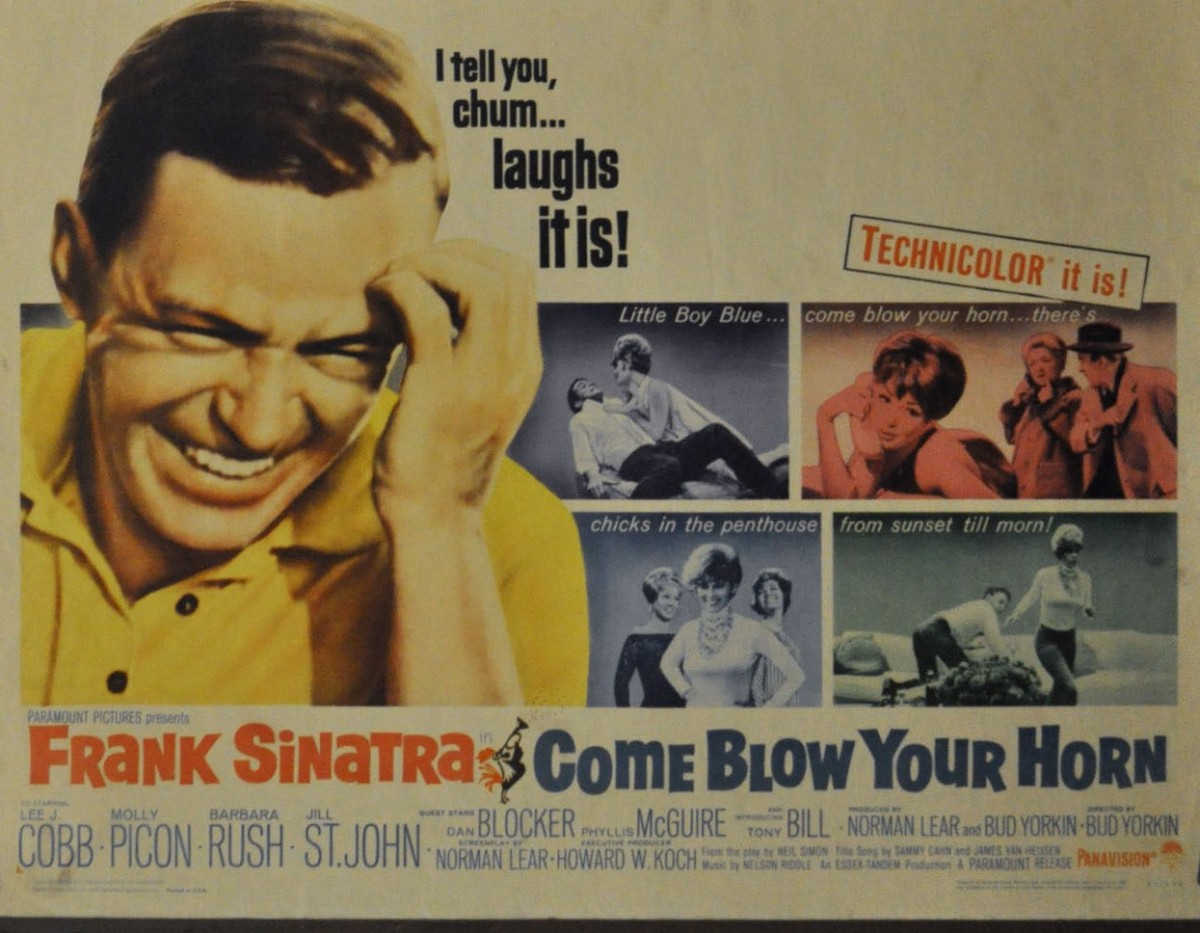
There’s a terrific western directed by John Sturges (The Magnificent Seven, 1960) inside this Rat Pack offering, the second of four in the series. On the plus side are plenty twists on traditional scenarios, Frank Sinatra and Dean Martin displaying a certain kind of easy screen charisma, and three exceptional and well-choreographed battle scenes.

Sinatra, Martin and Peter Lawford play the eponymous sergeants, Lawford committing the cardinal sin of wanting to quit the regiment to get married, with Sammy Davis Jr. as a former slave, bugler (an important plot point) and horse-lover wanting to sign up, and Joey Bishop (television star and occasional movie actor) as their sergeant-major boss.

A fair bit of time is spent on the usual Rat Pack shenanigans, getting drunk, brawling, playing tricks on each other, and exploring odd comic notions such as playing poker with a blacksmith’s implements as chips. But when it gets down to proper western stuff, it fairly zings along, with a decent plot (a Native American uprising) and excellent action scenes. You could have had William Goldman writing the script for the number of reversals involved as the picture keeps one step ahead of audience expectation.

For a start, rather than flushing out outlaws from a town, the troopers have to remove Native Americans who have taken it over. Instead of the cavalry pursuing Native Americans, it is mostly the other way round. It is the soldiers rather than the Native Americans who attack a wagon. Sinatra finds himself employing a bow-and-arrow and then a tomahawk rather than being on the receiving end of such weaponry.  Instead of dynamite, the good guys make do with fireworks. Where Native Americans are usually pinned down, this time it is Sinatra’s merry band. And when it comes to resorting to serious violence, that, too is usually the remit of the Native Americans, not as here, Sinatra chucking man off a cliff.

When it sticks to action, the picture is very well done and involving. When Sinatra has to take charge instead of larking about, the movie has focus. Both Sinatra and Martin were undertaking serious roles around this time, the former in The Manchurian Candidate (1962), the latter in political drama Ada (1961) so this might have appeared welcome relief.

The comedy isn’t along the laugh-out-loud lines of Support Your Local Sheriff (1969) or Blazing Saddles (1973) and the action of so full-on you wonder why anybody thought this required comedy at all, although there is a pretty good punchline ending. Action aside, It’s almost the equivalent of easy listening. The Rat Pack was a particular 1960s institution, the members joining each other on stage in Las Vegas or featuring in television programs, but there’s no real modern correlative.

It was interesting to see how the Rat Pack concept developed. This movie chucked out the idea of including a few songs as with Oceans 11 (1960) while the next one in the series, 4 for Texas (1963) was more of a serious straight western. But the final picture Robin and the 7 Hoods (1964) went in the opposition direction and was a full-on musical as if by the time they came to making that picture everyone had realized the film would make more sense if it played to their inestimable talents.

The series developed in other ways, too. Romance was minimal in Oceans 11, barely seen here, but was a major element of 4 for Texas – who would want to waste the talents of Ursula Andress and Anita Ekberg – but just as Andress is a smooth operator in 4 for Texas when it came to the last Rat Pack picture Barbara Rush was also a significant player for whom romance was merely a means to an end. You could also argue that the disappearance of Lawford and Bishop allowed the supporting roles to be played by actors who were not in on the joke.

CATCH-UP: the entire Rat Pack quartet has now been reviewed in the Blog with Oceans 11 (1960) and 4 for Texas (1963) also to be found here. Other Frank Sinatra films reviewed are Can-Can (1960), Cast a Giant Shadow (1966), The Naked Runner (1967) and The Detective (1968) while for Dean Martin the list, so far, comprises Texas Across the River (1966) and Rough Night in Jericho (1967).

When Comedy Was King (1960) ***

The 1960s was as much devoted to old movies as to new – the production shortage sent studios and producers back to the vaults to find anything that could fill a slot on a cinema program – and one of the most surprising beneficiaries of this was the silent movie.

It’s impossible to understand the 1960s without realizing what underpinned both the revival of slapstick comedy in such movies as It’s a Mad, Mad, Mad, Mad World (1963) and The Great Race (1965) and, just as crucially, brought to the attention of a new public other non-comedic stars from Hollywood’s “golden age,” the revival of whose movies in turn prompted a reissue boom and a decade or so further on provided the stimulus for the restoration of forgotten masterpieces.

The innovator in the silent comedy field was Robert Youngson, a two-time Oscar-winner (in the one-reel documentary category), who had set the ball rolling with The Golden Age of Comedy (1957).

When Comedy Was King sports a greater repertoire of stars and in essence presents a tribute – though not necessarily a greatest hits – to some of the best of the silent comedians The line-up includes Charlie Chaplin, Buster Keaton, Fatty Arbuckle, Laurel and Hardy, Mabel Normand and the Keystone Cops.

It was renamed “The Parade of Joy” for European markets.

None of the shorts featured are necessarily an individual artist’s greatest work – Chaplin’s contribution, for example, is drawn from a trio of 1914 pictures, The Masqurader, Kid Auto in Venice and His Trysting Place, none of which would be seen to represent the actor at his height. But they do give an idea of what silent comedy was all about.

Buster Keaton’s contribution is selected from the 18-minute Cops (1922) with well-timed gags, slapstick and car chases. Mutual self-destruction is a hallmark of Laurel and Hardy and Big Business (1929) sees the pair get into an argument with a customer, ending up demolishing everything in sight.  This is probably the pick of the compilation since the pair’s comedy relies on their relationship with each other and with anyone who gets in their way.

Appreciation of the particular talents of Fatty Arbuckle scarcely survived the scandal that ended his career while memory of Mabel Normand would also have been hazy so Fatty and Mabel Adrift (1916) is a good example of their comedy styles. They play a couple whose bed ends up floating on the sea.

Youngson was not above cashing in on a star’s future fame even when the example used of the person’s work could hardly be considered their best. In the case of Gloria Swanson (Sunset Boulevard, 1950) she was unrecognizable especially as she was only 12-years-old and being billed at the time as Gloria Dawn. Her inclusion is taken from the short Jimmie the Fox (1911) later renamed Bobby’s Sweetheart. Certainly, she is displaying none of the dramatic ability which made her the highest paid actress of the 1920s.

For all the varying quality of the actual footage, it does work as a showcase for the various stars, even though they would achieve greater success in later films. As importantly, it opened up for the 1960s generation the world of silent comedy and seemed to make that decade’s audience laugh as much as it had done previously.

Youngson would go on to make another five of these compilations throughout the decade. Without his initial forays into old school comedy, big-budget 70mm roadshows like It’s A Mad, Mad, Mad, Mad, Mad World would never have seen the light of day, nor would more modest efforts like the British-made The Plank (1967), written, directed and starring Eric Sykes.

Texas Across the River (1966) ****

Excellent comedy western mixing dry wit and occasional slapstick to joyous effect. The wedding between Spanish duke Don Aldrea (Alain Delon) and Louisiana belle Phoebe (Rosemary Forsyth) is interrupted by her previous suitor Yancy (Stuart Cottle) who is killed in the resulting melee. Escaping to Texas, Don Aldrea’s marksmanship leads settler Sam (Dean Martin) to recruit him to help fight raiding Commanches. Romantic entanglement ensues when the Don rescues Native American Lonetta (Tina Marquand) and Sam has more than a passing interest in Phoebe.

It is so tightly structured that nothing occurs that doesn’t have a pay-off further down the line. Bursting with terrific lines – including a stinger of a final quip – and set pieces, it pokes fun at every western cliché from the gunfight, the cavalry in hot pursuit, and fearsome Native Americans to the snake bite and the naked bathing scene. Incompetence is the order of the day – cavalry captain Stimpson (Peter Graves) issues incomprehensible orders, chief’s son Yellow Knife (Linden Chiles) cannot obey any.

The Don, with his obsession with honor and his tendency to kiss men on the cheeks, is a comedy gift. Despite his terrific head of hair, he is stuck with the moniker “Baldy” and every time he is about to save the day he manages to ruin it. Sam is the kind of guy who thinks he is showing class by removing his spurs in bed while retaining his boots. His sidekick Kronk (Joey Bishop), a mickey-take on Tonto, mostly is just that, a guy who stands at the side doing nothing but delivering dry observations.

Lonetta is full of Native American lore and has enough sass to keep the Don in his place. “What is life with honor,” he cries to which she delivers the perfect riposte, “What is honor without life?” Phoebe is a hot ticket with not much in the way of loyalty.

Two sequences stand out – the slapping scene (whaat?) and a piece of exquisite comedy timing when Sam, Phoebe and the Don try an iron out a complicated situation.

Good as Dean Martin (Rough Night in Jericho, 1967) is the picture belongs to Alain Delon (Once a Thief, 1965) and I would argue it is possibly his best performance. Never has an actor so played against type or exploded his screen persona. Delon was known for moody, sullen roles, cameras fixated on his eyes. But here he is a delight, totally immersed in a role, not of an idiot, but a man of high ideals suddenly caught up in a country that is less impressed with ideals. If he had played the part with a knowing wink it would never have worked.

Martin exudes such screen charm you are almost convinced he’s not acting at all, but when you compare this to Rough Night in Jericho it’s easy to see why he was so under-rated. Joey Bishop (Ocean’s 11) is a prize turn, with some of the best quips. Rosemary Forsyth (Shenandoah, 1965) is surprisingly good, having made her bones in more dramatic roles, and Tina Marquand (Modesty Blaise, 1966) more than holds her own. Michael Ansara (Sol Madrid, 1968) played Cochise in the Broken Arrow (1956-1958) television series. Under all the Medicine Man get-up you might spot Richard Farnsworth. Peter Graves of Mission Impossible fame is the hapless cavalry leader.

Director Michael Gordon (Move Over, Darling, 1964) hits the mother lode, the story zipping along, every time it seems to be taking a side-step actually nudging the narrative forward. He draws splendid performances from the entire cast, knowing when to play it straight, when to lob in a piece of slapstick, and when to cut away for a humorous reaction, and especially keeping in check the self-indulgence which marred many Rat Pack pictures – two of the gang are here, Martin and Bishop. There’s even a sly nod to Sergio Leone spaghetti westerns when the electric guitar strikes up any time Native Americans appear. Frank De Vol (Cat Ballou, 1965) did the score.

The Secret War of Harry Frigg (1968) ***

Except for an ingenious escape attempt and Paul Newman spoofing his Cool Hand Luke  persona, this World War Two POW number falls into the “sounded like a good idea at the time” category. Harry Frigg (Newman), the American army’s most notorious escapee (though from British military prisons), is promoted from buck private to two-star general and parachuted into northern Italy to organize a breakout of five one-star generals.

The premise that the war effort is hampered by embarrassment at the generals being captured seems far-fetched as is the notion that the quintet are hopelessly incompetent when it comes to doing anything that sounds like proper army stuff. Adding another offbeat element is that they are being held in effectively a deluxe POW camp, an ancient castle run by Colonel Ferrucci (Vito Scotti), a former Ritz hotel manager with a lapdog attitude to the rich and powerful.

Almost immediately Frigg discovers an escape route through a secret door but is disinclined to go any further since it leads into the boudoir of the countess (Sylva Koscina). New Jersey inhabitant Frigg feels out of the place with the high-falutin’ generals and proceeds to get himself a cultural education. Meanwhile, the countess, obtaining her position through marriage rather than birth, trying to bolster his confidence naturally triggers his romantic impulses.

The humor is of the gentlest kind – Frigg taking advantage of his superiority, Italians speaking tortured English – and not much in the way of bellylaffs either. Director Jack Smight, who collaborated so well with Newman in Harper (1966) and manages to achieve a tricky balance in No Way to Treat a Lady (1968), loses his way here, not least structurally, as the movie pingpongs between the generals, the commandant and Frigg and, thematically, issues of power. Crucially, he fails to rein in Newman.

The generals, squabbling among themselves for power, would be caricatures except that their characters are rounded out by the players, the pick being Charles Gray (The Devil Rides Out, 1968) as Cox-Roberts and Tom Bosley (Divorce American Style, 1967) as Pennypacker. The other generals are played by Andrew Duggan (Seven Days in May, 1964), John Williams (Harlow, 1965) and Jacques Roux (The List of Adrian Messenger, 1963). Representing the American top brass in England are James Gregory ( a repeat role in the Matt Helm series) and Norman Fell (The Graduate, 1967).

After her excellent turn as a mischievous and vengeful villain in Deadlier than the Male (1967), Yugoslavian Sylva Koscina comes down to earth with a less rewarding role as charming leading lady with a sly sense of humor rather than the femme fatale of A Lovely Way to Die (1968). Werner Peters (The Corrupt Ones, 1968) makes a late appearance as a Nazi and you might spot screenwriter Buck Henry (The Graduate) in a bit part.

The screenplay by Peter Stone (Arabesque, 1966) and Oscar-winner Frank Tarloff (Father Goose, 1968) is an odd mixture of occasional sharp dialogue and labored story. The set-up takes too long and you keep on wondering when it is going to get to the pay-off.

No doubt looking for some light relief after a quartet of heavier dramatic roles – Harper (1966), Torn Curtain (1966), Hombre (1967) and Harper (1967) – Newman acts like he has escaped the straitjacket of a considered performance and instead indulges in mugging and hamming it up, his body freeing up a barrage of mannerisms previously held in check.

The Plank (1967) ****

Hilarious credit sequence – I dare you not to laugh at the banana gag – sets the standard for this virtually silent slapstick vehicle featuring the cream of British television comedians. Hapless construction workers Eric Sykes (The Liquidator, 1965) and Tommy Cooper (The Cool Mikado, 1963) meet their match in the shape of a piece of wooden flooring. Running gags involve a car, a policeman with a bigger eye for a pretty girl than his duty, a car that is soon denuded of all its working parts, paint, rubbish and a pub.

But mostly this is driven by the antics of the bewildered pair, masters of the double-take and pained expression. Even when you think you can see the joke coming a mile off, some other piece of clever invention will take the idea in a completely different direction. Not reliant on clever dialogue, it’s one brilliantly imagined sequence after another. The plot, such as it is, is nothing but a succession of funny incidents.

British audiences were enjoying a small run of semi-silent comedies from A Home of Your Own (1965) through to Futtock’s End (1970), the hand of Bob Kellett behind this series of unlinked movies, but the difference between these and a gem like The Plank is that the latter was written and directed by a comedian (Eric Sykes) who understood timing and above all comic possibility. Clearly silent comedy classics provided much of the inspiration and Sykes has the sense not to spoof that genre but to create twists on originals.

The all-star comedy cast includes Jimmy Edwards (Bottoms Up, 1960), Carry On alumni Hattie Jacques and Jim Dale, Roy Castle (Dr Who and the Daleks, 1965), Sunday Night at the London Palladium television host Jimmy Tarbuck making his movie debut, Graham Stark (The Wrong Box, 1966) and the only straight actor among them Stratford Johns (BBC’s crime drama Z Cars, 1962-1965).

Too short at 45 minutes to qualify as a feature, it played for several years as a support to different movies and was often far more entertaining than the films it supported.

Ghostbusters Afterlife (2021) **** – Seen at the Cinema

This Geeks’R’Us (Junior Dept) reboot of a dying franchise is a blast. After the last leaden reinvention, this social-media infused spin brings redemption few brands can dream of. Most kid-centric films rely on a really cute kid. No need here. A brilliant screenplay does the job of bringing the kids to life, and you better believe kids can be that smart.

Drained impoverished Callie (Carrie Coon) dodges eviction by sneaking off to the prairie heartlands with her two offspring to a bleaker version of Bates Motel, owned by her unloved distant grandfather, now deceased. Pretty soon strange things happen, chess pieces move of their own volition, an overhead light points the littlest dork Phoebe (Mackenna Grace) in the right direction. Meanwhile the older nerd Trevor (Finn Wolfhard) uncovers the original Ghostbusters vehicle mouldering away in a collapsed barn. Teacher Grooperson, the kind of guy who lets his charges watch horror videos all day, fills her in on the seismic activity in the region.

It’s not long before all hell lets loose with new types of monsters, something to do with an ancient civilization and a mine filled with diabolical secrets. The action scenes are great fun but what holds it all together, as in the original, are the characters, and in particular the cynical social-media-savvy Podcast (Logan Kim) with a wry comment on every event, the kind of kid who enters what looks like a haunted house with relish.

If Ghostbusters (2016) was a gender reversal, this is a generational reversal, with the adults in general flopping around, Callie on an alcoholic spectrum (she’d be drunker if she could afford it), Grooperson capable of boring a date into insensibility. The kids take charge and not only save the day but save the brand. Podcast looks good for a few sequels to come. The scene where this oddball realises he has made a friend in Phoebe in pure acting gold.

Phoebe is saddled with the exposition, Podcast given the snappy one-liners. We’ve seen a Phoebe before but never a Podcast. Sappy Trevor, in love with waitress Lucky (Celeste O’Connor), brings more zing as the driver of the recharged Ghost-mobile. But this is the kind of film where all the parts fit, where something that seemed like a distraction turns out to be anything but.

Setting it in the middle of nowhere is a masterstroke, with fields and mountains aplenty for ghosts and ghosthunters alike to roam, and a town small enough that even the smallest ghost is going to make a big impact.

Four-time Oscar nominee Jason Reitman (The Front Runner, 2018) brings home a sequel so fresh it feels like a stand-alone. He co-wrote the screenplay with Gil Kenan (Poltergeist, 2015). Amazingly, this is Logan Kim’s movie debut. Much as he steals the show, Mackenna Grace (Malignant, 2021) delivers an excellent portrait of an outsider who grows into herself. Celeste O’Connor (Freaky, 2020) and Finn Wolfhard (Stranger Things, 2106-2022) create a believable juvenile not-yet romance. Paul Rudd (Ant-Man and the Wasp, 2018) is better for dropping the cuteness and Carrie Coon (The Nest, 2020), drained by life of all life, in a different movie universe would have had a movie all of her own.  

Not so much afterlife as reborn.

Discover WordPress

A daily selection of the best content published on WordPress, collected for you by humans who love to read.

The Atavist Magazine

by Brian Hannan

WordPress.com News

The latest news on WordPress.com and the WordPress community.