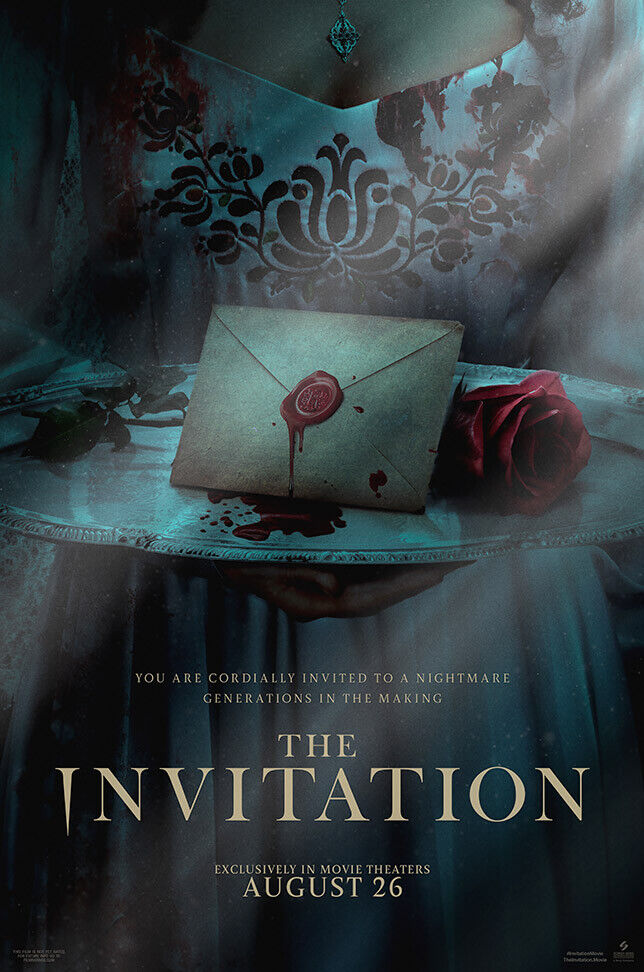
The Invitation (2022) ***- Seen at the Cinema

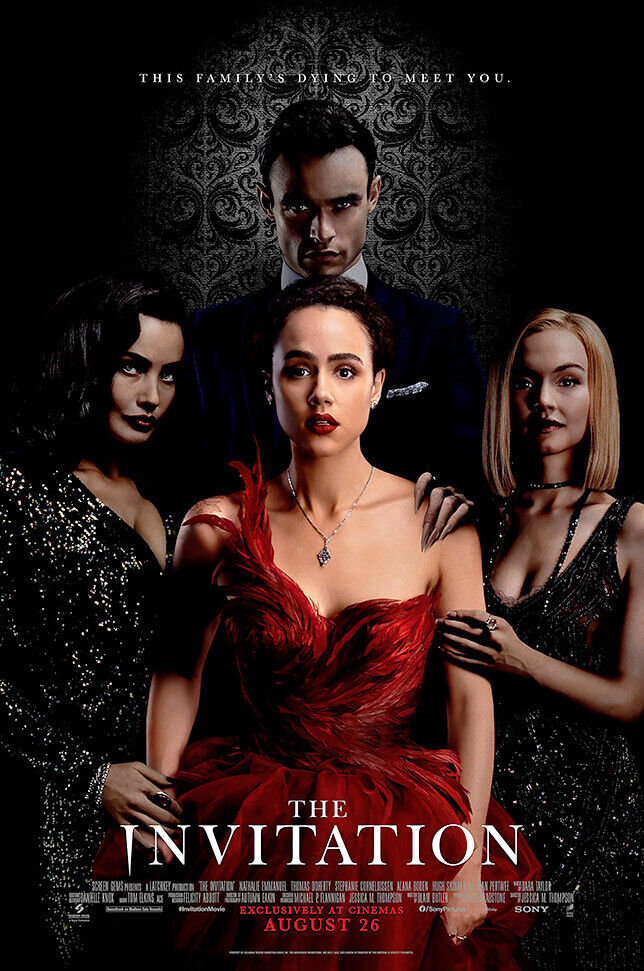
Two words – “Whitby” and “Carfax” – hint at what’s coming but luckily have no resonance for impoverished New York ceramics artist Evie (Nathalie Emmanuel) who takes up an invitation to visit long-lost relatives in an English mansion of significant splendour. Immediately taken by her host, lord of the manor Walt (Thomas Docherty), who comes across like a Regency buck, she finds herself a surprising guest of honour for a forthcoming wedding.

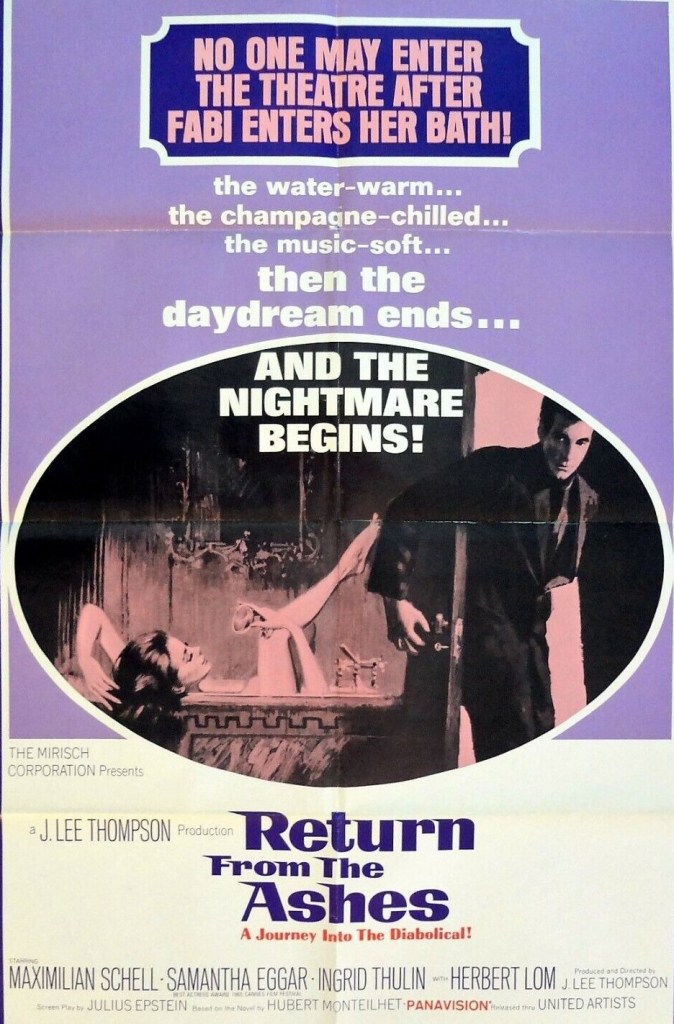
Head butler Mr Fields (Sean Pertwee) and the statuesque Viktoria  (Stephanie Cornelissen), another guest, are snippy but the others, a smorgasbord of three influential European families, make her welcome. A nightmare and a few things unexplained drive her into the arms of the sympathetic Walt and before she knows it, she has agreed, in jest, to marry him. “The Big Reveal” – a subject of the last two posts – is well-paced giving Evie time to react to her unexpected circumstances. Like Hide and Seek (1964) she has been led into a trap of her own making, millennial entitlement coupled with the chance to mix with the rich and famous enough to do the trick.

She, it transpires, is the bride of a very particular individual and despite her efforts to escape it will be a very red wedding.

If there had been no mention of Whitby and Carfax – and I don’t remember anything in the trailer – I would have been completely unprepared for what followed, at least in the vampiric context, for the other goings-on did not tilt the viewer in that direction. The romance was refreshingly modern, with various reversals, including Evie standing up for menials who had fallen foul of the butler, and for herself against belittlement by Viktoria.

The ice-house, a mainstay of such buildings prior to refrigeration, also turns out to be fit for purpose and in another twist Walt favours the harem approach to marriage.

Considerably less savage than your modern horror picture, and definitely a shade more romantic, I can see why it would go down poorly with the modern horror cognoscenti but I felt it was very well directed, much more in the classic tradition of pacing, character development and twist. And it has an excellent ending that I suspect might kick-start a sequel.

Nathalie Emmanuel – best known from a stint in Game of Thrones and F9: The Fast Saga (2021) – will surely be elevated to stardom after her first leading role. A big-screen natural, she carries the picture effortlessly, and even though effectively playing the innocent abroad, there are few moments where the character is out of her depth, tribute to her innate acting skills. This could have gone wrong in so many ways, but her performance evokes natural sympathy while at the same time you would not make the mistake of pitying her.

A bright future also awaits Thomas Doherty (High Strung Free Dance, 2018) who carries off his role with style and except until necessary does not hint at the real character underneath the charm. Sean Pertwee (The Reckoning, 2020) shows he can glower with the best of them but Stephanie Corneliussen, in her movie debut,  makes an excellent queen bitch and her whimpering sidekick Alana Boden (Uncharted, 2022) proves anyone can turn nasty given the right amount of prodding.

Big shout out to Scottish actress Carol Ann Crawford – better known as the dialect coach for Outlander – as the maid who sets Evie right. I do believe I was at university with her.

Director Jessica M. Thompson (The Light of the Moon, 2017) does an excellent job of keeping a tight rein on proceedings and even when all hell is about to break loose ensures that the ensuing havoc is carried out with some style. Blair Butler (Polaroid, 2019) knocked out the screenplay.

My only gripe is that Emmanuel and Doherty make such a fine couple – with the kind of screen charisma that is in short supply these days – it was a shame that the story had to take a turn into horror rather than continue (forgive the pun) in the romantic vein.

Hide and Seek (1964) ***

Too many peculiarities for a small British B-picture that just about makes it over the line after “The Big Reveal.” You can start with the fact that, ostensibly, this was director Cy Endfield’s follow-up to his blockbusting Zulu (1964). In fact, it had been made long before, but sat on a shelf for a year, and only released to cash in on Zulu. And you can see why studio British Lion didn’t know what to do with it.

Diving down a 39 Steps thriller-sized rabbit hole, baffled professor saddled with adventurous female go on the run searching for answers to, wait for it, a crime which hasn’t actually been committed. There’s action on a train, some comedy as the worlds of academia and the sophisticated fast set collide, romance on a barge,  Cold War skullduggery,  too much chess, a bit of welcome role reversal, a cliff-top fight, and some dry wit that might have fitted better into a straightforward romantic comedy. And it ends with a twist of such audacity that it would either come as a relief to a bewildered audience or send them home frustrated at such a denouement.   

Rocket scientist David Garrett (Ian Carmichael) becomes embroiled in not even really a plot when he attempts to return a box, containing an inordinate amount of loot, to its owner,  chess grandmaster Dr Melnicker (George Pravda). Luckily, a clue in the form of a chess move takes him to a posh London house in fashionable Chelsea where he encounters the slinky Maggie (Janet Munro) and after hiding in a sandpit in a children’s playground to evade pursuers he ends up on a train with her heading north to a place called Flamboro.

But, wait, his pursuers are also on the train, so naturally the couple have to jump off, fall into a river and hitch a lift on a passing barge whose owner Wilkins (Hugh Griffith) proves most obliging. Indeed, Maggie is even more obliging, taking the lead in bedding the shy professor.  Things get interesting when Maggie, at a road sign, takes David in the completely opposite direction to Flamboro. That works for about ten seconds until a henchman Paul (Kieron Moore) captures them at gunpoint.

Rather than just shooting David dead he decides it would be cleaner to chuck him over a cliff. Luckily, David is a shade pluckier than you might expect. After winning this cliff-top tussle and shocked at having chucked a man over a cliff he is even more astonished to discover he is stranded, Maggie having made off in the car. Luckily, a passing policeman on a bicycle ensures David makes it safe to Flamboro, which turns out to be a huge mansion perched on a cliff.

My guess is by now you are so hooked by this story that you’ll want me to reveal The Big Reveal. Well, the whole thing turns out to be a trap. Melnicker, the pursuing thugs, Paul (who,  you’ll not be too astonished to learn, ain’t dead) and even Maggie have all been plotting to bring David here so that he can be kidnapped and handed over to a submarine arriving the following day. You see, David has been so outspoken (has he?) against his masters that everyone will put his disappearance down to defection. It’s all been a cleverly worked-out chess move as chief baddie Hubert (Curd Jurgens) takes pains to point out.

But our David isn’t exceptionally brainy for nothing and finds a way to outwit the bad guys with Maggie, by now repenting of her bad ways and fallen in love, along for the ride.

So what’s gone wrong? The casting, unfortunately, for one thing. Star Ian Carmichael (School for Scoundrels, 1960), better known for comedy, doesn’t quite make the switch to more straightforward thriller. And Curd Jurgens (Psyche ’59, 1964), whom you might expect to add some gloss, doesn’t appear till the end.

Worse, the film doesn’t find the right tone, too much comedic British observation, and not enough of the hero being in genuine jeopardy. Only a clueless professor would run from the thugs. If the big twist had occurred halfway through and the audience had time to wonder whose side Maggie was on and feel David was in in genuine danger it might have hit the bullseye because, oddly enough, the romance is believable in a Hot Enough for June (1964) kind of way, where innocent male is scooped up by a more worldly female way above his league.

But the role reversal is fun. She’s the one who goes to his rescue when he falls in the river, she’s the seductress, and gets to tell him he looks better “when he’s cross” (a line more typically with slight variations falling to the male) and delivers the movie’s one cracker: “Being a man you have no respect for a mink coat.” She would be an ideal candidate for femme fatale if only the director had let us in on the story quicker, but she’s certainly an astute lure.

Because I wasn’t expecting much, I have probably been a shade less critical than if I was viewing it as a follow-up to Zulu. In the end, it’s passable enough, especially if you are willing to see how clever it’s been.  

As I mentioned Ian Carmichael (Lucky Jim, 1957) is the weak link but former Disney protégé Janet Munro (Swiss Family Robinson, 1960), now blossomed in sexy fashion, steals the show and on this performance you might be surprised she  did not have a more illustrious career but she had a heart condition and died prematurely at the age of 38. Curd Jurgens was at the early stages of inventing his villainous persona. The other characters are merely pawns in the plot so end up as stock villains. Cy Endfield’s genuine follow-up to Zulu was worth seeing – Sands of the Kalahari (1965).

You can catch this on YouTube.

https://www.youtube.com/watch?v=w3zj_VcTdBM

She Died With Her Boots On / Whirlpool / Perversion Flash (1969) ***

Sexual adventuress takes trip to the country with disastrous results. Best described as an early British venture in the giallo mold it lacks some of the style of that genre but is notable for the debut of Spanish cult director Jose Ramon Larraz (Vampyres, 1974). Perhaps as interesting is that it details a nascent killer warming to his task and climaxes in a nihilistic ending. Scoring so high on the sex/nudity quotient in the U.S., it was considered an out-and-out exploitationer.

Wealthy older woman Sarah (Pia Andersson) brings home model Tulia (Vivian Neves) for her protégé Theo (Karl Lanchbury), a budding photographer.  Sarah’s proclivities are apparent from the start, preferring young women though young men will also suffice, a switch in the normal power play of the era (and now for that matter) of rich old men chasing younger women.

Tulia is no innocent, lured or straying into the big dark house, and she’s game for anything, happily participating in a game of strip poker that ends in sex with Theo. However (and striking a contemporary note), he is unable to perform – for reasons that might be similar linked to young people today who suffer from the same condition due to over-exposure to porn – and in Theo’s case because he prefers watching.

Quite how far he is willing to go to achieve his kicks is shown in a scene where he drives Tulia to the woods where she is almost raped by his friend Tom so that Theo can photograph the act. Quite how far Tulia is willing to go is indicated by the fact that, while upset at this incident, she doesn’t run a mile and instead continues to enjoy games of seduction, this time with Sarah, with Theo at first limiting his participating to recording the action but later taking part in a menage a trois.

Meanwhile, a Scotland Yard Detective Inspector (Barry Craine) interrogates businessman Mr. Field (Edwin Brown), sugar daddy to missing Irishwoman Rhonda (Johanna Heger), and Field takes it upon himself to pay Theo a visit. Quite how he knows of Theo’s involvement with Rhonda is unclear but he doesn’t accept the explanation that the girl has gone home and hangs around to do a bit of spying. Not such a good idea, because he pays the penalty.

Although it’s a pleasant detached cottage and far from an old dark house, Tulia takes it upon herself to take a look at Theo’s studio where she finds various items of female clothing and photos of an unsavoury nature. A flashback reveals the death of Rhonda, seduced by Tom, then, following the arrival of Theo and his trusty camera, raped by a tramp. But it’s not Theo who kills her. It’s Tom, and largely by accident.

So what’s being set up really is how far beyond his normal games Theo will go, with Tulia providing the test case.

A chunk of the tension comes from having no idea what’s going on beyond Sarah indulging Theo. She appears ignorant of the depth of his perversion. And with Tulia being so complicit initially in the sex it appears to be going down a different route to the slasher pictures like Scream and more in keeping with the giallo which had yet to get into its stride. Tulia is a modern girl for the times, certainly not sexually repressed, which was refreshing, and being a model comfortable with her body. But she would not have been expecting something like this.

Karl Lanchbury (What’s Good for the Goose, 1969) looked like he was perfecting the creepy persona that would carry him through a few more Larraz pictures. Vivian Neves was a model, famous two years later for featuring in the first nude advertisement in The Times, but also a glamour model with pictorials in Penthouse and The Sun, and known as “The Body” a quarter of a century before that title was appropriated by Elle Macpherson, and later set up her own modelling agency. Pia Andersson only made this one picture.

Given he was dealing with so much inexperience and was himself a debutant, Larraz does a pretty good job. He would go on to make another 25 films mostly in the exploitation vein.  

I came across this on YouTube while looking for the Otto Preminger film noir Whirlpool (1950). The version I saw is taken from a very ropey VHS with time codes but there’s a better print on the channel under the title of Perversion Flash.

Harlow (1965) ***

Harlow presents such a convincing picture of Hollywood abuse that I was astonished to discover that it was not entirely truthful where the title character was concerned.

Jean Harlow was a hugely popular star in the 1930s before her untimely death at the age of 36. This film depicts her as a virgin (not true) who turns neurotic (not true) after her impotent husband commits suicide (debatable) on their wedding night (not true) leading to her go off the rails and die from pneumonia (not true). But in terms of the Hollywood system a great deal rings true and if the Me Too movement had existed in the late 1920s the finger would be pointed at a huge number of men.

The film is at its best when dissecting the movie business. A five-minute opening sequence demonstrates its “factory” aspect as extras and bit players clock in, are given parts and shuffle through great barns to be clothed and made up, often to be discarded at the end of the process.

No sooner has this version of Jean Harlow (Carroll Baker) been given a small part than she encounters the casting couch, operated by a lowly assistant director, who bluntly offers five days’ work instead of one if she submits to his advances. When she turns him down, work is hard to come by and she resorts to stealing lunch before rescued by agent Arthur Landau (Red Buttons). After tiny parts that mostly consist of her losing her clothing, receiving pies or eggs in the face and displaying her wares in bathtubs, she geta a big break only for that producer to demand his pound of flesh – “I’ve already bought and paid for you.” Here she has “the body of a woman and the emotions of a child” and ends up choosing the wrong suitor which leads to a calamitous outcome.

However, the pressures of stardom are well-presented: she is the breadwinner for her unemployed mother Jean (Angela Lansbury) and lazy stepfather Marino (Raf Vallone) and soon box office dynamite for studio chief Everett (Martin Balsam) who sees in her the opportunity to sell good clean sex. The negotiations/bribery/blackmail involved in fixing salaries are also explored.

But the film earns negative points by mixing the real and the fictional. The agent and husband Paul Bern (Peter Lawford) existed but most of the others are invented or amalgamations of different people. MGM is represented as “Majestic” and among her films there is no Red Dust (1932) or China Seas (1935) but lurid inventions like Sin City

Director Gordon Douglas was a versatile veteran, with over 90 films to his credit, from comedies Saps at Sea (1940) and Call Me Bwana (1963) to westerns The Iron Mistress (1952) and Rio Conchos (1964) and musicals Follow That Dream (1962) and dramas The Sins of Rachel Cade (1961) and Sylvia (1965) which also starred Baker. The opening scene apart, which is a seamless construction, he is adept at this kind of helter-skelter drama. John Michael Hayes (Rear Window, 1954) has produced a punchy script based on the book by Arthur Landau and Irving Shulman.

In the title role Carroll Baker (Sylvia) has probably never been better, comedian Red Buttons (Stagecoach, 1966) excellent in a straight role while the smarmy Raf Vallone (Nevada Smith, 1966) is the stand-out among an excellent supporting cast that also includes Angela Lansbury (In the Cool of the Day, 1963), Peter Lawford (Sylvia), Leslie Nielsen (Beau Geste, 1966), Martin Balsam (Seven Days in May, 1964) and Mike Connors (Stagecoach, 1966).

Except that virtually none of the movie is true, I would have given it four stars for its portrayal of Hollywood but I have come to expect that biopics, while moving facts around for dramatic purposes, are required to be good more faithful to their subjects than this. 

Enemy of the State (1998) ****

You are the star of the show so the last thing you want is to team up with a scene-stealer, but if you want to work with such an renowned talent, what can you do but let him steal.

It says a lot for Gene Hackman’s legendary status that, long past his box office peak in this fast-paced surprisingly contemporary paranoia thriller, his appearance late in the day turns up the heat on Will Smith at an early career pinnacle and at his charming best. You need someone as easy on the eye as Smith to lead the audience through a tortuous plot, centering on the collusion of big business and government to push through a commercially-motivated U.S. Government Act promoting greater surveillance, and someone as inherently gutsy as Hackman to carry the film over the line.

Ironically, the McGuffin is surveillance of the most benign kind, a camera trained on ducks at a river inadvertently picking up evidence of corrupt politician Reynolds (Jon Vogt) overseeing the murder of Representative Hammersley (Jason Robards) who stands in his way. The tape finds its way to an investigative reporter who, pursued by Hammersley’s goons, drops it into the shopping bag of labor lawyer Robert (Will Smith).

Unaware of the reasons why, Robert’s life unravels, Hammersley’s guys fabricating evidence that he has revived an affair with former lover Rachel (Lisa Bonet) and  is involved in Mafia money-laundering, resulting in wife  Carla (Regina King) throwing him out and being fired from his job. Bank accounts frozen (natch!), Robert turns to Rachel for help and she puts him in touch with her source Brill a.k.a Edward Lyle (Gene Hackman), an undercover communications expert who has been feeding Rachel information. When Rachel is eliminated, Lyle teams up with Robert and together they come up with a daring plan to incriminate Reynolds and absolve Robert.

Although brim-full of twists and turns, and a relentless government hit squad, the real joy of the picture is Tony Scott’s direction. Using his trademark speedy cuts, and scaring the life out of the audience regarding the depth of available surveillance, this is a thriller tour de force. The Top Gun (1986) director is at the top of his game, seamlessly shifting keys, racketing up the tension, the NSA’s encroachment on civil liberty so extensive it appears nobody can escape a web that is inexorably drawn tighter.

And it’s a fabulous double act, the innocent but slick Robert coupled with the world-weary but clever Lyle, the non-stop-talker versus the virtually silent. It’s the cat and mouse game where the mice turn out to hold the aces. Just brilliantly done and at such a speed. A plot that could easily become convoluted is superbly handled.

Will Smith (Independence Day, 1996) is given free rein and he’s good value for money, holding audience attention seamlessly, and until Gene Hackman (Crimson Tide, 1995) enters the frame he is running away with the picture. Their acting styles are completely different and you shouldn’t really be comparing them but when it comes to the crunch Hackman nails it every time and with hardly doing anything. Lisa Bonet (Angel Heart, 1987) makes a welcome return to the big-budget Hollywood scene. Jon Voigt (Midnight Cowboy, 1969) enjoys one of his better supporting roles.

The screenplay by David Marconi (The Dark Side of the Moon, 2015) is quite superb, not just with a whole series of riveting set-pieces and some terrific dialogue, but also with more humane touches, such as Robert’s encounter with his kids or his embarrassment shopping for lingerie in Victoria’s Secret.

And if there were not bonuses enough, there’s a virtual smorgasbord of talent in the supporting cast starting with 26-year-old Regina King (Boyz in the Hood, 1991) through Barry Pepper (Saving Private Ryan, 1998), Scott Caan (Ocean’s Eleven, 2001), Jake Busey (Starship Troopers, 1997), Jason Lee (Vanilla Sky, 2001) and Jamie Kennedy (Scream, 1996)  all the way to Gabriel Byrne (The Usual Suspects, 1995), Ian Hart (Backbeat, 1994) and Jack Black (School of Rock, 2003).

Stone cold classic not to be missed and worth another watch if you have viewed it already.

Book into Film – “The Americanization of Emily” (1964)

You did what?

Author William Bradford Huie’s cry of outrage could be heard from one side of Hollywood to the other.

Not that anyone would commiserate. A bestselling writer dealt with the movie industry at his or her peril. If you succumbed to the lure of Hollywood gold you might as well kiss goodbye to any expectation they were actually going to film the book you had written.

In this case, screenwriter Paddy Chayefsky stuck to the plainest of knitting, the romance between oversexed Yank Lt Col Edison (James Garner) and English rose Emily (Julie Andrews). He kept in the “dog-robbing,”* Edison stashing away crates of steaks, whisky, nylons, chocolates, whatever will keep the admiral happy and at the same time smooth the path for whatever officer or politician he was trying to schmooze.

But Huie’s tale went down a different route that Chayefsky chose to ignore. Yes, D-Day played a part, forming  the climax, and the author did intend to score a political point. In Huie’s version, Edison’s role in D-Day was merely to film some of the proceedings. Keen to highlight the risk to the common soldier, the hero was prone to film the sordid aspect of war, focusing as much on death and injury as heroism. He even opened with a prologue, a dedication to the three men who died in the making of the film.

But his film never saw the light of day. Or at least not his director’s cut. He was forced to eliminate all scenes of dead Americans. Dead Germans were okay, just not dead Americans. Especially irksome was a sequence showing bulldozers covering American corpses with sand. He only won one battle with his superiors, refusing to stick in the cliché of a chaplain praying over sailors before they embarked on the D-Day vessels, but only because there was no chaplain present and he refused to shoot such a scene.

Of course, since he didn’t die in Huie’s book, there was no reason to come back from the dead. In fact, post D-Day, he and Emily spend a good chunk of time together before he is despatched elsewhere on another task with the admiral and there is a happy ending, fourteen months later, a reunion as Emily turns up where he is now stationed.

So where did all the cowardice malarkey come from? The mind of Paddy Chayefsky is the simple answer. In the book, the hero, as much as the next man, does not want to die in the war, but his fears are the normal ones, he doesn’t go out of his way to avoid action, profess his cowardice and stand up for the rights of cowards everywhere. So the book isn’t larded with long speeches about the horrors of war.

What attracted a producer like Ransohoff to the picture was the film the hero wanted to make. Not one that glorified war. A film that refused to see heroism as a great and noble thing was, of course, the same as sticking up two fingers to all those who could only justify war if it provided the opportunity for heroism as a sop to the wives and children the dead left behind. It was a strong point to make. And, prior to filming, there was plenty Edison had to say on the subject. While the admiral saw the landing as a great success because the casualties were much lower than expected, Edison felt for every man killed.

There’s no need in the book for the admiral to be a loony because it would be quite plausible to film for documentary or PR purposes action on World War Two beaches – what were John Ford and other famous directors doing if not that? Lt Cummings (James Coburn) who comes up with the dastardly idea of killing off Edison does not come up with such a dastardly idea in the book. In fact, in the original novel he’s a relatively minor character. And the much-vaunted nudity, revolving in the main around Cummings, is not particularly obvious in the novel, though Huie is perfectly blunt about the role of the bulk of the women. The novel opens with the classic line: “Twelve Englishwomen, known as Sloane’s Sluts, served America during the Second World War.”

However, the said Sloane is eliminated from the film, in order to provide the immoral Edison with something of a moral tinge. In the movie, with so many women easily available, he doesn’t indulge beyond a bit of bottom slapping. But in the book, he has sex with said Sloane while romancing Emily and again at the end while separated from her.

The Chayefsky version is peppered with dialogue about war that is primarily, even though Edison’s life is at stake, in the aesthetic vein. Huie, on the other hand, provides a salutary commentary on the war, filling the reader in on aspects rarely covered, the kind of unfamiliar material that would later be the bedrock of the airport bestseller like, well, Arthur Hailey’s Airport.

* “A dog-robber is a personal attendant of a general or an admiral. To ensure his superior has the best food and lodging, a dog-robber is willing to rob not only troops, widows and orphans but even the goddam dog.” So runs Huie’s description, a little note at the bottom of a page just in case the reader did not quite work out to what depths this ultra-scrounger would go to satisfy his boss.

Where the Crawdads Sing (2022) **** – Seen at the Cinema

I enjoyed the film so much I went out (literally) and bought the book (multiplex and bookshop in same shopping mall). And I’ve no idea why this has received such a tepid response from critics. Reminiscent of Prince of Tides (1991), it packs a far greater emotional punch when it gets into its stride with the aftermath of romance gone wrong. And it’s not as sappy as that might suggest, themes far more adult than young adult, covering domestic abuse, attempted rape, vilification and humiliation.

Even though set in the 1960s, the sense that people fear the different is as topical today, it still stands as a portrait of the outsider for whom rejection by society is common. Illiterate Kya (Daisy Edgar-Jones), snubbed by locals, lives alone in the marshes of North Carolina so when her boyfriend is killed she becomes the automatic suspect. The movie then shifts between the the present day courtroom of 1969 and the past. Isolation makes her vulnerable but not to the point where she is scared to fight back, although she acknowledges that “men always need the last word.” She’s also accustomed to literally covering her tracks, returning leaves disturbed by her footsteps to their original position, with concealment a fact of life.

Regardless of the prejudices of the townspeople, the audience is fed enough clues to leave them guessing right up to the very last scene in one of those revelations straight out of Jagged Edge (1985). And sufficient red herrings muddy the pitch while in true modern style vital pieces of information that might easily have determined the outcome of the trial are hidden until late in the day.

But this is not primarily a courtroom drama. It’s a beautifully realized coming-of-age picture, sucking you into a wilderness that in previous depictions of such alternative worlds would have been doused in violence, check Deliverance (1972) or Southern Comfort (1981). Kya isn’t capable of setting traps to lure the unwary, nor of predatory behavior. Instead, she is more open to abuse of her trust. The two men – Tate (Taylor John Smith) and Chase (Harris Dickinson) – who enter her life, with different degrees of entitlement, are liable to either abandon her or wish to control her.

Self-discovery remains core, with Kya’s tale as much about growing up as finding her path as an artist, and as she develops self-confidence is able to monetize her naturalist skills. Her artistry is often on show and through poetic internal monologues we view her soul, sometimes aching but just as often practical, never confusing the beauty of nature with a reality in which “even doves fight” to quote from the first few pages of the book I managed to read before starting this Blog.

Producer Reese Witherspoon performed a nifty trick. She chose the novel for her book club, watched it turn into a bestseller and then produced the film.

Tate and Chase bring out different aspects of her personality, the former teaching her to read and write, the latter determined to ensure she doesn’t lose the freedom so essential to her being. But whether either man can provide the emotional support she requires is open to question.

The twists and turns of the courtroom are well done. Defence attorney Tom Milton (David Strathairn) is surprisingly gentle for a lawyer, doing his best to bat away the more aggressive  prosecutor’s claims. It’s classic stuff, trying to tie Sheriff Jackson (Bill Kelly) up in knots, deflecting prosecution attempts to paint her as an out-of-control feral child. Milton, plus storekeeper Jumpin’ (Sterling Macey Jr.) and his wife Mabel (Michael Hyatt), are the only locals to show any kindness.

It’s rich in atmosphere and the feeling Kya has for nature comes easily to the surface. I found it totally absorbing, helped in equal parts by the court proceedings, and Kya’s difficult navigation of the emotional highway. There’s a nice meet-cute, done with feathers would you believe, and her reactions to both men, restraint followed by passion, caution at war with raw impulse, are entirely believable. If there is any problem in the narrative relating to both suitors, it’s that we only see them through Kya’s eyes, rather than being given true insight into their ambitions, but you can hardly fault a movie taking the point-of-view of the heroine for expecting her to have a clearer picture of what would-be romancers would rather hide.

The early scenes, depicting abuse of the young Kya (JoJo Regina) at the hands of her alcoholic father (Garret Dillahunt) and her disillusion and fear as one by one she is abandoned by mother and brothers are especially powerful, nobody departing without a cut or a bruise, as if carrying a paternal brand.

The whole picture is such an immersive experience, understanding insects and shellfish as Kya’s wealth of knowledge grows, fearing for her involvement with any man, her inexperience inevitably faulting her choice. And yet she grows through bad experience until she gains the self-reliance to see her through.

Daisy Edgar-Jones, best known for the television mini-series Normal People (2020) does wonders with a difficult role, never playing the sympathy card. It’s always a delight to see a veteran like David Strathairn (Nomadland, 2020) get his teeth into a meaty role. And it’s refreshing to see neither of the young men, Taylor John Smith (Blacklight, 2022) and  British actor Harris Dickinson (The King’s Man, 2021) favoring the grandstanding approach, delivering largely subtle performances.

Restrained performances too from Sterling Macer Jr. (Double Down, 2020) and Michael Hyatt (The Little Things, 2021) while Garret Dillahunt (Ambulance, 2022) continues to do admirable work.

Most credit goes to Olivia Newman (First Match, 2018) for creating a fascinating well-paced picture that allows the actors to breathe and refuses to fall into the trap of delivering a bloated adaptation of a bestseller. And in part this is down to calling in for screenplay duty Lucy Alibar, who has form in this area through Beasts of the Southern Wild (2012).

This has all the hallmarks of a classic sleeper.   

Night of the Blood Monster / The Bloody Judge (1969) ***

Handsomely mounted historical drama set in 17th century England on the brink of revolution  meets Son of Witchfinder General. An uprising headed by the Duke of Monmouth in the south-west threatens to overthrow King James II. Involved in the plot are Harry Selton (Hans Hass), son of suspected agitator Lord Wessex (Leo Genn), whose beloved Mary Gray (Maria Rohm) is in the sights of Judge Jeffreys (Christopher Lee) after he has condemned her sister Alicia (Margaret Lee) to be burned as a witch.

The minute witchcraft enters the equation the narrative thrust is constantly interrupted by scenes of nudity, blood and torture, mostly involving women, but actually the film does attempt to cover the rebellion and its notorious aftermath when hundreds of rebels were executed, the “Bloody Assizes” with “Bloody Judge” Jeffreys to the fore. Conflating witchcraft with a genuine historical episode does not work very well and unlike Witchfinder General (1968), the murder of innocent women is more of a sideshow, despite the brutality involved, and you get the impression the story has been hijacked to accommodate supposed witch Mary in the interests of adding titillation.

Even as the story of the rebellion unfolds, the threat to the crown spelled out, the origins of the revolt mostly made clear (Monmouth being the illegitimate son of Charles II, and nephew to James II) although the sectarianism behind the rebellion is ignored, the narrative keeps jumping back to the witch element. Jeffreys connects the parallel narratives, hunting down rebels and witches, while handling most of the exposition. Given the budget, there’s a surprisingly good battle sequence, cavalry charging cannon. Given his later reputation, Jeffreys also reflects on the meaning of justice.

And while there are some camp moments – Jeffreys playing the organ while attired in grand robes, dancing girls sticking pins in his effigy – the twists and turns (Mary captured and rescued, captured again)  are effective enough. Despite the copious nudity, there a couple of low-key love scenes and, oddly enough, a touching moment when Mary licks the blood from a dead prisoner. And for all the blood, that is effect rather than cause, nothing too gory.

But with the powerful all-mighty, and investigators able to plant evidence, and the innocent forced into immoral acts to save their loved ones, lawlessness is apparently next to godliness. But in reality the wicked did not get away with their crimes so various villains get their come-uppance.

Most peculiar sight is Christopher Lee in a love scene where he is not about to sink his incisors into a neck. Occasionally, the film bursts into German with English subtitles – as if various versions were pillaged to produce this copy – or has lines like “you turn me on.”

However, fans of Spanish cult director Jess Franco (The Girl from Rio) who expected something more along the lines of 99 Women (1969) and Venus in Furs (1969) may be disappointed that he spends so much time on the historical elements and less on the random T&A. You might not be surprised to learn of the involvement of ubiquitous producer Harry Alan Towers (Five Golden Dragons, 1967).

The Best House in London (1969) *

One of the worst – and certainly among the most repellent – films ever made. A hymn to misogyny under the guise of the not very difficult task of exposing Victorian hypocrisy, it labors under the bizarre thesis that all women want to be prostitutes. Screenwriter Denis Norden’s befuddled sense of history is awash with the same kind of contempt for audiences. Elizabeth Barrett (of Wimpole St fame) rubs shoulders with Lord Alfred Douglas (Oscar Wilde’s illicit lover) even though they lived half a century apart, the Chinese Opium Wars and The Indian Mutiny feature despite being separated by 15 years.

Sex workers had proved the basis for many good (and occasionally excellent) pictures in the 1960s ranging from Butterfield 8, Never on Sunday, Irma la Douce and Go Naked in the World at the start of the decade to Midnight Cowboy at its end, but these all featured well-rounded characters facing understandable dilemmas. But here the cynical and demeaning plot –  more Carry On Up the Brothel than political satire – makes you wonder how this concept was perceived as either plausible or an acceptable subject for comedy

The monocle joke. Dany Robin sports the manacles her idiotic girls were supposed to wear rather the monocles they did wear.

Feminist philanthropist Josephine Pacefoot (Joanna Pettet) – a character based on the real-life campaigner Josephine Butler – has set up the Social Purity League to rescue fallen women. Walter Leybourne (David Hemmings) is hired as a publicist to bring the issues raised to a wider audience. When Josephine inherits the fortune of Uncle Francis (George Sanders) the pair come up against the nefarious Benjamin Oakes (also played by Hemmings), her cousin and his half-brother, who has purloined his uncle’s mansion in Belgravia as the premises for London’s first brothel – The Libertine Club. This venture is backed by the Home Secretary (John Bird) as a way of getting streetwalkers away from upmarket shopping streets where their presence discourages wealthy females. Josephine also has to deal with a caricatured “evil” Chinaman (Wolfe Morris) through her uncle’s investment in opium. There’s also for no particular reason apoplectic airship inventor Count Pandolfo (Warren Mitchell).

All the women rescued from the oldest profession by Josephine are soon recruited by Oakes and a good chunk of the middle section of the movie involves various excuses to give the viewers intimate glimpses of what goes on in the brothel, involving an abundance of nudity.  Oakes also aims to seduce Josephine while the shy Walter struggles to entice her into romance.

Excepting Josephine and Oakes’ mistress Babette (Dany Robin), the women are uniformly stupid. The story begins with Oakes’ duping a woman in a hot air balloon into removing her clothes on the grounds that it was the only way to reduce height enough to land. And it does not get any better. Women supposedly forced onto the streets after bad experiences with men turn out to be the seducers. Walter has the devil’s own job getting any of the girls to agree they had been raped. Walter, hoping to sell a story to The Times, is no less crass: “I can get five columns for a good rape.” Flora (Carol Friday), rescued much to her displeasure, is “gagging” for it. And there’s just an awful scene where a young girl sings about her “pussy” which even in the 1960s surely raised adverse comment.

The humor is largely of the sniggering variety. The brothel girls wear monocles instead of manacles, the only game on display in the Card Room is strip poker, and naturally there is a peeping tom, lawyer Sylvester (Willie Rushton).

As if to display his erudition, but without raising the laughter quotient, Norden chucks in literary cameos by the score – Charles Dickens (Arnold Diamond), Alfred Lord Tennyson (Hugh Burden), the aforementioned Elizabeth Barrett (Suzanne Hunt) and Lord Alfred Douglas (George Reynolds), Sherlock Holmes (Peter Jeffrey) and Dr Watson (Thorley Walters), plus explorer David Livingstone (Neil Arden) and department store entrepreneurs Fortnum (Arthur Howard) and Mason (Clement Freud).  

That the movie actually gets one star is thanks to a number of excellent visual jokes: one scene of Uncle Francis defying the mutineers by raising the Union Jack cuts to the blood-splattered flag decorating his coffin; Sylvester frustrated at the keyhole but still hearing the moans of seducer-in-chief Oakes is followed by the sight of the wannabe lover struggling to get out of his bonds, having been attacked by Chinamen.

There’s not much difference, beyond hair color, between the characters essayed by David Hemmings (Alfred the Great, 1969). Both are one-dimensional, the pop-eyed virgin astonished by the goings-on at the brothel, the suave villain who might as well be twirling his moustache for all the depth he brings to the role. Thankfully, Joanna Pettet (Blue, 1968) is at least believable though even she could not act her way out of scenes where she was suspended by the Chinaman above a vat of boiling acid.

George Sanders (Sumuru, Queen of Femina aka The Girl from Rio, 1969) has a ball as the hypocrite-in-chief who knows how to monetize vice while Dany Robin (Topaz, 1969) brings some finesse to an otherwise one-dimensional part. But everyone else is a cipher which is a shame given the talent on show – John Bird (A Dandy in Aspic, 1968), John Cleese (A Fish Called Wanda, 1988), Warren Mitchell (The Assassination Bureau, 1969), Bill Fraser (Masquerade, 1965) and Maurice Denham (Some Girls Do, 1969). Among the girls, you might spot Veronica Carlsen (Dracula Has Risen from the Grave, 1968) , Margaret Nolan (Goldfinger, 1964) and Rose Alba (Thunderball, 1965).

Director Philip Saville (Oedipus the King, 1968) should have known better and certainly made amends later in his career with among other projects BBC series Boys from the Blackstuff (1982). But Denis Norden (Buona Sera, Mrs Campbell, 1968) never wrote a more misguided piece in all his life.

For sure, a film like this is not going to do down well in these times but I was surprised how vilified it was on release, critics like Roger Ebert insulted by its endless attacks on women, the public no less hostile and it died a death at the box office.

Behind the Scenes with a Behind the Scenes Operator: Reel Life

From attending to director Michael Winner’s parking meter and falling foul of the British film censor to interviewing David Lean at the National Film Theatre in London, Tony Sloman’s autobiography casts a fascinating light on the British film industry.  A marvellous string of anecdotes relating to Othello (1965), One Million Years B.C. (1966), Chitty, Chitty, Bang, Bang (1968), Wonderwall (1968), De Sade (1969) and cult television series The Prisoner (1968) are augmented by insights into the less well-known aspects of how movies are made. 

Most commonly associated with the sound and editing departments, he also directed two British sex films Sweet and Sexy (1971) and Not Tonight, Darling (1971). In addition, he is also a walking encyclopaedia on film – he later lectured on the subject – and a riveting part of the book involves how he fell in love with the movies. I’ve read countless biographies of actors and directors who made it big in pictures and rarely, if ever, do their stories focus on their love of the medium, of the films they saw when growing up and the experiences that entailed. So the first part of this book plays off to the soundtrack of inveterate filmgoing in the 1950s at his local cinema in London and then up to the West End, one expedition to view a revival of Gone with the Wind ending up instead with the saucier Femmes de Paris (1953).

Getting into the business was very difficult for a tailor’s son from Streatham and, having determined to become a film editor, even attending evening film classes failed to open any doors until he responded to a newspaper advert and became a dispatch boy and soon after an editor for a small suite of cutting rooms in Soho in the same building as Private Eye magazine, thus beginning a long apprenticeship in this particular discipline, working in all the  British studios from biggies like Shepperton, Elstree and Pinewood to smaller outfits such as Merton Park.

Except for this book I would be unaware of the how menial are some of the tasks essential for a film to be made. One of his earliest jobs was to attend the screening of rushes and “tick the selected takes in the rushes notebook…and then after numbering them break them out in script order for the editor to assemble the next day in the cutting copy.” He learned not to count frames or measure length when dictating a particular cut but to put himself in the position of the character and the audience, how much of what they see needs to be shown to register.  

One of the refreshing elements of this biography is that the author is happy to own up to professional and personal mistakes. As he didn’t drive he was unable to synchronise car engine sounds in the correct manner. He got into trouble for labelling cans containing film in pen and not stencil. As a result of personal mishap, he learned the hard way never to film anything without a continuity person present.

His second directorial effort “Not Tonight Darling” was renamed “Frustrated Wives.”

And he has a fan’s delight at meeting stars in the flesh, walking down the street with a David Niven determined to be swamped by fans, recounting that Maximilian Schell is shorter than expected, James Mason taller. He reveals that Dana Andrews’ favorite of his own films is not a Hollywood classic like Laura (1944) or The Best Years of Our Lives (1946) but the lesser known Three Hours to Kill (1954) because when the producer ran out of cash he paid the actor in Mexican artefacts that came to be worth a quarter of a million dollars. Former silent film star Bessie Love tried to convert him to Christian Science when the author would have rather she reminisced about her days in early Hollywood. Eating in a restaurant in Cannes he watched at another table Federico Fellini and Luchino Visconti share a bowl of bouillabaisse and later bumped (literally) into Graham Greene and encountered in the hills working as barman a former camera operator for Jean Renoir.

He met the entire Dirty Dozen at lunch in the studio canteen, heard Maggie Smith swear and enjoyed an up-close-and-personal encounter with Raquel Welch over the moviola “pressing closer to me in that tiniest of bikinis.” Working with  Ray Harryhausen on One Million Years B.C. (1966) “my main function with him was to be his own personal soundstage at Elstree with the moviola…to see where his newly-shot material would go into the sequence as cut…Ray needed to see them over and over and do frame counts before shooting his effects.” On the same film he was responsible for writing “dialogue” – in other words” a series of grunts and sounds that would match up with the actor’s mouth movement.”

There are other fascinating nuggets. He played an unsung part in the success of The Prisoner, coming up with the ideal piece for the beginning of the Arrival episode – the “Radetzky March.” He had an unusual job title, too, “Film Librarian,” which consisted of getting all the back projections which had already been filmed ready for the actual set. Supplying library material as and when, shooting inserts, and matching new film to location work.  “The secret of finding music for mute material was not merely finding music that was appropriate but to find music that would positively enhance the image to which it would be matched.”

There are other fascinating nuggets. Donald Sutherland was revoiced in his role in Oedipus the King (1968) but after the success of Mash (1970) his original voice was put back in. The first screening of Wonderwall (1968) was for the Beatles because George Harrison had expressed an interest in writing the score. In the course of this when his Indian-style slippers were ruined  by rain someone on the set whipped up for him a “customized pair of cardboard shoes made from Technicolor delivery boxes.” Composer John Barry was set to co-finance a film called The Jam but the screenplay was shown to Jean-Luc Godard who promptly went out an made Weekend (1967).

Sweet and Sexy” was renamed “Foursome” for the U.S. market, even though no such activity takes place. At one point Scottish actress Quinn O’Hara had been engaged to U.S. pop star Fabian.

He shared a flat with Michael Billington (Alfred the Great, 1968) – who holds the record for most auditions for the role of James Bond. Billington was a lover of Liza Minelli, Barbara Broccoli and Quinn O’Hara and was slated to direct Sloman’s first film but when he was offered a starring role in the UFO series (1970-1971), Sloman took over the directorial reins and recruited as leading man Billington’s UFO stand-in Robert Case. Quinn O’Hara (Cry of the Banshee, 1970), Billington’s girlfriend, had the female lead. It began life with the relatively harmless title of City Suite.

But when it was funded by Miracle Films, the title changed to City, Sweet and Sexy and finally plain old Sweet and Sexy (though it goes by the name of Foursome on imdb). What the Americans called “sexploitation.” The initial budget only ran to £15,000 but was increased to  £20,000. But when submitted to the British Board of Films Censors in October 1970, it was refused a certificate unless 40 minutes were cut. After nearly 18 months of wrangling it was finally granted an X-certificate – minus 21 offensive minutes – and the 69-minute picture finally opened at the Cameo Royal in London in March 1972.

Sloman had better luck with his second feature, Not Tonight Darling (1971) – also known as Frustrated Wives. Luan Peters (Lust for a Vampire, 1971) came on board as star and Sloman had the good luck to snare pop band Thunderclap Newman, who had enjoyed a big hit with “Something in the Air”, for the score. There were also appearances by Jason Twelvetrees, who had also been in Sweet and Sexy, Fiona Richmond (Let’s Get Laid, 1978) and James Hayter  (A Challenge for Robin Hood, 1967).

The book ends in the early 1970s and I can only hope Tony Sloman is hard at work on a second volume as his memoirs are a welcome antidote to the raft of books about big stars which are often far less entertaining. An excellent read, especially if you are interested in the behind-the-scenes aspects of movie making.

EXTRA: This is not in the book but I did a bit of digging on my own account to see if any of his movies were ever screened in the U.S. I found out, as noted in the article above, that “Sweet and Sexy” was released in the U.S. as “Foursome”. Despite the concerns of the British film censor, it was not that out of line otherwise it would not have received an “R” rating when it could easily have been rated “X.” I couldn’t find any sign of a review, either in “Variety” or “Box Office,” the two main trade magazines. But I did find some evidence that it had been screened in some big cities.

It was distributed by AIP in the U.S, and C-P in Canada. “Variety” and “Box Office” had different methods of measuring revenue. The former simply listed the gross. But the latter employed a different approach. It related the receipts for each film according to the average weekly take of a particular cinema. This was in some senses a better idea. Strong figures might not necessarily mean a good result if that cinema was used to movies knocking up big numbers.

In January 1972 “Foursome”, playing solo, had a “sexy” opening week, according to “Variety,” at the 1,200-seat Midtown in Philadelphia (tickets priced at $1.50-$3.00) with $14,000 (equivalent to $96,000 today) followed by s second week of $9,500. The same month, supported by “Freedom to Love” (1969), a documentary about sexual behavior, “Foursome” ran for three weeks at the 609-seat World (tickets $1.25) in Chicago. The first and third weeks both accounted for $3,800 but the second week was tops with $4,000. In April there was a “lusty” (presumably intended ironically) $3,100 at the 2,809-seat Loews Downtown (tickets $2.00-$2.50) in Dayton where it played solo.

In August at the 676-seat Suburban World (tickets $2.25) in Minneapolis it scored a “fair” $4,000, again the only film on the program. In December it turned up at the 250-seat Playhouse (tickets $2.50) in Washington, as the supporting feature this time to “Together” (1971) starring Marilyn Chambers and directed by Sean S. Cunningham, later responsible for the first “Friday the 13th ” (1980). The outcome was a “sharp” $4,500. By comparing seating capacity and ticket prices you can get a better idea of the film performed.

Box Office magazine marked performance on a percentage basis against a basic mark of 100, which represented an average week. According to this magazine, the movie was also to be found in Hartford where it scored 175 (i.e. almost double the average week’s takings), New Haven (175), Boston (150) and Buffalo (100). The takings in Minneapolis were no great shakes according to this method of analyzing results, reaching only 100 on the magazine’s measuring system.

Box Office also noted a couple of outings in Canada, where it played as the supporting feature to “Love Me Like I Do” (1970) starring Dyanne Thorne, later immortalised as “Ilsa”. However, Canada appeared not to subscribe to the percentage system. Instead, in Winnipeg at the Downtown in March 1972 it was judged “very good” while in Toronto at the Coronet in November 1972 it was judged “fair.”

SOURCES: “Variety” – January 12, 1972, p8; January 26, 1972, p10; April 5, 1972, p14; August 30, 1970, p14; December 6, 1972; p14. “Box Office” – September 11, 1972, pB4; “Box Office Barometer,” September 18, 1972 pB4; November 6, 1972, p16; November 13, 1972, pK2; March 5, 1973, pK3.

Discover WordPress

A daily selection of the best content published on WordPress, collected for you by humans who love to read.

The Atavist Magazine

by Brian Hannan

WordPress.com News

The latest news on WordPress.com and the WordPress community.