The Wicker Man (1973) **** – Seen at the Cinema

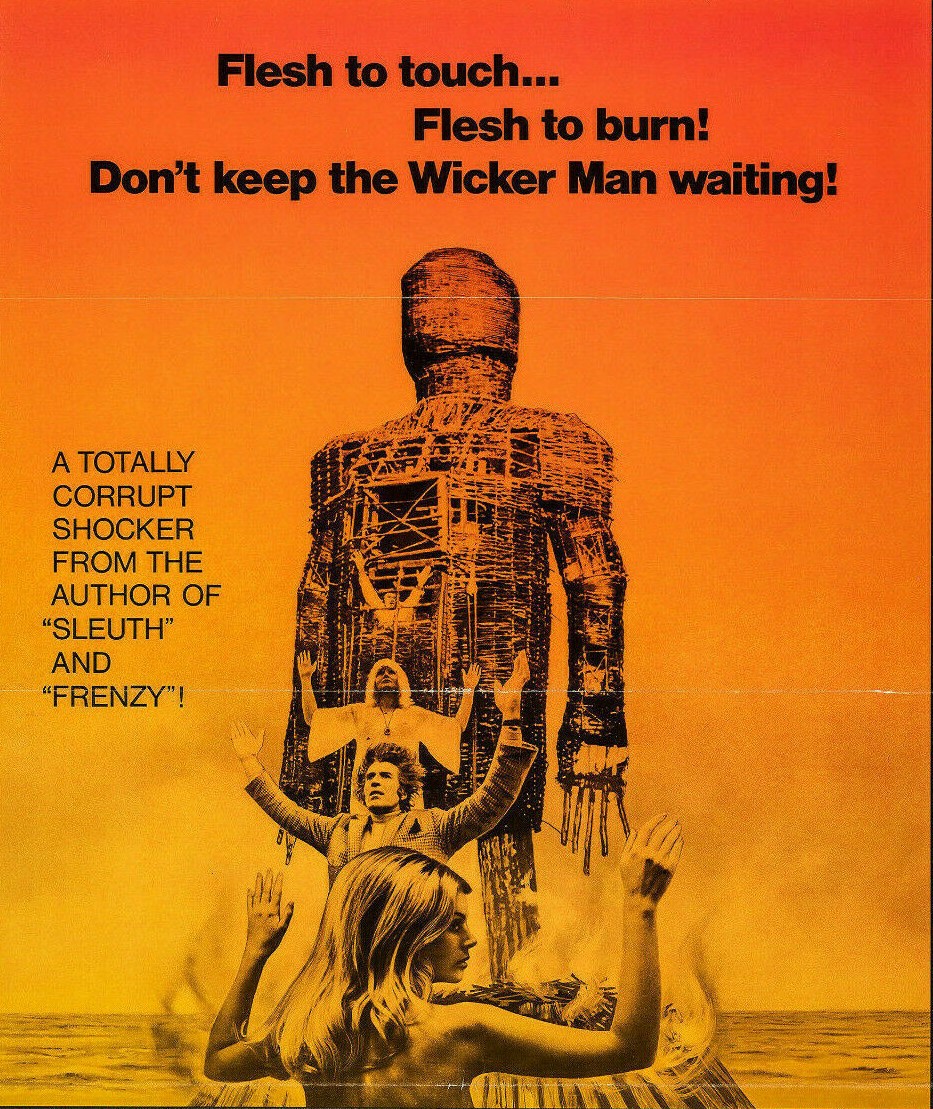
I first saw The Wicker Man in 1973, dismissed by critics on release, on the lower half of a double bill with Nicolas Roeg’s ecstatically-reviewed Don’t Look Now (1973), the films connected less by the horror elements than that they both made by British Lion. t’s now rubbing shoulders with the most superior kind of cult picture, the ones that the public will actually fork out hard-earned cash to see on the big screen, as was my experience this week. Some clever marketing person had the bright idea, given the picture concerns May Day activities of a dark nature, of running a special revival on May Day. What surprised me more was that the cinema was full (on a Monday night, no less), the audience was 20- and 30-year-olds and younger, and judging from overheard chatter afterwards they clearly enjoyed the experience.

What struck me most when watching this was the clarity of the pagan worship, compared to, for example, The Northman where I had no idea what they were worshipping beyond a rough notion. The procreation element was very well thought-out, the idea that such paganism should be taught in schools the way in the era when the film was made religion was on the curriculum. Most horror films do not take religion seriously, But here, even if it’s not your idea of true religion, the entire community invested in the symbolism of animals and trees and fertility rites such as jumping over a fire naked (otherwise your clothes would catch fire) in order to become pregnant. A naked woman weeps over a headstone in a graveyard. You can cure a cough by letting a toad sit in your mouth. And the entire soundtrack, often performed by folk singers in the pub, is filled with songs where the emphasis is on sex. But the detail is really quite extraordinary. Beyond The Wicker Man itself which I understand comes from the Druids, I’ve no idea if this is patchwork of other religions imbued with fictional elements, but it doesn’t matter because, no matter how fantastical it appears, it all rings true.

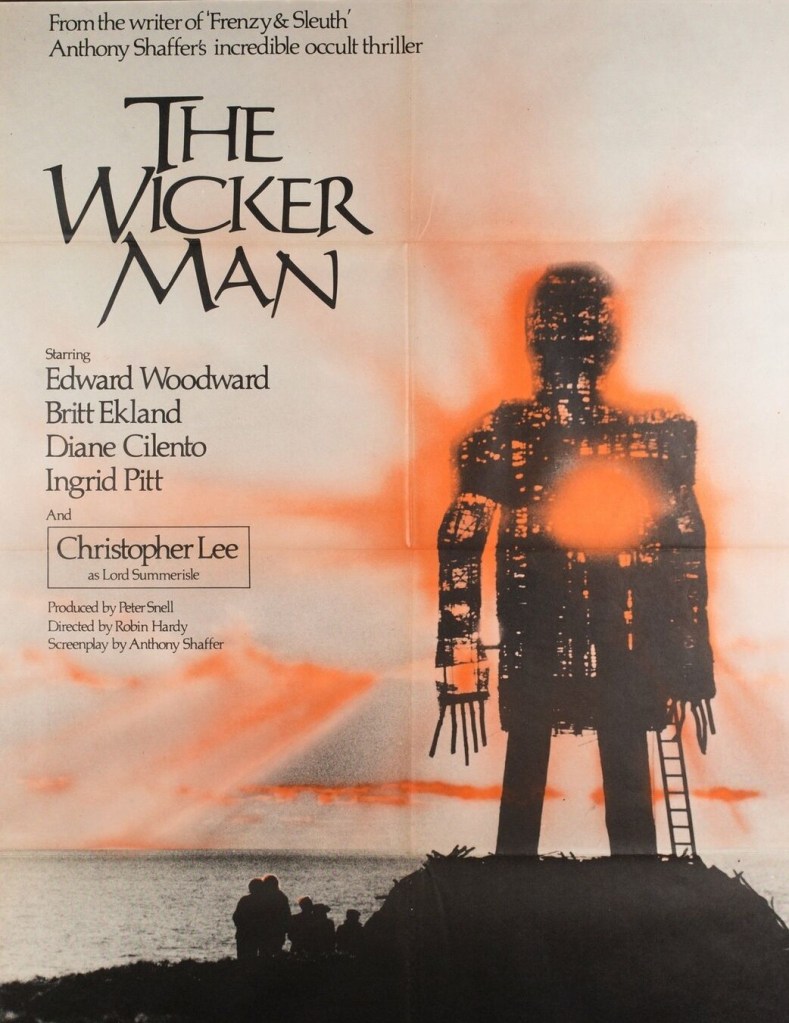
Policeman Sgt Howie (Edward Woodward) pilots a small seaplane to Summerisle to investigate the disappearance of a young girl, Rowan Morrison. At first the villagers deny knowing about the girl’s existence, and then provide conflicting reports, even going so far as to claim she is dead, or has transmogrified into the hare that lies in her supposed coffin. The villagers appear to either discreetly or openly mock him and certainly find much humor in his steadfast Christian beliefs. The schoolteacher Miss Rose (Diane Cilento) denies that the empty desk in her classroom belongs to Rowan. Island chieftain Lord Summerisle (Christopher Lee) debates Christianity. Landlord’s daughter Willow (Britt Ekland) and the librarian (Ingrid Pitt) are on seduction duty.

Frustrated, and threatening to return with more officers, Howie intends to leave but his airplane engine has broken down and soon he is convinced Rowan has been kept alive for ritual sacrifice on May Day as a way of providing rebirth for the island’s failing crops and fruit. In disguise as Punch, he joins the villagers in their parade only to discover that is the hunter who is hunted and that he has been tricked into coming onto the island.  The climax is horrifying, in part because the lack of CGI or a bigger budget, in part down to the delight of the observers, has meant that most of what occurs is left to the imagination.

What at one point appeared an idyllic spot populated by relatively harmless if somewhat wayward people with a highly-developed sense of community and none of the infighting that might common in such a remote location. In another reversal to audience expectation there was none of the bloodlust surrounding the burning of a witch or monster. The smile on the face of a killer indeed!

The audience is brilliantly enmeshed. The investigation appears to drive the narrative, the various obstacles in the way of  the policeman just par for the course in this kind of mystery. Just as we are beginning to become more enchanted by this community’s open attitude to sex especially when compared to Howie’s repressed Christianity, the story takes a sudden switch as the deeper level of meaning is revealed, that fertility actually means rebirth and that the ancient ways of achieving that are not for the faint-hearted.

Edward Woodward (File of the Golden Goose, 1969), making a debut as the star after hitting the television ratings heights as Callan (1967-1972), is excellent as the stern God-fearing policeman who gradually loses his power in a community where there is no tolerance for his kind of law. Christopher Lee (The Devil Rides Out, 1968) breaks out of his typecasting, especially with the wigs, with a very affable performance as a benevolent landlord. It’s hard to view him as an outright villain his actions are for perceived betterment.  Britt Ekland (The Night They Raided Minsky’s, 1968) is convincing as the free-as-a-bird aphrodisiac-on-legs damsel with vulnerability to the fore. Diane Cilento (Negatives, 1968) and Ingrid Pitt (Where Eagles Dare, 1968) have little to do but keep the plot ticking.

Robin Hardy, on his debut, does a remarkable job of setting the seductive atmosphere although the film’s box office failure meant he only made two further films. Anthony Shaffer (Sleuth, 1972) adapted the novel Ritual by David Pinner.

The movie celebrates its 50th anniversary next year so look out for more showings especially if it becomes inextricably linked to the May Day festival the way Casablanca had been adopted by St Valentine’s Day marketeers.

You can catch this on Amazon Prime.

Banned, Ignored, Shelved

If anybody in Britain told you they saw Wild Angels (1966) when it came out that year you could safely accuse them of being liberal with the truth for that was one of the many films banned by the censors there. Global censorship remained a major issue for studios during the 1960s, every country imposing its own system, and very rarely did they conform with each other. At the beginning of the decade, the biggest issue was sex, by the end it was joined by violence and drugs.

Films were rarely banned in the United States since scripts for movies liable to violate the agreed guidelines tended to be submitted in advance and a compromise reached prior to production. However, local U.S. censorship bodies acting independently prevented some films being shown, This Rebel Breed (1960) in Memphis, Room at the Top (1959) in Atlanta. Movies banned in different countries included: Operation Eichmann (1961) in Israel and Germany, Queen Bee (1963) in Italy, The Collector (1965) in New Zealand, Wild Angels (1966) in Denmark, Lady in a Cage (1964) in Sweden and Geneva, Ulysses (1967) in Glasgow and Edinburgh, and Easy Rider (1969),  despite winning a prize at Cannes, in France. Doctor Zhivago (1965) was banned in Thailand for being pro-communistic and in India for the opposite reason. Ireland banned 56 movies in 1960, Finland 12 in 1962, Sweden 10 in 1963 and West Germany 19 that same year. In South Korea in 1962 you still could not see any Japanese movies.

Being banned of course became a promotional tool. It was a regular joke in America that a low-budget picture had no chance of box office success unless it was banned in Boston. In France, Les Teenagers (1968), Young Wolves (1968), The Nun (1966) and Paris Secret (1965) all benefitted from being released after tussles with the censor and the controversy over Ulysses saw it break box office records in Dundee in Scotland.

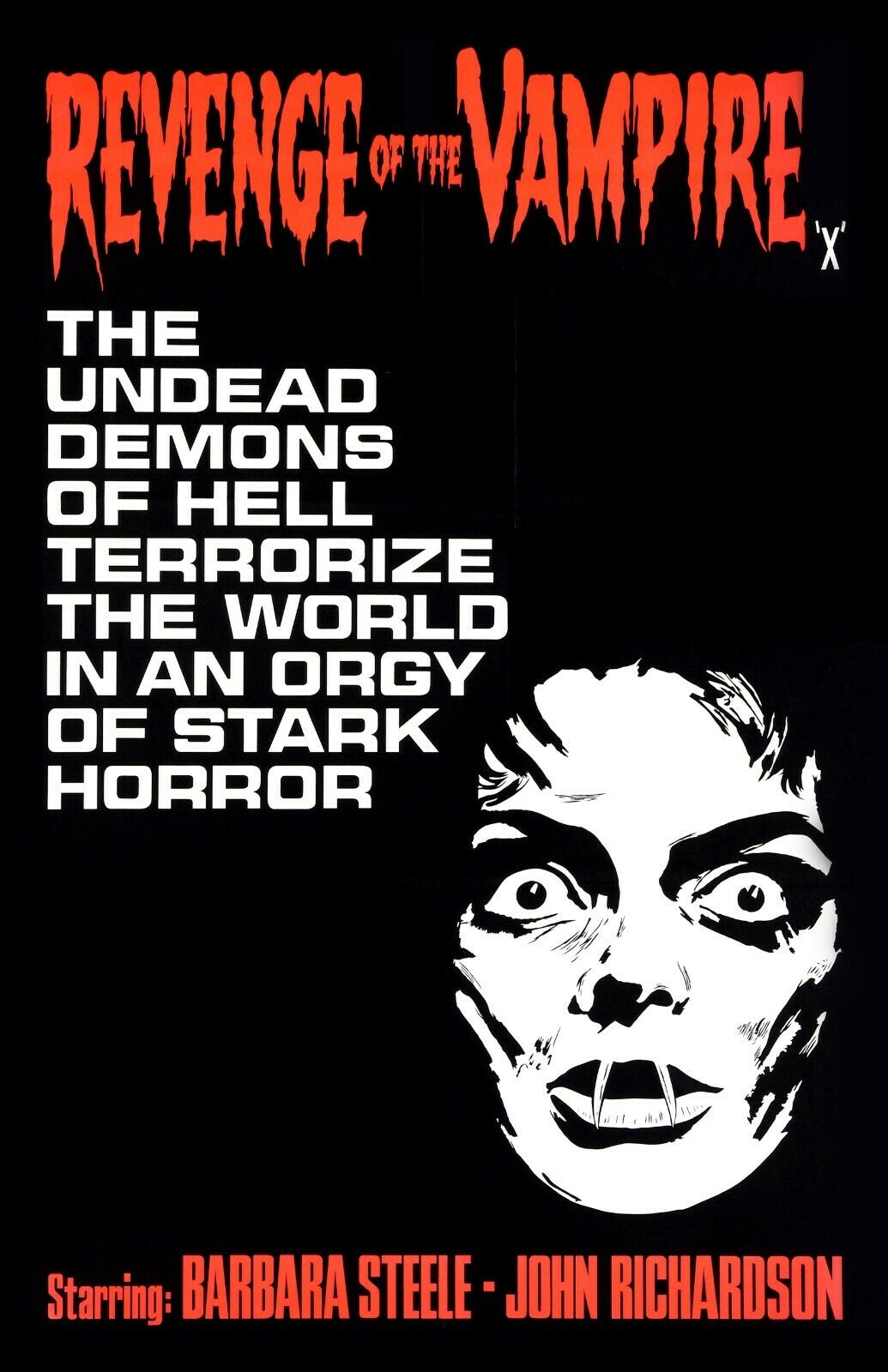
The British censor prevented screening of films deemed too violent including The Couch (1962) about a serial killer, Samuel Fuller’s Shock Corridor (1963), Violent Midnight (1963), The Thrill Killers (1963), Shock Treatment (1963) – despite a cast that included Lauren Bacall and Stuart Whitman – Fuller’s The Naked Kiss and Weekend of Fear (1966). Among horror films denied a showing were Blood Feast (1963), Two Thousand Maniacs (1964) and, initially, Mario Bava’s Black Sunday (1960) which was later reprieved and shown as Revenge of the Vampire.

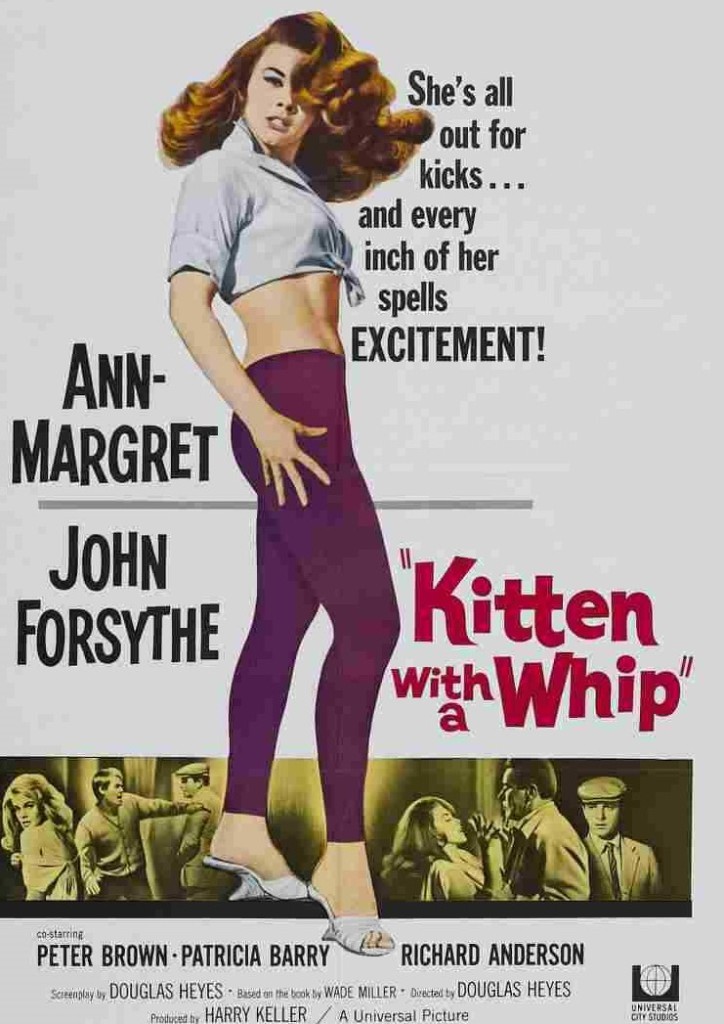
Juvenile delinquency, often straddling the biker world, was another subject to fall foul of the British Board of Film Censors. Among them The Choppers (1961), Jacktown (1962), The Cool World (1964), Kitten with a Whip (1964) starring Hollywood sensation Ann-Margret,  the aforementioned Wild Angels (1966), Rat Fink (1966), Hot Rods to Hell (1966) with Dana Andrews and Mickey Rooney, Riot on the Sunset Strip (1967), Born Losers (1967), Devil’s Angels (1967) and virtually anything that mentioned Hell’s Angels.

Drug taking was also forbidden to be seen, thus accounting for the absence on British screens of The Trip (1967), Hallucination Generation (1967), Mary Jane (1967), LSD Flesh of the Devil (1967) with Guy Madison and Revelation – The Flowering of the Hippies (1967). Easy Rider (1969) was passed for “being actively concerned with human beings and the effect of drug taking.” Films considered too morally dubious or too sexually open to let loose on British audiences included Sinderella and the Golden Bra (1964), 3 Nuts In Search of a Bolt (1964) starring Mamie Van Doren, 90 Degrees in the Shade (1965) with Anne Heywood, Russ Meyer’s Motorpsycho (1965), Good Morning…And Goodbye (1967) and Lee Frost’s The Animal (1968). Explicit language was the objection to Warrendale (1967) and Ulysses (1967), homosexuality the problem for Deathwatch (1965) starring Leonard Nimoy and Shirley Clarke’s documentary Portrait of Jason (1967).  

In Britain, to get round the censor’s strictures, the “cinema club” was invented in 1960 by Gala Film Theatres, an offshoot of a distributor specializing in racy fare, and within a month had 7,500 members, the operation launching with a showing of The Wild One (1953).  Local authorities could also take exception to the national censor’s findings and grant a reprieve for various films, Wild Angels and The Trip eventually achieving exposure in this fashion. Most cinema clubs would eventually segue into becoming outlets for soft porn but some stuck with the original concept of showing arty movies considered too risqué by the censor. The New Cinema Club in London, for example, in August 1969 programmed Wild Angels and Kenneth Anger’s Scorpio Rising (1963)

But the censor was not the only reason why films were not shown and ended up either ignored by the distributors or stuck on the shelf and we’ll come to those in another article.

David McGillivray, “The Crowded Shelf,” Films & Filming, September 1969, 14-15; “High Cost of Censor Fights vs. Principles,” Variety, March 2, 1960, 1;“If Banned in Britain, All Is Not Lost,” Variety, April 20, 1960, p48; “Theatre, Not Censors, Banned Breed,” Variety, June 1, 1960, p24; “Room at the Top Ban,” Variety, July 27, 1960, 4; “Operation Eichmann Banned in Germany, ” Variety, May 3, 1961, 1; “211 Pix Scissored, 56 Banned in Ireland,” Variety, May 3, 1961, p15; “Operation Eichmann Banned by Israeli,” Variety, November 1, 1961, p2; “12 Pix Banned by Finland Censors,” Variety, March 28, 1962, 17; “Singapore Censor Gets Tough with U.S. Pix; Satan, Suzie Banned,” Variety, August 8, 1962, 21; “Japanese Pix Still Banned by S. Korea,” Variety, December 12, 1962, p16; “Bee Banned by Italian Censor,” Variety, January 23, 1963, p18; “W. Germany Claims Only 19 Pix Banned, “ Variety, December 4, 1963, p11; “Swedish Censors Banned 10 in ’63,” Variety, February 5, 1964, p2;  “The Group Banned,” Variety, April 8, 1964, p84; “Lady in Cage Banned by Sweden Censors,” Variety, July 15, 1964, 2; “New Zealand Censors Turn Down Collector,” Variety, November 3, 1965, 11; “Cage Banned By Geneva Censors,” Variety, January 19, 1966, 16; “Can’t Second Guess Global Censors,” Variety, November 30, 1966, 20;  “Banned in Australia,” Variety, May 24, 1967, 26; “Scot Exhib, Whose Town Disapproves Censorship, Cleans Up with Ulysses,” Variety, May 1, 1968, 27; “Film Censors in France Spark B.O.,” Variety, May 8, 1968, 131; “Dracula Sole Film Banned in Israel Last Year,” Variety, May 28, 1969, 39;  “Britain gives ‘X’ Tag to Fonda’s Rider Pic,” Variety, June 18, 1969, 30; “Eire Banned 35  Films in ’68,” Variety, August 20, 1969, 32.

The Box Office Equalizer: Part Four

For three weeks at the end of November 1969 through to mid-December, the top films on the Variety weekly box office Top 50 chart were sexploitation films. The Swedish Fanny Hill (1968) was the first to hit the top and I Am Curious, Yellow, also from Sweden, took the top place for the next fortnight.  

This was something of a slap of cold reality in the face of Hollywood which had assumed that by and large its product was sufficient to meet the needs of exhibitors nationwide. The slump in production due to the financial issues facing the top studios led the industry to expect that the traditional low-budget pictures that would make up the shortfall would come from the usual sources – westerns, crime, horror. Few would have bet on sexploitation taking up the slack.

The new Variety system of collating box office was in part to blame for the influx of sexploitation films being so transparent. Until the magazine instituted its weekly Top 50 grossing pictures in April 1969 and widened the net for gathering in those figures, box office was reported from just 200-300 first run houses in the major cities. This now expanded substantially to five times as many cinemas and included smaller houses in a greater number of cities as well as cinemas that belonged to a Showcase (wide release) circuit.

That resulted in a greater breadth of films being reported. Except on first run arthouses, where some art films with greater sexual content could be shown, it was rare for a sexploitation picture to feature in a big city first run. Russ Meyer was the acceptable face of sexploitation, especially since his films contained humor. Even so, eyebrows were raised when the exploits of Common Law Cabin (1967) made headlines in Variety (“Sexploitation pair: $22,000 at Fox”) at Detroit’s biggest cinema, the 5,100-seater Fox, a major first run venue. That film found slots in first run in Chicago at the Center and the Fine Arts in Portland. Another Meyer opus Finders Keepers found a berth at the Randolph in Philadelphia (“Russ Meyer’s Nude Pic Into Philly’s Classy First Run”). But that was the extent of its invasion of first run for that year. And that was pretty much how the industry expected things to stay, a rare sexploitation making a few headlines, but not much more.  

So when Fanny Hill grossed $625,000 – equivalent to $4.7 million today – from 49 houses to hit the top spot it sent the industry reeling in shock. I Am Curious Yellow hit the top spot in successive weeks with $594,000 from 52 houses followed by $454,000 from 90. In some respects it should not have come as any great surprise. I Am Curious, Yellow had already had already featured several times in the weekly top ten, fifth with $213,000 from 16 houses, sixth with $137,000 from 14 and again with $$237,000 from 18.

Sexploitation distribution was handled in much the same way as any other picture. Probably it came closer to replicating an arthouse release, where prints, due to their cost, were in short supply and cinemas undertook to hold onto a movie for several weeks, if not months. But when a movie was clearly pulling in the crowds, the distributors switched to a more mainstream system, combining Showcase with first run.  The big danger when films went wide was that grosses plummeted. But that was clearly not the case here. Yes, the earlier per-screen averages were higher but the later ones certainly did not fall off a cliff.

Outside of these two pictures, other sexploitationers had been making an impact on the weekly chart. The Libertine (1968) had placed 11th with $184,000 from 56, Naked Angels (1969) came 17th one week with $148,000 from 11 and lower down the chart The Minx (1969) had showed potential with $52,000 from three while Camille 2000 (1969) had earned $32,000 from two. Sexploitationers absorbed lessons learned from more mainstream distributors in how to use the Top 50 as a promotional tool. A movie that was not only taking in big bucks, but placed high in the chart and had a great per-screen average was inevitably going to attract attention.

Perhaps the oddest part of the sexploitation breakout was that so few had seen it coming. If so, they had not been reading the trade papers. This side of the business had grown so fast in a couple of years that those involved had formed their own association. It turned out a war had broken out between the suppliers of cheaply-made sexploitationers and those willing to increase their budgets in order to entice audiences with better production values.

But this was at the hard-core end of the business, the number of outlets tripling from 300 theaters three years before to 800 in 1969, and operating obviously outside the restrictions of the Production Code or the new censorship system. Initially, movies costing $8,000-$15,000 could have been put together in a weekend. Now up to 100 movies budgeted at at a maximum of $45,000 were being made every year with a potential profit of $125,000-$300,000 each. About half a dozen companies had annual million-dollar turnovers.

But this business had also filtered down to the more easily exhibited soft-core, which fitted into the “X” category under the new censorship rules. The 100 cheap soft-core efforts financed by individual theaters or small chains which filled a supporting spot on a double bill produced meagre returns so it made more sense to edit down a hard-core feature to suit a soft-core audience. The demand for hard-core, most prominently seen in Detroit, where hard-core pictures often outgrossed first run, was filtering down into soft-core, hence the growth in bookings for the likes of Fanny Hill and I Am Curious, Yellow.

The other reason for moving into the soft-core market was that the hard-core end was saturated resulting in lower rentals and consequently lower profits which inhibited production. Theaters struggling to cover overheads from the thin stream of movies emanating from the major studios or finding there was little juice left in blockbusters by the time they drifted down the exhibition food chain increasingly turned to soft porn.

SOURCES: “Sexploitation Filmmakers, Showmen Form Adult Motion Picture Ass’n,” Box Office, January 20, 1969, p8; “Over-Seated for Sex,” Variety, July 2, 1969, p1; “Sexpix of $25,000-$45,000 Negative Cost See Bright, Not Clouded, Future,” Variety, July 16, 1969, p17. Results for the “Top 50 Chart” in Variety were taken from the following issues in 1969: Jun 4, Jul 2, Jul 9, Jul 23, Sep 24, Oct 1, Oct 15, Nov 5, Nov 26, Dec 3, Dec 10, Dec 17, Dec 24.  

Easy Rider (1969) *****

Just goes to show what a little bit of reimagining can do. A companion piece to The Wild Angels (1966) but which takes the viewer in the opposite direction, turning the characters from perpetrators of violence to its victims, adding in a stonking soundtrack and a bit more philosophy, though holding on to the long tracking shots of motorbikes that defined the Roger Corman approach. From the bare bones of the Corman movie emerged a cinematic – and box office – miracle.

You could be forgiven for thinking that the movie’s main influences were the early Cinerama pictures that focused on extensive tracking shots of scenery (in this case, the open road) and unusual customs (ditto, alternative lifestyles, dope-taking etc) and Mike Nichol’s use of contemporary pop music in The Graduate (1967). But it also drew on the assumption, as did Hitchcock in Vertigo (1958) and Kubrick with 2001: A Space Odyssey a decade later, that a camera doing nothing can be hypnotic.

Message pictures were the remit of older directors like Stanley Kramer and Martin Ritt and films that had something to say about the human condition generally emanated from Europe and not low-budget efforts coming out of Hollywood. Easy Rider has a European sensibility, an almost random collection of unconnected episodes with no narrative connection to the main story, itself incredibly slight, of two mild-mannered dudes heading to New Orleans to see the Mardi Gras.

Road trips were not particularly unusual in American cinema but the form of previous locomotion was horse-related – westerns. The journey has been a central theme to movies. This is an 80-minute picture masquerading as a 95-minute one, a good fifteen minutes of screen time taken up with endless shots of Peter Fonda and Dennis Hopper on bikes passing through the landscape, with a contemporary soundtrack as comment.

Unusually, it’s also a hymn to ancient values, heads bowed in prayer at meals as different as you could get, the Mexican family and the commune, a marching band playing “When The Saints Go Marching In” and the recitation of prayers in the cemetery.

What marks the film out stylistically, perhaps enforced by the lean financing, is the sparing way it is told. The most dramatic scenes – the three murders – are filmed in shockingly simple fashion. There are often long pans along groups of characters. While innovative, the flash-cut flash-forward editing adds little to what is otherwise a very reflective film. Inspired use is made of natural sound, the muffled thumping of oil derricks at the cemetery, the soundtrack to one death is just the battering of unseen clubs by unseen assailants.

The dialogue could have been written by Tarantino, none of the confrontation or angst that drives most films, but odd musings that bring characters to life. At the beginning of the trip, Hopper and Fonda are welcomed wherever they travel, but towards the end resented, treated as though a pair of itinerant aliens. They entrance young girls but are vilified by authority, jailed for no reason except the threat to traditional values they apparently represent.

Elements not discussed at the time of release make this more rounded than you would imagine. The excitable Hopper, a nerd in hippie costume, is driven by the American dream of making money. The more reflective Fonda, developing a character trait he revealed in The Wild Angels, senses something is not only missing from his life but has been lost forever. He has the rare stillness of a top actor, face reflecting unspoken inner turmoil. As revelatory is the performance of Jack Nicholson, here effectively making a bid for stardom in a part that would snare an Oscar nomination.

It remains an extraordinary film, a series of accumulated incidentals holding up a mirror to an America nobody wanted to acknowledge and the brutal climax no less powerful now. 


The Fox (1967) ****

Based on a novella by D.H. Lawrence, The Fox, relocated to contemporary Canada, marked the debut of director Mark Rydell. Originally, Alan Bates (Georgy Girl, 1966), Patricia Neal (Hud, 1963) and Vivien Merchant (Alfie, 1966) were in the frame for the three roles. Instead, the trio were Sandy Dennis, Keir Dullea and Anne Heywood.

Dullea’s career was at a dead end after flops The Thin Red Line (1964) and Bunny Lake Is Missing (1965). Former beauty queen Heywood had been a Rank starlet which resulted in small roles of no distinction until marriage to the film’s producer Raymond Stross improved her prospects. The main marquee attraction was Sandy Dennis who had won the Best Supporting Actress Oscar for Who’s Afraid of Virginia Woolf (1966) and starred in drama Up the Down Staircase (1967). But it was a low-budget enterprise all the way.

Dennis and Heywood play spinsters running a chicken farm in rural Canada, home-body Dennis the more introspective and content, task-oriented Heywood self-sufficient but sexually frustrated. Dullea is a merchant seamen who visits the farm in search of his grandfather, now deceased. Allowed to remain, his presence threatens their lifestyle and forces them to confront the intensity of their suppressed feelings towards each other. Although a real fox is causing trouble, Dullea is the symbolic fox in the symbolic hencoop. Rydell displays considerable confidence in his material.

It is very atmospheric, the natural backdrop, early morning sunsets and wintry chill in the air adding a certain tone, with the isolation providing a thematic template. The tiny cast creates a sense of intimacy as well as tension and the acting is uniformly good. There is no sense of lust, just a gradual emergence of submerged emotion.

Tackling such a bold theme would have brought the movie some attention anyway, but nudity, masturbation and sex brought much more. That such scenes were filmed in good taste and impressed critics was hardly going to deter the salacious. The nervy, whiny Dennis has the showiest role but Heywood’s subdued performance, trapped by her conflicting sexual needs, is the central figure.

George Roy Hill might well have purloined his freeze-frame ending in Butch Cassidy and the Sundance Kid from an idea Rydell employs here, one of only two effective stylistic devices in an otherwise highly-controlled piece. The only directorial downsides are a couple of instances of unnecessary melodramatic music when otherwise Lalo Schifrin’s gentle theme is perfectly in keeping with the picture’s mood. Made on a budget of buttons and reliant entirely on acting skill, this is one of the decade’s low-budget triumphs, not least for its sensitive treatment of its subject matter.

Sanctuary (1961) ***

This overheated melodrama stands as a classic example of Hollywood’s offensive attitudes to women. Nobel prize-winning author William Faulkner could hardly blame the movies for sensationalising his misogynistic source material since if anything the movie took a softer line.  Told primarily in flashback as headstrong southern belle Temple Drake (Lee Remick) attempts to mitigate the death sentence passed on her maid Nancy (Odetta). Given that such appeals are directed at Drake’s Governor father (Howard St John), and that the maid has been condemned for murdering Drake’s infant child, that’s a whole lot of story to swallow.

Worse is to follow. Drake takes up with Prohibition bootlegger Candy Man (Yves Montand) after being raped by him and thereafter appears happy to live with him in a New Orleans brothel – the “sanctuary,” no irony intended, of the title – despite him slapping her around. The film steers clear of turning her into the prostitute of the original book, but pretty much sets up the notion that high class women will fall for a low-class tough guy whose virility is demonstrated by his brutality. In other words a “real man” rather than the dilettantes she has previously rejected.

After the Candy Man dies, Drake returns home and marries wealthy suitor Gowan Stevens (Bradford Dillman) who blames himself, rightly, for Drake falling into the clutches of the gangster in the first place. But a past threatening to engulf her precipitates the infanticide.

Faulkner was a Hollywood insider, adapting Sanctuary for The Story of Temple Drake (1933) and earning high praise for  his work on Bogart vehicles To Have and Have Not (1944) and The Big Sleep (1946). The success of The Tarnished Angels (1957) starring Rock Hudson, The Long, Hot Summer (1958) with Paul Newman and The Sound and the Fury (1959) headlined by Yul Brynner had sent his cachet rocketing. But all three were directed by Americans – Douglas Sirk and Martin Ritt – who had a distinctive visual style and an ear for what made melodrama work.

Sanctuary had been handed to British director Tony Richardson (Look Back in Anger, 1959) and he didn’t quite understand how to make the best of the difficult project. So while Lee Remick manages to suggest both strength and fragility, and makes her character’s wanton despair believable, Yves Montand is miscast and Bradford Dillman fails to convince even though portraying a weak character. Too many of the smaller roles appear as cliches. And it’s hard to believe the maid’s motivation in turning murderer. Watch out for Strother Martin (Cool Hand Luke, 1967).

What was acceptable steamy melodrama in the 1930s fails to click three decades on. Faulkner’s thesis that high-falutin’ women want a man to master them and furthermore will fall in love with their rapist seems to lack any understanding of the female mind and will not appeal any more to the modern sensibility than it did on release. Lee Remick is what holds the picture together, in part because she plays so well the role of a woman embracing degradation, and refusing – no matter how insane the idea appears – to let go of the man she believes is the love of her life. It’s not Fifty Shades of Grey, but it’s not that far off that kind of fantasy figure, and given the success of that book, it’s entirely possible there is a market for what Faulkner has to peddle.

Not easy to find. This is actually on YouTube if you go onto that channel and search. Strangely enough, if I post a link, it says it is no longer playing there – but just as strangely if you go looking you will find it.

Station Six Sahara (1963) ***

Desert pictures come in two varieties – men battling the elements with little or no female distraction and men distracted from battling the elements by the presence of a female. Since the film I reviewed earlier today, Sands of the Kalahari,  fitted largely into the first camp with the sole female being viewed as a prize rather than a temptress, I thought it might be interesting to compare it to Station Six Sahara, made the year before, in which the seductive Carroll Baker disrupts the men-only oil station.

David Lean spent months in Jordan capturing his vision of the desert for Lawrence of Arabia. Seth Holt was granted no such luxury, a few weeks at Shepperton Studios in England to make this British-German co-production.  It is a surprisingly tight and effective drama made on a low budget excepting whatever fee induced Hollywood star Carroll Baker to join.

Five men trapped on an oil pipeline maintenance unit drive each other to distraction. Loud Scot Ian Bannen constantly needles stiff upper-class Denholm Elliott while overbearing German boss Peter Van Eyck cheats at poker. The arrival of steely-eyed German Hansjorg Felmy alters the status quo as he refuses in his own quiet way to knuckle down to authority. There is a wonderful psychological battle going on between Bannen and Elliott.

Extremely envious of the number of letters Elliott receives, Bannen offers a month’s pay for just one. When the offer is accepted, Elliott cannot stop fretting about what he might have given away and what secrets it revealed about himself. The arrival of Carroll Baker upsets the equilibrium further as the men attempt to win her affections. While apparently promiscuous, she is steelier than the lot of them, and tensions climb high when she begins to spread around her favors. Interestingly, she does no wooing but waits for men to come to her.

Given the budget restraints, or possibly because of them, it is surprisingly well directed. Two scenes stand out in directorial terms. In one featuring Bannen and Elliott, the Scot is only partly visible behind a piece of furniture but his dialogue continues even when out of sight. In the other, one of Baker’s suitors finds her door locked and as she is about to reply a hand appears (not in aggressive fashion) to cover her mouth, indicating she already has chosen her bedmate.

Naturally, this can only lead to a grim end. The cast of male unknowns are uniformly good but Baker steals the show as you would expect. Given the times, there was no nudity, but the overt sexuality certainly skirted the bounds of what passed as decency and Baker is alluring however little or much she wears. But her sexuality takes second place to her individuality. Her independence will not be surrendered to a man. Despite the budget restrictions it stands up very well.     

At any given moment Carroll Baker could be both a top Hollywood star and a middling box office attraction. She had just come off How the West Was Won (1963) but had really failed to justify the potential shown in Baby Doll (1956). Peter van Eyck (The 1,000 Eyes of Dr Mabuse, 1960). was best known for his role in Wages of Fear (1953). Scottish actor Ian Bannen (Psyche 59, 1964) was beginning to merge as a strong character actor, he and van Eyck had appeared together previously in The World in My Pocket (1961). The career of Denholm Elliott (Maroc 7, 1967) followed a similar arc to Bannen as a supporting player of distinction. Seth Holt (Danger Route, 1967) was considered a rising directorial star until his untimely death at the age of 41.

Bus Riley’s Back in Town (1965) ***

Given that Ann-Margret receives top billing I had automatically assumed she was the Bus Riley in question. Although decidedly the female lead, her role is secondary to that of a sailor returning to his small town. The backstory is that Bus – no explanation ever provided for this nickname, Buster perhaps? – Riley (Michael Parks) had been too young to marry the gorgeous Laurel (Ann-Margret) before he joined the U.S. Navy and in his absence she married an older wealthy man.  

Bus dithers over his future, re-engages with his mother and two sisters and finds he has not lost his attraction to Laurel. Although a handy mechanic, he has his eye on a white collar  career. An initial foray into becoming a mortician founders after sexual advances by his employer (Crahan Denton). Instead he is employed as a vacuum salesman by slick Slocum (Brad Dexter).  While his sister’s friend Judy (Janet Margolin) does catch his eye, she is hardly as forward or inviting as the sexy Laurel who crashes her car into his to attract his attention. But easy sex available with Laurel and the easy money from exploiting lonely housewives trigger a crisis of conscience.

Perhaps the most prominent aspect is the absence of good male role models. Bus is fatherless, his mother (Jocelyn Brando) taking in boarders to meet her financial burden – including the neurotic Carlotta (Brett Somers) – and while younger sister Gussie (Kim Darby) adores Bus the other sister Paula (Mimsy Farmer) is jealous of his freedom. Judy’s father is also missing and her mother (Nan Martin) a desperate alcoholic. The biggest male players are the ruthless Slocum and Laurel’s husband who clearly views her as a plaything he has bought. The biggest female player, Laurel, is equally ruthless, boredom sending her in search of male company, slithering and simpering to get what she wants.     

Scandal is often a flickering curtain away in small towns so it’s no surprise that Bus can enjoy a reckless affair with Laurel or that a meek mortician can get away with making his desires so quickly apparent, or that behind closed doors houses reek of alcohol or repression. A couple of years later and Hollywood would have encouraged youngsters like Bus and Laurel to scorn respectability in favor of free love. But this has a 1950s sensibility when finding a fulfilling job and the right partner was preferred to the illicit.

In that context – and it makes an interesting comparison to the more recent Licorice Pizza that despite being set in the 1970s finds youngsters still struggling with the difference between sex and love – it’s an excellent depiction of small-town life.

While Michael Parks (The Happening, 1967) anchors the picture, it’s the women who create the sparks. Not least, of course, is Ann-Margret (Once a Thief, 1965), at her most provocative but also revealing an inner helpless core. And you can trace her screen development from her earlier fluffier roles into the more mature parts she played in The Cincinnati Kid (1965) and more especially Once a Thief (1965).

In her movie debut Kim Darby (True Grit, 1969) is terrific as the bouncy Gussie and Janet Margolin (David and Lisa, 1962) invests her predominantly demure role with some bite. Jocelyn Brando (The Ugly American, 1963) reveals vulnerability while essaying the strong mother. Mimsy Farmer (Four Flies on Grey Velvet, 1971) also makes her debut and it’s only the second picture for David Carradine (Boxcar Bertha, 1972). Brad Dexter (The Magnificent Seven, 1960) is very convincing as the arrogant salesman.

It’s also the first film for Canadian director Harvey Hart (The Sweet Ride, 1968) and he has some nice visual flourishes, making particular use of aerial shots. The scenes of Bus trudging through town at night are particularly well done as are those of Laurel strutting her stuff.

It was also the only credit for screenwriter Walter Gage. That was because Gage didn’t exist. Like the Allen Smithee later adopted as the all-purpose pseudonym for pictures a director had disowned, this was the name adopted when playwright William Inge (Oscar-winner for Splendor in the Grass, 1961) refused to have anything to do with the finished film.

The movie was in limbo for over a year. It was never intended as a major picture, the budget limited to $550,000. Shot in Spring 1964, release was delayed for about a year until  Universal re-edited it and added new scenes. In part this was because Ann-Margret had  achieved surprising movie stardom between her recruitment and the film’s completion. Along with Raquel Welch, she became one of the most glamorous stars of the decade and in building up her own career Welch clearly followed the Ann-Margret template of taking on a bucket of roles and signing deals with competing studios.

After making just three movies, Ann-Margret was contracted for three movies with MGM at an average $200,000 per plus an average 12% of the profit, substantial sums for a neophyte. On top of that she had four far less remunerative pictures for Twentieth Century Fox, three for Columbia, Marriage on the Rocks with Frank Sinatra and a couple of others.

Universal also had another property to protect. Michael Parks was one of small contingent of novice actors in whom the studio had invested considerable sums, using them in television roles before placing them in major movies. Others in this small group – at a time when most studios had abandoned the idea of developing new talent – included Katharine Ross and Tom Simcox who both appeared in Shenadoah (1965), James Farentino (The War Lord, 1965), Don Galloway (The Rare Breed, 1965), Doug McClure (The Lively Set, 1964) and Robert Fuller and Jocelyn Lane in Incident at Phantom Hill (1965).

However, the introduction of Parks had not gone to plan. He was set to make his debut in The Wild Seed (1965) – originally titled Daffy and going through several other titles besides – but that was also delayed until after Bus Riley, riding on Ann-Margret’s coat-tails, offered greater potential.

SOURCES: “Escalating Actress,” Variety, May 22, 1963, page 4; “Inge Thinks Writer Contentment May Lie in Creative Scope of Cheaper Pix,” Variety, May 6, 1964, p2; “Ann-Margret Into the Cash Splash,” Variety, July 22, 1964, p5; “Universal Puts 9 Novices Into Pix,” Variety, March 3, 1965, p25; “Fear Ann-Margret Going Wrongo in Her Screen Image,” Variety, March 24, 1965, p5.

There’s a VHS copy available on Amazon, but otherwise it’s Ebay or this decent enough print on YouTube.

Titane (2021) *****

Perhaps the most unforeseen development of this startling picture is that ruthless serial killer Alexia (Agathe Rousselle) develops a caring relationship with an anguished fire chief father (Vincent Lindon) when masquerading as his long-lost son.  Even when it becomes increasingly clear he is harbouring an imposter his naked need for familial intimacy forces continued acceptance. Of course, given Alexia has been impregnated by an automobile, the cinematic wild ride is hardly over. Not just that the father is inclined to pump himself full of steroids to maintain his failing virility and the firemen let off steam by dancing, with no homoerotic overtones, of dancing among themselves.

But tension never slackens due to the off-the-wall off-the-scale opener that saw her enter the realms of the serial killer and the fact that her nipples start leaking oil. A relationship that could have been creepy and/or unbelievable becomes incredibly tender especially when the so-called boy, as teenagers will, causes his father major embarrassment only this time by revealing a more feminine side to his dancing.

While exploring similar territory to David Cronenberg’s Crash (1996), this shifts into a completely league. With the exception of what she undertakes to create the transformation into a boy, binding her breasts and breaking her nose, the violence is less about self-harm  than straight-out murder, weapon of choice being a handy hatpin. The most bizarre aspect about the enterprise is not the victims mounting up, but the hilarity the film engenders. When Alexis discovers that she has chosen the wrong locale for one of her killings and with a shrug of frustration has to embark on hunting down an entire household you can’t help but laugh. And the meet-cute with a female model is one of the funniest ever put on the screen.

We never find out what has turned her into a murderer especially as she is not gender-specific in this department. A car accident as a child that resulted in her being fitted with some metal has clearly created some affinity with vehicles and she earns a living as a bikini model who drapes herself over motors at car shows to the delight of leering men. Automobiles are more generally seen as expressions of male eroticism so it’s something of a twist that Alexia takes such love to the ultimate extreme.

Outside of superhero and fantasy movies, it’s rare to find a picture that creates its own world and maintains it in consistent fashion. What we learn about this vicious killer is that she needs care as much as anybody else. As the movie shifts from her selfish enjoyment to filling a gap in the fireman’s life it takes us on quite a different journey to that initially suggested.

Director Julia Ducournau (Raw, 2016) presents an unflinching vision that may be too brutal for most tastes. It won the Palme d’Or at Cannes but looks like being ignored by the Oscar fraternity. But the surface is deceptive. If the ending comes as a shocker then you haven’t been paying attention because enough hints are provided as to the potential outcome. And it also means you’ve been ignoring the film’s development which is heading in the direction of togetherness and paternal understanding rather than individual insanity.

In her movie debut Agathe Rousselle is quite astonishing, giving herself up to the needs of a picture that forces tremendous physical demands. It’s a tour de force in what it means to be a committed actor, action driven by character. Oscars have been handed out for a lot less and what makes her characterisation stand out is the transition from woman trapped by a fetish whose only emotional outlet is murder to someone accepting love without question or vicious rejection.

Vincent Lindon (Rodin,2017)  is at the other end of the career scale, with nearly three decades in the business, highlighted by a previous Cannes and Cesar win for The Measure of a Man/ La Loi du Marche (2015). His is a thankless role, at the very least a willing dupe, as much a self-harmer judging from the bruises on his exterior, as likely to be lost and flailing in his jab – a sequence of a forest fire is outstanding – as in his empty emotional life. Hats off also to Lindon, as one of France’s biggest stars, for supporting this project. Without his involvement, funding would have been more difficult.

Titane is a true original with surprising emotional depth.

Sisters (1969) ****

Erotically-charged, symbolically-heavy French drama of siblings trying to re-establish the intense relationship they enjoyed as teenagers. After a nervous breakdown and on the point of divorce, blonde translator Diana (Nathalie Delon) seeks respite at the home of younger sister Martha (Susan Strasberg), a brunette happily married to the wealthy and indulgent Alex (Massimo Girotti).

Initially, the more worldly Diana, the more flamboyant dresser, appears the superior but it soon transpires she is the more fragile. The apparently timid Martha allows her husband to control her life to the point of buying all her clothes and she confesses to feeling as if she is on “a perpetual cruise.” While on the surface, it seems as if she has given up too much, in reality she disapproves of disorder and seeks perfection. She comes across as needing protection, and believes the woman’s role is to sacrifice, but in fact has managed to arrange her life to her own satisfaction.

Their competitive streaks emerge in different ways, Diana in obvious fashion, seeking to beat her sister while out horse-riding, Martha in more subtle and sensual manner, flaunting her sexual relations with her husband, almost offering her sister to her husband, and having a lover (Lars Bloch) on the side. There is a sense of each attempting to impose their world view on the other. Diana gives her sister a make-over, a new look which Alex adores, Martha hates it. There’s a sense of a chess game, males the obvious pawns.

Sensuality is never far away. Diana nuzzles her sister’s neck to smell her perfume. Alex is photographed, encouraged by Martha, in almost intimate mode with Diana. Dario (Giancarlo Giannini) is brought in to tempt Diana. And a scene where the girls experiment with colorful scarves suggests libertarianism. 

But it is clear that both sisters live empty lives devoid of true love and equally obvious as the picture progresses that both have arrived at the conclusion that they were at their most happiest when together. There are subtle hints of incest, comforting each other in bed, the sensuality electric and the film begins to examine whether this taboo can be crossed and, if so, will it provide the necessary escape.

Despite Martha’s apparent subjugation, there is more than an inkling of feminism, the girls involved in a complicated scenario in which males are either rejected or made to look fools. While not fulfilled, Martha has turned as much as possible to her own advantage and Diana seems perfectly capable of taking what she wants.

Alex provides the symbolism. He cultivates rare plants in a greenhouse that need to hide from the sun, lengthy exposure to whose atmosphere would be fatal to humans. He endlessly photographs them because they won’t last long. And in similar fashion provides a haven for the apparently vulnerable Martha.

Nathalie Delon (When Eight Bells Toll, 1970), married at this point to Alain Delon, shows a subtlety of expression that is rare for someone appearing in just her third film, and effects a gradual character transition throughout. Susan Strasberg, daughter of famed acting coach, Lee Strasberg, inventor of the Method Style of Acting, was one of the boldest actors of her generation, appearing in drug pictures The Trip (1967) and Psych Out (1968). She delivers an excellent portrait of a woman who manages to keep her true personality hidden, and for whom sexuality has few barriers.

This is the puppy-fat version of Giancarlo Giannini (Swept Away, 1974), barely recognizable as the future arthouse superstar whose physical appearance relied on gaunt, angst-riddles features.  Massimo Girotti (Theorem, 1968) is good as the husband who thinks he has everything, not realising how little he has.  

Although this was an accomplished directorial debut from Roberto Malenotti, he only made one more movie. Perhaps he made enough from directing the famous Coke commercial I’d Like To Teach The World To Sing (1971).

Always intriguing, revelations continually undercutting what we think we know of the characters, but delivered in subtle European tones rather than employing Hollywood shock, each of the four main people involved changing considerably due to their interaction with the others. While certainly skirting close to the borders of what was permissible at the end of the 1960s, it does so without exploiting the actresses.

Not an easy one to find, your best bet is a secondhand copy on Ebay.

Discover WordPress

A daily selection of the best content published on WordPress, collected for you by humans who love to read.

The Atavist Magazine

by Brian Hannan

WordPress.com News

The latest news on WordPress.com and the WordPress community.