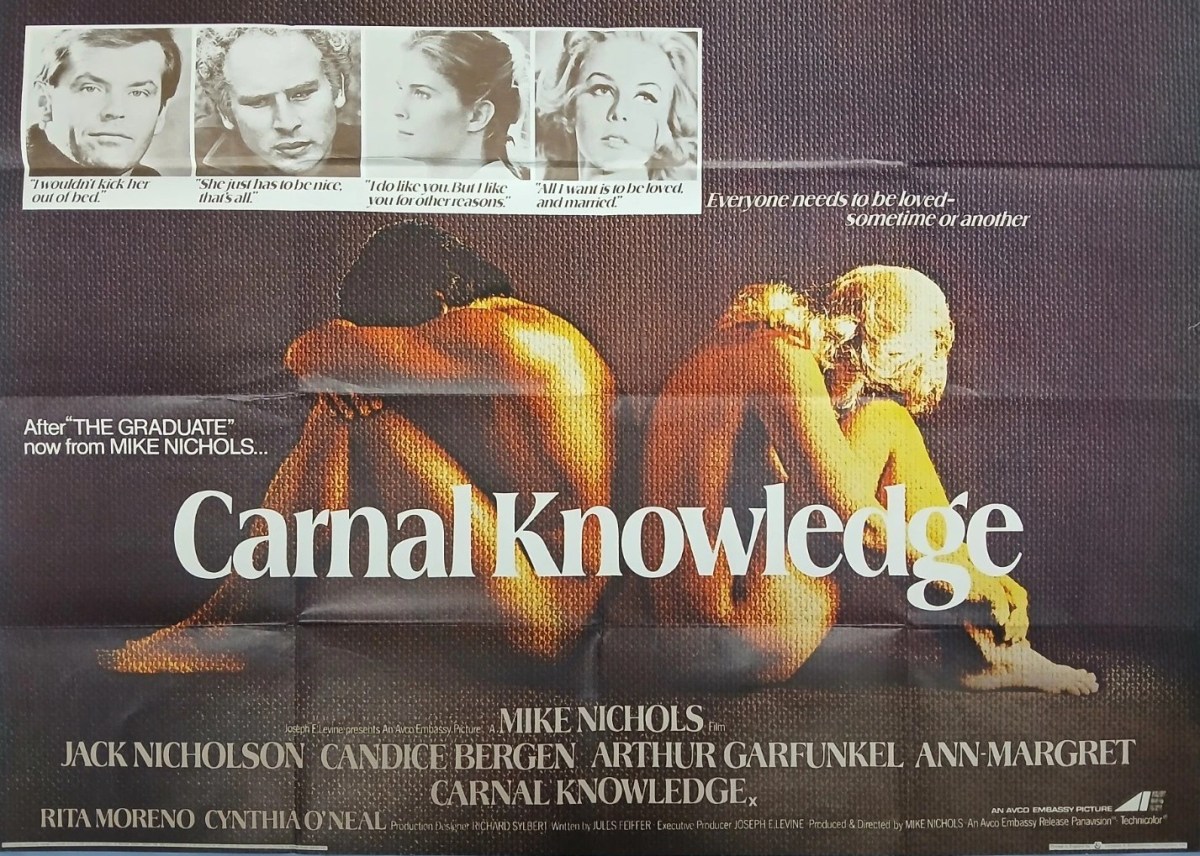
Carnal Knowledge (1971) ****

You could argue that this is every bit as meretricious as Three in the Attic (1968). That the misogynism is every bit as rampant, the language considerably coarser, women judged by their physical attributes rather than their brains, men boasting about every little detail of their sex lives. More locker room than intelligentsia. You could argue that Porky’s (1981) and American Pie (1999) take exactly the same approach with no suggestion they have reached some exalted critical status.

There’s similar reliance here as in Three in the Attic on technical tricks, long monologues with the camera in a fixed position, and it would appear as if the person is indeed breaking the fourth wall and talking directly to the audience except for one shot, two at most, of a listener. Or the same fixed approach focusing on, for example, a girl laughing hysterically or a female skater, and background music that appears completely irrelevant except in the most perfunctory fashion depicting a time period.
Of course, there’s no comparison when it comes to the actors. This boasts a stellar cast – Jack Nicholson (Easy Rider, 1969) with one Oscar nomination already under his belt casting a spell on the audience, Candice Bergen (Soldier Blue, 1970), a standout among the new generation of female stars, and Ann-Margret (Stagecoach, 1966) at one point bigger than either in the Hollywood stratosphere making a comeback that would win her an Oscar nomination. Art Garfunkel, one half of the most potent double act in the recording business, was making his movie debut.

Director Mike Nichols was on a hell of a roll, his first two pictures – Who’s Afraid of Virginia Woolf (1966) and The Graduate (1967) – awash with Oscar kudos and unprecedented box office gravy. 

And you could make the same double-handed argument about feminism. Susan (Candice Bergen) would certainly count as a liberated women given she’s stringing along best buddies Jonathan (Jack Nicholson) and Sandy (Art Garfunkel), not just having sex with both, but leading the way with the shy latter. And once married to Sandy she keeps him up to scratch in the bedroom, teaching him to make love the way she likes it.
Given Jonathan’s obsession with the inches on the female body that are so important to him, it’s amazing her was at all interested in Susan, except for his competitive streak, delighted to steal away the girl who is apparently his pal’s girl. While Sandy appears the more insecure, in fact Jonathan more than matches him, always comparing Susan’s gentler treatment of Sandy. He might even have invented the tale of his poor childhood in order to gain her sympathy.

Certainly, once Sandy and Susan are married, Jonathan’s jealousy goes up a notch, annoyed that his pal is greeted by his wife on return from work with a martini and dinner while his voluptuous girlfriend Bobbie (Ann-Margret) struggles to warm up a television dinner and can’t keep his apartment tidy.

While Jonathan avoids commitment, Arthur isn’t as committed as he seems, having a mistress Cindy (Cynthia O’Neal) in tow, whom Jonathan thinks it’s fair game to woo and even gives Arthur carte blanche to take a chance on Bobbie.

Even given the misogyny of the period, you’d struggle to find two more obnoxious men. Any woman that attempts to be their match or gives as good as she gets is deemed a “ball-buster” or just after men for their money. You’re almost thankful that, just like Three in the Attic, there’s a touch of morality at the end, with the impotent Jonathan reduced to paying sex workers to tell him how powerful he is in order to gain an erection. Though Sandy appears to get off scot-free – now dating 18-year-olds.

But the performances all round are superb. Susan could perhaps have done with her character being filled out rather than just seen through the eyes of the men. Ann-Margret revived her career with his performance, of a woman whose body has betrayed her, all her sexiness not winning her the security she desires. It’s as bold a move for Jack Nicholson to play such a loathsome arrogant character. I was never convinced by Art Garfunkel.

Despite the tricksy presentation, Mike Nichols, as with Who’s Afraid of Virginia Woolf, traps his characters under an intense microscope. Screenwriter Jules Feiffer, better known at the time as a cartoonist and playwright, excels in his debut.

Hard going at times given the repellant characters but still excellent.  

Easy Rider (1969) *****

You could be forgiven for thinking that the movie’s main influences were the early Cinerama pictures that focused on extensive tracking shots of scenery (in this case, the open road) and unusual customs (ditto, alternative lifestyles, dope-taking etc) and Mike Nichol’s use of contemporary pop music in The Graduate (1967). But it also drew on the assumption, as did Hitchcock in Vertigo (1958) and Kubrick with 2001: A Space Odyssey a decade later, that a camera doing nothing can be hypnotic.

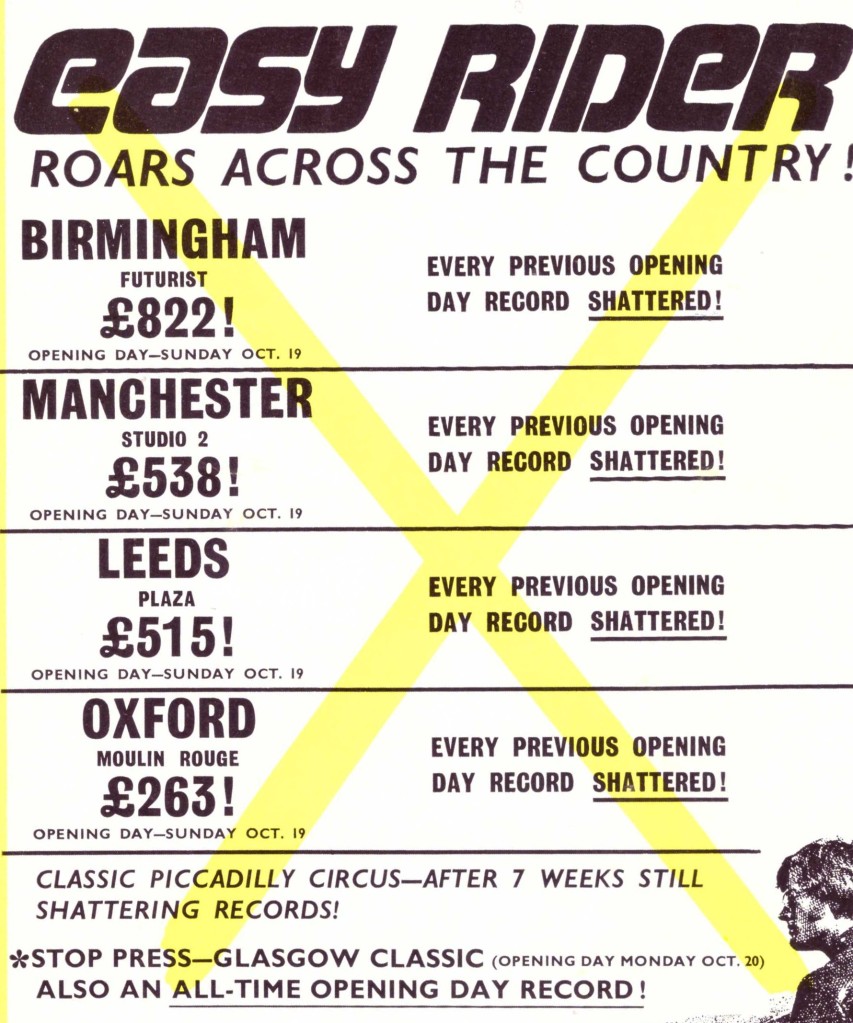
Selling a picture to the public and selling it to cinemas were two separate marketing skills. The easiest way to guarantee bookings for any film was to promote the box office figures through the trade press – as here in the British “Kine Weekly.” Columbia had cleverly booked the movie into one of the smallest cinemas in London’s West End where it was almost certainly guaranteed to break the box office record. But even the studio must have been taken aback by the way Easy Rider pulverized the previous record.

Message pictures were the remit of older directors like Stanley Kramer and Martin Ritt and films that had something to say about the human condition generally emanated from Europe and not low-budget efforts coming out of Hollywood. Easy Rider has a European sensibility, an almost random collection of unconnected episodes with no narrative connection to the main story, itself incredibly slight, of two mild-mannered dudes heading to New Orleans to see the Mardi Gras.

Road trips were not particularly unusual in American cinema but the form of previous locomotion was horse-related – westerns. The journey has been a central theme to movies. This is an 80-minute picture masquerading as a 95-minute one, a good fifteen minutes of screen time taken up with endless shots of Peter Fonda and Dennis Hopper on bikes passing through the landscape, with a contemporary soundtrack as comment.

Unusually, it’s also a hymn to ancient values, heads bowed in prayer at meals as different as you could get, the Mexican family and the commune, a marching band playing “When the Saints Go Marching In” and the recitation of prayers in the cemetery.

Success in London was no guarantee that a movie would perform as well all over the country. Columbia continued to book it into smaller venues in the hope it would repeat the London experience of breaking box office records. When it did the studio took out another advert in Kine Weekly to let exhibitors know.

What marks the film out stylistically, perhaps enforced by the lean financing, is the sparing way it is told. The most dramatic scenes – the three murders – are filmed in shockingly simple fashion. There are often long pans along groups of characters. While innovative, the flash-cut flash-forward editing adds little to what is otherwise a very reflective film. Inspired use is made of natural sound, the muffled thumping of oil derricks at the cemetery, the soundtrack to one death is just the battering of unseen clubs by unseen assailants.

The dialogue could have been written by Tarantino, none of the confrontation or angst that drives most films, but odd musings that bring characters to life. At the beginning of the trip, Hopper and Fonda are welcomed wherever they travel, but towards the end resented, treated as though a pair of itinerant aliens. They entrance young girls but are vilified by authority, jailed for no reason except the threat to traditional values they apparently represent.

Elements not discussed at the time of release make this more rounded than you would imagine. The excitable Hopper, a nerd in hippie costume, is driven by the American dream of making money. The more reflective Fonda senses something is not only missing from his life but has been lost forever. He has the rare stillness of a top actor, face reflecting unspoken inner turmoil.

It remains an extraordinary film, a series of accumulated incidentals holding up a mirror to an America nobody wanted to acknowledge and the brutal climax no less powerful now.   

Of course, the Easy Rider soundtrack itself summons up memories of the era and it is worth listening to just by itself and you might even want to go all the way and listen to it in the original vinyl.

Below is a link for the DVD.

   https://www.amazon.co.uk/Easy-Rider-DVD-Peter-Fonda/dp/B00LTK2Z44/ref=sr_1_1?crid=YSG6SCL8QQF9&dchild=1&keywords=easy+rider+dvd&qid=1596660339&s=dvd&sprefix=easy+rider%2Caps%2C153&sr=1-1

Discover WordPress

A daily selection of the best content published on WordPress, collected for you by humans who love to read.

The Atavist Magazine

by Brian Hannan

WordPress.com Blog

News, Tips & Website Tutorials