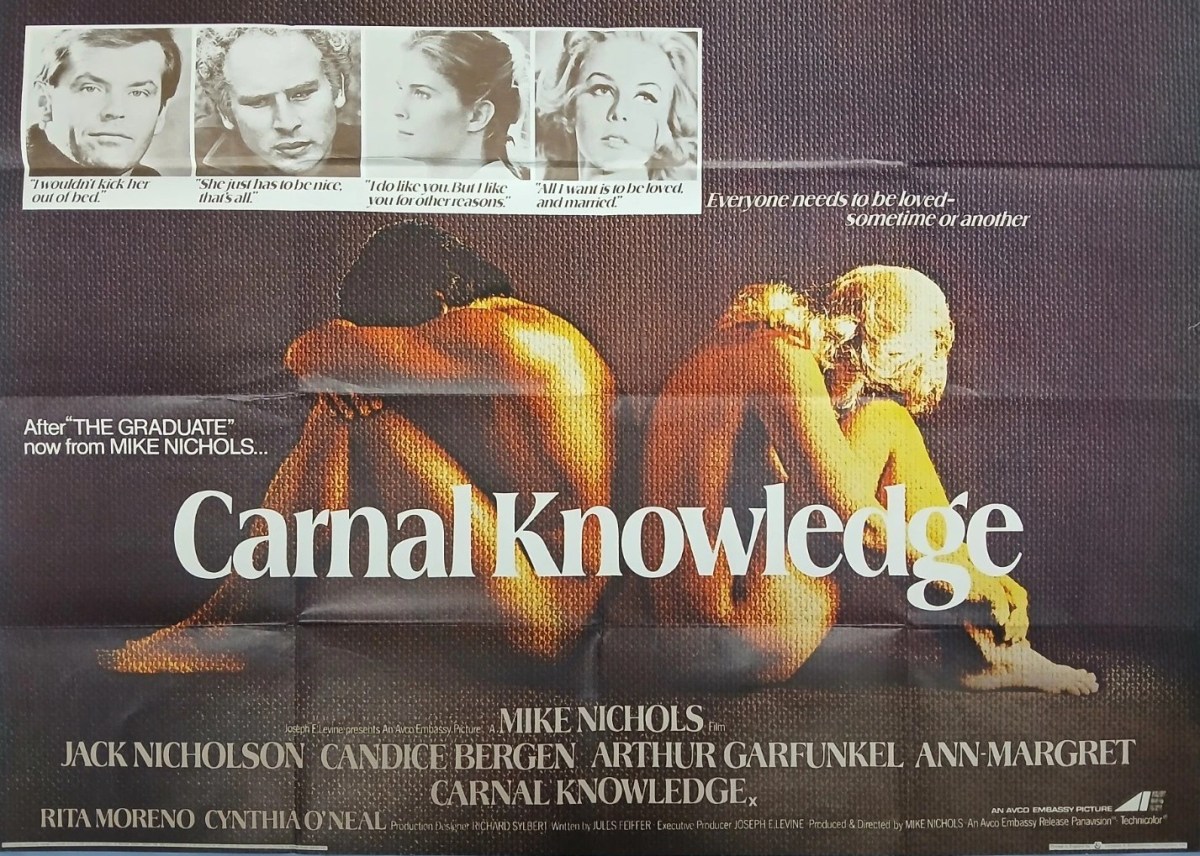
You could argue that this is every bit as meretricious as Three in the Attic (1968). That the misogynism is every bit as rampant, the language considerably coarser, women judged by their physical attributes rather than their brains, men boasting about every little detail of their sex lives. More locker room than intelligentsia. You could argue that Porky’s (1981) and American Pie (1999) take exactly the same approach with no suggestion they have reached some exalted critical status.
There’s similar reliance here as in Three in the Attic on technical tricks, long monologues with the camera in a fixed position, and it would appear as if the person is indeed breaking the fourth wall and talking directly to the audience except for one shot, two at most, of a listener. Or the same fixed approach focusing on, for example, a girl laughing hysterically or a female skater, and background music that appears completely irrelevant except in the most perfunctory fashion depicting a time period.
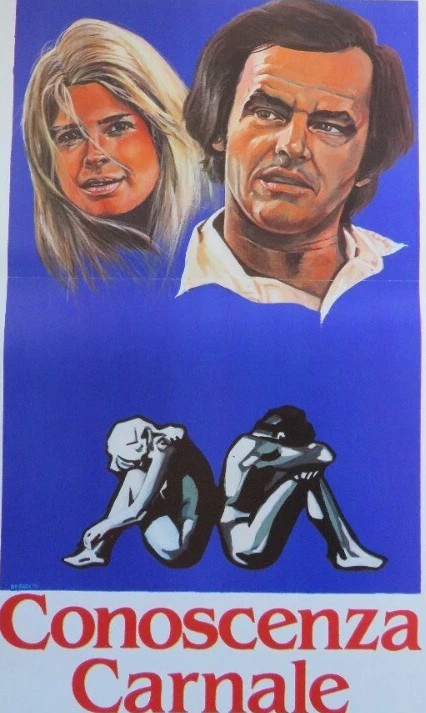
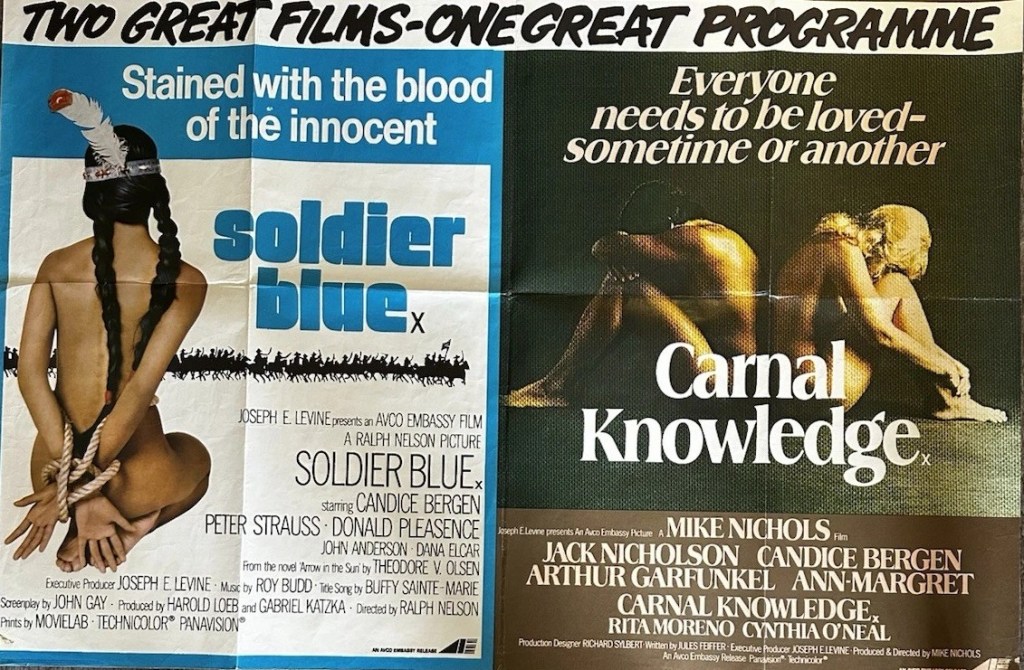
Of course, there’s no comparison when it comes to the actors. This boasts a stellar cast – Jack Nicholson (Easy Rider, 1969) with one Oscar nomination already under his belt casting a spell on the audience, Candice Bergen (Soldier Blue, 1970), a standout among the new generation of female stars, and Ann-Margret (Stagecoach, 1966) at one point bigger than either in the Hollywood stratosphere making a comeback that would win her an Oscar nomination. Art Garfunkel, one half of the most potent double act in the recording business, was making his movie debut.
Director Mike Nichols was on a hell of a roll, his first two pictures – Who’s Afraid of Virginia Woolf (1966) and The Graduate (1967) – awash with Oscar kudos and unprecedented box office gravy.
And you could make the same double-handed argument about feminism. Susan (Candice Bergen) would certainly count as a liberated women given she’s stringing along best buddies Jonathan (Jack Nicholson) and Sandy (Art Garfunkel), not just having sex with both, but leading the way with the shy latter. And once married to Sandy she keeps him up to scratch in the bedroom, teaching him to make love the way she likes it.
Given Jonathan’s obsession with the inches on the female body that are so important to him, it’s amazing her was at all interested in Susan, except for his competitive streak, delighted to steal away the girl who is apparently his pal’s girl. While Sandy appears the more insecure, in fact Jonathan more than matches him, always comparing Susan’s gentler treatment of Sandy. He might even have invented the tale of his poor childhood in order to gain her sympathy.
Certainly, once Sandy and Susan are married, Jonathan’s jealousy goes up a notch, annoyed that his pal is greeted by his wife on return from work with a martini and dinner while his voluptuous girlfriend Bobbie (Ann-Margret) struggles to warm up a television dinner and can’t keep his apartment tidy.
While Jonathan avoids commitment, Arthur isn’t as committed as he seems, having a mistress Cindy (Cynthia O’Neal) in tow, whom Jonathan thinks it’s fair game to woo and even gives Arthur carte blanche to take a chance on Bobbie.
Even given the misogyny of the period, you’d struggle to find two more obnoxious men. Any woman that attempts to be their match or gives as good as she gets is deemed a “ball-buster” or just after men for their money. You’re almost thankful that, just like Three in the Attic, there’s a touch of morality at the end, with the impotent Jonathan reduced to paying sex workers to tell him how powerful he is in order to gain an erection. Though Sandy appears to get off scot-free – now dating 18-year-olds.
But the performances all round are superb. Susan could perhaps have done with her character being filled out rather than just seen through the eyes of the men. Ann-Margret revived her career with his performance, of a woman whose body has betrayed her, all her sexiness not winning her the security she desires. It’s as bold a move for Jack Nicholson to play such a loathsome arrogant character. I was never convinced by Art Garfunkel.
Despite the tricksy presentation, Mike Nichols, as with Who’s Afraid of Virginia Woolf, traps his characters under an intense microscope. Screenwriter Jules Feiffer, better known at the time as a cartoonist and playwright, excels in his debut.
Hard going at times given the repellant characters but still excellent.

