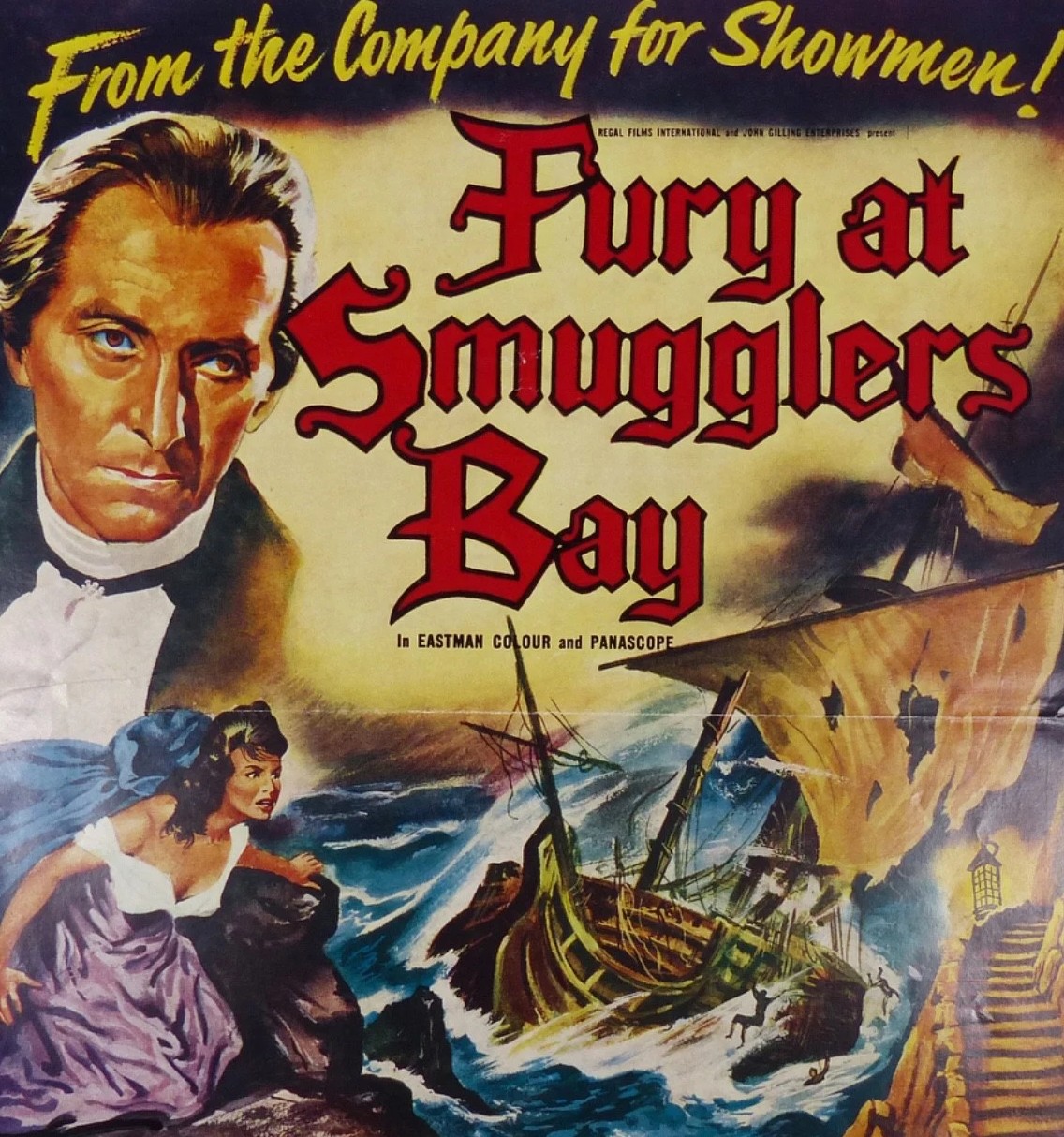
Fury at Smuggler’s Bay (1961) ***

Surprising to find so much moral complexity when it seemed we would be restricted to discussing the difference between good bad smugglers and bad bad smugglers and good good bad guys and bad bad guys. Given the limited running time (it clocks in at 82 minutes) we’ve also just got about enough time to take in hypocrisy.

Compromise, too, for that matter. Squire’s son Christopher (John Fraser) is inclined to warn girlfriend smuggler’s daughter  Louise (Michele Mercier) that his father Squire Trevenyan (Peter Cushing) is setting soldiers on the local smugglers. The local highwayman known as The Captain (William Franklyn) is considered something of a decent fellow because once he’s robbed travellers going along the road one way he’ll make sure they’re not robbed on their return.
Trevenyan finds the most convenient way to prevent his son marrying beneath himself is to imprison Louise’s father Francois (George Coulouris) on the grounds of receiving stolen goods – his sentence is deportation to Australia. He’s helped by his son having to run off to London after killing one of the smugglers in self-defense, the father assuming anyone witness to the struggle will side with the smuggler.

Aware that maybe the plot’s getting a bit too cute for anyone’s liking, director John Gilling makes the most of the thunderous seas, boats getting battered to bits in the storm, waves hammering the wheelhouse, men swept overboard from vessels losing their way because rudimentary lighthouses have been shattered by predatory smugglers (known as “wreckers”). Stunning Cornwall scenery also helps though beaches being littered with heavy-duty rocks rather than glistening sand tends to inhibit action sequences.

The wreckers are the bad bad smugglers, the ordinary locals, dealing with a bit of rum and tobacco to avoid the exciseman or helping themselves to loot from legitimate shipwrecks, are the good bad smugglers.
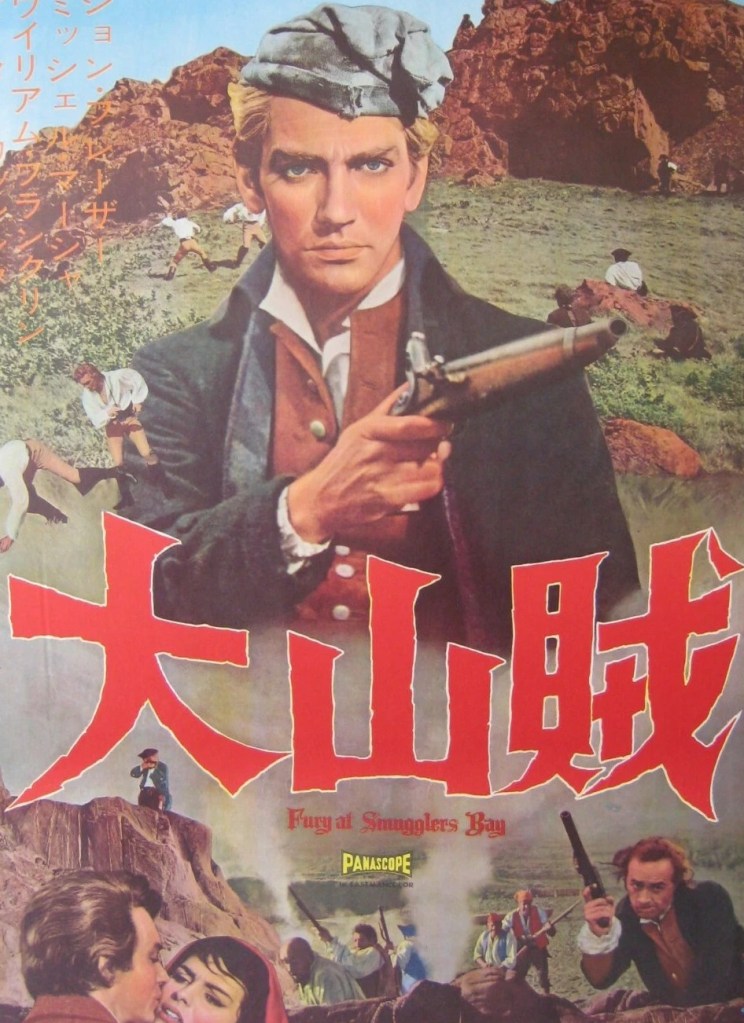
You can always depend on a good bad highwayman to defend an innocent girl against a bad bad smuggler. As you might expect the Squire is deliberately ineffectual since he’s being blackmailed by Black John (Bernard Lee), leader of the wreckers, because Christopher is the result of an indiscretion. So it’s left to the son to race back from London and set things to rights.

Although there’s a bit of fenceplay – there is one good duel between Christopher and The Captain –  it’s not really a swashbuckler, a knife or pistol or musket the more likely weapon of choice, and since the director’s enamored of the silhouette against the darkening sky quite often what takes place is obscured.

Which helps the final section of the plot, as Christopher puts abroad that he’s dead while secretly signing up with Black John. This could have fitted into the Renown portfolio given the number of twists. Traps backfire. Ruses fail. Falling for the tale that his son is dead, Trevenyan puts the boy in mortal danger by sending troops to the beaches. Various rivals have to team up for the good of the cause.

By the time it turns into high adventure most of the moral complexities have been resolved.

The only problem is it’s the bad guys who steal the picture. While Peter Cushing (The Skull, 1965) continues his evolution as an actor of considerable scope, John Fraser (Tamahine, 1963) is a cardboard cut-out of a hero. But Bernard Lee, before assuming the mantle of M in the James Bond series, cuts loose as the bad bad guy while William Franklyn (The Big Day, 1960) does a dastardly good job of creating a charming good bad guy. For a bonus there’s rising French star Michele Mercier (You Can’t Win ‘Em All/Dubious Patriots, 1970).

Written and directed, with some panache, by John Gilling (The Pirates of Blood River, 1962).

Entertaining matinee fare with a soupcon of complexity.
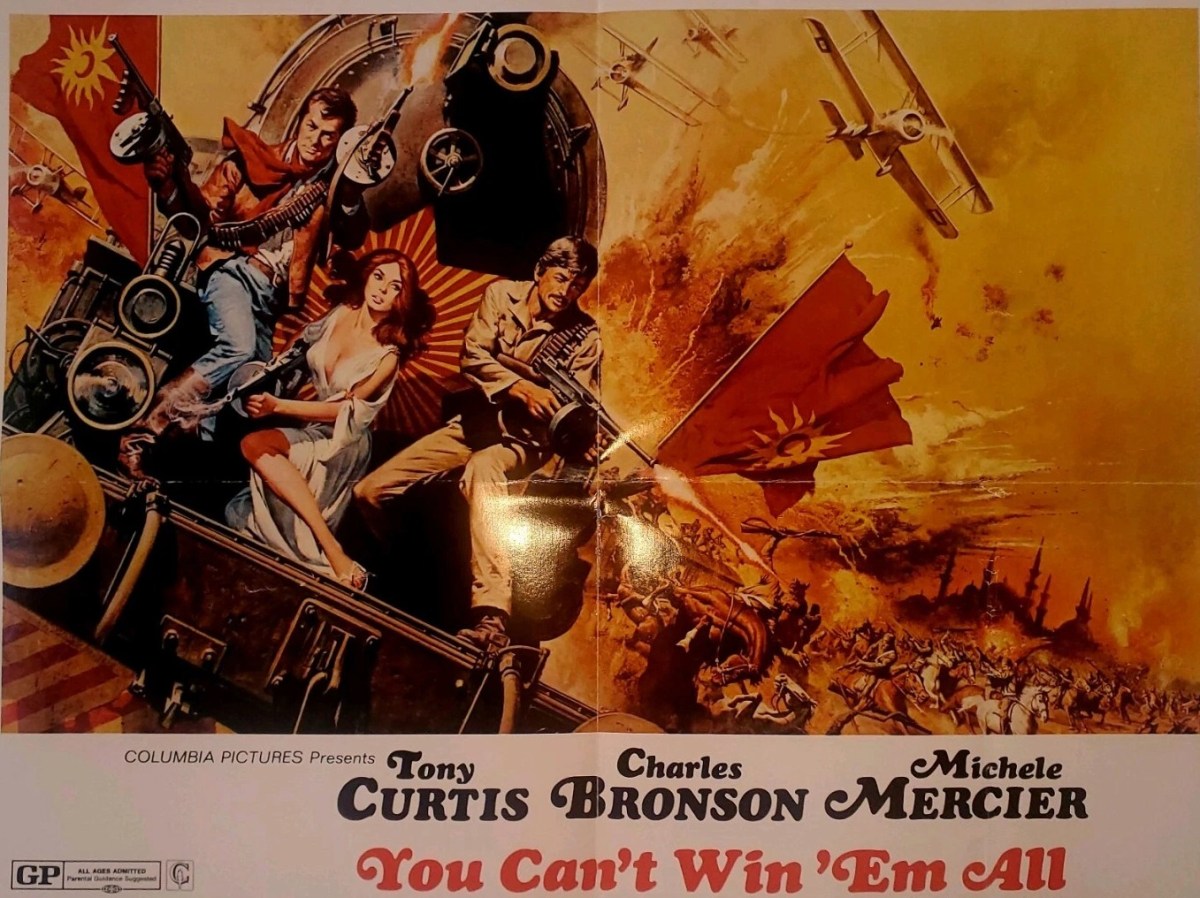
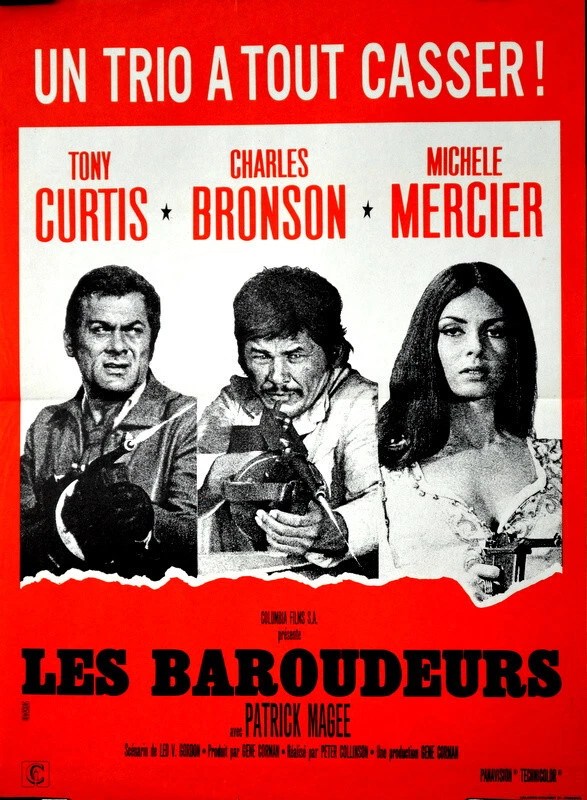
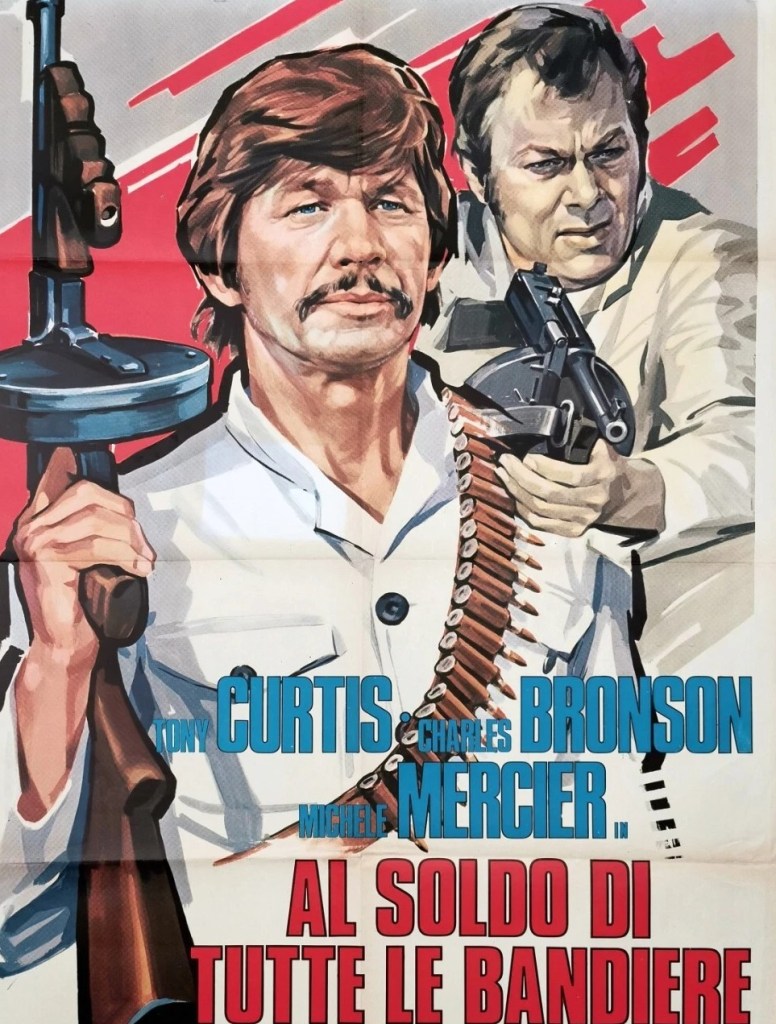
You Can’t Win ‘Em All (1970) ***

Charles Bronson travelogue. Slowest action picture you will ever come across. Director Peter Collinson forgets all he learned about tension from The Penthouse (1967) and action from The Italian Job (1969) and in trying to create a Turkish version of the visual delights of David Lean’s Lawrence of Arabia (1962) comes a cropper, not least because he hasn’t counted on the dust resulting in endless scenes of men on horseback being obscured. There must be about 10-15 minutes of just travelling by horse, train and boat through boring scenery.

There’s an interesting story in here somewhere but you’ll need all your patience to stick with it.  Soldiers of fortune Adam (Tony Curtis) and Josh (Charles Bronson) are the type of characters who buddy up one minute and stitch each other up the next. Their attitudes are ingrained from the outset – Josh robs shipwrecked Adam who takes revenge by stealing his boat. They team up to take advantage of the chaos ensuing in Turkey in 1922 following the collapse of the Ottoman Empire, setting themselves up as mercenaries before their small force of like-minded fellows, armed with Tommy guns,  is hired by Governor Osman Bey (Gregoire Aslan) to escort a consignment of gold to Cairo. They soon discover that’s just a cover. The only gold on the gold bars is as much as it takes to provide a golden sheen to blocks of lead. There are actually more valuable prizes: Bey’s daughters and a trunk of priceless jewellery.

So far, they’ve beaten off various attacks, the submachine guns making short work of rebels armed only with rifles, and this looks as if it’s heading into fairly standard territory whereby the scoundrels will evade their captors and make off with the loot. But halfway through it does a U-turn. We discover that Adam is actually in the country to repossess one of his father’s ships lost in World War One. This is tweaked into an important plot point – the Turks have been blockaded by the Brits but a ship flying an American flag would be permitted safe passage.

Then it twists on its axis once again and we’re dropped into femme fatale land. The daughters are being escorted by the beautiful but wily Aila (Michele Mercier). She’s a step up from the usual two-timing female of the species. She’s a three-timer, attempting to woo in turn the governor, Adam and Josh. Actually, she returns to two-timing when she knifes the governor to death. And her plans go awry when Josh rejects her advances with a vicious slap.

Even so, he’s not averse to teaming up with her to betray Adam and make off with the loot. Adam, who has considered himself worldly wise, is furious and eventually traces Josh and Aila to the port of Smyrna.

It doesn’t end well, Josh and Adam are captured. But then it does end well. Aila, revealed as a spy, negotiates their freedom. After all, inadvertently, they helped her to transport the real treasure, an ancient Koran, while keeping the jewels for herself.

Leo Gordon (Tobruk, 1967) has penned a very wayward screenplay. Charles Bronson (Farewell, Friend, 1968) and Tony Curtis (The Boston Strangler, 1968) play well off each other, occasionally exchanging decent quips, with the kind of personalities that might congeal into an acceptable screen pairing, guys, while minus an honor code, who don’t stray into unacceptable behaviour. And it might have worked equally as well if the Michele Mercier (Angelique, 1964) strand had been introduced at the beginning and we had a three-way romantic dilemma. But director Collinson takes forever to get the two elements of the tale to mesh and wastes countless minutes, as previously noted, as our heroes laboriously grind their way towards their destination. The introduction of Mercier – sudden light catching her eyes in the darkness – is the only composition of note. And while Bronson and Curtis are a sparky pairing most of the time they flounder in an incomprehensible tale.

You can either catch this on YouTube and have your viewing interrupted by an advert every two minutes or on Amazon Prime where such interference is minimal.

Discover WordPress

A daily selection of the best content published on WordPress, collected for you by humans who love to read.

The Atavist Magazine

by Brian Hannan

WordPress.com Blog

News, Tips & Website Tutorials