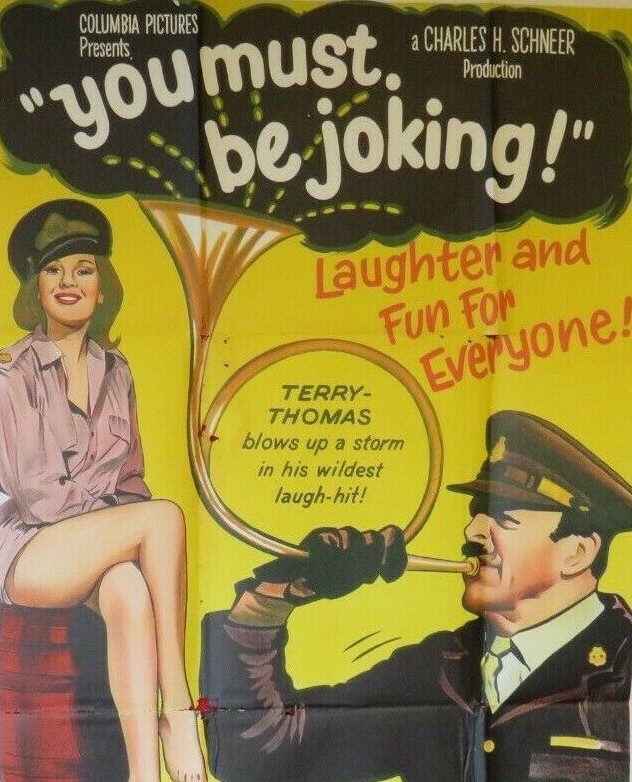
British thriller specialist Michael Winner (Death Wish, 1974) learned all about structure churning out low-budget comedies like this unusually contemporary number. A precursor of the reality television trope of a variety of characters in competition to complete a series of odd tasks, this has a military set-up, aiming to find, oddly enough in an organisation where strict hierarchy dominates, people capable of bending the rules. Initiative, in other words.
Some of the motley crew, of course, have no intention of bending any rules if they can get everyone else to do the work for them, namely upper-class Capt Tabasco (Denholm Elliott) who gets the game rolling by calling in a helicopter as a favor from an old school chum to rescue him from a maze, the first task. He spends most of the time pampered in a hotel suite while dispatching girlfriend Poppy (Tracy Reed) on various expeditions.
Saved by the double bill: Winner’s comedy found a bigger audience by being booked as the support for hit “Cat Ballou.”
There’s a Yank involved, of course, to target the all-important American market, Lt Tim Morton (Michael Callan) also using assistance in the form of upmarket girlfriend Annabelle (Gabriella Licudi) whose specialty is causing vehicle pile-ups. We’ve got a whisky-drinking Scot, Sgt Major MacGregor (Lionel Jeffries), stiff upper back rather than stiff upper lip with his constant snapping to attention, and two graduates from the Army Hapless Division in Sgt Clegg (Bernard Cribbins) and Staff Sgt Mansfield (Lee Montague). Directing proceedings are Major Foskett (Terry-Thomas) and General Lockwood (Wilfred Hyde-White), at opposite ends of the character arc, the former frantic, the latter laid back.
A couple of the five tasks involve unravelling clues, finding a particular rose, for example, but the whole purpose of the exercise is to have the soldiers constantly getting in each other’s way, trying to outwit one another, falling into bizarre scenarios – a fox hunt the cleverest – and generally getting all muddled up one way or another, so that initiative is the last thing they display.
What the movie does have in abundance is imagination, otherwise how to explain the involvement of a seductive housewife, pop star, television show, tunnelling, Lloyd’s of London, Rolls Royce and a greyhound racetrack. On the other hand this might be a smaller-scale precursor to If It’s Tuesday, It Must Be Belgium (1969) in shovelling together all sorts of British institutions and tourist attractions. And certainly Capt Tabasco with his love of the finer things of life demonstrates just how much fun it can be to be British if you’re upper class, wealthy, went to the right school and are not above a bit of blackmail.
As you might expect, the pace is hectic, which is just as well, because if you stopped to think about what was going on you might well throw in the towel. That’s not to say it’s not enjoyable in a riotous sort of way, running jokes almost in a separate competition of their own, and if you always hankered to see Michael Callan’s dance moves this is for you – suffice to say he’s not in the Fred Astaire class. But everyone here is there to be made a fool of, except Capt Tabasco, who rises above it all in classy fashion and when he’s out for the count appears blessedly delighted.
Denholm Elliott (Station Six Sahara, 1963) comes off best, testing out his lazy scoundrel, but the top-billed Michael Callan (The Interns, 1962) might never have signed up if he’d known the consequence was being relegated to television for seven years. However, given we are well accustomed to the shtick of the likes of Bernard Cribbins (The Railway Children, 1970), Lionel Jeffries (First Men in the Moon, 1964), Terry-Thomas (Bang! Bang! You’re Dead! 1966) and Wilfred Hyde-White (The Liquidator, 1965), he does at least have the advantage of standing out, if only as a novelty.
And just in case the goings-on don’t hold your attention, Winner has recruited a platoon of top British stars in bit parts including Leslie Phillips (Maroc 7, 1967) and James Robertson Justice (Guns of Darkness, 1962) and rising stars such as Tracy Reed (Hammerhead, 1968), Gabriella Licudi (The Liquidator) and Gwendolyn Watts (The Wrong Box, 1966) and future British television treasures Clive Dunn (Dad’s Army, 1968-1977), Richard Wattis (Copper’s End, 1971) and Peter Barkworth (Telford’s Change, 1979). So if you get fed up trying to work out what’s what you can play who’s who.
Alan Hackney (Sword of Sherwood Forest, 1960) wrote the screenplay based on a story by director Winner.
Not non-stop hilarity but definitely non-stop something with a good few chuckles thrown in.
How is that the British, way down now in the rankings of global movie production, have come up with a successful genre all of their own – the national treasure. Maggie Smith and Helen Mirren to be sure first came to prominence in the same year, 1969, with The Prime of Miss Jean Brodie and Age of Consent respectively, but whereas Hollywood has turned its back on the ageing female contingent, the British film industry has wrapped its most famous stars in cotton wool and proceeded to give them roles they can take to the Oscar bank.
Mirren was in her early 60s when she romped home in The Queen (2006); you only have to say Downton Abbey and Smith, already two Oscars to the good, is regarded as screen royalty. And that’s before Judi Dench enters the equation, a few years older than Mirren when she nabbed the Oscar for Shakespeare in Love (1998). You can pretty much count on getting funding for any picture if you can rustle up any of this trio. Want to bring back the older crowd? Dangle these carrots!
Elevated into this category now is Lesley Manville, the 66-year-old star of the delightful Mrs Harris Goes to Paris. While largely escapist, there’s enough of a contemporary vibe, a Paris redolent of filth, the downtrodden going on strike, to provide an edge, and a narrative that continually punctures dreams any time fantasy looks like running away with itself. Set in 1950s London and Paris where the poor know their place, and are rigidly kept in it by the arrogant rich, but where aspiration can at any moment take flight.
Cleaner Mrs Harris, dreaming of buying a £500 dress – we’re talking the best part of £14,000 these days – scrimps and saves, and through a couple of more than fortuitous events, finds her way to the House of Dior where she is despised by haughty manager Claudine (Isabelle Huppert), adored by philosophic model Natasha (Alba Baptista) for having such aspirations, and manages to cast a spell, although not for the reasons expected, over rich widower the Marquis de Chassagne (Lambert Wilson).
There’s not much plot. She has to remain in Paris for a fortnight for fittings and whiles away the time helping along the romance between under-manager Andre (Lucas Bravo) and Natasha, assisted by their existentialist leanings, eventually overcoming hostility and putting everything to rights in the Dior empire. But you don’t need plot when you’ve got charm. The English notion of fair play initially comes a cropper when facing French egalitarianism out of whack, when the rich can jump the queue and basically make everyone jump to their tune. But when a character like Mrs Harris settles for second best you can be sure she’ll come up trumps. Whether it’s icing on the cake or to make a rubbish-strewn Paris more palatable, there’s a good ten minutes of oo-la-la devoted to parading the latest fashions.
Not content with conquering one city, Mrs Harris developed sequelitis and headed for New York.
And there’s not just a philosophical undertone – people not what they appear on the surface – but a feminist one, women holding the world together while men whistle. But by and large it’s joyous entertainment, a confection straight out of the Hollywood top drawer, a poor woman having her day in the sun through sheer strength of character.
Unless you’re British or a big fan of arthouse director Mike Leigh or noticed her Oscar nomination in the largely unnoticed The Phantom Thread (2017) Lesley Manville will probably have passed you by. She nabbed a cult following as the dumped-upon lead in comedy series Mum (2016-2019) and picked up a wider audience as Princess Margaret in The Crown, but mostly she’s known for a certain kind of acting, where she can change expression 20 times in a minute without ostensibly doing anything different. Just like her predecessors, Smith, Dench and Mirren.
You can’t take your eyes off her, which is quite feat when she’s up against French screen royalty (perhaps a “tresor national”) Isabelle Huppert (Elle, 2016). Alba Baptista (Warrior Nun series) could well be the breakout star here though Lucas Bravo definitely runs her close. I saw Bravo in Ticket to Paradise (2022) and the characters there and here could not be more different. Ellen Thomas (Golden Years, 2016), Lambert Wilson (Benedetta, 2021), Anna Chancellor (For Love or Money, 2019) and Jason Isaacs (Operation Mincemeat, 2021) have smaller roles.
Director Anthony Fabian (Skin, 2008) adds deeper issues to a movie that was crying out to be all surface. He co-wrote the screenplay with Carroll Cartwright (What Maisie Knew, 2012) based on the classic Paul Gallico novel.
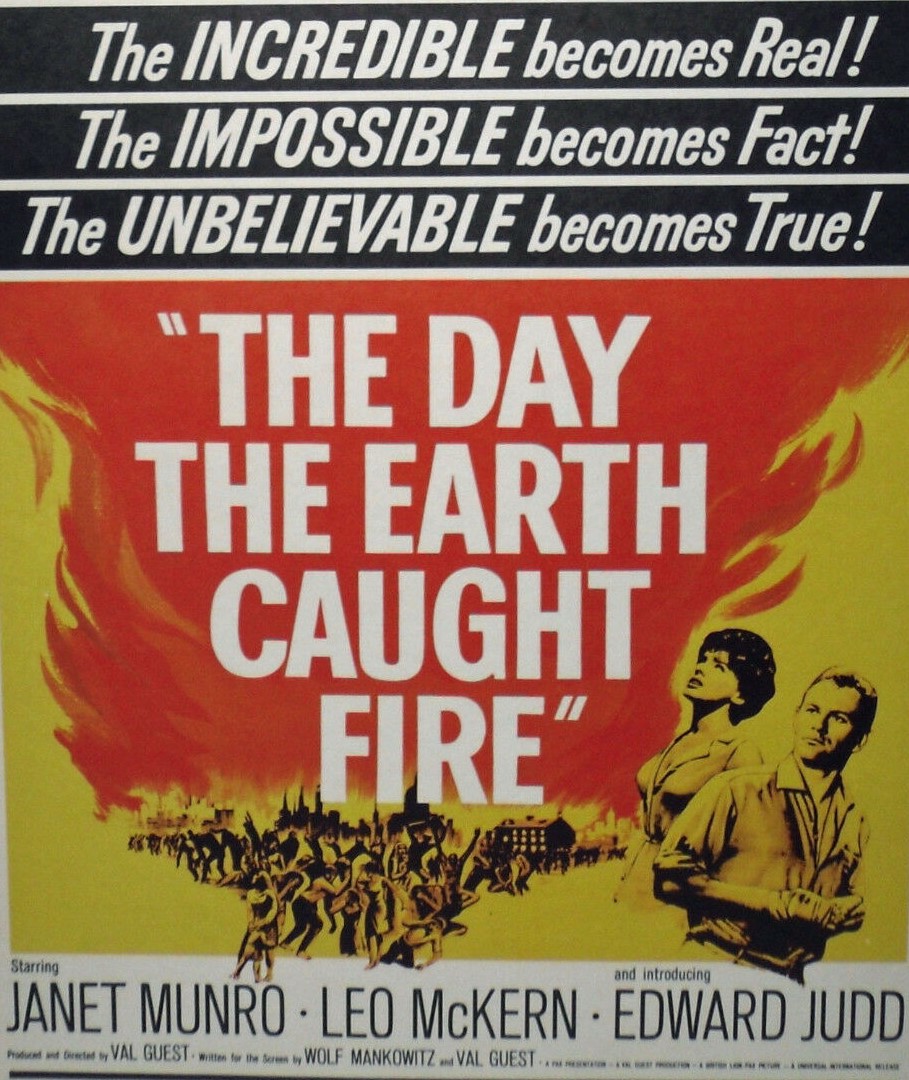
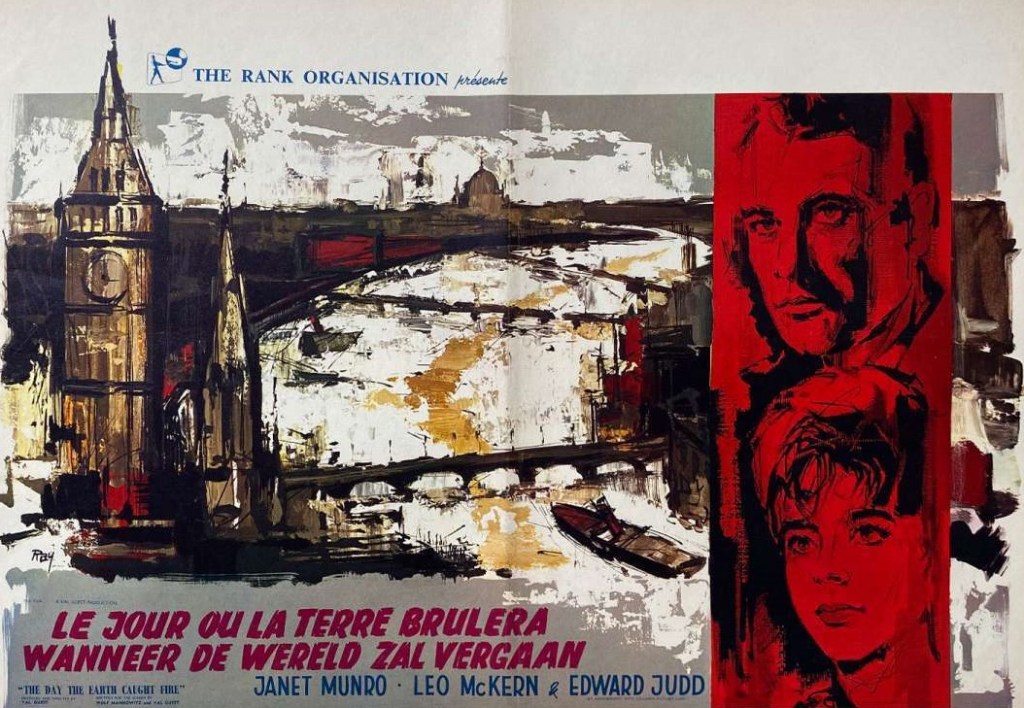
A more prescient picture you couldn’t find, tapping into a contemporary audience’s greatest fear – global warming. Its bold cliff-hanger ending would also appeal to a modern audience often left dangling at the climax of a blockbuster. And it cleverly skims on the special effects, relying on the more easily achieved downpours, thick fog, constant sweating, newsreel footage of natural disasters, water rationing and end-of-the-world riots than anything bigger.
But what surprised me more was the sheer pace. Not just a story moving at a frenetic pace but the British characters acting like they had been injected with a heavy dose of New York zap, talking over each other, hardly getting a complete sentence in before interruption, like Howard Hawks had taken command instead of a mere Englishman like Val Guest (Assignment K, 1968), a former journalist.
Front cover of the Pressbook.
It channels the director’s experience into creating the most realistic newspaper office you will ever come across, beating out All the President’s Men (1974) in its representation of how journalism really works, as concerned as much with the general fodder of unheralded stories as the scoops that normally drive such a narrative. And for a story that started off as pure pulp, the dialog is superb, so good it won the Bafta award.
It certainly helped that an actual newspaper editor, Arthur Christiansen (of the Daily Express) lent a guiding hand, playing the role of the editor of this downmarket daily. The summoning of copy boys (actually grown men), the demand for 500 words, the printers ready to switch the front page at a moment’s notice, the inevitable diet of pie and pint, and the emotional casualties as marriages crumble under the strain of a husband more concerned with this next story than wife or children, all serves to ground the film.
And yes, the narrative plays into the usual journalistic tropes, ambitious newspaperman Peter (Edward Judd), career on the line, uses typical wiles, duping lowly scientific secretary Jeannie (Janet Munro) into revealing more than she should. It’s a meet-cute of the old-fashioned variety, she hates him on sight.
Peter is as off-kilter as the world, knocked off its axis by the simultaneous explosion of nuclear devices, unable to come to terms with his divorce, finding solace in the time he spends with his child, and it seems fitting that much of that is spent diving into the darkness of the ghost train ride, the fog equally thematic as he wanders round in circles in that, as aimless as in his life, while a bath is just as cinematically important, not just for the obvious semi-nude scene but as a place of refuge from impending terror.
These journalists know how to sniff out a story, how to separate the what from the chaff of the official line, digging deeper, and with global connections able to put two and two together far swifter than officialdom. It helps that Peter’s guardian angel Bill (Leo McKern) has a scientific brain and is able to work out the source of the infernal rising temperature.
It’s axiomatic of how clever the screenplay is that Peter and Jeannie come together over a lost child, although Peter, cynical and bitter, but more vulnerable than most, remains a conniving character, happy to risk their burgeoning relationship for the sake of a scoop.
Like Quatermass and the Pit (1967) it’s one revelation after the other as the world hurtles towards oblivion, though not before ending up as the biggest barbecue of all time. The film acknowledges the anti-nuclear demonstrations of the time before piling on proof that man has sown the seeds of destruction on a four-month countdown to doomsday.
We have been here before with end-of-the-world scenarios but this story unfolds not in scientific or official offices, and there’s no President around to add gravitas or take the blame, but in the minds of the dogged journalists, soon appalled by their discoveries, and for once a scoop is unable to save the day or give the villain his just deserts. Whoever is behind the catastrophe remains nameless, although the outcome of superpowers duking it out for supremacy is never in doubt.
Edward Judd (First Men on the Moon, 1964) delivers a star-making performance as the jaded, jagged, journo capable of emotional depths while Janet Munro (Hide and Seek, 1964) escapes Disney tomboy servitude with a very adult role. Leo McKern (Assignment K) has the solid acting chops that would, two decades before television fame as Rumpole of the Bailey, see as a formidable heavyweight addition to any film and a threat to any co-star through jis charismatic ability to steal scenes.
But the film belongs to Val Guest, who constantly turns up the emotional heat and the terror scale, getting the most out of the riveting, sparkling screenplay he co-wrote with Wolf Mankowitz (The 25th Hour, 1967).
Kind of film that needs sold on word-of-mouth and a slow platform-release rather than being bundled out to fill the distribution gap. Let the audience sing its praises first before slinging it out in wide release. Because this is a definite audience-pleaser, a fun whodunit. Though a limiting factor might be that appeal may be restricted to those of a certain age familiar with The Mousetrap. I wouldn’t bet my last dollar, either, on modern young audiences even having a clue who Agatha Christie was, or responding to a picture set in dull, dull, Britain in a year -1953 – when there was a significantly more glorious event that might have suited better the average Downton Abbey moviegoer: the coronation of the recently-deceased Queen Elizabeth II.
Delightful pastiche on the detective story, too much to suggest it’s a piss-take on Knives Out or the latest big-screen veneration of Hercule Poirot, but it certainly has enough going for it even if none of those connections are eventually made. Certainly, there’s some sly humor in scoring points for mentioning, a la Murder on the Orient Express, that the initial murder could have been committed by all the suspects.
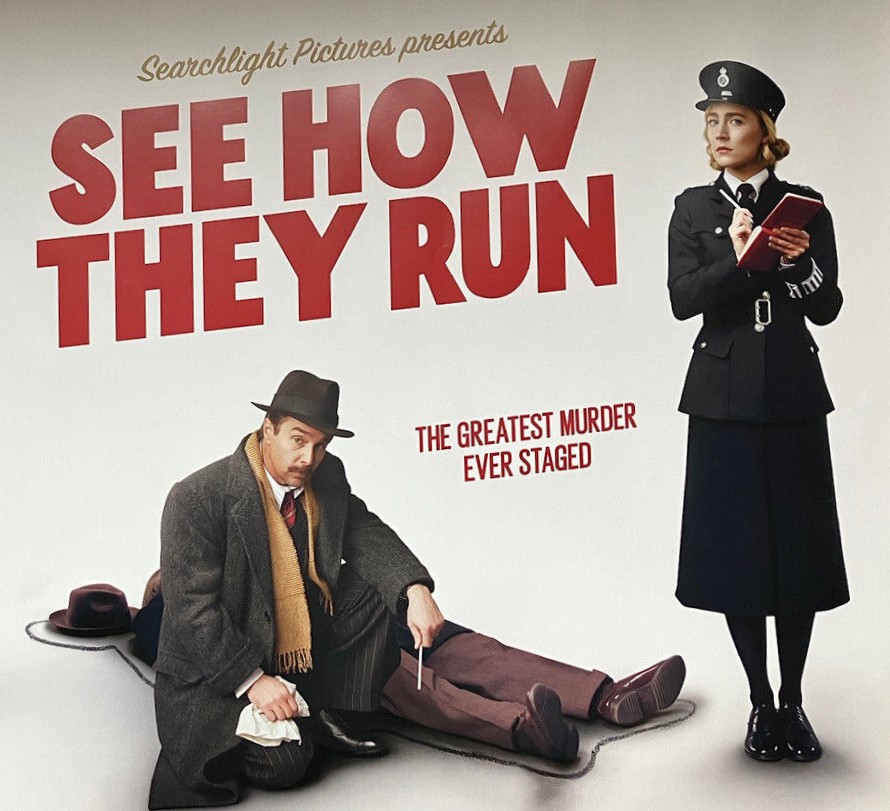
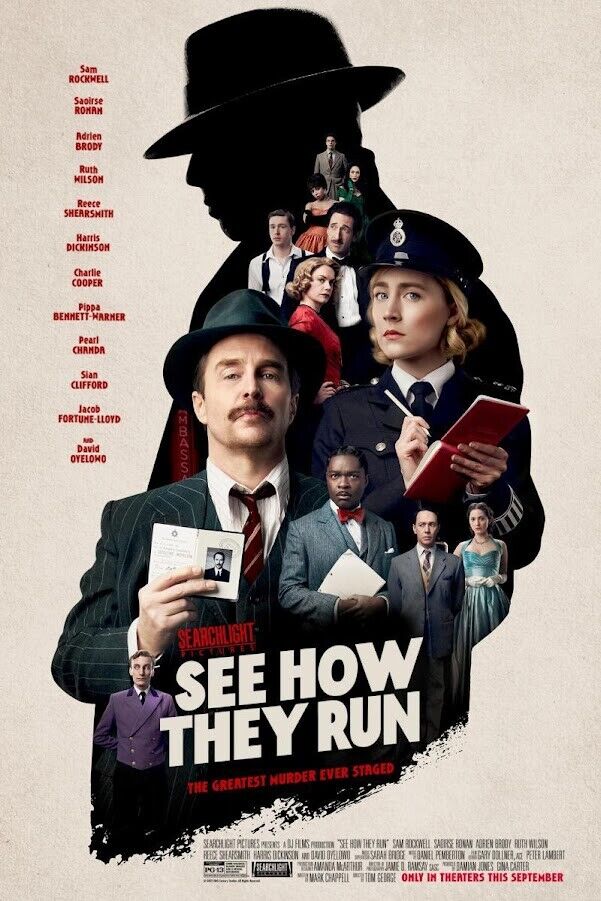
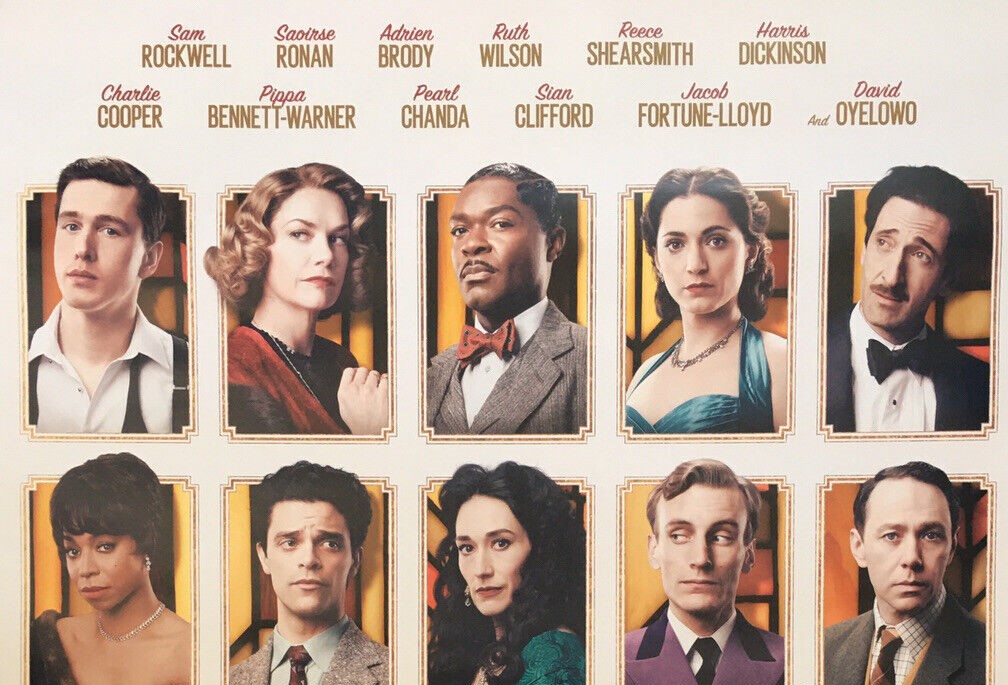
Basically, out of favor war hero and alcoholically-inclined cop Inspector Stoppard (Sam Rockwell) is saddled with rookie Constable Stalker (Saoirse Ronan) – two in-jokes right there, John Stalker being a very prominent British cop, playwright Tom Stoppard the author of The Real Inspector Hound – to investigate the death of Yank Leo Kopernick (Adrien Brody), in London to turn Agatha Christie’s famed play into a movie for real-life producer John Woolf (Reace Shearsmith) who made The African Queen (1951).
Virtually everyone associated with the play becomes a suspect. These include pompous playwright Mervyn Cocker-Norris (David Oyelowo), the play’s petulant producer Petula “Chew” Spencer (Ruth Wilson), real-life actor Richard Attenborough (Harris Dickinson) and even Agatha Christie (Shirley Henderson) is not above a bit of poisoning. Throw into the mix that the cops have assigned the bulk of their resources to tracking down the 10 Rillington Place serial killer – another in-joke, Attenborough playing the murderer in that movie.
One of the movie’s delights is that whereas both Stoppard and Stalker have considerable personal issues, we discover them in passing, and neither character makes a meal of them. Instead, their screen charisma works a treat, Stoppard dogged and the earnest Stalker inclined to jump the gun.
Even the “all-star-cast” is a spoof on films like “Death on the Nile.” The title was a popular one, movies in big-screen or small using it in 1955, 1964, 1984, 1999 and 2006.
The stage shenanigans are a hoot, puffed-up pride and ruthless machinations powering many of the sub-plots. There’s some pretty clever sleight-of-hand not to mention occasional cinematic avant-garde and there’s no shortage of laughs and that out-dated comedy fall-back – slapstick. The climax is particularly excellent, in part because it is a notion immediately discarded as the denouement of the proposed movie version of the play, one that succinctly critiques the differences between British and Hollywood approaches to movie-making.
Red herrings and cul-de-sacs abound, flashbacks remove any plot-holes, while managing to ram in a country-house finale takes some brio. And in among all the jokes, you might be surprised to find a serious point being made about reality vs fiction. Full marks to the virtually laugh-a-minute screenplay by Mark Chappell (The Rack Pack, 2016) and director Tom George in his movie debut who brilliantly shuffles the deck.
Dramatic heavyweight pair Sam Rockwell (Three Billboards, Outside Ebbing Missouri, 2017) and Saoirse Ronan (Mary, Queen of Scots, 2018) prove a double-act to cherish. In gentle comedic roles at odds with virtually their entire portfolios, a wise producer might already be sizing them up for a re-run. Everyone else gets to be bitchy/scheming/ruthless to their heart’s content and certainly in those categories Adrien Brody (The Grand Budapest Hotel, 2014) and Ruth Wilson (His Dark Materials, 2019-2022) win hands-down. But spare a thought for excellent performances from David Oyelowo (The Bastard King, 2020), Reace Shearsmith (of League of Gentlemen TV fame), Lucian Msamati (The Bike Thief, 2020) as the imperturbable Max Mallowan, husband of the distinctly perturbed Agatha, played with venomous glee by Shirley Henderson (Greed, 2019).
I went to see it not expecting much at all and came out singing its praises. Definitely worth a whirl.
Five million dollars. That’s roughly the budgetary difference between Hammer’s Quatermass and the Pit and Twentieth Century Fox’s Fantastic Voyage. Although the protagonists in the latter face the unexpected, the movie is (as would be 2001: A Space Odyssey, 1968) an exercise in awe, in controlled exploration of wonder, whereas Quatermass, lacking the money for special effects, concentrates more on story and human impact. The government funds the experiment in Fantastic Voyage while Professor Quatermass (Andrew Keir) finds nothing but obstruction from his superiors.
Quatermass and the Pit is a masterpiece of stealthy exposition. Virtually every minute brings another development, gradually building tension, stoking fear. The principals – Dr Roney (James Donald), Barbara Judd (Barbara Shelley) and the professor – are cleverly kept apart during the early stages. A human skull discovered on a building site for a London Underground station is followed by a skeleton. Palaeontologist Roney determines it is five million years old, older than any previous find.
A metallic object is found nearby. First guess is an unexploded bomb from the Second World War. But it’s not ticking. And a magnet won’t stick to it. Col Breen (Julian Glover) is called in along with hostile rocket expert Quatermass. They have been locking horns from the outset.
There’s a whole bunch of apparent red herrings, mostly of the demonic variety. The location, historically associated with weird occurrences, is a nickname for the Devil. A pentagram is detected. Touching the object can give you frostbite. Col Breen argues it’s a leftover German propaganda machine from World War Two. A hideous dwarf and other spectral images are sighted. Telekinesis is involved. And tremendous vibrations.
Some people, such as Barbara, have a more receptive brain and can play memories millions of years old that reveal the alien truth. But this is an alien race with genocidal tendencies and able to unleash psychic energy.
The genre requires the scientists to discover an improbable solution which of course they do. Given the miserly budget, the special effects are not remotely in the Fantastic Voyage league. But that hardly matters. The movie coasts home on ideas, marrying sci-fi, the demonic, dormant and institutionalized evil, the militarization of the Moon and the ancient infiltration of Earth by Martians, no mean achievement, and a vivid narrative.
Director Roy Ward Baker (aka Roy Baker) provides many fine cinematic moments as he chisels away at the story, finding clever methods of revealing as much of the aliens as the budget will permit, focusing on very grounded characters, concentrating on conflict, and human emotions, mainlining fear rather than awe, building to an excellent climactic battle between man and monster.
Barbara Shelley (The Gorgon, 1964) is the pick of the stars, in part because she is at such a remove from her normal Hammer scream-queen persona, but more importantly because she brings such screen dynamism to the role. It’s refreshing to see her step up, as she carries a significant element of the story. Oddlyenough, although she has as good a movie portfolio as Andrew Keir and is certainly superior to James Donald, the denoted star, in that department, she is only billed third.
While Andrew Keir (The Viking Queen, 1967), warm-hearted for an intellectual, and James Donald (The Great Escape, 1963), trying to keep a cool head in the middle of inclination to panic, are good, they don’t bring anything we haven’t seen before. Julian Glover (Alfred the Great, 1969) is never anything but imperious and/or irascible, so ideal casting here.
The innovative electronic music was down to Tristram Cary and the unsettling credit sequence deserves some recognition. Nigel Kneale, who originally explored similar ideas for the character on television, came up with the screenplay.
A genuine all-star cast goes off-piste in what used to be called – and maybe still is – a comedy of manners. A chance encounters at the stately home owned by Victor (Cary Grant), an Earl who makes ends meet by opening up his home to tourists, sees his wife Lady Hilary (Deborah Kerr), who helps make ends meet by selling home-grown mushrooms, fall in love with American oil millionaire Charles (Robert Mitchum).
Victor is far too English and posh to go off in the deep end and after considering allowing her to indulge in an affair until she gets bored, comes up with a strategy to ensure it’s her lover who is shooed away. Hilary’s best friend, the glamorous and often barmy Hattie (Jean Simmons), all Dior outfits and full-on make-up, meanwhile, steps in to attempt to rekindle her romance with former lover Charles.
Needless to say, this scene does not exist in the film.
While it’s peppered with epigrams and clever lines and several twists, what’s most memorable is the acting, the initial scene between Charles and Hilary a masterpiece of nuance, what’s shown in the face opposite to what they say. And there’s another peach of a scene where the most important element is what’s conveyed by a sigh. And by Robert Mitchum of all people, an actor not known for nuance.
But it’s let down by the staginess – it was based on a hit play – the very dated by now notion of showing the comic differences between British and Americans and the pacing. The theatrical element, thankfully, doesn’t resort to farce but with a whole bunch of entrances at unexpected moments you occasionally feel it’s heading in that direction. There are minor attempts to open up the play, a scene in the river, some location work in London and upmarket tourist haunts, but mostly it’s a picture that takes place on a couple of sets.
The British vs American trope just becomes tiresome after a while except that essentially the two men trade cultures, Victor exhibiting the kind of ruthlessness you might expect (in the old cliched fashion) from an American while Charles displays the kind of subtlety you would more likely find in an Englishman.
The pacing’s the biggest problem. The actors deliver lines at such speed that no time is allowed for the audience to laugh. The three British characters are almost manic in their urgency, while the Yank so laid-back he might belong to a different century.
Late on, a couple of subplots brighten up proceedings, a joke played on Hilary by Victor over the contents of a suitcase that she has devised an elaborate cover story to explain, and a betrayal of Hilary by her friend. Devilishly clever though it is, the duel scene almost belongs to a different picture. There’s also an amusing butler Sellers (Moray Watson), a wannabe writer, who believes, as is obvious, he is being under-employed, and pops up when the movie requires straightforward comic relief.
It starts off, via the Maurice Binder (Goldfinger, 1964) credits with babies, occasionally in the buff, unspooling film and indulging in other humorous activities. The only characters established before the plot kicks in are the Earl and the butler, Victor shown as tight-fisted, literally counting the pennies (although, literally, these are actually half-crowns, the price of admission to the stately home), the efficient Sellers revealed as otherwise baffled by life. The joke of a wealthy couple forced to rely on the income from visitors was not even much of a joke by then.
Perhaps what’s most interesting is that this movie essentially about immorality failed to click with U.S. audiences while an equally immoral picture The Apartment (1960) did superb business, the difference less relating to star quality than directorial ability, Billy Wilder’s work always having a greater edge than the confections of Stanley Donen.
It’s the supporting cast – if stars can be so termed – who steal the show. Robert Mitchum (Man in the Middle/The Winston Affair, 1964) is just marvelous, one of his best acting jobs, relying far more on expression to carry a scene. He delivers a masterclass in how little an actor needs to do. Jean Simmons (Rough Night in Jericho, 1967) is also excellent for the opposite reason, an over-the-top mad-as-a-hatter conniving ex-lover with an eye on the main chance. That’s not to say Cary Grant (Walk, Don’t Run, 1966) and Deborah Kerr (The Arrangement, 1969) are not good, just overshadowed, and Kerr’s first scene with Mitchum, where she, too, realizes she is falling instantly in love is remarkably underplayed.
Stanley Donen (Arabesque, 1966) should have done more, pre-filming, to tighten up the script and expand the production. Hugh Williams and Margaret Vyner adapted their own play. It’s entertaining enough but I was more taken by the acting than the picture.
Julie Andrews could not have made a more controversial choice in her bid to prove she was more than a Hollywood goody two-shoes as introduced in her debut Mary Poppins (1964). In the months leading up to release, The Americanization of Emily movie made all the wrong sort of headlines, aligning the innocent Andrews with the unsavory matter of producer Martin Ransohoff (The Cincinnati Kid, 1965) challenging the all-powerful Production Code, the self-censorship system in operation in the United States until the late 1960s.
Ransohoff demanded the right to include four scenes of substantial nudity in the film, at a time when any flashes of skin in mainstream pictures were taboo. He argued that the scenes were “necessary for the farcical overtones of the picture.” But more to the point, he was annoyed that foreign filmmakers, who did not have to abide by the stringent rulings of the Code, could show nudity, sometimes even condoned by censor Geoffrey Shurlock who accepted their artistic validity. Ransohoff railed: “We are losing our market because we allow pictures that are full of nudity done in an artistic manner to play our top houses but we can’t get into them because the Code robs us of our artistic creativity.”
I’m not sure exactly when MGM dropped the “Americanization” element from the title and made Julie Andrews the star by promoting her image more than that of top-billed James Garner.
Faced with a lawsuit from studio MGM for delivering a movie not fit for the Code, Ransohoff conceded he had gone “overboard” with the nudity and that Judy Carne – who later sprang to fame in Rowan and Martin’s Laugh In (1969-1973) – in particular, was “over exposed.” Other actresses named as revealing too much were Janine Gray (The Pumpkin Eater, 1964) and Kathy Kersh in her movie debut. The women were identified in the movie credits as, disgracefully, “Nameless Broad.”
At the outset, such agitation would not have preyed so much on Andrews’ mind as a possibly limitation in her future career, Mary Poppins not due to be unveiled until the summer and few members of the public aware of what a game-changer that would prove for studio and star alike. But once Mary Poppins hit the box office heights, there was every chance the star would quickly lose the adoration of the public if seen to play the female lead in a steamy picture. Ransohoff complicated matters by failing to come out and say whether Andrews was involved in the nude scenes, no matter they were considerably toned down by the time the movie hit cinemas in October 1964. (Had he delayed the picture’s release six months, his approach might have been deemed more acceptable, as, by that time, a flash of breasts had been passed by Shurlock for The Pawnbroker.)
It had been a troubled picture from the start. As early as 1962, Oscar-winner William Holden (The World of Suzie Wong, 1960) had been signed up to star and the movie was due to go before the cameras in London in July 1963 and, following a slight delay, re-scheduled for the next month under the direction of Oscar-winner William Wyler (Ben-Hur, 1959). Production was not quite settled because Andrews was only hired in September 1963. But when Wyler pulled out a month later he was quickly followed by Holden. Andrews was such an unknown quantity that when she signed up, the news did not even receive a headline in Variety, just a few lines at the bottom of a page.
And there were screenplay issues. Norman Rosten had begun work on the adaptation of the William Bradford Huie bestseller in April 1962 only for, 10 months later, the author to be drafted in. But scripting problems would continue until after shooting was complete (see below) with the filmmakers unable to make up their mind about the tone of the picture.
Despite Rosten being assigned, a story later emerged that the book had struggled to reach Hollywood. Huie contended that it had, after all, not been sold to Ransohoff in 1962 and that the sale only occurred later after the author had written the screenplay on spec and sold it to the producer. He tied this up with another contention, little borne out by fact, that producers had turned against buying blockbuster novels in favour of original screenplays.
At that point Ransohoff was on a roll as one of the biggest independent producers in Hollywood, on his slate The Sandpiper, which would appear in 1965, Topkapi (1964), The Loved One (1965), The Wheeler Dealers (1963) and The Americanization of Emily, a fantastic batting average for a neophyte producer. Emily would be his third production, The Sandpiper, with two of the biggest stars in the world, Elizabeth Taylor and Richard Burton, his fourth.
James Garner, who had blown his entire fee of $100,000 from three years’ work on television series Maverick on getting out of his contract with Warner Brothers, had been given a helping hand by Ransohoff, winning second billing behind Kim Novak in Boys Night Out (1962) and Lee Remick in The Wheeler Dealers. Ransohoff gambled Garner was ready to make the jump up to top billing in The Americanization of Emily.
In fact, it would take several years before Garner was considered a proper star, thanks to Support Your Local Sheriff (1969), with the kind of marquee appeal that produced box office commensurate with his fees. In fact, James Coburn was considered a better prospect with a seven-picture deal with Twentieth Century Fox – for whom he would make his breakthrough movie Our Man Flint (1966) – a five-film deal with Ransohoff and Major Dundee (1965) on the starting grid with Columbia.
The three-minute sequence of the D-Day beach landing cost $250,000. It was shot in California, sixty miles north of Hollywood, on a public beach though anyone happening upon the site would possibly be put off by signs proclaiming “Explosives next ½ mile.” The shoot involved 5,000lb of explosives, mostly dynamite and black powder, planted in iron tubs buried in the sand and connected by wires to a central control board. The complicated set-up involved four cameras rolling simultaneously with a 250ft high crane lifting a camera platform into the sky for aerial shots. Another platform was sited in the surf. Special effects expert Paul Byrd was on hand to point out to participants where explosions would occur. Eighty smoke pots were lit, each in an assigned position. Rehearsals soaked James Garner and while he waited for the scene to be set up again he lay down on the beach, still in n his wet clothes, but covered in a towel.
Preparing the segment had taken four months with bulldozers clearing the area. Ransohoff himself climbed into a camera platform to test the rig. Camera positions were selected to capture close-ups of the actors going ashore. To maximize daylight the lunch break was limited to 30 minutes.
Ransohoff, as much a maverick in marketing as in production, took out a double-page advertisement in Variety in July 1964 – nearly four months before the movie opened – to promote the response of the preview audiences. And although the comment cards returned easily promotable lines like “you have a blockbuster on your hand” and “one of those rare films that combine tragedy, comedy and drama properly,” Ransohoff was clearly intending to continue to court controversy by including quotes along the lines of “I’m broadminded but this time you’ve gone too far” and “a disturbing and terrible thing.”
But you couldn’t argue with Ransohoff seeking an alternative marketing strategy with such a recalcitrant publicist as Garner. The actor had a marked aversion to talking about his private life, which, of course, meant the focus would have to shift to his dubious star quality or the controversial scenes. Nothing infuriated journalists more, especially in those days when the media was not so tightly controlled, than to turn up for an interview with an actor who had nothing to say. “My private life is just that and I’ll keep it that way,” he averred.
Quite why the movie took so long to open is not really a mystery. Sneak previews might be followed by a little tweaking but the film would expect to be in cinemas within a month or so, the previews intended to build public awareness and word-of-mouth buzz rather than tell the director where he had gone wrong. But clearly Ransohoff held back in order to capitalize on the box office of Mary Poppins. Despite the wrangling with the Code being over and done with by March 1964 and the preview taking place three months later, the film did not open until October, going wide at Xmas, with the additional purpose of aiming for Oscar voters.
Even as Ransohoff was adding the finishing touches to the advertising campaign, there were doubts about what kind of picture the public would be shown. Four endings were considered, two filmed with Edison (James Garner) dead which turned the movie into a straightforward black comedy, but the other two retained the romantic ending.
The black comedy approach dictated that the unsuspecting Edison (James Garner) was lured to his death on Omaha Beach by the glory-hunting Cummings (James Coburn). With no return from the dead, this left Emily (Julie Andrews) in one version to carry the movie to a dutiful conclusion, commiserating with Admiral Jessup, who had been committed to a mental asylum, while a parade commemorating Edison’s sacrifice and led by the treacherous Cummings took place in the background. This was junked when the parade prove too expensive an addition.
All the other endings kept Edison alive, but in one, partly filmed, Cummings was banished to the North Pole, the producers going as far as to film Coburn with penguins.
The major adjustment in all versions was to present Jessup as off his head when he conceived the plan. That meant the Navy could not be blamed for outrageous publicity-seeking, with the finger instead pointed at a maverick officer, whose decisions could be tempered by his temporary instability.
SOURCES: “Holden’s Americanization,” Variety, May 23, 1962, p11; “Screenplay (Ready to Shoot) Cost-Conscious Producers Goal in Retreat from Pre-Sold,” Variety, January 30, `1963, p3; “Emily Screenplay to Be Done by William Bradford Huie,” Box Office, February 11, 1963, pW1; “Ransohoff’s Big Spurt of Features,” Variety, February 17, 1963, p3; “Ransohoff To Start Five Films in 6 Month Period,” Box Office, June 17, 1963, p27; “Julie Andrews,” Variety, September 11, 1963, p16; “Bill Holden Follows Wyler in Leaving Emily,” Box Office, October 7, 1963, pW2; “Garner Gets Emily Lead,” Box Office, October 14, 1963, p9; Michael Fessier Jr., “Can’t Be Americanized With Duds On,” Variety, November 20, 1963, p5; “Martin Ransohoff To Seek Production Code Seal,” Box Office, November 26, 1963, p6; “Emily and Her Attire Settled,” Variety, March 25, 1964, p5;“Nudies In Emily Are Cut to Get MPAA’s Seal,” Box Office, March 30, 1964, pW4; “Advertisement,” Variety, July , 1964, p14; “Admiral’s Glory Seeking Is Final Ending of Metro’s Emily,” Variety, November 4, 1964, p5; “Mad Film Promotion,” Variety, November 4, 1964, p15; “Promo Credo of Hollywood Actor,” Variety, November 4, 1964, p15; Action on the Beach (1964) MGM promotional featurette.
MGM wasn’t the first studio to hit upon the idea of re-editing episodes of a television series into a movie for cinema release. Small-screen The Lone Ranger had spawned The Legend of the Lone Ranger (1952) and Disney had stitched together episodes from its Davy Crockett franchise to create Davy Crockett, King of the Wild Frontier (1955) and Davy Crockett and the River Pirates (1955). The Challenge for Rin Tin Tin (1957) derived from The Adventures of Rin Tin Tin, Frontier Rangers (1959) born out of Northwest Passage, the Texas John Slaughter series the basis for five movies shown between 1960 and 1962, Crimebusters (1962) originated from Cain’s Hundred and Lassie’s Great Adventure (1963) from five episodes of the eponymous series.
But all these movies had one major disadvantage. Like their source material, they appeared in black-and-white. The Disney pair mined some box office gold, but primarily as matinee material. The rest were fillers, scheduled for the bottom half of a double bill and aimed at suburban and small-town cinemas and drive-ins desperate for anything to fill out a program. And all were nothing cruder than editing two or more episodes together to make a feature film.
MGM took a different approach. Instead of merging two different episodes, albeit starring the same stars, the studio decided to take one episode and expand it, filling out the story with subplots and extra characters and spicing up proceedings with levels of sex and violence that would not be tolerated on mainstream television. As important, it would be shot in color to make it stand out from the television series being shown in black-and-white.
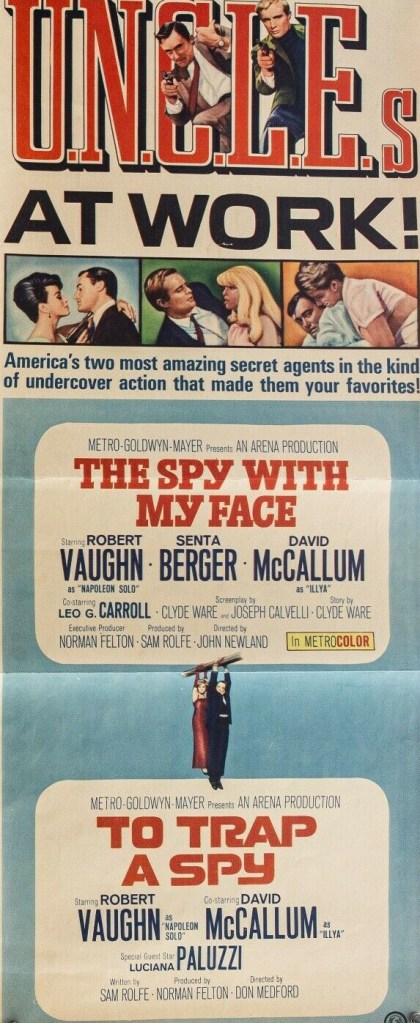
First picture in the trial scheme was To Trap a Spy (changed form the initial To Catch a Spy), an expanded version of the television pilot known as The Vulcan Affair, and as well as series leads Robert Vaughn (The Magnificent Seven, 1960) and David McCallum (The Great Escape, 1963) toplined future Bond femme fatale Luciana Paluzzi (Thunderball, 1965). A second movie was culled from The Double Affair which had been screened on November 17, 1964, with an European star with a considerable pedigree in Senta Berger (Major Dundee, 1965).
Since MGM had no idea whether the spy series, launched in the U.S. on NBC on 22 September 1964, would catch on abroad, where in any case stations paid comparatively little to screen top American shows, its initial idea was to release films only for the foreign market.
In fact, the studio didn’t wait to see if the BBC could make a hit out of the debuting The Man from U.N.C.L.E. series and shunted out To Trap a Spy before the series even screened in Britain. And lacking momentum from television, it went out as the support on the ABC circuit in Britain to The Americanization of Emily (1965) starring Julie Andrews and James Garner.
At that time, the ABC chain was not beholden to the double bill idea. In fact, more than half the annual weekly releases went out as solo affairs. A double bill was more likely to suggest that there were doubts over the pulling power of the main film. There was no way of judging the box office appeal of any film put out in the lower half of a double bill.
The odd thing was that if MGM had held off pressing the button on the circuit release, To Trap a Spy would have demonstrated box office success. At the same time as the double bill was simultaneously released at nationwide first run theaters, To Trap a Spy opened in London’s West End in May 1965 at the 529-seat Ritz and delivered the best business MGM had enjoyed there for two years. It returned to the 556-seat Studio One, also in the West end, in October that year as the top attraction in a double bill that included Glenn Ford-Henry Ford western The Rounders (1965) and in its fifth week took in an excellent $5,600 and a few weeks later shifted back to the Ritz.
Between released the first and second Uncle pictures, MGM had launched a major marketing campaign on the back of the launch of the series on BBC. One marketing gimmick, inviting the audience to write in for The Man from U.N.C.L.E. certificates, brought in over half a million applications. MGM splashed out $85,000 marketing The Spy with My Face (1965). Again, the movie went out in an ABC circuit release – in July 1965 – as part of a double bill, with Son of a Gunfighter (1965), but this time the Uncle film topped the bill. Launched in the West End at the much larger 1,330-seat Empire it took $22,000 in its opening week. Nationally, “it was far and away above average for a top-grossing picture in the UK.”
To Trap A Spy and The Spy with My Face each grossed $2 million in the UK market. By January 1996, a third Uncle film had launched in the British market, One Spy Too Many, based on the two-episode Alexander the Great Affair which had screened in America in September 1965. This time MGM held off from ABC circuit release until mid-February until One Spy Too Many had cleaned up in January in the West End, $25,000 at the Empire, helped along by a Xmas merchandizing bonanza that saw the country flooded with memorabilia, paperbacks, three singles and an album. It broke studio records in 91 of the 125 situations it first played.
The success of the first pair pointed up the potential U.S. box office from these featurized episodes and MGM put together the double bill The Spy with My Face/To Trap a Spy on the assumption that the films at the very least would pick up business outside first run venues where bigger-budgeted pictures dominated and provide respite for showcase (wide release) theaters, drive-ins and small cinemas suffering from product shortage. The bigger a hit a movie became, whether roadshow or not, the longer it took to move down the food chain.
MGM was also inspired by the merchandizing boom generated by the television. A toy gun was well on its way to notching up sales of two million, and there were in addition, games, puzzles, trading cards, costumes and masks and chewing gum.
The MGM was entering a very crowded espionage market. Not only had Thunderball taken the top off the box office with an explosive debut in Xmas 1965, but any new entrant into the field in 1966 would come up against such spy behemoths as Columbia’s Our Man Flint (1966) and The Silencers (1966) from Twentieth Century Fox as well as more offbeat spy numbers like Paramount’s The Spy Who Came in from the Cold (1965) and other pictures aiming for a slice of the cake like Where the Spies Are (1966) with David Niven and That Man in Istanbul (1965).
Variety magazine was sniffy about the double bill’s prospects – “for the least discriminating audiences” was its take on To Trap a Spy although Box Office deemed it “far better story-wise” than The Spy with My Face.
Advert in “Variety” (May 27, 1964, p41) announcing the new series.
The Spy with My Face/To Trap a Spy gained surprising traction in first run, even though MGM was demanding a 50 per cent share of the box office. In some cities it ran smack bang into the openings of one or other of the biggies while Thunderball played for months on end. Even so, the results were surprisingly good. Leading the single cinema first run bows was $24,000 – equivalent to $214,000 now – in Chicago (and a second week of $18,000). Boston audiences delivered $16,000 (plus $11,000 second week), Detroit $18,000 (and $12,000). It ran for three weeks in Washington D.C., Philadelphia and Providence and two weeks in St Louis, Buffalo, St Louis, San Francisco and Cleveland.
There were one-week bookings at other major cities like Seattle, Pittsburgh, Minneapolis and Cincinnati. Except in Portland (“drab” first week and “dull” the second) and Seattle (“okay”) the box office verdict varied from “potent,” “virile” and “sock” to “nice,” “fine,” and “pleasant.” Box Office magazine reckoned that in Hartford the duo produced revenues over three times the average and in Memphis twice the average.
Following first run, it would go into wider breaks in these various cities. Some cities ignored first run and opted for a straight “showcase” (wide release) bow, New York leading the way with $104,000 – $928,000 equivalent today – from 25 cinemas, Kansas City bringing in $35,000 from 10 in week one and $25,000 from 10 in week two, and Baltimore good for $40,000 from 18. In new England cinemas and drive-ins united for a multiple run release hat “rang up some of the briskest business of the winter months despite the adverse weather conditions.” The only downside was the Pacific chain of drive-ins refusing to show the double bill on the grounds that previous experience of showing movies adapted from television series had “brought patron beefs” and that its own tests had not worked.
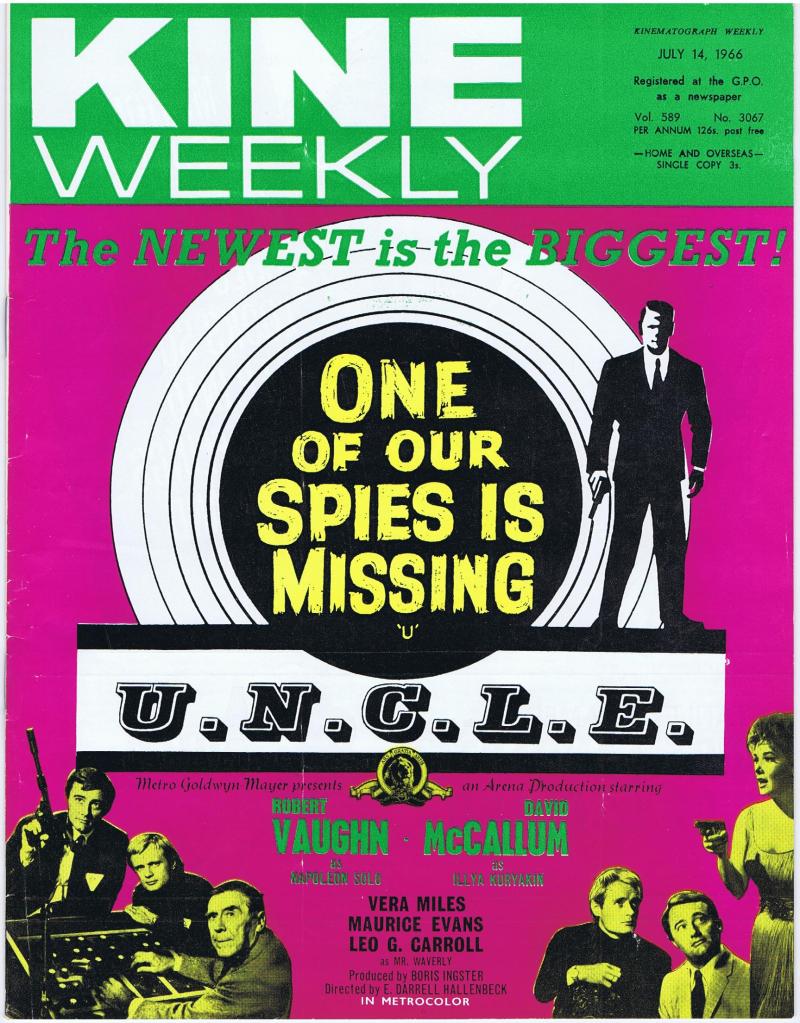
Even when The Man from U.N.C.L.E. series ended after three-and-a-half seasons, MGM continued bringing out movies, eventually totalling eight in all. The others were: One of Our Spies Is Missing (1966), The Spy in the Green Hat (1966), The Karate Killers (1967), The Helicopter Spies (1968) and How to Steal the World (1968).
Towards the end of the decade the Easy Rider (1969) phenomenon prompted a brief vogue for box office analysts to point to low-budget pictures generating the biggest profit. Nobody tended to include the first three Uncle films in this equation regardless of the fact that, costing an original $200,000 per episode plus extra for reshoots and editing, they were, on a profit-to-cost basis, extraordinarily successful, easily bringing home revenues in the region to 10-15 times their budgets.
SOURCES: Allen Eyles, ABC: The First Name in Entertainment (CTA, 1993), p123; “Another Uncle Sequel As O’Seas Theatrical,” Variety, September 23, 1964, p79; “Uncle Gets 3rd Whirl As O’seas Feature,” Variety, January 27, 1965, p26; “International Soundtrack,” Variety, May 26, 1965, p26; “Toys from Uncle,” Variety, June 30, 1965, p42; “Uncle Stunt in London Is Metro Hit,” Variety, December 8, 1965, p23; “Metro Sees Uncle TV Stanzas As B.O. Kin to James Bond in Theaters,” Variety, February 2, 1966, p1; Review, Variety, February 16, 1966, p18; Review, Box Office, February 21, 1966, pB11; “Box Office Barometer,” Box Office, March 14, 1966, p22; “One Spy Looms MGM Leader in Britain,” Variety, March 20, 1966, p29; “Drive-Ins in New England Preparing To Solve Springtime Problems,” Box Office, March 21, 1966, pNE4; “Pacific Prefers Not To Follow Video,” Variety, April 20, 1966, p24; “Box Office Barometer,” Box Office, June 20, 1966, p14; “How Uncle in Great Britain Clicked Via Tie-Ups with Tele,” Variety, June 22, 1966, p17; “Uncle TV Conversions Boffo at B.O. Theatrically O’Seas,” Variety, March 20, 1968, p4; Box Office figures taken from the weekly edition of Variety in the “Picture Grosses” section on the following dates: in 1965 on November 10 and December 8, in 1966 from February 2 until June 1; and August 18, 1966.
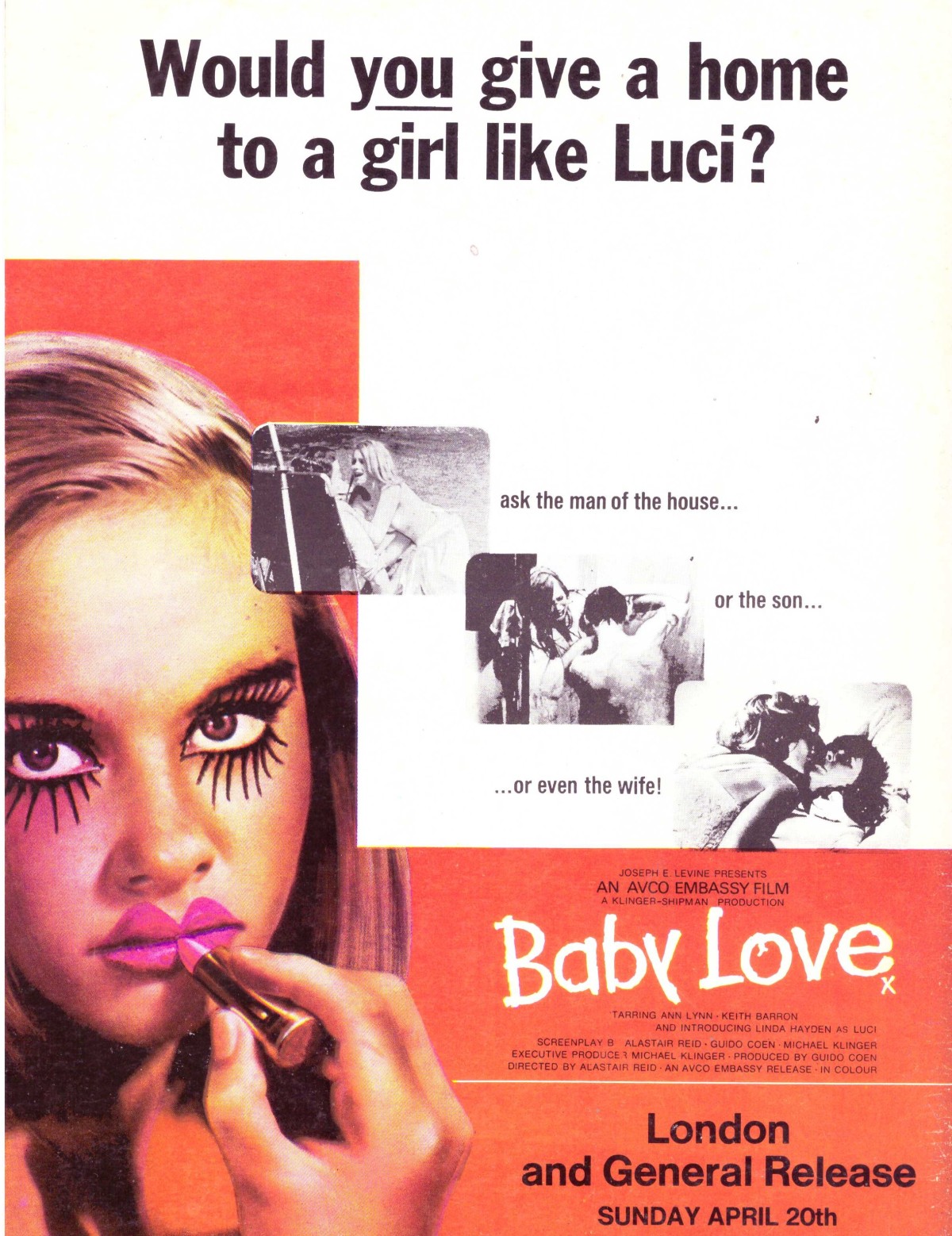
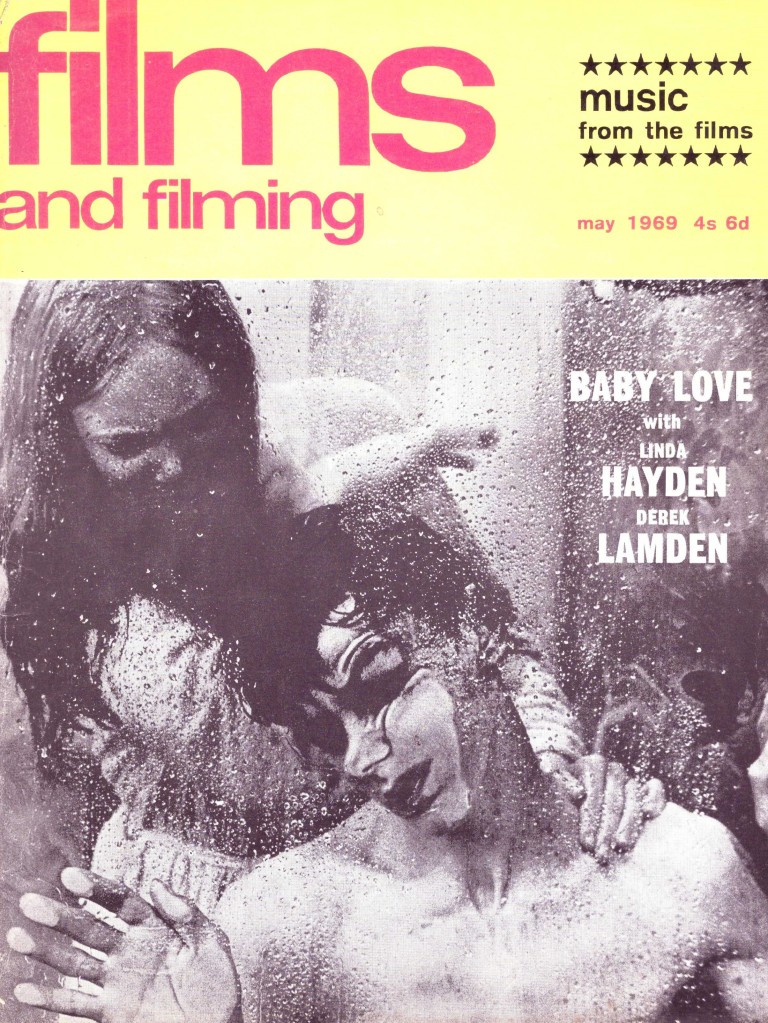
Disturbing tale about grooming marking the debut of Linda Hayden could not more accurately reflect changes in public perception from over half a century ago. What had originally seemed a movie about a young woman wreaking havoc on a middle-class family is now more easily recognized as a more sympathetic study of a young girl denied familial attention attempting to find a stable and welcoming home.
After the suicide of her mother (Diana Dors) Luci (Linda Hayden) is taken in by Robert (Keith Barron), a highly successful doctor and ex-lover of her mother, and his wife Amy (Ann Lynn). His marriage to sophisticated housewife Amy is distinctly rocky. They live in a fabulous three-storey house on the bank of the Thames with son Nick (Derek Lamden), a typical teenager the same age as Luci but who is sexually naive, confused and hypersensitive. Amy comforts Luci when the young girl has terrible nightmares and ends up sleeping in the same bed until she realizes how inappropriate is such behavior.
Nick chances his arm with Luci but is continually rejected, not surprisingly since his approach is more than a tad creepy, spying on her in the bathroom, entering her bedroom when she is naked, leching after her in the garden. Robert is the only one to try and keep his distance and in the absence of her own father becomes the subject of a father fixation.
Conditioned to accept the advances of older men finds her in potentially unsavory situations in a cinema, a club, and with a friend of the couple (Dick Emery). That she apparently welcomes such attention reveals the depth of her grooming, not just forced to watch her mother make love, but, as suggested in a flashback, the mother complicit in not preventing her lovers making a play for her. If Luci appears sexually confident that only disguises her inner turmoil, a desperate need to be loved, lack of proper parenting and setting of boundaries and having chanced on a proper home determined to do whatever it takes to remain there.
It is actually Ann who is the disturbing element, eventually overcoming her own inhibitions and not only seducing the girl but telling her that if she wants to remain in the house she will need to twist Robert round her little finger. And the only way she knows how to do that is follow her mother’s example and exploit her sexuality. If Luci appears exploitative in the context of the family that is only because they are not privy – as is the audience – to the depth of her nightmares, the constantly reappearing image of her mother dead in the bath, her mother’s leering lovers. Even when she goes over-the-top with make-up or clothing there is an innocence to such behavior, little more than a young woman testing boundaries and trying to find her way. Any intelligent assessment of what is going on would clearly see the child as the victim.
The grandeur of her new potential home bears no comparison to the poky working-class council house she occupied up north. For a child with such an impoverished upbringing, she is fairly grounded. She is not the wild child you might expect from her upbringing. She fits well into family life, happy to listen to classical music, and to Ann’s astonishment can actually cook breakfast and knows how to lay a table, skills her spoiled son patently lacks.
Considerable efforts are made to make each character more rounded. Robert hates his wife’s sophisticated parties and is an insomniac judging from the stack of books on his bedside. The guilt he feels for abandoning Luci’s mother, apparently his one true love, in favor of ambition, is exacerbated by Luci’s presence that reminds him not only of a path wrongly chosen but of what he has lost, that relationship ripped asunder when abortion entered the frame.
Ann clearly needs to project success, expensive clothes and champagne the least of their lifestyle, and with little outlet for pent-up emotion and a need to mother settles on Luci as the object of, initially at last, her affection. Nick hides his cigarette ends in a matchbox, would accept Luci as just a friend, occasionally rising to the role of protector, delighted to be seen in the company of a beautiful girl. Teenage fantasy in other words but with an edge of entitlement that goes too far.
In her debut Linda Hayden (Taste the Blood of Dracula, 1970) is superb in an extremely difficult role and it was a shame that it was the sexual part of her portrayal that made its biggest impact on future movie producers rather than the sensitivity of her performance, the look in her eyes when she is shown her bedroom for the first time is amazing. Also making a movie debut Keith Barron (Nothing But the Night, 1973) lacks the mellifluous tones that were later his hallmark and his performance as unloved husband and guilty ex-lover is very well observed.
Ann Lynn (I’ll Never Forget Whatsisname, 1967) has the most challenging role of a woman tortured by desire she has until now kept hidden or under control. Derek Lamden did not make another movie. Diana Dors (Hammerhead, 1968) has a fleeting role.
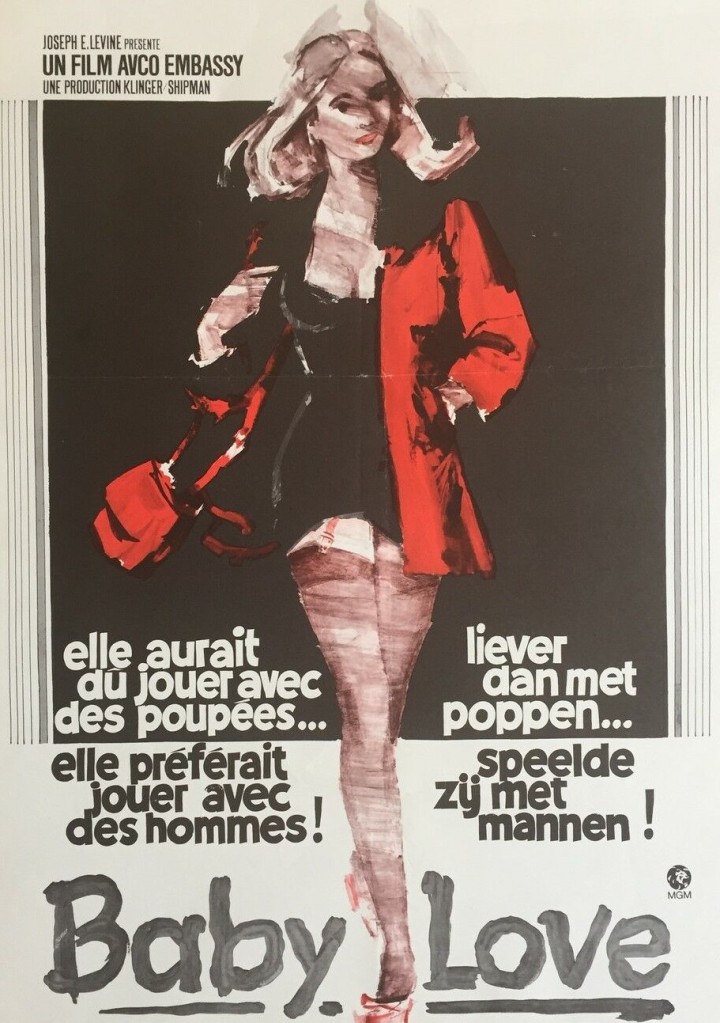
It wasn’t the fault of director Alasdair Reid that uber-producer and marketing kingpin Joseph E. Levine (The Carpetbaggers, 1964) wanted to sell a different movie from the one that was made, focusing on titillation and turning Luci’s sexual confusion into something predatory. The idea that this movie is a sexualized film noir is a marketing trick. Closer re-examination reveals that Luci is entering a disturbed household, one she lacks the skills to negotiate and is in reality the exploited one.
In fact, Reid (Something to Hide, 1972) did a very commendable job. He made some bold decisions especially relating to sound. The opening credits are accompanied by the sound of a dripping tap that would turn into a cascade of water. That would become a recurring motif, along with steam. Most scenes lacked music. Although most nightmares are image-driven, the initial one is full of clashing sound as well as disturbing sights. As the movie hits its stride, a clever device is adopted, showing disturbing images outside the house that are actually, you quickly discover, another nightmare. Mostly the camera remains fairly static but it occasionally swoops to represents anxiety from one point-of-view. The bulk of the story takes place in the house but when the camera goes outside, to a disturbing scene on the river for example there are original ideas, one character speaking through a megaphone.
Passed by the British censor with an X-certificate then and an 18-certificate DVD today, it still has the power to shock. However as far as I can see it was last classified in 1994 and I have written to the BBFC to see if that classification should still stand.
The movie Cinderella story to end all movie Cinderella stories. Quite how The Wicker Man came to earn its cult status given that for more than a decade it was hardly screened is quite a remarkable tale. An occult picture that as authoritative a producer as Michael Deeley (Blade Runner, 1982) deemed one of the ten worst films of all time – and without even the compensation of falling into the “so bad it’s good” category.
Most people who saw it during its original British release did so by default. They had gone to see Nicolas Roeg’s Don’t Look Now (1973) with top stars Donald Sutherland and Julie Christie and tagged onto that box office hit – and critical smash – was this other movie critics had dismissed. That it surfaced at all was because British Lion put it out on the lower part of a double bill in order to legitimately defray its costs by snipping off some of the revenue accrued by Don’t Look Now.
It certainly wasn’t that the Nicolas Roeg picture needed a helping hand on the box office front. Prior to opening, Don’t Look Now had already covered its $1.2 million budget by selling off foreign rights with Paramount taking it for the United States. Despite having the same budget of $1.2 million, The Wicker Man, did not attract the same foreign interest, or indeed any foreign interest. and for the time being was put on the shelve. British Lion had been sold to EMI who put Deeley in charge and his assessment of The Wicker Man‘s worth put paid to any prospect of a high-end launch.
Don’t Look Now opened, minus The Wicker Man, in October 1973 at the London West End’s most prestigious cinema, the Odeon Leicester Square and in phenomenal fashion. An opening week $32,000 (equivalent to $126,000 these days) was bettered by a second week of $44,000 ($174,000 equivalent). A further two weeks brought in $41,000 and $35,000 respectively (or about close on to a total of $600,000 in today’s money).
Advertisement that ran in the “Variety” trade paper on November 16, 1977.
Then it switched, still minus The Wicker Man, virtually next door to the equally prestigious 1,402-seater Leicester Square Theater. An opening salvo of $29,000 dropped just $1,000 in the second week. A six-week run garnered $138,000 ($546,000 equivalent). Four weeks into that run it also opened at the 1,394-seat Metropole, this time as a double bill with The Wicker Man. It wasn’t a genuine double bill. A proper double bill consisted of two films of roughly equal standing that might both have premiered in the West End, top billing given to the movie that had performed best at the box office.
The Wicker Man had been on quite a different trajectory to Don’t Look Now. Despite it being promoted in “a savvy publicity ploy” at the Cannes Film Festival in May 1973 with a 30ft high “wicker man” set on fire on the Croisette, once Michael Deeley took control, replacing Peter Snell, also producer of The Wicker Man, he had no intention of giving a solo launch. By piggybacking on a hit movie, it was guaranteed to bring in some income.
However, initially, it seemed a disastrous idea. The Metropole double bill opened in mid-December 1973 to a miserly $5,300, second week no better, just $4,900.
But then something extraordinary happened. The third week was through the roof, a whopping $13,700. Over seven weeks it snapped up $57,000 (equivalent to $225,000 today). It wasn’t that surprising, however, since in the first two weeks it was still showing at the Leicester Square Theatre, but once the Metropole was the only option, the figures jumped up. Assuming revenue would taper off, in the fifth week of the Metropole run it began playing simultaneously at the 1,883-seat Odeon Kensington – probably to coincide with the general release – where the first week raked in $16,800. It continued at this cinema for six weeks, bringing in another $57,000.
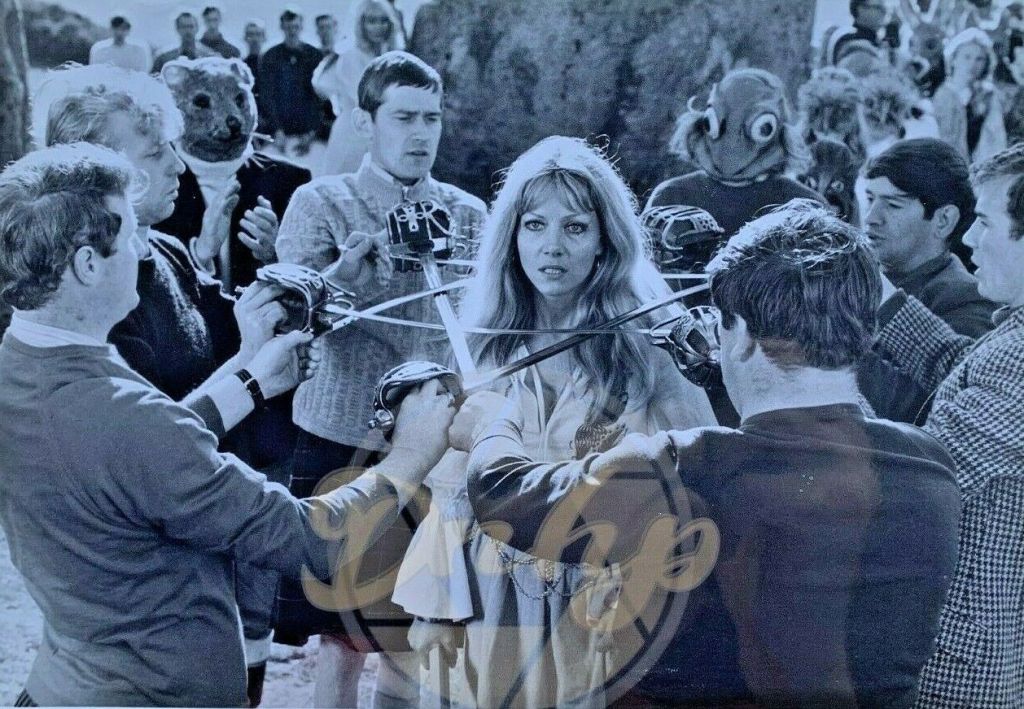
Let the fun begin: Ingrid Pitt does a blade runner.
And even then it wasn’t done. Towards the end of February the double bill switched to the 600-seat Odeon Haymarket, also in the West End. and opened with $6,000. A decent enough tally for a movie that had been on the market for over four months, but it turned out that except for its eighth and final week, that amount was the lowest it grossed. It ran out with a similar sum to the other two cinemas, $56,200. And then it moved again to the 150-seat Cinecenta 3, just off Leicester Square in London’s West end for a final flourish of $5,300 in two weeks, the second week improving on the first. All told, the double bill grossed $175,100 in the West End (just under $700,000 at today’s figures). The double bill also went out on general release on the Odeon circuit in Britain at the start of February 1974 – and not in December 1973 as has been argued (the London West End screenings were what would be termed “pre-release” activity).
How much of the double bill’s success could be attributed to The Wicker Man is not that difficult to calculate. As we have seen, Don’t Look Now was already an enormous success before it took on a perhaps-unwanted partner. Not every Odeon general release required a supporting feature, often a short would do. Without another film on the program, Don’t Look Now would have received more daily showings which could boost receipts and at the very least been more profitable for not having to share the box office.
Whereas Don’t Look Now sailed into New York on a tide of box office and critical glory at the 549-seat Sutton with a first week tallying $30,000 and had massed $110,000 in five weeks, The Wicker Man was deemed a massive flop. British Lion wrote it off to the tune of $470,000, a substantial amount.
There was no chance of British Lion fobbing off the more astute Americans with the notion of The Wicker Man running as the stablemate of Don’t Look Now. Major U.S. distributors bought pictures that had been hits on release in their home country. Perhaps not surprisingly, the main contender for the rights was Roger Corman, a horror specialist, and he thought he could make it work if the film was editing from the original 102-minutes to 86-minutes, a timing that make it more appealing in a double bill. But Corman could not meet EMI’s terms.
However, it was bought in 1974 for American release by the Beechwood Properties – which Variety mispelled as “Beachhead Corp” but only initially as as a tax shelter. However, Beechwood succeeded in drumming up a distributor, National General Corporation which distributed John Wayne movies Rio Lobo (1970) and Big Jake (1971) as well as Little Big Man (1971) and Le Mans (1971), The Getaway (1972) and The Life and Times of Judge Roy Bean (1972). NGC was taken enough by the movie to pay EMI $300,000 for the rights.
But then NGC hit a financial brick wall and pulled out and the project passed on to Warner Brothers after it picked up the top prize at the International Festival of Fantasy and Science Fiction. As a prelude to a release, Warner Brothers submitted it to the American censor where it earned an “R” (restricted) rating in keeping with its British X-certificate. Warner Brothers test-marketed the shortened version as a solo feature with 24 prints playing the San Diego and Atlanta regions. But when the movie failed to attract an audience it was deemed a flop and shelved.
And in summer 1974 it was officially shelved.
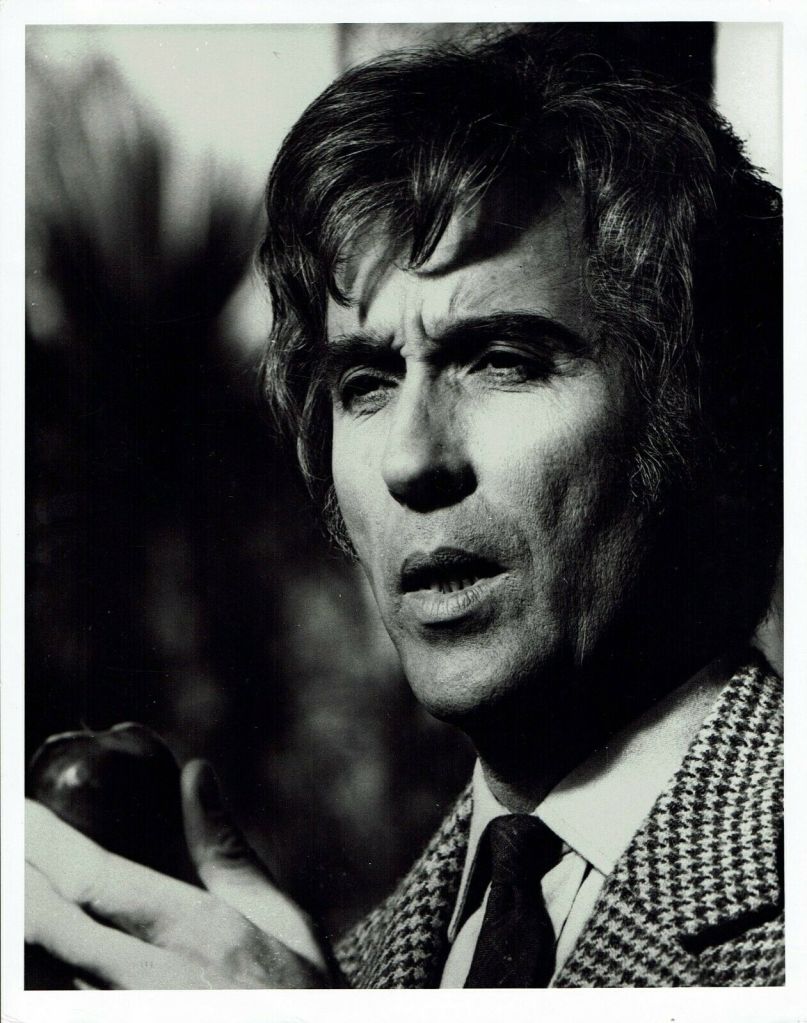
Christopher Lee with flowing locks.
So it sat in limbo for another three years before in 1977 Cinefantastique magazine dubbed it “The Citizen Kane of Horror Pictures” and devoted a 32-page spread to it in its Vol 6 No 10 issue, so determined it had uncovered a work of genius that it took out a substantial advertisement in U.S. trade paper Variety. That appeared to elicit some distributor interest and it was purchased in 1977 from Beechwood by New Orleans company Abraxas, headed by Stirling Smith, John Alan Simon, and Ron and Micheline Weinberg. Abraxas got the rights for a song – just $20,000.
But then the Weinberg’s split from Abraxas and set up a company (I am presuming) called International Films. It looked like they were licensed to show The Wicker Man, which they did in a kind of hit-and-run strategy, racing all over the country with the movie in the back of the car, and renting it out to around 30 arthouses, presumably assuming the “Citizen Kane” tag might attract an audience.
Distributed under the banner Summerisle Films, some of these showings were indeed propitious. In January 1979 at the 300-seat Lumiere in San Francisco with tickets priced at $4 it knocked up a “boffo” $19,000 (equivalent to a meaty $75,000 now). There was none of the steep fall-off either that you might expect. The second week hauled in an excellent $15,500 ($59,000 today) and the nine-week run brought in total of $93,000 (a very good $368,000 in today’s terms). It was deemed so successful that it achieved in exhibitor parlance a “move-over,” transferring to the 300-seat Cento Cedar.
Results were similar in Los Angeles. At the 763-seat Los Feliz Westland 1, also primarily an arthouse, it racked up opening week figures of $19,000 and after six weeks had powered to $61,900 plus another $37,000 from a two-week run at four suburban houses. There was a decent performance in Seattle, close on $40,000 in a five-week run at the 700-seat Crest. Enough to counter a poor showing in Minneapolis at the 461-seat World where it opened to a “slow” $2,000. And excepting that result, the prospects must have looked rosy.
That is, until the wheels came off.
International Films turned out to be beset by financial problems. Weinberg had been due to pay Abraxas a total of $150, 000 by December 1978, paid off in three tranches, an initial amount of $30,000 by December 1977, another $50,000 by June 1978 and the the remaining sum by December of the same year. When the debt was not settled, Abraxas took Weinberg in court in July 1979 and the outcome was that the rights reverted back to Abraxas, now headed by Smith and Simon. And that was timely from a publicity perspective for the movie had just been named Best Horror Picture and Best Screenplay by the Academy of Fantasy and Horror Films.
So Abraxas started all over again, sticking to the precedent of opening it in arthouses. But it looked like they sold off regional rights for the movie appeared under different distributors, Horror Films as well as Abraxas and the original Summer Isle banner April 1980 saw The Wicker Man set a new house record at the 200-seat Orson Welles III in Boston with a $15,000 opening and over the next eight weeks it locked up a hefty $73,500 ($256,000 equivalent). The same month it hit New York, but an excellent opener of $21,000 at the 533-seat Paramount dropped to just $9,000 in the second week, then $4,400 in the third and $4,000 in the last. In December it scored $7,500 at the 150-seat Cerberus II in Washington D.C, finishing with $16,000 for three weeks.
In January 1981 it was the last movie shown in a 12-week season of revivals at the 560-seater Fine Arts in Kansas City and, despite registering only a “mild” $3,500, it moved over the Watts Mill 2 for a $3,200 opener and an $8,400 total over four weeks. But a four-screen “showcase” in Miami produced a “remote” $3,700. There was some publicity derived for being selected, eight years after initial launch in Britain, at the Cleveland International film Festival.
But success in the independent field required momentum and despite excellent results in a handful of cinemas, The Wicker Man never really took off.
Salvation came via another route – video. Without VHS and then DVD it is doubtful if the movie would ever have achieved its current cult status. It’s not the first film to hit the ground running in the video format after a less than stellar performance in the cinema. I doubt that anyone, years after it was first shown, believed The Wicker Man had a hidden pot of gold. But my guess is the video rights cost little and in the burgeoning market where taste was not stifled by choices made at a cinema chain head office it was a film that finally found an audience.
SOURCES: “Michael Deeley Replaces Snell at Brit Lion,” Variety, April 11, 1973, p4; “Doing The Cannes-Cannes,” Variety, May 23, 1973, p26; “Form Beachhead Corp To Handle Wicker Man,” Variety, Jan 2, 1974, p4; “This Week’s Code Tags,” Variety, April 24, 1974, p4; “Wicker Man Wins Top Prize at Fantasy Fest,” Variety, May 1, 1974, p7; “British Lion 6 Months Slips to 890G,” Variety, January 29, 1975, p39; Advert, Variety, November 16, 1977, p38; Stuart Byron, “Something Wicker This Way Comes,” Film Comment, November-Dcember 1977; “Abraxas Corp Sues Ronald Weinberg,” Variety, April 18, 1979, p5; “Enjoin Weinberg Re Wicker Man,” Variety, Jul 4, 1979, p35; “Cleveland: 45 Titles: 3 Situations,” Variety, April 1, 1981, p24; “Metropolis Strikes Deal with Magnum,” August 10, 1988, p34. Box office figures all from the following issues of weekly Variety: Oct 24, 1973-April 24, 1974; October 5, 1977; March 21, 1979, April 11, 1979; April 18, 1979; April 25, 1979; May 7, 1979; April 23, 1980; December 3, 1980; February 4, 1981; April 1, 1981; May 20 1981.











 The Magnificent 60s