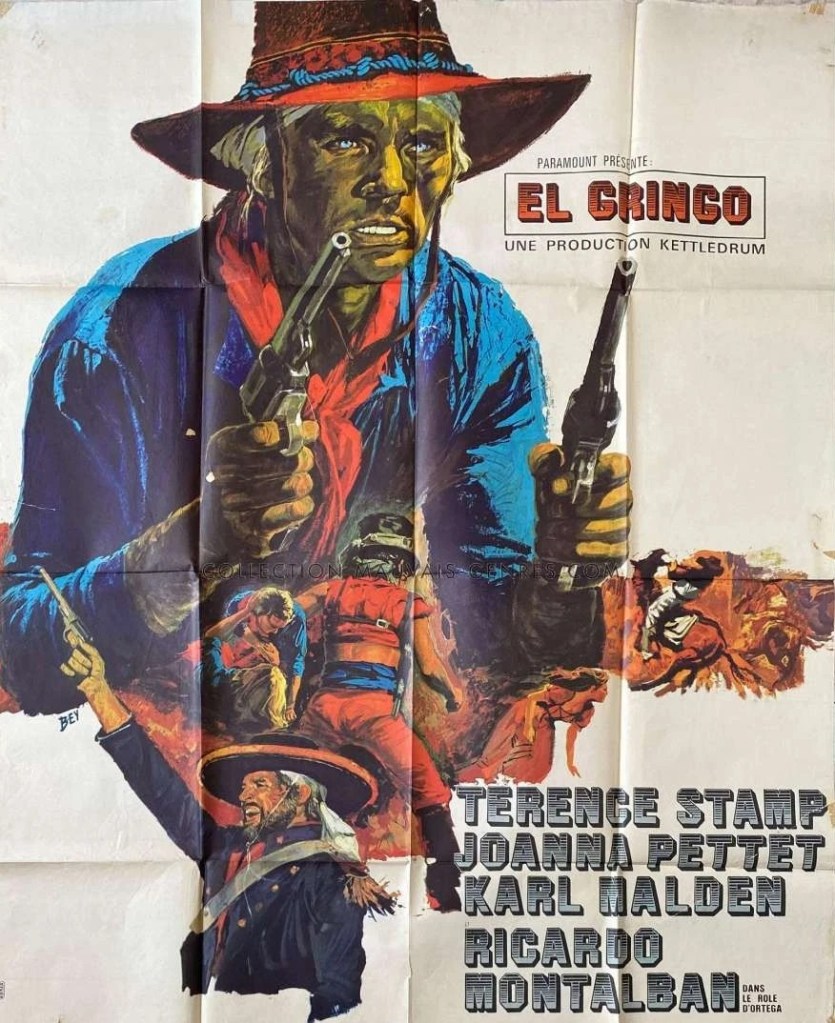
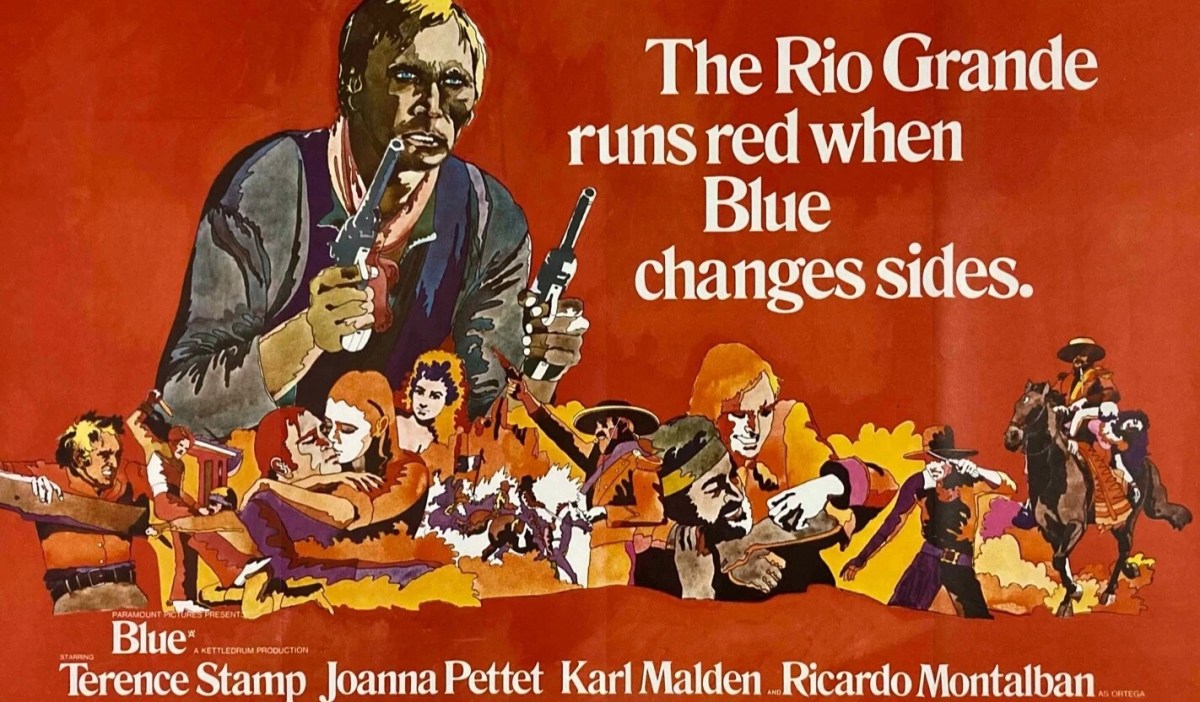
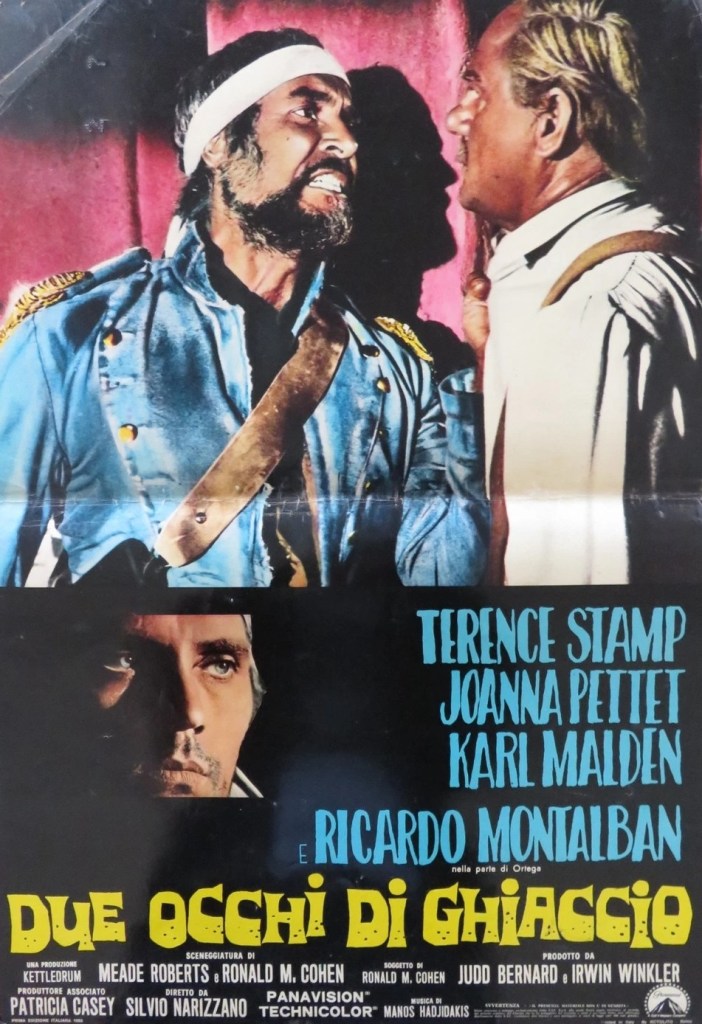
Blue (1968) *****

Easily the most underrated western of all time. Few people saw it on release and precious few since. If remembered at all, it’s for reasons of movie trivia. Robert Redford got into a legal fight with Paramount when he pulled out of the starring role. And it was what was being shot in the background of the Burt Reynolds movie Fade In (1968).

Decades before cultural appropriation was a major no-no, Americans didn’t take too kindly to Brits taking on top-billed roles in westerns. Audiences sniggered at Dirk Bogarde as a Mexican bandit in The Singer Not the Song (1960), John Mills proved an obstacle to audience acceptance of  Chuka (1967) and Shalako (1969) starring Sean Connery, the world’s biggest box office draw at the time, would become a huge flop Stateside.  

Yet there are some extraordinary moments here. Some, frankly, I’m astonished never rated a mention at the time nor since. The director’s use of natural sound is ground-breaking. For a start, there’s very little music, none of the triumphal brass that generally accompanies hordes of cowboys racing across plains. Often, here, all we get is hoofbeats. In terms of the aural Hitchcock would have applauded one scene, where a man is hunted through tall grass. All we hear is the crackling sound of the pursuers as they stalk him through the dried-out terrain.

Most times when in other films we see a bunch of cowboys charging along, it’s filmed from the front or the side. Reason being, shoot it from the back and you’ve got to deal with all the dust churned up by the hooves. Not so, here, bring on the dust. Let’s have something new.

There’s even a nod to The Searchers (1956), the famous doorway scenes, but here the main character is neither coming nor coming but cannot make up his mind whether to do either and so slouches against the doorframe.

The opening sequence is The Wild Bunch (1969) in reverse. It’s the good guys in the town, and the bandits who create the ambush and, minus Peckinpah’s obsession with bloodletting, treat their captives ever bit as brutally. Even here, there are two notable scenes. In the first, our hero Blue (Terence Stamp) has been sitting napping under his hat when a troop of Mexican soldiers arrive. Once they hunker down inside the saloon he throws a huge red scarf in the hair, signal to the watching bandits. Then, after the soldiers have been routed, and their leader is still trying to make a stand, Blue races up behind and whips away first his upraised gun, then his hat, then the man himself.

And these are not ordinary bandits. You might think they are given our post-action  introduction to them shows them whoring, gambling and fighting. But actually they are revolutionaries and leader Ortega (Ricardo Montalban) has a strategic brain and realizes that they have to take the fight across the river to the Americans – on their most important day of the year, July 4th, Independence Day – and get them so riled up they do something about the inequities in Mexico.

And he has his work cut out to rein in his rebellious son and the concerns raised by his number two that the life, hiding out in the hills and sleeping in caves, is losing its appeal to his followers. So, intelligent bandits.

The Americans might not be particularly bothered by their neighbors, but still they’ve got a stuffed mannikin hanging from a noose with the word “Greasers” written upon its chest. The bandits break up the party, rob the Yanks, but for some reason leave the enemy with all their weapons, allowing the farmers to form an immediate posse and set off in pursuit.

Blue is shot but makes his way to a farmhouse where, luckily for him, he is tended by farmer’s daughter Joanne (Joanna Pettet) whom he previously saved from rape. It’s a bit of a tip-off that the fugitive goes by the name Azul (the Spanish word for “blue”) to the Mexicans given, I’m assuming, all Mexicans are brown-eyed. So he must be an outlander. And so he is, brought up by the Mexican bandits.

At first he appears to be of the Clint Eastwood persuasion, monosyllabic to the point of dumbness, but, eventually, in a quite brilliant scene, forced to utter a word before Joanna cuts his throat with a razor, an idea that found its way, as I recall, into Alan Parker’s Mississippi Burning (1988).

And if ever action carries more meaning than words, it’s in the scene where Joanne discovers Blue has apparently fled only to spy him ploughing the fields. As you might expect, whether an American male or female is brought up by Native Americans (Hombre, 1967) or as here Mexicans, they find it hard to be accepted. The issue is forced upon his new countrymen when the bandits return, and Blue has to choose a side.

Blue was an orphan thanks to racism against his American parents when they settled in Mexico. And he suffers, unfairly you would say given he was born in the U.S., from racism again when he crosses the border.

The sex scene is brilliantly handled, relying both on sight and sound. It’s Joanna who has to instigate it, instinctively knowing that he won’t make any move in case it is wrongly interpreted. The father, noting her bedroom is empty, begins to walk along the corridor to Blue’s room. Hearing his footsteps, Joanna turns out the light. Seeing the light go out, the father retreats – on tiptoe.

There’s also the best demonstration of pistol shooting this side of Butch Cassidy and the Sundance Kid the following year. And without taking anything away from the Robert Redford scene, it’s remarkably similar.

And Blue proves himself to be a brilliant tactician. He sets up a stunning ambush and the bandits are slaughtered from both sides of the river when they attempt to cross. His leadership, unusually, sets up emotional issues. When Joanne reacts against this new tough side of him, it’s her father that calms her. But that isn’t the peach. Blue confesses that he enjoys killing, it “pleasures” him.

I’m afraid to say the ending of Butch Cassidy also has remarkable similarities to this. There it’s the freeze frame that encapsulates the death of the heroes. Here, the camera draws back and back into the sky as Joanne holds her dead lover in the river.

Terence Stamp (The Collector, 1965)  doesn’t quite have enough going on behind the eyes to become a top-class actor so sensibly director Silvio Narrazino (Georgy Girl, 1966) avoids going in too close on the baby blues and allows the actor freedom of movement to reveal his feelings, the slouching in the doorway one example, another being Blue’s slow realization that much of what he sees in the farmer’s house is familiar. Stamp acquits himself well in the action scenes.

But Joanna Pettet (The Best House in London, 1969) is the revelation. We’re quite used to spunky or feisty females in westerns. But I don’t think I’ve ever seen one who takes control with subtlety. Her father Doc Morton (Karl Malden) can’t get a word out of Blue no matter the threats uttered and violence threatened. But when Joanna takes up a cut-throat razor for the first time in her life and begins to trim his stubble, deliberately making a hash of it, that’s as novel a meet-cute as you’re going to find as well as one of the best definitions of female character that you’ll see in a western.

Written by Meade Roberts (The Stripper, 1963) and Ronald M. Cohen (The Good Guys and the Bad Guys, 1969).

One of the most stylish and innovative westerns you’ll ever see and you need to watch it with your ears attuned to sound.

A true find.

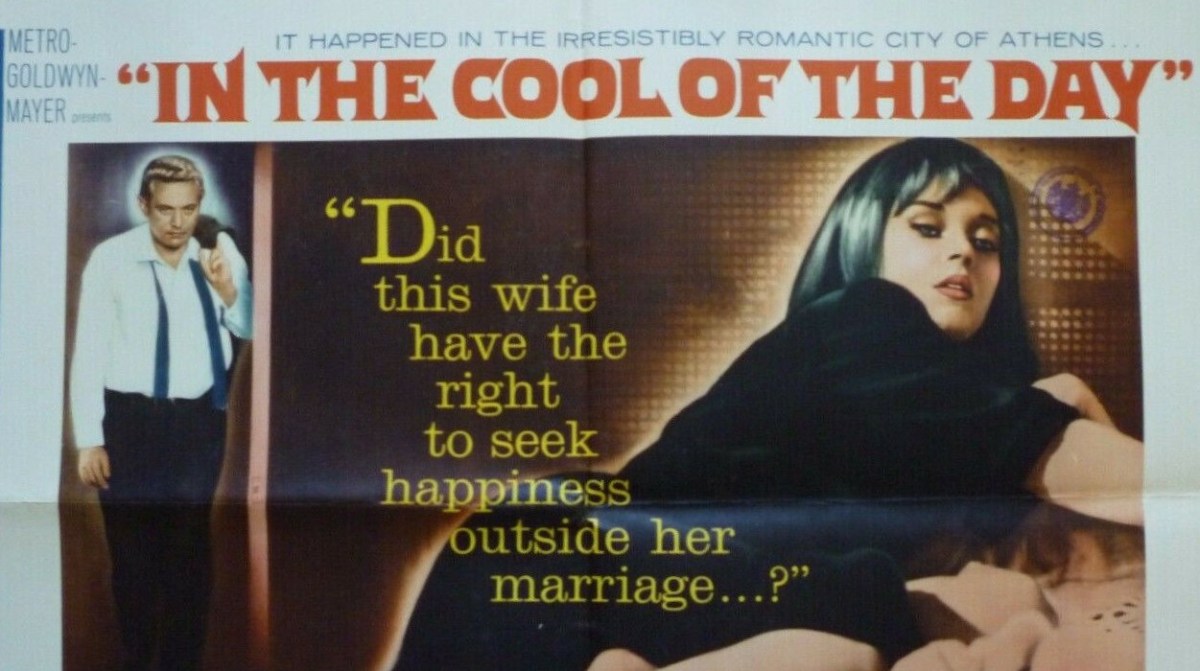
In the Cool of the Day (1963) ***

Jane Fonda tagged this the worst film of her career but that’s a bit harsh and I suspect it owed a lot to the actress being dressed up Audrey Hepburn-style in outfits that scarcely suited her. While it’s certainly overheated, melodramatic moments indicated by thundering music, a marvellous supporting cast, including a quite bitchy Angela Lansbury, provides ample compensation.

It’s  romance in the Love Story vein, rich young flighty heroine Christine (Jane Fonda) at death’s door half her life, but feeling smothered by understandably over-protective husband Sam (Arthur Hill). When she falls for married publisher Murray (Peter Finch) and sets off on a trip to Greece, chaperoned it turns out by Murray’s bitter wife Sybil (Angela Lansbury), it takes a while for romance to physically bud. That it does at all is only because   Sybil has taken off with suave traveling salesman Leonard (Nigel Davenport).

The movie takes a long time to heat up because, as in The Bramble Bush fashion, there’s overmuch character filling-in to do. Part of the interest in this picture is how the bad guys are effectively good guys, more victims of their partner’s behaviour than anything else, though for story purposes, the audience has to be persuaded otherwise.

So besotted Sam, having dealt with umpteen bouts of his wife’s pneumonia and lung operations, a “slave” to her illnesses, is deemed as treating her like a child rather than a wife, preferring her ill rather than well, and denying her the adventure to which she feels entitled. When she meets Murray she has run away. Murray’s wife has a downer on her husband because, wait for it, he killed her child and left her facially scarred (hidden now by hair but she’s still very sensitive about it) in a car accident he caused.

But she’s portrayed as over-sensitive, worried about her appearance, snippy, blaming him for her distraught life, and worse, a philistine, hating being dragged around ancient Greek monuments. Aware of her husband’s proclivities, she mocks, “You’d be an idiot to fall in love with her.” And any time she ventures out, the music rises to a crescendo as if she is a character straight out of film noir.

When she goes off with Leonard, her love affair is viewed as sneaky rather than redemptive, even though he restores her faith in herself. Triumphantly, she tells Christine, “He’s all yours” and her husband “nobody need feel sorry for me any more.”Admittedly, she does take revenge by informing Christine’s husband, who has entrusted his wife to Murray’s care, of their affair. And you would be hard put to argue, although the film wants you to believe otherwise, that Sybil and Sam have been ill-treated by their partners, Sam, in particular, funding her trip to Greece in the hope that allowing her the freedom she needs will save their marriage.

Of course, the characters of both partners, even if their self-pitying is the result of circumstance, do mean that Christine and Murray are presented as people trapped in bad marriages and for whom love, however brief, provides sanctuary from tortured lives, her physical, his more mental, since he is not averse to guilt. 

Sybil’s lack of interest in tourist Greece handily gives the prospective lovers plenty time to fall in love, amid gorgeous scenery, and breathing in air rich in culture. With all film made in the 1960s and set in foreign parts – Pretty Polly (1967) another example – sometimes the story takes second place to the scenery, so it’s lucky that the romance is played out against such an interesting background, an ideal combination, killing two birds with one stone if you like. Given this is prior to Zorba the Greek (1964), the filmmakers have even managed to sneak in some traditional Greek dancing, albeit on the deck of a ferryboat.

Dress-wise, the lovers are ill-matched, Murray plodding around in a suit while Christine parades the latest often clingy fashion. When Sybil departs the scene, that leaves one happy character of the happy couple free of marital encumbrance, but still leaves open the question of how Christine will rid herself of Sam and, more importantly, will Murray wish to take on the all-consuming job of nursing Christine. He never gets the chance to find out. When she does fall ill – as the result of Murray recklessly keeping her out in a thunderstorm – her mother Lily (Valerie Kendrick) swoops in to rush her to hospital.

Spoiler Alert – I’m telling you that she dies because it seems to me that the ending the filmmakers hoped for is not how the audience will perceive it. Beautiful young woman dies too young, yep that’s there, but the man, now free and able to shake off his dull life and start afresh as a writer, seems a long shot. Given he has now, thanks to the thunderstorm episode, killed two people, I would surprised if guilt was not uppermost in his mind.

Not so-good-it’s-bad, and despite the complications, and perhaps because of the Sybil-Leonard romance, it’s certainly an interesting picture as much, perhaps, because it fails to send the audience in the desired direction.

In only her fifth movie, Jane Fonda (They Shoot Horses, Don’t They, 1969), exhibiting the nervous friskiness that would become a hallmark, does pretty well with a febrile, spoiled, character. If she falls down at all it’s that she appears uncomfortable wearing Orry Kelly’s fabulous gowns and it would take Hollywood some time to work out she was not a natural successor to Audrey Hepburn. Peter Finch (The Pumpkin Eater, 1964) is perfectly at ease with the illicit.

But Angela Lansbury (Harlow, 1965), a hoot as the wife who turns rejection into triumph, steals the show. Throw in Arthur Hill (Moment to Moment, 1966), Nigel Davenport (Sands of the Kalahari, 1965), for once neither smug nor snippy, Alexander Knox (Khartoum, 1966), veterans Constance Cummings (The Criminal Code, 1930) and Valerie Taylor (Went the Day Well, 1942), John Le Mesurier (The Liquidator, 1965) and Alec McCowan (Frenzy, 1972) and you have a movie where hardly a moment goes by without admiring a performance.

Robert Stevens (I Thank a Fool, 1962) directed from a screenplay by Meade Roberts (Danger Route, 1967) based on the novel by Susan Ertz.
Discover WordPress

A daily selection of the best content published on WordPress, collected for you by humans who love to read.

The Atavist Magazine

by Brian Hannan

WordPress.com News

The latest news on WordPress.com and the WordPress community.