These days fact-based magazine articles commonly spark movies – The Fast and the Furious (2001) was inspired by a piece in Vibe, A Beautiful Day in the Neighborhood (2019) started life in Esquire – but it was rare in the 1960s (see Note below).
However, a series of seven lengthy historical articles in the multi-million-selling Life magazine in 1959 about the Wild West, extensively illustrated with material from the time, captured the attention of the nation. Bing Crosby acquired the rights, not as a potential movie, but for a double album recorded in July 1959 on a new label Project Records set up specifically for the purpose – two months after the series ended – and a proposed television special.

When the latter proved too expensive, the rights were sold to MGM which then linked up in a four-film pact with Cinerama to create the first dramatic picture in that format, the three-screen concept that had taken the public by storm in 1952 with This Is Cinerama. Since then, Cinerama had focused exclusively on travelogs and coined $115 million in grosses from just 47 theaters, including $9 million in seven years at the Hollywood theater in Los Angeles. Eight years in its sole London location had yielded $9.4 million gross from a quartet of pictures, Cinerama Holiday (1955) leading the way with (including reissue) a 120-week run, followed by 101 weeks of Seven Wonders of the World (1956), 86 for This Is Cinerama and 80 weeks for South Seas Adventure (1958).
Box office was supplemented with rentals of the projection equipment. But the novelty had worn off, lack of product denting consumer and industry interest, many of the theaters set up for the project returning the equipment, so that by the time of this venture there were only 15 U.S. theaters still showing Cinerama. The company went from surviving primarily on equipment royalties to becoming a producer-distributor-exhibitor. Ambitiously, the company believed it could generate $5,000 a week profit for each theater, and, assuming growth to 60 houses, that could bring in $15 million a year.
Crosby initially remained involved – crooning songs to connect various episodes – but that idea was soon abandoned. Director Henry Hathaway (North to Alaska, 1960), claimed he came up with the movie’s structure. “The original concept was mine,” he said, “The first step in the winning of the West was the opening of the canal, then came the covered wagon, next the Civil War which opened up Missouri and the mid-West then the railroads, and finally the West was won when the Law conquered it instead of the outlaw gangs; which was the theme I worked out for the picture.
“So I conceived the whole idea and then got writers to work on the five episodes. Each episode was about a song originally. Then I travelled all over the country to find locations.”
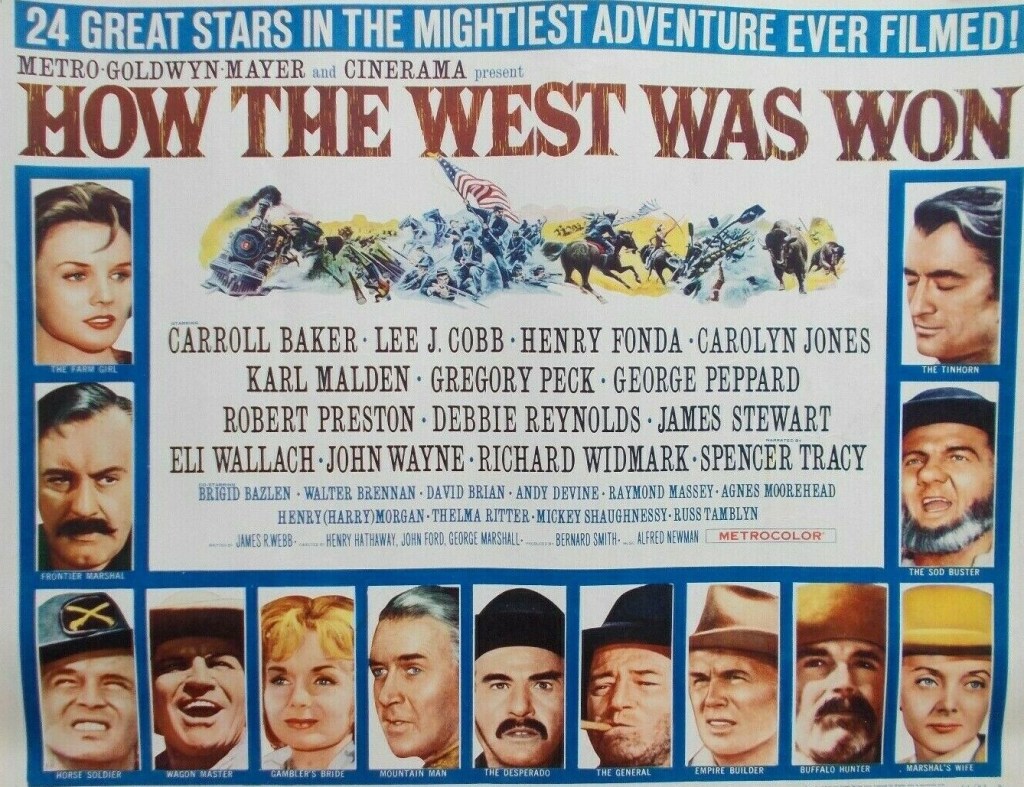
For once this was a genuine all-star cast headed up by actors with more than a passing acquaintance with the western: John Wayne (The Man Who Shot Liberty Valance, 1962), Oscar-winner Gregory Peck (The Big Country, 1958), James Stewart (Winchester ’73, 1950), Richard Widmark (The Alamo, 1960) and Henry Fonda (Fort Apache, 1948) with Spencer Tracy (Broken Lance, 1954) as narrator plus George Peppard (Breakfast at Tiffany’s, 1961) in his first western.
The two strongest female roles were given to actresses playing against type, Carroll Baker (Baby Doll, 1956), who normally essayed sexpots, as a homely pioneer and Debbie Reynolds (The Tender Trap, 1955), more at home in musicals and comedies, as her tough sister. The impressive supporting cast included Lee J. Cobb, Eli Wallach, Walter Brennan, Robert Preston, Carolyn Jones and Karl Malden.
Glenn Ford and Burt Lancaster were unavailable. Frank Sinatra entered initial negotiations but ultimately turned it down. Gary Cooper, also initially considered, died before the film got underway.
Initially under the title of The Winning of the West screenwriter James R. Webb (The Big Country, 1958) was entrusted with knocking the unwieldy non-fiction story into a coherent fictional narrative. In effect, it was an original screenplay at a time when Hollywood was turning its back on bestsellers, “the pre-sold theory less compelling.” His first draft accommodated various montages covering the journey from the Pilgrim Fathers to the building of the Erie Canal and the Civil War and it was only in subsequent drafts that the tale of Linus Rawlings (James Stewart) emerged with surprising focus on female pioneers.

Webb’s initial ending had involved a father-son conflict, presumably a fall-out between the Rawlings played by James Stewart and George Peppard, but that was rejected in order not to finish on a “note of bitterness” out of keeping with the spirit of the movie. Although he did not receive a credit, John Gay (The Happy Thieves, 1961) also contributed to the screenplay.
Given the film’s episodic structure it is amazing how well the various sequences fit together and the narrative thrust maintained. The story covers a 50-year stretch beginning in 1839 with the river sequence bringing together James Stewart and Carroll Baker. After Stewart is bushwhacked by river pirates, he marries Baker and they set up a homestead. The next section pairs singer Debbie Reynolds with gambler Gregory Peck whose wagon train is attacked by Indians on the way to San Francisco. Later, Stewart and son George Peppard enlist in the Civil War (featuring John Wayne as an unkempt General Sherman).
Stewart dies at the Battle of Shiloh. Peppard joins the cavalry and later as a marshal in Arizona meets Reynolds and prevents a robbery that results in a spectacular train wreck. It took a superb piece of screenwriting to pull the elements together, ensure the characters had just cause to meet and to create solid pace with a high drama and action quotient.
The undertaking was too much for one director. Initially, it was expected five would be required but this was truncated to three – John Ford (The Searchers, 1956), Henry Hathaway and George Marshall (The Sheepman, 1958) although Hathaway carried the biggest share of the burden and Richard Thorpe (Ivanhoe, 1952) handled some transitional historical sequences.
The directors broke new ground, technically. The Cinerama camera was actually three cameras in one, each set at a 48 degree to the next and when projected provided a 146-degree angle view. Each panel had its own vanishing point so the camera could, uniquely, see down both sides of a building.
But there were drawbacks. The cumbersome cameras required peculiar skills to achieve common shots. Directors lay on top of the camera to judge what a close-up looked like. Sets were built to take account of the way dimensions appeared through the lens, camera remaining static to prevent distortion. When projected, the picture was twice the size of 65mm and before the invention of the single-camera lens led to vertical lines running down the screen. Trees were built into compositions to hide these lines.
“You couldn’t move the camera much,” recalled Hathaway, “or the picture would distort. You have to shove everything right up to the camera. Actors worked two- and three-feet away from the camera. The opening dolly down the street to the wharf was the first time it had ever been done.
He added, “Over 50 per cent of the stuff on the train was made on the stage (i.e. a studio set) and 60 per cent of the stuff coming down the rapids. I never took a principal up north to the river, the principals never worked off the stage. We never photographed the scenes with transparencies in three cameras with Cinerama – we photographed them with one camera in 70mm and then split the negative.
“I wouldn’t shoot close-ups in Cinerama – I shot the close-ups in 70(mm) and then separated the negative because in Cinerama it distorted their arms. When (George) Stevens shot The Greatest Story Ever Told he used only 70mm and split it all. So from then on they never used the three cameras again. Now they’re actually shooting it in 35(mm).”
Rui Nogueira, “Henry Hathaway Interview,” Focus on Film, No 7, 1971, p19.
After a year spent in pre-production, an eight-month schedule due to start on May 28, 1961, and a completion date of Xmas 1961, MGM anticipated a 1962 launch, Independence Day pencilled in for the world premiere. The original $7 million budget mushroomed to $12 million and then to £14.4 million, $1 million of that ascribed to adverse weather conditions, hardly surprising given the extent of the location work. A total of $2.2 million went on the 10 stars and 13 co-stars, virtually talent on the cheap given the salaries many could command, transport cost $1 million and the same again in props including an 1840 vintage Erie canal boat.
Rain and overcast skies added $145,000 to the cost of shooting the rapids sequence in Oregon and another $218,000 was required when early snowfall scuppered one location and required traveling 1,000 miles distant. Nearly 13,000 extras were involved as well as 875 horses, 1,200 buffalo, 50 oxen and 160 mules. Thousands of period props were dispersed among the 77 sets. Over 2,000 pairs of period shoes and 1500 pairs of moccasins were fashioned as well as 107 wagons, many designed to break on cue.
Virtually 90 per cent of the picture was shot on location to satisfy Cinerama customers accustomed to seeing new vistas and to bring alive the illustrations from the original Life magazine articles. Backdrops included Ohio River Valley, Monument Valley, Cave-in-Rock State Park, Colorado Rockies, Black Hills of Dakota, Custer State Park and Mackenzie River in Oregon.
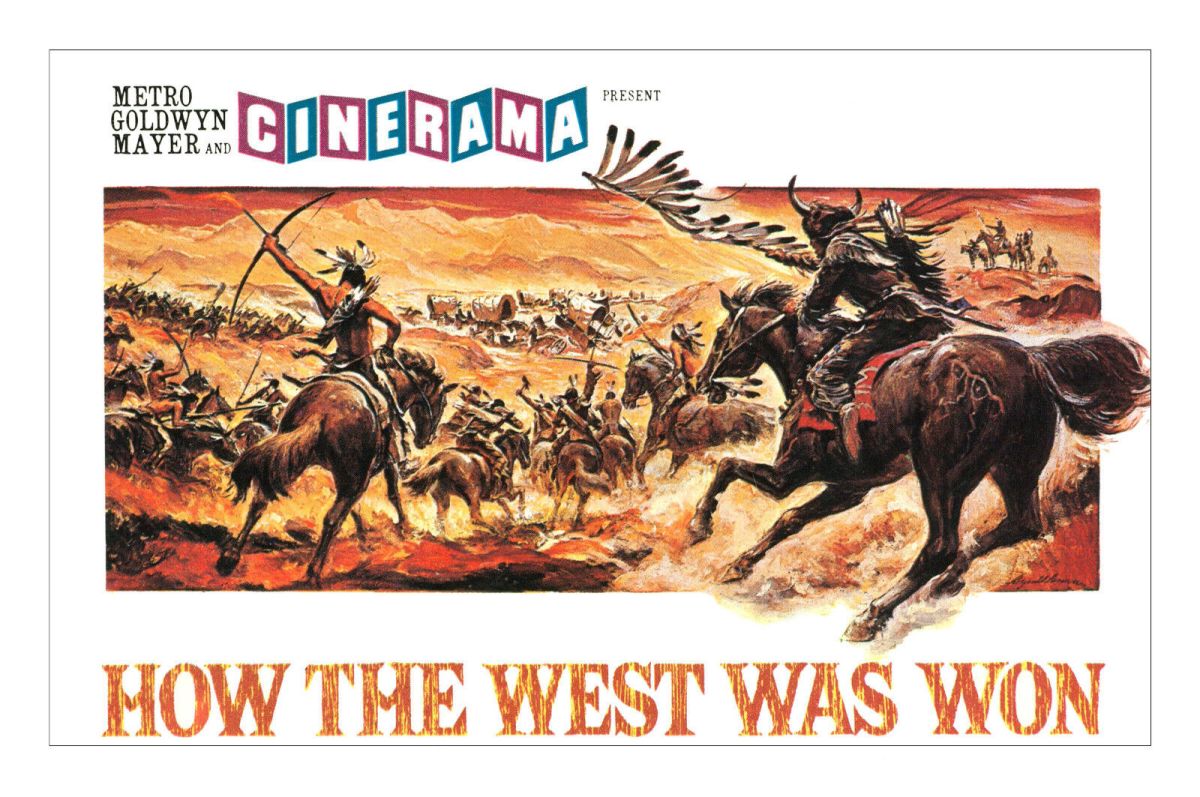
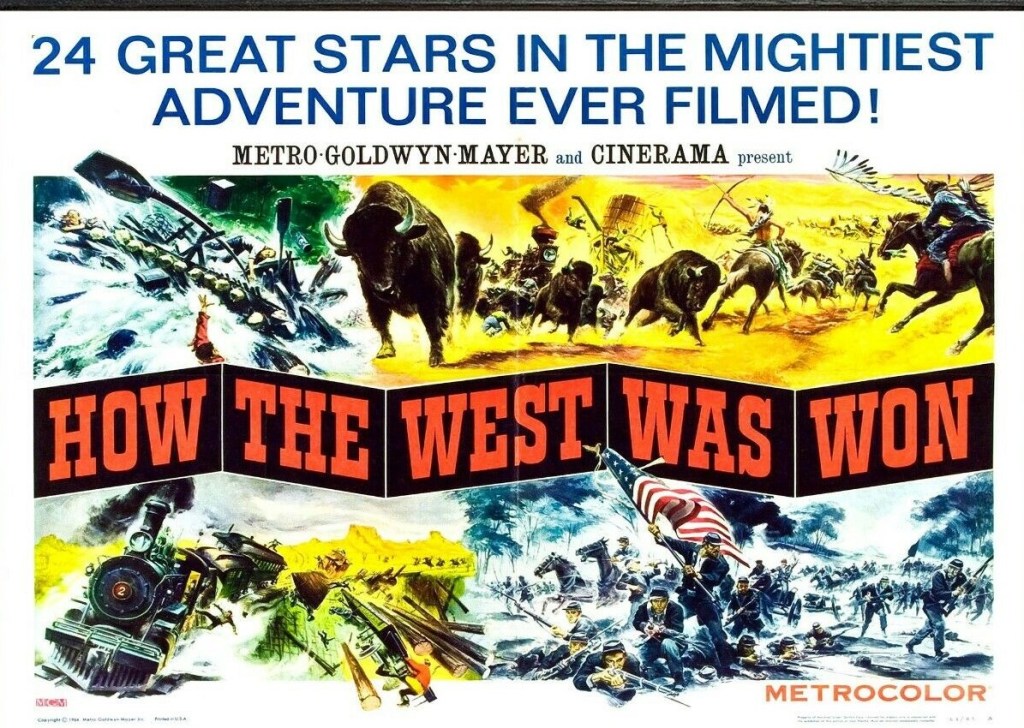
The picture, including narration, took over a year to make. Cinerama sensation was achieved by shooting the rapids, runaway locomotive, buffalo stampede, Indian attack, Civil War battle and cattle drive. Motion was central to Cinerama so journeys were undertaken by raft, wagon, pony express, railroad and boat, anything that could get up a head of steam.
Initially, too, the production team had been adamant – “rigid plans for running time will be met” – that the movie would clock in at 150-155 minutes (final running time was 165 minutes) and there was some doubt, at least initially, on the value of going down the roadshow route in the United States. Roadshow was definitely set for Europe, a 15-minute intermission being included in those prints, for a continent where both roadshow and westerns were more popular than in the States.
Big screen westerns in particular in Europe had not been affected by the advent of the small-screen variety. Some films received substantial boosts abroad. “The Magnificent Seven and Cimarron (both 1960) took giants steps forward once they made the transatlantic crossing.” British distributors also reported “striking” success with The Last Sunset (1961) and One-Eyed Jacks (1962) which had toiled to make a similar impression in the U.S.
In the end the decision was made to hold back the release in the U.S. in favor of another Cinerama project The Wonderful World of the Brothers Grimm, which had begun shooting later and ultimately cost $6 million, double its original budget. Rather than bunch up the release of both pictures, MGM opted to kick off its Cinerama U.S. launch with Grimm in 1962 and shifted How the West Was Won to the following year. MGM adopted the anticipation approach, holding the world premiere in London on November 1, 1962, and unleashing the picture in roadshow in Europe.
A record advance of $500,000 was banked for the London showing at the 1,155-seat Casino Cinerama (prices $1.20-$2.15) on roadshow separate performance release. Before the advertising campaign even began in October, a full month prior to the world premiere, over 62,000 reservations had been made via group bookings. Critics were enamored and audiences riveted. The cinema made “unusually large profits” and after two years had grossed $2.25 million from 1722 showings.
Dmitri Tiomkin (The Alamo, 1960) was hired to compose the music, but an eye condition prevented his participation though he later sued for $2.63 million after claiming he was fired before the assignment began. Alfred Newman (Nevada Smith, 1966) wrote the thundering score but uniquely for the time MGM shared the publishing rights with Bing Crosby. In the U.S. Bantam printed half a million copies of a paperback tie-in, sales of the soundtrack were huge and there was a massive rush to become involved by retailers and museums with educational establishments an easy target.
Audience response was overwhelming, a million customers in the first month, two million by the first 10 weeks at just 36 houses, some of which had only been showing it for half that time. But it failed to hit ambitious targets – predictions that it would regularly run for three years in some situations “based on the star roster and the fact the pic offers more natural U.S. vistas than anything yet done on the screen” proving wildly over-optimistic. Still, it had enjoyed 80 roadshow engagements including eight months at the Cinerama in New York and grossed $2.3 million in 92 weeks in L.A, $1.14 million after 88 weeks in Minneapolis and $1.5 million after one week fewer in Denver.
By 1965, as it began a general release 35mm roll-out with 3,000 bookings already taken, it had already passed the $9 million mark in rentals including a limited number of showcase breaks the previous year.
Nominated for a Best Picture Oscar, it won for screenplay, sound and editing. The movie became MGM’s biggest hit after Gone with the Wind and Ben-Hur. In my recent book The Magnificent ‘60s, The 100 Most Popular Films of a Revolutionary Decade I placed it twelfth on the chart of the decade’s top box office films.
It provided a popularity fillip for most of the big stars involved, none more so than James Stewart who, prior to shooting, had been on the verge of retirement. Box office appeal diminishing, work on his next picture Take Her, She’s Mine postponed by the Actor’s Strike, after the death of his father he had “quietly begun to make plans to get out of his Fox contract, retire, and move his family out of Beverly Hills.” He had spent $500,000 on a 1,100-acre ranch and was already well set to quit acting having accumulated a large real estate portfolio in addition to oil well investments.
NOTE: Robert J. Landry (“Magazines a Prime Screen Source,” Variety, May 30, 1962, 11) pointed to Cosmopolitan as the original publication vehicle for To Catch a Thief (1955) by David Dodge in 1951 and Fannie Hurst’s Back Street (1932), serialized over six months from September 1930. Frank Rooney’s The Cyclist’s Raid – later filmed as The Wild One (1953) – first appeared in Harpers magazine. Movies as varied as Edna Ferber’s Ice Palace (1960) and The Executioners by John D. MacDonald, later filmed as Cape Fear (1962), were initially published in Ladies Home Journal. The Saturday Evening Post published Alan Le May’s The Avenging Texan, renamed The Searchers (1956), and Donald Hamilton’s Ambush at Blanco Canyon, renamed The Big Country (1958) as well as Christopher Landon’s Escape in the Desert which was picturized under the more imaginative Ice Cold in Alex (1958).
SOURCES: Brian Hannan, The Magnificent ‘60s, The 100 Most Popular Films of a Revolutionary Decade (McFarland, 2022) p168-170; Marc Eliot, James Stewart A Biography (Aurum Press, paperback, 2007) p350-351; Rui Nogueira, “Henry Hathaway Interview,” Focus on Film, No 7, 1971, p19; Sir Christopher Frayling, How the West Was Won, Cinema Retro, Vol 8, Issue 22, p25-29; Greg Kimble, “How the West Was Won – in Cinerama,” in70mm.com, October 1983; “Reisini Envisions Cinerama Leaving Travelog for Fiction Pix,” Variety, December 14, 1960, p17; “Metro in 4-Film Deal with Cinerama,” Variety, March 1, 1961, p22; “Cinerama Action Awaits Plot Tales,” Variety, March 8, 1961, p10; “Fat Bankroll for How West Was Won,” Variety, May 24, 1961, p3; “Return to Original Scripts,” Variety, June 28, 1961, p5;“MGM-Cinerama Set 3-Hour Limit For West Was Won,” Variety, August 23, 1961, p7; “Hoss Operas in O’Seas Gallop,” Variety, August 23, 1961, p7; “Coin Potential As To Cinerama,” Variety, September 20, 1961, p15; “Changing Economics on Cinerama,” Variety, October 11, 1961, p13; “Bantam’s 22 Paperback Tie-Ups in Hollywood,” Variety, October 25, 1961, p22; “How West Was Won for July 4 Premiere,” Box Office, December 11, 1961, p14; “Crosby Enterprises Holds West Cinerama Songs,” Variety, January 24, 1962, p1; “Grimm First in U.S. for Cinerama but Abroad West Gets Priority,” Variety, April 4, 1962, p13; “Cinerama Fiscalities,” Variety, April 11, 1962, p3; “Cinerama Story Pair Burst Budgets,” Variety, May 16, 1962, p3; “Tiomkin’s $2,630,000 Suit Vs MGM et al,” Variety, June 27, 1962, p39; “Hathaway a Pioneer,” Variety, July 25, 1962, p12; “Bernard Smith Clarifies Fiscal Facts,” Variety, August 8, 1962, p3; Review, Variety, November 7, 1962, p6; “London Critics Rave Over West,” Variety, November 7, 1962, p19; “Brilliant World Premiere in London for West,” Box Office, November 12, 1962, p12; “West in Cinerama the Big Ace,” Variety, November 14, 1962, p16; Feature Reviews, Box Office, November 26, 1962; Bosley Crowther, “Western Cliches; How West Was Won Opens in New York,” New York Times, March 28, 1963; “Big Book Aid for West,” Box Office, April 1, 1963, pA3; “West Was Won Seen By 2,000,000 in 10 Weeks,” Box Office, June 3, 1963, p15; “How West Was Won for 19 Showcase Theaters,” Box Office, June 15, 1964, pE1; “West End,” Variety, November 11, 1964, p27; “How West Was Won Ends Roadshowing,” December 9, 1964, p16; “3,000 Bookings Expected for How the West Was Won,” Box Office, May 3, 1965.