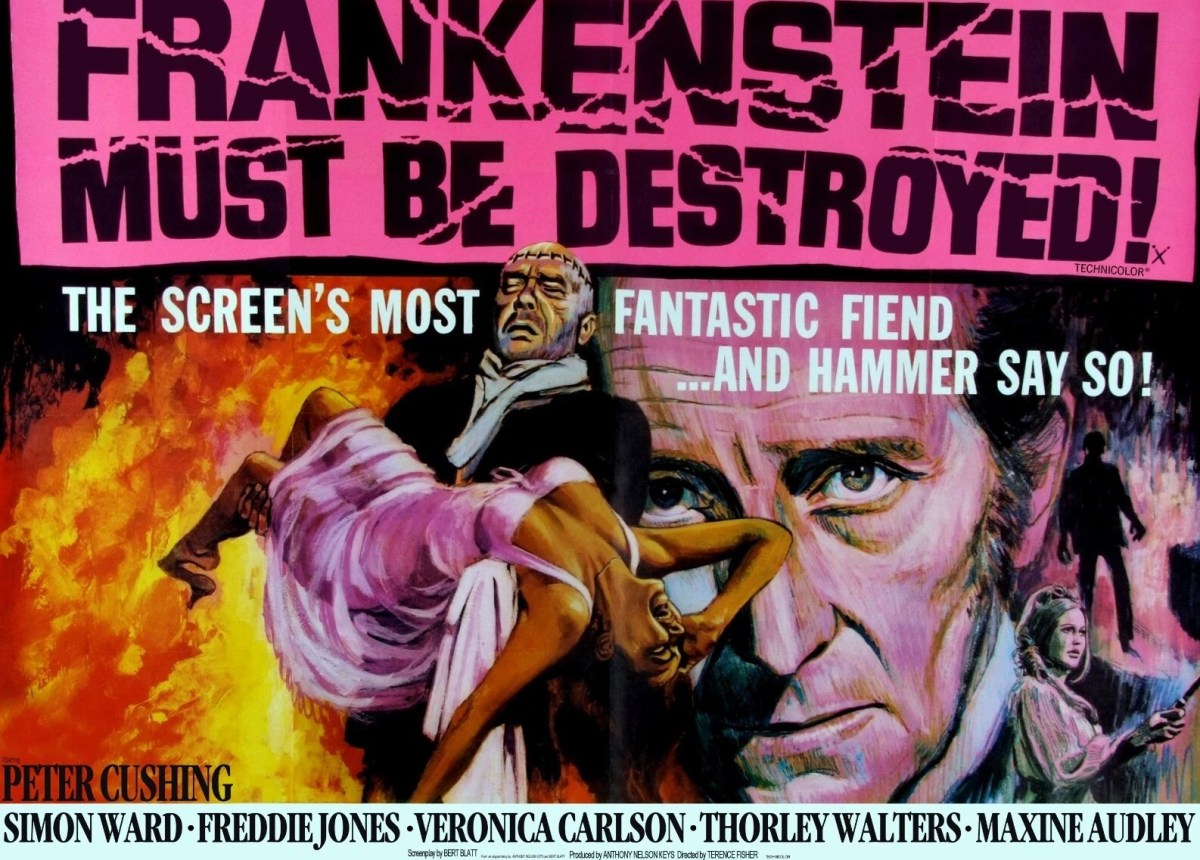
Hugely enjoyable, mainly because it throws away the standard template for this kind of horror picture. Long before Hollywood got into the habit or remaking or reimagining hit films, Hammer was constantly finding a reason to revive a character who in his previous iteration had met a sticky end. Even though Baron Frankenstein was not one of those villains who always managed to escape at the end of every episode, audiences had no trouble accepting him in whatever guise, era or location he turned up in.
But this is a considerable reinvention of the accepted characterization. Usually, Frankenstein is represented as somewhat academic arrogant scientist, not suffering fools gladly, but rarely has he been given such a wealth of finely tuned insults to offer. Nor has he ever exhibited what you might term passion. You’d never wonder, for example, who he fancied. But that’s all changed here. When he takes a woman here, it’s an extension of his power as much as his passion, and although the sex takes the form of rape, it does reveal him (if that’s not too awful to contemplate) as more human than before.
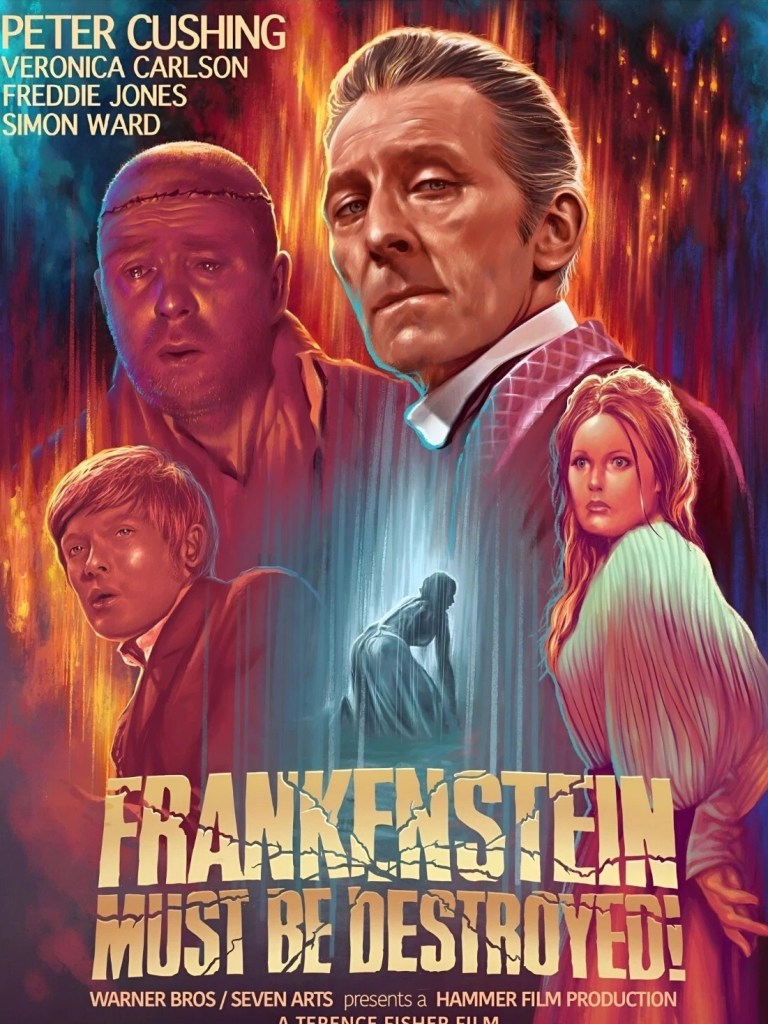
And the young couple in love, dragged into his web, are far from the usual innocents. On top of that, there are scenes of tremendous pathos when a wife cannot accept the husband brought back from the dead. And there’s quite a brilliant, if ironic, climax that you would not see coming.
In addition, at times the direction by Terence Fisher exhibits tremendous confidence, not just following a structure that brings out far more emotion than is generally accorded the genre, but surprises with flashes of humor and the kind of editing that would generate acclaim had it been in anything other than this.
This time round Baron Frankenstein (Peter Cushing) is in London, haunting the streets with a scythe to lop off the heads of passing pedestrians on dark nights. While he’s employed in this endeavor a burglar discovers the secrets of the baron’s cellar and inadvertently destroys the monster undergoing creation. Frankenstein hides out in a boarding house run by Anna (Veronica Carlson), whose fiancé Dr Holst (Simon Ward) is stealing drugs from the mental asylum where he works, thus making him easy prey for blackmail. The baron wants to kidnap asylum inmate and former colleague Dr Brandt (George Pravda) to find the secret formula for their previous work together.
With Holst soon knee-deep in murder, Anna an accessory to the drug theft, the “innocent” pair are dragged further into the baron’s web. When Holst pleads with Frankenstein, “Let her go, you don’t need here,” the baron replies in deliciously supercilious tones, “I need her to make coffee.”
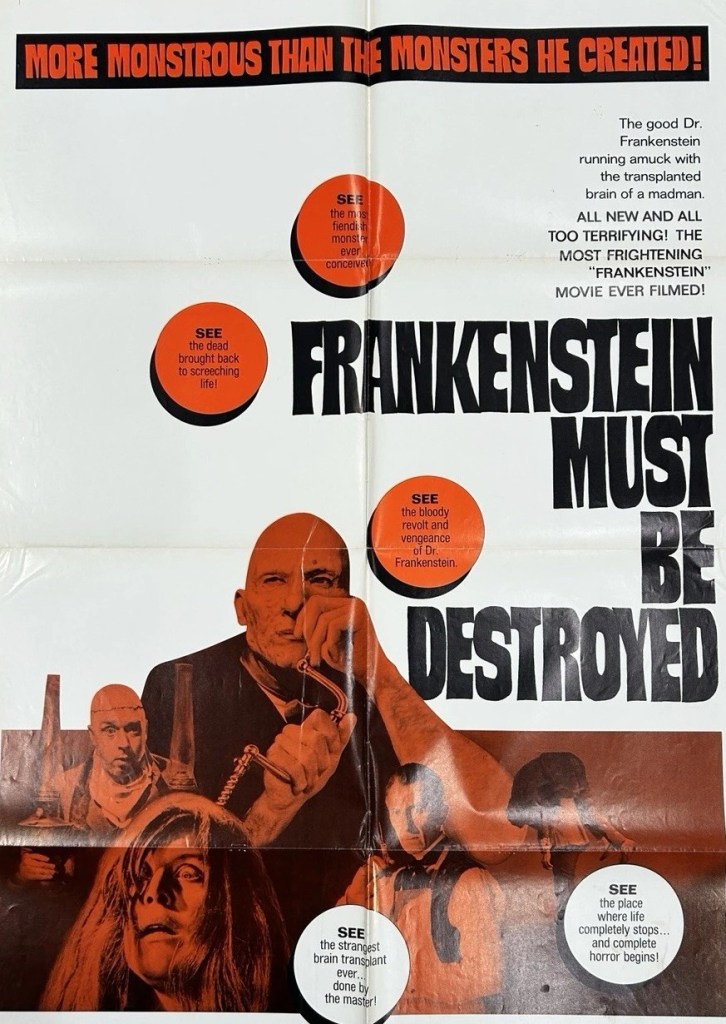
During the escape from the asylum, Brandt has a heart attack so Frankenstein arranges to transplant his brain into the body of Professor Richter (Freddie Jones). Brandt’s wife Ella (Maxine Audley), initially delighted to find her husband not just alive but cured of insanity, nonetheless is later repulsed by this “creature”, even though in appearance he is not awful, just not the husband she knew.
The plot quickly turns. Frankenstein rapes Anna. In turn, she wounds the creature. And the baron murders Anna, meanwhile realizing that Holst cannot be trusted. The creature, turned away by Ella, and now determined to gain revenge, sets a fiery trap for Frankenstein and in a superb ending hauls the baron into a burning house.
As I said, the structure takes a considerable detour from the standard Frankenstein picture, in particular taking time out from the main plot of the “innocents” escaping and/or thwarting the baron in order to focus on the relationship between Ella and the creature. Her rejection of him, his disgust with his new appearance, and the emotional loss of his wife moves into territory you wouldn’t normally associate with the genre, much closer to the more contemporary reading of the original tale.
Every now and then we dip into a subplot of a police investigation aided by the thief and Ella as witnesses. At first the pompous Inspector Frisch (Thorley Walters) seems little more than a comedic diversion, but actually he’s more switched-on than you’d expect and his detective work adds more tension.
Making Frankenstein more human – even if it’s just him giving into evil impulse – works to the movie’s advantage, as it allows him to pepper his lines with rapier wit. Peter Cushing (The Skull, 1965) has never been better but Freddie Jones (Otley, 1969) as the victim steals the show with a performance of tremendous pathos.
Simon Ward should count himself lucky that Richard Attenborough overlooked his performance and saw something in him that made him the ideal candidate to play Young Winston (1972). Veronica Carlson (Hammerhead, 1968) became the latest Hammer Scream Queen.
Occasionally inspired direction from Terence Fisher (The Devil Rides Out, 1968) in allowing the characters to develop and relationships to foster. Screenplay by Bert Batt, in his debut, and producer Anthony Nelson Keys (Pirates of Blood River, 1962) and based, somehow, on the original by Mary Frankenstein.
Surprised how much I appreciated it.
 The Magnificent 60s