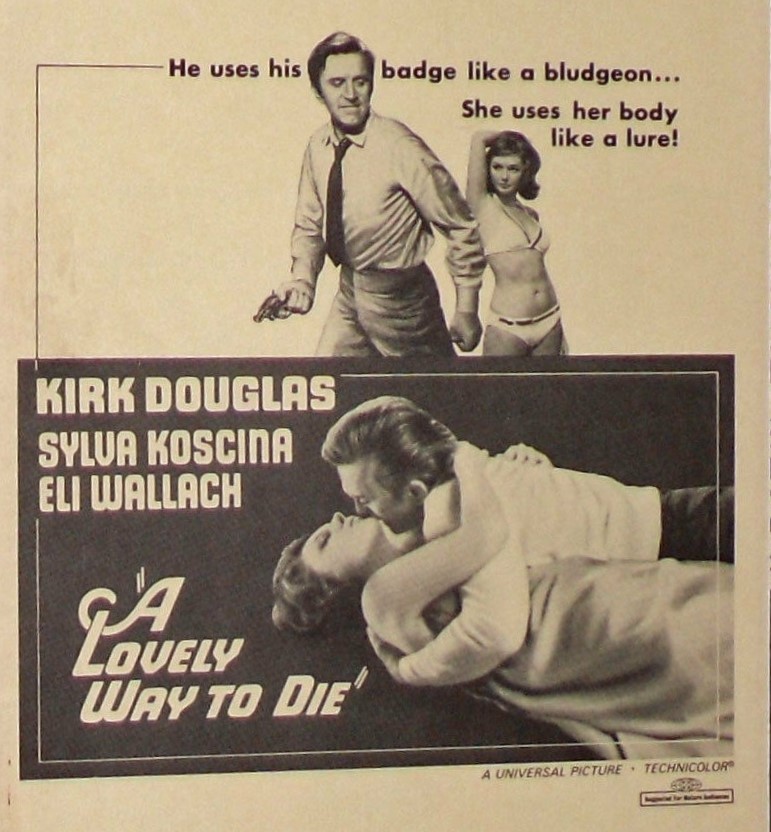
A Lovely Way To Die/A Lovely Way To Go (1968) ****

Woefully neglected detective thriller with a sparkling script and sexy leading stars exuding screen charisma. Like the celebrated William Goldman-scripted opening to Paul Newman private eye picture Harper (1966), the credit sequence here is at least as innovative in that it appears to be little short of a trailer, a highlights reel showing the audience what lies in store.

Kirk Douglas is a womanizing cop too handy with his fists, half his arrests making an unexpected detour to hospital. Sylva Koscina is the bored young wife of an older millionaire whose idea of fun is to chuck an expensive scarf out of a speeding car forcing her husband to pull up and go back and fetch. When her husband is shot, suspicion falls on Koscina – inclined  to dress in revealing outfits for the media – and her playboy boyfriend.
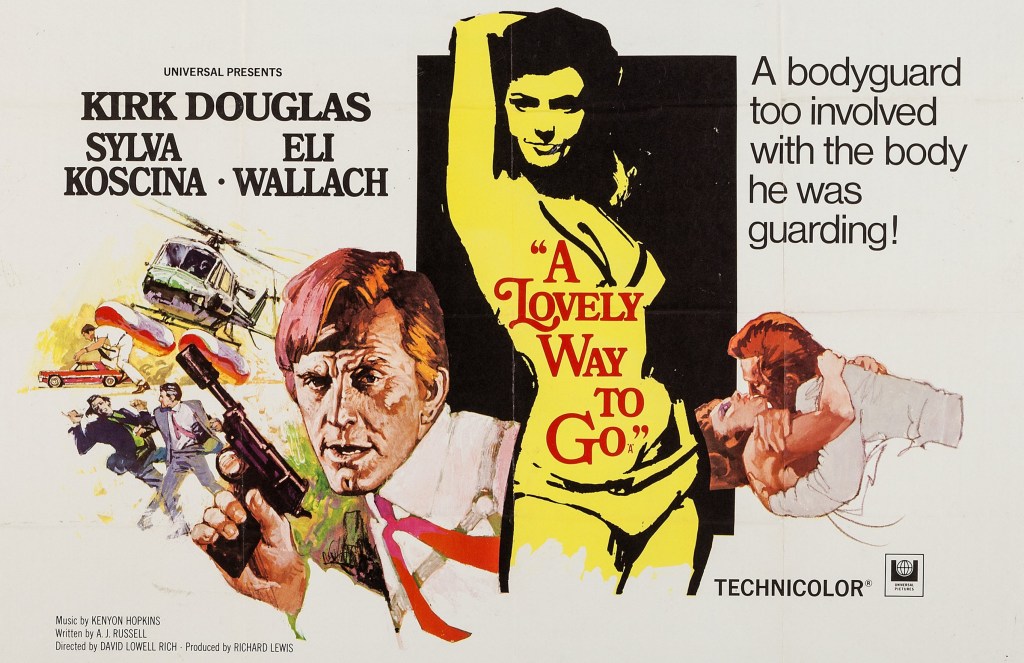
At the behest of attorney Eli Wallach with a rich Southern accent and a knack for speaking in parables, Douglas, having resigned from the force one step ahead of being fired, is sent in to provide security and find out whether her alibi stacks up. He soon finds out it doesn’t but by this time he has fallen under her spell. Witnesses disappear, intruders are dealt with, attempts are made on the detective’s life, and the twists come thick and fast. Koscina is the arch femme fatale who is a past master in the twisting department – twisting every male within a 50-mile radius round her little finger.

Harper was a throwback to The Maltese Falcon/The Big Sleep but A Lovely Way To Die knocks that shamus tradition on the head. For a start, Douglas is a high-living high-rolling  character who doesn’t take prisoners. The second time we meet him he has dumped the girl he took to the races for someone he has met while picking up his winnings.  Seducing gorgeous women and dumping them is second nature. This is Douglas as glorious charmer, a part of his screen persona lost after a glut of more serious pictures like Seven Days in May (1964) and Cast a Giant Shadow (1966). Yugoslavian actress Koscina, often little more than eye candy for most of the decade, had vaulted into the higher echelons after a turn as Paul Newman’s squeeze in The Secret War of Harry Frigg (1968).

Typical of the cheesecake type of photo used in movie fan magzines in the 1960s – this one of star Koscina appeared in the Yugoslavian magazine “Filmski Svet.”

An inherent part of the attraction of this picture is how deftly she keeps Douglas at bay. Scriptwriter A. J. Russell and director David Lowell Rich (Madame X, 1966) deliver the goods in maintaining the tension in their relationship. There is a wonderful scene where the expectant Douglas follows her up the stairs of her fabulous mansion and three times he ignores the import of her unmistakable “Goodnight,” his uber-confidence taking him to her door – which she shuts in his face.  
Sure, in some ways it is slick, but it is also taut and realistic, Douglas does not win all his fights and he eats with the rest of the help at the mansion. And he does some terrific detection so it doesn’t fall short in that department. He is definitely helped by some choice lines – “police methods are sometimes difficult for an amateur to understand” he tells Koscina after brutally despatching an intruder. Koscina is in her element as the sexy, wealthy suspect, and especially in her banter with Douglas, in which her main aim to disarm his cockiness.

Eli Wallach is also superb, given just enough ham to hang himself, but matching Douglas in arrogance and outgunning the D.A. with his courtroom gymnastics. A couple of the subsidiary characters are well-drawn, a housekeeper who plays the markets for example.   

For some reason this sank like a stone on its initial outing, audiences perhaps being more attuned to the Bogartian sleuth, but I found it highly enjoyable and this could be seen as a  taster for anyone familiar with the antics of the star’s son Michael Douglas who found himself in similar territory in Basic Instinct (1992).

Many of the films from the 1960s are to be found free of charge on TCM and Sony Movies and the British Talking Pictures as well as mainstream television channels. But if this film is not available through these routes, then here is the link to the DVD and/or streaming service   
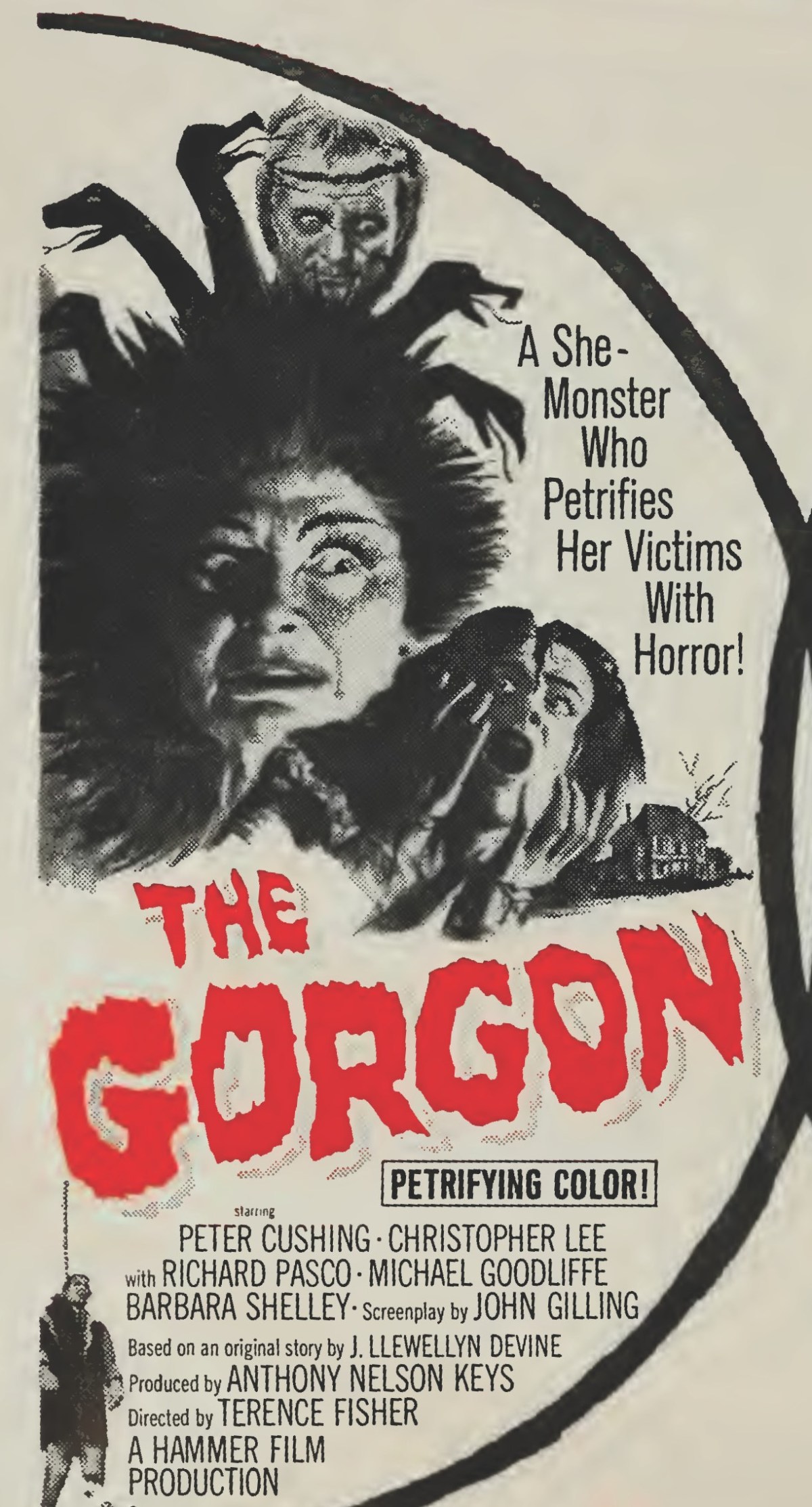
The Gorgon (1964) ****

This impressive Hammer conspiracy-of-silence slow-burner, more thriller than horror, features the triumvirate of Christopher Lee (The Devil Ship Pirates, 1964), Peter Cushing (The Sword of Sherwood Forest, 1960) and Barbara Steele (Black Sunday, 1960) in untypical roles. Lee and Cushing, of course, had locked horns before, namely in Hammer’s reimagining of the classic Dracula, with the former the charismatic fiend and the latter his nemesis.

Here Cushing is a  doctor in a an unnamed European turn-of-the-twentieth-century police state who knows more than he is letting on about seven inexplicable deaths in five years and the possibility of a 2,000-year-old myth coming to life and taking on a human form. And with quite a human side, jealous when his assistant Steele falls for a younger man. Lee is a professor coming late in the day to investigate. Steele, a gentle beauty, initially introduced as merely the love interest, becomes central to the story but without sucking up all the available horror oxygen by over-acting.   

Director Terence Fisher, who had shepherded the studio’s Dracula, Frankenstein, The Mummy and Dr Jekyll franchises through the starting gate, builds up the atmosphere with full moons, haunting voices, fog, sudden sounds, drifting leaves and an abandoned castle forever in shadow. The camera is often a weapon of stealth. Shock is kept to a minimum, fleeting ghostly apparitions and a finger falling off a corpse. Given the limitations of special effects in this era, that was a smart move. Far better to concentrate on fear of impending doom, a man knowing he is turning to stone, a woman living in terror of being taken over by the phantom. The title gives away the story somewhat – even if you didn’t know the Gorgon was a mythical monster with a headful of snakes and the ability to turn people to stone, that is soon explained. 

Death remains the trigger for action, the suicide of an artist after he has apparently murdered his pregnant girlfriend bringing his father onto the scene and then his brother accompanied by Lee. But all investigation hits a wall of silence after police chief (Patrick Troughton) refuses to instigate detection. At the heart of all the relationships is betrayal. The artist leading his girlfriend on, Cushing willing to endanger Steele, whom he professes to love, rather than revealing the truth. Even Steele spies on the brother, with whom she is falling in love, in order to gather information for Cushing. 

Forgive the pun, but Steele steals the picture. An amnesiac, a victim and finally the lure, she remains enigmatic, a whisper of a woman. It is a haunting portrayal far removed from Hammer’s traditional cleavage queens. This is a very human character who nonetheless must stand guard over herself. Cushing embroiders his character with little touches, smoking a cigarette in a holder, for example, but Steele’s character, her distrust of herself, shows in every move she makes.

Many of the films from the 1960s are to be found free of charge on TCM and Sony Movies and the British Talking Pictures as well as mainstream television channels. But if this film is not available through these routes, then here is the link to the DVD and/or streaming service.

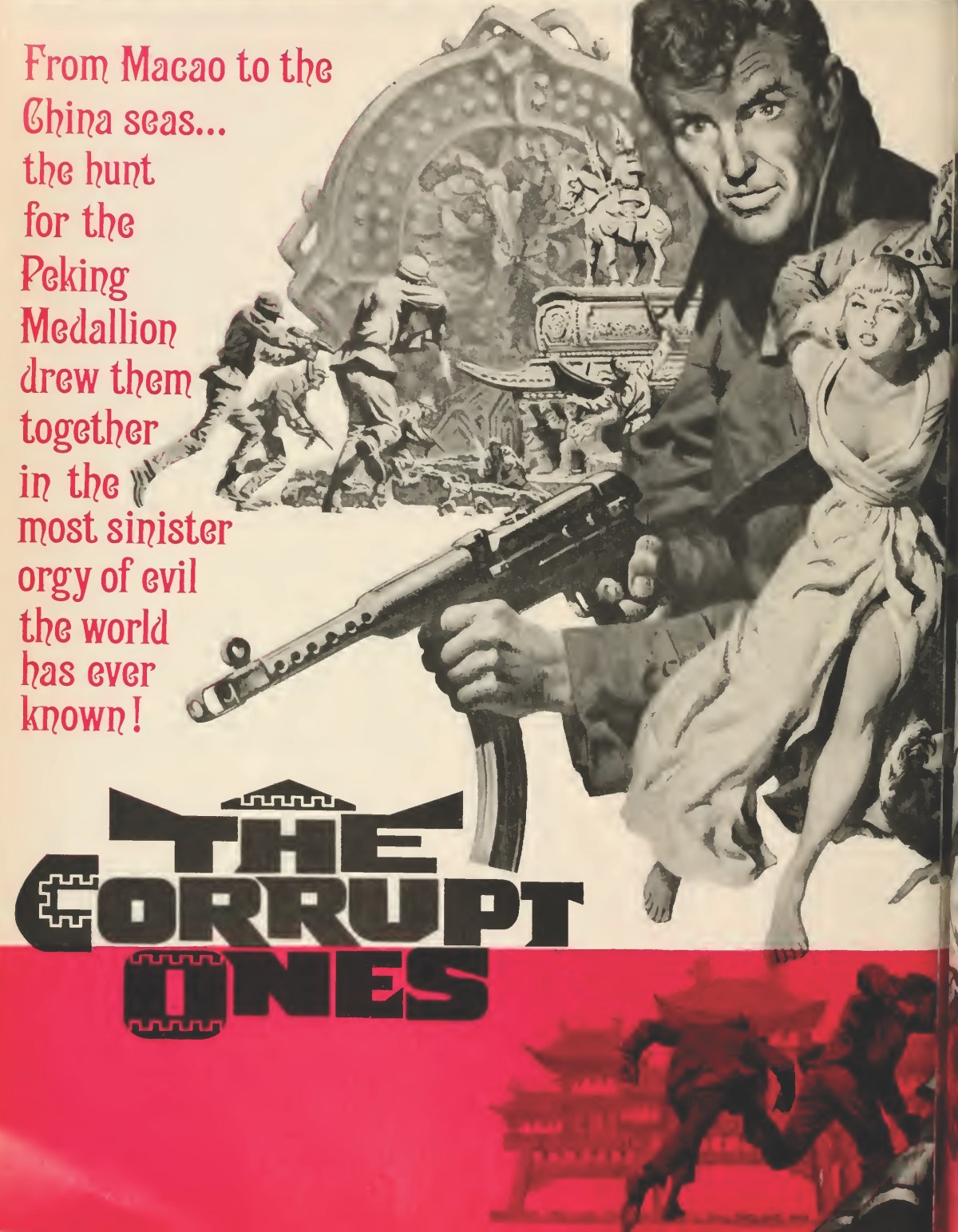
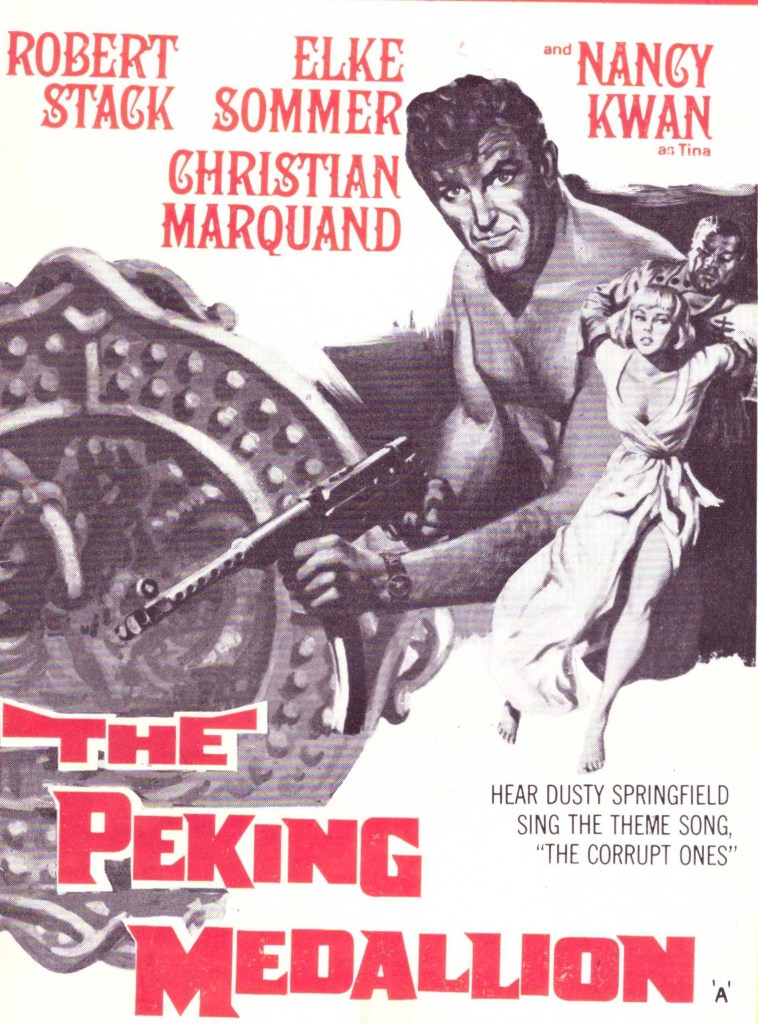
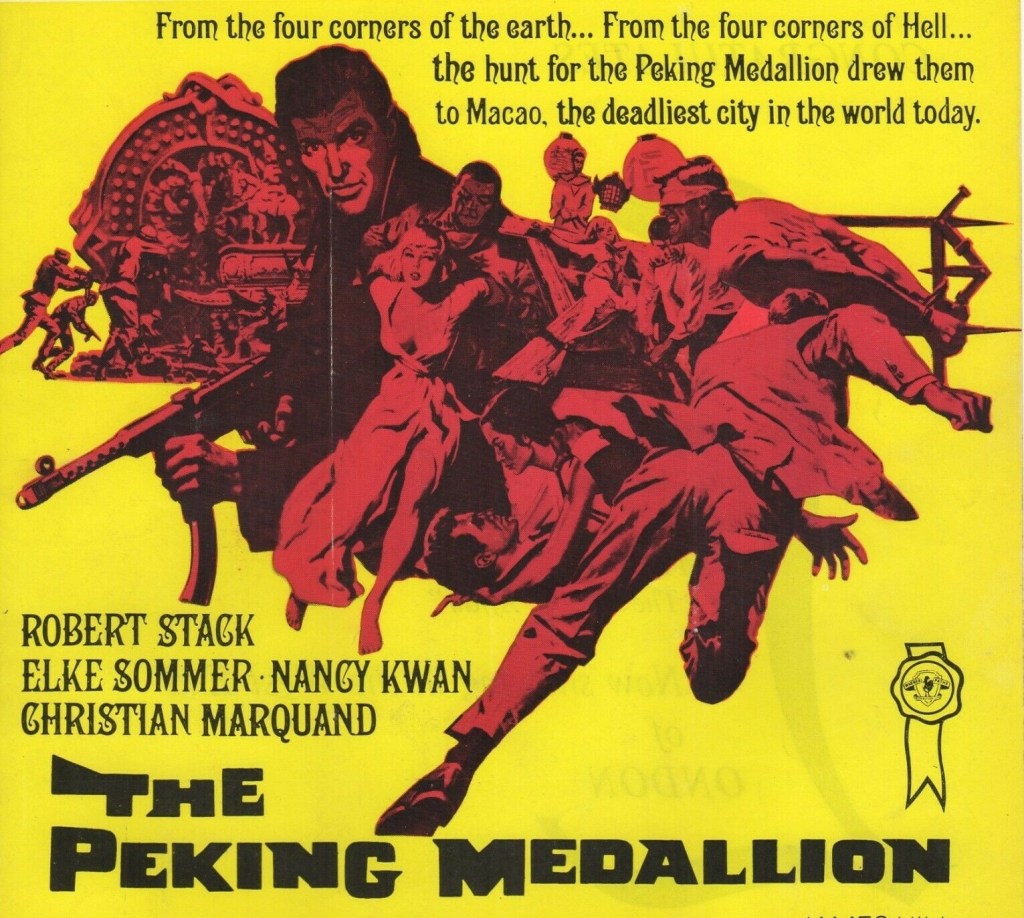
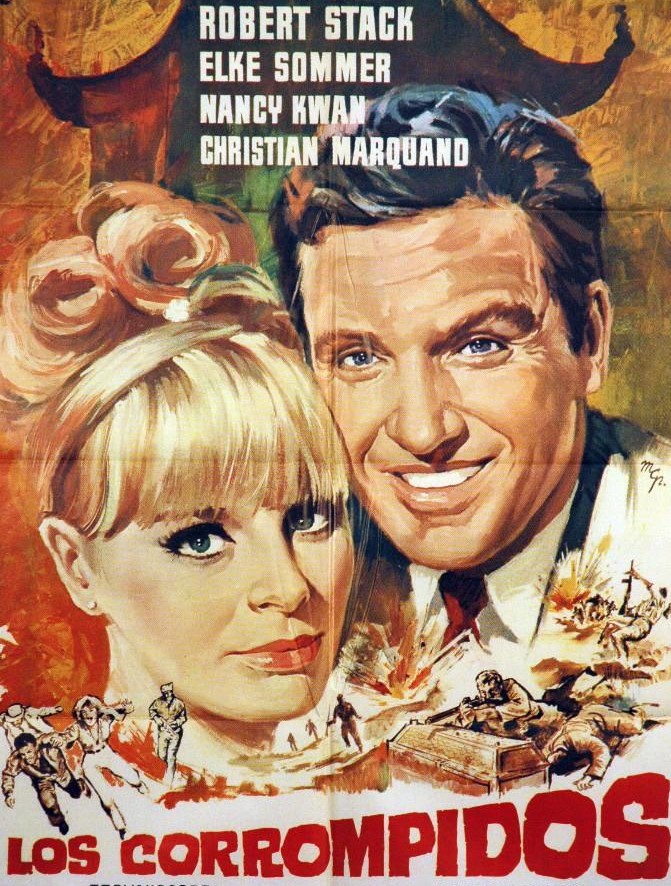
The Corrupt Ones / The Peking Medallion (1967) ****

Non-stop action as spy Robert Stack (The Untouchables tv series) battles a variety of crooks in Macao on the Chinese border as they seek the legendary Peking medallion. Stack hails from the James Bond school of espionage, duty bound to kiss every girl he meets. He might wonder at their compliance until he realizes they are only after his knowledge of the missing medallion.

The violence is criminally brutal – punch-ups, gunfights, samurai swordfights, murder, torture by blowtorch and acid and being dragged behind a motorboat. The string of sexy women is matched by handsome men (Christian Marquand and Maurizio Arena in addition to Stack). The thriller pitches helter-skelter through nightclubs, casinos, caves, temples and palatial mansions, the pace only slowing down for, naturally, a scene in a stately rickshaw.

As well as Stack who briefly – and unknowingly – has the medallion in his possession, others in the hunt include Elke Sommer, wife of the man (Arena) who passed it to Stack before being killed. Sommer is on the wrong side of the femme fatale equation. Once Stack is wise to her seductive charms he quips, “Maybe you’re telling the truth but I can’t trust you.”

The original title of the picture was “Hell in Macao” and that was used in Germany for example. It was called “The Peking Medallion” in the UK, Italy and Mexico and “The Corrupt Ones” in the US, France and Spain.

Also in hot pursuit are gangster Brandon (Marquand) and a Chinese mob headed by Nancy Kwan (The World of Suzie Wong, 1960). That’s on top of a corrupt cop (“I have never feared death only poverty” is his mantra) who doesn’t care who wins the prize as long as he gets his share. Double cross is the order of the day, alliances forged then broken. The action never stops long enough for one of those tension-building scenes of which Alfred Hitchcock or imitators like Stanley Donen (Charade, 1963, and Arabesque, 1966) were so fond.

Stack faces danger with a quip, a kiss or gritted teeth, an old-fashioned tough guy without the James Bond self-awareness. He carries out his manly duties until his brain kicks in and he realizes this isn’t a spy picture after all but a genuine treasure hunt with clues that have to be deciphered. As this causes the movie to sidetrack down another route, it looks like the picture has lost the plot. But then all hell breaks loose and we are back on the safe ground of fistfights, double-crossing and shooting.

The script by Brian Clemens deftly mixes a variety of genres. What might have been a definite change of pace for British director James Hill given his previous effort was Born Free (1966) was anything but since he was responsible for the most recent Sherlock Holmes thriller A Study in Terror (1965).

Fans of improbable storylines, exotic settings, action, interesting bad guys and twists and turns will love this. How can you fail to love a movie with a fight featuring a samurai sword versus a camera tripod?

Many of the films from the 1960s are to be found free of charge on TCM and Sony Movies and the British Talking Pictures as well as mainstream television channels. But if this film is not available through these routes, then here is the link to the DVD and/or streaming service.

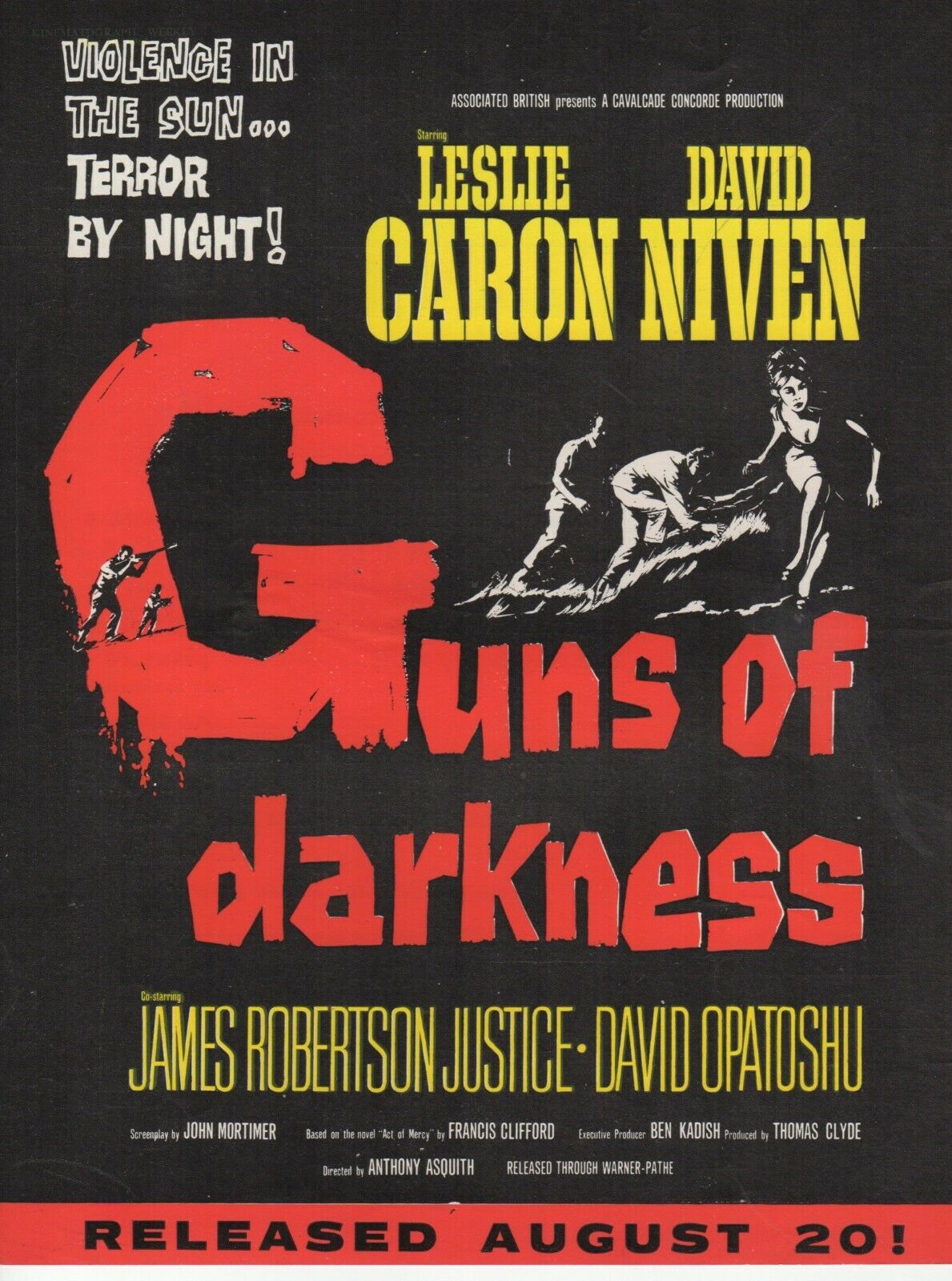
Guns of Darkness (1962) ***

You might think David Lean in Lawrence of Arabia (1962) had cornered the market in startling transitions involving light (from Peter O’Toole’s match to the rising sun) and gut-wrenching scenes involving quicksand but nearly six months prior Anthony Asquith (The Millionairess, 1960) in the less-heralded Guns of Darkness had adopted similar techniques. He cuts from a nightclub singer blowing out a candle to a man lighting a candle in a church and since his film is in black-and-white it cannot hope to match Lean’s fabulous color transition. However, the quicksand scene in the Asquith, I would argue, lacking color or not, is far superior to that of the desert epic.

Thanks to Pygmalion (1938) and The Winslow Boy (1948) Asquith was one of a handful of British directors – Lean, Powell/Pressburger and Carol Reed the others – with an international reputation. Stars David Niven and Leslie Caron had topsy-turvy careers. Niven’s box office cachet had almost disappeared in the mid-1950s before an unexpected Oscar for Separate Tables (1958) and a starring role in The Guns of Navarone (1961). Although Caron had An American in Paris (1951), Lili (1953) and Gigi (1958) on her dance-card she was not an automatic big-name star. It reflects their respective positions that Caron has star billing.

Niven and Caron are an unhappily married couple caught up in a revolution in a fictional South American country. His boyish charm has long worn thin, his employment record is spotty and he is inclined, when drunk, to insult bumptious boss (James Robertson Justice). On New Year’s Eve while an enclave of pampered Brits is counting down to the bells, rebels  are preparing to storm the presidential palace and seize power. Niven seems the last person to give shelter to a fugitive from the revolution, especially when the runaway turns out to be the ex-president Rivero (David Opatoshu, Exodus, 1960). Caron, who has been planning to leave Niven the next day, finds herself involved in the escape.

The couple are both quickly disabused of notions of the saintliness of presidents and peasants, Rivera nearly strangling a child who discovers his hiding place, Caron stoned by villagers, pacifist Niven forced into a horrific act of violence.  

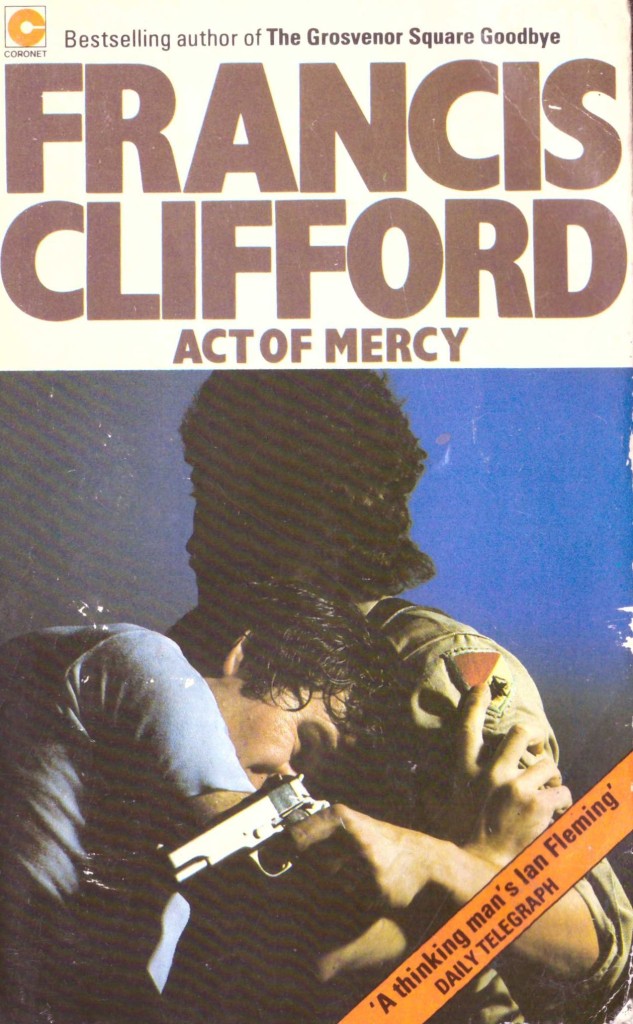
If you ever wondered what screenwriters do to earn their money, this film is a good place to start. It was based on a book “Act of Mercy” by British thriller writer Francis Clifford, who also wrote “The Naked Runner,” also later filmed. The screenwriters changed the David Niven character from the happily married committed businessman of the book to the dissatisfied dilettante of the film. As a happy couple, there are none of the marital tensions in the film. The revolution in the book has already started but in the film it is moved to New Year’s Eve and about to begin. The quicksand scene is a screenwriter’s invention as is the incident with the boy and the massacre in the village.

The pace is brisk from the outset, Asquith cross-cutting between revolutionaries and the Brits and as the manhunt steps up a gear the three escapees face a succession of perilous incidents. Not least is a river that has turned to quicksand. This six-minute scene is a standout, the mud closing in on their heads, Niven having to crawl back to rescue Rivera. As you would expect with this kind of picture there is a fair bit of philosophizing, moralizing and sheer brutality. As the couple flounder towards reconciliation, the script spends some time trying to ascertain Niven’s motives. Had the film stuck to the source book’s title, Act of Mercy, that would not have been necessary.

A taut film with, once the revolution has begun, the British put in their place rather than acting as imperialist overlords. There are a couple of unexpected twists at the end and Asquith finished with a technical flourish of his own, the camera tracking back from people walking forward. Both Niven and Caron are excellent, James Robertson Justice at once cuddly and ruthless, and the picture comes out as a tidy character-driven thriller.

Many of the films from the 1960s are to be found free of charge on TCM and Sony Movies and the British Talking Pictures as well as mainstream television channels. But if this film is not available through these routes, then here is the link to the DVD and/or streaming service.

Morgan: A Suitable Case for Treatment / Morgan! (1966) ***

While Hollywood was capable of dealing with mental illness head-on in pictures like Frank Perry’s David and Lisa (1962), Sam Fuller’s Shock Corridor (1963) and Robert Rossen’s Lilith (1964), the British were more inclined to take an alternative approach. The titular characters of Billy Liar (1963) and this film dealt with awkward reality by creating a fantasy world.   

Morgan, played by David Warner in his first starring role, is a failed artist and virulent Communist who cannot come to terms with being divorced by rich Vanessa Redgrave who is planning to marry businessman Robert Stephens. Warner forces his way back into his wife’s house and attempts to win her back with nothing stronger than whimsicality and when that fails resorts to kidnap. And it is clear that she shares his fancy for furry animals, responding to his chest-pounding gorilla impression with tiny pats of her own chest. For a slim guy, Warner makes a believable stab at a gorilla, shoulders hunched up under his jacket, chest stuck out. And he has an animal’s sense of smell – detecting his rival’s hair oil.  

But Vanessa Redgrave, in her second film and her first starring role, steals the picture, winning her first Oscar nomination (in the same year as sister Lynn for Georgy Girl). She is made of gossamer. Still attracted to a man she knows will only bring her pain, she is far from your normal leading lady. There is a touch of the Audrey Hepburn in her ethereality but she portrays a completely genuine soul, not a manufactured screen personality.

The tone of the film is surreal. Had David Attenborough been a big name then you could have cited him as one of director Karel Reisz’s influences, such was his predilection for inserting wildlife into the proceedings, not just primates but giraffes, a hippo, a peacock and a variety of other creatures. Some are comments on Morgan’s state of mind but after a while it becomes monotonous. The film is clearly intentionally all over the place, the class struggle also taking central stage, but it’s hard work for the viewer.

Having said that, towards the end of the picture there is an extraordinary image – possibly stolen from the opening of La Dolce Vita – of Warner in a straitjacket hanging from a crane. Had that been the film’s starting point, it might have dealt more demonstrably with the subject matter.  The whimsy is all very well and Redgrave is delightful and while Warner is clearly on a mental descent the focus on external animals does little to illuminate his internal struggle. Also, having said that, Warner is imminently watchable. He has an intensity that is hard to ignore and usually is cast with that in mind but here his vulnerability, his inability to grasp that he is living in a different reality, is very touching. Even when his imagination is at its most vivid – such as when Redgrave appears at the end supposedly bearing his child – you are partly convinced that this may actually be true. I would have preferred less of the animal imagery and more of Warner’s true reaction to the world around him. It’s a case of performances spoiled by over-direction.

Setting aside the director’s indulgence, the film is remarkable in one other way. It was almost revolutionary to find a British picture that, despite Warner’s working-class agitation, is effectively about joie de vivre as opposed to the more traditional British stiff upper lip, that inbred stoicism afflicting the entire nation regardless of class status. While Lawrence of Arabia (1962) represented an exhibition of flamboyance, again not a British trait, and the truculent Albert Finney in Saturday Night and Sunday Morning (1960) was determined to enjoy life to excess, Warner’s character epitomizes a desire to be free of normal cares in order to live life to the full.

Given the Warner would later be more famous buttoned-down roles – and that, in contrast, Redgrave would later portray another famous flamboyant in Isadora (1968) – it is surprising that this fun aspect of Warner’s screen persona was not called upon more often.

Many of the films from the 1960s are to be found free of charge on TCM and Sony Movies and the British Talking Pictures as well as mainstream television channels. But if this film is not available through these routes, then here is the link to the DVD and/or streaming service.

The Pawnbroker (1964) *****

Director Sidney Lumet (Fail Safe, 1964) could have made an excellent film just about the customers of a pawn shop, the haunted individuals haggling for more bucks than they will ever be paid, the sad sacks, junkies, lost souls and general losers whose stories are told in the items they pawn or redeem – candlesticks, lamps, radios, musical instruments, occasionally themselves. You don’t need to be a pawnbroker to know that three hoodlums turning up with a pricey lawnmower are dealing in stolen property. And it comes as something of a surprise to learn that the pawnbroker is involved in some kind of money-laundering scam for a local gangster. Clearly shot on location on a bustling low-rent area, north of 116th St in East Harlem, New York, there’s enough going on in the streets – the markets, the tenements, poolrooms, the bustle, the eternal noise – to keep you hooked.

But you might think twice about positing as your hero an “absolute bastard” as Lumet himself described shop owner Sol Nazerman (Rod Steiger). He is more haunted than any of his clientele, a Holocaust survivor, plagued by flashbacks to the concentration camp where he witnessed his son die and his wife raped. He is devoid of life, completely shutdown to any emotion, rejecting overtures of friendship, and his life is played out in tiny elliptical shreds. He does not even derive any enjoyment out of his affair with a widow and although he claims to worship money – according to him the only “absolute” outside of the speed of light – that brings no fulfillment either. It is surprising he has lasted so long without imploding. After his war experience, you would have to wonder at a man who spends his life behind the bars of the grille in his shop and just in case he considers escaping from his predicament designer Richard Sylbert (Chinatown, 1973) incorporates other visual aspects of imprisonment into the production.

This startling image taken from the Pressbook encapsulates one of the striking moment of the film. As seen on the advert at the top of the blog, although not technically a roadshow in the normal sense (i.e. in the grandeur of 70mm) it played separate performances. This was a technique to drive up demand by limiting access. Originally, to take advantage of a British tax break known as the Eady Levy, the film was due to be made in London. Lumet pulled out when MGM insisted on a London shoot and only returned after that idea was abandoned and second-choice director Arthur Hiller bowed out.

Steiger gives a very restrained performance, especially for an actor known for his volubility and over-acting. He seems to sink into the role. He is accused of being among “the walking dead.” Around him are a set of very lively characters, his ambitious assistant (Jaime Sanchez, The Wild Bunch, 1969) trying to go straight and his girlfriend (Thelma Oliver), a very smooth and wealthy and gay gangster (Brock Peters), and a trio of small-time hoods with whom the assistant is friendly. But also the deranged and the lonely. A widowed social worker (Geraldine Fitzgerald) who suffers from the “malady of loneliness” offers him friendship but is rejected.

There is little plot to speak but it is just enough to teeter him on the brink of self-destruction. So it is primarily a character study. Unusually, Lumet observes without any sentimentality those around Steiger. “Sol has buried himself in this area,” Lumet wrote (“Keep them on the hook,” Films and Filming, October 1964, p17-20) “because he needs to be with people that he can despise….This is a man who is in such agony that he must feel nothing or he will go to pieces.” There is no redemption and he lacks the courage to commit suicide. It’s a stunning, bold picture, as raw as you can get without turning into a bloodsucker.

Fans of “The Godfather” might recognise this image – of a puppet on the strings -used to symbolise the power of the Mafia don. Eight years before Coppola’s gangster saga, this rarely seen but similar image in the Pressbook for “The Pawnbroker” evoked the opposite – a broken man.

The film had a few firsts. It was the only mainstream American picture to deal with the Holocaust from the perspective of a survivor (although films like Judgement at Nuremberg, 1961, has shown camp victims). It broke mainstream conventions on nudity, bare breasts being seen for the first time. Lumet experimented with incredibly short cuts – just one-frame and two-frames in places (a technique he had first used in television)- when the standard assumption was that audiences required three frames to register an image. Brock Peters played not just the first openly gay person in a mainstream picture, but the first gay African-American (although The Long Ships the same year had a bit of comedy about a eunuch chasing Vikings).

Quincy Jones made his debut as a movie composer. If you listen closely you might detect a piece of music later made famous by the Austin Powers pictures and if you look closely you might spot a debut sighting of Morgan Freeman. And if want another anomaly, try and work out why Rod Steiger lost out to that year in the Best Actor Oscar stakes to Lee Marvin in Cat Ballou (1965).

Many of the films from the 1960s are to be found free of charge on TCM and Sony Movies and the British Talking Pictures as well as mainstream television channels. But if this film is not available through these routes, then here is the link to the DVD and/or streaming service.

Pharaoh/Faraon (1966) ****

I had been familiar with Polish film Pharoah (1966) from a striking cover of British movie magazine Films and Filming and surprised at coming across the film while browsing YouTube I began watching without realizing there were no subtitles. I was so mesmerized by the visuals and the stunning camerawork that I could not stop watching.

There are as many versions of the Jerzy Kawalerowicz picture as director’s cuts of Blade Runner. The original clocked in at three hours. The version given limited showings in European countries was hacked down to under two hours. The DVD released in 2000 is limited to two hours, although the most recent DVD is 25 minutes longer. I suspect it was the latter that had ended up on YouTube since that version runs two hours and twenty-four minutes.  

Advert in Variety (May 4, 1966). Although little seen outside Poland it did well in Rome where it was a “smash” at the box office on the strength of a “sex-baiting campaign promising filmgoers a full dish of screen nudity approved exceptionally by the censors in the name of art” (“Shrew Paces Rome Box Office,” Variety, April 19, 1967, p64).

The story is relatively straightforward. The theme is power. Egypt is in decline when a fictional Rameses XIII (in reality only eleven bore that name) in ascending to power clashes with priests who seek to usurp his rule. That religion dominates Egypt is seen in the opening sequence where, rather than disturb two holy scarabs rolling a ball of clay, the priests take the army en route to battle out of their way. That leads to the destruction of a newly-built and much-needed canal, and the suicide of one of the loin-cloth-clad laborers working on the channel.

But that opening image and the director’s stunning use of the camera as well as the brilliance of the actors in depicting emotion through their eyes and facial expressions makes the film more than accessible despite the lack of sub-titles. This is a different Egypt to that conjured up by Hollywood and such desert-worshippers as David Lean. There is no beauty in a desert. Viewed as a waste, but one in which people have to live, through which foot soldiers have to trudge (rather than gloriously charge on camels), it is a lived-in reality, a great emptiness, devoid of mystery or splendor. The desert is a dead weight. Water is such a visual delight that in a brief scene on the river, the screen is at once bright and wonderful.

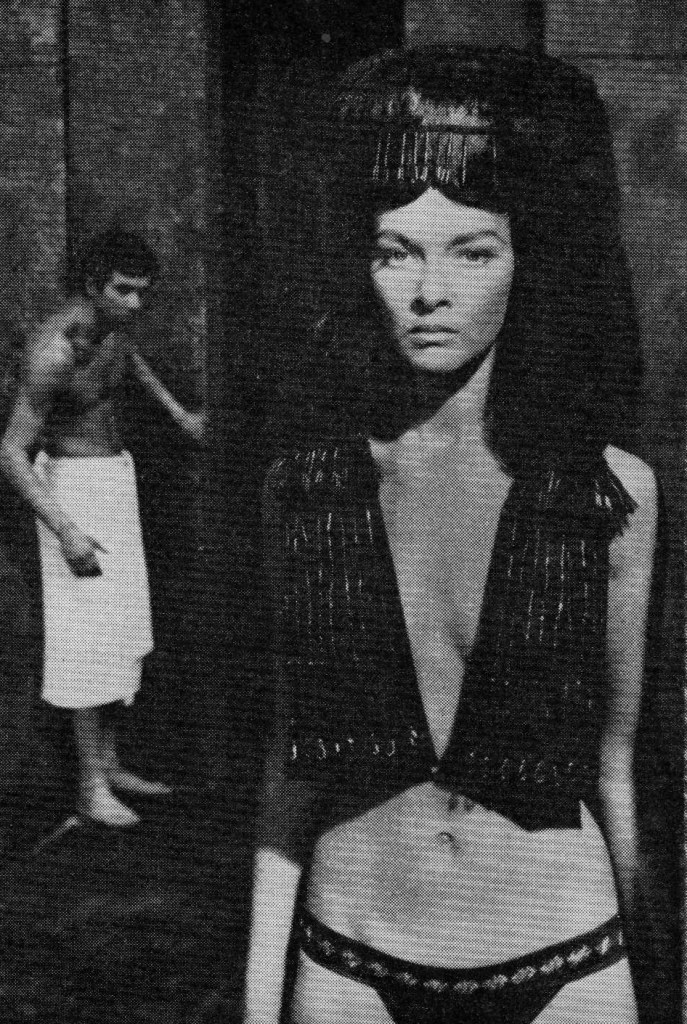
Barbara Brylska as the priestess-dancer who seduces Rameses. It is she who appears on the cover of “Films and Filming.”

Glory – temples, pyramids, jewellery – is man-made. But the whole enterprise is naturalistic. Men are bare chested, many clad only in loin cloths, priests are bald while the wealthy are attired in in heavy wigs.   What is not lacking is genuine historical detail. Hollywood had a habit of cherry-picking history for the items that would show up best on camera, but that is not the case here.  

What elevates the film is visual mastery and cinematic flair. Just opening an epic film with two dung beetles having a scrap on an arid plain and holding that image for the best part of a minute suggests a director of considerable talent. He follows this with over a minute of a reverse tracking shot following a soldier running who reveals a waiting army. There are a host of terrific visual scenes – a wild horse is impaled with spears as if in a Spanish bullring, the corpse of the suicidal laborer swings from a noose, cumbersome battles see soldiers surmount arduous dunes, golden doors open one after the other in the palace. 

Even in simple emotional scenes, Kawalerowicz knows where to place the camera and how to use it. The camera follows a woman as she enters a scene. She crouches down to the prostate Rameses. The camera remains on her as she retreats and he comes up to stop her and he remains out of shot as she moves away to the wall where, with her back to him, she begins to wail and then kneels down, hands raised in supplication. Another scene is shot in darkness except for Rameses in a white tunic and a seductress in a transparent dress.

The acting is uniformly good and even though the style is somewhat stilted Jerzy Zelnik as Rameses and the two women in his life, who bear the film’s emotional brunt, Krystyna Mikolajewska as his Jewish mistress and Barbara Brylska as a seductive priestess, are excellent.  Kawalerowicz was best known for Mother Joan of the Angels (1961). Pharaoh was the official Polish entry for the Cannes Film Festival and nominated for the Best Foreign Language Film Oscar, up against the far more commercially viable A Man and a Woman from Claude Lelouche (the winner), Gillo Pontecorvo’s The Battle of Algiers and Milos Forman’s Loves of a Blonde.

Treat the Youtube version as a sampler and if you are impressed you will find below a link to the DVD with Polish voices dubbed into English.

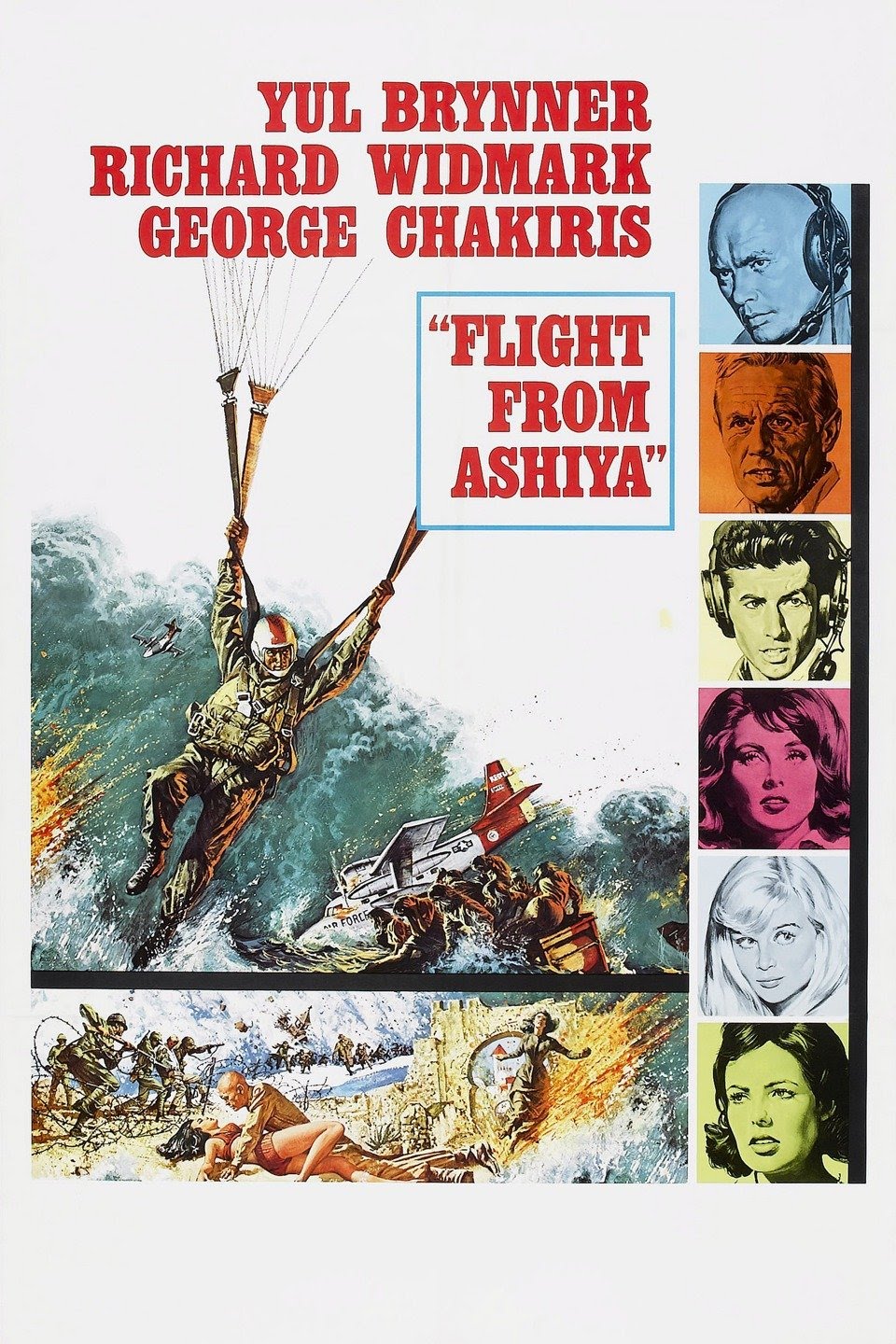
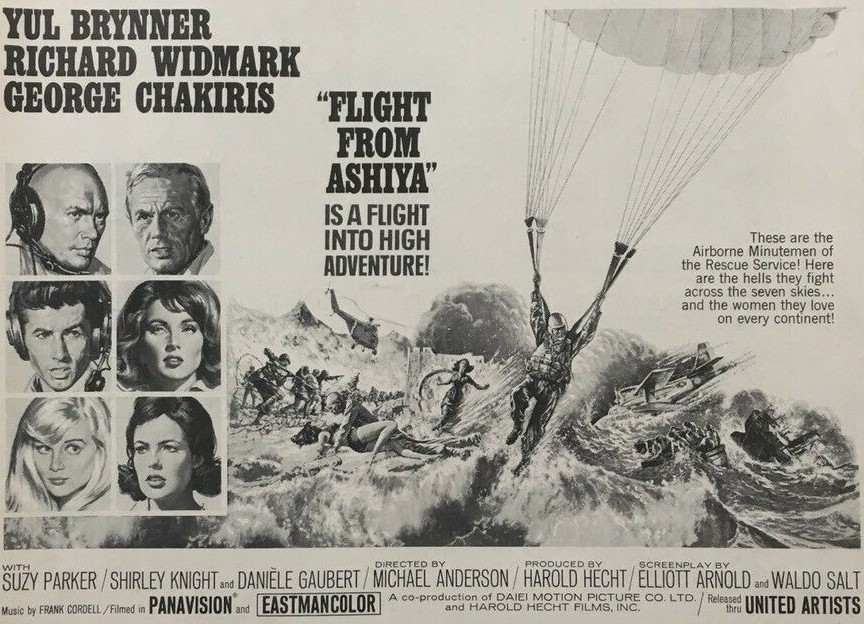
Flight from Ashiya (1964) ***

A post-WW2 operation to save a handful of Japanese adrift at sea in a storm is endangered when three members of the U.S. Air Force Air Rescue Service confront conflicts from their past. Despite tense rescue action, this is basically a three-hander about guilt and how men deal – or fail to deal – with emotions. Extended flashbacks illuminate the tangled relationships between Yul Brynner, Richard Widmark and George Chakiris.

So really it’s like one of those portmanteau films that were occasionally popular – like Trio (1950) made up of Somerset Maugham short stories or the more recent The VIPs (1963) or The Yellow Rolls Royce (1964). Each of the episodes stands up in its own right, actions taken in the past having a direct bearing on the present situation. Chakiris is haunted by causing an avalanche after flying his helicopter too close to a mountain and by having to leave behind many of the victims, due to restricted capacity on board, and now he is terrified of flying solo. 

As a consequence, Widmark has no faith in abilities as a pilot. Widmark has an ongoing hatred of the Japanese – colleague Brynner of Japanese ancestry also bears his wrath – because his ill wife (Shirley Knight) and child died in a Japanese prisoner-of-war camp where medical supplies were reserved for the Japanese. Faced with rescuing Japanese, he is enraged.  For his part, Brynner, as a paratrooper during the war, inadvertently caused  the death of his Algerian girlfriend.

It’s not so much an examination of tough guys under pressure as about their inability to deal with the consequences of action. There’s certainly a sense that the only way men like these have of dealing with trauma is to throw themselves further into harm’s way. Unusually, at a time when product was in short supply and for a film boasting a strong cast, the picture was shelved for two years after completion. Michael Anderson (Around the World in 80 Days, 1956) directed.

The title’s a bit of a misnomer, suggesting someone is trying to escape from Ashiya when, in fact, that is just the name of the air base where the rescue team are located. Critics complained it was neither one thing nor the other, but in fact I found it a perfectly satisfactory combination of action and drama, especially as it dealt with rarely-recognised male emotions.

Many of the films from the 1960s are to be found free of charge on TCM and Sony Movies and the British Talking Pictures as well as mainstream television channels. But if this film is not available through these routes, then here is the link to the DVD and/or streaming service.

The Running Man (1963) ****

Twisty Carol Reed thriller pivoting on emotional entanglement that keeps you guessing right up to the end. In revenge for losing his business after an insurance company failed to cough up for his crashed plane, entrepreneur Laurence Harvey (Butterfield 8, 1960) fakes his own death and flees to Malaga in Spain.

But when girlfriend Lee Remick (Days of Wine and Roses, 1962) joins him she finds he has assumed the identity of an Australian millionaire whose passport he has purloined and completed the transformation by changing his black hair to blond. Harvey has a mind to repeat the experiment by killing off himself (under the new identity) and claiming the insurance. Remick, complicit in the original scam, not only balks at this idea but finds disconcerting his change of personality and clear attraction to the opposite sex.

Tensions mount when mild-mannered insurance investigator Alan Bates (A Kind of Loving, 1962) appears on the scene. Anyone watching the film now has to accept that in the days before social media every face was not instantly tracked and accept that Bates is unaware of what Harvey looks like.

The couple cannot run because they are awaiting a bank draft. Bates immediately sets the tone for suspicion when he pronounces that their vehicle  “looks like a getaway car.”  Forced to follow “The Godfather” dictum of keeping your enemies closer, the pair befriend Bates with the intention of finding out what he knows and what are his intentions. Harvey and Remick have to pretend they have only just met, and have separate bedrooms, leaving the door open for Bates to gently woo Remick, an action endorsed by Harvey. They are caught out in small lies. Harvey’s Australian accent falters. Bates keeps on making notations in a notebook. Harvey foils Bates’ attempts to photograph him.

The ensuing game of cat-and-mouse is complicated by Bates pursuit of Remick. Is this as genuine as it appears? Or is he trying to get her on her own to admit complicity? Both Harvey and Remick are, effectively, forced to adopt the new identities they have forged to dupe Bates with unforeseen results. There are red herrings aplenty, a race along mountainous roads, and some marvelous twists as the couple find the tale they have woven is turning too tight for comfort until murder appears the only solution.  

As with his international breakthrough The Third Man (1949), Reed grounds the whole Hitchcockian enterprise in local culture – this being unspoiled Malaga prior to the tourist deluge – Spanish churches, a wedding, a fiesta, the running of the bulls, with an occasional ironic twist – “gypsy” musicians watching ballroom dancing on television. Reed resists taking the material down a darker route –  Hitchcock would undoubtedly have twisted the scenario in another direction until Remick came under threat from Harvey – but instead allows it to play out as a menage-a-trois underwritten by menace.

The acting is sublime. Harvey wallows in his part, Remick quietly anxious scarcely coming to believe that she had played a part in the original crime, Bates with a pleasant inquisitive demeanor the ideal foil to Harvey. Unusually, they all undergo change, Harvey uncovers a more ruthless side to his character, Remick responds to the gentler nature of Bates, while Bates shrugs off his schoolmasterly aspects to become an attractive companion. It all leads towards a thrilling conclusion.

A couple of footnotes – special mention to Maurice Binder for the opening credits and this was the final score of British composer William Alwyn (The Fallen Idol, 1948).

Many of the films from the 1960s are to be found free of charge on TCM and Sony Movies and the British Talking Pictures as well as mainstream television channels. But if this film is not available through these routes, then here is the link to the DVD and/or streaming service.

The Swimmer (1968) *****

Ever since Broadway had produced an elegy to a man broken on the rack of the American Dream in Arthur Miller’s Death of a Salesman, Hollywood had been searching for an equivalent, but had only managed to come up with tales of men self-destructing through drugs (The Man with the Golden Arm, 1955) and alcohol (Days of Wine and Roses, 1962). The Swimmer, with its physical and mental dereliction, filled that void. It was the bravest choice of Burt Lancaster’s career – William Holden, Paul Newman and George C. Scott turned it down –  the athletic prowess that had carried him through a host of films from The Flame and the Arrow (1950) to The Professionals (1966) now virtually redundant.

The final scene when, in the pouring rain, clad only in swimming trunks, he crouches, broken, on the steps of his abandoned house, as if seeking sanctuary in a church, was a stunning image. But it was more than that. Few actors of his generation would have been willing to stoop so low. Yes, the likes of Marlon Brando were often beaten to the point of humiliation (The Chase, 1966), but that was in the course of duty, not in pursuit of the American Dream. That Lancaster, a touchstone to Hollywood virility, the man-god with the dazzling style, was the one to come apart made the drama even more powerful.

The under-rated Frank Perry had struggled to find a footing in Hollywood even after the (minor) success of David and Lisa (1962), but he was one of the few directors willing to tackle the uncommercial subject matter. It was such a troubled production that producer Sam Spiegel, never one to shy away from publicity, did not put his name on it and Sydney Pollack who had directed Lancaster in The Scalphunters (1966) was called in to re-edit the rough cut. Eleanor Perry, the director’s wife, fashioned the script from one of the most acclaimed short stories of all time, by John Cheever.

The story is a simple one. Lancaster plans to swim across the county via the swimming pools of his upmarket neighbors to reach home. At the start he is vigorous, powerful, with a terrific dive and swimming stroke. He names the journey “the Lucinda river” after his wife. But he is like Ebenezer Scrooge, meeting ghosts from his past, facing up to the present, and left with only a desolate future. With each successive visit to a swimming pool, another part of his life unfolds. From the outset we can tell something is wrong – couples exchange odd looks and occasionally he is met with sympathy or hostility, neither of which he comprehends, and persists with a rose-tinted version of his life. And gradually, his physique deserts him and he limps, can’t pull himself effortlessly out of a swimming pool and instead of being warmed by the sun begins to shiver.

Stylistically, the movie begins with the idyllic, a camera tracking through the countryside from Lancaster’s point-of-view, his footsteps on the soundtrack, deer, a rabbit and an owl popping into view. As a counterpoint to long tracking shots of Lancaster trotting down a sunlit avenue of trees, Perry employs the zoom camera (an innovative technique at the time) to go so deeply into his eyes it must pierce his camouflaged soul. Harsher music and slower movement by Lancaster prefigure the onset of dangerous reality. And it is not the end of summer as Lancaster imagines (making reference to flowers or trees) but the beginning of autumn as the drifting leaves show.

By focusing so much on the actor’s physicality – he is never out of swimming trunks – we see at once his strength and his eventual weakness. There is one glorious sequence where he races a horse. In another, he leaps a five-barred fence. This is as the character perceives himself, a triumphant physical specimen.

But what we see, as he is pitifully stripped of dignity, is something else. Scenes that start brightly end ominously. For part of his adventure he is accompanied by former babysitter Julie (Janet Landgard). Initially, this is a picture of lost innocence, a three-minute sequence of Lancaster and Landgard mostly in longshot walking in dappled sunshine through the trees, as if they belong in a fairytale, with their voices detached from the images. But when she professes an adolescent crush (stealing one of his shirts, for example) and he begins to act in overprotective paternal fashion she takes it the wrong way and although nothing untoward occurs it clearly creeps the girl out and makes us realise that Lancaster is living in the past.

The present he could – and should have – enjoyed is tantalizingly all around. Every pool he visits belongs to the rich. There is alcohol aplenty. The houses are fabulous. As well as swimming pools, people own horses. Middle-aged neighbors sit out, ignoring the attractions of the pool, enjoying what their wealth has brought.

It is not a descent into madness for he must already have been unhinged to embark on his excursion but a nightmare that never ends. There is no safety harness for the American Dream. Once you fall, there is nothing to stop the plummet. Nothing left but, to mix the metaphors, swimming on empty.

The Swimmer is on Amazon Prime. Incidentally, there is an excellent documentary, directed by Chris Innis, The Story of the Swimmer (2014)  which you can find on YouTube.

Discover WordPress

A daily selection of the best content published on WordPress, collected for you by humans who love to read.

The Atavist Magazine

by Brian Hannan

WordPress.com Blog

News, Tips & Website Tutorials