The Brotherhood (1968) ****

Minimal violence and no sex was the wrong recipe for this Mafia picture – as proven at the box office – but this is an absorbing, underrated drama nonetheless.

It bears a surprising number of parallels to The Godfather (1972). Pure coincidence, extraordinary though that may appear, because The Brotherhood premiered in December 1968 while the Mario Puzo novel was printed in March 1969 (and delivered to the printers long before), so no opportunity at all for plagiarism.

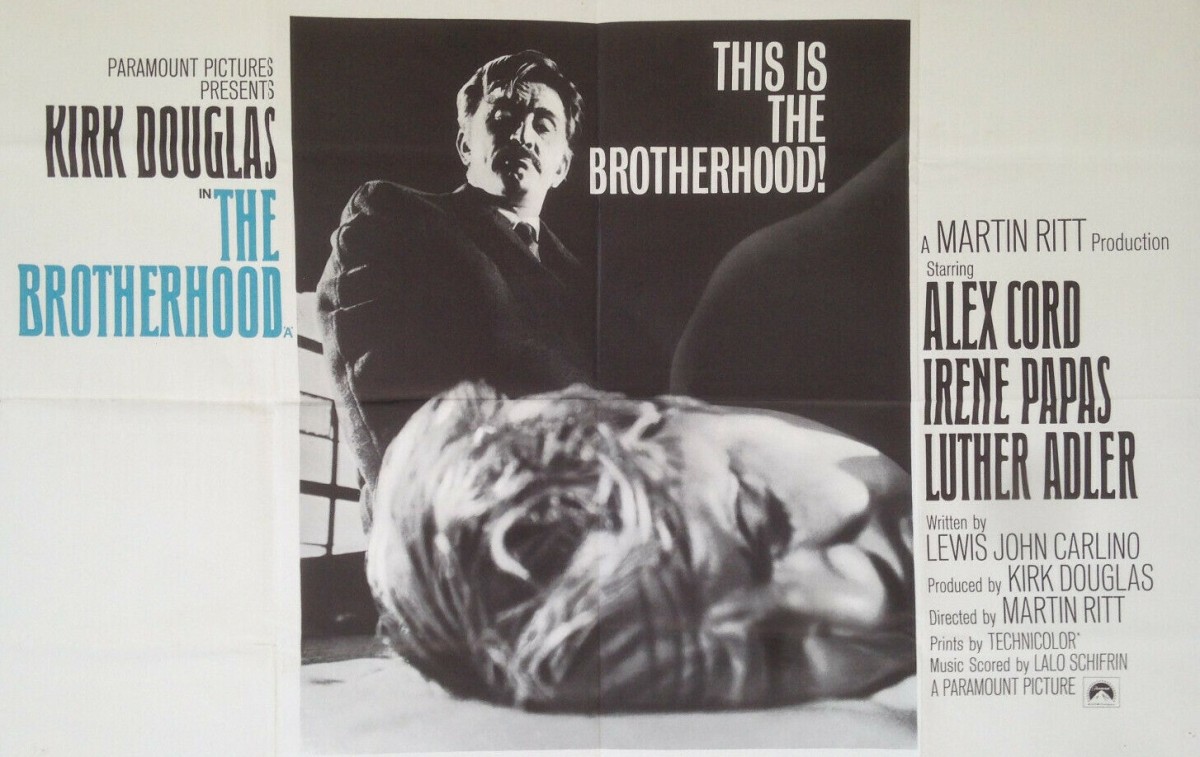
The two films could be opposite sides of the same coin. For a start, both begin with a wedding. Vince Ginetta (Alex Cord), brother of Mafia kingpin Frank (Kirk Douglas), is marrying Emma (Susan Strasberg), daughter of another Mafia chief Dominick (Luther Adler). Like Michael (Al Pacino) in The Godfather, Vince is just out of the army, well-educated and primed for a life outside the business. And like Michael is called upon to commit an act of supreme violence. There’s even a hint of Tom Hagen (Robert Duvall) in the relationship between the brothers, Frank having brought up the much younger Vince after his father’s premature death.
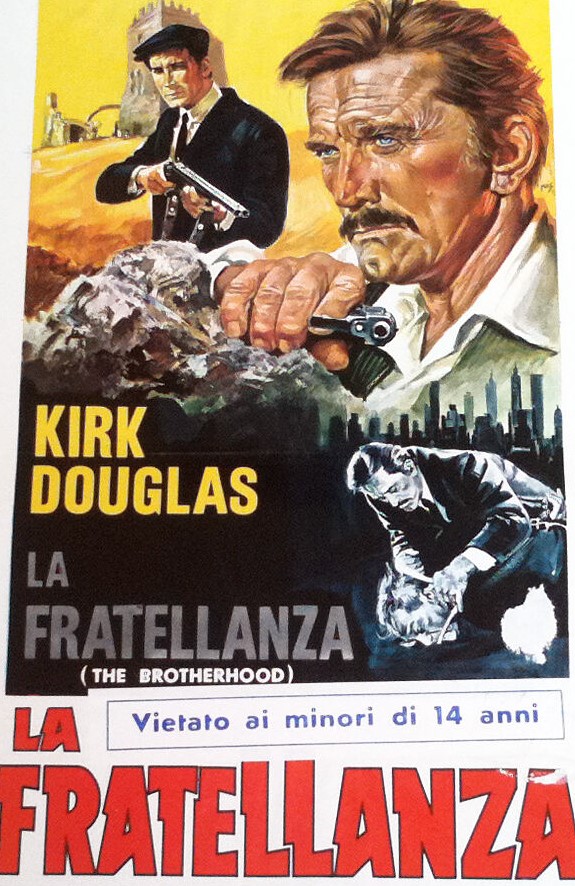
And just as Don Corleone (Marlon Brando) refuses to join the other Mafia families in a new business venture (in that case, drugs) so Frank bows out of an incredibly high risk (but amazingly prescient) scheme to invest in electronic firms involved in military work for the government, a deal that not only promises huge profits but a potential hold over the powers-that-be.

Frank’s wife Ida (Irene Papas) is like Don Corleone’s wife, not wanting to know anything about the business, but both Emma and Frank’s daughter Carmela (Connie Scott) are thematic cousins to Kay Adams (Diane Keaton) as initial implicit trust is wiped away. When Frank dances with Carmela at the wedding, that is reflected in Don Corleone dancing with his daughter at her wedding. Like The Godfather our first sight of the other Mafia chieftains – including Jim Hagen (Murray Hamilton) and Don Peppino (Eduardo Cianelli) – is at the feast where they are viewed with suspicion by Frank’s clan. And the scene where Frank uses a banana to tease his nephew will remind you of Don Corleone spooking his grandson with an orange.

However, the twist, if you like, is that, unlike Michael, Vince is desperate to join the Family and is instrumental in developing legitimate enterprises, which is echoed by Michael Corleone’s strategic shift to Las Vegas. In some respects, Frank is more like Sonny (James Caan), happy to assume personal command of murders which the other Mafia chiefs now scrupulously delegate to “mechanics” in Los Angeles. He is more old-school whereas the others act as respectable businessmen.

And then it becomes a question of loyalty. Which side the ambitious Vinnie will take is crucial to the story. Frank is under pressure on all sides, from the other Mafia leaders, a government investigation, Vinnie, and the need to exact revenge on the man who caused his father’s death.
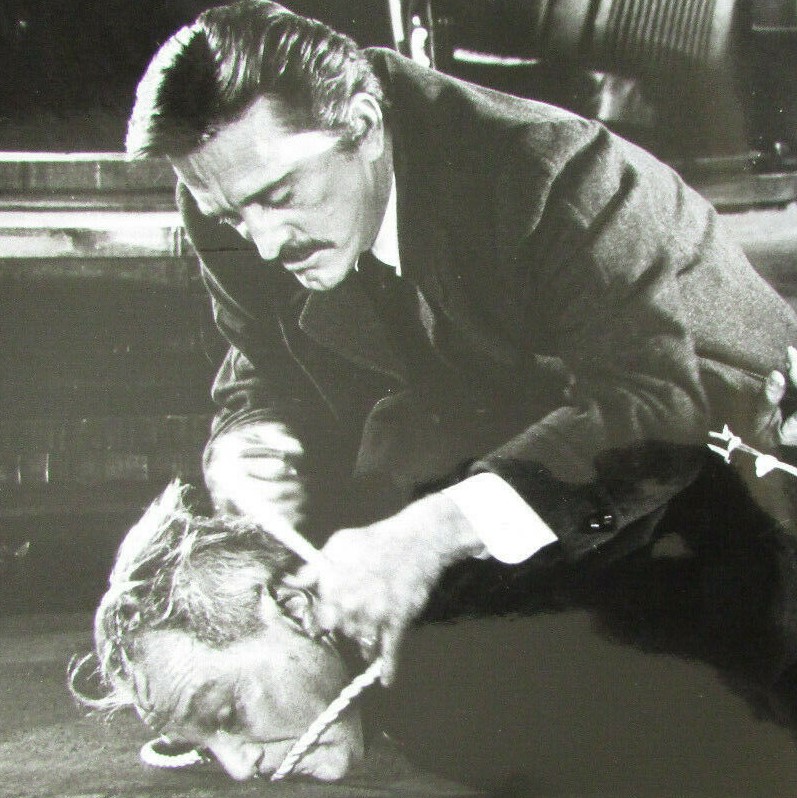
There is authentic detail here as well – religious procession in Sicily, Frank playing boccia (the Italian version of the French boules) with his old pals, family dinner, canary stuffed in the mouth of a stool pigeon, but it is less spaghetti-drenched than The Godfather. Screenwriter Lewis John Carlino (The Fox, 1967), also listed as technical adviser, claimed to be drawing on his intimate knowledge of organized crime.

There are only three moments of violence – four if you count a shocking moment of someone spitting on a corpse at a wake – a pair of straightforward murders that bookend the film, plus a scene of Godfather-style brutality in which a man slowly strangles himself to death after being hogtied. Everyone is happily married, Ida very old-school to the extent of removing her husband’s clothes (and shoes) when he returns home drunk, Vince in a good relationship.

Kirk Douglas (Cast a Giant Shadow, 1966) is excellent in a difficult role that presents a fully rounded character, playful with his daughter, loyal to his wife, holding his own against the other mob bosses, enjoying the company of the old-timers who resemble his father, and the changing nature of his relationship with brother Vince. Alex Cord, whose work I initially dismissed (Stiletto, 1969), I have come to more fully appreciate, especially here, where, in a masterpiece of restraint, he makes the transition from adoring brother to threat.

The supporting cast is terrific, a rare Hollywood sojourn for Irene Papas (The Guns of Navarone, 1961), Luther Adler  (Cast a Giant Shadow, 1966) as one of the hoodlums exasperated by Frank’s recalcitrance,  Murray Hamilton (The Graduate, 1967) but, except at the start, Susan Strasberg (The Trip, 1967) is underused.

While director Martin Ritt (Hombre, 1967) is at times guilty of melodrama, his rendering of family life is much more nuanced than Coppola’s. There are very tender moments between Frank and his wife and Frank and his daughter, as well as moments where Ida plays a more maternal role.

For nearly half a century, The Brotherhood has lain in the shadow of The Godfather simply because they both deal with the Mafia. But this is an excellent movie in its own right.
Breaking News: The Blog Goes Daily

As some of you may have noticed, this isn’t news at all, as for about the last month, I have been posting every day. However, that was never my intention. I had originally planned to review films of the 1960s on Sunday, Wednesday and Friday, but gradually I have expanded the content to include contemporary films and features like Pressbooks, Books into Films, Behind the Scenes and material which goes under the general heading of “Other Stuff” which has a very wide remit.

The 1960s was a period of dramatic change not just in the way films were made, or presented (70mm etc), but in the way they were sold and the way they were shown as the industry moved from films in release moving down a steady food chain that might take a year to complete to movies gradually opening much wider than ever before. And as studios cut down on output, older films, which had previously been dismissed as worthless or as television fodder, were now coming back into the reckoning.

As a result of including material other than just films reviews, I have gradually been posting more often. And it seemed to me I have more than enough material to jsutify continuing in this fashion. but rather than doing this in a haphazard manner, five posts one week, three the next, I thought it would make more sense to bite the bullet and just decided to post every day.

As of tomorrow the format will be as follows: more reviews on a weekly basis of 1960s films with in between items relating to these films or articles about 1960s developments, Pressbooks, Interviews, Behind the Scenes Reports, Book into Film analyses, and pretty much anything else that take my fancy as well as reviews of contemporary films.

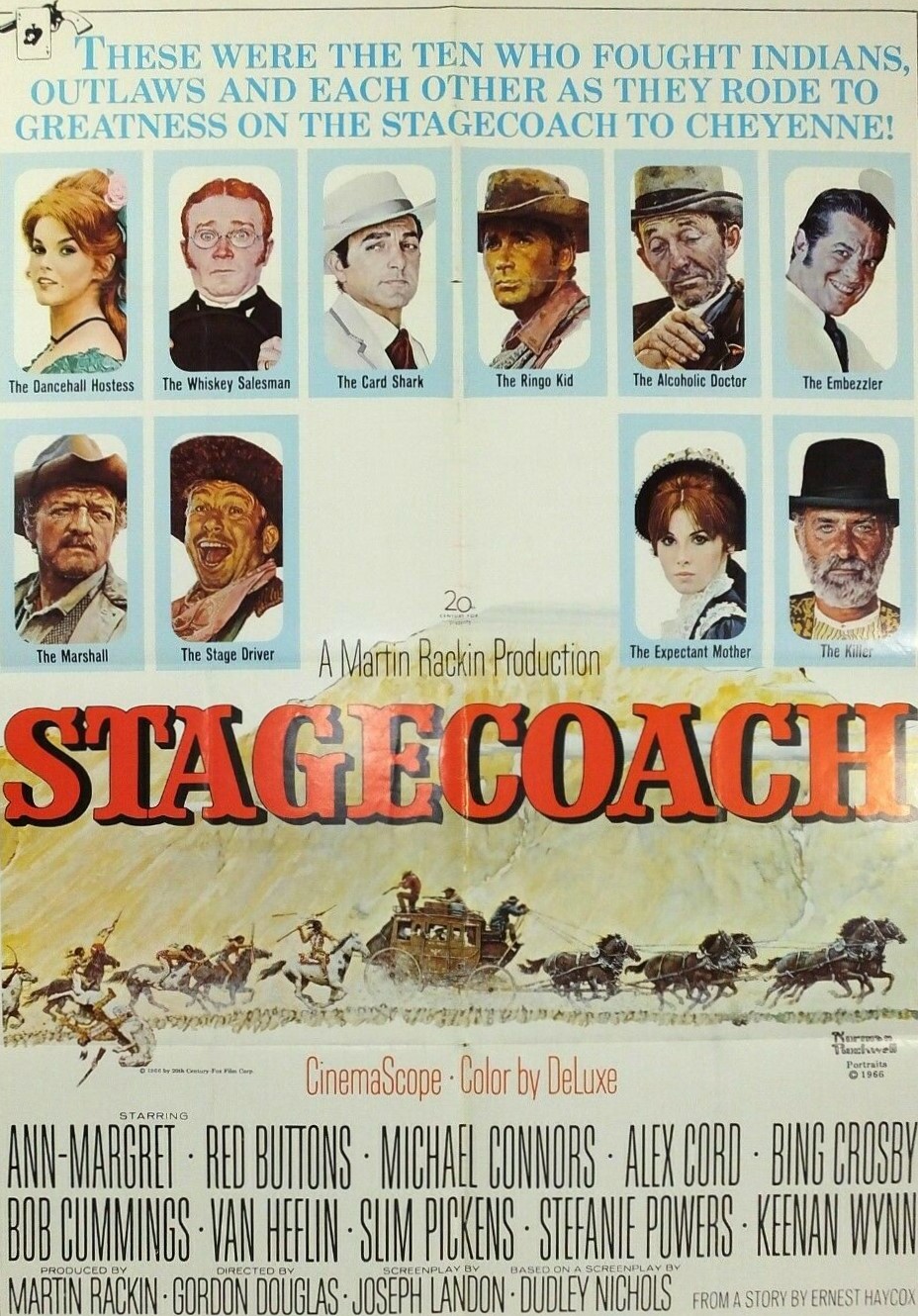
Stagecoach (1966) ****

It’s probably sacrilege to admit that I quite enjoyed this. Also it’s been so long since I’ve seen the John Ford original that I could remember very little of the specifics and I haven’t seen the remake before so this was just like watching a new movie.

Basically, it’s the story of a group of passengers taking the stagecoach to Cheyenne for different reasons who are joined by an escaped murderer and shepherded along by the driver and a town marshal. There is some excellent action but mostly it’s a relationship picture, how the characters react to one another and their response to crisis.

Good-time girl Dallas (Ann-Margret) is on the run, banker Gatewood (Bob Cummings) is hiding a stash of stolen money, alcoholic doctor Boone (Bing Crosby) is penniless, liquor salesman Peacock (Red Buttons) is a coward, gambler Hatfield (Mike Connors) has Civil War secrets, pregnant Lucy Mallory (Stefanie Powers) is meeting her cavalry husband in Cheyenne. Ornery Buck (Slim Pickens) is the driver. Curley (Van Heflin) is riding shotgun and when he comes upon stranded escaped murderer the Ringo Kid (Alex Cord) promptly arrests him.

The drama unfolds as the characters confront each other or their own weaknesses. Dallas, who had a high old time as a saloon girl, is way out of her depth in respectable company,  concealing the secret of her affair with the married Gatewood. Ringo coaxes her along, bringing her out of her shell, giving her back self-respect, and of course falling in love. Curley, with his eyes on the $500 reward for bringing Ringo in, has no intention of letting the gunslinger take his revenge in Cheyenne on Luke Plummer (Keenan Wynn) who killed his family. Boone and Peacock provide the fun, the doctor spending most of his time separating the salesman from his cargo of booze.

There are endless permutations with a story like this, the kind of material favoured in  disaster movies like Airport (1970) and The Towering Inferno (1974) where disparate characters battle for survival. The action is only part of the deal. The picture only truly works if the characters are believable. For that, you need a heap of good acting. The audience could certainly rely on old dependables like Bing Crosby (The Road to Hong Kong, 1962) in his big screen swansong, Van Heflin (Shane, 1953), Red Buttons (Oscar-winner for Sayonara, 1957), Robert Cummings (Saboteur, 1942) and cowboy picture veteran Slim Pickens to put on a good show. But the main dramatic load was to be carried by relative newcomers Ann-Margret and Alex Cord.

Ann-Margret has made her name with sassy light-hearted numbers like The Pleasure Seekers (1964) and had only just stepped up to the dramatic plate with Once a Thief (1965). This was Alex Cord’s sophomore outing after Synanon (1965), the odds stacked against him making any impact in the role which turned John Wayne into a star. 

Amazingly, the casting works. Ann-Margret moves from feisty to restrained, meek to the point of being cowed, and for most of the film, far removed from the false gaiety of the saloon, seeks redemption. The cocky trouble-making minx emerges only once, to knock the wind out of Mrs Mallory, but, after taking a tumble down the humility route, gradually steers her way towards a better self, preventing Gatewood from causing chaos, nursing Mallory and inching her way towards true feelings for Ringo. As in the best movies, it’s not for her to open up about her woeful life but for another character, in this case Ringo, to identify her predicament: “What you doin’ about your scars, you got ‘em even if they don’t show…when you goin’ to stand up and stop crawlin’?” When they finally kiss it is one of the most tender kisses you will ever see.  

My reservations about Alex Cord’s acting skills were based on his moustachioed performance in Stiletto (1969) but I reversed my opinion after seeing him in The Scorpio Letters (1967) and this is another revelation. As much as he can deliver on the action front, and sports on occasion a mean-eyed look,  it’s in the dramatic scenes that he really scores, gentle, vulnerable, caring. He certainly matches the Duke’s trademark diffidence in terms of romance. That the camera can mine depths of expression from both faces proves the calibre of their acting.

If director Gordon Douglas (Rio Conchos, 1964) had more critical standing, his bold long opening aerial tracking shot over rugged forest, mountain and plain before reaching the stagecoach would have received the acclaim accorded Stanley Kubrick for a similar shot in The Shining (1980). The opening also makes it clear how far removed this is from the original, not just in colour obviously, but (although filmed in Colorado) in a different locale, Wyoming, rather than the arid Arizona of Monument Valley. After a brief glimpse of the stagecoach, Douglas switches to a cavalry troop making camp. A soldier going into a wagon is met by a hatchet in the head. The camera tracks the corpse’s blood as it flows down a stream where it alerts another soldier washing clothes. Before he can raise the alarm, he gets a lance in the back.

Where the passengers have heard rumors, quickly dismissed (“nobody got scalped by an old rumor”) of the Sioux (Apaches in the original) on the warpath, the audience has seen the cavalry troop slaughtered, so (in effectively a Hitchcockian device) provides the movie with the tension the on-screen characters initially lack The passengers soon grasp reality when they come across another patrol dead at a staging post, and eventually are battling for their lives when ambushed. But prior to that there is a tense sequence of leading the stagecoach across a narrow mountain ridge during a storm.

There’s a clever reversal before the Sioux onslaught. The passengers think they have seen soldiers approaching, but it is the Sioux wearing cavalry uniforms. There is no river to cross as in the original, but the chase along a mountainous path is breathtaking, aerial and tracking shots given full rein, ending in a shoot-out without (as in the original) the cavalry riding to the rescue.

Douglas has his work cut out with the drama, as various characters confront their issues, and his staging is superb, characters always given reason to move. Screenwriter Joseph Landon (Rio Conchos) borrowed material from the Dudley Nichols original but added and subtracted quite a bit.

At the time critical deification of John Ford had not begun and Hollywood was in a cyclical remake mood – new versions of Beau Geste and Madame X appearing the same year – so Gordon Douglas didn’t quite face a critical backlash, although praise was generally sparse. Judging by the box office it received an audience thumbs-up – as it does from yours truly.

You can rent this on Amazon Prime.

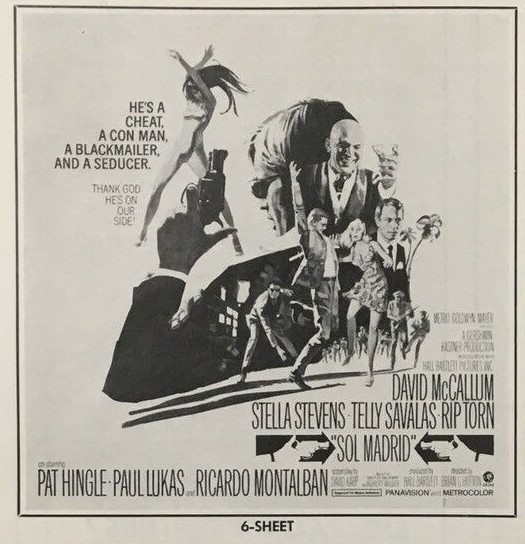
Sol Madrid / The Heroin Gang (1968) ***

Was it David McCallum’s floppy-haired blondness that prevented him making the jump to movie action hero because, with the ruthlessness of a Dirty Harry, he certainly makes a good stab at it in this slightly convoluted drugs thriller. Never mind being saddled with an odd moniker, the name devised surely only in the hope it would linger in the memory, Sol Madrid (McCallum) is an undercover cop on the trail of the equally blonde, though somewhat more statuesque, Stacey Woodward (Stella Stevens) and Harry Mitchell (Pat Hingle) who have scarpered with a half a million Mafia dollars. Hingle is the Mafia “human computer” who knows everything about the Cosa Nostra’s dealings, Woodward the girlfriend of Mafia don Villanova (Rip Torn).

Sol tracks down Stella easy enough and embarks on the audacious plan of using her share of the loot, a cool quarter of a million, to fund a heroin deal in Mexico with the intention of bringing down both Mexican kingpin Emil Dietrich (Telly Savalas) and, using the on-the-run pair as bait, Villanova. A couple of neat action sequences light this picture up. When Sol and Stella are set upon by two knife-wielding hoods in a car park, he employs a car aerial as a weapon while she taking refuge in a car watches in terror as an assailant batters down the window. Sol has hit on a neat method of transferring the heroin from Tijuana to San Diego and that is filled with genuine tension as is the hand-over where Sol with an unexpected whipcrack slap puts his opposite number in his place.

Meanwhile, Villanova has sent a hitman to Mexico and when that fails turns up himself, kidnapping Stella and planning a degrading revenge. Most of the movie is Sol duelling with Dietrich, suspicion of the other’s motives getting in the way of the trust required to seal a deal, with Mitchell, hiding out in Dietrich’s fortified lair, soon being deemed surplus to requirements. Various complications heighten the tension in their flimsy relationship.

Madrid is Dirty Harry in embryo, determined to bring down the gangsters by whatever means even if that involves going outside the law he is supposed to uphold, incipient romance with Woodward merely a means to an end. McCallum certainly holds his own in the tough guy stakes, whether trading punches or coolly gunning down or ruthlessly drowning enemies he is meant to just capture, and trading  steely-eyed looks with his nemesis.

It’s a decent enough effort from director Brian G. Hutton (Where Eagles Dare, 1968), but is let down by the film’s structure, the expected confrontation with Villanova taking far too long, too much time spent on his revenge with Woodward, for whom audience sympathy is slight. Just at the time when Hollywood was exploring the fun side of drug taking – Easy Rider just a year away – this was a more realistic portrayal of the evil of narcotics.

It is also quite prescient, foreshadowing both The Godfather Part II (1974) in the way Villanova has modernised the Mafia, achieving respectability through money laundering, and this century’s television obsession with South American drug cartels with all-out police battles with the Narcos. And there is a bullet-through-the-glasses composition that will be very familiar to fans of The Godfather (1972), and you will also notice a similarity between the feared Luca Brasi and the Mafia hitman Scarpi (Michael Conrad) here. And why we’re at it, Woodward’s predicament is close to Gene Hackman’s in French Connction II (1975).

The action sequences are excellent and fresh. Think Madeleine cowering in terror as the car window is battered in No Time to Die (2021) and you get an idea of the power Hutton brings to the scene of a terrified Woodward hiding in the car. Incidentally, you might think McCallum was more of a secret agent than a cop with the cold-blooded ruthlessness with which he dispatches his enemies.

Stella Stevens (The Silencers, 1966) is the weak link, too shrill and not willing to sully her make-up or hair when her role requires degradation. Her part is better written (“I never met a man who didn’t want to use me”) than Stevens can act and she gets a clincher of the film’s final line. Telly Savalas (The Dirty Dozen, 1967) with his playful villain, though the trademark laugh is in occasional evidence, is in sharp contrast to Rip Torn who is all snarling bad guy. Ricardo Montalban (Madame X, 1966) is Sol’s Mexican sidekick and Paul Lukas, a star of the Hollywood “golden age”, puts in a fleeting appearance.

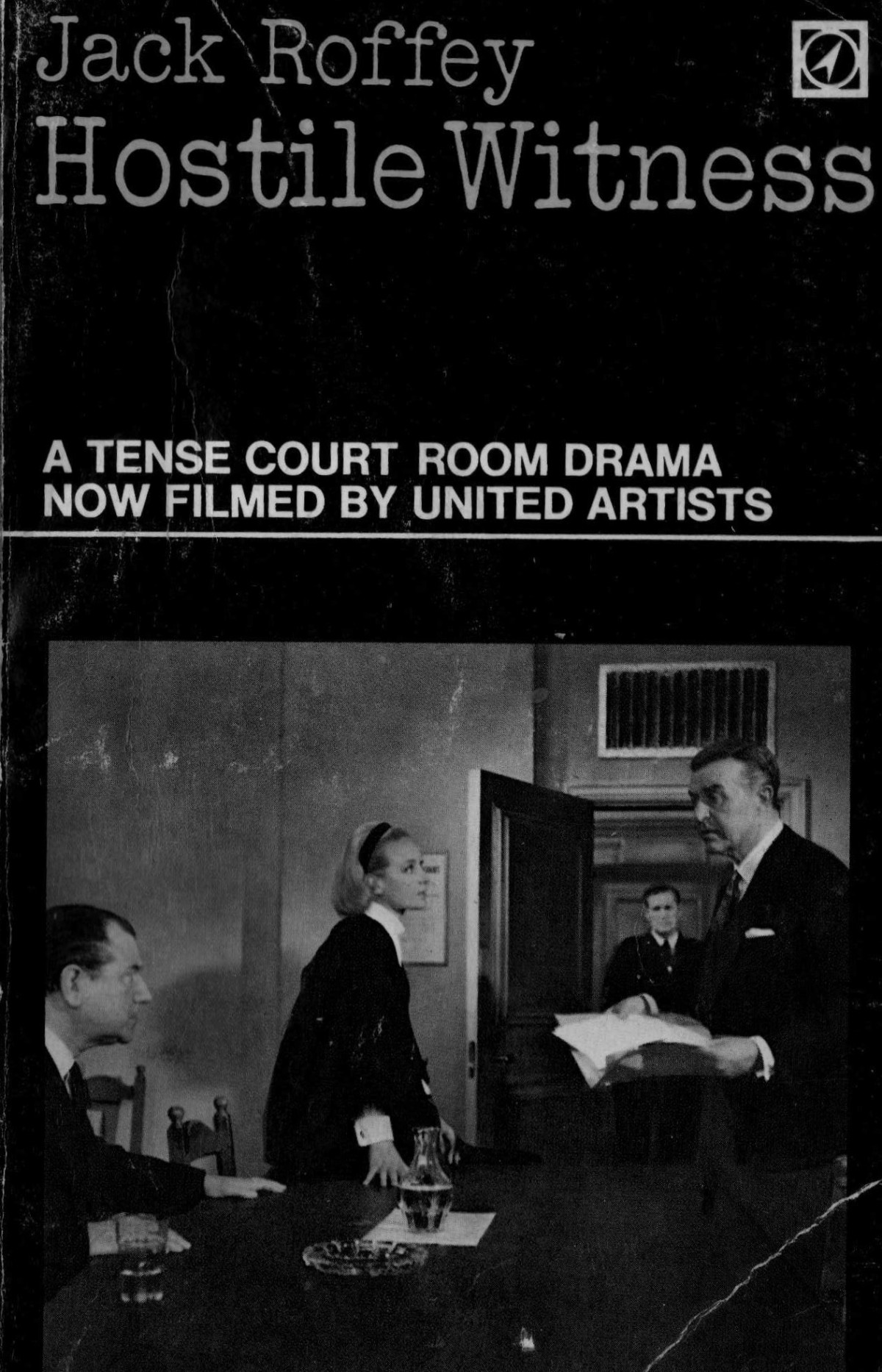
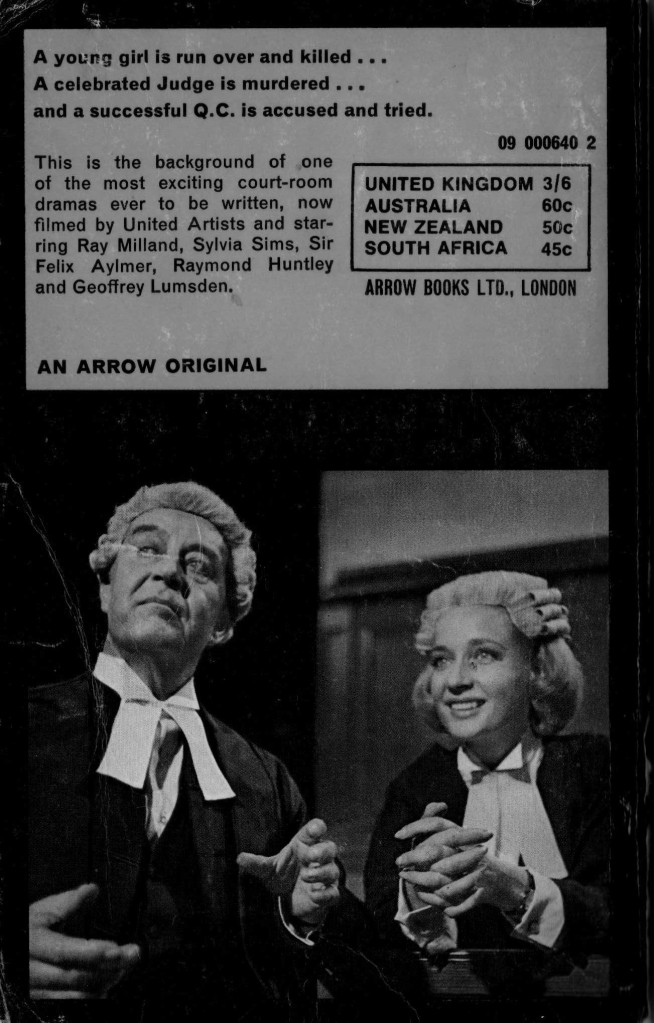
Film into Book – “Hostile Witness” (1968) Movie Tie-In

As you will be aware I have been running a little series of how books were adapted into films and I thought it would be interesting to see what happened when the process was the other way round. I have in general about the lucrative business of novelisations of screenplays as movie tie-ins but never examined any single one in particular. But I came across this book in a secondhand bookshop on holiday and gave it a read.

British writer Jack Roffey had turned his play – a hit in London West End and Australia though less so on Broadway – into a screenplay and was inveigled into making a quick buck by churning out the movie tie-in book, published straight into paperback in Britain by Arrow. It turned out to be an interesting exercise because the play was no longer in circulation and the film failed to get a proper release so the book had to survive on its own without the help of movie publicity or posters outside the chain cinemas.

The book is about 60,000 words long while the play/screenplay probably comprised fewer than 5,000 words so that was a lot of padding-out to do, if that was all the author could manage. Interestingly, Roffey proved himself an adept novelist, taking the opportunity to both clarify the proceedings and mystify the reader even more, accentuating the ambiguities of the initial work. Where the movie glosses over main protagonist Simon Crawford’s (Ray Milland in the film) mental difficulties until brought into question during the court case itself, in the book Roffey lays the groundwork more straightforwardly, recounting the period spent in hospital and, more importantly, his rapid decline after returning to work so that by the time he is arrested his mental health is very poor.

Sheila Larkin’s (Sylvia Syms) unspoken feelings for her boss remain just that, but there is a physical closeness – she catches him when he collapses, briefly nursing him, and she is presented as a woman more aware of her own sexuality. And the door is opened later in the book for a relationship – “intimacy umbrellaed them in soft folds, inviting positive expression.” Equally, when given the opportunity to take on the case, her first reaction is fear: “She couldn’t possibly accept it…it would be a terrifying responsibility for a junior of her standing” and she expects the episode to end in abject humiliation until she catches sight of her boss and registers the fear in his eyes. Thus, Roffey is able to get inside all the major characters rather than have the camera – and the shortage of screen time – dictate the point of view. Other characters, some incidental, are also more fully drawn.

While the play’s dialogue would not have sufficed to carry a book of this length, Roffey has to add considerably to his original material, and in most cases extended conversations are made to count. Perhaps most interesting of all since he is in charge, Roffey can dispense with the need to constantly cut back to the accused during the trial to register his facial reactions and that allows the personality of Sheila Larkins to flower and take true centre stage rather than be constantly undercut by continually focusing on Crawford. Roffey was also an expert on court procedure and the opportunity to delve into that gives the book greater authority.

The book is certainly enjoyable and well-written with some sharply observed characterisations. “Mr Justice Gregory came in, diffidently at first, like a small boy at the edge of a pond, who wonders if the ice will hold.”  Simon Crawford is introduced in court in the opening page thus: “There was an affected boredom is the half closed grey eyes – a calculated indifference to the heat and the coming verdict.” While Sheila Larkins is the opposite – “properly wrung out.”

There’s style in the descriptions. “Gordon Mews is one of those peaceful backwaters that an earlier and more gracious London put aside for a rainy day, and promptly forgot about.” And the book moves along briskly, a crime thriller with the unlucky caught in a web that is closing in fast. Roffey is able to touch on more specifically Crawford’s disintegration and his shock at being tabbed a criminal. Like the film, it was more than passably entertaining.

A Twist of Sand (1968) ***

Initially promising, ultimately disappointing thriller that proves you should not go to sea  without a big budget. Because he is the only skipper to have successfully negotiated the Skeleton Coast off Namibia in South Africa, smuggler Geoffrey Peace (Richard Johnson) gets roped into a scheme by Harry Riker (Jeremy Kemp) and Julie Chambois (Honor Blackman) to collect stolen diamonds.

Peace knows his way around this area thanks to World War Two submarine exploits and that particular expedition is recalled in flashback while its repercussions form part of a plot. Also on board the boat are the goggle-eyed knife-wielding Johann (Peter Vaughn) and Peace’s shipmate David (Roy Dotrice).

Peace has to navigate the treacherous waters of the Skeleton Coast before the team embark on a trek through the desert to find the diamonds, hidden in the unlikely location of a shipwreck, itself in imminent danger of being buried in an avalanche of sand that could be triggered by (shades of Dune) sudden movement or sound.

On paper – and it has been adapted from the bestseller by Geoffrey Jenkins – it has all the ingredients of a top-class thriller but it doesn’t quite gel. For a start, the flashback, where Peace has to hunt down a new class of German submarine and not only sink it but make sure there are no survivors, gets in the way of the action.

The sexual tension you might expect to simmer between Peace and Julie does not appear to exist, the bulk of the threat coming from the villainous-looking pair, Riker and Johann, the former already known to be untrustworthy, the latter too fond of producing a knife at odd occasions. The trek into the desert takes way too long and rather than increase tensions slackens it off and there is no real explanation as to why the ship was lost so far into the desert without entering Clive Cussler archaeological territory.

Extracting the diamonds is certainly a taut scene, with the sand dunes threatening to collapse any moment but the climax you saw coming a long way off and although there is an ironic twist it is not enough to save the picture.

On the plus side, Richard Johnson (Deadlier Than The Male, 1967) shucks off the suave gentleman-spy persona of Bulldog Drummond to emerge as a snarly, believable smuggler. But Honor Blackman (Moment to Moment, 1966) is wasted and this is one of the least effective bad guy portraits from the Jeremy Kemp (The Blue Max, 1966) catalogue. Roy Dotrice (The Heroes of Telemark, 1965) is better value while Peter Vaughn (Hammerhead, 1968), menacing enough just standing still, overplays the villain.

Set up as a thriller very much in the Alistair MacLean vein, this shows just how good MacLean’s material was, how great a command he had of structure and not just of action but twists along the way. A Twist of Sand wobbles once too often in its structure and never quite manages to build up the necessary tension between characters. Although the Skeleton Coast sea-scene falls apart due to defective special effects, the other two sequences at sea are well done, the opening section where Peace is being chased by Royal Navy vessels, and the underwater attack on the German submarine where murky water manages to obscure the effects sufficiently they appear effective enough.

Don Chaffey (The Viking Queen, 1967) does his best with material that’s not quite up to standard. Marvin H. Albert (Tony Rome, 1967) doesn’t do as good a job of adapting other people’s work as he does his own.  

Catch-Up: Richard Johnson films previously reviewed in the Blog are The Pumpkin Eater (1964), Khartoum (1966), Deadlier than the Male (1967), and Danger Route (1967).

Play into Film – “Hostile Witness” (1968)

Adapting a play into a film requires more specialist skills than transforming a book into a movie. A book either needs considerably trimmed (example, The Detective) or the requiring a complete overall (as with Blindfold). It’s much harder to muck around with a play which has usually been well-honed, edited down night after night, from a run on the stage. The main decision the writer charged with the adaptation has to make is a tricky one – whether to open it up or not. Can a play, especially a thriller, sustain the tension it achieved on stage without additional elements – and therefore appear “stagey” on film – or must it be expanded in the hope of generating greater tension or ambiguity, making characters more sympathetic or clarifying the plot.  The story in both play and film concerns top lawyer Simon Crawford being arrest for murder.

Jack Roffey, adapting his own play, decided the original needed opening up. The play’s structure consisted of two acts, each containing two scenes. The first scene lasted 21 pages, scenes two and four 23 pages each, while scene three is considerably shorter just 12 pages. So, except for the third scene, the play’s rhythm is consistent. And while this might look as if most scenes last 20-plus minutes, an inordinately long time to sustain rhythm on the screen, there are lot of moment where various characters go offstage to concentrate action between fewer characters, thus heightening tension or creating character conflict.

 A lot of information that was imparted purely via dialogue in the play transforms on screen into a series of extra scenes. This is especially true at the beginning. The movie’s opening scene, set in a court and concerning the trial of a brothel-keeper, was not in the play; it was dealt with in passing at the beginning of the play, as a character reporting on the outcome, albeit that some of the reported speech became dialogue in the film. It was probably felt that the movie audience had to be introduced right away to a courtroom since the play’s opening scene takes place entirely outside the courtroom, in the offices of the leading character Simon Crawford (Ray Milland). The play begins in the present and the back story, that Crawford is widowed, recently lost his daughter in a hit-and-run traffic accident, and suffered a nervous breakdown as a result, is dealt with as exactly that – events from the past. The film puts them in the present. We are shown the daughter, who clearly has a strong relationship with her father, we hear the accident (which occurs offscreen), witness Crawford’s unravelling and the murder that forms the core of the story. And we are also treated to some additional scenes, not in the play, including an initial police investigation.

The upshot is that it takes 25 minutes for Crawford to be arrested. Compare that to the play. He announces his imminent arrest within the first five minutes. For pure audience shock the play holds the upper hand. I’m not sure the film ever matches that moment. Pre-arrest, in the film, Crawford’s erratic behaviour and hospital confinement add to a sense that he might be unhinged or, in classic film noir, feeding the audience a line. His state of mind is complicated by making visual some incidents that were just verbal in the play.

There are three major departures from the play. The first was the introduction of a private eye whom Crawford takes by the throat in frustration at the gumshoe producing no results. This suggests early on that Crawford is capable of violence. But it also causes a complication. In the play there is only one main private eye, name of Armitage, whose evidence proves key in the case against Crawford, but he is missing and in fact never appears. Apart from testifying to Crawford’s murderous inclination the introduction of this other private eye, named Rosen, makes little sense. The second is to bring quicker to the fore the involvement of junior lawyer Sheila Larkin (Sylvia Syms in the film). In the play she takes over his defence when her senior quits on a point of principle but in the film it is almost from the start.

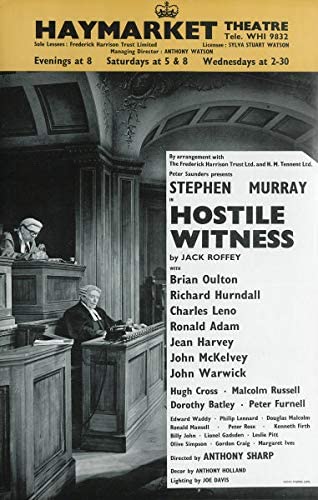
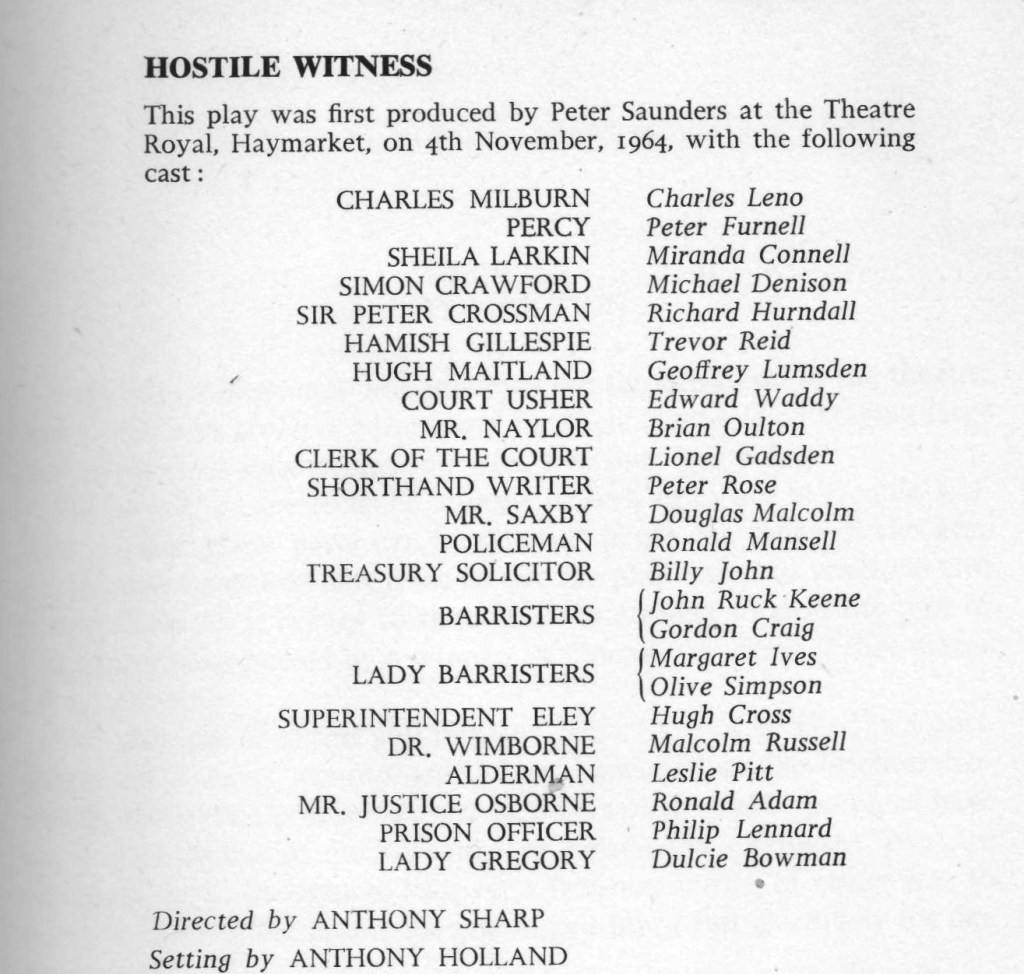
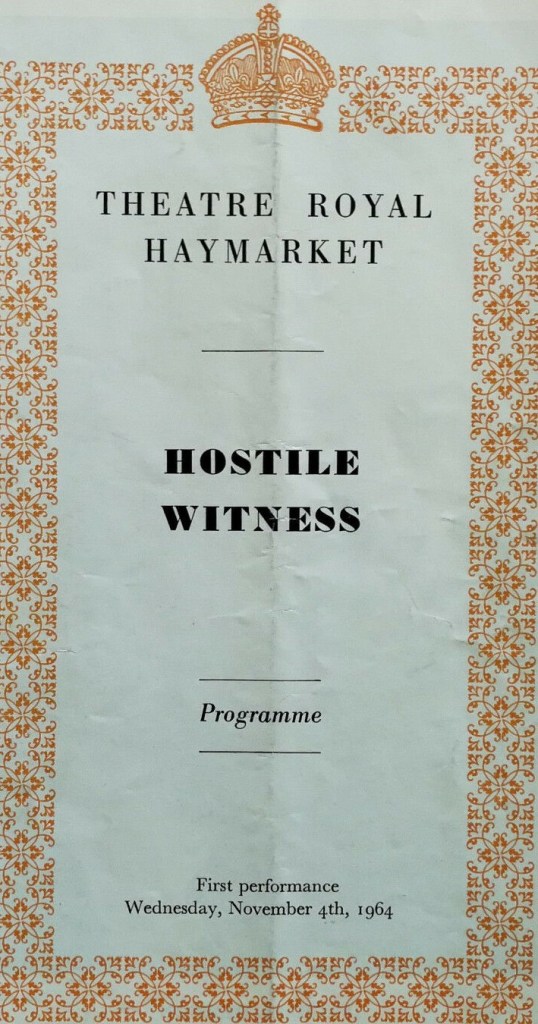
Programme for the premiere of the play in London’s West End.

The third development also involves Larkins. But I’m not sure this one works in building up Crawford-Larkins into a potential May-December relationship. In the play it seems more obvious that Larkins is a daughter substitute rather than a potential love interest but the film adds an additional scene where she brings celebratory goodies to the lawyer and her demeanor suggests sublimated ardor. The way director Ray Milland uses looks between the pair and an occasional touching of hands makes the alternative more obvious.

You could argue that the film could have simply had Crawford arrested in the first five minutes but that would have necessitated police interrogation. The device brilliantly used in the play of imminent arrest would have worked in the film, I believe, and made for a more explosive start, and then either sticking with the play structure or dealing with the backstory in flashbacks.

It’s worth noting that plays on the page look far more intense than screenplays. There is nothing but line after line of dialogue whereas a screenplay always has cuts or directions to interrupt the flow of material. Dialogue, of course, being what a play relies upon more than the camera, Roffey, as the adaptor, was lucky in having so many choice lines at his disposal. Ray Milland, in his role as director, unfortunately, was not able to add atmospheric heft.

Hostile Witness (1968) ***

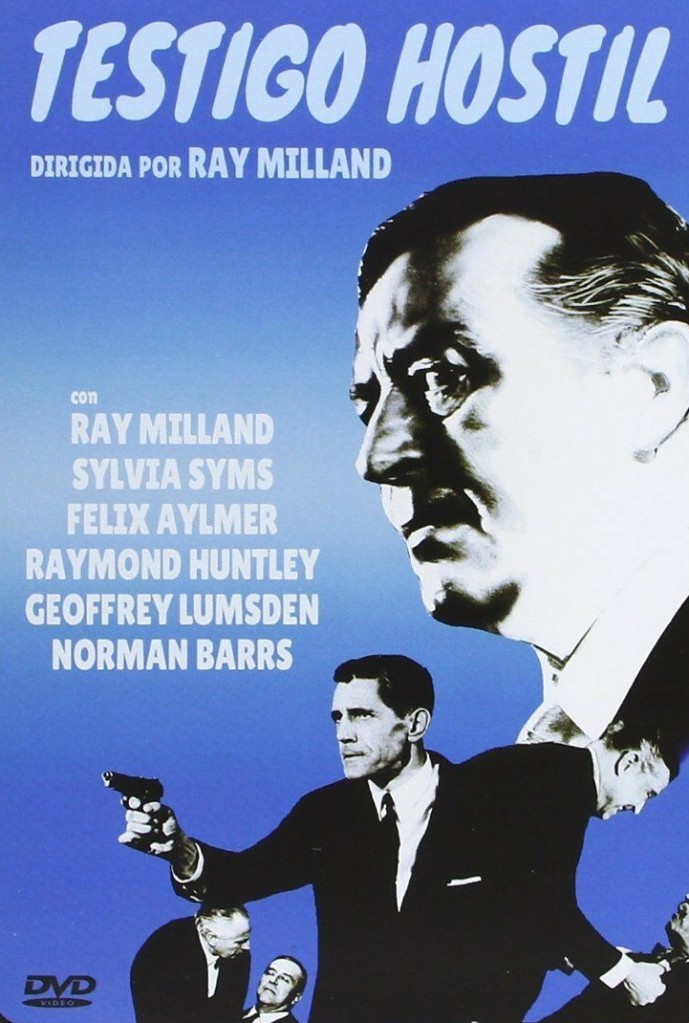
Shoddy initial release means this is unlikely to have been on your radar, but this entertaining courtroom drama plays on madness, involves minimal sleight-of-hand, employs some notable reversals as a defence strategy sinks under the weight of its own misplaced ambition.  Courtroom dramas were a scarce commodity in the 1960s, the sub-genre almost killed off by U.S. television hits like Perry Mason (1957-1966) and The Defenders (2961-1965).  Although, technically, Inherit the Wind (1960), Judgement at Nuremberg (1961) and To Kill a Mockingbird were of the same ilk, they did not rely on last-minute intervention or the normal twists and turns of legal dramas as evidenced by Witness for the Prosecution (1957). Hostile Witness only saw the light of day because Oscar-winner Ray Milland had starred in the Broadway version of the British play, author Jack Roffey experienced in the mechanics of this kind of fare after British television series Boyd Q.C. (1956-1964).

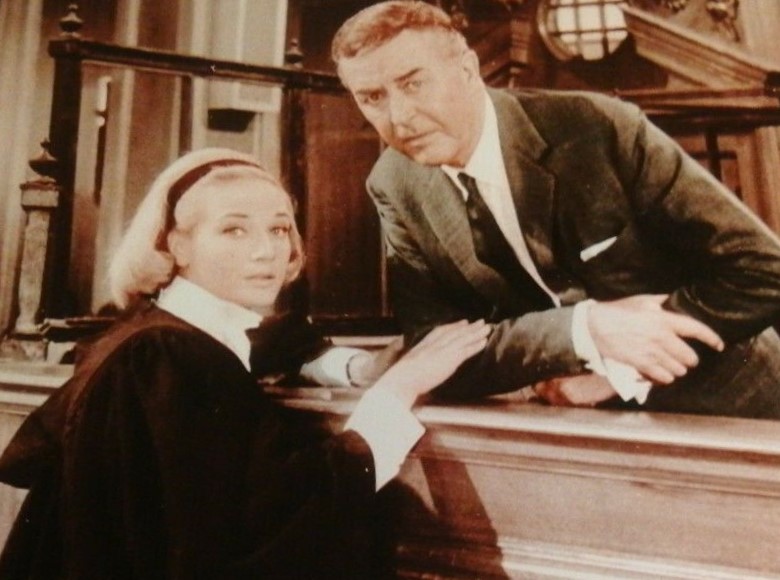
Daughter dead in a tragic car accident, top-notch Q.C. Simon Crawford (Ray Milland) is accused of killing the man he believed deliberately responsible. Unable to defend himself, he relies on his junior Sheila Larkin (Sylvia Syms). Circumstantial evidence links him to the crime. Questions surround his mental health, which disintegrated following his daughter’s death, especially after he cannot prove claims that would exonerate him. Casting around for the potential killer leads to a cul de sac, each clue that could absolve him rapidly dissolves and as he is soon fighting for his life. And as tension mounts, the defence team is soon in disarray, Sims quitting on a point of principle. Like all the best court cases the proof is in front of his eyes if only he could see it, and the traditional last-minute witness and twist does not disappoint. 

The courtroom aspect is very well done, great banter between the lawyers and swift and witty put-downs by the presiding judge (Felix Aylmer). While the story demands that Crawford remains off centre-stage at times, his presence, as a tense observer of proceedings that could spell his fate, calls on Milland to display probably the widest set of non-verbal reactions you will ever encounter. Syms (East of Sudan, 1964) is excellent in a role that offers greater scope than her usual female lead and while carrying a torch for Crawford she is more than capable to standing up to him and is ruthless in cross-examination. Geoffrey Lumsden (A Dandy in Aspic, 1968) tickles as a befuddled major and Raymond Huntley (later a success in Upstairs, Downstairs) sparkles as the grumpy prosecutor. To some extent, the picture plays on the film noir ethos that good guys often turn out to be anything but and Milland has the undoubted gift of looking both villain and hero dependent on the time of day.

By this point Welsh-born Milland was an odd refugee from Hollywood’s Golden Age, fallen far below the box office peaks of Billy Wilder’s The Long Weekend (1948) and noir turns like The Big Clock (1948). Apart from Dial M for Murder (1954) he was mostly became a television stalwart – the eponymous Ray Milland Show (1953-1955) and Markham (1959-1960) – and turned his hand to occasional direction. An unexpected dip into horror – The Premature Burial (1962), Panic in the Year Zero (1962) and The Man with the X-Ray Eyes (1963) failed to revive his mainstream career and prior to Hostile Witness had only appeared in one other movie.

For a time Hostile Witness did look as if he would put him back on top after taking up an offer to make his Broadway debut in the play. Although not a stand-out hit, it ran for a decent 157 performances, then went on tour in the U.S. and later Australia, leaving Milland with the impression that, with himself directing to cut costs and running to a tight 24-day shooting schedule in Britain, it might just be the correct vehicle. Unfortunately, it was probably the staid direction that put paid to any prospect of box office success. A director like Billy Wilder or Hitchcock would have concentrated far more on character ambiguity and  made more of the unreciprocated romance and either tightened or opened up the original play to add more tension. Even so, it is pleasant enough viewing, not a dud by any means.

Book Review – Dreams of Flight: “The Great Escape” in American Film and Culture

In the history of rousing action cinema few movies are as revered or have produced such a collective cinematic response as John Sturges’ World War 2 POW picture The Great Escape (1963) starring Steve McQueen, James Garner and Richard Attenborough and a host of upcoming stars including The Magnificent Seven alumni James Coburn and Charles Bronson,  

Dana Polan’s rich assessment of the film’s making coupled with a superb analysis of the film itself, script, style, themes and directorial bravura is filled with informative nuggets. Eschewing the standard star bio approach, Polan goes much deeper to detail how earlier adaptations for American television and Australian radio (made by novelist Morris West’s company and with Rod Taylor as a German guard) affected the film, how it fitted into the British POW tradition (The Colditz Story etc) and the influence of an American offshoot like Stalag 17.

You might already be familiar with the work of Dana Polan since he has written books on Pulp Fiction, The Sopranos and Jane Campion and another half-dozen books besides. This is an excellent addition to his impressive portfolio.

Paul Brickhill, author of The Great Escape (and other war classics The Dam Busters and Reach for the Sky) had been an inmate at Stalag Luft III so drew on personal experience – including that of tunnel digger – and sketches made at the time of the tunnels to turn out, as co-writer, a precursor Escape to Danger. It was either interviews relating to this or a magazine article or condensation that alerted neophyte director Sturges in 1945/1946 to a potential film. The book, published in 1950, sold a million copies in paperback in the UK alone and was a huge global success. And for independent producers Mirisch, for whom Sturges later made The Magnificent Seven, buying the rights was integral to the director’s pact with that company in 1957 and indeed The Great Escape was mooted as his debut picture for them. When finally greenlit, it was intended to be shot in the U.S. with only 10 per cent taking place in Europe. That it went the other way was due to an unusual set of circumstances.

In his analysis of the picture, Polan makes other interesting connections, first of all to the caper picture where each character has a specific task to contribute to the overall effort. Unusually for a heroic film, he points out that courage is continually undercut, each uplifting moment leading to defeat, the film itself having an essentially downbeat ending, the only true victory found in defiance. And in some respects The Great Escape created a bridge between the gung-ho war films of the 1950s and the more cynical approach to war envisioned in The Deer Hunter and Apocalypse Now.

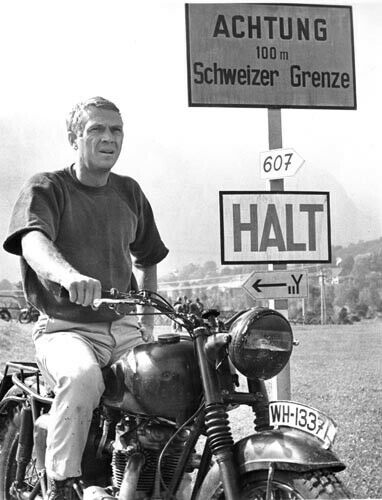
Being British, it had never occurred to me how important the baseball glove was to American culture, the glove representing for many a “certain brand of American problem-solving in the face of adversity” although far more universally accepted would be the premise of the motorcycle escape representing the triumph of the spirit even as it results in a more down to earth resolution.

Tracing Sturges’ stylistic development back to post-WW2 B-movies made for Columbia explains the importance of the trademark parabolic shot in driving action forward. Yet for all his stylistic bravura, Sturges was very grounded when it came to the work required to make pictures, for example here adopting coloured index cards to shuffle around pieces of action to best effect.

The script went through various hands – William Roberts and Walter Newman, both integral to The Magnificent Seven, but was finally credited to crime writer W.R. Burnett (who had worked with Sturges on Sergeants 3, 1962) and James Clavell (who adapted The Satan Bug, 1965), himself a POW in a Japanese camp with British writer Ivan Moffat (Giant, 1956) coming in at the last minute as script doctor. A breakdown of the various scripts attributes the Hilts’ cooler baseball bouncing to Moffat who also wrote the scene that changed Hilts from loner to participant.

In a terrific appendix you can discover exactly the problems facing the real escapees and who came up with the book title (clue – not the author) four years after the idea originally surfaced. There’s a fascinating coda about the film’s impact on Hollywood and general culture and Polan takes time out to reflect on the experience of various fans on their virgin encounter with the picture. The movie was a big hit and so well received that when critic Bosley Crowther wrote a negative review the “New York Times” postbag was filled with complaints. Written with tremendous authority and great style, this is one book you would want to find in your Xmas stocking.

Dreams of Flight: The Great Escape in American Film and Culture by Dana Polan is published by University of California Press at $24.95 / £20 in both paperback & ebook.  ISBN 9780520379305. It is available on Amazon and Kindle.

https://www.ucpress.edu/book/9780520379305/dreams-of-flight

Selling Religion – “The Shoes of the Fisherman” (1968)

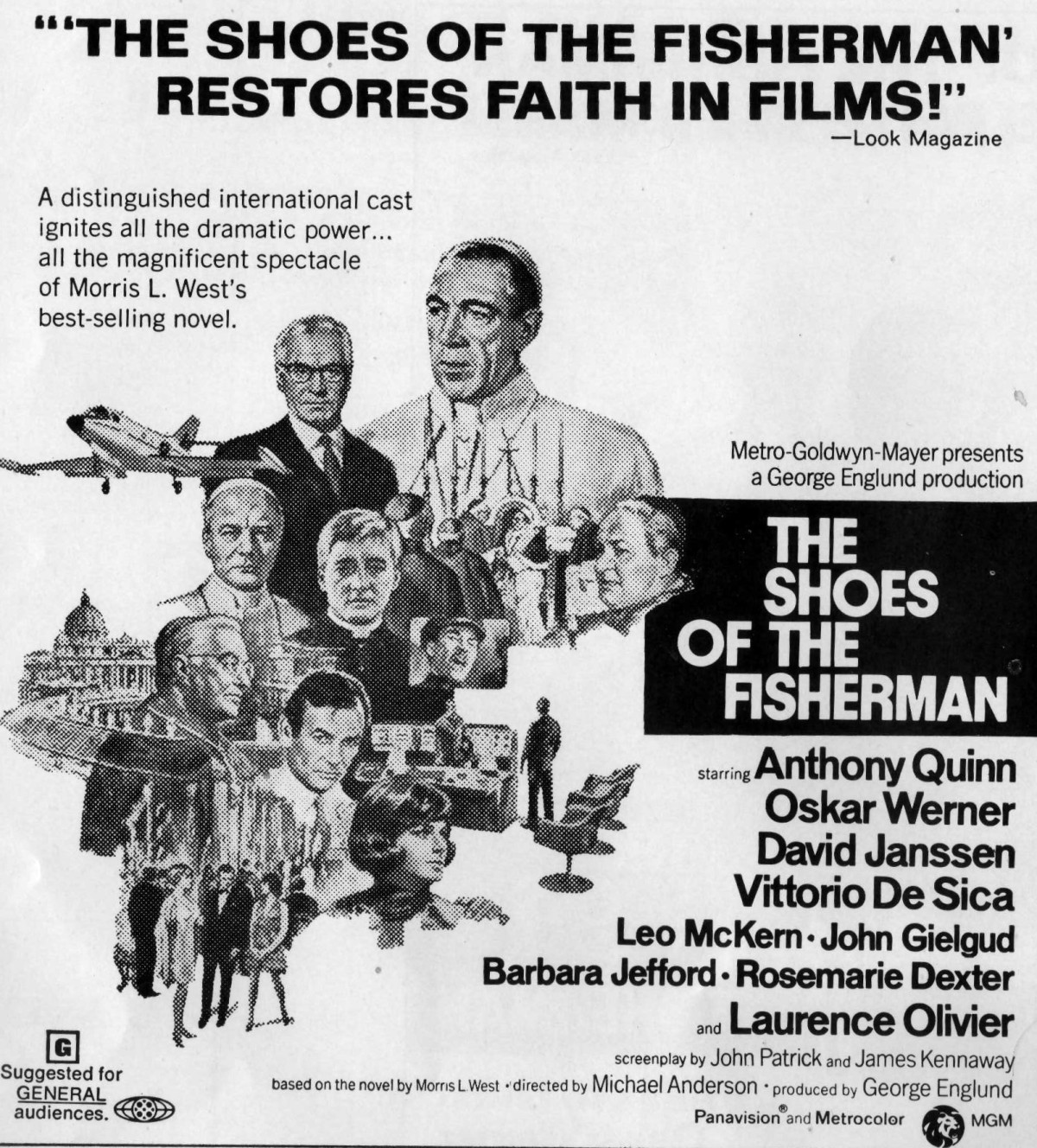
The Pressbook for The Shoes of the Fisherman is almost reverential in approach. For a start there is a complete lack of the madcap schemes designed by marketing men to promote the picture to the exhibitor. Nor is there any mention of the tie-ins that did exist – the book had sold seven million copies and the soundtrack by Alex North was already being acclaimed – it would be nominated for an Oscar. And there are very few of the titbits that might appeal to a local journalist.

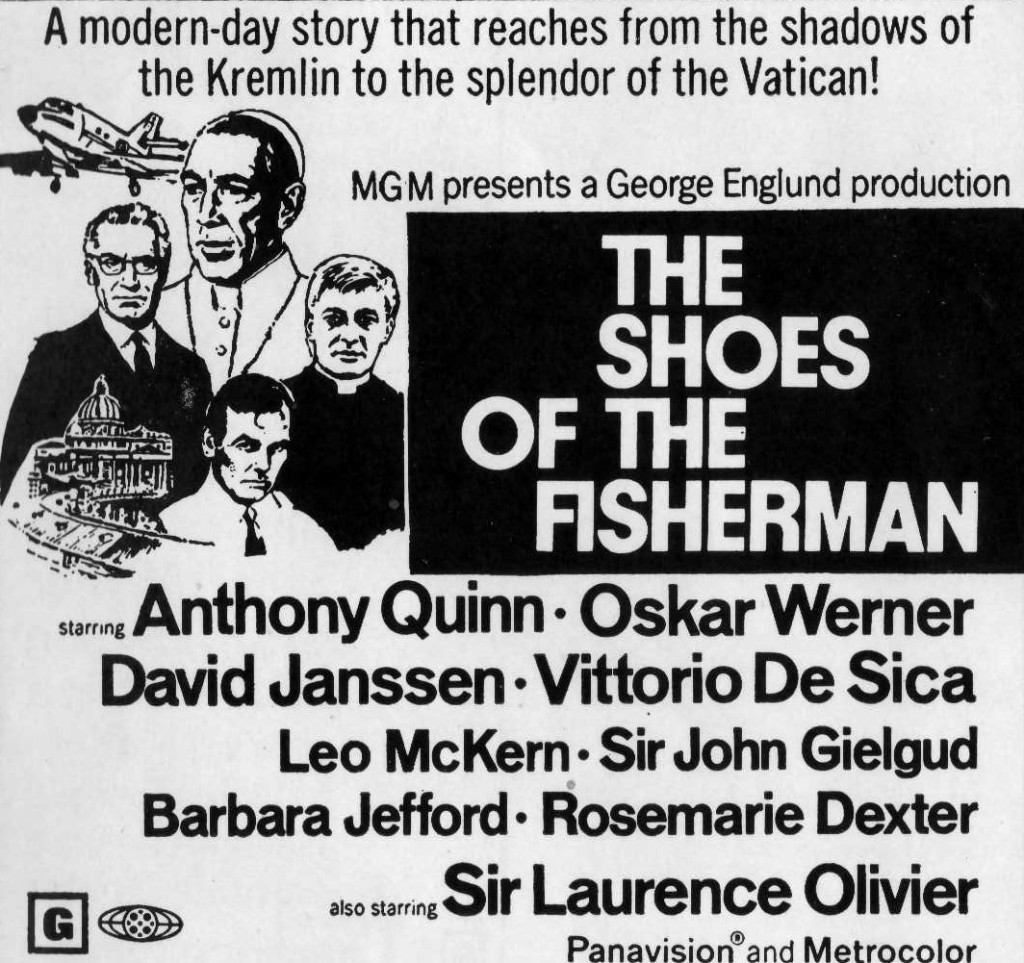
There is only one piece of artwork, although a truncated version provides a secondary opportunity for advertising and combined with a scene from the film material for a third ad. Taglines are equally scarce. “A distinguished international cast ignites all the dramatic power…all the magnificent spectacle of Morris L. West’s best-selling novel” is all there is apart from a puff from Look magazine puff that espouses “The Shoes of the Fisherman restores faith in films.”

The better tagline, in the sense that it sold an actual story rather than promoted the ingredients, was: “A modern-day story that reaches from the shadows of the Kremlin to the splendor of the Vatican.” One further tagline gave away more of the plot: “In a last desperate attempt to prevent World War III, a secret meeting is arranged. One man is called upon to succeed where all the world leaders have failed. That man was once a prisoner in a Russian labour camp. He is now the Pope.”

So what’s left, you might ask. Well, as promised in the tagline, the “distinguished international cast” and “magnificent spectacle.” The cast was awash with Oscars. The stars included four-time Oscar winner Vittoria De Sica, two-time Oscar winner Anthony Quinn, Oscar winner Laurence Olivier and Oscar nominated Oskar Werner.

The sets were of the no-expense-spared variety. Barred from using the Vatican itself, the producers used a mixture of real locations and sets at Italian studio Cinecitta to create the necessary backdrops. The Sistine Chapel set measured 133 feet by 45 feet and the paintings that dominate the altar including “The Last Supper” were copied in Hollywood and transported piece by piece. This set actually functioned and was accurate down to the tiniest detail. The only major touch omitted from the sets was the steps leading to the altar, since that would have necessitated cumbersome ramps to track the movement of the cardinals as they cast their votes.   

Oher buildings were appropriated for modern scenes – the Palazzo dello Sport for the secret peace conference. Cardinals arriving to vote were filmed at Fiumicino airport and Stazione Termini railroad station. Other locations included the Palazzo Farnese at Capranola used for scenes of the breaking of the old Pope’s seals, the Church of San Andrea della Valle for the interior of St Peter’s for the papal coronation, and Castello San Angleo, Biblioteca Vallicelliani and Palazzo Barberini.

Incidental information, the kind that journalists could use to augment their material, was scant. Author Morris L. West had once been a monk; bit part actor Clive Revill had been knifed in his previous film by Burt Kwouk; stage actress Barbara Jefford was appearing in only her third film and her role as a cerebral wife was in stark contract to her debut as the sensual Molly Bloom in Ulysses (1967); small-screen star David Janssen of The Fugitive played a small-screen reporter; and Oskar Werner had turned down over a 100 screen roles if they interfered with his commitment to the stage.

Discover WordPress

A daily selection of the best content published on WordPress, collected for you by humans who love to read.

The Atavist Magazine

by Brian Hannan

WordPress.com News

The latest news on WordPress.com and the WordPress community.